
It has been a while since I attended any virtual events by the Royal Heraldry Society of Canada. Today’s was rather different in style to the ones I remember during the COVID years.
The speaker was Ann Marie Rasmussen, Professor and Diefenbaker Memorial Chair in German Literary Studies at the University of Waterloo. Her lecture was divided into three parts.
Badges are small devices found mainly in north west Europe. They were easy and cheap to make, usually from pewter in moulds carved from stone. We have an example of a surviving stone mould in Mont-Saint-Michel showing the image of St Michael slaying the dragon. Pewter can show fine details well, but it has the weakness of tarnishing easily. Currently there are more than twenty-thousand medieval badges surviving in museums, and during the middle ages there were probably more than a million in existence. Badges were designed to be decoded. Pilgrim badges were one type, made and sold at holy sites showing religious imagery (e.g. one from Canterbury shows Thomas Becket, one from the Vatican shows crossed keys with a tiara). There survives an anonymous painting of Christ himself among the pilgrims, all of them wearing badges. 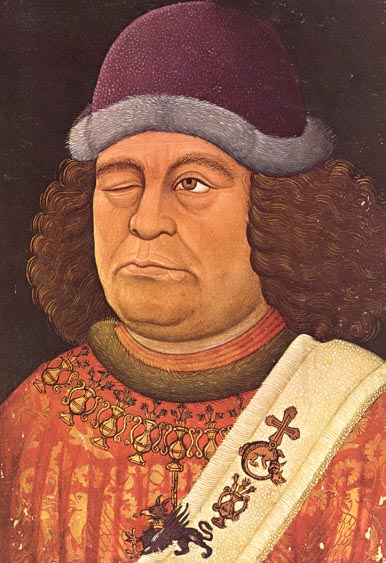
Almost all retainers and employees would have a badge to show the identity of the lord, household or organisation for which they worked. There are even examples of badges made of children’s toys. A 1432 portrait of the poet Oswald von Wolkenstein shows him wearing a badge of a dragon and griffin.
The separation of the spiritual and temporal realms is a modern idea. The types of badges often crossed over. Not all imagery was reverential – there are some humourous ones designed to resemble unsightly body parts, and there are records from medieval times of people complaining about indecent badges being worn and distributed around festival times.
EXTERNAL LINKS
UPDATE (June 13th)
The Society has uploaded the lecture to its YouTube channel, so I am spared from writing out a long description of its contents.
 Robin Stanley Taylor
Pingback: Ten Years of Blogging | Robin Stanley Taylor