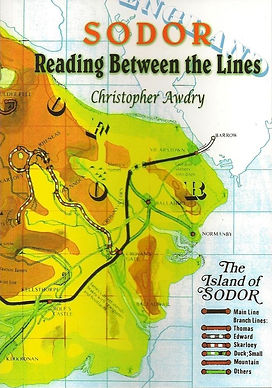
Review: Sodor — Reading Between the Lines by Christopher Awdry (2005)

As we reach the end of the Railway Series’s 80th anniversary year, I take a look at this companion book put out by Christopher Awdry in 2005 as part of the franchise’s Diamond Jubilee. That of course means the book itself has now had its own 20th anniversary, and indeed last month an updated edition went out in celebration of that occasion. I have yet to read it, though, so my review here is only concerned with the original version. “Between the Lines” can be considered the literary equivalent of “behind the scenes” for the book recounts in brief the origin of the franchise, answers some frequently-asked questions, goes through each of the stories and prominent characters clarifying their details in the RWS canon as well as their real-life inspirations. It also includes some commentary by the author about the Sudrian endeavour as a whole. This book represents the second attempt at such a publication; the first was in 1987 when Wilbert Awdry wrote The Island of Sodor — Its People, History and Railways. Christopher wrote this book because PH&R was becoming scarce and the publishers would not agree to another print run, as well as to take account of new material in the series itself since then.

The introduction recounts the well-told tale (by his own admission) of Christopher being confined to bed with measles in 1942 and his father making up railway stories to entertain him, then getting involved with his own model railway, then being encouraged to turn the stories into proper books, then publishers’ requests for multiple sequels until a substantial corpus had been produced. Once said corpus had established itself, questions about lore and continuity were inevitable, from Wilbert’s own children and from the paying audience. He therefore set about creating a detailed fictional world in which his stories could take place. He took the name Sodor from the Diocese of Sodor and Man, drawing the island itself as an expansion of the the isle of Walney. Over time he and his brother George undertook a project of serious research into history, geography, geology and etymology to flesh out an authentic and plausible setting for the stories. Comparisons to Tolkien and the “sub-creation” of Arda are obvious, though mercifully Awdry’s legendarium is much more manageable in volume and scope. The main difference, of course, is that rather than fading millennia into distant past, the history of Sodor continues into the present day.

The biographies of the major characters (both mammal and metal) are generally written from a diagetic perspective, though often leaning quite heavily on the fourth wall (“Percy defies certain identification, and it sometimes appears that he was put together by using any appropriate parts that came to hand…”) and other times walking through it (“[Sir Topham Hatt] is, in fact, based on no-one in particular.”).

Four important figures in Sodor’s railway operations are established as hereditary identities: The “Fat Controller” of the North Western Railway represents three generations of the Hatt baronets, the present of whom was born in 1941; ownership of the Skarloey Railway is by two Sir Handel Browns (also baronets) with a third in waiting; the “Thin Controller” of said railway is a post given to the Sam family and even then foreman “Mr Mugh” is really father Ivo and son David. A noted exception is Francis Duncan, the “Small Controller” of the Arlesdale Railway, who is said to be a lifelong bachelor planning to retire soon with no successor named.

The recap of all the stories notes where on the island they were meant to take place (sometimes highlighting improbabilities such as Toby being at Wellsworth goods yard in Dirty Objects) and the incidents on which they were based: Thomas Goes Fishing derives from a story about a Glasgow & South Western driver putting fish in his engine’s tank “to keep the water clean”; Percy’s Predicament from an accident at Swanley Junction in 1876; Smokescreen from a real wedding disaster on the Bluebell Railway.

Though most of the book is an earnest retelling of the facts (err… fictions) there are occasions where Christopher veers into satire and polemic: On the matter of electrification he says “since a change of locomotive would be necessary there anyway — or at least until the route from Carnforth to Barrow is electrified (“Fat chance!” do I hear you say?) — The Fat Controller has shelved the plan.”; on the disuse of the nickname “Fat Controller”, in Canada and the United States, “I cannot feel that down at grass roots the PC movement on this point, even over there, is really as strong as it must have been made out to be.”.

There are many points in the book where the author is surprisingly candid about his frustrations with both the book publishers and the television studios:

  • “despite their classic status many of these books have been out of print for up to 10 years, a scandalous situation… the publishers, as you will read here, decided to change direction. The author is greatly saddened…” (inside cover)
  • “we are thus forced to conclude that responsibility for the perceived lack of sales that I have been told about by the publisher must rest with their own sales methodology.” (p2)
  • “some bizarre TV stories… elaborate dockside cranage at a port which has nothing like the amount of business to warrant it… for one who had made such a point of authenticity… such flights of fancy left a bitter taste.” (p4)
  • “the publishers — Egmont Children’s Books — have claimed that falling sales make them commercially unviable. But if they aren’t there for people to buy in the first place no one can possibly know how viable they are, can they?” (p26)
  • “The fact that the feature film Thomas and the Magic Railroad used the Isle of Man for locations was based, I suspect, more on tax breaks than because of any historical significance” (p30)
  • [The name “Fat Controller” was dropped] “purely for “politically correct” reasons. In my view it is a great pity that Britt Allcroft was co-erced by the Americans into using the character’s proper name in order to sell her TV product over there.” (p31)
  • “though when HIT Entertainment took over the rights in 2002 it was suggested that a return to original authorship was their policy nothing has so far (as at February 2005) happened.” (p31)
  • “The story… gradually became watered down between fears of fright to readers from the publishers… until it became a shadow of its former self. A pity” (p65)
  • “a last-minute publisher’s unilateral decision altered it [the book title] — it wouldn’t have been so galling had they not owed me t the annual sales conference to talk about it beforehand.” (p68)

The whole of the epilogue “Thomas:  A Crown Worth Fighting For” is a heartfelt plea for the new rights holders not to let the books disappear from print or the quality of the TV series continue to decline.

As I said at the beginning of this review, I am reading the book with the benefit of two decades’ hindsight. This means that some of the open ends in the original have since been closed: On pages 32-3 Christopher considers that his own son Richard may one day take over the series, but says “I do not propose to hang a millstone that he may not want around his neck, and I certainly don’t take it for granted that he will carry on.”. It emerged earlier this year that Richard, now aged 45, has indeed taken over as “lore keeper” of the franchise and is giving lectures on the present state of the island, though whether he intends to write any more books is yet to be seen. On page 71 he hints that there are two new RWS books to come. He ultimately managed to get Thomas and Victoria published in 2007, followed by Thomas and his Friends in 2011. More concerning are the comments on page 72 about “the quality of the stories emanating from the Gullane company over the last few years”. He is presumably referring to seasons 5-7 (when Allcroft stopped adapting his stories) and 8 (when HIT imposed a new format). He had no idea of what was to come with the early CGI seasons, “Big World, Big Adventures!” and “All Engines Go”.

While Reading Between the Lines is not a particularly famous work among the general public, its audience, however niche, appreciates its existence greatly. Though there are some embarrassing proofreading errors (such as missing out The Twin Engines from the recap section, then giving the next book the wrong date) and inconsistencies with PH&R (such as calling the Small Controller Francis instead of Fergus), on the whole is is considered an authoritative, faithful and canonical testament to the wondrous world the Awdry clan created, and which continues to captivate so many of us to this day.

Finally, it is worth remembering that today marks one year since the death of Britt Allcroft. Despite the occasional controversial creative decisions she made (some of which are detailed above) she remains an invaluable figure in Sudrian history in her own right.

Footnotes

†Of course, that also then happened to RBtL itself, which is precisely why the new edition has had to be released. I was fortunate to be able to access digital copies of both books (although the scan of this one was quite crude) through the Internet Archive.

‡I was able to read this book, and PH&R, from my computer screen in a few days each and I’m fairly confident about . By contrast, I started reading my physical copies of The History of Middle-earth before this summer started. They felt like the sort of books best enjoyed by daylight when sitting in the orchard, which has become challenging in the winter months but I persevere. Even now I’m only at page 270 of Volume II and I still don’t entirely know my Eldalië from my Edain.
Some Small Trifles About Titles

There was a fair bit of media interest generated two days ago when the Prince of Wales took his elder son to London homeless charity The Passage.

Nowadays most television news broadcasts have a ticker graphic at the bottom of the screen which gives the top few trending headlines. News headlines often adopt a strained form of English which omits various words from a sentence for the sake of concision. When it comes to ticker reels, this is often so that the sentence can fit within the width of the screen without needing to use an illegibly-small font*.

In this case, the BBC ticker reported the royal headline as “George joins Prince William in preparing meal for homeless“, raising the awkward question of why the former’s princely title was omitted while the latter’s was retained. The next was an entirely-unrelated headline about the final of the latest series of Strictly Come Dancing, in which the celebrity finalists were Amber Davies, Karen Carney and George Clarke. The ticker omitted all their surnames, resulting in two adjacent titles involving apparently-mononymous Georges. A viewer unfamiliar with the subject matter could have thought they were the same person. There may have been yet another headline about “Andrew” in the same rotation, but I can’t find the clip on iPlayer to check.

Prince George of Wales in 2023

George Clarke in 2024


As it turned out, there was a royal connection in the Strictly story: The Queen had written a message to two outgoing presenters, which was read aloud by Craig Revel Horwood during the broadcast. The online text of the message was headed by the Timothy Noad illustration of the royal arms (rather than the impaled arms of the actual sender, as might have been more appropriate), and signed “Camilla R”. Horwood read it out as “Her Royal Highness, Queen Camilla” which of course is not correct. The page on his clipboard is briefly visible but never properly shown to the camera.

For the past year Sir Stephen Fry has been playing the role of Lady Bracknell in a production of The Importance of Being Ernest. He performed a small skit in that role for this year’s Royal Variety Performance. Jason Manford, the host, introduced the character as “Lady Augusta Bracknell”. This another pet peeve of heraldists, for she derives her title as the wife of a peer (of unspecified rank, but presumably not a duke) rather than as the daughter of an earl or above.

*This is less of a problem when the text continually slides from right to left instead of the bar rotating vertically every few seconds.

Jimmy Wales on the BBC

Video

Jimmy Wales, the co-founder of Wikipedia, yesterday gave an interview about the challenges of keeping the project running, including maintaining fidelity in the age of misinformation and staying neutral in the face of (often bad faith) bias allegations from both sides of a paranoid partisan divide. These are of course issues with which the BBC itself is all too familiar.

Two months ago Wales gave a similar interview to Channel 4.

The King’s Cancer Message

Since the announcement last February that His Majesty had (an unspecified form of) cancer, speculation about the monarch’s health was inevitable. In just the past few days I found a handful of headlines suggesting that he was on death’s door:

The above are the few I can find that are close to original. There were plenty of duplicate headlines either from other news sources that were mirror sites of these, or that repackaged the same articles, or at least referred to these as their source. They all seem to come from one interview with an unnamed royal insider and the story was not picked up by any of the remotely reputable British papers (or even some of the fairly disreputable ones) so I would judge that it is safe to dismiss as trash.

Early yesterday it was announced that Charles III himself would release a message about his experience. Some outlets referred to this as his “cancer journey”. Based on the headlines above, one would expect the message to be that he would soon, well… arrive. The message wasn’t actually released until after 8pm, so for the entire day viewers were held in suspense. This strikes me as perhaps a misstep, since the vacuum allowed further morbid rumours to circulate.

The King actually announced that he was recovering and his treatment could be reduced next year. Clearly, he does expect to see the Christmases of 2026, 2027 and beyond after all.

The message was uploaded on the royal family’s official YouTube channel as a standalone video but it was also broadcast on Channel 4 as part of an episode of Stand Up to Cancer. The video on the YouTube channel was clearly extracted directly from the television broadcast as, unlike their other videos, there were no title cards featuring any royal insignia. Instead all the onscreen graphics were from Channel 4, and it even had the “4” logo in the top left corner throughout. This could be an oversight, or perhaps it was at the channel’s own insistence.

Notes on the German State Visit

Last week Windsor Castle hosted the last of three state visits this year, featuring Frank-Walter Steinmeier & Elke Büdenbender, President & First Lady of the Federal Republic of Germany.

This one made the news far less (most likely because it was far less controversial) than that of Donald Trump in September. Unlike Trump, Steinmeier was able to partake in the public-facing elements of a state visit, such as the carriage ride through the streets of Windsor and an address in the royal gallery of the House of Lords.

This was in some ways the reciprocation of the state visit which our King & Queen made to Germany in 2023. In his state banquet speech Steinmeier said to Charles

“the fact that your very first trip abroad as King brought you to Germany was a special symbol of the German-British friendship, a gesture of appreciation which meant a great deal to me and to us Germans.”

This is not strictly true as Their Majesties had been planning to visit France first, but that visit was postponed a few months as Macron dealt with protests over state pensions.

The King’s speech at the same event included this quip

“our languages, English and German, [ ] share such deep common roots, but now do sound a little different. It is undoubtedly true, that your language contains a very large number of very long words. As someone who has spent some time trying to learn a little Welsh, I have some sympathy for the proposition that needless gaps between words are a dreadfully inefficient use of paper… “

There was no exchange of honours this time, as Steinmeier had already been appointed an honorary GCB during the aforementioned 2023 visit. He and Charles both wore their red sashes to dinner. The Prime Minister, a KCB, notably continues not to wear his badge.

The Duke of Kent did not attend the state banquet but he later separately met the Bundespräsident at a service at Coventry Cathedral, to commemorate its bombing during the Second World War. It is worth remembering that the Duke is now the only living British prince to have been born before that war started. We got a rare glimpse of his royal cypher on a wreath lain at the old altar.

Steinmeier also had a meeting with Sir Keir Starmer at 10 Downing Street. While his state visit was still going on Starmer also had an unrelated meeting with the Prime Minister of Norway, and already since the President’s departure he has held another “Coalition of the Willing” meeting including Chancellor Merz.

From a ceremonial perspective there is little innovation here (bar a lot of stories about tiaras), as the proceedings stuck closely to the template established by recent precedents. The most interesting parts are His Majesty’s and His Excellency’s speeches, which I think, well, speak for themselves.

Recent state visits have been good opportunities for uploading free-licence photographs to Wikimedia Commons but sadly on this occasion the pickings have been very limited as the government Flickr accounts’ only pictures of Steinmeier are of his visit to Downing Street, leaving out anything involving the royals. Those on the Parliamentary accounts are not released under the correct licence, and it doesn’t look as if the German government has the same attitude to copyright that the British one does so finding anything from their end is also unlikely.

David Lammy and Bleak House

David Lammy, in his new role as Lord High Chancellor of Great Britain and Secretary of State for Justice, has recently announced plans to tackle a long-running backlog of cases in the English & Welsh judicial system by severely narrowing the circumstances in which juries are used for deciding the verdicts in criminal cases, transitioning trials for less serious offences to relying solely on the judge. These plans are highly controversial, with detractors expressing suspicion that he will undermine long-standing principles of English constitutionalism as well as scepticism that the move will actually save any time or money.

Lammy has attracted particular ridicule for a comment in an interview that was reported in The Times two days ago:

I remember studying Bleak House for my A-levels, and the Jarndyce and Jarndyce case that went on and on and on. We cannot go back to a Victorian system in which all new people who are the victims of crime don’t get justice.

The 1853-2 novel Bleak House is a satire of the English court system of the early nineteenth century and is credited with spurring on reforms later in that century, but to use the Jarndyce case (or any of the real one inspiring it) as a justification for Lammy’s proposals is nonsensical as this was a probate case in the Court of Chancery (later succeeded by the Chancery Division in the High Court of England & Wales) not a criminal case, and crucially it did not involve any juries!

Then again, the Lord Chancellor is not the only one to fail to understand that story: Over recent years (well, decades really) there have been growing concerns among the intellectual classes that their own numbers may functional literacy among the populations of developed countries is going into decline. One particular alarm bell was sounded last year in A Study of the Reading Comprehension Skills of English Majors at Two Midwestern Universities, entitled “They Don’t Read Very Well“, which used the first seven paragraphs of Bleak House as the yardstick. A worrying proportion of English majors (for whom reading literature should really be a specialist skill) struggled to understand it.

I listened to the LibriVox recording of Bleak House in 2022 and watched the BBC adaptation of it in 2024. I know from reading through Great Expectations that Dickens, being paid by the word, had a habit of using far too many when far fewer would do, but the idea that his works may be slipping out of human comprehension, even among those who have specifically chosen literature as a course of study, has implications which themselves are bleaker than the house could ever be.

Ongoing Heraldic Stories

In this post I have new updates on three different heraldry-related stories that I have covered before.

The Greater London Authority

The campaign by the Greater London Authority to acquire the iconic armorial achievement of its predecessor body the Greater London Council has been successful. The King issued a royal warrant on Thursday 13th November authorising the transfer, though frustratingly it the corresponding notice in the London Gazette was not published until yesterday.

British Passports

(I’ve discussed this topic ad nauseam by now so won’t link specific earlier posts.)

It was announced by the Home Office in October that a new British passport design would be coming out which featured Timothy Noad’s illustration of the royal arms with the Tudor crown in place of the previous design favoured by Elizabeth II. Recently the story has been picked up by newspapers as the new passports actually come out.

The Prince & Princess of Wales

I and other heraldists have been waiting for some time to see evidence of William & Catherine updating their personal heraldry to reflect the former’s status as heir apparent. While searching for news stories about the GLA I found articles in Hello!, People, Marie Claire and The News International (though curiously none of the more mainstream outlets) reported that when the couple attended the Royal Variety Performance last month, their invitation printed by the charity featured their conjugal coat of arms in the updated format. The style is very clearly Sodacan, and it looks as if the particular image was created on 12th April 2023 by user Mangwanani but not actually used in any articles until 22nd November this year, presumably for lack of evidence of real-life usage. Whoever found the image for the invitation must have dug rather deeply into Wikimedia Commons to find it. Reports in the aforesaid magazines that the Prince & Princess have made this change themselves seem a little misguided as it would not have been their own office in charge of producing the image, and recent evidence of their own correspondence still shows their old-style cyphers in use (not the lack of an arch on the coronet). This is thus yet another example of Wikipedians not just getting ahead of real life, but actually pushing it along a little, however inadvertently.

The new programme can be contrasted with this one from 2023, which still uses their conjugal arms as Duke & Duchess of Cambridge (or rather as son & daughter-in-law of the heir apparent), even though the new graphic image had already existed for seven months and William had held the status of heir apparent for more than a year. The old graphic still showed Catherine’s shield with a cordelière around it to balance William’s Garter circlet, even though she had been made a GCVO in 2019. Note too that the great many depictions of the main royal arms still alternate between old and new variants.

Update on Andrew

It has been just over a month since Buckingham Palace announced that Prince Andrew, Duke of York, would be formally stripped of the title of Prince as well as the title Duke of York. Notices to this effect were published in the London Gazette (see my previous posts). I submitted a Freedom of Information Request to the Ministry of Justice to see the full texts of the legal instruments in play. The answer arrived yesterday:

Your request has been handled under the FOIA. I can confirm that the MoJ does hold some information related to your request, it has no plans to publish the texts of the Warrant and Letters Patent relating to the Peerage Roll and title “Prince”. The Warrants relating to the Order of the Garter and Royal Victorian Order are not matters for this Department and you may wish to contact the Cabinet Office to request this information.

This feels like a refusal, and indeed the Ministry’s response does not include the documents I requested, and yet those very same documents were released to the public yesterday.

In the run-up to this I emailed Jason Loch of A Venerable Puzzle, François Velde of Heraldica and David Torrance of the House of Commons Library (no reply from the latter). I also wanted to inform Benjamin Lewis but could not find his contact details. Loch had submitted his own request and has already put out his analyses of both documents. There are many peculiarities compared to other such instruments which might be considered the nearest precedents.

Notable in the patent is that it begins with “AND WHEREAS” in the first clause, when logically that shouldn’t happen until the second. It also doesn’t refer to “Prince Andrew” first and then explain that he is being renamed “Andrew Mountbatten Windsor” but instead refers to him by his plain name from the start. There’s also the fact that the patent omits any greeting and the warrant declines to name a recipient. A lot of the flowery formalities normally seen in documents like this are likewise notable for their absence.

In part these oddities may be a deliberate choice by the Palace in response to the circumstances which forced this action (e.g. Andrew can hardly be called “Most dear and entirely beloved”) and in part they could be explained by the extreme haste in which this operation has been carried out. Even so, questions about constitutional propriety are likely to linger.

There have been further notices in the Gazette yesterday that Andrew’s appointments to the Royal Victorian Order and the Order of the Garter have been revoked. Jason or I may need to submit another request to see those legal instruments now as well.

It should be noted too, that since these instruments were originally signed off Andrew has gone through yet another change of name, very petty this time: The patent and warrant, along with the press release on 30th October, give him the surname “Mountbatten Windsor”, omitting the hyphen that normally appeared there. This was corrected twelve days later, and the Gazette notices from yesterday show his surname in the hyphenated form. This, of course, required the third movement of his Wikipedia page in the space of two months.

Belize, Paddington and Royal Variety

The Royal Variety Performance for 2025 was held last night, though it won’t be broadcast until next month. This time the Prince & Princess of Wales attended, as they have done in every odd-numbered year since 2015. I mentioned last year that the Royal Variety Charity was extensively using Sodacan’s Wikipedia illustration of Elizabeth II’s British heraldic achievement. Looking at this year’s photographs it appears nothing has changed.

I mentioned last week the oddity of having the Prince of Wales and his aunt the Princess Royal both undertaking prominent overseas diplomatic visits to different places at the same time. This week the Firm leaned further into this by having a married couple, the Duke & Duchess of Edinburgh, simultaneously touring different continents.

The Duke flew to Nigeria to meet with the President and attend a meeting of the Duke of Edinburgh’s International Award programme, founded by and named after his father Prince Philip.

The Duchess went on a tour of South and Central America. She visited the Republics of Peru, Panama and Guatemala, finishing in Belize. The first three were standard-fare bilateral diplomatic visits on behalf of Britain, with the Palace news page explicitly saying they were requested by the Foreign, Commonwealth & Development Office (specifically the Foreign part in this instance). In some of the photographs we can see her meeting the host president with a Union Flag prominently displayed beside that of the host state.

The visit to Belize is the more interesting one as, unlike the others, this is a Commonwealth Realm, and indeed this is highlighted multiple times in the press releases, with the Palace Twitter feed even calling it “the Realm of Belize” despite the country having no official long name. By strict Commonwealth constitutional logic Sophie should have been there in her capacity as sister-in-law to the King of Belize, acting on the advice of the Belizean government. Despite this, many of the official reports mentioned bilateral ties between Belize and the United Kingdom, which suggests a deliberate straddling of both thrones. I can’t see any royal standard flown by the Duchess on the other visits, but in Belize she was clearly photographed flying the generic ermine-bordured version. As I have lamented before, royals other than the sovereign himself do not have dedicated heraldic flags for each specific realm save Canada so must default to their British arms even where this causes constitutional confusion.

It is also worth remembering that recently there have been reports of Guatemalan military personal making illegal incursions onto Belizean territory, which was condemned by the Commonwealth. It is a little strange, therefore, that a senior royal should visit both countries in such rapid succession without the incident being brought up.

On a final note, two of the aforementioned stories featured appearances by Paddington Bear: The Duchess of Edinburgh posed with a plush toy of him at the British Embassy in Lima (Peru of course being the character’s country of origin), then the Prince & Princess of Wales greeted an actor in costume at the Royal Albert Hall. Paddington Bear has long been an international icon of British culture. Since his appearance in a video for the Platinum Jubilee celebrations in 2022, he has been particularly associated with the royal family. Some have criticised an apparent cult forming around him. This year Spitting Image created a parody of him to appear alongside the Duke of Sussex in a spoof podcast, which at time of writing is the subject of a lawsuit by Studio Canal.

EXTERNAL LINKS

DUke of Edinburgh

Duchess of Edinburgh

Paddington Bear

Royals and Remembrance

Once Halloween and Guy Fawkes Night have passed, poppy season is all that remains to block Christmas from achieving total domination for the rest of the year. There are, of course, two separate dates for this occasion — Armistice Day (always 11th November, the exact anniversary of the end of the First World War) and Remembrance Sunday (second Sunday in November, a broader commemoration of war dead). Both of these events involve two-minute national silences… assuming, of course, that a silence actually falls. Due to the logistics and practicalities of the working week, some organisations have to hold subsidiary events outside the universal dates. Silences here can be hard to regulate if everyone around isn’t coordinated with it. I remember quite a few occasions from childhood when a reverent, contemplative peace was anything but. Even the highest are not immune to this: The Queen attended a service at Westminster Abbey last Thursday, but it was immediately outside rather than inside the main building. As you would expect from an open-air event in central London on a weekday, the “silence” was actually filled with a lot of traffic noise as well as two different emergency sirens. The only blessing was that at least there were no dogs barking. I’m actually a little surprised that this phenomenon hasn’t been the subject of a Family Guy cutaway by now, given that it would be an easy way to get two minutes of padding with minimal animation.

Another big event in November is the United Nations Climate Change Conference, now taking place in Belém, Brazil. The Prince of Wales flew down some days in advance to present his Earthshot Prize, which Sir Keir Starmer also attended, though neither stayed for COP30 itself. This is the latest in a long line of solo overseas engagements undertaken by the heir apparent since his wife’s cancer diagnosis last year*. William was back in time for the Sunday cenotaph service but he missed the Festival of Remembrance at the Royal Albert Hall on Saturday night. Prince George attended for the first time, in his father’s place. The festival includes the religious and patriotic music expected for a solemn occasion, but also a handful of modern entries. One of these was a cover of Avicii’s The Nights. I can’t work out whether it adds to or detracts from the spirit of the event to know that Avicii himself, err, left this world behind some years ago, his life clearly remembered but tragically brief, and predeceased his father. He was from Sweden, a country formally neutral in both world wars. The festival featured multiple performances from Sir Rod Stewart, who sported the unusual sartorial combination of a knight bachelor’s badge hung from an open shirt.

The cenotaph ceremony in Whitehall traditionally involves the laying of wreaths by senior royals, senior servicemen, cabinet ministers, diplomats, various officials representing the British Overseas Territories and Crown Dependencies, and leaders of the significant political parties in the House of Commons. This has always been a bugbear for Nigel Farage, because his parties have so far never met the threshold of six MPs needed to qualify. UKIP in 2015 got 12.6% of the popular vote but only one seat. Douglas Carswell, as the party’s sole representative in the Commons, was regarded for procedural purposes as an independent rather than a leader. Reform in 2024 got 14.3% of the vote and five seats. The cruel twist here is that since the election the Reform caucus has gained two members (one from defection, one from by-election) but also lost two of the originals, so that when November came they were back as they started. It should be noted that the six-member rule, introduced in 1984, has exceptions for the Northern Ireland parties to avoid the appearance of sectarian bias. It is also possible for two or more parties to coalesce for this purpose, as Plaid Cymru and the Scottish National Party have done since 2001**.

The Princess Royal was also absent from the London commemorations, having gone on a royal tour of Australia. She instead paid her respects at the ANZAC memorial in Sydney. It is a little extraordinary for two royal overseas visits to take place at the same time, especially when both of those away from the United Kingdom are counsellors of state. Recently I have been constructing a Wikipedia page listing all of Anne’s official overseas travel (similar to those which already exist for other senior royals) but it has quickly become a little overwhelming to see just how busy she is, with twenty such journeys listed in the Court Circular just for the last two years.

One ought probably to discuss heraldic matters now. In some of the photographs of Anne’s visit I can see her two crosses and a heart flying in various places. I didn’t see William or Camilla flying theirs in the outings aforementioned. Close-up shots of the wreaths laid and crosses planted also show royal symbols. The Queen’s monogram appeared on hers, complete with the Tudor crown. William’s, even now, still uses the pre-Carolean design (note the oak leaves and lack of arch on the coronet). The King’s wreath did not use his monogram, but instead the full royal achievement with BUCKINGHAM PALACE underneath. Once again it was the old-style illustration with St Edward’s crown.

Sir Lindsay Hoyle is something of a vexillophile and has taken to Tweeting whenever a new flag is flown from New Palace Yard. In 2021 he began making a point of raising the flags of the Overseas Territories. His most recent example was the flag of the British Indian Ocean Territory, allegedly celebrating its national day. I can’t find photographic evidence (including on Parliament.UK) of the flag actually flying in the yard, so I can only go on the image shown in the Tweet itself. The BIOT flag includes the Imperial crown, sometimes with a cap of maintenance and sometimes without, but always in the St Edward form. Hoyle’s picture had a Tudor crown. I cannot find this version on the territory’s website or any other source. Is it a custom make? The BIOT is currently the subject of a slow-moving but high-stakes political controversy as Starmer’s government intends to cede sovereignty of the landmasses to Mauritius. This would mean that the territory as a political entity ceases to exist, hence no point updating the flag. I notice that there was not a representative of the BIOT among all the other BOT representatives laying wreaths at the cenotaph. The flag of the BIOT has been widely used in the campaign against the handover, including by the displaced islanders themselves. The bill to ratify the handover passed the House of Commons and recently had its second reading in the Lords, but then there were reports that the government has paused its progress due to public resistance. In this context it is tempting to read Mr Speaker’s Tweet as a not-so-subtle dig at the Prime Minister.

Finally, a point about Flickr: The cenotaph ceremony and the Earthshot prize both produced plenty of government photographs which can be moved onto Wikimedia Commons. The former had two photographers: Simon Dawson for the Prime Minister’s Office and Gunter Hofer for the DCMS. After migrating both albums across I quickly realised that the time stamps given in the metadata were wrong. Dawson’s were one hour too late (probably not adjusted for daylight savings) while the DCMS ones were in some cases out by a whole year! This feels like an elementary mistake for a professional photographer. Sadly there are not likely to be many photographs of Anne’s excursion to Sydney for the reasons I explained last year.

FOOTNOTES

*The Princess of Wales appears not to have gone abroad on official business since 15 October 2023.
**The SNP alone has won at least six seats in every subsequent general election, so in practice the utility of this alliance is one-sided.