
 Reported today was the death at age 89 of the actress Dame Maggie Smith, best known in recent decades for her roles in the Downton Abbey and Harry Potter series – the latter especially poignant as her co-star Sir Michael Gambon died exactly a year ago.
This post is not meant as a eulogy or obituary for her – many others can do that far better than I – but a discussion of two points of interest relating Dame Maggie to the topics covered on my blog.
First, her status as a Dame: In 1970 Smith was appointed Commander of the Most Excellent Order of the British Empire. Twenty years later she was promoted to Dame Commander. This is one means by which to certify her status among the “National Treasures” of British acting, nearly all of whom have had the chance to become a knight or dame even if a small number have declined. The Order of the British Empire was founded by King George V in 1917 and was the first British order of chivalry in the modern era to explicitly allow female recipients to have the title. The top two grades of the order are Knight/Dame Commander (K/DBE) and Knight/Dame Grand Cross (GBE). The DBE is by far the most common form of damehood and it is the only grade of any order at which dames outnumber knights. This is partly because the other orders (e.g. the Bath) are reserved for senior government and military officials, a group which tends to skew male anyway, and partly because there is no female equivalent of the honour of Knight Bachelor (i.e. knighthood unconnected to membership of an order of chivalry) which is the rank that the majority of knights possess (including fellow treasures like Gambon as aforesaid). Most of Britain’s orders of chivalry (the Royal Victorian Order is an exception) have statutory limits on how many there may be at any particular grade at any given time. For the grade of K/DBE that limit is 845, with male and female members counting the same towards the total. I do not actually know how close we are to hitting the limit. The English Wikipedia has a page listing all the people who have been awarded the status of DBE and they number over a thousand, but without going through each biography individually (and some don’t have their own pages anyway) I cannot tell how many are currently alive and still holding the same dignity.
In 2021 Netflix released an animated sitcom named The Prince, focusing on a fictionalised caricature of Prince George of Cambridge. It was produced and largely written by Gary Janetti, who previously wrote fourteen episodes of Family Guy, and it strongly resembles that series both tonally and aesthatically. Despite its star-studded cast the series received overwhelmingly negative reception for its offensive premise and unfunny execution. The series was neither renewed nor widely distributed and now is viewable only as a scattering of short clips on video-hosting site by either the studios’s own paltry few advertisements or other people’s reviews of it. The first episode features a minor subplot about the possibility of Elizabeth II conferring a damehood on either Kelly Ripa or Greta Thunberg. On two occasions the suggestion results in another character asking if Smith had just died, presuming there to be a moratorium. As explained above this reasoning is technically correct, although Janetti seems to have missed that neither Ripa (American) nor Thunberg (Swedish) were the late monarch’s subjects so could not receive substantive appointments to the order anyway. They could only receive honorary appointments (giving them the post-nominals but not the salutation) which would be supernumerary to the quota.
The news of Smith’s death has brought renewed interest in her earlier appearances, the most famous of which was the 1969 film The Prime of Miss Jean Brodie, based on the 1961 novel by Muriel Spark (who herself became a DBE in 1993). News features about Smith’s death kept playing the same speech by her character, which is also featured on the book’s TV Tropes page:
I am in the business of putting old heads on young shoulders, and all my pupils are the crème de la crème. Give me a girl at an impressionable age and she is mine for life. You girls are my vocation. If I were to receive a proposal of marriage from Lord Lyon, King of Arms, I would decline it. I am dedicated to you in my prime. And my summer in Italy has convinced me that I am truly in my prime.
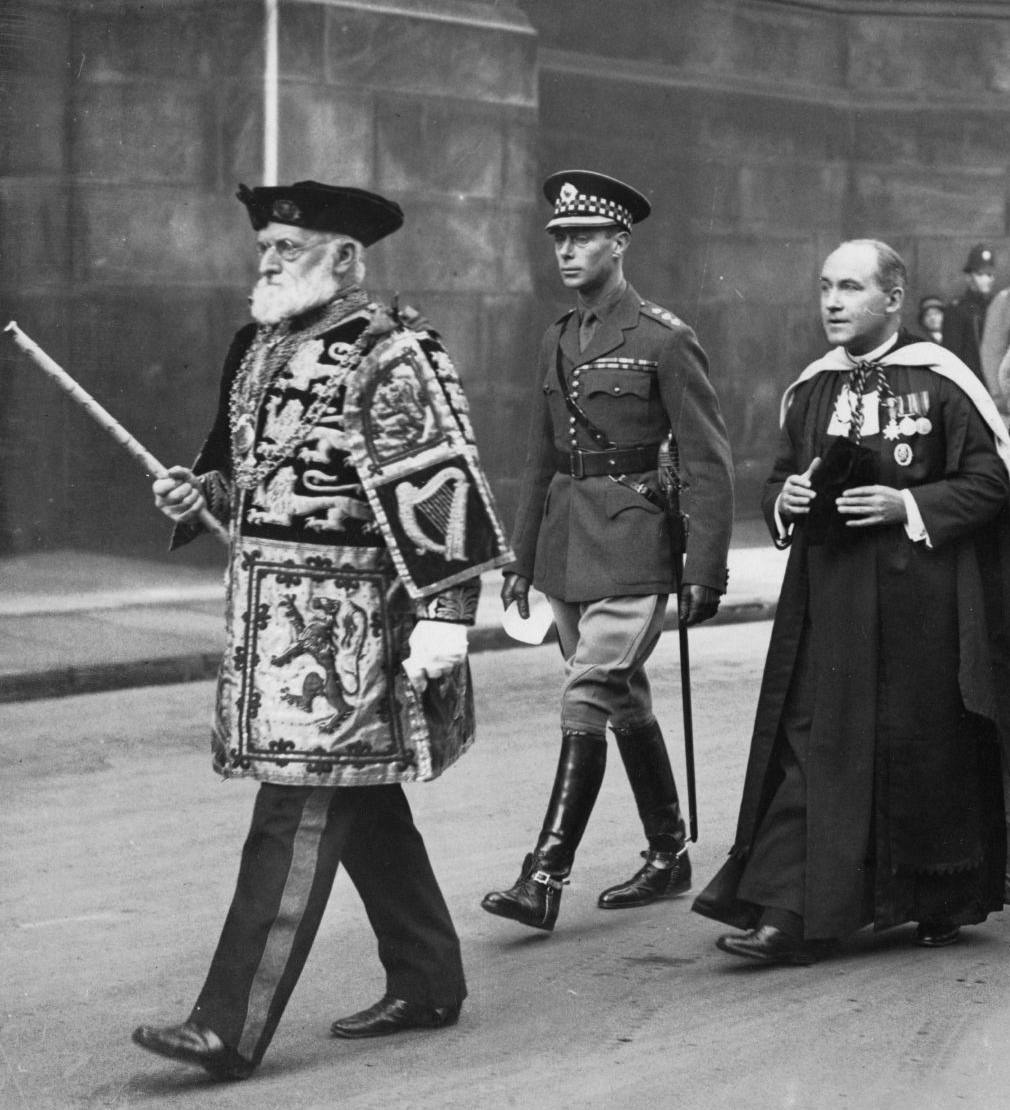
Grant with the future George VI in 1933
I have not yet watched the film or read the novel in full, but searching a digital scan on Archive.org for the word “lyon” gives two instances, both of them in the context of Brodie turning down his hand, with the implication that he must be highly desirable and that declining him requires a serious force of will. The only other reference to heraldry in the book is a passing mention of the school’s “crest” which I think is really a shield. The book is set in the 1930s and the Lord Lyon King of Arms from 1929 to 1945 was Sir Francis James Grant, whose Wikipedia article is such a short stub that I don’t even know if he had a wife or not. He was sixty-eight by the time the novel was published, so not in his “prime” by any reasonable definition. Why his title was used in the book is unclear, and may be a matter I need to raise at a subsequent virtual heraldry lecture, whenever that comes up.
 Robin Stanley Taylor
Pingback: Realms and Revelations | Robin Stanley Taylor