
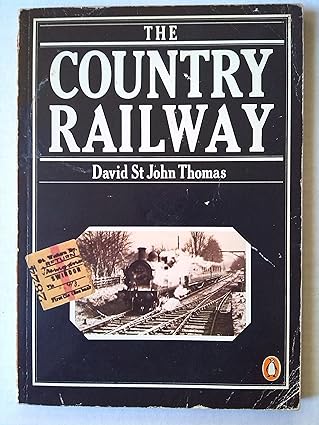
After a tumultuous voyage through Dead Europe I needed a rest on more familiar literary ground. The most obvious choice was another railway book. This one was printed in 1979 with an original price of £1.50. I picked it up from Dovehouse Hospice earlier this year for £1.00. The book is a few years older than The Penguin Guide to the Railways of Britain and rather different in scope: It is only really looking at the past rather than the present and it focuses, as the name implies, specifically on the rural lines rather than the urban ones. This book also doesn’t trouble itself to recap the evolution of locomotives and rolling stock from the beginning, assuming the reader already knows the broad strokes and only bringing up the details where directly necessary. Instead this book is mainly about the experience of daily life for the workers and passengers, as well as the financial aspects of operating the organisation.
The phrase “Country Railway” feels inherently nostalgic precisely because, following the Beeching Axe, there are not many of them around anymore (save heritage lines). A recurring theme of books like this is that the railways were vital to the survival of rural communities yet paradoxically those rural communities tended to be a dead loss to the railways. Closures of country lines would be bitterly mourned despite few people actually riding on them. There is an element of the rotten boroughs about some of the remote services where trains were run back and forth daily with full signalling operations and well-built stations even though the carriages would were at low capacity at the best of times and frequently had no passengers at all. The opening paragraphs of Chapter 8 (starting page 120) lay this out in most striking terms, and it is difficult to avoid simply quoting the entire page verbatim: Rural railways companies insisted on building and staffing their lines, stations and signal boxes to the same standards of quality — as well as safety — that would be expected on urban routes despite the far lower ticket revenue, in contrast to Continental Europe where country railways were far more cheaply constructed. As Thomas sums up:
“An army could have been carried in safety where only scores of people ever travelled. Because stations were so costly, they were often not provided at all where there might still have been useful traffic; and one could argue that in the motor age more lives would have been saved had the railways reduced safety standards — more people would have gone by train, which would still have been safer than buses and cars.”
It may feel a little odd to read someone explicitly argue for the moral virtue of cutting corners in public safety, but a robust case is made that the builders’ noble aspirations actually doomed their projects in the long run. Thomas notes another major obstacle in the need for the company to get a special Act of Parliament passed and/or secure the consent of all the landowners along the route, which an attempted streamlining of the process in 1864 failed to fix. The result was that construction costs per mile of track ended up being many times the original estimates and the railway companies frequently found themselves financially sunk before operations even started. These problems are entirely familiar in the present day. Indeed, I was struck when reading this section by how much the prose of a book on such a genteel topic, written nearly fifty years ago and describing events almost a hundred years before that, bore so much resemblance to that by Ezra Klein & Derek Thompson in Abundance, released earlier this year and addressing the same problems on a larger scale in the present — even including the building of railway lines!
On the flipside, the book also emphasises the death and destruction that results when strict safety protocols are not followed, the appendix retelling the tale of the Abermule Disaster of 1921, in which a quartet of negligent station staff got a pair of signalling tablets swapped around so that two trains collided head-on. The final sentence draws parallels with RMS Titanic:
“Time and again one or other of these mistakes had been made with impunity, but at Abermule on that disastrous day, like the scattered pieces of a jigsaw puzzle, these trifling faults fitted one into another until the sombre picture was complete.”
The book looks over the lifestyle of the rural stationmaster, isolated from the station’s local community, assailed from above as well as below and occupying a liminal, uncertain position within the British class system of the time. The ticket prices were no less convoluted then than now with a dizzying array of tariffs, rates, discounts, equivalences and exceptions. Thomas further looks at the advancement of new technologies and working practices in railway operations, particularly as regards the directions of trains — from turntables to passing loops to runarounds to push-pull to double-ended railcars. A recurrent problem for this sector was that, although the stationery infrastructure was kept to the same standard as the urban lines, the moving parts were not. Whereas the intercity main lines were upgraded to diesel and electric multiple units, the country branches were stuck with antiquated steam engines and their threadbare coaches. Even getting electric lighting on the platforms instead of gas was a struggle. Continuing with old-fashioned systems kept these lines more labour-intensive than they could otherwise have been, which only widened the gap in profitability compared to the main lines. Speed was also an issue for a lot of country lines, particularly in pre-war times, due to the low power of the locomotives and the mixing of passengers with goods on stopping trains.
In contrast to a lot of books of this type, which only look at Great Britain, this one also includes sections set in Ireland. Mostly these serve to tell us how the Irish rural railways were even more spendthrift, disorganised and ramshackle than the English, Scottish and Welsh ones. Attention is drawn to the larger gauges on this island (standard 5’6” and “narrow” typically 3′) which further increased expenditure. Timekeeping too was even worse and page 141 has an amusing anecdote relayed from Punch wherein a local dignitary was surprise to see his train actually leaving on time, only to be informed that it was the train from the previous day.
Despite the myriad problems in running the railways, Thomas is keen to point out that the local communities held great affection for them, staging elaborate celebrations when they were opened and even grander funerals at their closure. That books such as this (and indeed films, magazines and television series) about old railways and the engines that ran on them are so numerous and constitute such a well-established genre is testament to the high regard in which the British hold at least the idea of the railways, even if in practice relatively few get to make regular use of them.
 Robin Stanley Taylor