
This is the Sudrian Armorial page itself. For the blog post explaining it, click here.
This is a catalogue of heraldic and armorial devices relating to the Island of Sodor — the fictional location of The Railway Series by Wilbert Awdry and its television adaptation Thomas the Tank Engine & Friends by Britt Allcroft. I have covered this topic in many posts on my blog over the years but wanted to collate them into one coherent display.
The majority of these are diagetic examples (also known as “in-universe” or “Watsonian”), with a few non-diagetic ones (also known as “real-world” or “Doylist”) given at the end. To keep the latter category to a manageable size I have narrowed its scope to those places directly relating to the series’s setting or its authors. Attempting to include the blazon of every armigerous person or institution mentioned in the series (e.g. Sir Nigel Gresley) would render the page far too long and in any case I have already created a real British railway armorial on Wikipedia which would fulfil much the same function.
Very little explanation and very few examples are given in the primary text or illustrations of The Railway Series itself. My sources for the diagetic examples are as follows:
- The Island of Sodor: Its People, History and Railways by Wilbert & George Awdry, 1987, hereafter “PH&R”
- Sodor: Reading Between the Lines by Christopher Awdry, 2005, hereafter “RBtL”
- The Thomas the Tank Engine Man: The Story of the Reverend W. Awdry and his Really Useful Engines by Brian Sibley, 1994, hereafter “Sibley”
- Various episodes of the television series, hereafter “TVS” with episode name and maybe time reference
- This page of concept sketches, on display at the Talyllyn Museum and spotted in this video by Max Davies (a.k.a Terrier55Stepney), hereafter “sketches”
My sources for the non-diagetic examples are the works of Burke’s Peerage and Fox-Davies. The texts are easy to find nowadays on Archive.Org, Google Books, or Hathitrust. If you’re really lucky you may find physical copies in a library nearby.

The Flag of the Island

Azure a fess Argent fimbriated Or.
The blazon is conjecture. The flag is carried by engines representing the island at international events.
(Source: TVS “The Great Race” et al)
I dimly remember reading a description of the flag in one of the Awdrys’ books but cannot now find the reference.
Cities, Towns & Villages on the Island
Crovan’s Gate

- Escutcheon: Vert a gateway kernelled Or with portcullis closed of the same. In base a glove dexter Argent.
- Motto: Ave Amicos Cave Hostes (Welcome Friends, Beware Enemies)
(Source: Sketches)
The symbolism here is fairly obvious – the gate is a literal interpretation of the proverbial “gate” (the narrow pass in the hills between eastern and central Sodor) at which King Godred Crovan held the Normans at bay in 1089, while the glove is one of his famous white leather gauntlets.
Suddery

- Escutcheon: Argent in base three closets wavy Azure charged at the nombril point with a coracle therein a monk erect dexter hand raised in blessing in sinister hand a crozier all Proper.
- Motto: Luoc Sodoris Lux (Luoc, the Light of Sodor)
(Source: Sketches)
Luoc in the 5th Century was the first Christian missionary to reach Sodor. The city’s Arms perpetuate the legend of his miraculous arrival. They show the saint arrayed as a bishop standing in a coracle and holding his crozier. Below is the city’s motto ”Luoc Sodoris Lux” (Luoc – the light of Sodor).
(Source: PH&R p.27)
The city’s Coat of Arms perpetuates the legend of his arrival, The saint is shown arrayed as a bishop in cope and mitre standing in a coracle holding a crozier. The city’s motto is Luoc Sodoris Lux (Luoc the light of Sodor).
(Source: PH&R p.108)
There is a contradiction between the sketch whose blazon says he is dressed as a monk and two references in PH&R which say he is dressed as a bishop. Awdry does not describe Luoc’s appearance nor his liturgical vestements, so I took a drawing of St Vallier and changed the colours to give a more Anglo-Irish aesthetic, with the mitre using the blue and green shown on the other coats of arms here.
Tidmouth
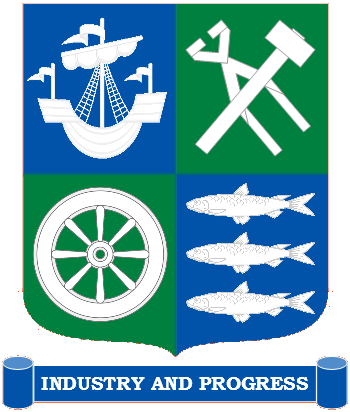
- Escutcheon: Quarterly Azure and Vert 1st a lymphad 2nd a Smith’s hammer & tongs saltirewise 3rd a wheel 4th three herrings naiant all Argent.
- Motto: Industry and Progress
(Source: Sketches)
It ought to be rather elaborate, as it is relatively new, and the simple ones are doubtless allotted already.
…to feature a smith’s hammer and tongs, a lymphad (a heraldic ship), three herrings and a wheel. This covers all Tidmouth’s titles to importance: shipping, transport, fishing, engineering…
(Source: Sibley p.180)
There is some obvious faux-quartering here, though clearly that is to some extent intentional and at least the colour scheme works. The first and fourth quarters refer to the towns history of fishing and later ship-building while the second and third refer to the other industries based there – possibly including the big train station.
Corporate Bodies
The North Western Railway
- Escutcheon: Per saltire Azure and Vert two gloves Argent saltirewise in fess a rose of Lancaster Proper in chief Azure a wheel or winged of same dexter Vert a fleece Argent sinister Vert a mattock Argent hafted Or in base Azure three herrings naiant Argent.
- Motto: Nil Unquam Simile (There’s Nothing Quite Like It)
(Source: Sketches)
The gloves are here again, though I have elongated and narrowed them to fit the saltire. The herrings also make a reappearance. The winged wheel has a long history in heraldry and has appeared in the arms of a few real-life transport companies. The fleece and mattock presumably represent agriculture and industry, both of which are serviced by the railway but do not have any more specific importance. The rose refers to Sodor’s attachment to the Duchy of Lancaster, though of course its symbolism as such is very much a modern affectation.
The Sodor Regiment
- Badge: Sable two gloves Argent saltirewise, charged in fess with the Rose of Lancaster Proper.
(Source: PH&R p.26)
The blazon is given in the book (described as the regiment’s “colours”), though I wasn’t sure which shape to use for the field. The significance of the red rose and the white gloves has already been explained. The military is not covered much in the franchise so there is little detail to give here.
Resident Peers
Boxford, Duke

- Escutcheon: Quarterly 1st & 4th Argent a bend Azure fimbriated Sable 2nd & 3rd Gules in the 3rd a fleur-de-lis Or.
- Other elements: Behind the shield two flagpoles in saltire Or flying forked pennons Gules.
The blazon is my conjecture and I cannot identify the charge in the second quarter. The image is based on a carving which Thomas once wore when transporting the Duke & Duchess . A motto scroll is included but with no text on it.
(Source: TVS “Dream On”)
This very crude makes only a brief appearance in one episode and was probably devised solely for that purpose with little thought about the detail. It is the nadir of this catalogue for sure.
Sodor, Earl (surname Norramby)
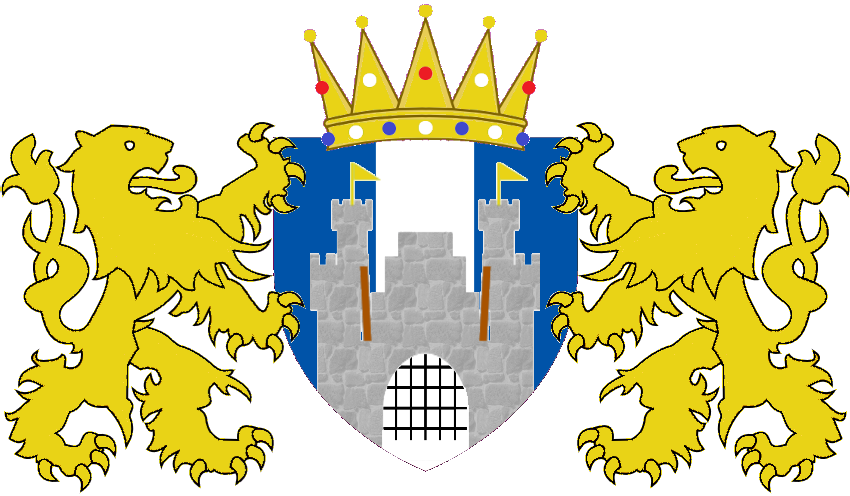
- Escutcheon: Azure a pale Argent overall a representation of Ulfstead Castle Proper.
- Coronet: An Eastern crown Or jewelled Proper.
- Supporters: On either side a lion rampant Or.
The blazon is my conjecture. The image is based on what is depicted on Robert Norramby’s lecterns and locomotives.
(Source: TVS “King of the Railway” et al)
This is reasonably good heraldry, though the supporters could do to be a bit less generic and the non-standard coronet is never explained.
Wilbert Awdry gives a short genealogy (though no heraldry) of the Earls of Sodor. One of them is called Robert, but he is not likely the same character as in the TV series. They are elevated from comital to ducal rank in the islanders’ culture.
The Earls of Sodor have always been active on the Council of the Duchy of Lancaster, and since there is no Duke of Lancaster, Sudrians affectionately refer to the Earl as their ”Duke”.
(Source: PH&R p.102-3)
Sadly, no arms are given for the Hatt baronets.
Real Life Locations
Barrow-in-Furness (town)

- Escutcheon: Gules on a bend between a serpent nowed in chief and a stag trippant in base Or an arrow pointing upwards to a bee volant Proper upon a chief Argent on waves of the sea a paddle-wheel steamship under steam and canvas also Proper.
- Crest: On a wreath of the colours out of the battlements of a tower a ram’s head Proper armed and collared Or.
- Motto: Semper Sursum (Always Upwards)
Originally granted to the then-County Borough on 13th December 1867.
(Source: Fox Davies’s Book of Public Arms, 1907, p.64)
This of course is the Island of Sodor lying between Barrow-in-Furness and the Isle of Man.
The NWR have had Running Powers into Barrow Central Station ever since their Agreement with the LMS in 1925. For through trains NWR engines are detached and engines from the Other Railway (BR) take over. Since the 1925 Agreement, the NWR have also had their own locomotive shed, turntable, and servicing facilities here. There is also a joint goods yard for exchange of traffic.
(Source: PH&R p.4, 9)
So the Island of Sodor was born, and cartographers among our readers will find that it comprises, in fact, a westward extension of Walney Island, olf the Cumbrian coast at Barrow, even including the community of Vickerstown thereon —though we in Sodor spell it Vicarstown.
(Source: RBtL p.3)
Lancaster (Duchy)
Gules, three lions passant guardant in pale or, a label of three points throughout argent.
(Source: Fox-Davies, 1907, p.428)
The Duchy’s arms are the same as the personal arms of the original Duke of Lancaster, Henry of Grosmont, being a differenced form of the royal arms of England.
By the accident of history, while the Isle of Man has retained Home Rule, Sodor has, since the 15th Century, been attached to the Duchy of Lancaster; but Sudrians have never allowed that circumstance to disturb their way of life. While paying lip service to Westminster they pursue a traditionally independent course.
(Source: PH&R p.5)
The Earls of Sodor (see above) are active on the Duchy of Lancaster Council.
In real life the Duchy in the modern era is a collection of land and other assets held in trust for the reigning sovereign but administered separately from the Crown Estates, an arrangement arising from Henry of Bolingbroke’s usurpation of the throne in 1399. The monarch is sometimes traditionally called “Duke of Lancaster” (even if female) in Lancastrian communities or by Duchy-affiliated bodies, but does not (and legally cannot) actually hold that title as a peerage distinct from the Crown.
Sodor & Mann (diocese)
- Escutcheon: Argent upon a pedestal the Virgin Mary with arms extended between two coronetted pilllars in her dexter hand a church Proper and in base upon an escutcheon the arms of Man (Gules three legs in armour conjoined at the thigh and flexed at the knee) the escutcheon being surmounted by a mitre.
(Source: Debrett’s Peerage, 1976, p.1062)
The original see was founded by Germanus in 447. [Sodor is an abbreviation of Sodorenses, the Hebrides and Western Islands of Scotland, now called “The Isles” in the Episcopal Church of Scotland, which were formally under this Bishop’s jurisdiction.] The Bishop has neither seat nor vote in the House of Lords, as he legislates in the Isle of Man, where there is a separate form of government.
(Source: ibid)
though the Bishop had the title of Sodor and Man, he only had Man for his diocese. There is, of course, a historical reason for this, but as you have to go back some 700 years to find it, George and I decided that we could safely ignore it! We would, we felt, be doing the Bishop and his successors a kindness by restoring the other half of their diocese to them!
(Source: PH&R p.4)
The name is a corruption of the Suddries or South Hebrides, and since this area, with the Isle of Man and part of Northern Ireland, came at the time under the jurisdiction of a Bishop his title became the Bishop of Sodor and Man. The South Hebrides are now part of the See of Argyll, but the Bishop of Sodor and Man retains his ancient honorific.
(Source: RBtL p.30)
The Awdry Family
There are multiple entries for the Awdry family in heraldic catalogues. The motto, where given, is always Nil Sine Deo (Nothing Without God) but there are some small variations in the crest and shield. This likely represent marks of difference to represent cadet branches of the family, but inconsistently applied.
Awdry of Notton House
- Escutcheon: Argent on a bend Azure cottised Sable between two crescents of the second a crescent between two cinquefoils Or.
- Crest: On a wreath of the colours in front of a lion’s head erased Azure gorged with a collar gemel Argent a cinquefoil between two crescents fesseways Or.
This includes Sir John Wither Awdry, DL, (1795-1878), who was Chief Justice of the Supreme Court of Judicature at Bombay 1839-42.
(Source: Burke’s Landed Gentry, 1921, page 53)
Awdry of Seend
- Escutcheon: Argent three cinquefoils Or on a bend Azure cotised of the same and crest
- Crest: Out of a ducal coronet a lion’s head Azure.
(Source: Burke’s Landed Gentry, 1862 and 1871, page 39)
Note that the 1862 edition says that the Notton arms are the same as the Seend, while that of 1921 gives no blazon for Seend at all.
Specific Family Members
Page 51 of Fox-Davies’s Armorial Families, 1895, lists a great many by this name:
Dame Frances Ellen Awdry, cc Lady Awdry (daughter of Thomas Carr, second wife of Sir John)
- Escutcheon: Argent on a bend cottised Azure three cinquefoils Or a crescent of the second for difference.
Born on a lozenge as a widow.
Thomas Awdry, Esq (b. 6 Jul 1840, first son of Sir John)
- Escutcheon: Argent on a bend cottised Azure three cinquefoils Or a crescent of the second for difference.
- Crest: Out of a ducal coronet Or a lion’s head Azure.
Rev. William Awdry (b. 24 Jan 1842, second son); Charles Awdry, Esq, JP (b. 12 Feb 1846, fourth son); James Awdry, Esq (b. 8 Sep 1848, fifth son); Herbert Awdry, Esq (b. 20 Oct 1851, sixth son); Rev. Vere Awdry (b. 14 October 1854, seventh son, also father of Wilbert & George)
All same arms and crest as Thomas.
Rev. William Henry Awdry, MA (Oxon), JP (b. 1835, first son of West & Mary Awdry)
Ditto.
Fox-Davies repeatedly cites Burke’s Landed Gentry as the source for the Awdry arms, and the blazon is the same as that given for Awdry of Seend in the 1862 edition, but says each time “for which no authority has been established”. At the foot of each page is the assurance “The Editor undertakes that every entry not in italics is that of a genuinely armigerous person.” All of the Awdry entries are in italics.
The 1910 edition of the same book is a little different. For simplicity I will not write out all the names again, but on pages 55 and 56 the same people are listed with a common blazon, this time matching what is given for Awdry of Notton in the 1921 edition of Burke’s.
- Escutcheon: Argent on a bend Azure cottised Sable between two crescents of the second a crescent between two cinquefoils Or.
- Crest: On a wreath of the colours in front of a lion’s head erased Azure gorged with a collar gemel Argent a cinquefoil between two crescents fesseways Or.
Fox-Davies 1910 is, of course, a year before Wilbert’s birth, but his name is squeezed into his father Vere’s sub-entry Burke 1921.
For now I will accept the later version (where the crest has the lion wearing a silver collar) as the correct one for Wilbert. Pending further research, I would speculate that the Awdrys of Seend are the senior branch of the family with the relatively simple arms while the Awdrys of Notton are the long-established offshoot with permanent (although irregularly recorded) augmentations.
Given that Wilbert & George clearly had a keen interest in heraldry and included so much of it in the books and papers they wrote, it is a little perplexing that their own armorial inheritance never got a mention, and indeed that the franchise’s wider fan community doesn’t seem to have picked up on it either.
 Robin Stanley Taylor