

Early in the new reign, the College of Arms announced a new royal cypher for Charles III. A noted difference between this one and his mother’s (other than the name, of course) was the depiction of the crown.
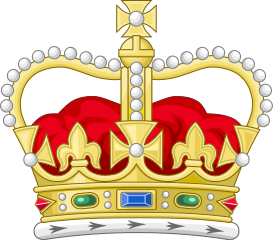
“St Edward’s” crown, favoured by Charles II to Victoria
Up to and including Victoria’s reign, depictions of the crown in heraldic drawings could be inconsistent. Edward VII ordered a standardised depiction with simple arches, which has come to be known as “the Tudor crown” due to its resemblance to one supposedly commissioned by Henry VII or VIII (and seen in royal portraits up to the Civil War). Elizabeth II later decided to change this to a version with depressed arches, better resembling St Edward’s crown which monarchs actually wear at coronations, and which seemed to be favoured in heraldic drawings before Victoria’s time. The timing of these decisions created a general misconception that the Tudor crown is always used when the monarch is male and St Edward’s when the monarch is female. Charles’s decision is likely to reinforce that belief.

The “Tudor” crown, as used by Edward VII-George VI
On the day of the coronation, the Canadian Heraldic Authority unveilved their own new version of the crown, intended to be more distinctly Canadian. The overall shape of the crown is still based on the Tudor version, but the jewels have been replaced by a wavy blue line, the uppermost cross by a snowflake (as already used in the Order of Canada) and the crosses around the rim by – of course – golden maple leaves. The removal of explicit Christian symbols may be due to the lack of an established church in Canada, though the omission of fleurs-de-lis is a little perplexing, given the constitutional importance of the country’s French heritage.

The Canadian crown, as used by Charles III
It is not clear on exactly what timescale the new crown is to supersede the old. Four days after the coronation the government of Canada released a revised Canadian passport design. Though many radical changes have been made, the 1952 depiction of the crown retains pride of place. It is also not certain whether this will apply to the parliamentary maces. Currently the mace of the House of Commons is modeled on the Tudor crown while that of the Senate is modeled on St Edward’s. This is reflected in the heraldic badge of the parliament, showing both maces in saltire behind the shield. Funnily enough, British passports, though updating the introductory text to reference His Britannic Majesty instead of Hers, also still seem to have the prior crown on their covers.
The shield itself (fleurs and all) remains unchanged. It was announced on the same day that the arms of Canada may be flown as a banner to represent Charles and all future sovereigns. Previously Elizabeth II’s flag had the royal arms of Canada with her personal EIIR cypher imposed on a hurt in the middle. The removal of the cypher brings Canada closer in line with British heraldic practice whereby the reigning monarch bears the arms of dominion undifferenced, as well as avoiding the hassle of redesigning the flag for each subsequent reign. It remains to be seen whether the heraldic banners of other members of the royal family will also omit their cyphers and keep just the cadency labels.
FURTHER READING
- St Edward’s Crown: a Restoration gift from Parliament by The History of Parliament, 30th March
- The Return of the Tudor Crown by TrimTag, 12th October
- A Complete Guide to Heraldry by Arthur Charles Fox-Davis, 1909 (Chapter 22)
- Heraldry, Historical and Popular by Charles Boutell, 1864 (pages 315-322)
 Robin Stanley Taylor
Pingback: New World Heraldry with Bruce Patterson | Robin Stanley Taylor
Pingback: The Sovereign’s Crown and the Southern Cross | Robin Stanley Taylor