
Having written a few times now about heraldry as featured in The Railway Series, as well as significant events in that franchise, I felt that now would be a good time to do a spotlight on the most particularly heraldry-heavy story.
Today is the seventieth anniversary of the UK publication of Gordon the Big Engine, the eighth book in the series, came just fifteen days after Elizabeth II’s coronation. I will, of course be focusing on the fourth chapter in the book (and its 1995 television adaptation), in which the monarch herself visits the big station.
The written story has seven illustrations by Clarence Reginald Dalby, of which only the last three are relevant here. The television episode obviously has a large number of potential screenshots. The images used below are linked from the bountiful gallery on ttte.fandom.com and are labelled by their timestamp within the episode (not counting opening credits) in case of future link rot.
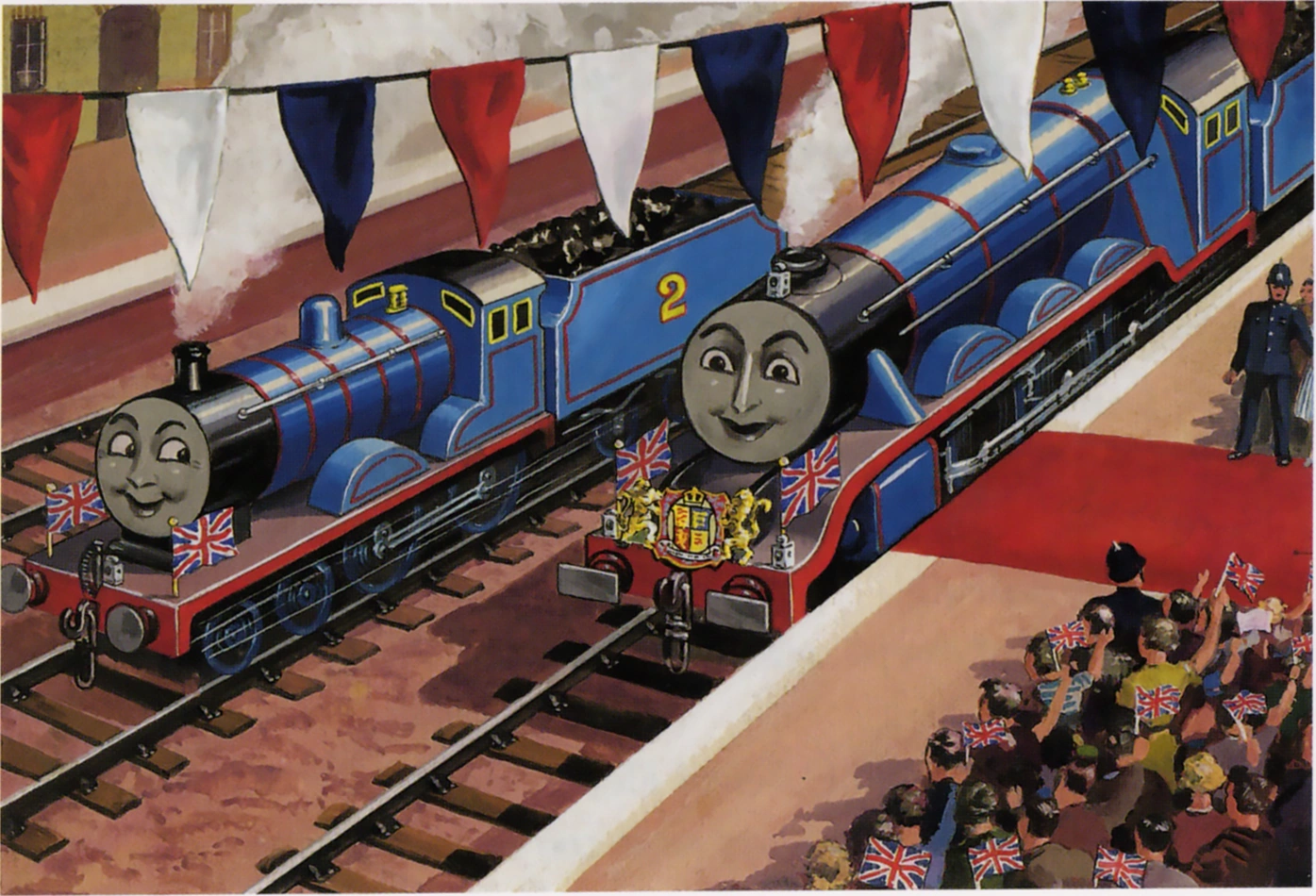
5th illustration
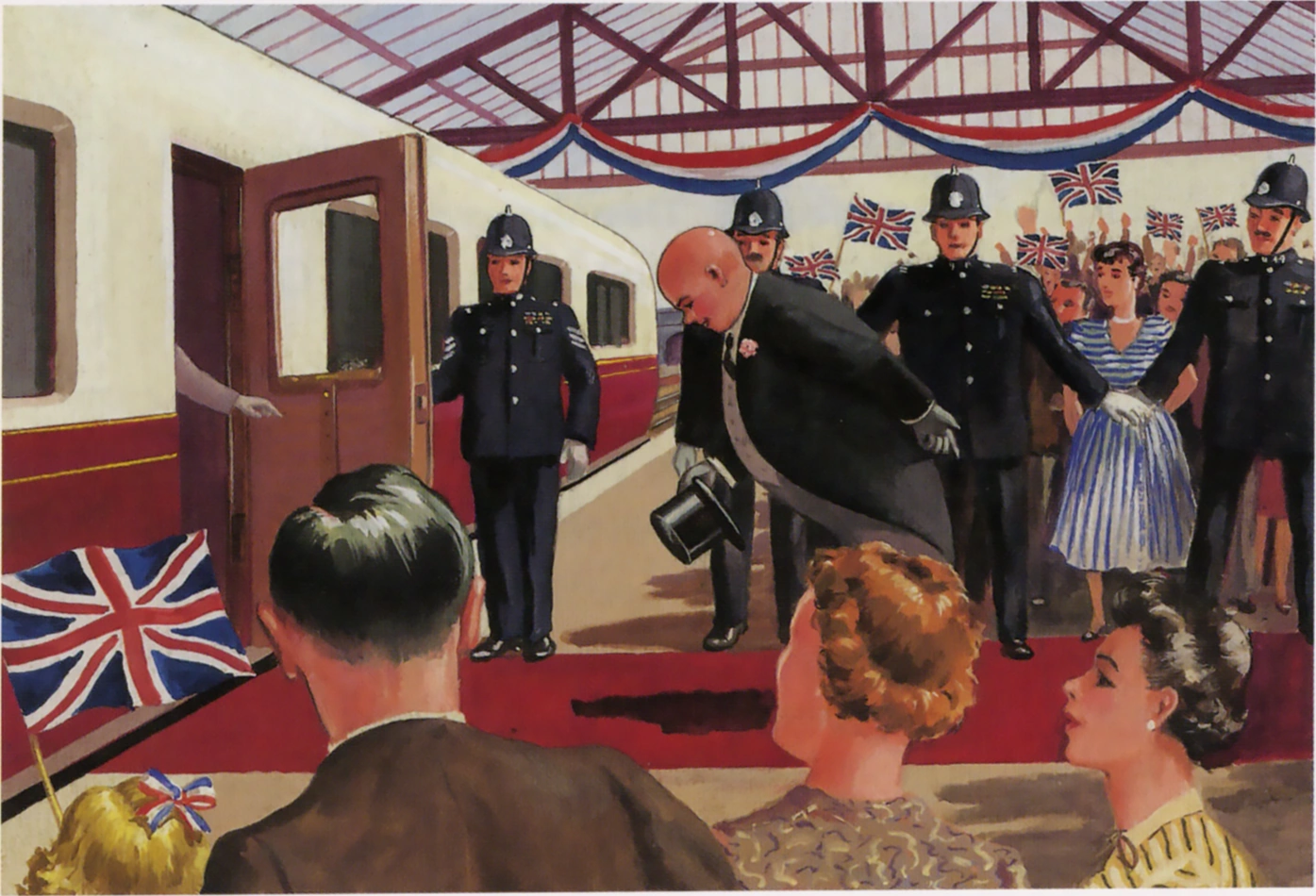
6th illustration
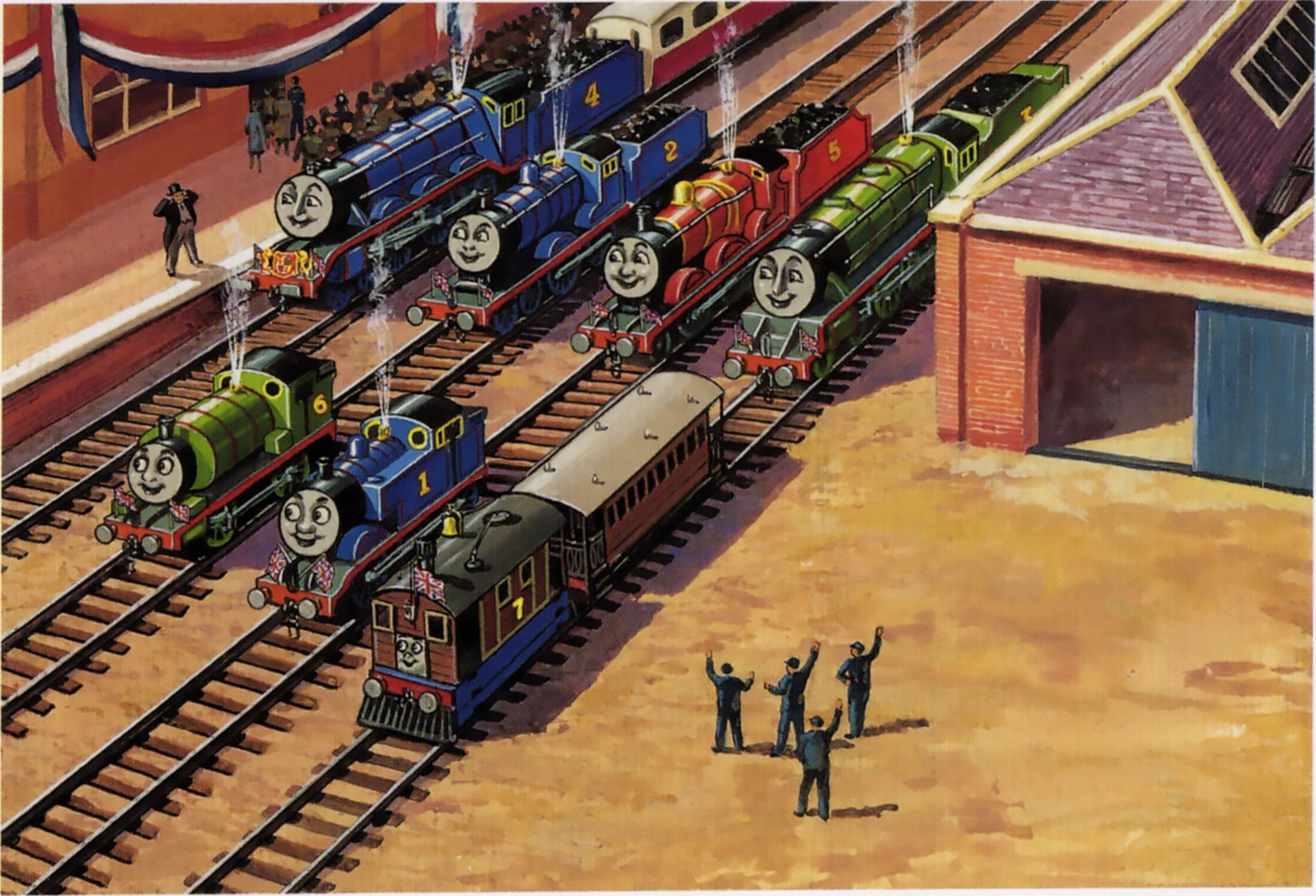
7th illustration
The text of the story says:
Edward steamed in, looking smart with flags and bright paint.
…the Queen’s train glided into the station. Gordon was spotless, and his brass shone. Like Edward, he was decorated with flags, but on his buffer beam he proudly carried the Royal Arms.
In the illustrations themselves we can see Union Flags galore, as well as a string of pennons in the national colours.There is also a tricolor drape across the frame of the station which runs the risk of inadvertently looking French or Dutch. Gordon’s carving of the royal arms is obviously the centrepiece here: It looks to have a lion Or as the supporter on both sides with the quarterings being first and fourth Or, second Azure third Gules. The actual charges on them cannot be deciphered but the crown looks like a reasonable approximation of either the Tudor crown or St Edward’s (the former likely still being in wide usage at this early stage of Elizabeth’s reign).
The television adaptation depicts things a little differently – Britt Allcroft at this stage was keen to present Sodor as a mystical fantasy land and dissociate it from the United Kingdom (although clearly not from the monarch), so the Union Flags are entirely absent and the bunting is generically technicoloured. We do, however, see multiple carvings of the royal arms – one leaning on either side of Gordon’s smokebox and at least four more attached to the station itself – originally on the glass of the canopy but later moving to the pillars and a nearby lamppost.
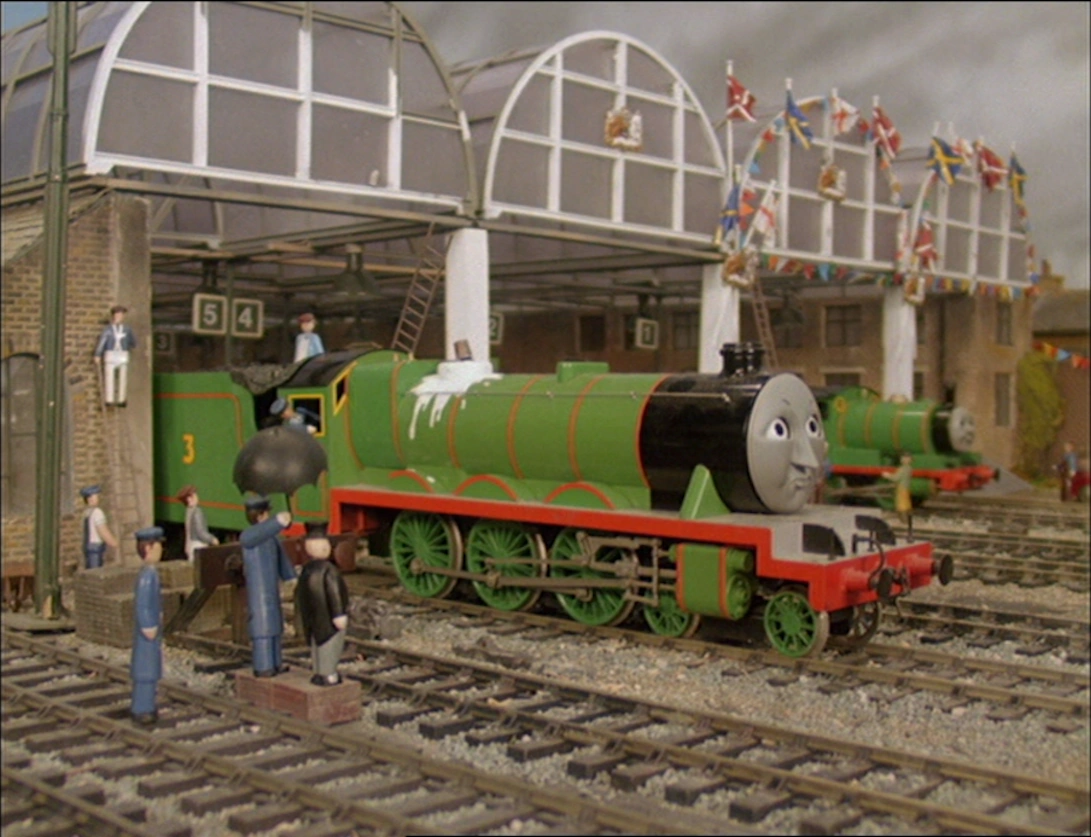
2m02s
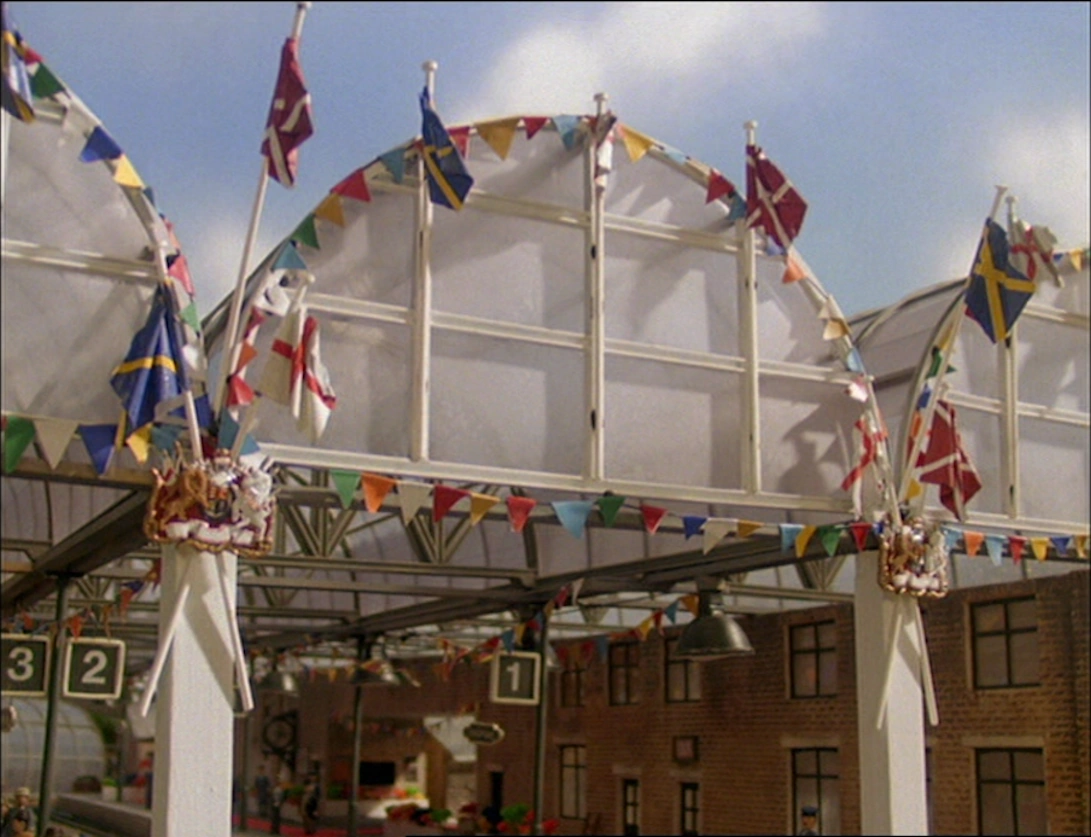
2m43s
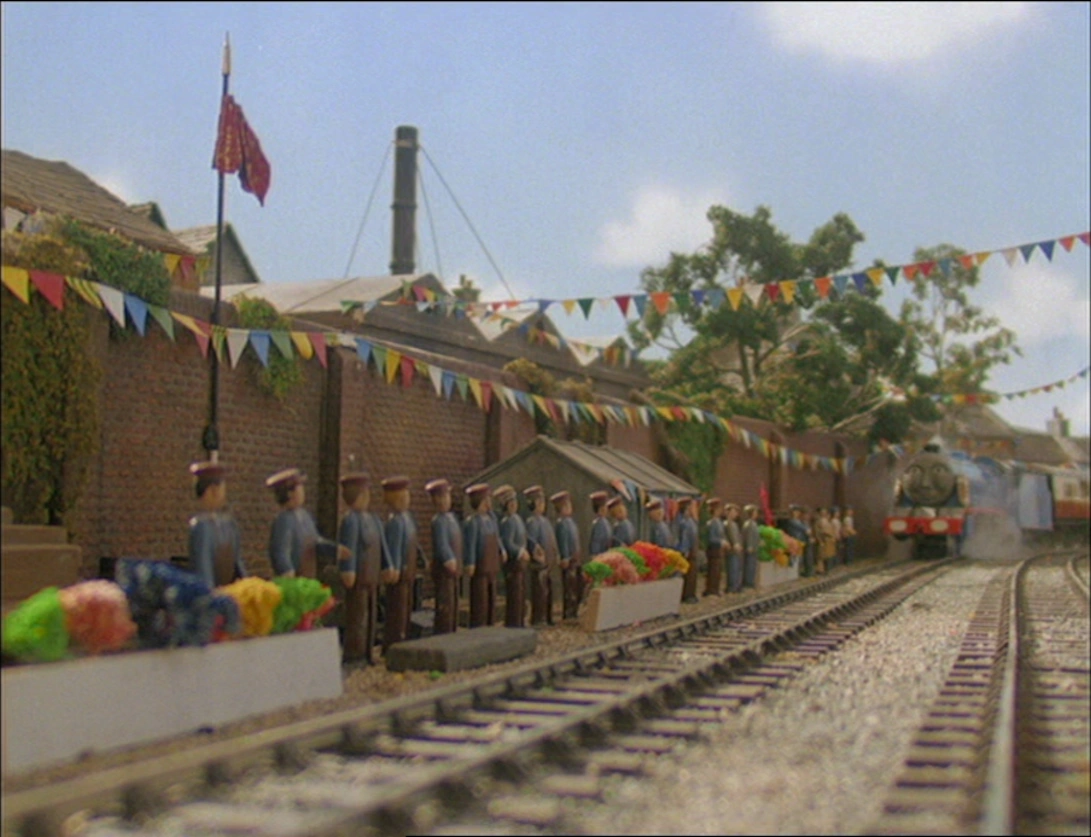
3m24s
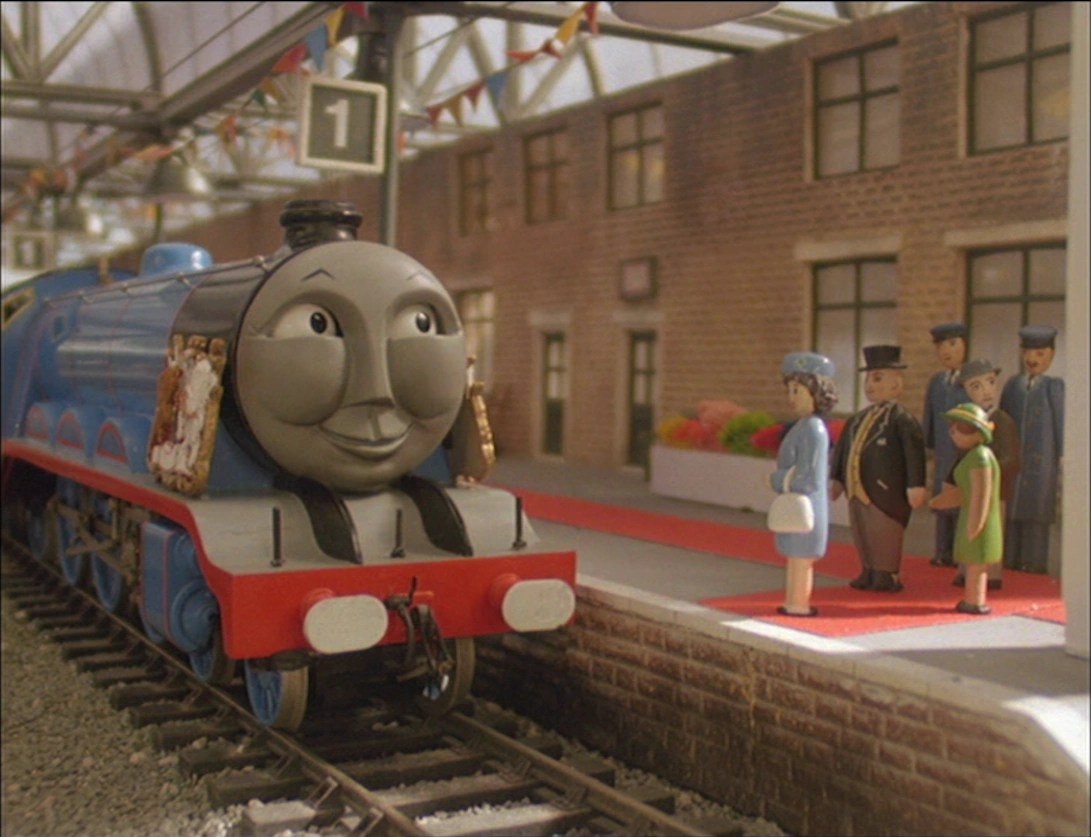
4m20s
Also flying from the canopy are three flags of more definite designs, the first Argent a cross Gules, the second Azure a saltire Or and the third Murrey a saltire Argent. The first is obviously the flag of England but I don’t know the origin of the other two. We don’t get a close-up shot of the royal arms, but they are clearly supported by a golden lion and a white unicorn in the right arrangement. The shield itself looks to be blue in both the lower quarters but the upper quarters for England and Scotland are potentially correct. A red banner with indecipherable golden embroidering also flies outside the station as Gordon approaches.
This, incidentally, was not the first adaptation of the source material, for the story was republished as part of a series of Changing Picture Books called Busy Engines in 1994. The illustrations here (by Arkadia Illustration Ltd.) show many Union Flags as in the original book but no royal arms. Gordon’s footplate instead carries a large facsimile of St Edward’s Crown (perhaps foreshadowing the Duchess of Loughborough).
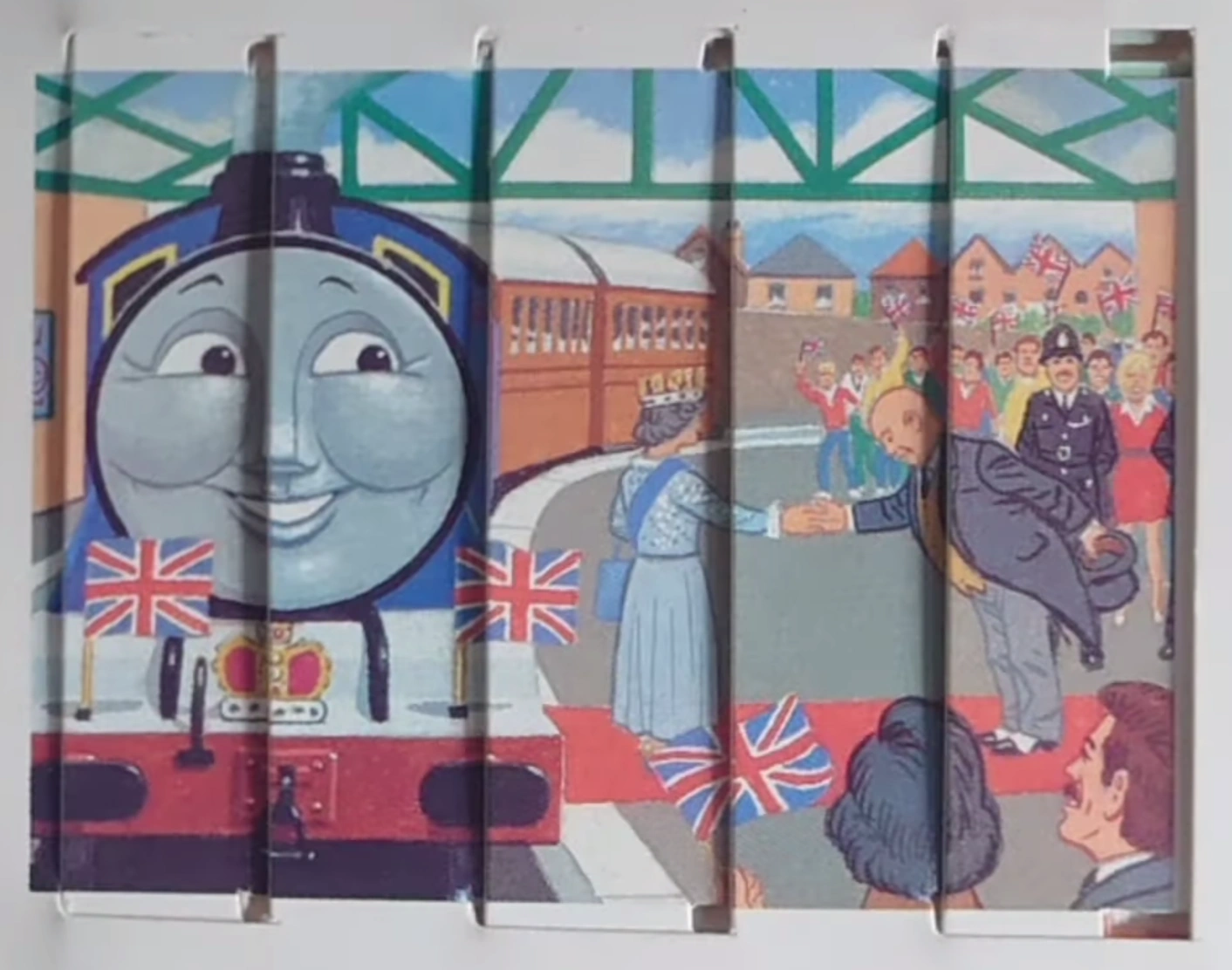 The Queen’s own appearance also changes – in the 1953 book she is shown only as an arm emerging from her carriage, in the 1994 book wearing a golden circlet trimmed with ermine and a thick blue sash from her right shoulder (very formal for a day trip on a steam train) and in the 1995 episode in a light blue dress with matching hat. It has been suggested but never confirmed that the man in the brown jacket is meant to be her husband and the short woman in the green dress her mother, which might be the clue as to why the story title implies that more than one queen visited.
 Robin Stanley Taylor