

The King, fresh off his farewell to President Tinubu, made headlines on the cliffs of Seven Sisters, Sussex, on Thursday by officially opening what may physically be his largest namesake, the King Charles III England Coast Path.
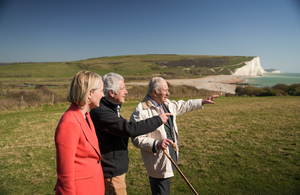
Charles’s coat looks quite like the sort of thing my grandmother would have worn.
As the government’s press release explains, the project actually long predates his reign, his name being appended to it in 2023 as part of his coronation celebrations. It resulted from the Marine and Coastal Access Act passed all the way back in 2009 and, as all the updates on this other government webpage indicate, it was supposed to be completed by 2030, then optimistically brought forward to 2020, then pushed back again during the pandemic.
The ambition was to link up all the existing footpaths, as well as carving out new ones where needed, to create a continuous walking trail which covered the entirety of the English coast line. Of course, the English coast line itself is not continuous, as England has sizeable land borders with Scotland and Wales. A Wales Coast Path, proposed in 2006 and completed in 2012, links up to the English one in two places and there is also a Scottish Coastal Way in the pipeline. As this is a devolved matter, the institutions are not entirely alike and it is not certain if the other two will ever bear the monarch’s name, or if Northern Ireland will attempt something similar. Even now, despite the official opening this week, the English path has 20% still to go and is expected to be completed at the end of 2026. “Coast” is also being used in quite a broad sense, as the path incorporates trails along not only the seas, but also the rivers — including the Humber, which runs quite close to my house and along which I walk fairly regularly.
The situation with the naming and timing has some echoes of the Elizabeth Line, the commuter railway through Greater London from Reading to Shenfield, which likewise was a combination of new paths built from scratch and old ones appropriated. The proposals had been floated as far back as the 1940s and work finally began in 2009. The construction project was called Crossrail, and this by default might have become the name of the completed railway. It was only in 2016, in the run up to Elizabeth II’s ninetieth birthday, that the line was named after her. The name was slightly controversial as it gave the false impression of being part of the London Underground rather than a different railway in its own right. The completion was originally scheduled for 2018 but, inevitably, there were delays and services did not run until 2022. The repeated schedule slips raised concerns over whether Elizabeth herself would live to open her namesake line. In the event she did open the first section in May that year, but had died by the time the rest opened in November.
Hopefully His Present Majesty will not exhibit the same phenomenon.
 Robin Stanley Taylor