Found in the Booth

For the past few years I have kept a keen eye on the blog Heraldry Online by Stephen Plowman. Most of the heraldry community learn of grants of arms by updates on relevant authorities websites, or by the accounts given in volumes of Debrett’s. Plowman, however, posts a regular stream of photographs of the actual letters patent by which the arms were granted, spotting the historic documents as they come up for auction (typically after the actual line of armorial inheritance has gone extinct). Today he has posted one particularly important to me – the late Baroness Boothroyd.

I have written many times before about my history with her arms, but it is nice to see the definitive article at last. The text of the blazon is the same as in Debrett’s, but we now know the date of granting (8th October 1993) and the herald responsible (Conrad Swan).

She Spoke to Serve

The late Baroness Boothroyd has fascinated me for as long as I have followed British politics, and hers was among the deaths I most dreaded.

Just last October, with my newly-registered library card, I took out her autobiography. There are eighty pages before she actually becomes an MP (and she goes into detail of her multiple failed attempts), describing her childhood in impoverished Dewsbury, then her time as a Tiller girl, then going into politics as a secretary to two Labour MPs, then going overseas to work for JFK. Even when she gets into parliament, her struggles are as within her own party as against the others – this being the age of entryism by Militant, which she was instrumental in rooting out.

Before the release of the 2018 parliamentary portrait series ,(and note that her image is the one used on the PDS blog) Boothroyd was one of the many prominent politicians for whom I struggled long to find a free photograph to use on Wikipedia. The only one on which I could lay my hands was a poor-quality screenshot from President Obama’s speech in Westminster Hall in 2011, published on the White House channel and thus public domain. The baroness is shown looking the wrong way, sandwiched awkwardly between George Osborne and Douglas Alexander. For the top (indeed, only) illustration in a prominent online biography it just wasn’t good enough.

The other big challenge was her coat of arms – one of my earliest such works. Unlike her successor Michael Martin, Boothroyd’s arms were widely photographed and shown online. Recreating the lozenge visually was easy enough, though it wasn’t until years later that I tracked down the text of the blazon to go with it. My first attempt was not well-received by the residents of r/heraldry, so it was one of the few of my graphics which I completely remade.

I never got to see how the community (or anyone else) viewed my second attempt, for within hours of her death being announced another user, ProfAuthor, had replaced it with his own vector graphic. It is technically superior, of course, but still it is disappointing to know that my own efforts are made redundant. Something similar happened with Sir Ernest Shackleton the last time he was in the news.

The Green Chair Quartet

The Ways & Means Committee was, and in some countries still is, a subgroup of the national legislature responsible for proposing changes to fiscal policy. In the House of Commons a tradition developed whereby the Chairman of Ways & Means, rather than the Speaker, would preside over the chamber during the annual budget statement. From 1853 the Chairman took on the role of the Speaker’s deputy in general. This was codified by the Deputy Speakers Act of 1855. The Chairman was given his own Deputy in 1902.

The committee itself was abolished in 1967, with full authority over fiscal matters going to the Chancellor of the Exchequer, but the chairmen retained their functions as deputy speakers. Like the main Speaker they do not speak in the chamber except on matters of procedure, nor vote unless to break a tie. Unlike him they remain members of their respective parties and must fight as party candidates at general elections. Traditionally the Speaker was elected at the first sitting day after each general election, whereas the deputies were appointed just after the first State Opening.

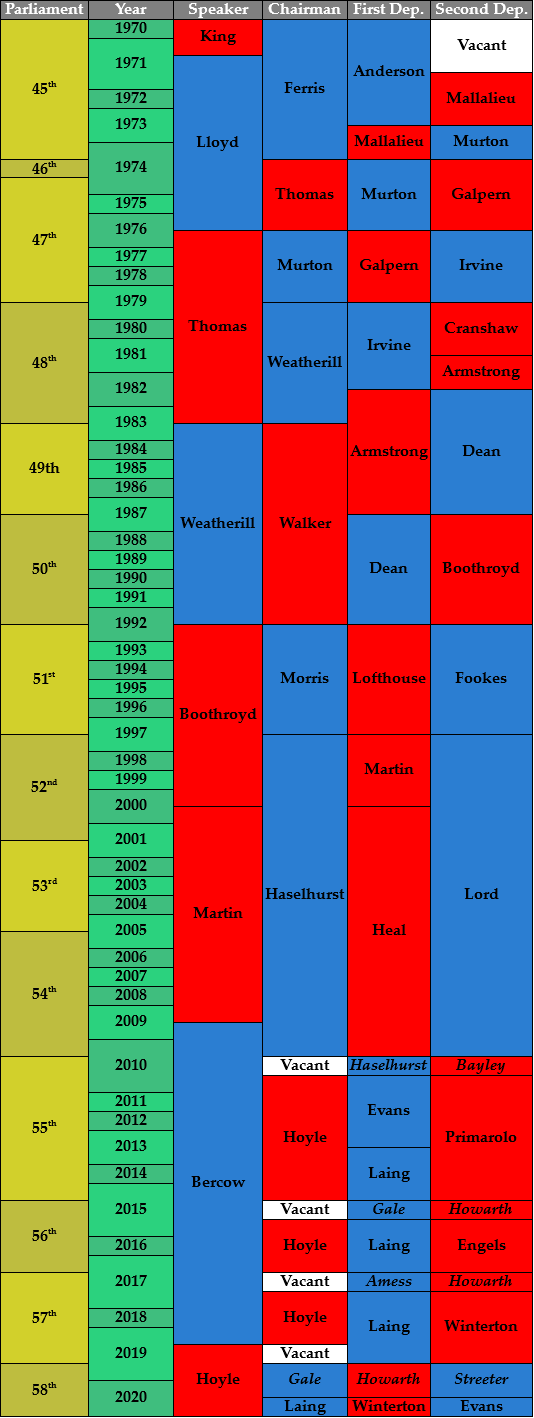
The table that I have created shows all of the speakers and their deputies since the beginning of the 45th Parliament in 1970.

The Commons assembled on 29th June and Dr Horace King, member for Southampton Itchen, was elected to a third term as Speaker, having taken office following the death of Sir Harry Hylton-Foster in 1965. On 2nd July he was given Sir Robert Grant-Ferris (Conservative, Nantwich) as Chairman and Betty Harvie Anderson (Conservative, East Renfrewshire) as Deputy.

On 12th January 1971 King retired and former Foreign Secretary Selwyn Lloyd was, with a bit of difficulty, elected to replace him. This briefly resulted in an all-blue speakership trio. Ten months later the post of Second Deputy Chairman was established and conferred upon the Labour backbencher Sir Lancelot Mallalieu. Anderson resigned her post at the end of the third session. After the state opening Mallalieu was promoted to replace her and his position given to Oscar Murton, Conservative member for Poole.

Ferris and Mallalieu both retired from the Commons at the general election of February 1974. The short-lived 46th Parliament saw Lloyd re-elected as speaker and Murton promoted to First Deputy, with former Secretary of State for Wales George Thomas becoming chairman. Seemingly no Second Deputy was appointed that time. After the October election Lloyd, Thomas and Murton were restored, with Sir Myer Galpern (Labour, Glasgow Shettleston) becoming Second Deputy. This arrangement persisted until 3rd February 1976 when Lloyd retired and Thomas was elected to replace him. That same day Murton and Galpern were promoted one step each, with Sir Godman Irvine brought in at the bottom.

At the 1979 general election Murton and Galpern both retired from the Commons and were kicked upstairs that summer. Anderson, a backbencher since her resignation, did the same with the unusual title Baroness Skrimshire of Quarter, of Dunipace in the District of Falkirk, but she suffered a fatal asthma attack just a week after her introduction to the Lords. Thomas resumed his place, with Irvine becoming First Deputy under Bernard Weatherill (Conservative, Croydon North East). Richard Cranshaw (Labour, Liverpool Toxteth) was then appointed Second Deputy. Cranshaw vacated the post in February 1981 when he defected to the Social Democratic Party. He was replaced by Ernest Armstrong (Labour, North West Durham). On 28 May 1982 Armstrong was promoted after Irvine’s resignation, with Paul Dean (Conservative, North Somerset) appointed below him.

At the 1983 general election Cranshaw was defeated while Thomas and Irvine both retired. The former two were ennobled. Weatherill then became Speaker and Harold Walker (Labour, Doncaster Central) became Chairman. Armstrong and Dean stayed still.

In 1987 Armstrong retired. Weatherill and Walker remained, with Dean made First Deputy and Betty Boothroyd (Labour, West Bromwich West) Second. In 1992 Weatherill, Walker and Dean all stood down. Boothroyd beat Peter Brooke to the Speaker’s chair. She acquired a new team of Michael Morris (Conservative, Northampton South), Geoffrey Lofthouse (Labour, Pontefract & Castleford) and Dame Janet Fookes (Conservative, Plymouth Drake). They too departed on masse in 1997 – the latter two voluntarily, the former less so.

Their replacements were Alan Haselhurst (Conservative, Saffron Walden), Michael Martin (Labour, Glasgow Springburn) and Michael Lord (Conservative, Central Suffolk and North Ipswich). Martin succeeded Boothroyd upon her retirement in 2000, and was himself replaced by Sylvia Heal (Labour, Halesowen and Rowley Regis). This team remained stable for most of the noughties.

Martin resigned in 2009. Haselhurst and Lord both contested the ensuing election, the former getting a measly sixty-six votes and the latter just nine. The winner was outsider John Bercow (Conservative, Buckingham). That knocked off the party balance for the first time in thirty-five years. At the 2010 general election Heal left politics behind and Lord moved upstairs, taking the title Baron Framlingham, of Eye in the County of Suffolk, to avoid the obvious joke.

At the start of the 55th Parliament Bercow was re-elected Speaker, and new rules took effect requiring deputies to be elected a ballot of members rather than appointed in the old manner. Haselhurst was no longer eligible to be Chairman, only First Deputy, so he became Chairman of the Administration Committee instead. Those elected were Lindsay Hoyle (Labour, Chorley), Nigel Evans (Conservative, Ribble Valley) and Dawn Primarolo (Labour, Bristol South). Evans resigned as First Deputy in September 2013, and the next month Eleanor Laing (Conservative, Epping Forest) took his place.

In 2015 Primarolo left for benches redder. Bercow, Hoyle and Laing continued, with Natasha Engel (Labour, North East Derbyshire) taking the junior spot in a rather noncompetitive election. Engel was defeated in the 2017 snap election. Haselhurst stood down, accepting a life peerage the next year. The new Second Deputy was Dame Rosie Winterton (Labour, Doncaster Central).

Some awkwardness ensued in 2019 when another snap election was imposed. Bercow resigned his seat in the 57th House of Commons two days before it was due to dissolve. All three deputies sought to succeed him as Speaker, with Hoyle ultimately prevailing. His former position as Chairman of Ways & Means was left vacant on the one remaining sitting day.

The present parliament assembled on 17th December and Hoyle was swiftly re-instated, but the deputies were not elected until January. Laing was made Chairman, with Winterton becoming First Deputy unopposed and Evans coming back in as second. How long this team will stay together is to be determined.

You may notice that there are some italicised names not yet mentioned. The new arrangements for electing deputies contained a caveat that the old system could still be used to appoint up to three temporary placeholders from among the surviving members of the previous house’s Panel of Chairs so that the Speaker was not left to carry the whole workload alone for the first few days. Haselhurst was kept on in 2010 with Hugh Bayley (York Central). In 2015 the appointments were Sir Roger Gale (Conservative, North Thanet) and George Howarth (Labour, Knowsley). In 2017 they were Howarth and Sir David Amess (Conservative, Southend West). In these instances the documentation of was hard to find, and I really only know who served as temporary deputies from the Speaker thanking them once the permanent deputies were elected. In no case was it made clear which member acted in which particular office, so I have assigned them to the roles for which they would have been eligible to contest in the elections, and according to seniority of service in the house.

For 2019-2020 it was much clearer, with an explicit statement in the appointment motion that Gale would be Chairman, Howarth would be First Deputy and Sir Gary Streeter (Conservative, South West Devon) would be Second.

FURTHER READING

Commons Deputy Speakers – UK Parliament

The Arms of the Speakers

On the whole, my ideas for new Wikipedia pages have not gotten far. My template for life peers was rejected because the category was too large. My template for husbands of princesses was rejected because the topic was considered irrelevant. My plot to list all current members of the House of Commons by length of continuous service was aborted once I found that such an article already existed.

Recently, and without having received any direct notice, I discovered that one of my proposed articles had been accepted  – a list of the armorial bearings of all the Speakers of the House of Commons since 1707.

From the Acts of Union of England & Scotland (a useful jumping-on point for “British” parliamentary history, though the death of Elizabeth in 1603 could also work for the royal component), there have been thirty-three holders of the office. Each of them acquired a grant of arms during their term if they were not armigerous already. Depictions of their arms appear on small wooden escutcheons which are carved onto the interior walls of the speaker’s official residence in the Palace of Westminster.

To create a Wikipedia list of these grants seemed natural given the presence of similar armorial lists for heads of state and government in this and various other countries. Unfortunately my first submission of the list was swiftly rejected for the lack of reliable sources. Cracroft, it seems, is not considered worthy.

Scouring the subject on Google Books, I discovered a tome from 1851 which gave biographical accounts of a great many former speakers, each concluding with his blazon. It is a shame that modern publications do not consider such details so important. Speakers John Smith to Charles Shaw-Lefevre were covered thus, but their successors from the latter half of the nineteenth century were not so easily ticked off. I tried looking for biographies of later speakers, but frequently found that only limited previews were available.

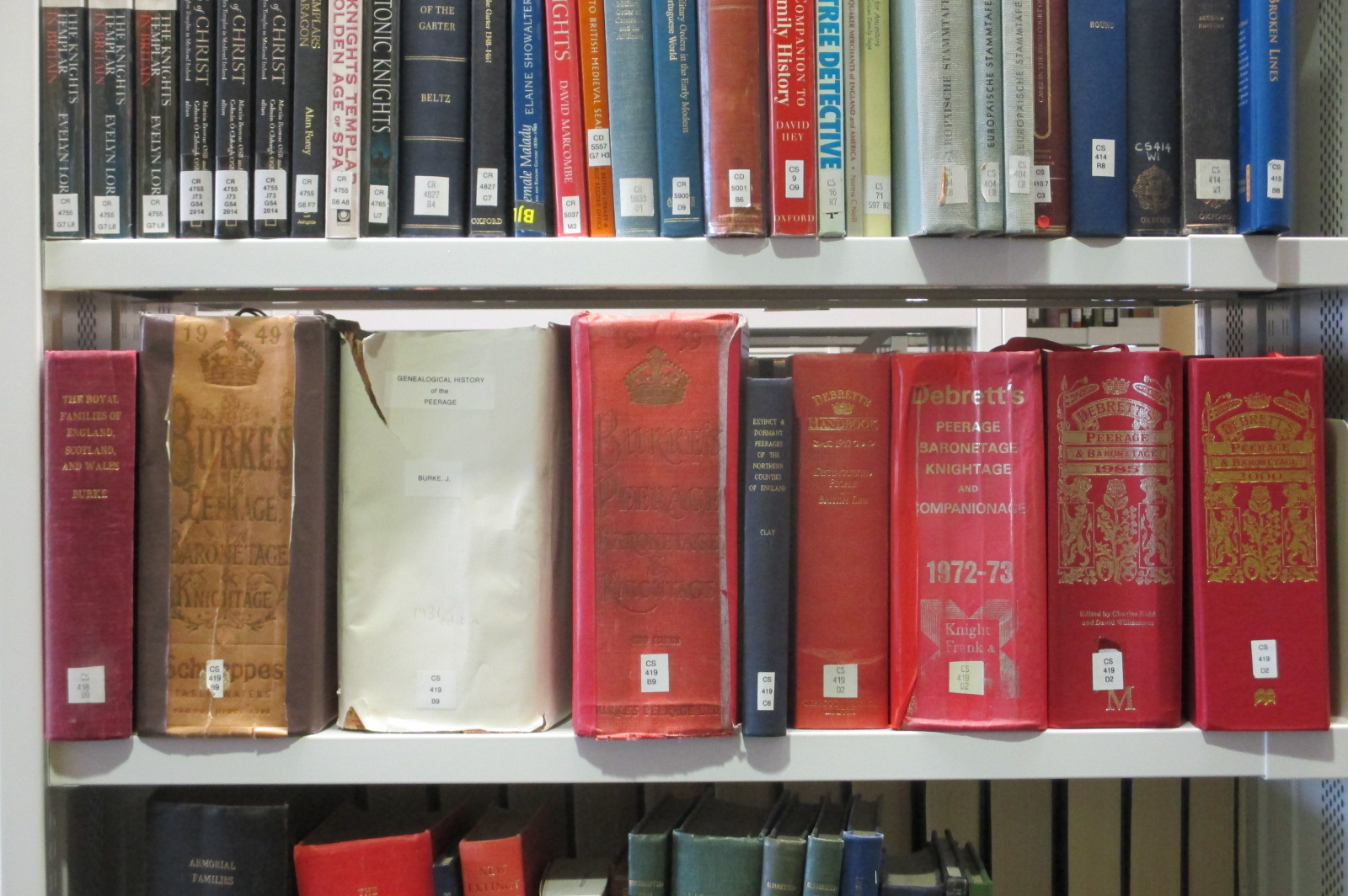
Only rather a long time into my heraldic hobby did a thought occur to me which, in retrospect, should have been obvious from the beginning – that being in a university library I could find many of those same books in physical form. Sure enough a scout around the fourth floor uncovered several such books. More importantly, I also found a shelf holding several old copies of Burke’s and Debrett’s accounts of the Peerage & Baronetage.

A Herald’s Treasure Chest

These titles were not new to me, for I had heard and read them referenced many times in relation to matters of the British aristocracy. Previously I had understood these volumes to be address books and genealogical guides for upper class, which indeed they are. I had not, however, realised that they also functioned as an armorial database. This discovery allowed me to vastly expand my portfolio for all heraldic uploads, but in particular it gave me access to the arms of several speakers in the twentieth century.

As the names imply, Burke and Debrett detail the peers and baronets of the United Kingdom and its predecessor states. Some also document the knightage and companionage, but these entries do not include arms. This means that speakers who are neither peers nor baronets will not have their arms listed – a problem for several of the individuals being studied.

It is customary for a retiring speaker to leave the house altogether and ascend to the other place – the monarch having been petitioned by MPs to confer some mark of her royal favour upon him, and the prime minister having recommended that this be a peerage. George Thomas’s arms can therefore be located as those of the Viscount Tonypandy, as can William Morrison’s as Viscount Dunrossil. Some speakers, though, never moved from the green leather to the red. This can either be because they preferred to remain commoners (in the case of Whitley) or because they did not leave office alive (in the case of Fitzroy and Hylton-Foster). A difficulty also occurs for those speakers whose peerages were short-lived: The shelf had volumes from 1949, 1959, 1972-3, 1985 and 2000. The viscountcy Ruffside does not feature, having existed only from 1951 to 1958. The barony Selwyn-Lloyd (1976-78) was similarly absent. Of course, the deferment of elevation until one’s retirement means that no edition would include the contemporary speaker, only the emeriti. In a few cases I was helped by other Wikipedians who had access to editions which I did not, but that still left me with a smattering of omissions from the record.

As explained before, when no blazon can be found then one can only resort to replication by visual inspection. Speaker’s House is often used for public events, and pictures often make their way online. Of course, the photographers are typically not there to take closeups of the wall decorations, but in a handful of cases I was able to get a good look at the escutcheons which had previously eluded me. The shields are arranged sequentially, so that if at least one of them is already known then a viewer can count along the line to identify the others. It was an easy deduction that the Stuart-era royal arms defaced by a bendlet sinister would belong to Edward Fitzroy, agnate of the Dukes of Grafton. Selwyn-Lloyd’s could be spotted two spaces down from Weatherill’s, but the depth of field made it difficult to precisely identify the charges.

Michael Martin’s arms were a challenge to reproduce as they contain a great many non-standard charges and a motto in Gaelic, “Gorbals Mick” wishing to emphasise the proletarian lineage which set him apart from most other politicians. The display of large graphics online had become much easier by the time John Bercow matriculated his arms, so that their appearance was widely distributed by various news outlets. There is currently some uncertainty as to when, if ever, he will relinquish the chair, but it is likely that the achievements of his eventual successors will receive similar publicity.

The only remaining gaps in the list are for John Henry Whitley and Sir Harry Hylton-Foster, both of whose shields I have seen in the photographs, but too far away to capture the fine details. The latter case is especially infuriating because although Sir Harry perished as a mere knight, a barony was conferred upon his widow, Audrey – who also happened to be Ruffside’s daughter. I sought out her entry in Debrett’s expecting to see the arms of her father and husband impaled, but instead the books gave her no heraldic information at all.

As I am unlikely to be invited to the speaker’s residence in person any time soon – being not a politics student, after all – these last two items may well stay beyond my grasp indefinitely. Still, it’s nice to finally have an article I may call my own after all these years.

UPDATE (January 2021)

Late in 2019 the Chairman of Ways & Means Sir Lindsay Hoyle was elected to replace Bercow as Speaker. His father was ennobled decades ago, but I could not find any arms recorded for him. Recently I found this piece by BBC Radio Lancashire, in which Sir Lindsay muses about a future grant. He says “I’d like to think maybe a bumble bee, the busy bee… who knows? And of course, if I was to do that, I would want a Lancashire rose.” though a year later there is still no news of him getting it.

UPDATE (January 2022)

Baz Manning, having read this post, is putting together a new Flickr album of photographs inside Speaker’s House. I am now able to fill in the remaining gaps, and have learned that Morrison had a Scottish grant separate to his English one.

EXTERNAL LINKS

  • E. Churton – The Lives of the Speakers of the House of Commons by James Alexander Manning, 1851.
  • Burke’s Peerage – The General Armory of England, Scotland, Ireland & Wales by Sir Bernard Burke, 1864.
  • C-SPAN – Bernard Weatherill reflects on his career, 7th April 1992.
  • C-SPAN – Betty Boothroyd shows of her residence, 1st July 1995.
  • Whitehall 1212 -Torcuil Chrichton sheds some light on Michael Martin’s charges, 4th December 2008.
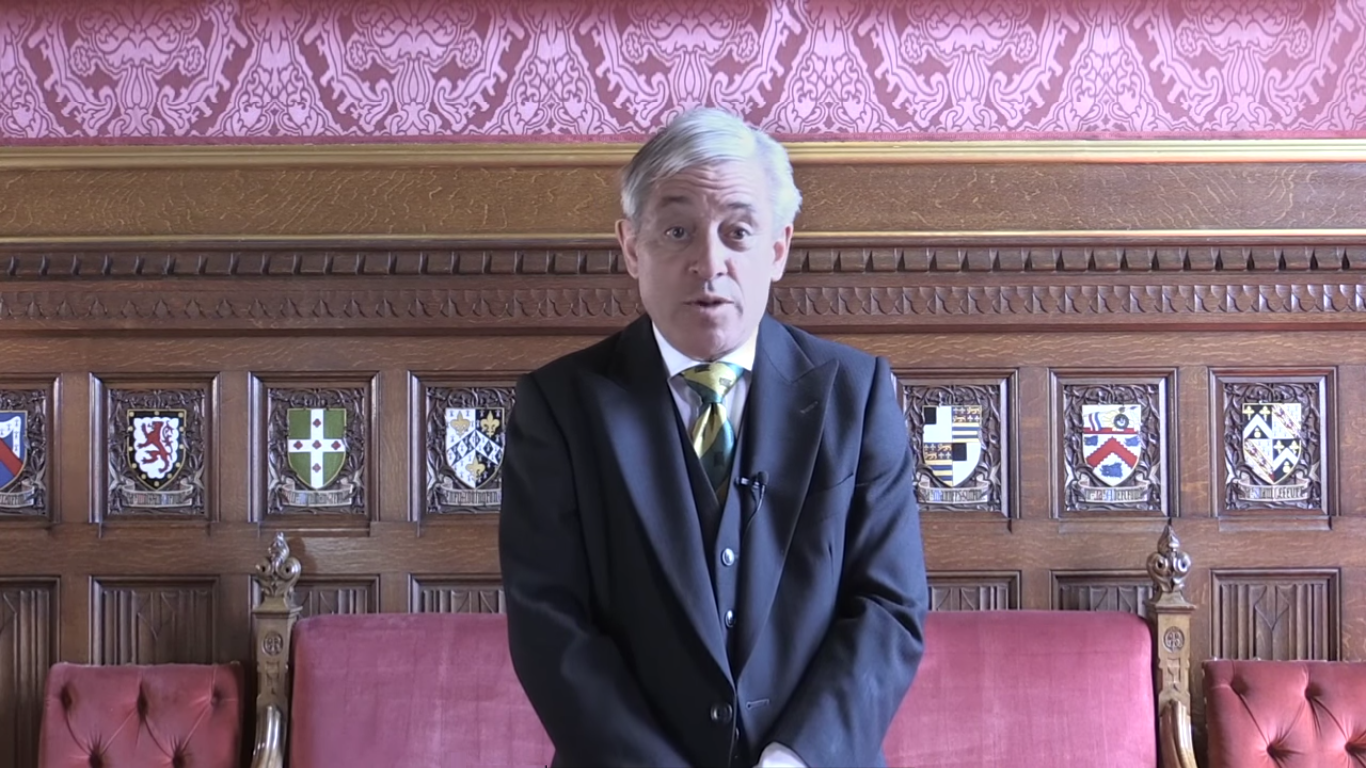
  • UK Parliament – John Bercow is interviewed with some escutcheons behind him, 7th September 2009.
  • The Daily Telegraph – Response to Bercow’s arms and portrait by Christopher Hope, 28th November 2011.
  • The Guardian – Report on Bercow’s arms, 28th November 2011.
  • The Workers’ Photos Archive – Photographs inside the speaker’s chamber, 19th June 2013.
  • I CAN – Photograph inside the speaker’s chamber showing the arms of Selwyn Lloyd, 26th November 2013.
  • UK Parliament – Bercow before row of escutcheons paying tribute to Jo Cox, 15th June 2017.
  • Hansard – Bercow pays tribute to his deceased predecessor, including a brief description of his arms, 1st May 2018.
  • Reddit – Members were not impressed by my first attempt at Boothroyd’s lozenge, 28th January 2019.