Nothing especially deep to say here, but it felt worth mentioning.
Today, at least in Holderness, the weather is relatively pleasant.

Nothing especially deep to say here, but it felt worth mentioning.
Today, at least in Holderness, the weather is relatively pleasant.
Throughout the past two years I have been a regular viewer of Jimmy Carr’s YouTube channel. He has uploaded many full-length videos of his old standup specials, as well as dozens of shorter compilation videos. He even did a quiz to entertain those trapped in lockdown, although this content has subsequently faded from prominence, condensed into a few large weekly compilations.
Late last year, he announced that after getting by for so long by endlessly rehashing old material, he was finally releasing a new show, albeit not on YouTube. His Dark Material premiered on Christmas Day.
There are two segments which focus on the events of the past two years, but these are relatively brief and the majority of the material is interchangeable with what one comes to expect from all his other concerts – I even caught a few classic lines being reused.
His earlier shows primarily used a static multi-camera format, with occasional panning to keep up with him as he walks about the stage or to focus on a heckling audience member. His later output features much greater use of swooping shots from behind while he’s standing still, as well as over the audience. This can be a little surreal at times, giving the impression that one is watching a film (perhaps a biopic) rather than a live event. It also, unfortunately, highlights the increasing sagginess of Carr’s face.
A consequence of watching so many compilations of much older material is that one develops a mental cache of a celebrity’s face, hair, voice and mannerisms that averages out as being a few years into the past, which then makes it a shock to see how they’ve changed when new material finally arrives. The problem is exacerbated if the “new” material is actually delayed for a long time. I have discussed this before in relation to ‘Cats Does Countdown: Throughout 2020 and into 2021 the programming still consisted wholly of holdovers from 2019, and it was quite jarring when post-COVID footage (only four episodes so far) finally arrived showing Sean Lock‘s deathly pallor, Katherine Ryan’s increased girth and, of course, Carr’s hair transplant (which he got after the Lockdown quiz and laughs at in this special).
Later in the special Carr pondered the passing of the ages in a different way – by lecturing to the younger members of the audience about how social interaction, telephony and taxi rides used to work in the 1990s. Here I must digress into a rant about a common trend I have witnessed among comedians and other social commentators – premature declarations of obsolescence. As someone born in the cusp of generations Y and Z (sometimes called a “Zillennial”), I will say for the record that well into the noughties I was playing and recording cassettes and VHS tapes (many of which I still have). I also operated fax machines a few times and stored some school projects on diskettes. Even restricting to the past five years I have regularly sent and received paper letters (both typed and handwritten), paid for things in cash, driven a car with hand-wound rear windows and made calls on public payphones. On at least two occasions I have ridden on trains pulled by steam locomotives. The notion pushed by so many talking heads that all of these things are entirely alien to anyone born after about 1995 has never quite rung true to me.
NOOOOOOOOOOOOOOOOOOOOOOOOOOOOOOOOOOOOOOOOOOO!
WHYYYYYYYYYYYYYYYYYYYYYYYYYYYYYYYYYYYYYYYYYYYYYYYYYYYYYYY?!
NOOOOOOOOOOOOOOOOOOOOOOOOOOOOOOOOOOOOOOOOOOO!
AAAAAAAAAAAAAAAAAAAAAAAAAAAAAAAAAAAAAAAAAAAAAAAAAAAAAAAAAH!
In the summer of 2018 I discovered the Dilbert comics by American satirist Scott Adams. It features a cynical depiction of office life in the technology sector. I may have seen clips of it before used in a school assembly once, but this was the first time I became familiar with the series. I also discovered short clips (seemingly with crude flash animation) of it on YouTube dating back to 2012. It also spawned a fully-fledged cartoon series at the turn of the millennium. Episodes of the latter can now be watched for free on the channel Throwback Toons.
I was born a year and a half too late to see the original Spitting Image when it aired on television. My first encounter with the series was, if I recall correctly, in late 2013 when I discovered clips from it on YouTube (a great many of which have recently been purged). Occasionally a clip show would include snippets of it, or there would be a nostalgic documentary, but watching the series properly was unfeasible.
Over my lifetime there have been a few attempts to provide a spiritual successor, but none had the staying power – or indeed the cultural weight – of the original. 2DTV (2001-2004) with its crude animation, was eventually cancelled due to low viewing figures. Headcases (2008) ran for just eight episodes. Newzoids, which used physical puppets with CG faces, appeared in advance of the 2015 general election and returned for a second series in late 2016, but then unceremoniously faded away.
Just over a year ago news broke that Spitting Image itself would be returning. Three weeks ago, it finally did. However, as before, I haven’t actually seen it. As with so many new productions, the creators have opted to bypass standard television and go directly to a streaming service. In this instance, the satirical puppet show will be the first original commission on BritBox, which was set up in 2017. It seems that Spitting Image is intended to be the “flagship” of the service which will tempt new viewers aboard. From what I have seen on various forums, there is some skepticism of this approach, with many expressing fatigue at having to juggle so many online subscriptions to get what they previously would have done from broadcast television.
The upshot of all this is that, as with the classic series, I must rely on the clips that are steadily dribbled out on the series’ YouTube channel. I had mixed views about the first few clips – while the visual design was on form, many of the vocal impressions felt lackluster and forgettable, with the action and dialogue not quite having the energy of the original. Still, it was nice to see a few nods to the older series, such as the giant portrait of Margaret Thatcher, Priti Patel reprising Edwina Currie’s role vampire portrayal, or Mike Pence copying John Major’s grey face aesthetic.
Many question now whether political satire is even possible nowadays, when public figures are rarely granted any dignity in the first place and various sectors of society are so offense-prone that any seriously biting comedy is liable to be swiftly shut down. We will have to wait and see whether this franchise is able to weather that storm. Already there is one instance of a sketch being withdrawn – whereas the original dropped a parody of “Tomorrow Belongs To Me” from its 1987 election special, the new one has quickly removed a Supercalifragilisticexpialidocious parody about Jacinda Ardern because the sketch ended with her decapitating a COVID patient, shortly before a real beheading took place in France. A similar incident befell the Doctor Who episode Robot of Sherwood due to the murders of James Foley and Steven Sotloff.
Can the new Spitting Image succeed? Only time will tell.
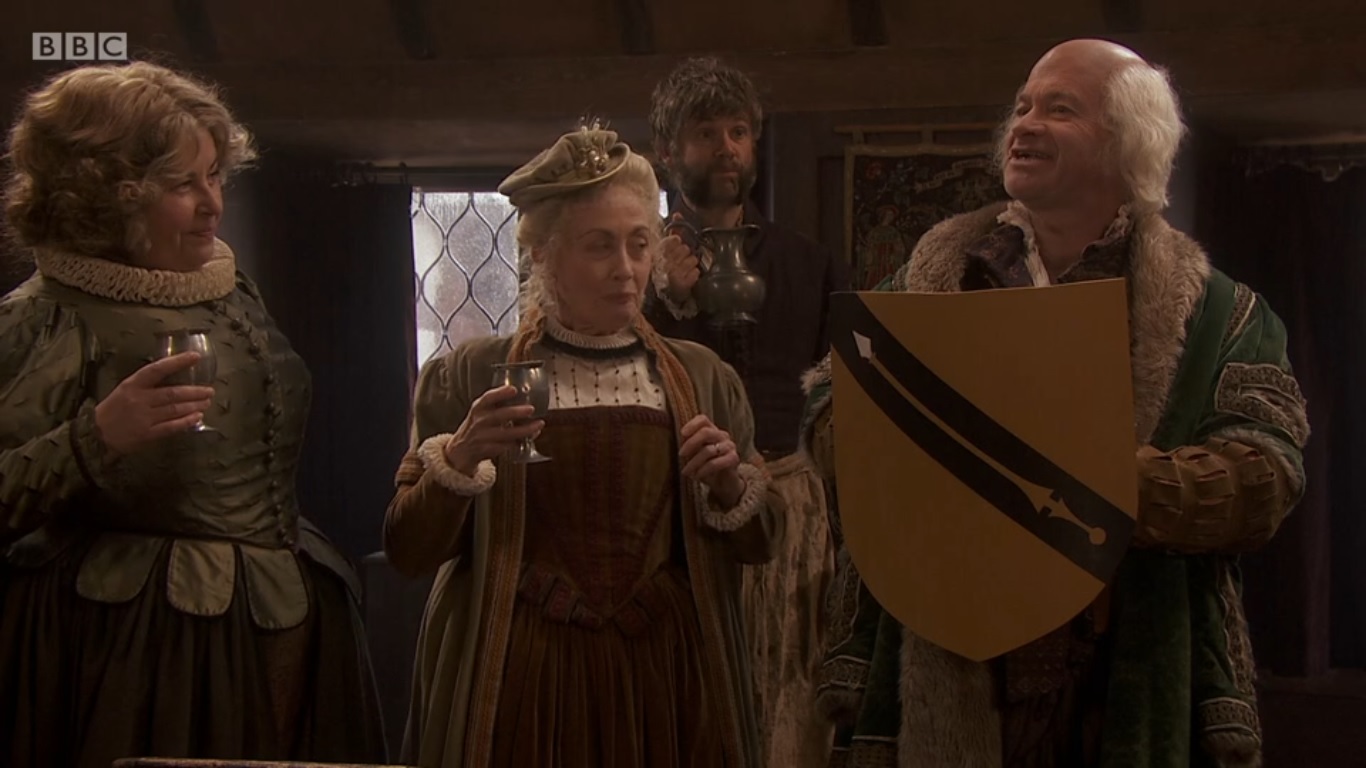
Ben Elton’s BBC sitcom Upstart Crow, covering the life of William Shakespeare (David Mitchell), contains some interesting heraldic treasures. A subplot of the series involves the playwright’s attempt to elevate himself to the gentry with the acquisition of a grant of arms. Robert Greene (Mark Heap), Master of the Revels, seeks to deny him this, viewing the Shakespeares as of insufficiently high birth.
Success comes in the third season, Elizabeth I allegedly having been so impressed by Shakespeare’s latest play that she decreed “Only the son of a gentleman could have writ such wit!” and thus elevated the bard’s father accordingly.
There are other armorial treats, though also causes for confusion: At the theatre where Shakespeare and his troupe are seen rehearsing, there is a large cloth of the royal arms at the time – quarterly France & England – hanging in the background. There appear to be multiple versions of this prop used. On some occasions the arms are depicted in the correct tinctures, on others the field colours are swapped so that the fleur de lis are on gules and the lions on azure. There are other curiosities in that same set, for on either side are other shields which also get swapped out at various points. On the right, in seasons 1 and 2, is a shield resembling that of the Dauphin of France, though again with the background tinctures changed, while those appearing on the left are not those I can identify.
The Queen herself (Emma Thompson) appears at Hampton Court Palace in the 2017 special A Christmas Crow. Behind her is a large, colourful relief of the modern-day royal arms, showing quarterings for Scotland and Ireland but not for France, and featuring a unicorn argent as the sinister supporter. These elements would not be brought together until the union of the crowns, which of course occurred at Elizabeth’s death. The specific iteration shown in this episode, with the motto scroll floating in the air, would belong to the reigns of Victoria, Edward VII, George V, Edward VIII and George VI.
NOTABLE CLIPS
FURTHER READING
 Robin Stanley Taylor
