Discovering the Small Web Movement

What happens when the mines run out?
The Captain announces a new golden age of prosperity. They just fill up again.
What, just like that?
Yeah. Well, you don’t think that’s wrong, do you?
Wrong? It’s an economic miracle. Of course it’s wrong.
Oh. Oh then, of course, the lights change.
What lights?
You know, the lights. The ones on the sky at night. Little points of light.
Do you mean the stars?

Conversation between the Doctor (Tom Baker) and Kimus (David Warwick) in The Pirate Planet (part 2) by Douglas Adams, broadcast 7th October 1978.

Anyone perusing my blog’s back-catalogue recently may recall my post about The Queen’s Reading Room, a post which I named “Reading the Room” in a very weak pun on the topic name. That post now has an update at the bottom clarifying that since I wrote it another podcast has started up which actually is called “Reading the Room”. Of course, it’s such an obvious title that, in this age of mass podcast proliferation, it was bound to be used eventually (and indeed the Substack blog carrying it needs to have “pod” at the end of its subdomain because plain “readingtheroom” was already taken), but this one seems to be rising to prominence among intellectual circles. It almost certainly gets a leg-up due to the fact that both the hosts – Felice Basbøll and Ella Dorn – are columnists for a handful of newspapers and magazines, as likely are a lot of their listeners, so its popularity is not entirely grassroots. Apart from the very broad stroke that they both talk about books, this podcast is entirely unlike the Clarence House production: There are no interviews with the authors, tours of vintage libraries or commissions of research into national literacy statistics. This podcast consists of the two hosts talking among themselves for over an hour at a time about one or more books they’ve read, their choices and the outflowing discussions focusing heavily on philosophy and contemporary socio-political matters. This is not an approach that it would be practical (or constitutionally wise) for Her Majesty to take.

Alright, that’s enough unpaid advertising. The podcast is not the real reason I’m writing this article now. In addition to their newspaper editorials, Basbøll and Dorn both also have individual Substack blogs. Most of what they write there isn’t relevant to this article either, but there was one that particularly struck me as important – Dorn’s post from 27th February this year entitled “How to Take Down Big Tech”. The main thrust was that, for the preservation of online freedom and, more broadly, of enlightened society, it would be better if we avoided large social networks as a general principle in favour of smaller forums and individual websites. She referred to this as “The Small Web Movement”. I have supported the same goals for practically the whole of my online life and have often encountered posts, articles, comments and videos from other people concurring, but only here did I discover that it was an established ideology with a tangible identity.

My history with the World Wide Web is a fought one. For most of the noughties, my family – and most households in the area – had about the connection quality you would expect from rural broadband at that time. Then again, the web itself was still quite primitive. In 2009 out ISP jacked up the price prohibitively high. For the next few years we had no home broadband at all, and internet access was only achievable through a prepaid WiFi plug-in device, which had limited utility. I think it was in 2012 that, having established HubbNet, we finally got a decent connection again. No sooner had I rejoined the online world then I became aware that it was under threat. In the good old days it appeared that, subject only to the physical limitations of their hardware, anyone could have their own website, use any number of online services and upload any number of photographs or videos. It seemed to be, quite literally, a free-for-all. The story of the past decade or so has been the realisation that this utopia was unsustainable. For a long time all of these big sites were running at a loss, heavily subsidised by very wealthy investors who supported the development of these technologies in the hope that they would somehow become massively profitable in the near future. A lot of them still haven’t. As the money dried up and investors started insisting on a tangible return, and even moreso post-pandemic as the long era of ultra-low interest rates finally ended, companies had to make drastic changes to their products to increase revenue and slash costs. Restrictions were placed on space, ads became more aggressive and harder to skip. Pages disappeared behind paywalls and old pictures/videos/files were deleted. The crusade against free riders often became in practice a war on usability. The polite term, though not the common one, for this phenomenon is “Platform Decay”. If the freedom of the web wasn’t under threat from the companies themselves, it was threatened by politicians. Leaders and legislators across many countries, parties and decades have repeatedly sought to take control of the medium that most of them don’t understand in the slightest. This is alternately done in the name of copyright, security and safety. In the New Tens we were threatened with the spectres of SOPA, PIPA, CISPA, ACTA and Article 13. thankfully the most dangerous aspects of these were killed before they could reach the statute book. In the present decade we haven’t been so lucky: I am writing this in the wake of the coming-into-force of the Online Safety Act, a multipartisan disaster passed in 2023 against the objections of everyone with half a brain. Similar laws exist in some parts of the United States and are expected to proliferate across the European Union. However virtuous may have seemed the intentions these laws claimed, they all had the potential to destroy the internet as it has been known for the past thirty years. The deliberations over these laws tend to play out as battles between sovereign states and the major tech businesses, with the common end user having plenty of reason to distrust both. With states concentrating on the most prominent large platforms, and the platform owners themselves often pre-emptively shutting messages which could offend either the government or their advertisers, the need for a decentralised network of small independent backup sites becomes pressing.

The main benefit of having an entire website of your own is that it gives you a greater degree of personal control, especially with regard to visual customisation. Twitter and similar sites give you a profile picture, a couple of sentences’ written biography and maybe a header image if you’re lucky. Long ago YouTube channels allowed you to change the button colours and set a background image, but those abilities were removed around the time they were bought out by Google. Variables, on social media profiles, tend to be restricted within a fairly narrow range. Website builders, by contrast, often allow dozens, maybe hundreds of templates, after which the client has further options for menus, logos, assorted other widgets, fonts and colour schemes. If you’re coding your own website from scratch you can have it look and work basically any way you want. For a physical analogy, imagine a street where each resident can have his own house with its own unique design and decoration, versus a barrack hall where each inmate can, at best, have a different selection of photographs on the backboard behind his pillow. The flipside of this, of course, is that increased proximity allows conversations to happen faster. Short, snappy replies can be given almost in real time, whereas with separate websites they would naturally tend to be longer and more spaced out. Most in and indeed out of the Small Web Movement would consider that a positive, perhaps even the positive, but there are others for whom this spontaneity and intimacy are extremely valuable. There are ways to approximate this, if need be – most website builders include the options for comment sections on posts and pages, as well as a “re-blog” feature. If inter-platform compatibility is an issue, you could always just include a hyperlink to the other person’s post in your own. If that’s too cumbersome… maybe email each other? In my personal experience, I’ve more often witnessed this problem occur the other way around, as Tweeters desperately crush a substantial paragraph of text into a long string of single-sentence posts, or even screenshot the block of text on another medium then upload that as an image. The latter solution has the advantage of speed but it must be monstrously inefficient in terms of accessibility, searchability and digital memory space.

The Movement’s favoured solution is the return to the dedicated online forum. Forums have been around since the earliest days of the World Wide Web, but their power and prominence has waned in latter years with the rise of the social media giants. Reddit, in particular, is designed as a sort of universal mega-forum which subsumes all the others. Forums are a halfway point between personal websites and major social networks, giving people with shared interests a common space without having to invite the whole world in, allowing customisation of design at group level but not individual. Examples of forums which still command some cultural weight are The Student Room, Digital Spy and the notorious Mumsnet. One might throw in the Army Rumour Service as well. There are also lots of smaller forums dedicated to specific hobbies, needs or franchises. Often a long-running film, book, or television series will have a quasi-official fan forum, e.g. Star Trek has Trek BBS, Doctor Who has Outpost Gallifrey and I think I’ve already mentioned Sodor Island Forums. In case I’ve not mentioned already, there are, of course, heraldry forums too.

Fairly it could be said that all of this still falls short of the intention of the Small Web Movement because they still involve using someone else’s platform. The real goal is to have each blogger hosting their own website independently. While I accept the principle of decentralisation, I think expecting everyone to keep individual servers running may be a little beyond feasibility given constraints on money, space, electricity supply and technical knowledge. Indeed, since it has been over a decade since I completed my Information Technology GCSE or had much direct involvement in HubbNet, some of the material I’ve come across from the Movement about Gopher and Gemini is stretching the limits of my own understanding a little, though I hope to get there reasonably soon. Perhaps a compromise could come about in the form of small local data centres, with hosting space rented out in a manner akin to garden allotments. More realistically, since the intention is to transition the masses away from social media accounts, builders such as this would be a relatively easy first step, from which those most determined (and whose sites are successful enough to justify it) can later move the whole way.

I remain undecided on the necessity of registering your own domain rather than using a subdomain of the website builder. I have written before about my disappointment in having to go for “HomeworkDirect.UK” because the Uncle Ben’s rice brand snapped up “HomeworkDirect.Com” just before I could claim it. I always intended this blog to be at “RobinStanleyTaylor.Net”, but did not actually get around to registering the domain until 2017, with “RobinStanleyTaylor.Wordpress.Com” sufficing for the first two years. I cannot run a proper counterfactual to see how the blog would have fared without the change, but I know I was getting at least some regular engagement on the small number of posts I’d made up until that point. I suppose the main value of a domain is on an aesthetic level – it confers an air of formality and professionalism, whereas a “.someonelse.com” looks casual and amateur. A personalised domain also tends to be shorter (what with one of the levels being removed) which makes branding easier. On a practical level, and in keeping with the general thrust of this article, having your own domain allows you to totally replace the website you use without having to give up the URL you’ve already posted everywhere. I took advantage of this in 2022 when I moved Homework Direct to WordPress because Wix put its prices up. On the other hand, renting a domain is itself an expense as well as requiring identification whereas subdomain sites can still be free and anonymous. Of the sites I frequent (on which topic more later), I notice that The Norton View is still on a WordPress subdomain after operating more than fifteen years, as did Murrey and Blue under its original ownership. Of the many Substack blogs I’ve recently encountered, the vast majority have kept it at “.substack.com”, whereas it would be difficult to imagine them all doing the same on WordPress. Perhaps one is considered more prestigious than the other in some way.

As a case study into the importance of having a website and not just a channel, I point to the example of Chuck Sonnenburg, professionally known as SF-Debris. Chuck is a film and television critic of more than seventeen years’ standing, making him one of the seniormost figures in what is now a very large “reviewtainment” industry. He got his start talking about Star Trek: Voyager, then gradually branched out to the rest of the Star Trek franchise, then to other science fiction and fantasy franchises (e.g. Doctor Who and Red Dwarf) as well as whatever miscellaneous films and series his fans suggest for him. He claims to have surpassed the ten thousand video mark some years ago. His journey has rarely been easy. His review videos take the form typical of the genre – ten to fifteen minutes of footage from the episode he’s reviewing, occasionally playing the sound but mostly as a silent montage over which he reads his commentary. Purveyors of this type of content maintain that it falls under Fair Use, but that doesn’t stop IP owners – or indeed the automated systems of the video-hosting services) from blocking videos on the grounds of copyright infringement. Chuck has been around long enough to witness several such piracy purges. For his first few years he used YouTube as his primary platform – only natural as it was and is by far the largest – with a backup channel on Blip.TV. The backup channel was mainly used for long-form videos, as YouTube back then had quite restrictive limits on running time. In 2011, having had a few too many threats from YouTube, Chuck decided to take down hundreds of his own videos before the platform inevitable purged them, then set about making Blip his main platform instead. Rather than simply reupload his old videos in their original form, Chuck decided that a lot of them needed rerecording. He did this alongside still making new reviews, so it took years before all his missing episodes were available again. Almost immediately this effort was rendered worthless because BlipTV completely shut down as a platform. Chuck therefore had to reupload everything again with yet another host. He has joked about this himself, claiming not to remember how many platforms have dropped him over the years. At the time of writing he seems to be using DailyMotion for his “full motion” videos while, ironically, going back to YouTube for lesser versions where he essentially talks over a slideshow of still images instead of moving clips. This alternative format is less engaging to watch but safer from a copyright perspective, as well as almost certainly being easier to edit. Here the point of this [my, not Dorn’s] article comes into play – originally Chuck’s videos were displayed on his YouTube channel and that was likely to be the place where people watched and commented on them. Alongside this, however, he also had a standalone website at sfdebris.com which essentially ran like a blog with each post being titled after the episode or film he was reviewing and consisting of an embed of the corresponding video followed by a short (and snarky) written description. Originally this could have struck some as pointless, but the repeated purges vindicated his approach, for links to his website remain usable long after links to his video channels are killed. When the videos are taken down, the sites pages are left with error messages or even just empty spaces where the embeds used to be, but the page titles, the descriptions and the navigation menus are intact so that the site exists as something of an empty shell. As Chuck proceeds with reuploading on a new video host, the shell is gradually filled in again with the new videos being embedded exactly where the old ones had been. When the reupload process is eventually completed, visitors will find the site looking and working much as it did before. If they notice any difference at all, it will only be that the play button on the video is a different colour – just like the citizens of Zanak noticing the new lights in the sky when the mines are refilled. Nowadays Chuck has the DailyMotion videos unlisted to they cannot be viewed from the hosting site itself, only as embedded on his blog, so that none come to think of the former as his home. Chuck also has a dedicated forum set up to take on the role normally played by the comment section. Again, this helps to maintain long-term continuity, because comments left on the videos themselves would be lost to digital history upon blocks or takedowns. It also has the advantage that the conversations themselves are easier to write and read.

If you’re as much a pessimist as I am you’ve probably already anticipated that if a critical mass of content creators adopted this strategy then the platform owners would cotton on and start forbidding embeds, or at least restricting them in some (probably financial) way to force viewers to use the host sites directly. In this scenario I would hope that creators already using said strategy would be able to vote with their feet by switching to hosts more obliging (unless of course they were to all do it at once). In the interim a simple direct link on the blog page would probably suffice for the same purpose, even if it was less elegant in looks.

Dorn’s article expressed a wish to see people exchanging URLs for websites instead of handles for profiles, so at this point I ought to share some of my own recommendations. Per her advice, I have created a link directory on this website, which can be accessed under the “About” heading in the main menu.

FURTHER READING

My Political Life So Far

Thursday 5th May 2016, © my father.

Sir Keir Starmer’s appointment as Prime Minister, following the general election in which the Labour party won a landslide victory and the Conservatives lost almost everything, leads naturally to recollections of (and generally unfavourable comparisons against) the Blair landslide of May 1997. Many people will cite this as a defining moment in the course of their lives. In particular, many ask “Were you up for Portillo?”.

I wasn’t. I only know this period from documentaries and diaries. I hadn’t quite been born yet.

I think it was around 2003-ish that I remember hearing mentions of the name Tony Blair and the office of Prime Minister for the first time, as well as of George W. Bush as President of the United States. Blair cropped up a few times in fictional television, such as his cameos with the Simpsons and Catherine Tate. Expy versions of him also appeared, most famously in Little Britain, but also the titular “Sinister Prime Minister” in the premiere of M. I. High and in the first revived series of Doctor Who, the latter as a hollowed-out skin suit. That whole two-parter, of course, was a fairly explicit parody of the events leading up to the invasion of Iraq.

When Blair resigned and was succeeded by Gordon Brown there were quite a few skits on television about it. I mentioned it in an ICT lesson that week (the task being the formatting of a newspaper). As far as specific events, the aforementioned Iraq invasion is something I only really learned about years later and I have no contemporary memories at all of 9/11, only learning about it from a documentary in the late noughties discussing conspiracy theories about it, but I was very aware of newspaper and television reports about the “Credit Crunch” and parliamentary expenses scandal as they happened. The bird flu and swine flu pandemics late in that decades were recurrent stories.

I think most of my political knowledge probably came from Jeremy Clarkson, both in the form of his many “World According To” books we’d accumulated at home and to the references he would make on Top Gear, frequently complaining about Blair, Brown and Prescott for their ideology in general and their approach to motoring and environmentalism in particular. Though I recognised Prescott’s name and face I probably did not appreciate that he was Deputy Prime Minister and represented a constituency very close to where I lived – nor that Alan Johnson, Secretary of State for a great many things, was also next door. The series includes quite a few references to (and impressions of) Margaret Thatcher, who was also mentioned in at least one storybook read in school, but it was not until years later that I heard of John Major.

Despite not really being that interested in politics as a subject, I still ended up watching a lot of political comedy – especially Have I Got News For You and Mock the Week. Possibly Russell Howard’s Good News was in there as well.

I dimly followed the 2010 general election, by which time I was in secondary school. I didn’t know or care what the parties were but there were a few others in my year who had already nailed their colours to the mast. Graham Stuart’s campaign posters could be seen at several points along the route of the school bus. I and a friend of mine would count these as we went back and forth. We would also comment “Vote Tory!” upon the disembarking of another pupil, purely because he’d ranted negatively about them beforehand. We kept that up for some years afterwards.

Of course, the 2010 election was not a clean break between Labour and Conservative – it produced a hung parliament, so there ensued a five day hiatus while coalition negotiations went on. David Cameron did not actually get to the lectern outside Number 10 until late Tuesday evening, with Nick Clegg not being named as his deputy until Wednesday and other ministerial appointments completed on Thursday.

Recently I went back through the records to see what I was up to in that week. In theory that should have been easy since I’ve kept all my school books from that time as the source material for Homework Direct. Unfortunately it seems that there are no entries at all for that month, with only one each for April and June. This is likely to be because we were headed towards the end of the year with internal examinations looming so much of our activity at that time would have been centred on revision. I look through my exercise books again is not so revealing:

Food Technology
Nothing at all from this period, it seems.
French
6-13: Some vocabulary tests and a series of answers to textbook exercises. I don’t have the textbook anymore and the test questions were given orally so I don’t really have any contextual detail.
Geography
7-12: The exercise book runs out here and the new one doesn’t start until September. All I found were a crude diagram of the courses in a river showing where erosion takes place and a wordsearch for related key terms.
History
6-13: An analysis of sources on the role of the monasteries in England and Henry VIII’s reasons for dissolving them, then about the wider consequences of the break with Rome.
Latin
6-12: A crossword (although the worksheet bizarrely calls it a “criss-cross puzzle”) translating some vocabulary from Latin into English and a wordsearch vice-versa. A short scene from the textbook translated.
Mathematics
10: A small paragraph of notes about surface areas of cuboids.
Music
Nothing at all from this period, it seems.
Science
10-13: I actually change exercise books on 13th May itself. Lots of worksheets and quizzes about the rock cycle, the three different kinds of rock and the types of weathering to which they can be subjected.

It should be noted that I could not actually find my Religious Studies exercise book. I’m sure I don’t have my English book for that year, as our teacher took them home for marking in February and mysteriously never handed them back. My planner page from that week is little more than a list of textbook chapters.

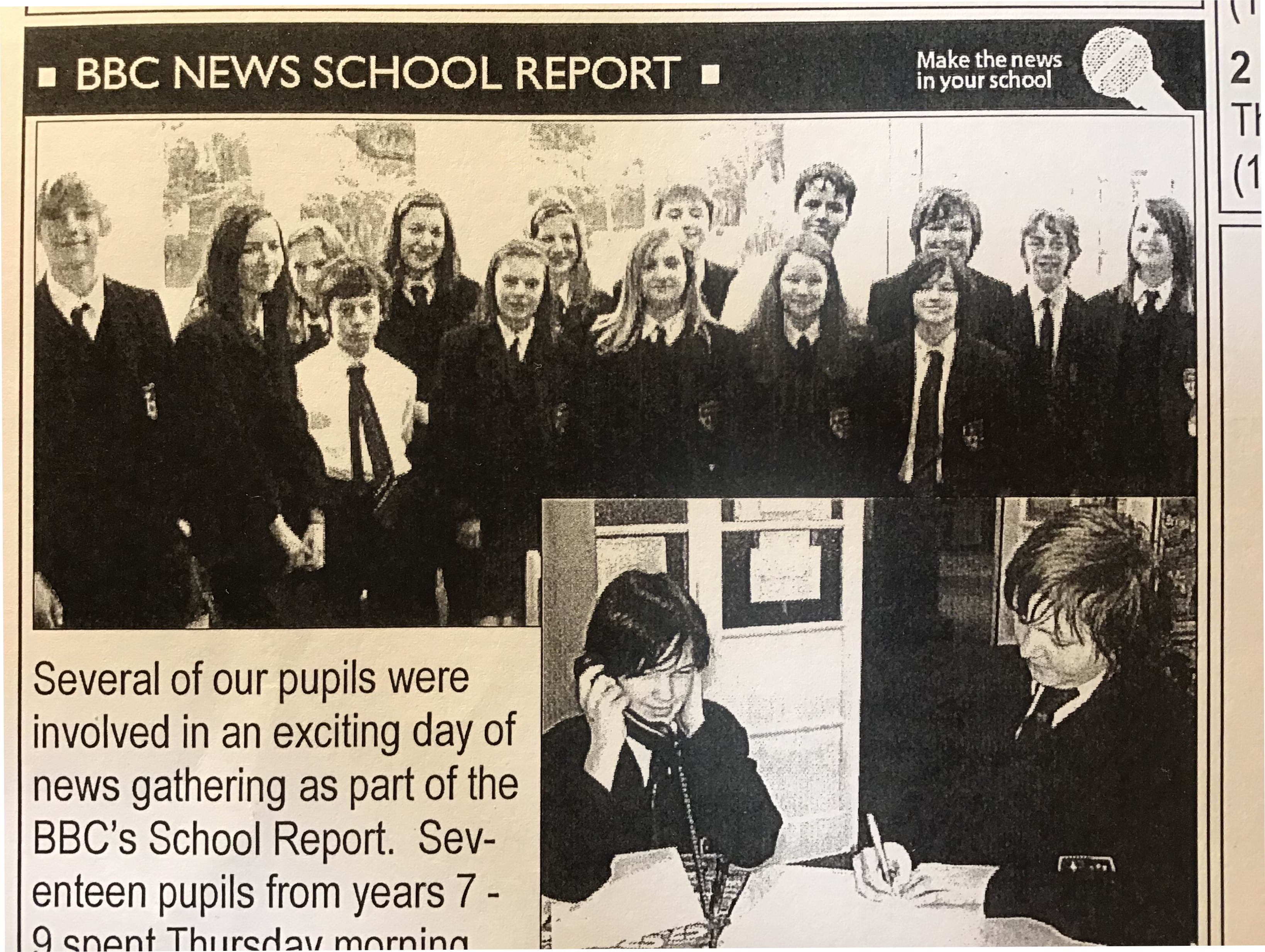
Even so, it is good that I kept so many paper records from this time as the digital trail almost disappears before 2011 (at least until I can hunt down the old memory sticks on which it was saved). Looking through my school’s online records from that time through the Wayback Machine is hopeless due to link rot. I have some surviving copies of the school’s newsletter from that year, but none from the time of the election. The closest edition is the one sent out on 15th March, on the back of which is a group photograph from BBC School Report 2010 (not to be confused with BBC School Report 2011, which actually got me on television).

It’s a shame I couldn’t straighten my tie. From the poor quality of this photograph you might well think this came from a much earlier era than it really did.

For most of the period of 2010-11 I followed American politics more closely than British, mainly through the YouTube extracts of Real Time with Bill Maher. American issues, and some that were international, came to me indirectly – a lot of my favourite reviewtainment channels were facing constant blocks and deletions due to copyright policy, and this was the age of PIPA and SOPA (later followed by CISPA and ACTA) which threatened the whole existence of such a hobby, as well as online freedom more generally.

2012 had the big British events of the Diamond Jubilee and the London Olympics, followed by the Obama-v-Romney election in the states. Late in that year I started the GCSE course on Russia & the Cold War which was the first time I had studied recent(-ish) politics in detail. As Bolshevism and its fallout continues to cast shadows on world affairs even today, naturally this was a segue into a great many other adjacent topics. Not only did I carry my reading forward to the end of the twentieth century and into the twenty-first to see the lingering effects of e.g. the Russian Revolution and the Word Wars, I also went backwards to the eighteenth and nineteenth to find their roots. I also discovered the Russia Today channel at this time. It was of course in RT’s interests to look for and present stories (not always true) that Western media would avoid. Obviously it was during this time that I had my first experience reading Orwell.

By 2013 this had led me back around to the politics and government of the United Kingdom. I followed contemporary stories as they came out and filled myself in on what I’d earlier missed using whatever documentaries I could find. Sacrilegious as this may be to some, you really can teach yourself a lot just by reading (and later writing) the relevant Wikipedia pages.

This all happened during the tenure of the Cameron-Clegg coalition, explicitly not a normal time in politics (not that “normal” ever truly exists, of course). Cameron is therefore “my” prime minister in that sense, though I was not eligible to actually vote for or against him during that time. The 2015 general election was the first one that I watched live.

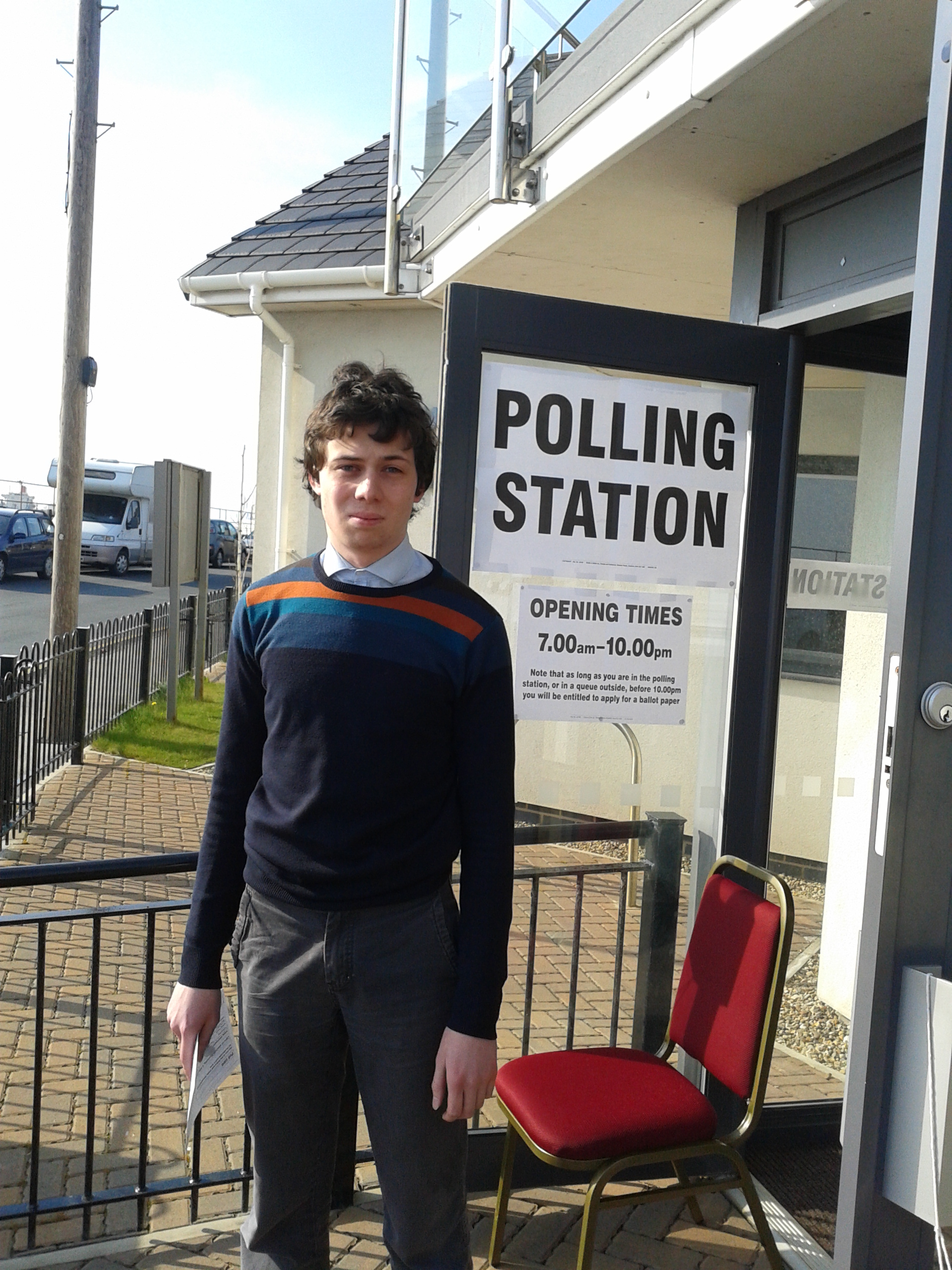
My first actual ballot cast, as pictured above, was for Humberside Police & Crime Commissioner (not otherwise that important), followed swiftly by the EU referendum. At that point the story might as well end, for it was during Cameron’s second term that this very blog got going, and thus memory lane merges back into the main road.

Last year (around 20th May) the Conservatives from Cameron onwards passed the point where they had been in power for longer than New Labour. Slightly ahead of that they passed the point of having been in power for more than half my life.

The purpose of this exercise is to recall what I was up to the last time the Labour party governed Britain, to determine what parts of my life already came about before Brown’s resignation and what would come after.

Much of the comparison is not really a political comparison of Labour vs Conservative but more a cultural comparison of the noughties vs the new tens. As aforesaid, the first red years included Top Gear up to Series 15, as well as the first five series of revived Doctor Who (with The Vampires of Venice airing during the post-election negotiation period and Amy’s Choice being the first under Cameron). They also involved all three films of The Lord of the Rings, plus all seven Harry Potter books and the first six film adaptations. The blue years included The Hobbit trilogy and an explosion of new Star Trek spinoffs. Charlie Brooker’s Screenwipe and Newswipe came before the switch with Weekly Wipe coming after. 8 Out of 10 Cats dates back to 2005 but ‘Does Countdown only to 2012. David Starkey’s Monarchy series (as well as many smaller documentaries about the Tudors) came in the noughties whereas Lucy Worsley started in the tens. Peep Show skews to the Labour end and is strongly associated with that era. That Mitchell and Webb Sound and Look had four seasons each made under New Labour, while John Finnemore’s Souvenir Programme exclusively exists under the Conservatives. This isn’t a perfect guide, though, since many of the programmes made in the former period are ones I didn’t actually watch until the latter. I’m also fudging the lines a bit for series whose production and broadcast dates fall either side of the border.

On a personal level Conservative government has been a constant throughout adolescent and adult life while Labour had the whole of my childhood. I’m obviously not in the same frame of body or mind now as in 2010, and I’ll be following Starmer’s government in real time in a way that I didn’t for Brown or Blair. There are some psychological tricks at play here – if, during the 2010-24 period, you recalled something that happened during the Thatcher-Major years, it would be easy to feel on some level that there was continuity in the partisan situation and forget that the Labour government interrupted it. Conversely, it might now be possible to think back to 1997-2010 and forget about Cameron-Sunak. This is especially the case if policies, styles of government and indeed people are carried over and political situations from long ago are restored, which is often the case. For some people it may be like finding the last decade was all a dream, for others the nightmare is just beginning.

Time to sleep… or are you waking up?

Yet More Podcasts

Some months ago I discovered a weekly podcast entitled The Benji & Nick Show. It mainly reviews old Doctor Who, but also branches out into lots of other old television. The hosts are Nicholas Briggs (voice of the Daleks) and Benji Clifford (of 5WF fame, later sound designer for Big Finish). They speak in a candid but reasoned manner about a wide range of media. Sadly, they announced some weeks ago that their series will come to an end in September.

Still going is The Delta Flyers, which started last spring but which I only discovered a week ago. It is an episode-by-episode commentary on Star Trek: Voyager by two of its principal cast – Robert Duncan McNeil (Lieutenant Tom Paris) and Garrett Wang (Ensign Harry Kim). Their discussions include personal recollections from the time as well as insights from their later careers. There’s even a bit of poetry thrown in. Currently they have just finished the third season, which means with one episode per week they should finish exactly two years from now.

A Decade Since Doomsday

Few analyses of the revived series of Doctor Who, much less the David Tennant era specifically, could be complete without this. It is easy to remember the moment where a new trend, a new idea or a new meme begins but often very difficult to pinpoint the moment at which it ends. Can we really know exactly when the Harlem Shake died off (or the Ice-Bucket challenge for that matter). We are often quick to notice when a new character or personality enters the public consciousness, but do not notice when they have gone, for we are already concentrated on the successors who eclipsed them. This is particularly noteworthy when you look at the quick stream of events in the weeks since the EU referendum – just look at the news coverage on Wednesday 22nd June and compare it to today’s to see how quickly events can move. Sometimes, however, a certain person or event, a certain character does have a lasting presence long after their departure. For the purpose of this article I am talking about Rose Tyler.

It would be wrong to suggest that Rose is universally considered the greatest companion in the franchise, nor even a contender – indeed many fans of the program are keen to express their dislike, even contempt for her. Nevertheless her position within the timeline of Doctor Who means that she cannot be easily forgotten. The very first episode was named after her, with the opening sequence being a catalogue of her existence. The Doctor himself does not appear until quite a long way in. It is also noteworthy that her companionship was structured very differently to that of her predecessors. Whereas most companions would leave their old lives behind to travel with the Doctor, departing from the TARDIS just as abruptly, Rose had a whole family in the supporting cast to which she would return every few episodes. There was no precedent for this from the classic series – except perhaps the UNIT crew, but that was a more professional relationship.

Ian and Barbara left Coal Hill in An Unearthly Child and did not return for another two years, after which they never featured in the series again. Ben and Polly left the TARDIS when they arrived back at their starting point by coincidence. Jamie and Zoe were unceremoniously plonked back in their homelands with no memory of their other adventures. Romana and K-9 II were abandoned in E-Space. Nyssa stayed behind at Terminus, Traken having been destroyed. The only companion who returned to mundane life before travelling again was Tegan, and even that was a one-off stunt. Furthermore, the appearance of a boyfriend usually only occurred at the end of each’s tenure as a way of detaching them from the Doctor – Susan with David, Jo with Clifford, Leela with Andred. Such pairings usually developed within a single serial and had little narrative foundation.

IanBarbaraRealPoliceBox

Ian & Barbara were perhaps the best-developed couple of the Classic Series.

The revival, however, changed all of this. Partly this was a matter of necessity. Russell T. Davies began his quest to bring back the series in 2003, in an environment where few remembered how to execute a science fiction series. The new program therefore had to be redesigned for an audience used to soaps and reality shows. To some extent this was referenced by the characters themselves – the Doctor said he didn’t do domestic.

Odd as it may have been, though, this model stuck with Doctor Who for several years: Martha Jones had regular encounters with her siblings and parents, and they even had her mother repeat the face-slap made famous by Jackie two years prior. In many ways it seemed like a conscious retread. In Gridlock, Martha commented “You’re taking me to the same places you took Rose.” with a muttering of “Rebound”. Indeed, much of Series 3 saw Martha being compared to Rose and a conscious retreading of the previous two years’ themes. Donna Noble likewise had a family, though they were structured differently – her mother Sylvia and her father Wilfred were used for comic relief more than for drama, though Wilfred later became a companion in his own right. The late Geoff Noble was also made something of a legacy character.

ClarasDinner

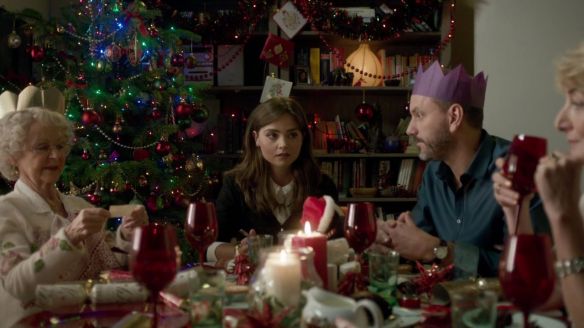
The less than memorable family of Clara Oswald, Christmas 2013.

Into the Moffat era, the companion family largely disappeared as an integral part of the story, but a vestigial presence remained. Amy Pond’s parents were absent for most of Series 5, having been erased from time. Their emergence in The Big Bang was a sign of sanity returned to the universe, though afterwards they never actually appeared afterwards. Brian Williams, however, played a prominent role towards the end of the Ponds’ tenure. Clara’s family had only one outing as a minor sub-plot in The Time of the Doctor, but her parents’ history had earlier been an important feature of her character arc. While the Oswalds had nothing like the narrative significance of the Tylers, it is notable that their block of flats was filmed somewhere that strongly resembled the Powell Estate. Even eight years, two Doctors and four sets of companions after the revival, Rose’s shadow still fell, however faintly, over her successors.

Were it insufficient for Rose’s archetype to continue shaping the series long after her departure, there is still the matter of Rose herself never quite going away. From the moment that Series 2 concluded, there was always speculation that the character would eventually return. There were hints and nods in Series 3, but by the time of Series 4 it was a certainty. The premiere, Partners in Crime, featured Rose in person, quietly disappearing in a cloud of mystery. Her face briefly flashed on screen in The Poison Sky and Midnight before she fully emerged in the finale. After a second farewell scene (again on Bad Wolf Bay) it appeared that her character was finally finished, her ghost having haunted the franchise for what then constituted more than half of its existence. Even so, there was still time for yet another goodbye in The End of Time, though this time with an earlier version prior to her début.

A shot from The Day of the Doctor (2013). Bad Wolf Girl, with glowing yellow eyes, stares at the camera from inside the barn.

Billie Piper as “Bad Wolf Girl”

When Billie Piper returned for the golden anniversary special The Day of the Doctor it was significant that she did not quite play Rose Tyler again. Instead she had the role of “Bad Wolf Girl”, a manifestation of galaxy-eating superweapon “The Moment”. She was visible only to John Hurt’s character, the War Doctor, with David Tennant’s never actually interacting with her. Evidently the producers wanted to avoid playing out her tearful departure a third time. Even so, it was in itself rather odd to find that Piper had returned as a nostalgic reference, rather than as an active incumbent. This, more than anything else, was the solid confirmation that the Rose era had actually concluded and would not be revived.

The legacy of Doomsday is not the long-awaited battle between the Daleks and the Cybermen, nor the introduction of the Torchwood Institute or even the first glimpse of Donna Noble but the departure of Rose Tyler as a regular companion. In particular, the episode is remembered for the closing dialogue on the Norwegian beach of Pete’s World and the Doctor’s abruptly-terminated “Rose Tyler…” before his final loss of contact. The viewer never learned what the end of this sentence would have been, but hints can be found in the commentary, where the executive producers had the following exchange:

Russell T Davies: “Rose Tyler, I owe you ten pence.”

Julie Gardner: “He was going to tell her he loved her. I will not have it any other way.”