Another lecture from the Church Monuments Society, given by Dr William Roulston.

Another lecture from the Church Monuments Society, given by Dr William Roulston.
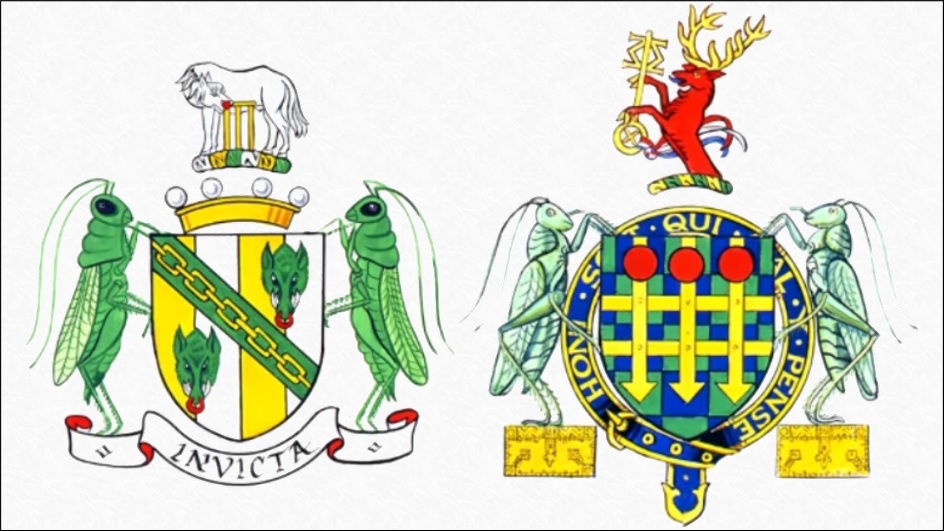
Armorial achievements of the Lord Cowdrey of Tonbridge (left) and Sir John Major (right)
Having exhausted what I could glean from the available editions of Burke’s and Debrett’s, I am ever on the lookout for new material on heraldry. Last week the College of Arms published its latest newsletter (which now regrettably appears only to print in October and January), but as usual the actual exemplifications of new armorial bearings were few.
I was delighted yesterday to discover this lecture on the development of English heraldry, given by the Somerset Herald David White in 2014. It is far from the only heraldry-related lecture video I have encountered online. Unfortunately I commonly find that the piece rarely goes beyond the basics of armorial composition and a brief overview of medieval chivalry, thus not telling me much beyond what I knew already – indeed it’s probable that the people making them are reliant on the same online and/or public domain resources that I am. This was not one of those, for it went beyond the Middle Ages to cover modern heraldry and much in between.
White’s lecture studied the artistic phases of heraldry, from the very simple designs of the medieval period to the more crowded ones of the early Tudors – when the nouveau riche were acquiring arms to display where they could be studied up close instead of glimpsed in motion – followed by a deliberate return to simplicity in the later Tudor and Stuart eras. There was a section on the infamous “landscape” and “seascape” heraldry of the Georgian years, with particular emphasis on Horatio Nelson, whose absurdly augmented escutcheon is often considered the nadir of the art. The Victorian era is not discussed in as much detail, save for a vague assertion that they went back to earlier styles as a result of the blossoming Gothic revival. Along the way he gave examples of families assuming arms and then later trying to get similar ones granted, or appropriating those of namesakes who were not actually related. The relative popularity of certain charges was also shown, with an ordinary or arms from the mid-1500s showing that already by then there were dozens of pages of lions (indeed a double-page spread shows thirty-two separate shields just with white lions on a red backdrop). White said that in modern times “one’s heart sinks” if a new applicant for arms requests a lion be included due to the difficulty of inventing an original design. He also speculated that the utility of heraldry as a system of identification might have been undermined by the preponderance of so many near-identical blazons.
Near the end of the lecture he showed some examples of reasonably recent grants of arms. Of particular interest was that of the cricket-player Colin Cowdrey, who was ennobled by John Major in 1997. His shield has a paly of four defaced by a bend dexter, representing the tallying of points. His crest had a set of wickets nosed by the white horse of Kent. Just to quash any remaining uncertainty, he also had crickets as supporters. Major himself became entitled to supporters upon his appointment as a Knight of the Garter in 2005. He too wished to have crickets, but was required to distinguish them from Cowdrey’s and so had them stand upon despatch boxes. Heraldry, of course, has no sense of scale. White called it a “slightly depressing thing” that the portcullis symbol was increasingly used on the shields of retired politicians to represent their profession.
The lecture I found was part of a collection of public lectures archived online by Newcastle University. The range of topics is as wide as you would find at Gresham, so well worth checking out.
UPDATE (March 2026)
White’s lecture can no longer be viewed directly from the link I originally posted as the university has deleted it from their website, but a record of it can be found on the Wayback Machine. For the Panopto recording itself the link within the crawled page does not work either, but miraculously the video is still accessible, and I’ve made sure to archive that as well.
I think I left the oven on.
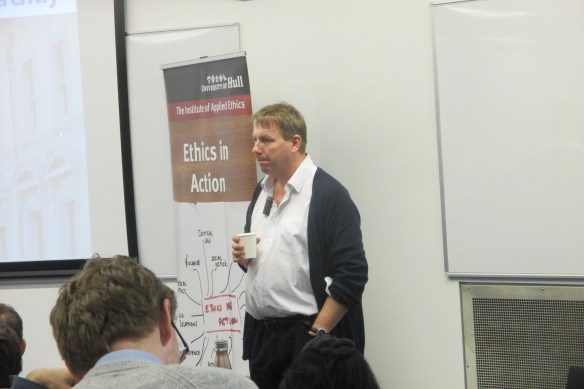
The Institute of Applied Ethics is a subdivision of the School of Histories, Languages and Cultural Research. Tonight it put on a talk by Professor Danny Dorling of St Peter’s College, Oxford. He came to show us his statistical research into the demography of the EU referendum two years ago and the history of Britain’s political consciousness. He also plugged his upcoming book Rule Britannia: Brexit and the End of Empire, written in collaboration with Professor Sally Tomlinson. The event started late, as there had been an unexpectedly large audience signing up and so the venue had been changed at late notice.
The director of the institute, Professor James Connelly, introduced Dorling as a forefront thinker on the left. From this alone one could probably guess the general theme of the presentation and indeed Dorling himself gave a similar “warning” by starting with a slideshow of graphics used in his book – many of them relating to the British Empire and immigration.
Dorling attempted to counter some of the conventional wisdom which has emerged during the last few years concerning the circumstances of Britain’s withdrawal. In particular he drew our attention to a common assertion that people in deprived areas were more likely to vote Leave and those in wealthy areas to vote Remain. He said that, under statistical analysis, the correlation between deprivation and Euroscepticism was only 3%, whereas an 80% correlation could be found for obesity (not because Leave voters themselves were necessarily overweight, but because Remain-voting districts had higher concentrations of disproportionately slim foreigners). Dorling speculated as to why the referendum result had been misrepresented this way, and ultimately suggested that the affluent leave-voting districts in the home counties included the parents of prominent television and newspaper journalists who – being based in cosmopolitan, Remain-voting London – decided to pin the referendum outcome on supposed northern backwaters instead.
The speaker also asserted that widespread Eurosceptic sentiment in Britain was a fairly recent phenomenon whipped up by certain self-interested media outlets. He displayed some very complicated graphs to show that the European Union had been a fairly low priority on most voters’ minds for most of the last decade.
For the bulk of his speech, Dorling emphasised the difference in political culture between the United Kingdom and the rest of the member states. He stated that, contrary to perceptions of fascism engulfing the continent, it was actually Britain which most supported the far right. Sensing that the audience’s doubt of his bold assertion, he explained that the Conservative MEPs had, in late 2009, broken away from the European People’s Party group to form the European Conservatives & Reformists group, which lay to the political right. In the 2014 election UKIP, which was in the group Europe of Freedom & Democracy, won 26.6% of the British vote and returned 24 members. The Conservatives won 23.1% and 19 members. The British National Party, the English Democrats and Britain First also contested the election, failing to win any seats but collectively garnering about 2% of the vote. From this Professor Dorling concluded that Britain, uniquely among members states, had given the majority of its votes and seats to far right parties. This analysis has some obvious shortcomings – it relies on defining “Far Right” in the most technical and elementary sense rather than the way most observers would understand it – but it does go to show that the political atmosphere in this country is very different to that in those it neighbours.
The rest of the talk followed much of the path that one would expect a presentation by a left-wing Europhile to take: Dorling expounded on the unusual level of economic inequality in Britain and suggested that the Leave vote was built on the public’s misdirected anger at social immobility. He noted that the protest vote against immigration was highest in areas with very few immigrants, implying that many Brexiters’ perceptions were based on racist hearsay rather than real experience.He also speculated on the role of education decades back, with references to old textbooks which explained Britain’s history in a manner politically correct for the pre-war era but less than palatable now, suggesting that older voters still harboured under delusions of imperial entitlement. As expected, our speaker took a swipe at private schools and elite universities, saying that they were designed to churn out an empire-ruling establishment. He disparaged the interview system for Oxford and Cambridge on the grounds that they allowed the personal biases of the interviewers to override a candidate’s objective merits. He even postulated that well-qualified applicants were turned down for being too fat.

Surely I wasn’t declined on that basis?
The talk wound up with a question and answer session. An audience member asked Professor Dorling to predict the next few years in British politics. Dorling suggested that Theresa May would step down before the next general election, with the plausible excuse of failing health, and hand the leadership to someone untainted by the departure process. He also hoped that Jeremy Corbyn would suffer a convenient stroke at some point and be replaced by a younger female (he didn’t much care which) who would then go on to head up a coalition with the Scottish National Party.
The microphone came my way for the final question. I asked if the professor thought that the much-decried London-centrism of Britain’s media and journalism had contributed to widescale misperceptions of the country’s demography. He didn’t quite answer my main query, but said it was a tragedy that the Guardian had left Manchester, and recommended that the capital be relocated somewhere near the Birmingham intersection of High Speed 2 so that the existing architecture could be opened up for tourism – an industry which he predicted to boom in the coming years as foreigners took advantage of the inevitable falling of the Pound Sterling.
FURTHER READING
 Robin Stanley Taylor