Human Rights – Where Are We Going

P1030101

Yesterday, as I walked out of the lecture theatre where Mr Bond had given his Polymath talk, I noticed a monochrome A4 poster pinned to a notice board on the opposite wall which bore the face of The Right Honourable Dominic Grieve QC MP, the former Attorney General for England & Wales. I was startled to see that his present was scheduled to occur less than 24 hours after the one which I had just left.

This evening, as the sweltering heat of the afternoon had begun to subside, I arrived at the Esk building. Being a mathematics student, I lacked much in the way of prior experience with that part of the campus and for some minutes I thought I might be lost. I was reassured that I had reached the correct venue by the appearance of a wine table just outside the lecture theatre flanked by several men in dark suits (among them Professor Norton). I shambled in believing myself to be late, but in fact our right honourable and learned guest was himself delayed by almost thirty minutes due to faulty railway signals between London and Doncaster.

Though Mr Grieve was invited and advertised primarily for his legal experience, he chose on this occasion to speak in his capacity as a politician. His speech covered the ups and downs of the relationship between the British political scene and the concept of Human Rights.

In recent years the Conservative Party has pushed to replace the Human Rights Act 1998 with a British Bill of Rights, mainly with the intention of disentangling British courts from those in Strasbourg. Theresa May has even been known to say that leaving the European Convention on Human Rights is more important than leaving the European Union. Grieve confessed that he would struggle to maintain an impartial stance on this issue, his own career as Attorney General having ended because of it.

The ECHR was promoted in the immediate post-war years by Sir David Maxwell-Fyfe (later known as Lord Kilmuir). In 1951 the United Kingdom became the first country to ratify the convention. Controversy came and went over the years, with tensions notably emerging under New Labour who, Grieves said, made much of the promotion of Human Rights legislation but did little to confer any national character upon it.

In the latter half of the noughties, the Conservative Party began planning for major changes to our human rights legislation. Michael Howard in particular was hostile to the Human Rights Act, and David Cameron leaned in that direction for – leading towards the 2010 general election – he was trying to form an alliance with News International, who did not much care for the expansion of privacy law. Grieve, Shadow Secretary of State for Justice, produced reform proposals in late 2009.

In the next section of his speech, our guest explained how, despite their partisans’ decade of obsession, Conservative governments have struggled to make any noteworthy progress in separating British courts from those on the continent. The First Cameron Ministry (sometimes known as ConDem) made considerable noise, but no action could actually be taken without the cooperation of the Liberal Democrats, who – being ardent Europhiles – naturally refused to give any.

It became very quickly apparent through the speech that Mr Grieve considered the British Bill of Rights to be an exercise in pointlessness. He noted that only 16% of polled voters showed any interest in repealing the HRA and said that the government was struggling against the reality of the convention’s benefits, apparently oblivious to the destructive influence of the UK’s non-adherence – such as Russia’s using Britain’s attitude as justification for its own non-implementation – or to the positives when we do confirm – such as the improvements in Jordanian law following the Abu Qatada case.

Our guest closed  his presentation by criticizing some of his Conservative colleagues for pursuing a mythologized view of parliamentary supremacy which bore little if any resemblance to constitutional reality.

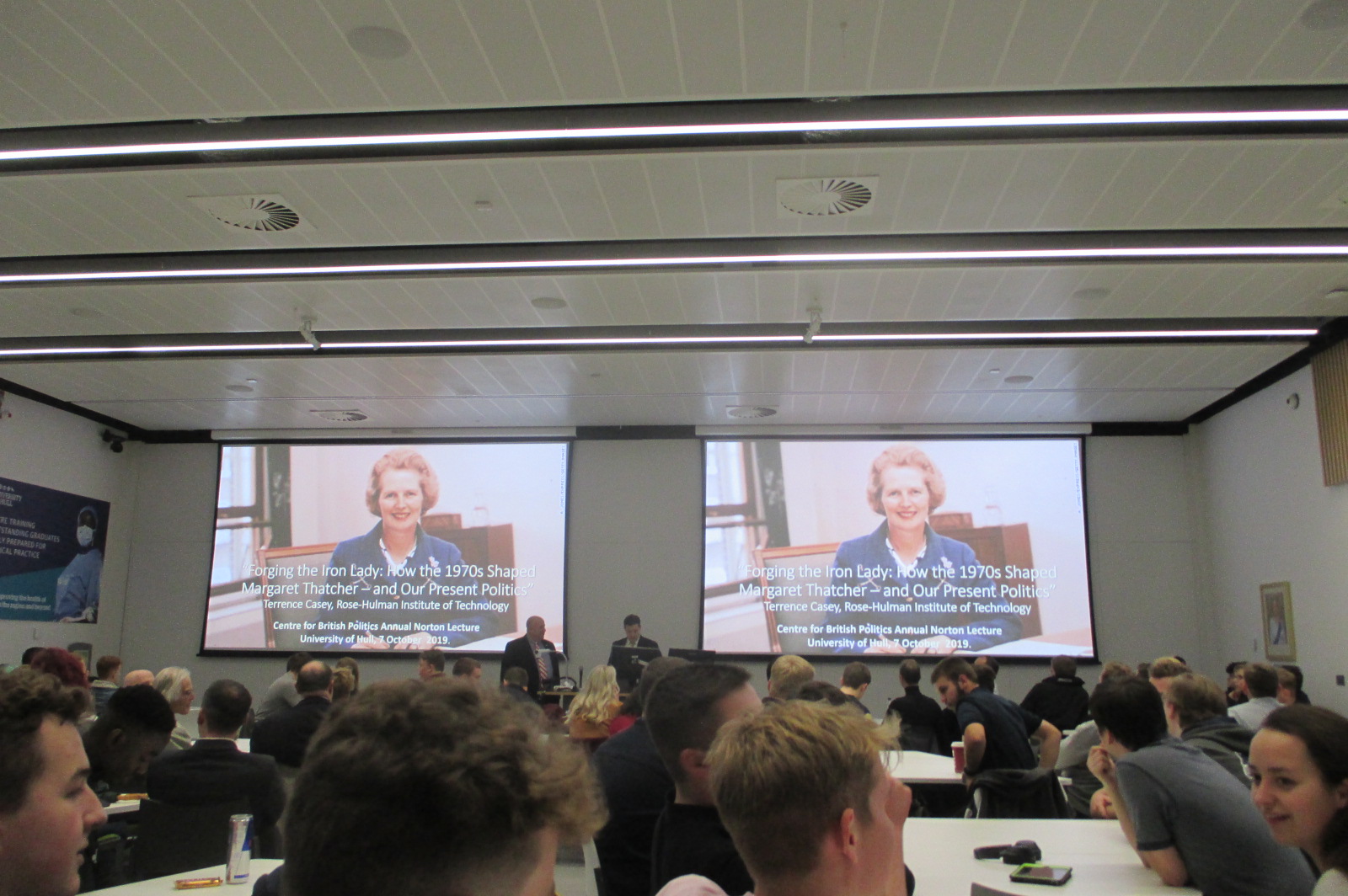
Due to the delayed start, many attendants had already filed out before the question & answer session could proceed.  The organizers were keen to wrap up the event swiftly so that the promise of wine could be fulfilled.

P1030102

This is probably not the kind of party that most students have on campus.

As a non-drinker, and having given up my dinnertime to attend this, I was more than a little disappointed at the absence of the usual buffet nibbles. Even so, this was a small price for making Dominic Grieve the twelfth name on my notables list.

FURTHER READING


First Time Meeting Philip Norton

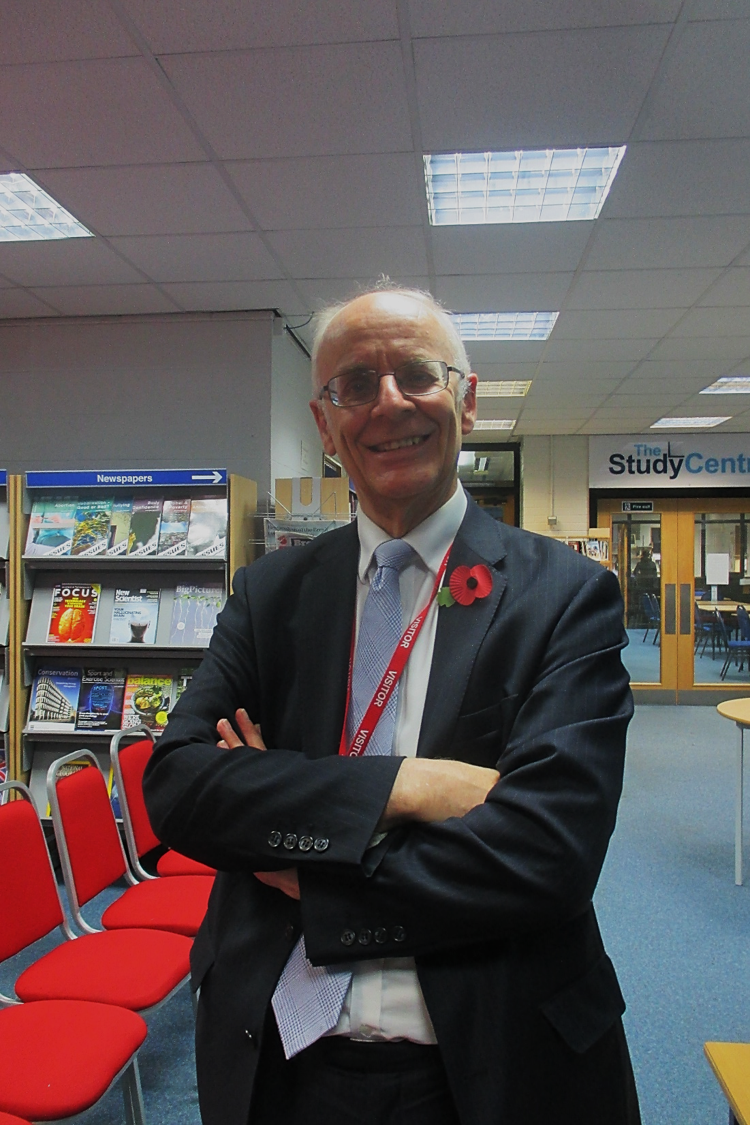
A modern library - a bald man stands before a crowd of adolescents.

Our visitor before his crowd.

So far in my time at Wilberforce College I have met two Labour MPs (Diana Johnson and Alan Johnson), one UKIP MEP (Mike Hookem) and an archbishop (Dr John Sentamu). Today the college welcomed Professor Philip Norton, who was both the first Lord Temporal and the first Conservative.

When told at a council meeting two weeks ago of his pending visit I imagined it would be a round-table discussion in the conference room similar to that with Mrs Johnson. Instead his lordship’s appearance bore more in common with that of Sentamu eight months prior, as a hoard of student delegations from various classes (I recall Sociology and Law being singled out) filled out the library to watch his presentation. Whereas for the archbishop’s visit I had been at the edge of the front row, on this occasion I was almost directly in front of our guest, and indeed may have caught some of his saliva at various points in the speech.

His lordship began by asking us all “What Is Politics?” and taking shows of hands from the audience on various contentious political issues. There were majorities in favour of same-sex marriage, assisted dying, and EVEL. Prison suffrage was rather less popular. That done, Norton moved on to explain the role of Parliament in making laws and regulating Her Majesty’s Government. He told us of the work done by the House of Lords in reviewing legislation at great length and in fine detail which the Commons would not have had the capability to manage. He also talked of the value brought to the chamber by the ennoblement of certain surgeons and medical professionals (he brought up The Lord Winston as an example he hoped we would recognize*) and recounted the tale of the Human Fertilisation and Embryology debate in 2007, during which The Lord Brennan collapsed shortly after giving his speech. Norton said that this was the best time and place to do so, as there were numerous leading medical professionals (including the minister leading the debate, The Lord Darzi of Denham) able to rush to his aid.

Once the formal presentation had concluded, Professor Norton held a brief question and answer session. One of my ex-classmates from the history department asked if it was a source of frustration to know that a measure not to his liking was going to pass through parliament. The peer replied that it was a natural part of a parliamentary career, but it at least was not as bad as in the Commons where a member not of the majority party is practically powerless in terms of major legislation. I then asked if, in light of the recent High Court ruling, he believed there was a strong chance of his noble friends and colleagues ultimately blocking Britain’s exit from the European Union. He replied that although the house would certainly subject the decision to a heavy level of scrutiny and criticism, there was little chance of them blocking the move outright. The professor went so far as to suggest that the House of Commons might even resort to the use of the Parliament Acts to ensure that the result of the referendum was implemented.

A bald man in a suit with a poppy and lanyard smiles while crossing his arms.

Sadly my camera found more light in the background than on his lordship’s face.

As the meeting drew to a close and students filed out of the library, I convinced his lordship to pose for a photograph, so that his Wikipedia page could have a profile picture – which it and many others currently lack due to the difficulty of finding public domain images. Now that I have obtained such an image, I can ensure that today’s meeting will have some significance in Norton’s public image.

*I had previously seen Professor Winston at GCSE Science Live in January 2013, but I hesitate to claim I met him given that the enormous lecture hall allowed a substantial chasm between his podium and my upper-gallery seat.

UPDATE (December 2016)

Katherine Oldershaw, the staff member in charge of the student council, requested that I write a report on Norton’s visit in my capacity as secretary. That report was later published in the college’s internal magazine. Through a chain of emails (with so many forwards and replies that it resembled an archaeological dig) I learned that Katherine had passed it on to business liaison manager Clare Shaw, who in turn sent it to Gina Page, assistant private secretary at the Lord Speaker’s office. Miss Page arranged for me to be sent a stack of information booklets from the Palace of Westminster. I wonder what I’d have to write to get a free Bertie sent to me?

UPDATE (April 2018)

My photograph has been made redundant as the Parliamentary Digital Service has released several hundred new free-licence portraits of members of the House of Lords by Chris McAndrew, who did the same for MPs just after the 2017 general election. As of posting, my illustration of the noble lord’s shield of arms is still there.

UPDATE (December 2019)

I have changed the post title from “Meeting Philip Norton FRSA” to “First Time Meeting Philip Norton” and added the tag “Norton of Louth”. When I originally made this post I expected that the presentation would be a one-off event. Since I matriculated at the University of Hull I have found myself attending quite a few events involving the professor and thus have decided that, in retrospect, this post is better viewed as the prelude to a series instead of a standalone occasion.