
Few analyses of the revived series of Doctor Who, much less the David Tennant era specifically, could be complete without this. It is easy to remember the moment where a new trend, a new idea or a new meme begins but often very difficult to pinpoint the moment at which it ends. Can we really know exactly when the Harlem Shake died off (or the Ice-Bucket challenge for that matter). We are often quick to notice when a new character or personality enters the public consciousness, but do not notice when they have gone, for we are already concentrated on the successors who eclipsed them. This is particularly noteworthy when you look at the quick stream of events in the weeks since the EU referendum – just look at the news coverage on Wednesday 22nd June and compare it to today’s to see how quickly events can move. Sometimes, however, a certain person or event, a certain character does have a lasting presence long after their departure. For the purpose of this article I am talking about Rose Tyler.
It would be wrong to suggest that Rose is universally considered the greatest companion in the franchise, nor even a contender – indeed many fans of the program are keen to express their dislike, even contempt for her. Nevertheless her position within the timeline of Doctor Who means that she cannot be easily forgotten. The very first episode was named after her, with the opening sequence being a catalogue of her existence. The Doctor himself does not appear until quite a long way in. It is also noteworthy that her companionship was structured very differently to that of her predecessors. Whereas most companions would leave their old lives behind to travel with the Doctor, departing from the TARDIS just as abruptly, Rose had a whole family in the supporting cast to which she would return every few episodes. There was no precedent for this from the classic series – except perhaps the UNIT crew, but that was a more professional relationship.
Ian and Barbara left Coal Hill in An Unearthly Child and did not return for another two years, after which they never featured in the series again. Ben and Polly left the TARDIS when they arrived back at their starting point by coincidence. Jamie and Zoe were unceremoniously plonked back in their homelands with no memory of their other adventures. Romana and K-9 II were abandoned in E-Space. Nyssa stayed behind at Terminus, Traken having been destroyed. The only companion who returned to mundane life before travelling again was Tegan, and even that was a one-off stunt. Furthermore, the appearance of a boyfriend usually only occurred at the end of each’s tenure as a way of detaching them from the Doctor – Susan with David, Jo with Clifford, Leela with Andred. Such pairings usually developed within a single serial and had little narrative foundation.
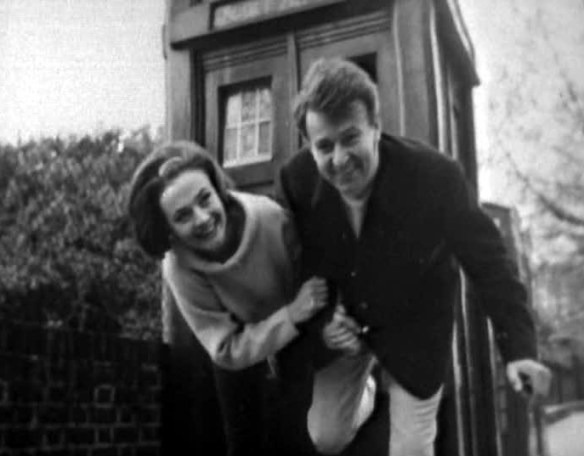
Ian & Barbara were perhaps the best-developed couple of the Classic Series.
The revival, however, changed all of this. Partly this was a matter of necessity. Russell T. Davies began his quest to bring back the series in 2003, in an environment where few remembered how to execute a science fiction series. The new program therefore had to be redesigned for an audience used to soaps and reality shows. To some extent this was referenced by the characters themselves – the Doctor said he didn’t do domestic.
Odd as it may have been, though, this model stuck with Doctor Who for several years: Martha Jones had regular encounters with her siblings and parents, and they even had her mother repeat the face-slap made famous by Jackie two years prior. In many ways it seemed like a conscious retread. In Gridlock, Martha commented “You’re taking me to the same places you took Rose.” with a muttering of “Rebound”. Indeed, much of Series 3 saw Martha being compared to Rose and a conscious retreading of the previous two years’ themes. Donna Noble likewise had a family, though they were structured differently – her mother Sylvia and her father Wilfred were used for comic relief more than for drama, though Wilfred later became a companion in his own right. The late Geoff Noble was also made something of a legacy character.
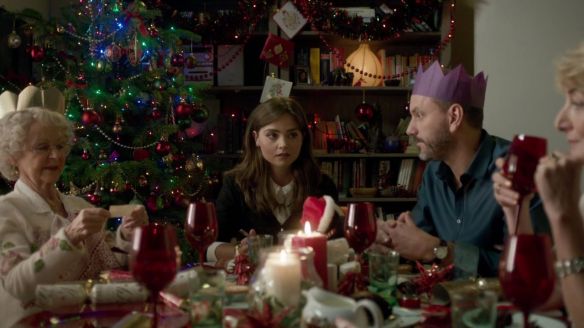
The less than memorable family of Clara Oswald, Christmas 2013.
Into the Moffat era, the companion family largely disappeared as an integral part of the story, but a vestigial presence remained. Amy Pond’s parents were absent for most of Series 5, having been erased from time. Their emergence in The Big Bang was a sign of sanity returned to the universe, though afterwards they never actually appeared afterwards. Brian Williams, however, played a prominent role towards the end of the Ponds’ tenure. Clara’s family had only one outing as a minor sub-plot in The Time of the Doctor, but her parents’ history had earlier been an important feature of her character arc. While the Oswalds had nothing like the narrative significance of the Tylers, it is notable that their block of flats was filmed somewhere that strongly resembled the Powell Estate. Even eight years, two Doctors and four sets of companions after the revival, Rose’s shadow still fell, however faintly, over her successors.
Were it insufficient for Rose’s archetype to continue shaping the series long after her departure, there is still the matter of Rose herself never quite going away. From the moment that Series 2 concluded, there was always speculation that the character would eventually return. There were hints and nods in Series 3, but by the time of Series 4 it was a certainty. The premiere, Partners in Crime, featured Rose in person, quietly disappearing in a cloud of mystery. Her face briefly flashed on screen in The Poison Sky and Midnight before she fully emerged in the finale. After a second farewell scene (again on Bad Wolf Bay) it appeared that her character was finally finished, her ghost having haunted the franchise for what then constituted more than half of its existence. Even so, there was still time for yet another goodbye in The End of Time, though this time with an earlier version prior to her début.

Billie Piper as “Bad Wolf Girl”
When Billie Piper returned for the golden anniversary special The Day of the Doctor it was significant that she did not quite play Rose Tyler again. Instead she had the role of “Bad Wolf Girl”, a manifestation of galaxy-eating superweapon “The Moment”. She was visible only to John Hurt’s character, the War Doctor, with David Tennant’s never actually interacting with her. Evidently the producers wanted to avoid playing out her tearful departure a third time. Even so, it was in itself rather odd to find that Piper had returned as a nostalgic reference, rather than as an active incumbent. This, more than anything else, was the solid confirmation that the Rose era had actually concluded and would not be revived.
The legacy of Doomsday is not the long-awaited battle between the Daleks and the Cybermen, nor the introduction of the Torchwood Institute or even the first glimpse of Donna Noble but the departure of Rose Tyler as a regular companion. In particular, the episode is remembered for the closing dialogue on the Norwegian beach of Pete’s World and the Doctor’s abruptly-terminated “Rose Tyler…” before his final loss of contact. The viewer never learned what the end of this sentence would have been, but hints can be found in the commentary, where the executive producers had the following exchange:
Russell T Davies: “Rose Tyler, I owe you ten pence.”
Julie Gardner: “He was going to tell her he loved her. I will not have it any other way.”

 Robin Stanley Taylor