The Crown old and new

Early in the new reign, the College of Arms announced a new royal cypher for Charles III. A noted difference between this one and his mother’s (other than the name, of course) was the depiction of the crown.
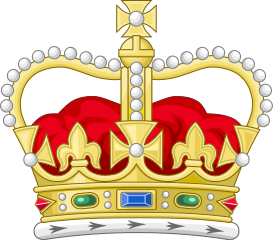
“St Edward’s” crown, favoured by Charles II to Victoria

Up to and including Victoria’s reign, depictions of the crown in heraldic drawings could be inconsistent. Edward VII ordered a standardised depiction with simple arches, which has come to be known as “the Tudor crown” due to its resemblance to one supposedly commissioned by Henry VII or VIII (and seen in royal portraits up to the Civil War). Elizabeth II later decided to change this to a version with depressed arches, better resembling St Edward’s crown which monarchs actually wear at coronations, and which seemed to be favoured in heraldic drawings before Victoria’s time. The timing of these decisions created a general misconception that the Tudor crown is always used when the monarch is male and St Edward’s when the monarch is female. Charles’s decision is likely to reinforce that belief.

The “Tudor” crown, as used by Edward VII-George VI

On the day of the coronation, the Canadian Heraldic Authority unveilved their own new version of the crown, intended to be more distinctly Canadian. The overall shape of the crown is still based on the Tudor version, but the jewels have been replaced by a wavy blue line, the uppermost cross by a snowflake (as already used in the Order of Canada) and the crosses around the rim by – of course – golden maple leaves. The removal of explicit Christian symbols may be due to the lack of an established church in Canada, though the omission of fleurs-de-lis is a little perplexing, given the constitutional importance of the country’s French heritage.

https://upload.wikimedia.org/wikipedia/commons/thumb/d/d4/Crown_of_Canada_2023.svg/248px-Crown_of_Canada_2023.svg.png

The Canadian crown, as used by Charles III

It is not clear on exactly what timescale the new crown is to supersede the old. Four days after the coronation the government of Canada released a revised Canadian passport design. Though many radical changes have been made, the 1952 depiction of the crown retains pride of place. It is also not certain whether this will apply to the parliamentary maces. Currently the mace of the House of Commons is modeled on the Tudor crown while that of the Senate is modeled on St Edward’s. This is reflected in the heraldic badge of the parliament, showing both maces in saltire behind the shield. Funnily enough, British passports, though updating the introductory text to reference His Britannic Majesty instead of Hers, also still seem to have the prior crown on their covers.

The shield itself (fleurs and all) remains unchanged. It was announced on the same day that the arms of Canada may be flown as a banner to represent Charles and all future sovereigns. Previously Elizabeth II’s flag had the royal arms of Canada with her personal EIIR cypher imposed on a hurt in the middle. The removal of the cypher brings Canada closer in line with British heraldic practice whereby the reigning monarch bears the arms of dominion undifferenced, as well as avoiding the hassle of redesigning the flag for each subsequent reign. It remains to be seen whether the heraldic banners of other members of the royal family will also omit their cyphers and keep just the cadency labels.

FURTHER READING

With Heart and Voice to Sing

The coronation, in addition to its visual majesty, is an opportunity for musical expression. In addition to the long list of traditional pieces, there were twelve brand new compositions commissioned for the day. The whole has been turned into an album, which was uploaded to YouTube and various streaming services on the same day. It is also due to go on sale in CD format on 15th May.

Naturally I took it upon myself to arrange it all into a convenient table for the coronation’s Wikipedia page, which another editor shortly afterwards redesigned almost entirely.

THE OLD

  • Johann Sebastian Bach: Magnificat in D Major; Sunday After New Year; Singet dem Herrn ein neues Lied; Alla breve in D Major.
  • William Boyce: The King Shall Rejoice: Opening Chorus
  • Anton Bruckner: Ecce sacerdos magnus.
  • William Byrd: Prevent Us, O Lord; Gloria; Earl of Oxford’s March.
  • Walford Davies: Confortare.
  • Edward Elgar: Nimrod; March No. 4.
  • Orlando Gibbons: Threefold Amen
  • John Goss:
  • George Friderich Handel: The Arrival of the Queen of Sheba; Oh, had I Jubal’s lyre; Care selve; Zadok the Priest.
  • William Henry Harris: Flourish for an Occasion.
  • Gustav Holst: Jupiter, the Bringer of Jollity.
  • Hubert Parry: I was glad; March from the Birds; Chorale Fantasia on “The Old Hundredth”.
  • Henry Purcell: Trumpet Tune; Christ Is Made The Sure Foundation.
  • Richard Georg Strauss: Wiener Philharmoniker Fanfare;
  • William Walton: Crown Imperial; Coronation Te Deum.
  • Thomas Weelkes: O Lord, Grant the King a Long Life.
  • Ralph Vaughan Williams: Fantasia on Greensleeves; Prelude on Rhosymedre.

THE NEW

  • Karl Jenkins: Crossing the Stone.
  • Sarah Class: Sacred Fire.
  • Patrick Doyle: King Charles III Coronation March.
  • Iain Farrington: Voices of the World.
  • Nigel Hess, Roderick Williams & Shirley Thompson: Be Thou My Vision.
  • Paul Mealor: Kyrie Eleison.
  • Roxanna Panufnik: Coronation Sanctus.
  • Tarik O’Regan: Coronation Agnus Dei.
  • Christopher Robinson: The Recognition; Homage Fanfare.
  • Andrew Lloyd-Webber: Make A Joyful Noise.
  • Judith Weir: Brighter Visions Shine Afar.
  • Debbie Wiseman: Alleluia.

Personally, I’m a little disappointed at the lack of Howard Shore.

William IV & the Royal Visit of 1827

Today’s virtual lecture was presented by Owen Ryles, Chief Executive of the Plymouth Athenaeum. It concerned the time that the Duke of Clarence (later King William IV) visited the naval yards at Plymouth.

The lecture began with a preamble establishing the titular character: William was his father’s third son, long expected to lead a relatively quiet life. Even his creation as Duke of Clarence & St Andrews was not guaranteed, being granted only because he threatened otherwise to stand as MP for Totnes. He was sent into the navy at age 13 to keep him away from the perceived negative influence of his elder brother George IV. In his active career he was the first British royal to set foot in the American colonies, took command of HMS Pegasus in 1786 and gave away Frances Nisbet in her wedding to Horatio Nelson in 1787. He was commissioned as an honorary admiral in 1798, and then appointed to the office of Lord High Admiral in 1827 during the brief ministry of George Canning. In his private life, he scandalised Georgian society by cohabiting with his mistress Dorothea Bland and siring ten illegitimate children with her. He gave her a stipend on the condition that she would not return to acting, and later took legal action against her when she did anyway. When his niece Princess Charlotte of Wales unexpectedly died in childbirth William moved up in the line of succession and was forced into a royal marriage, but his wife’s children all died young.

For the grand occasion the duke arrived on HMS Lightning to a deafening chorus from onlookers. He did not disembark until 7pm. He visited the original Admiralty House, later renamed Hamoaze House, and met the Superintendent of Works Jay Whitby. On 12th July he inspected the Plymouth Division of the Royal Marines and said that Plymouth was his favourite naval resort (it was also the first borough in which he had been made a freeman). On 13th he received a loyal address by the mayor and municipal corporation at the Royal Hotel. Among the military men with whom he dined was his own son, Colonel Frederick Fitzclarence.

Also during the visit he laid the top stone of the sea wall at the Royal William Victualling Yard and donated ten guineas to each of the workmen. He also witnessed a demonstration by William S. Harris of the application of fixed lightning conductors to ships.

William’s tenure as Lord High Admiral did not last long – the next year he was dismissed after taking HMS Britannia to sea for ten days without government permission. In 1830 he acceded to the throne, the eldest until Charles III last autumn. He was reluctant to have a coronation at all, eventually spending just £30k on it compared with his elder brother’s £420k. His reign was short, and he clung to life just long enough to see his niece Victoria come of age. He was regarded as the “least obnoxious Hanoverian”, which some might consider high praise.