The Death of Dame Maggie

Reported today was the death at age 89 of the actress Dame Maggie Smith, best known in recent decades for her roles in the Downton Abbey and Harry Potter series – the latter especially poignant as her co-star Sir Michael Gambon died exactly a year ago.

This post is not meant as a eulogy or obituary for her – many others can do that far better than I – but a discussion of two points of interest relating Dame Maggie to the topics covered on my blog.

First, her status as a Dame: In 1970 Smith was appointed Commander of the Most Excellent Order of the British Empire. Twenty years later she was promoted to Dame Commander. This is one means by which to certify her status among the “National Treasures” of British acting, nearly all of whom have had the chance to become a knight or dame even if a small number have declined. The Order of the British Empire was founded by King George V in 1917 and was the first British order of chivalry in the modern era to explicitly allow female recipients to have the title. The top two grades of the order are Knight/Dame Commander (K/DBE) and Knight/Dame Grand Cross (GBE). The DBE is by far the most common form of damehood and it is the only grade of any order at which dames outnumber knights. This is partly because the other orders (e.g. the Bath) are reserved for senior government and military officials, a group which tends to skew male anyway, and partly because there is no female equivalent of the honour of Knight Bachelor (i.e. knighthood unconnected to membership of an order of chivalry) which is the rank that the majority of knights possess (including fellow treasures like Gambon as aforesaid). Most of Britain’s orders of chivalry (the Royal Victorian Order is an exception) have statutory limits on how many there may be at any particular grade at any given time. For the grade of K/DBE that limit is 845, with male and female members counting the same towards the total. I do not actually know how close we are to hitting the limit. The English Wikipedia has a page listing all the people who have been awarded the status of DBE and they number over a thousand, but without going through each biography individually (and some don’t have their own pages anyway) I cannot tell how many are currently alive and still holding the same dignity.

In 2021 Netflix released an animated sitcom named The Prince, focusing on a fictionalised caricature of Prince George of Cambridge. It was produced and largely written by Gary Janetti, who previously wrote fourteen episodes of Family Guy, and it strongly resembles that series both tonally and aesthatically. Despite its star-studded cast the series received overwhelmingly negative reception for its offensive premise and unfunny execution. The series was neither renewed nor widely distributed and now is viewable only as a scattering of short clips on video-hosting site by either the studios’s own paltry few advertisements or other people’s reviews of it. The first episode features a minor subplot about the possibility of Elizabeth II conferring a damehood on either Kelly Ripa or Greta Thunberg. On two occasions the suggestion results in another character asking if Smith had just died, presuming there to be a moratorium. As explained above this reasoning is technically correct, although Janetti seems to have missed that neither Ripa (American) nor Thunberg (Swedish) were the late monarch’s subjects so could not receive substantive appointments to the order anyway. They could only receive honorary appointments (giving them the post-nominals but not the salutation) which would be supernumerary to the quota.

The news of Smith’s death has brought renewed interest in her earlier appearances, the most famous of which was the 1969 film The Prime of Miss Jean Brodie, based on the 1961 novel by Muriel Spark (who herself became a DBE in 1993). News features about Smith’s death kept playing the same speech by her character, which is also featured on the book’s TV Tropes page:

I am in the business of putting old heads on young shoulders, and all my pupils are the crème de la crème. Give me a girl at an impressionable age and she is mine for life. You girls are my vocation. If I were to receive a proposal of marriage from Lord Lyon, King of Arms, I would decline it. I am dedicated to you in my prime. And my summer in Italy has convinced me that I am truly in my prime.
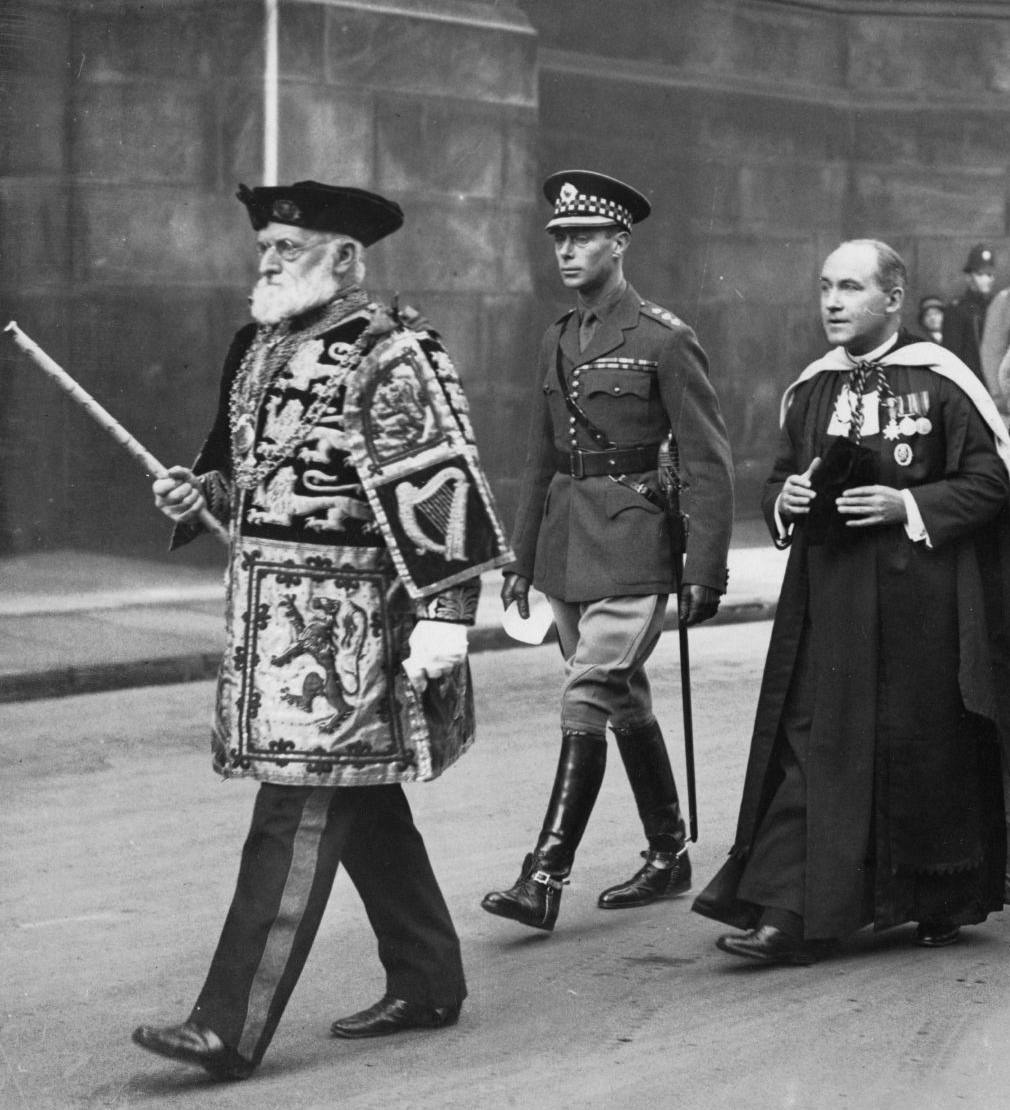
Grant with the future George VI in 1933

I have not yet watched the film or read the novel in full, but searching a digital scan on Archive.org for the word “lyon” gives two instances, both of them in the context of Brodie turning down his hand, with the implication that he must be highly desirable and that declining him requires a serious force of will. The only other reference to heraldry in the book is a passing mention of the school’s “crest” which I think is really a shield. The book is set in the 1930s and the Lord Lyon King of Arms from 1929 to 1945 was Sir Francis James Grant, whose Wikipedia article is such a short stub that I don’t even know if he had a wife or not. He was sixty-eight by the time the novel was published, so not in his “prime” by any reasonable definition. Why his title was used in the book is unclear, and may be a matter I need to raise at a subsequent virtual heraldry lecture, whenever that comes up.

Timothy Noad at the World Calligraphy Museum

Video

Heraldry is not a topic much-covered on YouTube, so I cherish what scraps I can find. Recently I found this video from seven years ago of Timothy Noad, illuminator of many heraldic patents, giving a short lecture on his career and craft to the World Calligraphy Museum.

The presentation is actually only half as long as it seems, for as Noad has finished reading out each paragraph in English he has to stop while it is translated into Russian. This results in the whole performance having a stilted cadence redolent of schoolchildren performing class assemblies.

Still, it is nice to actually see and hear from the man who for so long has existed only as a name. I suspect that events in the last two years will make joint ventures like this rather difficult to replicate in the foreseeable future.

Extracting the Anthem

Many times I have written about the travails involved in finding free-licence images for Wikimedia Commons, but this time it is sound files that concern me.

When Charles III acceded to the throne two years ago, the royal anthem of the Commonwealth Realms changed from “God Save the Queen” to “God Save the King”, having been in the feminine form for longer than the internet had existed. Extant recordings of the masculine form were hard to find, and those that did exist were inevitably very old.

Lacking the budget to form my own choir or hire a recording studio, I went looking for recordings of the song in the place it seemed most likely to find them – videos of His Majesty’s outdoor accession proclamations.

Of the dozens (perhaps hundreds) of these which actually took place, I managed to find just four for which either the venue host or a charitable bystander had uploaded the video to YouTube under Creative Commons. I firstly copied these videos themselves to Wikimedia Commons, then set about extracting the audio of people singing. Both of these involved a bit of a learning curve and the use of some third-party tools.

The Royal Exchange in the City of London (by Alison Pope)

This is the most high-profile of the four, and the one with the best sound quality. The band are playing (I think) Sir Henry Wood’s arrangement of the anthem (which is good because the composition itself is public domain) and the crowd are all in time. There is some noise due to wind, local dogs and the sliding of camera shutters.

Cornwall St Ives (by Cornishpastyman)

This version is sung a cappella. Most of the crowd have picked up by the third syllable and stay remarkably in time for the rest, though not necessarily in tune – one in particular says “noble” and “victorious” in a way that sounds almost like a dog yawning.

Charnwood (by Crep171166)

Music is provided by a lone trumpeter. Almost nobody picks up singing until the second line, and even then they all sound a bit low on energy.

Chatteris (by Chatteris Watch)

Again a lone brass-player and really only one voice is heard singing, picking up midway through the first line.

None of these are studio quality, of course, and none go beyond the first verse. Still, it’s a start.

UPDATE (August 2025)

The YouTuber Gobernador-Heneral has put together a 17-minute compilation of public performances of the anthem in the mourning period.

Photographs of the State Opening

One of the recurrent themes of this blog is the inconsistency of licensing in British governmental and parliamentary photographs. Without rehearsing the entire story again, I will note that yesterday I made a wonderful discovery:

Since the day of the event itself I had thought that the only photograph of the 2024 State Opening of Parliament to be released under a free licence was this one of His Majesty in procession through the royal gallery. It is fairly tightly framed, with only the middle ground in focus so that Charles and the page boys to his flanks appear a little too sharp while the Duke of Norfolk in front and the Marchioness of Lansdowne behind are entirely blurred.

The House of Lords Flickr account had a generous album of high quality shots, but these were released under a Non-Commercial and No Derivatives licence, rendering them useless for Wikimedia Commons*. When this happened last year I was able to get around it by using those which had been re-issued under a looser licence by the Oireachtas, although some other Wikipedians challenged the legitimacy of these. No such republication existed this time around.

Happily, yesterday when strolling through the relevant category on Wikimedia Commons I came across a second photograph of the event, taken from inside the upper chamber and showing the speech being read. The source was given as parliament.assetbank-server.com, and the link revealed a page from what seemed to be an official Parliament-owned website with twenty-eight of the forty-five photographs in the Flickr album, but this time very explicitly licensed under Attribution 3.0 Unported (CC BY 3.0), which meant they could be used on Wikimedia Commons. Of course, I took the opportunity offered by the handy “DOWNLOAD ALL AS ZIP” button to transfer the lot of them. I had to give new names to all of them as the file originals were mostly gibberish and I noticed that the metadata were inconsistent as well (some had timestamps and others didn’t, some were taken by Roger Harris and others by Annabel Moeller). Some more editing may well be required in future to rectify this.

Though I am reluctant to look this gift horse in the mouth, I am a little perplexed by the existence of this website, which bears the UK Parliament logo but is not at the parliament.uk domain, and whose individual pages can be seen freely once you have the direct link but which cannot be navigated without a login. It could be the case that the majority – or indeed entirety – of the recent House of Lords photograph collection is actually released under a usable licence and these pages would prove it, if only we ever manage to find them.

*The irritating thing about photographing licensing in a parliamentary context is that one must continually differentiate between Wikimedia Commons, Creative Commons and the House of Commons. The presence of Their Majesties in these images means that “royalty-free” isn’t very practical either.