The Queen’s Flags Elsewhere

Following the sighting of Her Majesty’s impaled British royal banner on a limousine in Australia, I’ve had a go at mocking up what her arms should look like in each of the realms where she is queen consort. These all consist of the arms of Bruce Shand as illustrated by Fry1989 impaled by the arms of dominion of each realm as illustrated by various other artists. In all cases I have done some minor colour correction so the shades of the tinctures are consistent and rearranged the components a little to fit a square rather than a shield shape.

Antigua & Barbuda

The national arms are Barry wavy of six Argent and Azure a sugar mill on a grassy ground Proper on a chief wavy Sable a rising sun radiant Or. The Shand arms are Azure a boar’s head erased behind the ears Argent armed and langued Or on a chief engrailed Argent between two mullets Gules a cross crosslet fitchy Sable.

Australia

The national arms are Quarterly of six 1st Argent a cross Gules charged with a lion passant guardant between on each limb a mullet of eight points Or 2nd Azure five mullets one of eight two of seven one of six and one of five points Argent ensigned with an Imperial Crown Proper 3rd Argent a Maltese cross Azure surmounted by a like Imperial Crown 4th Or on a Perch wreathed Vert and Gules an Australian Piping Shrike displayed also Proper 5th Or a Swan naiant to the sinister Sable 6th Argent a Lion passant Gules the whole within a bordure Ermine.

Bahamas

The national arms are Upon a representation of the Santa Maria on a base barry wavy of four Azure and Argent on a chief Azure demi-sun Or.

I noticed as I went along that depictions of the Santa Maria appeared in quite a few of the Carribean blazons, although the style of depiction varies a bit.

Belize

The national arms are Party per pall inverted 1st Argent a paddle and a squaring axe Proper in saltire 2nd Or a saw and beating axe Proper in saltire 3rd per fess Bleu celeste and barry wavy Or Vert Azure above the last a sailing ship Proper.

There is some inconsistency between depictions as to the tinctures used in the barry wavy, with some other versions simply having naturalistic water.

Canada

The national arms are Tierced in fess the first and second divisions containing quarterly 1st Gules three lions passant guardant in pale Or 2nd Or a lion rampant within a double tressure flory-counter-flory Gules 3rd Azure a harp Or stringed Argent 4th Azure three fleurs-de-lis Or and the third division being Argent three maple leaves conjoined on one stem Proper.

Since Canada is the only other realm to have its own heraldic authority, this is probably the one most likely to actually be officially used.

Grenada

The national arms are Quarterly 1st & 4th Gules a lion passant guardant Or 2nd & 3rd Vert a crescent and a lily Or over all a cross Or and in nombril point a picture of the Santa Maria Proper.

It was quite difficult to fit the Santa Maria into the nombril point of the cross without either making the image too small or the cross too thick.

Jamaica

The national arms are Argent on a cross gules five pineapples slipped Or. This is the shortest blazon of them all.

The illustration is also the simplest, and thus this was the first one I did. From a distance it could potentially look like a defaced England flag.

New Zealand

The national arms are Quarterly Azure and Gules on a pale Argent three lymphads Sable 1st four mullets in cross of the last each surmounted by a mullet of the second 2nd a fleece 3rd a garb 4th two mining hammers in saltire all Or.

New Zealand’s arms may technically be an example of faux-quartering.

Papua New Guinea

Papua New Guinea’s national emblem is not a coat of arms as such, so I’ve had to improvise a little here by just putting the whole thing on a “bedsheet” the tincture of the background is up for debate. I ultimately went with Azure as that is used for the Governor-General’s flag.

Saint Kitts & Nevis

This realm does have a coat of arms but I can’t actually find a blazon for it.

This coat of arms has a lot of the same charges as does Saint Lucia’s, but the boat depicted is seemingly not the Santa Maria as in other examples.

The chief above the chevron makes for a rather crowded field with the sails difficult to fit in the base.

Saint Lucia

The national arms are Azure two sticks of cut bamboo in cross surmounted of an African stool of authority Or between in dexter chief and sinister base a rose Argent charged with another Gules both barbed and seeded Proper and in sinister chief and dexter base a fleur-de-lis Gold.

Saint Vincent & the Grenadines

Again, I can’t find a blazon for the arms and I would struggle to come up with one.

This one is a rare example of pictorial heraldry on this page, looking more like a painting than a series of armorial symbols. The flames have come out looking a little crude.

Solomon

The national arms are Or a saltire Vert charged with two spears in saltire points in base and a bow and two arrows charged with a native shield in fess point between two turtles all Proper and on a chief Azure an eagle sejant on a branch between two frigate birds all Proper.

Tuvalu

The national arms are Per fess Azure and Or in chief upon grass issuant a representation of an Ellice Maneapa or meeting house all Proper and in base four barrulets wavy Azure a bordure Or charged with banana leaves and mitre sea shells placed alternately Proper together.

The Sovereign’s Crown and the Southern Cross

The King & Queen in Sydney (NSW Gov, CC BY 4.0). The King’s mouth is unfortunately hanging open in this shot, which combined with the opaque glasses makes for a bit of a Hubert Farnsworth look.

The King & Queen have just spent the past nine days on a tour of Australia and Samoa. Bizarrely, the Palace’s press release called this an “Autumn Tour” even though in the destination countries it was spring. The tour was originally supposed to have included New Zealand as well, but His Majesty’s cancer diagnosis earlier this year forced the itinerary to be severely reduced.

Charles wore three distinct metaphorical “hats” during the course of the tour: First as King of Australia conducting domestic business, second as King of Great Britain & Northern Ireland conducting a bilateral state visit, and third as Head of the Commonwealth presiding over the biennial Heads of Government Meeting.

Photographs of the sovereign couple at these events are unfortunately few and far between. Australian governments both federal and state lack official Flickr accounts with clear licensing indications as their British counterparts have, and the paltry few hosted on their websites are also of uncertain origin – at time of posting a handful have been accepted on Wikimedia Commons but these all look so suspiciously similar to those on Getty and Alamy that I wouldn’t be surprised if they ended up getting deleted shortly afterwards. There seem to be no free-licence photographs of the state visit to Samoa at all. Number 10 and the FCDO both have albums from the CHOGM, but only one picture of the lot actually shows Charles and none at all show Camilla.

I do not know the full details of the travel arrangements, but what I can gather is that Their Majesties and a small entourage took a commercial flight from Heathrow to Singapore, whence they were picked up by the Royal Australian Air Force and taken to Sydney Kingsford Smith Airport in New South Wales.

The tour marked the first in-the-fabric appearance of the Australian royal banner of arms (known officially as “The King’s Flag for Australia”), which was seen flying from the cockpit window and then later from several road and watercraft. The Australian banner follows Canada’s example by reverting to showing the national arms undifferenced, in contrast to the practice followed during Elizabeth II’s reign of defacing the banner with her own personal cypher. The King approved the present version on 30th August.

The current coat of arms of Australia was formalised in 1912. The shield is a composite in “quarterly of six” format, representing the six constituent states of the federation. The states of South Australia and Western Australia did not yet have full coats of arms at the time but all had heraldic badges (which are also shown on their respective civil flags) so these were used instead. The whole is surrounded by a bordure ermine.
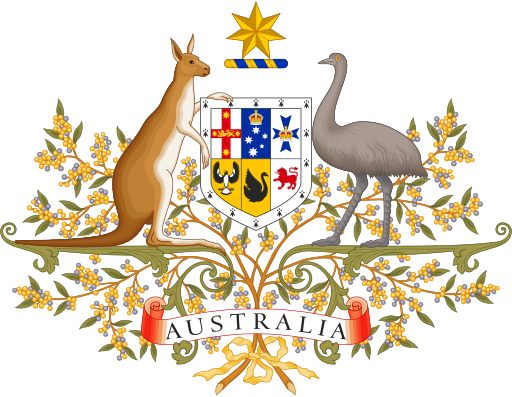
The whole federal armorial achievement is normally depicted with the crest on a torse hovering some distance above the shield – omitting helm, mantling or coronet – but the Imperial Crown appears as a charge on the badges of Victoria and Queensland, notably at different sizes.

As in Britain (though unlike Canada) the depiction of the crown in Australian royal symbols has changed from St Edward’s Crown to the Tudor Crown, though this has not yet entirely filtered through to all the state arms and flags themselves. I dimly remember – but can no longer find the proof – that the flag as approved on the government’s website in August still showed St Edward’s Crown, and that the graphic on Wikimedia Commons did likewise until photographs of the real flag caused an update.

The King at several points on the tour wore the sovereign’s badge of the Order of Australia along with a hefty line of other honours I will need time to identify. The Governor-General gave him honorary commissions at the top ranks of all three branches of the Australian armed forces. This is is a little perplexing from a legal perspective: One would have thought that the reigning monarch would hold these ranks substantively ex officio and would not need to be appointed to them by his own deputy.

The Queen is another story: For months now I have been looking out for signs of Camilla being granted the use of her own banner of arms – being the royal arms of the sovereign impaling those of her father Bruce Shand. This was finally seen to be the case during the Australian tour, flying from the bonnet of her car on a few occasions when she travelled without her husband. The videos did not show the flag long enough (and the stills tended to have it covered by the watermark) but from what little I can determine of the artistic subtleties of its design I reckon it is actually a printout of the vector file on the Commons. The car itself was a black Audi (I think a Q8) and the regular numberplates were obscured with plates bearing an image of the Tudor Crown. That image looks to have been taken from Wikimedia too, though I can’t find the exact image. The glaring problem here, of course, is that this banner shows Shand impaled by the British royal arms rather than the Australian, resulting in a mismatch with her husband. There is a burning irony that after all this time, the one occasion Camilla can be seen using a personalised banner of arms as Britain’s royal consort is the one occasion in which it was not appropriate to do so.

This unfortunately seems to be far for the course with royal tours – with the notable exception of Canada (probably because that country has its own heraldic authority), banners of royal arms in the other Commonwealth Realms seem to only be made for the reigning sovereign himself, with the rest of the royal family defaulting to their British blazons instead of coming up with a local variant. This may be marginally more convenient from a logistical and fiscal perspective, but it can be constitutionally misleading as it implies that they are representing a foreign state instead of that country’s own crown. If creating a personal one for each prince or princess is too onerous, it at least would be relatively easy to create a generic ermine-bordered version which they could all use when in the country. Admittedly that might not work in Australia where the sovereign’s own shield and banner have an ermine bordure already. For the royal wives, it might even make more sense to use banners of their paternal arms unimpaled so that they needn’t change based on location at all.

During the visit, His Majesty attended a service at St Thomas’s Anglican Church in North Sydney, made addresses to both the state Parliament of New South Wales and the national Parliament of Australia (sadly not from the throne in either case) and undertook a review of the fleet. God Save The King was played by a brass band while Charles inspected the troops and also by a solo amateur flautist during his walkabout but I can’t find any clip of it actually being sung at any point, in contrast to Advance Australia Fair which was sung by a children’s choir at Parliament House. That the monarch made no remark about his late friend Barry Humphries (a.k.a Dame Edna Everage) was also a little surprising.

When the royal party landed in Samoa they switched back to their British identities and the British royal banner was flown from the cockpit window alongside the Samoan flag, although the aeroplane itself was still very obviously branded as Australian.

While in Samoa Charles was invested with two honorific titles – Tui Taumeasina (King of Taumeasina) and Toa’iga o Tumua (Paramount Chief). The Queen was seen using a hand-fan with her royal cypher printed on it, which was given to her by Stewart Parvin in February. Both switched for much of the visit to bespoke white outfits in the local style.

Charles attended the CHOGM in his capacity as Head of the Commonwealth. Elizabeth II adopted a personal flag to represent herself in this capacity with no reference to any particular country. Her son so far appears not to have done so, which is a pity.
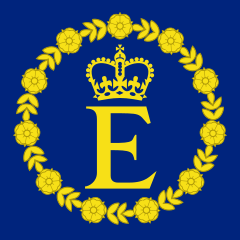
The official royal YouTube channel has uploaded some videos from these events. Not only are they continuing to use the outline of the British royal arms as the channel logo, they have also taken to including a new drawing of the arms in the thumbnails of individual videos. This, again, is a little problematic when the contents of the videos relate to other realms. I am left to wonder what recognisable symbol could be used here to avoid this problem. The livery badge of the House of Windsor might work, but even that technically has the British banner of arms included in it. The only solution that would truly work is, I suppose the CIIIR cypher on its own, without even a crown above it. Indeed, that could work for other family members’ flags and banners too.

Heraldry in “Stoke Me a Clipper”

Red Dwarf is a science fiction comedy series about a man from the twenty-third century who gets put into stasis and wakes up three million years in the future. As such, one would not expect it to include much in the way of medieval heraldry. Indeed, mostly it doesn’t. However, much like Star Trek, the normally-futuristic series occasionally delves into history, and historical fantasy, by means of either time travel or simulation.

The episode “Stoke Me a Clipper” (1997) involves Lister spending a few minutes in a virtual reality game based vaguely on medieval England, featuring an unnamed King & Queen of Camelot. That term is normally associated with Arthurian legends, which are nominally set in the fifth and sixth centuries but have much of their imagery and iconography backported from much later eras. The scene we witness in this episode looks most likely to be set in the fifteenth century, though no detail is actually given about the overall plot nor the setting of the story and no claim is made to historical accuracy.

A great many heraldic banners are seen in this scene, which manage to almost, but not quite, resemble real historical blazons.

The most obvious of these is “The Good Knight” (John Thompson) who wears an off-model version of the royal arms of England: His tabard is quarterly Gules and Azure, the first quarter bearing two lions passant guardant in pale Or and the second quarter bearing three fleurs-de-lys two and one Or. Curiously the lower quarters were left blank, as were those on his back. Perhaps they were meant to be out of frame?

Screencap circa 6m17s

The King (Brian Cox) & Queen (Sarah Alexander) sit on a raised platform under a canopy on two ornate wooden thrones. Their gowns have no heraldic motifs but several are visible on the wall behind them. Above and between the thrones is a depiction of the coronet of a Marquess, the style of which probably dates to the seventeenth century. Lower down is a shield Argent a saltire between four fleurs-de-lys in cross although I am not certain of the latter’s tincture. At the top right of the screen is a shield with two piles reversed the point of each charged with a rose and in the top left is a shield parted per pale and charged with one large fleur-de-lis. Again the tinctures are uncertain. There are four rectangular images behind the thrones. The first looks to be Azure with at least two fleurs-de-lys Or (France again?) the second and third have a metal background with a fess chequy of a colour and a different metal (Clan Stuart?). The fourth cannot be seen as the consort’s throne obscures it completely from this angle.

Screencap circa 6m22s

Four banners are held aloft to the side of the throne area: That on the far right of the screen is divided per bend, the upper part being Azure four crosses fitchee Or and the lower being Gules fretty Argent. Closest to the platform is Azure seme-de-lis Or a double cross Argent over all a label of three points Argent. In between we have Quarterly 1st & 4th Vert a bend between two crosses flory Or 2nd & 3rd bendy of six Vert and Argent a label of three points Argent and Quarterly 1st & 4th Gules a bend between six crosses crosslet fitchee Argent 2nd & 3rd Gules three lions passant guardant in pale Or a label Argent. That last one bears more than a passing resemblance to the arms of the Howard Dukes of Norfolk.

Screencap circa 8m58s

We also see a trumpeter with a cloth shield hanging from his instrument. My best guess is Per fess Argent and Purpure in chief a cross throughout Gules impaling Gules three lions passant guardant reversed in pale Or. This is perhaps the least heraldic-looking of the bunch.

Screencap circa 6m7s

There are knights either side of the royal couple on the platform. That by the king’s right hand wears a tabard Ermine two piles Sable each charged with a lion rampant Or and that to the queen’s left Paly of four Azure and Argent on a bend Gules three birds displayed wings elevated Or. I cannot identify the birds from this distance but given heraldic trends they are most likely eagles, possibly falcons. Affixed to the roof of the stage is a shield which I would guess as Or a bend between two lozenges Sable each charged with a saltire of the field. The most obviously anachronistic element here (beside the decaying castle ruins, of course) is the tasselled embroidering at the front of the stage which shows a Georgian or Victorian depiction of the arms of the United Kingdom.

Screencap circa 8m16s

A man in the crowd (holding his helmet in front of his chest) wears a tabard which seems to be Per pale Sable and Or a label of three points Gules.

Screencap circa 8m37s

The trumpeter and a knight in the crowd both wear a tabard Gules two broken swords inverted Or on a pile reversed Azure fimbriated a broken sword of the second. Two children wear Chequy Or and Azure on a chief of the second three fleurs-de-lys of the first and yet another bystander wears something like Gules a crescent Argent between an orle of martlets Or.

Screencap circa 7m48s

A shot from the back of the crowd shows a knight with a helmet on wearing Vert on a pile Or a falcon’s head erased of the first and a man in a brown hat wearing Per pale Purpure and Argent a dragon passant counterchanged. Both animals are depicted as langued Gules.

Screenshot circa 9m14s

Lister’s own armorial bearings are difficult to make out – what we see on his outfit looks almost like the Russian double-headed eagle. There are a few other examples of heraldry in this scene but they are too faraway to read properly. Overall the resemblance of this scene is more to a Renaissance fair or a gathering of the Society for Creative Anachronism than to a typical period drama. Ugly faux-heraldry is avoided with almost all the arms shown being in keeping with the principles of good heraldic design, even if the matching up of arms to people is apparently entirely random.

I suppose Blackadder, particularly the first series, is the logical next stop for checking out heraldry in British television. Unfortunately that one doesn’t seem to be on iPlayer at the moment, nor can I find a convenient source of screencaps.

SOURCES

New Government Arms

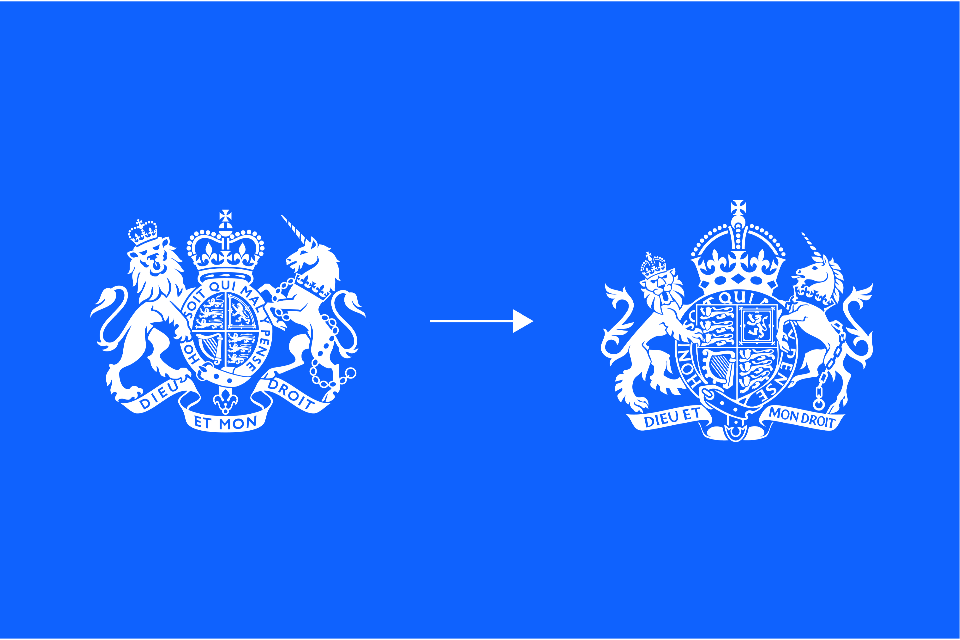
The latest development in a long-running story, yesterday the Cabinet Office announced the rollout of a new rendering of the British royal arms, based on an illustration by Timothy Noad, for use by HM Government, including in all departmental logos on the website. It will presumably also appear in the letterheads of governmental paper publications, but of course the appearance of those example will be less instantaneous.

The most obvious, and important, change is of course the change from St Edward’s Crown to the Tudor Crown, about which I have written before. The crown is also now depicted much larger relative to the other elements. The lion and unicorn supporters have also been redrawn in a much more chunky, angular style than in the old version.

The escutcheon is restored to a more traditional heater shield shape, poking out in front of the Garter circlet, whereas the old depiction had it as a fully-enclosed cartouche. The circlet itself has been enlarged and the motto typed in a serif font as well as having the colours inverted – it now matches the shield, supporters and crown by having the field depicted in negative while the charges and outlines are positive. The fleur-de-list at the end of the strap is gone.The motto scroll is now much flatter, but anomalously retains the old font and colour scheme.

Comparing the two overall, I would say that the new version looks better as an example of heraldic art due to the shield itself no longer being denied its due prominence, but the old version may work better as a corporate logo due to its stronger outline, especially when shrunk for low resolutions.

In other heraldic news, The Heraldry Society recently released a digital upload of 244 pages from Volume 6 of The Coat of Arms, and I have discovered the Fellowship of the White Shield, whose blog currently has nine articles on the subject. I will not be short of reading material in the foreseeable future.

The Death of Dame Maggie

Reported today was the death at age 89 of the actress Dame Maggie Smith, best known in recent decades for her roles in the Downton Abbey and Harry Potter series – the latter especially poignant as her co-star Sir Michael Gambon died exactly a year ago.
This post is not meant as a eulogy or obituary for her – many others can do that far better than I – but a discussion of two points of interest relating Dame Maggie to the topics covered on my blog.

First, her status as a Dame: In 1970 Smith was appointed Commander of the Most Excellent Order of the British Empire. Twenty years later she was promoted to Dame Commander. This is one means by which to certify her status among the “National Treasures” of British acting, nearly all of whom have had the chance to become a knight or dame even if a small number have declined. The Order of the British Empire was founded by King George V in 1917 and was the first British order of chivalry in the modern era to explicitly allow female recipients to have the title. The top two grades of the order are Knight/Dame Commander (K/DBE) and Knight/Dame Grand Cross (GBE). The DBE is by far the most common form of damehood and it is the only grade of any order at which dames outnumber knights. This is partly because the other orders (e.g. the Bath) are reserved for senior government and military officials, a group which tends to skew male anyway, and partly because there is no female equivalent of the honour of Knight Bachelor (i.e. knighthood unconnected to membership of an order of chivalry) which is the rank that the majority of knights possess (including fellow treasures like Gambon as aforesaid). Most of Britain’s orders of chivalry (the Royal Victorian Order is an exception) have statutory limits on how many there may be at any particular grade at any given time. For the grade of K/DBE that limit is 845, with male and female members counting the same towards the total. I do not actually know how close we are to hitting the limit. The English Wikipedia has a page listing all the people who have been awarded the status of DBE and they number over a thousand, but without going through each biography individually (and some don’t have their own pages anyway) I cannot tell how many are currently alive and still holding the same dignity.

In 2021 Netflix released an animated sitcom named The Prince, focusing on a fictionalised caricature of Prince George of Cambridge. It was produced and largely written by Gary Janetti, who previously wrote fourteen episodes of Family Guy, and it strongly resembles that series both tonally and aesthatically. Despite its star-studded cast the series received overwhelmingly negative reception for its offensive premise and unfunny execution. The series was neither renewed nor widely distributed and now is viewable only as a scattering of short clips on video-hosting site by either the studios’s own paltry few advertisements or other people’s reviews of it. The first episode features a minor subplot about the possibility of Elizabeth II conferring a damehood on either Kelly Ripa or Greta Thunberg. On two occasions the suggestion results in another character asking if Smith had just died, presuming there to be a moratorium. As explained above this reasoning is technically correct, although Janetti seems to have missed that neither Ripa (American) nor Thunberg (Swedish) were the late monarch’s subjects so could not receive substantive appointments to the order anyway. They could only receive honorary appointments (giving them the post-nominals but not the salutation) which would be supernumerary to the quota.

The news of Smith’s death has brought renewed interest in her earlier appearances, the most famous of which was the 1969 film The Prime of Miss Jean Brodie, based on the 1961 novel by Muriel Spark (who herself became a DBE in 1993). News features about Smith’s death kept playing the same speech by her character, which is also featured on the book’s TV Tropes page:

I am in the business of putting old heads on young shoulders, and all my pupils are the crème de la crème. Give me a girl at an impressionable age and she is mine for life. You girls are my vocation. If I were to receive a proposal of marriage from Lord Lyon, King of Arms, I would decline it. I am dedicated to you in my prime. And my summer in Italy has convinced me that I am truly in my prime.

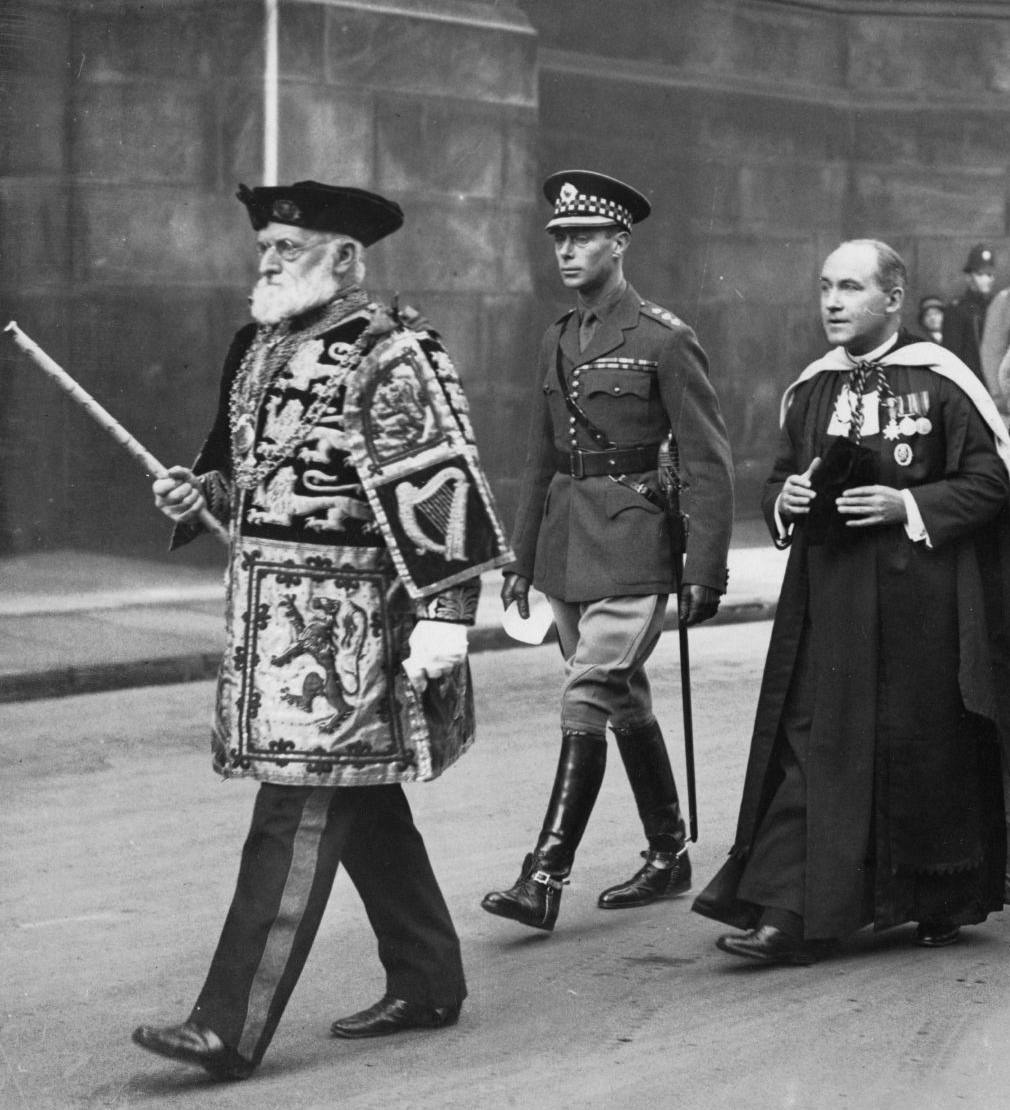
Grant with the future George VI in 1933

I have not yet watched the film or read the novel in full, but searching a digital scan on Archive.org for the word “lyon” gives two instances, both of them in the context of Brodie turning down his hand, with the implication that he must be highly desirable and that declining him requires a serious force of will. The only other reference to heraldry in the book is a passing mention of the school’s “crest” which I think is really a shield. The book is set in the 1930s and the Lord Lyon King of Arms from 1929 to 1945 was Sir Francis James Grant, whose Wikipedia article is such a short stub that I don’t even know if he had a wife or not. He was sixty-eight by the time the novel was published, so not in his “prime” by any reasonable definition. Why his title was used in the book is unclear, and may be a matter I need to raise at a subsequent virtual heraldry lecture, whenever that comes up.

Timothy Noad at the World Calligraphy Museum

Video

Heraldry is not a topic much-covered on YouTube, so I cherish what scraps I can find. Recently I found this video from seven years ago of Timothy Noad, illuminator of many heraldic patents, giving a short lecture on his career and craft to the World Calligraphy Museum.

The presentation is actually only half as long as it seems, for as Noad has finished reading out each paragraph in English he has to stop while it is translated into Russian. This results in the whole performance having a stilted cadence redolent of schoolchildren performing class assemblies.

Still, it is nice to actually see and hear from the man who for so long has existed only as a name. I suspect that events in the last two years will make joint ventures like this rather difficult to replicate in the foreseeable future.

Late-Summer Heraldic News

In the past fortnight there have been a handful of significant developments in the world of British heraldry.

Firstly, on 15th August the College of Arms published the 76th edition of its newsletter. Much of the text deals with topics already explained (such as the coronation roll and the year’s garter appointments) but there were some new details, such as the grant of arms to the University for the Creative Arts, which will be another addition to my list on Wikipedia.

Secondly, there are two long-form videos on YouTube of armorial interest: On August 20th a video by the White House Historical Association about the making of the Presidential Seal and on August 23rd by American Ancestors interviewing the York Herald Peter O’Donoghue. These videos speak for themselves so I will not elaborate them.

Thirdly, and of most interest, is a Tweet from 24th August by Alastair Bruce. It includes three photographs from inside the High Kirk of Edinburgh, showing the stallplate and banner of Queen Camilla. There is not much of surprise about the composition of the arms – they show the arms of King Charles impaling the arms of Bruce Shand – but it is reassuring to have confirmation that both shield and banner exist in formal usage, given the persistent uncertainties of Her Majesty’s status in England.

The most intriguing of the three photographs is the one which shows Camilla’s stallplate accompanied by five other royal ones: In the left column are Prince William, Earl of Strathearn (middle) and Olav V, King of Norway (bottom). In the right column are Queen Elizabeth Bowes-Lyon (top) the Prince Philip, Duke of Edinburgh (middle) and the Prince Albert, Duke of York (bottom). The fact that these six achievements are put together like this is itself a little confusing since some of those members of the order had overlapping tenures so could not have occupied the same stall. Also noteworthy is the way in which the artistic styles have changed over the years:

  • The Prince Albert, (later King George VI) was appointed to the order by his father in 1923 and presumably this is what it says on the scroll underneath (although it’s not legible in the photograph). He uses the royal arms differenced by a label of three points argent the centre bearing an anchor Azure. He has the coronet of a child of the sovereign sitting on top of a forward-facing golden helmet, and the coronet itself is topped by the lion crest, gorged at the neck by another label of three points argent – although that one doesn’t have the anchor in the middle. While that could be dismissed as an omission by the painter (perhaps too small to draw properly) it is unmissable that this stallplate clearly uses the English version of the royal arms and crest as well as referring to the prince by his England-based title (Duke of York) instead of his Scottish-based one (Earl of Inverness).
  • Queen Elizabeth was appointed by her husband in 1937. Her stallplate shows his arms impaling those of Claude Bowes-Lyon. Again the English arrangement of the royal arms is used, especially confusing as Elizabeth was herself of Scottish ancestry. The shield is topped by the royal crown. I can’t work out if it is the English or Scottish version of the crown shown, given the vagaries of the art style.
  • The Prince Philip was appointed by his wife in 1952. His stallplate shows his arms as granted in 1949. He used the same coronet as his sons and uncles-in-law, but here it is depicted beneath the helm rather than atop it as in the other examples. Philip apparently used the same arms in every heraldic jurisdiction, as well as the same title. His personal motto “God Is My Help” appears on a scroll above the crest, as is the Scottish tradition.
  • Prince William was appointed by his grandmother in 2012. Earl of Strathearn was his secondary peerage, his primary being Duke of Cambridge. His arms are in the Scottish arrangement. He uses the coronet of a son of the heir apparent on top of a front-facing grey helmet with gold bars, itself topped by the Scottish royal crest. Both crest and shield are differenced by his label of three points Argent, the centre bearing an escallop Gules. The Scottish motto “In Defens” flies over the crest. The tinctures used for this stallplate look a little off, with the Or in particular being shown as a much darker shade of yellow than that used for all the others.
  • Queen Camilla was appointed by her husband in 2023. Her shield uses the Scottish arrangement of the arms. The royal crown is drawn rather differently to that used by her grandmother-in-law, but it’s still just as unclear which one it is supposed to be.
  • Olav V, the only foreign member here, was appointed by his first cousin one removed in 1962. Crests are not a traditional feature of Norwegian heraldry, but the royal crown of Norway is placed atop a forward-facing grey helm with gold bars. The mantling is Gules doubled Or whereas the British princes here use Or doubled Ermine. Domestic depictions of the Norwegian arms tend to omit helm and mantling altogether or use a pavillion Purpure doubled ermine.

Sightings in the Channel

A few months ago I noted that, during the illness of her husband, Queen Camilla had been carrying out royal engagements solo, and had been flying the generic ermine-bordered version of the royal banner of arms.

The King has since recovered at least enough to be allowed out, and today Their Majesties jointly visit the Bailiwick of Jersey – a crown dependency in the English channel. Although a self-governing country with its own coat of arms, Jersey is part of the realm of the United Kingdom (i.e. it doesn’t count as a separate crown from the British one) and the sovereign’s heraldic identity is the same as in England.

In the disappointingly-limited series of photographs and videos I have found so far (none of them free-licence) I could not see much evidence of the sovereign’s banner flying over buildings, though I did see it on the roof of the Bentley State Limousine. What intrigued me was seeing (at 2m08s in the video above) some enthusiasts who had brought their own banner of Her Majesty’s arms and draped it over the railing. Based on the art style, I am dead certain it is a printout of this creation by Fry1989. The King actually reacts to it, though I can’t quite make out the words he says. The presumed owner of the flag says to him “I hope you enjoyed France last year.” in what I take to be a French accent.

EXTERNAL LINKS

Thistle Day 2024

Today was the last in a string of high-profile royal engagements that went ahead despite the ongoing general election – although there are reports that the traditional “royal week” has been shortened due to the need for His Majesty to run back to London on Friday to meet the prime minister.

Unlike last year’s Presentation of the Honours of Scotland, this was a standard ceremony of the Order of the Thistle. The Queen and the Duke of Edinburgh were due to have their banners installed at the High Kirk.

This excursion also featured the Ceremony of the Keys – which will be Alastair Bruce’s last as Governor of Edinburgh Castle.

It would be nice if I could include some photographs of either event, but it seems that unlike last year (when the Scottish Government Flickr account uploaded many) there are only commercial ones to be found. I hope that perhaps some amateur ones may be released under the right licensing arrangements soon. I also hope that we will soon get a good look at the Scottish arrangement of Her Majesty’s coat of arms – not that we don’t already know exactly what it should look like, but just to get proof that it exists!

The Emperor’s New Collar

Naruhito & Masako, Emperor & Empress of Japan, conducted a three day visit to the United Kingdom this week. It was the third state visit to Britain during the present reign, and the first monarchical one since that by the King & Queen of the Netherlands in 2018.

The visit consisted of the expected activities – a state banquet at Buckingham Palace, then another banquet at the London Guildhall, as well as military parades and presentations.

According to the Court Circular for 25 June, the palace guest list included “Mr. Christopher Broad (Founder of YouTube channel, Abroad in Japan)”. This is thought to be the first time that a prominent YouTuber has been invited to a state event specifically in that capacity.

As is customary during state visits, the monarchs exchanged appointments to their respective orders of chivalry: Charles received the Collar of the Supreme Order of the Chrysanthemum while Naruhito became a Stranger Knight of the Most Noble Order of the Garter. It is a shame that his visit was not a few days earlier, or he could have marched in the procession.

File:Coat of Arms of Japanese Emperor (Knight of the Garter Variant).svg

Sodacan’s representation of the Japanese Garter arms.

Naruhito ascended the imperial throne in 2019 when his father Akihito abdicated. Japan now joins Spain and the Netherlands in having two Garter stalls simultaneously. What makes the Japanese representation different to the Spanish and Dutch is the different style of heraldry. The Japanese Imperial Seal is a mon representing a stylised chrysanthemum flower. Mon are normally standalone objects without a background – more visually similar to a Western crest or livery badge than a shield of arms. To make the symbol compatible with European heraldic customs for use in St George’s Chapel it is typically presented as the lone charge on a red background for the shield and banner, then again without a background as the crest atop the helm. The Emperor paid a private visit to Windsor Castle to view his predecessors’ stall plates there and to lay a floral wreath on Elizabeth II’s tomb.

The state banquet also marked the first appearance of the Royal Family Order of Charles III. Dating back to the reign of George IV, the royal family orders are an informal and highly personal decoration restricted to senior royal women. Each consists of a silk ribbon from which hangs a jeweled miniature portrait of the sovereign. The orders do not always have formal classes but their badges tend to come in different sizes which correlate to the seniority of the recipient. The colour of the ribbon varies: Charles III follows George V in using pale blue, whereas Victoria used white, Edward VII blue and red lined with gold, George VI pink and Elizabeth II yellow. The Queen was seen wearing the new Carolean order immediately above the Elizabethan one she received as Duchess of Cornwall in 2007, and there is a clear difference in size. The Duchess of Edinburgh also wore Elizabeth’s order to the banquet.

This state visit was a little unusual in that it happened during a general election campaign. Some changes had to be made to the itinerary to cut out the more obviously political elements: Unlike previous visiting sovereigns, the Emperor did not make an address to Parliament (since their isn’t one) and while the cabinet and opposition leaders attended the state banquet they did not have individual meetings with him. Notably Sir Keir Starmer and Sir Edward Davey were not wearing their respective knightly insignia.