
By Adpopulum, 1992 (CC-BY-SA-3.0)
The people of Yorkshire have an unusually strong local identity compared to those of other English regions, and Kingston-upon-Hull a greater notability (or perhaps notoriety?) compared to other cities.
Around 208 CE York was established by Emperor Septimius Severus as the provincial capital of Lower Britain. A reorganisation in 296 made it the probable capital of Second Britain. From around 450 to 654 it was the capital of the Anglian Kingdom of Deira, which then became the southern half of the Anglo-Saxon Kingdom of Northumbria. From 867 to 954 it was known as Jórvík and was under Danish rule. It was during this period that the North, West and East Ridings* were established to subdivide the area. The territory was absorbed into the unified Kingdom of England in 954, then from 966 to 1055 an Earl of York was appointed to govern on the monarch’s behalf.
Prior to the Norman conquest the earls of England had each ruled multiple shires and considered themselves of equal stature to continental dukes, but William of Normandy did not want to be outranked and so diminished them to one shire each, putting the earls level with European counts and so leading to their administrations being called counties. The county system emerging from this time remained fairly stable until Victoria’s reign.
Parts of Cumberland, Lancashire of Westmorland were split off from Yorkshire in the twelfth century, but by the time of the 1831 census it was still by far the largest of England’s forty then-counties, having more than more than twice the acreage of Lincolnshire or Devon and nearly thrice of Norfolk. The Local Government Act 1888 removed many administrative duties from the courts of quarter sessions and invented county councils to take them on instead. The three ridings, already given separate sessions, also had their own separate councils. The next big reform was the Local Government Act 1972, which sought to radically alter the county map of England and Wales so that the borders corresponded to the modern – rather than medieval – population distribution. Yorkshire’s three ridings were abandoned. A few smaller parts around the edges were given to other neigbouring counties, and the rest reconstituted as four entities – North Yorkshire, South Yorkshire, West Yorkshire, and Humberside.
The non-metropolitan county of Humberside mainly replaced the East Riding, but also incorporated parts of the West Riding and northern Lincolnshire. It was subdivided into nine districts, all of which obtained borough status: North Wolds, Holderness, Kingston-upon-Hull, Beverley, Boothferry, Scunthorpe, Glanford, Grimsby and Cleethorpes. Although the government had used the term Humberside in planning since 1964 and the BBC had launched Radio Humberside in 1971, the creation of a county by that name was strongly disliked by a significant proportion of its residents. In 1981 North Wolds renamed itself East Yorkshire and Beverley became the East Yorkshire Borough of Beverley. Already by the 1990s it was clear that the county could not last. With effect from 1996 the area was reformed yet again. Those parts which had been in Lincolnshire were returned, while the Yorkshire part was made into the new ceremonial county (also called a lieutenancy area) called East Riding of Yorkshire. The governance of the new county was split between two unitary authorities – Kingston-upon-Hull became one, while Beverley, Boothferry, Holderness and North Wolds were merged into the other, which confusingly was also called East Riding of Yorkshire.
Even though Humberside has now been dead longer than it was ever alive (as well as longer than I have been) the name continues to haunt us in the aforementioned radio station, the fire service, the airport, the scouts and the police force. There was even a Humberside Police & Crime Commissioner created in 2012. A lot of junk mail continues to put Humberside in our address, and many official notices put up by the former borough councils are still in place.
Hull itself has a place in the national consciousness – particularly in comedy – long before its designation as City of Culture. By the end of the thirteenth century the King’s town upon the River Hull had an active market, a travelling funfair, a seat in the House of Commons and a royal charter. From 1331 the burgesses had the power to elect a mayor. Another charter in 1440 created the municipal corporation and made Hull a county of itself (an early version of the same idea that a unitary authority today expresses). Seven years later the county’s boundaries were widened to include some nearby villages, which were sometimes called Hullshire. These were removed in 1835. The 1888 act made Hull a county borough. Victoria bestowed city status on the town to commemorate her diamond jubilee. George V upgraded the mayor to lord mayor after opening King George Dock. The city council replaced the corporation in 1972.
Readers may be wondering why I have bothered to tell them all of this. Well, in Eye 1540 I came across this passage in the Rotten Boroughs section:
HOW DEMOCRACY WORKS (1): Labour Hull city council is keen to get into bed with Tory East Riding of Yorkshire Council to set up a combined authority. Jumping on the devolution bandwagon with an elected mayor and all could bring in a hoped-for £1.6bn in Whitehall funding.
Under the planned timetable for the creation of the combined authority, a deal will be signed off by 31 March. But public “consultation” on any agreement will not start until late June at the earliest. How might the (meaningless) public consultation go?
Back in 2014, Hull wanted to extend its boundary to take over part of East Riding, so a referendum was held. Fewer than 2,000 voters were in favour, with more than 51,000 against, so the plan was ditched. But this time the public may not have any effective say in the matter.
Looking back I found a story about the plan in the Hull Daily Mail from October, with other hints still earlier but public interest only really seems to have picked up a few days ago. The gist of the plan seems to be that the existing councils will remain, but they will pool their resources to form a combined authority similar to that used by metropolitan counties, and on top will be a directly-elected “metro mayor”. It is not clear if the mayor will absorb the role of the existing Police & Crime Commissioner, as has been the case in other regions. It will also be interesting to see what name the combined authority will take – most have been named after the counties in which their constituent districts are situated, and indeed the county councils which used to be there before 1986, but in this case one of the districts has the same name as the overall county, so most likely the combination will be called something like “Hull & East Riding”, a redundancy akin to saying “Parliament and the Lords” or “Europeans and the French”.
The existence of directly-elected executives is a new development in Britain, and one at odds with the traditions of our constitution. This has long been a nation of parliamentary government, not presidential. The scramble for local and regional devolution has not been without controversy, especially the PCCs. The cost of and confusing of so many reorganisations in local administration also tends to provoke public anger. Many mock the patchwork of differing political structures across the United Kingdom, but attempts to standardise them never really seem to work. In particular it is noted that local personal identity tends to align more with the pre-Heath counties than with the modern ones, which were designed around administrative efficiency rather than emotional allegiance.
In this instance any controversy over the merits of the plans themselves is accompanied by anger at the secretive manner in which negotiations were carried out, and in the apparent intention of both central and local government to impose the new system without public consent. Two items arrived in my postbox today: Issue 39 of Your East Riding, and a campaign leaflet. The first is keen to announce that East Riding won Council of the Year 2020, but makes no mention of the new combined authority, merely having a brief segment about the Humber Local Enterprise Partnership on page 5. The second is credited to Matthew Grove, who was Conservative PCC from 2012 to 2016 but has since defected to the Liberal Democrats. Half of the front page is dedicated to a large-lettered condemnation of the deal and its negotiation process.
There is also a partisan component to consider here, which the Eye briefly mentioned. Generally it is observed that urban voters lean to the left and rural voters to the right. This is clear in recent election results for the two districts.
Hull City Council, 2018: Labour 31, Liberal Democrats 24, Conservatives 2.
East Riding Council, 2019: Conservative 49**, Liberal Democrat 8, Yorkshire Party 2.
The latter result is particularly impressive given that the UK-wide results were disastrous for the Conservative party. While there have been times when the Liberal Democrats gained significant footholds, the norm has been for Labour to have a majority within City of Hull and the Conservatives an ascendancy without. By contrast, the metro mayoral elections across the combined county would be very tight races. I wonder if, without the promise of such a large payment, the existing council leaders would have been more reluctant to relinquish such secure areas of control.
As this blog is so often about heraldry, I will end with some of the arms of the authorities I have been discussing.
Kingston-upon-Hull: Azure three ducal coronets in pale Or. Certified in 1879 but seen in use as early as the fifteenth century.
York: Argent on a Cross Gules five Lions passant guardant Or. Recorded in the 1584 visitation but in use as early as Edward III’s reign.
On 11th February 2004 Hull was also granted a badge of Three coronets in pale Or without the blue background.
The creation of county councils in the nineteenth century led to a proliferation of county heraldry, which previously had been inapplicable. In medieval times it was considered that helmets and crests were appropriate only for human men not impersonal corporations, so older grants of arms are of just a shield, though York obtained semi-official permission to ornament its arms with sword, mace and cap of maintenance in 1396. By Victoria’s reign this principle had been abandoned and so later civic grants of arms frequently include crests, supporters and mottoes. In contrast to the city arms which have been carried through multiple reconstitutions, the county arms have been designed anew as often as the counties themselves.
East Riding County Council (1889-1974): Escutcheon Per chevron Argent and Or in chief two garbs Proper and in base an eagle displayed Azure on a chief Sable three Roses of the first barbed and seeded Proper; crest On a wreath of the colours on a garb fessewise Or an eagle displayed Azure; motto Solis Ortum Conspicere. Granted 28th February 1945.
Humberside County Council (1974-1996): Escutcheon Per fess Sable and Gules on a fess wavy Argent between in chief a coronet Or between two roses Argent barbed and seeded Proper and in base two fleurs de lis Or a bar wavy Azure; crest On a wreath Or and Gules rising from flames Proper a demi-eagle Azure goutté d’Or armed also Gold holding in the beak a sword point downwards Proper hilt and pommel Or; supporters On the dexter a dolphin Argent finned Or charged on the shoulder with a terrestrial globe Azure the land masses Or supporting an anchor Proper and on the sinister a female figure habited representing Ceres with cornucopia all Proper upon a compartment per pale water barry wavy Azure and Argent and a grassy field Proper; motto United We Flourish. Granted 28th July 1976.
Holderness Borough Council (1974-1996): Escutcheon Per saltire the chief Azure charged with a sun in splendour Or the base barry wavy Argent and Azure the dexter flaunch per fess Vert and Sable the sinister flaunch per fess Sable and Vert each charged with a rose Argent barbed and seeded Proper; crest On a wreath Or Vert and Sable within a mural crown Argent charged with a saltire Gules an ancient ship with one mast and two sails set standing on the poop a man with cocked hat and telescope beneath his sinister arm Sable mantled parted Vert and Sable doubled Or.; supporters On the dexter side a mermaid on her head a Roman helm proper and holding in her exterior hand a trident Or and on the sinister side a Triton on his head a horned Danish helm Proper and brandishing with his exterior hand a sword Argent pommel and hilt Or; motto Think Right Do Right; badge A Viking ship with sail and pennon flying within an annulet compony Or and Argent. Granted 30th March 1978.
East Riding of Yorkshire District Council (1996-present): Escutcheon Barry Vert and Or on a chevron engrailed plain cotised Gules three roses Argent barbed and seeded Proper; crest Issuing from a mural crown Argent an eagle displayed Gules armed and langued Azure supporting with the dexter talons a sword hilt upwards and with the sinister talons a crozier in saltire Or mantled Gules doubled Argent.; supporters On the dexter a lion Azure guardant armed and langued Gules gorged with a wreath of barley supporting between the forelegs a trident Or on the sinister a demi-horse Argent langued Gules maned Or the feet webbed Vert conjoined to the lower half of a hippocampus Vert supporting between the forelegs set upon a staff a cross fleury Gules.; motto Tradition and Progress. Granted August 1996.
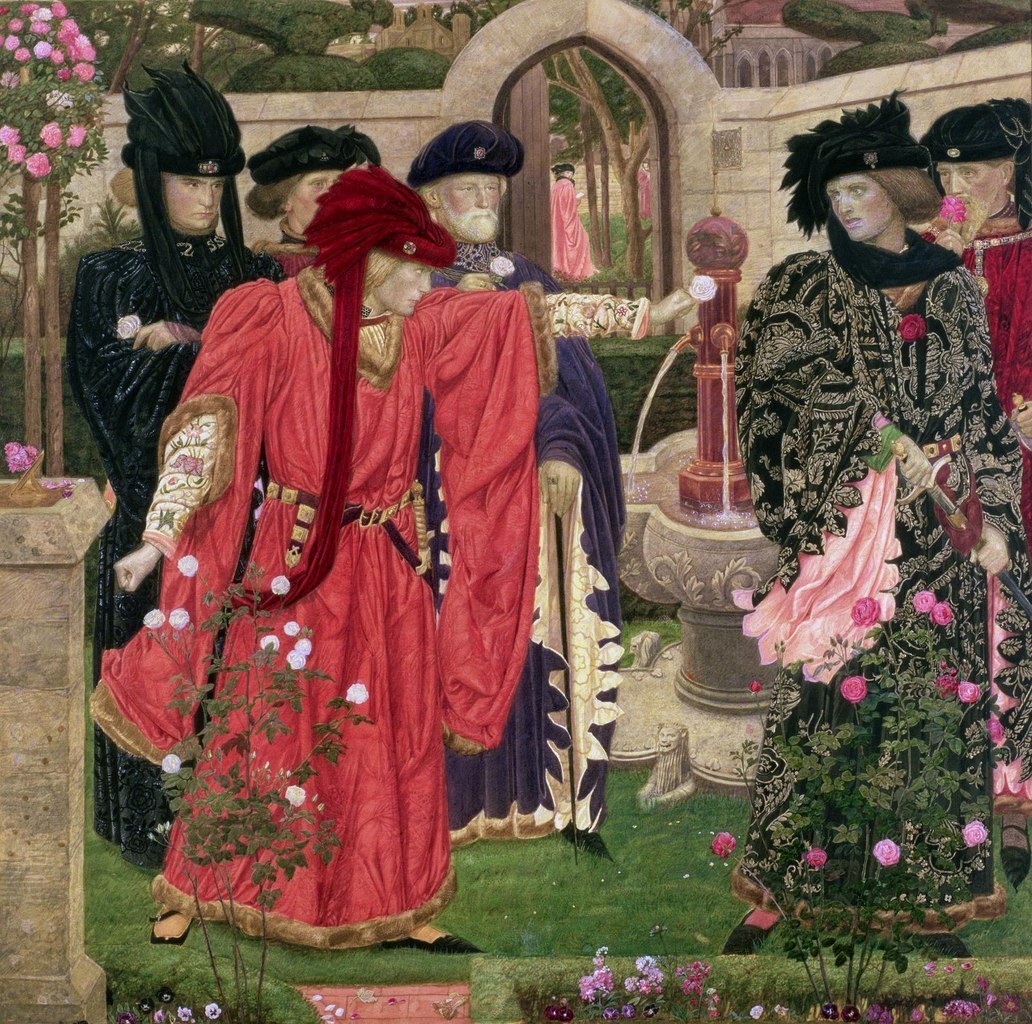 Finally a note about the roses: while the white rose was indeed a badge used by many heads of the House of York, and the red rose a badge used by many heads of the House of Lancaster, the status of each as the badge of its respective faction was imposed retroactively by Henry VII’s creation of the Tudor rose upon his marriage to Elizabeth of York, then bolstered by William Shakespeare’s writing of the Temple Gardens scene in Henry VI, Part 1. The name “Wars of the Roses” came into common use after 1829 in reference to said scene. Their use of symbols for the counties of Yorkshire and Lancashire emerged still later. Notably the roses appear frequently in municipal grants of arms since the 1888 reforms but not in earlier ones. In spite of what some may claim today, the conflict was not a petty rivalry between two northern counties.
EXTERNAL LINKS
UPDATE (13th September)
The latest episode of Jay Foreman’s Map Men covers many of the same topics I have done in this article. Indeed, the resemblance is almost suspicious…
UPDATE (1st November)
For those interested in the region’s past more broadly, I have just found the channel Hull History Nerd. Most of the videos are focused on transport and infrastructure rather than governance.
*The term riding literally means one third (in contrast to the farthings used prominently by a different famous shire) so one of the compass directions had to be left out. Much like the Diocese of Sodor and Man, the name was eventually adopted for a fictional location in Winifred Holtby’s novel. The BBC adapted the novel in 2011 for a miniseries, some parts of which were filmed close to my house.
**Two of them, Leo Hammond and Benjamin Weeks, were at university with me at the time of the election.





 Robin Stanley Taylor