Meeting Michael Foale CBE

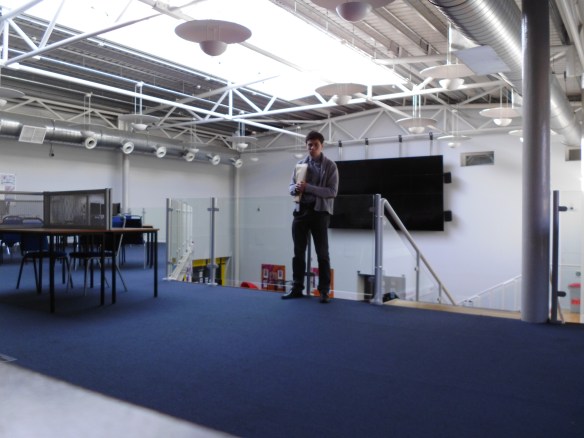
Do my teeth look okay?

During the eighteen months during which I have been a Wilberforce Student, I have met many notable figures. By last Christmas the college had hosted two MPs, an MEP, a baron and a bishop. Today, though, we had an astronaut.

Colin Michael Foale CBE PhD has experience of six shuttle missions, and holds the record for the most time spent in space by any UK citizen. Today he gave a presentation about his career path to being an astronaut. He originally believed that only pilots could have gone onto space missions, but instead found his way in as a scientist.

He attended Queens’ College, Cambridge, attaining a first class degree in Natural Sciences and later a doctorate in Laboratory Astrophysics.Twice he unsuccessfully applied to NASA. Dr Foale showed us footage of the Challenger disaster in 1986, when a shuttle blew up barely a minute after launch and killed all seven occupants. After the disaster, Foale told us, enthusiasm for space only grew. He told us that for his third application essay he abandoned talk of his lifelong dreams and instead focused on the difficulties that the administration then faced, particularly relating to the crash. He was accepted in 1987.

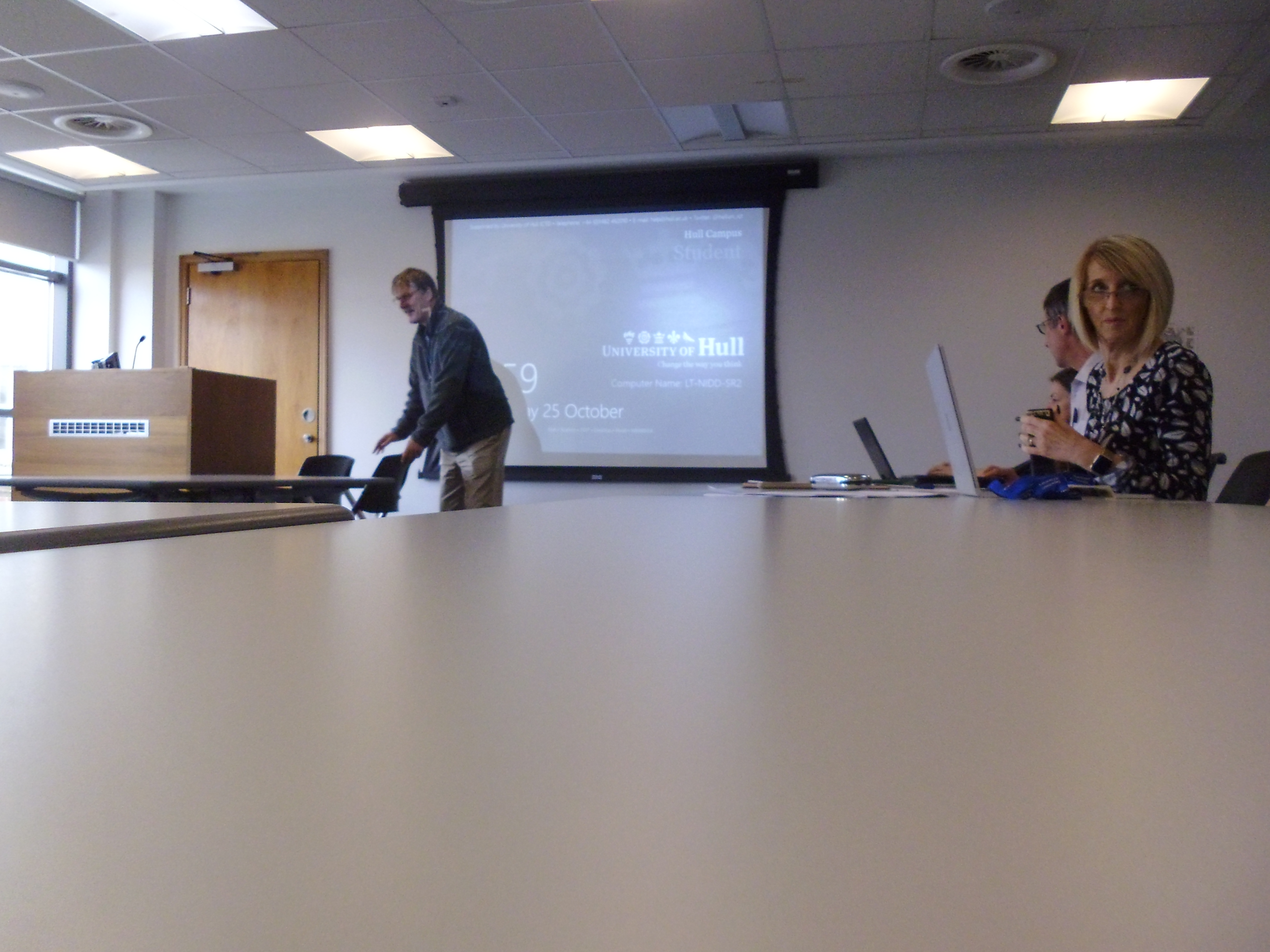
He may have fixed a space station, but can he master Power Point?

He may have fixed a space station, but can he master Power Point?

During his tenure Foale suffered catastrophes of his own. He gave a graphic account the time in 1997 when the Progress M-34 supply craft collided with the Mir station. Ordinarily the Progress ships used the Kurs radio telemetry system to facilitate its docking procedures. This was manufactured by the Kiev Radio Factory, and following the dissolution of the Soviet Union it fell under the jurisdiction of the independent Ukraine, whereas most other things relating to space flight were inherited by the Russian Federation. The Russian Federal Space Agency was at the time facing severe budget cutbacks due to economic troubles and resented having to pay its former constituent republic vast sums of money for the use of Kurs, and so wanted to examine the option of going without. This particular docking attempt was therefore done under the TORU system – meaning that the ship was controlled manually with a camera and two joysticks.

In his presentation, Dr Foale told us (with the aid of his own amateur footage) that the pilot had misjudged the angle of approach, with the result that M-34 damaged Mir‘s solar panels and punched a hole in the Spektr module. Foale was sent into the Soyuz escape craft with the expectation that Mir would be abandoned. He recalled the sensation of his ears popping as the interior began to de-pressurise. Instead they stayed on board to insert a hatch over Spektr’s entrance to seal of the other modules. This stemmed the air leak, but getting it into position required the uncoupling of several cables, with the result that the station lost power. It was also tumbling in space, its orbit having been disrupted by the collision. Foale used his scientific education to analyse the movement of the stars past his window, and from that worked out how to stabilise the station using Soyuz‘s rockets. Eventually power returned when Mir drifted back into sunlight.

Spektr damaged by the collision

Spektr damaged by the collision

We were also shown some of the comparatively mundane realities of living in space. Videos were shown of Foale exercising with bungee straps in lieu of gravity, and of drinking water from a floating sphere. The students also saw a fly-through tour of another space station, showing crew at work and internal walls lined with sacks of spare underwear.

When the presentation proper concluded, Dr Foale took questions from his audience. I asked him what he saw in the future of manned space travel, and he told me to look out for inflatable hotels arriving next year. He also said that things would really kick off when valuable materials could be mined from other planets.

After about ten minutes of questions and answers, the fire alarm went off. In contrast to the instant evacuations which that noise would normally trigger, staff went out to investigate before confirming that we had to leave. The presentation informally concluded in the car park, where Dr Foale took some more questions from passers-by and stopped for some group photographs. Following the all-clear, our guest went back indoors for an interview with BBC Radio Humberside. I and three other students followed him so that we could be interviewed as well.

That evening our visitor did another presentation, though for paying external guests rather than Wilberforce students. Throughout the day we also had a planetarium, lent to us by the University of Hull, set up in the atrium, and visiting pupils from other schools in the area.

A large black igloo-like structureDr Foale was accompanied in his visit by Chris Barber of the International Space School Educational Trust. He advised us that if ever we set up an organisation we should look for a more memorable name. He also remarked that the demolition of two of his former residences showed the degree to which Hull honoured his legacy.

FURTHER READING

Public Domain Day 2017

Monochrome, a suited man with a moustache holds a book.

Wells in 1890.

In most of Europe, a work that is published within the creator’s lifetime remains under copyright for seventy years after their death. As 2016 ends, the works of people who died in 1946 become freely available to all. Such people include…

Helen Bannerman

Helen was born in Edinburgh, but after marrying an officer from the Indian Medical Service she moved to Madras for thirty years. She wrote several children’s books about the Indian people, most famously The Story of Little Black Sambo, in which a small child is chased around a tree by tigers. Bannerman was also the grandmother of Professor Sir Tom Kibble.

The Lord Keynes

Perhaps history’s most famous economist, John Maynard Keynes is the founder of the Keynesian school of economic thought which held that the state should intervene to buffer against depressions and recessions. He has a long list of publications over the course of thirty-six years, but his most notable is A Treatise on Money, where he said that a recession would occur where saving exceeded investment, and that a nation’s wealth should be measured by national income rather than possession of gold.

Paul Nash

Primarily an artist rather than an author, Nash was posted to the Western Front with the Hampshire Regiment where he made sketches of life in the trenches. When sent back to London with a broken rib, he completed a series of twenty images which went on exhibition twice. He was later commissioned as an official war artist. In his next outing to the front he made “fifty drawings of muddy places” which eventually formed another collection. In World War Two he was made an artist for the Royal Air Force where he produced paintings of aeroplanes and the Battle of Britain.

Herbert George Wells

Dubbed by some as the father of science fiction, Wells’s bibliography spans more than fifty years. As well as the obvious classics – The Time Machine, The Island of Doctor Moreau, The Invisible Man and The War of the Worlds – he also did non-fiction work such as Text-Book of Biology and a great many political publications such as War and the Future, The Way the World is Going and In Search of Hot Water and instruction books such as Little Wars which set out the rules for toy soldiers.

Further Reading:

2017 in Public Domain

Interview at Selwyn College

A bush-lined path with a black sign bearing the words "Selwyn College Beware Cyclists"

For Elliot.

Applying to the University of Cambridge was never going to be an easy undertaking. Already I had to submit my UCAS application several months before everyone else, then send of a long series of forms, then sit an entrance examination. Finally (for this year at least) I had to travel to Cambridge in person to attend three interviews with the faculty.

It would not have been feasible to make the journey there and back in a single day, so I left home on Tuesday 13th December and headed for Hull Paragon. I took the 11:23 to Doncaster where, according to my ticket receipt, I was supposed to catch a connection to Stevenage. The timetable, however, was thrown off by a failure some way down the line so I was ushered onto a different service (actually a much earlier train which had already been stuck at Doncaster for about an hour) and told to get off at Peterborough instead. Naturally all of my other connections were lost and so wound up taking the scenic route through Ely before finally arriving in Cambridge at 16:30. My hopes of arriving in daylight had been dashed.

Undeterred I left the station and headed for Selwyn College. This did not go to plan so some time later I returned to the station and got a taxi instead. That journey was much faster (owing to the driver’s unconventional interpretation of both speed limits and the road-pavement divide) and I was able to receive my room key from the porter’s lodge. My accommodation did not have an en suite bathroom – this was shared with the neighbouring room – but it did have a piano, which is not found in most hotel rooms. I was also given six meal vouchers to be used in the dining hall.

P1000647

The Dining Hall

Selwyn’s campus has a split identity: I was housed in Old Court (which you see on most publicity shots), filled with nineteenth-century Gothic revivalism. Behind this, though, you will find a series of strikingly modern buildings for the actual teaching. There is also Ann’s Court, which seems mostly to be of Palladian design.

My first interview was with Doctor Rosie Bolton and Professor Bill Clegg. Bolton showed me a photograph of a walking lawn sprinkler and had me calculate the rate of water flow, the pressure and various other quantities. Clegg then showed me a molecular diagram of a large solid and asked me about the science of driving a wedge through it.

My second interview was with M Smith and Doctor James Keeler. Smith asked me to differentiate and integrate the graphs of trigonometric functions, then Keeler quizzed me on electrophilic addition.

The last session was the general interview. Doctor Daniel Beauregard pondered my career interests beyond university and wanted to know about my extra-curricular interests (such as the internet company and the tower). He also asked for copies of my modular examination certificates. The formal business of my visit was thus concluded. In an excursion spread over three days, the interviews themselves had comprised little more than an hour.

The train station on the morning I left.

After the second night I departed Selwyn and walked back to the railway station. The return journey was far easier as the station was regularly signposted whereas the university was not, though while walking through a large leafy park I did wonder if I had gone astray, and at least one street sign appeared to have been rotated from its proper orientation. The trains back to Hull were all on schedule so I did not need to deviate from my planned route (coincidentally the planned route for the return was the same as the makeshift one for the original journey).

The application process is now out of my hands. I await the post on 11 January for the college’s decision.

Council Report for Michaelmas 2016

A canteen in darkness

The meeting didn’t last that long, did it?

Today was my last day at college for this year. Next week I shall be in Cambridge, giving an interview of Selwyn College, and after that the Christmas holiday begins. I may not see Wilberforce until January.

This term began for me exactly three months ago on Thursday 8th September. As the student council had dissolved several weeks prior, I had the odd experience of reverting to nothingness for the first few days. This state of affairs, though, was short-lived: I had already been asked to return as Secretary for my second year and my reappointment had near-immediate effect.

Last year the council had a slow start as our convener, Katherine Oldershaw, held an introductory session first and then launched the presidential elections. Only after Thomas Gill had been declared victorious (with Miss Alice Longton as his Vice-President) did the council finally begin on the 10th November. This time, per our requests, we had our first meeting on 22nd September. The fact that we had changed the order of events meant that the council was headless for the first four meetings. Katherine essentially made me the acting leader, including making provisional portfolio appointments and chairing once in her absence. The new members (there were only three continuing presences) were eager to make suggestions for improving the college, in particular putting forth a proposal for a so-called “Holistic Pamper Day” to ease the stress of examinations.

Our first major event was on 6th October, when councillors ran a stall at the college’s Freshers’ fair. This aimed to get more people involved in the council, as well as advertising the presidential election and selling cards for the National Union of Students. The election itself was done by email, with polls open from 17th to 21st October. The winner was Mr Sohaib Muhammad, while the runner up (who then became Vice-President) was Miss Reham Bela.

On 4th November, The Lord Norton of Louth gave his speech. My report on the event made its way to Gina Page, Assistant Private Secretary at the Lord Speaker’s Office, who seemed rather impressed.

On 10th November the council’s scheduled meeting was replaced by a session with Tim Blackburn, who wished to advertise to us the Seeds of Change programme. He suggested that students form a company (his preferred form was the worker co-operative, and he gave us pamphlets to this effect) to sell the produce grown on college grounds, in particular concentrating on pizzas with college-grown toppings. He also showed us the kinds of things which could have been bought with the profits, such as outdoor shelters or new furniture.

I was not present for the Children in Need events of 18th November, but reports said that the council had collectively raised £70 for its part. At our meeting on 1st December we debated whether to go ahead or not with the Seeds of Change proposal. Ultimately we decided to put out a student survey on the matter to gauge the general level of interest. A councillor also requested a survey on how to deal with lunchtime queueing (this issue has been a perpetual bug). It was at this meeting that I and the president were formally invited to the meeting of the corporation.

This was to be Muhammad’s first such meeting and my fourth, though it was my first time as a full member. The corporation (which might as well be called the board of governors) contains two student members. The President of the Student Council is automatically one of these, with the other post being open for any councillor to take. All members of the council are additionally allowed to attend corporation meetings as observer status, as I did (the second governorship having gone to Vice-President Longton, though she never actually attended).

The meeting lasted from 16:30 to 19:00. Ordinarily the Student Council section was done first, and the students were not obligated to remain afterwards (indeed I have several times seen other governors disappear midway through sessions). This time, however, our presentation was buried deep in the agenda. A knock-on effect of this was that our gubernatorial appointments did not formally take place until about an hour into the meeting, which also meant that we were not actually allowed to read some of the key documentation for the first stretch. The report was well appreciated, and the governors offered to publish it on-line with the rest of the minutes.

The next day I minuted my final plenary of this term. It was mostly centred around Christmas celebrations, though we also had some notices from the Hull Student Forum (which we largely rejected as spam) and from the United Kingdom Youth Parliament. We also, naturally, recounted a summary of the preceding day’s corporation meeting. On unusual development was that Katherine presented me with an information pack from the House of Lords, containing six booklets and a mouse-pad. Apparently, it was sent following their reception of my report on Professor Norton’s visit. I am still unsure as to how I should respond to this, except with the realisation that the council has no policy on official gifts.

Since I shall be absent for the meeting next week (if, indeed, there is one at all) I shall have to temporarily appoint an under-secretary to whom to discharge my responsibilities. The show, after all, must go on, and someone must ensure it is properly transcribed.

UCAS Day in Leeds

A laboratory, with polished wooden furnishings a scattering of computers and machinery.As my secondary education undergoes its final phase, the planning for the tertiary is well underway. Some weeks ago I submitted my application with the Universities and Colleges Admissions Service (UCAS). As I had applied to study Chemistry at the University of Leeds, I received a letter on 18th October inviting me to their School of Chemistry to be interviewed by one of their staff.

I had visited the same university eleven months prior as part of the Inspire programme, but on this occasion I attended in a personal capacity using private transport. Despite leaving home at 7 am, it was not until past 10 that we finally managed to find the arranged parking space, having lapped Leeds city centre at least once.

A large stone spire against a blue sky.

The funeral venue of Professor Charles Read.

My father drove me as he had his own business in the city: Last year he had become acquainted with Charles Read, with whom he shared an interest in sailing, and who had spent several hours of the early summer going through my Decision Mathematics papers – the mutual benefit being that I needed to pass my AS-Level examinations and he needed to practise the topics his future students would be using. Fifteen months ago Charles suddenly dropped dead while on a research visit in Winnipeg. Today my father needed to go to Leeds in order to collect some boat components from the late professor’s cousin. His most recent prior experience with the city had been to attend Charles’s funeral at the Emmanuel Centre across the road.

Arriving at last at the School of Chemistry, I and the other candidates were assembled in the uncharacteristically glamorous Chaston Chapman Lounge where Dr Warriner formally greeted us and then took us to a student-led presentation on the content of the degree and the opportunities it afforded. Particular attention was given to the industrial advantages of such a qualification, as well as to the potential for trips abroad (all for research purposes, of course).

A large white room with wooden chairs and green leather tubes across one wall.

The Chaston Chapman Lounge did not much resemble the rest of the School of Chemistry.

The next stage of proceedings was to take the applicants on a tour around the campus and the undergraduate accommodation. Much of the scenery felt oddly familiar from my visit last December – right down to the Christmas decorations. We were provided with a free lunch with the students before a second tour, this time of the School of Chemistry in particular. This section of the excursion was perhaps the most important, as though I have been sent on many university visits before it is relatively rare that I have actually seen inside the working areas. Here I was greeted with vast halls of laboratories, with pairs of undergraduates hunched over wooden desks in each alcove. Fume cupboards lined practically every wall. We also saw inside a more generic space – the lecture theatre.

The penultimate experience was that of a practical demonstration by Dr Bruce Turnbull. He explained how machines are used to arrange vast arrays of small chemical samples, allowing hundreds of experiments to be carried out simultaneously. To prove his point he had the device produce a map of the British Isles in the form of coloured solutions.

Dr Turnbull's automated laboratory assistant.

Doctor Turnbull’s automated laboratory assistant.

The final part of the event was the one on one interview with a member of the faculty. In my case that was Dmitry Shalashilin, Professor of Computational Chemistry. He had, in his own words, been destined for academia his whole life, having emigrated from the Soviet Union where his father had been active in the space race. After the boilerplate questions of what made me choose the course or study the sciences generally, he gave me some mathematical puzzles and then we hurried back to the lounge for the wrap-up.

I was assured by the current undergraduates that anyone who turned up to the interview was more-or-less guaranteed an offer. Three down, two to go.

First Time Meeting Philip Norton

A modern library - a bald man stands before a crowd of adolescents.

Our visitor before his crowd.

So far in my time at Wilberforce College I have met two Labour MPs (Diana Johnson and Alan Johnson), one UKIP MEP (Mike Hookem) and an archbishop (Dr John Sentamu). Today the college welcomed Professor Philip Norton, who was both the first Lord Temporal and the first Conservative.

When told at a council meeting two weeks ago of his pending visit I imagined it would be a round-table discussion in the conference room similar to that with Mrs Johnson. Instead his lordship’s appearance bore more in common with that of Sentamu eight months prior, as a hoard of student delegations from various classes (I recall Sociology and Law being singled out) filled out the library to watch his presentation. Whereas for the archbishop’s visit I had been at the edge of the front row, on this occasion I was almost directly in front of our guest, and indeed may have caught some of his saliva at various points in the speech.

His lordship began by asking us all “What Is Politics?” and taking shows of hands from the audience on various contentious political issues. There were majorities in favour of same-sex marriage, assisted dying, and EVEL. Prison suffrage was rather less popular. That done, Norton moved on to explain the role of Parliament in making laws and regulating Her Majesty’s Government. He told us of the work done by the House of Lords in reviewing legislation at great length and in fine detail which the Commons would not have had the capability to manage. He also talked of the value brought to the chamber by the ennoblement of certain surgeons and medical professionals (he brought up The Lord Winston as an example he hoped we would recognize*) and recounted the tale of the Human Fertilisation and Embryology debate in 2007, during which The Lord Brennan collapsed shortly after giving his speech. Norton said that this was the best time and place to do so, as there were numerous leading medical professionals (including the minister leading the debate, The Lord Darzi of Denham) able to rush to his aid.

Once the formal presentation had concluded, Professor Norton held a brief question and answer session. One of my ex-classmates from the history department asked if it was a source of frustration to know that a measure not to his liking was going to pass through parliament. The peer replied that it was a natural part of a parliamentary career, but it at least was not as bad as in the Commons where a member not of the majority party is practically powerless in terms of major legislation. I then asked if, in light of the recent High Court ruling, he believed there was a strong chance of his noble friends and colleagues ultimately blocking Britain’s exit from the European Union. He replied that although the house would certainly subject the decision to a heavy level of scrutiny and criticism, there was little chance of them blocking the move outright. The professor went so far as to suggest that the House of Commons might even resort to the use of the Parliament Acts to ensure that the result of the referendum was implemented.

A bald man in a suit with a poppy and lanyard smiles while crossing his arms.

Sadly my camera found more light in the background than on his lordship’s face.

As the meeting drew to a close and students filed out of the library, I convinced his lordship to pose for a photograph, so that his Wikipedia page could have a profile picture – which it and many others currently lack due to the difficulty of finding public domain images. Now that I have obtained such an image, I can ensure that today’s meeting will have some significance in Norton’s public image.

*I had previously seen Professor Winston at GCSE Science Live in January 2013, but I hesitate to claim I met him given that the enormous lecture hall allowed a substantial chasm between his podium and my upper-gallery seat.

UPDATE (December 2016)

Katherine Oldershaw, the staff member in charge of the student council, requested that I write a report on Norton’s visit in my capacity as secretary. That report was later published in the college’s internal magazine. Through a chain of emails (with so many forwards and replies that it resembled an archaeological dig) I learned that Katherine had passed it on to business liaison manager Clare Shaw, who in turn sent it to Gina Page, assistant private secretary at the Lord Speaker’s office. Miss Page arranged for me to be sent a stack of information booklets from the Palace of Westminster. I wonder what I’d have to write to get a free Bertie sent to me?

UPDATE (April 2018)

My photograph has been made redundant as the Parliamentary Digital Service has released several hundred new free-licence portraits of members of the House of Lords by Chris McAndrew, who did the same for MPs just after the 2017 general election. As of posting, my illustration of the noble lord’s shield of arms is still there.

UPDATE (December 2019)

I have changed the post title from “Meeting Philip Norton FRSA” to “First Time Meeting Philip Norton” and added the tag “Norton of Louth”. When I originally made this post I expected that the presentation would be a one-off event. Since I matriculated at the University of Hull I have found myself attending quite a few events involving the professor and thus have decided that, in retrospect, this post is better viewed as the prelude to a series instead of a standalone occasion.

A Brief History of By-elections

cameron-wave3

David Cameron, formerly the right honourable member for Witney

This morning the proceedings in the chamber of the House of Commons began with the following exchange:

The Right Honourable John Bercow (Speaker of the House and member for Buckingham): Order, order, Dame Rosie Winterton.

The Right Honourable Dame Rosie Winterton (Opposition Chief Whip and member for Doncaster Central): I beg to move that Mr Speaker do issue his warrant to the Clerk of the Crown, to make out a new writ for the electing of a member to serve in this present parliament for the borough constituency of Batley & Spen, in the room of Helen Joanne Cox, deceased.

John Bercow: The question is that I do issue my warrant to the Clerk of the Crown to make out a new writ for the electing of a member to serve in this present parliament for the constituency of Batley & Spen, in the room of Helen Joanne Cox, deceased. As many as are of that opinion will say “Aye”.

Honourable members: Aye!

John Bercow: …of the contrary “No”.

Honourable members: –

John Bercow: The ayes have it, the ayes have it. Order, order, Mr Gavin Williamson.

The Right Honourable Gavin Williamson (Parliamentary Secretary to the Treasury and member for South Staffordshire): I beg to move that Mr Speaker do issue his warrant to the Clerk of the Crown to make out a new writ for the electing of a member to serve in this present parliament for the county constituency of Witney, in the room of the Right Honourable David William Donald Cameron, who since his election has been appointed to the office of Steward & Bailiff of Her Majesty’s manor of Northstead in the county of York.

John Bercow: Thank you. The question is that I do issue my warrant to the Clerk of the Crown to make out a new writ for the electing of a member to serve in this present parliament for the county constituency of Witney, in the room of the Right Honourable David William Donald Cameron, who since his election has been appointed to the office of Steward & Bailiff of Her Majesty’s manor of Northstead in the county of York. As many as are of that opinion will say “Aye”.

Honourable members: Aye!

John Bercow: …of the contrary “No”.

Honourable members: –

John Bercow: I think the ayes have it, the ayes have it.

The above prose records “moving the writ” – the first component of a parliamentary by-election. The House of Commons is elected at large once every few years following the dissolution of its predecessor, with all six hundred and fifty constituencies being contested simultaneously. On occasion, however, an individual seat will be vacated during the course of a parliament, requiring the electoral process to be repeated in that constituency alone so that a new member can represent that constituency in the same legislature (rather than waiting for the whole new parliament to arrive). Sometimes there will be more than one vacancy overlapping, so multiple by-elections will be held simultaneously.

Since the general election of 2015 there have so far been five by-elections (not counting the two just initiated). The first was in Oldham West & Royton, following the death of Michael Meacher. Alongside “Super Thursday” in May there were two more – Sheffield Brightside & Hillsborough (for Harry Harpham, who had died in January) and Ogmore (for Huw Irranca-Davies who had resigned to contest the same seat for the National Assembly). That same day saw London elect as its mayor The Right Honourable Sadiq Khan, who promptly vacated the constituency of Tooting. All of these elections were Labour holds.

The most recent pair, however, have a different story. On the day of the Tooting by-election (16th June) there was a shooting attack against Jo Cox MP. She died a few hours later. Campaigning for the EU referendum seven days later was briefly suspended and parliament recalled from its short recess to pay tributes. The timing was unfortunate not just because of its proximity to the referendum but also because of its proximity to the summer recess. By-elections take approximately four weeks between the moving of the writ and the polling day, but for a deceased member the writ is delayed until after the funeral. In Jo Cox’s case this meant there was no time left before the summer and so the election will wind up happening more than four months after the vacancy opened.

Witney is a different story. Its vacancy opened on 12 September when the aforementioned Mr Cameron received his aforementioned appointment. In a bizarre case of the patron becoming the client, he was given the job after writing to the Chancellor of the Exchequer whom he had so recently employed at the Foreign & Commonwealth Office. The Steward and Bailiff of the Manor of Northstead, alongside that of the Three Hundreds of Chiltern, is an office of profit under the crown. They are mere sinecures (the manor house collapsed in the 1600s and the hundreds were taken over by other officials still earlier) which have since the mid-eighteenth century been used for the sole purpose of allowing a member of the commons to step down.

In the old kingdom of England the role of parliamentarian was a rather taxing one – pay was only nominal and attendance at Westminster deprived many of life in their constituencies. Many were elected reluctantly or even against their will. It was in this situation that a resolution was passed in 1624 banning members from resigning their seats. Decades later, though, a loophole was created by the Act of Settlement. Being desirous of reducing the influence that royal patronage held over the legislature, parliament enacted an early form of separation of powers – any MP who was appointed to an office of profit under the crown (this term then included ministerial posts) would be disqualified from his seat, but a person was allowed to be elected to the house without vacating such a position which they held already. This began a very long tradition whereby a newly-appointed minister would begin his tenure by immediately fighting a by-election to renew their mandate. As time went on and ministers of the crown became more numerous such elections became a severe nuisance with each cabinet reshuffle demanding multiple writs and a general election which resulted in a change of government would then see the new set of ministers have to contest their constituencies for a second time in rapid succession.

Changes were enacted in 1867 for the shuffling of existing ministers to be exempted. In the First World War there were acts to temporarily suspend the procedure and finally in 1926 the concept was abolished altogether. Sinecures such as the Chiltern Hundreds were the exception, surviving purely as a means of allowing a member to quit in the course of a parliament. To “take the Chiltern Hundreds” is a long-standing euphemism for resignation.

FURTHER READING

Wikipedia:

Resignation from the British House of Commons

The Act of Settlement

Ministerial by-election

Recent By-Elections

Chiltern Hundreds

Manor of Northstead

Parliament:

By-elections

Timetables


Encyclopedic Knowledge

The main selling point of Wikipedia is its open nature. Unlike other on-line information sources, Jimmy Wales’s gift to the world can be edited by anyone and everyone reading it. Further, where most forums or newspaper articles would request at least a name and an email address before permitting outsider contributions to be made, if not a full account established, Wikipedia allows strangers to interact with the site’s content with negligible effort or commitment. That being said, a great many regular users do sign up, as I did in February 2014. Since then I have made well over a thousand edits to various pages. The vast majority of these have been minor, often inconsequential details, but then that is how most Wikipedia edits go. Thousands of contributors make thousands of piecemeal amendments (linking one page to another, adding a picture, extending a paragraph by half a sentence, etc) which over time allow enormous and elaborate articles to grow. There are few pages which any individual can truly call their own work, for each is the product of less an elephant than an army of ants.

Theoretically any editor can write anything on any page. In practice, however, editors who attempt to cover all the information in the world will quickly find their efforts obliterated by another with superior local knowledge. In a community so vast, the generalist stands no chance. It is more prudent, therefore, to specialise in the extreme and carve out a niche, however minuscule, where one can reign supreme. In my case this was the correction and maintenance of the honorifics of British politicians.

While my primary interest would ordinarily have been the natural sciences, I knew that I would struggle to hold my own on any scientific topic compared to those with far greater qualification on the matter. I went instead for a relatively simple yet frequently error-laden topic where the corrections were simple to grasp and unlikely to be challenged.

By and large my edits were to pages rarely perused – such as colourising the illustration for John Fane, 10th Earl of Westmorland or establishing a new info-box for George Henry Roberts. Occasionally, though, I have moved to more populous wards, whose greater interest and attention can sometimes generate controversy and conflict. Margaret Thatcher, for instance, is hotly contested – not only for her divisive political legacy, but also the mere issue of whether she should be styled as “The Lady” or “The Baroness”. If edits to the biographies of the dead were contentious, those of the living are a minefield. In particular those involved in unfolding events tend to undergo short but dense periods of extremely heavy editing over seemingly minor but often quite important issues.

Since I took up this hobby, Britain has undergone two changes of government. The first was caused by a parliamentary general election whose date was advertised as 7th May, but whose origins were several weeks earlier: When a parliament of the United Kingdom has run its course it must dissolve, to be replaced by the product of the ensuing votes. In the past the dates of dissolution and election would be a closely guarded secret until its announcement by the prime minister, but the Fixed-term Parliaments Act 2011 removed this prerogative so that the expiration date of the fifty-fifth parliament was known in advance to be Sunday 30th March 2015. As midnight approached on Saturday 29th I was poised to strike, for dissolution means that the House of Commons no longer exists and thus the people formerly described as MPs are no longer entitled to that status. Their post-nominals must therefore be deleted and suggestions of incumbency rectified. On the first day of official campaigning I enacted this for the pages of more than a hundred politicians. On election night, of course, I had to begin putting them back again.

After a British general election it is traditional for the outgoing government to publish a list of Dissolution Honours. I created a page in waiting but no list appeared, and when I tried to add the names of new peers appointed immediately to the new parliament (Maude of Horsham, Altmann, Keen of Elie, Dunlop) they were swiftly struck down. Finally I gave up and, assuming that there was to be no list at all, requested that the useless page be deleted. When the list finally did appear I was on holiday with no access to the internet, so that the process was started again and almost completed without me. All that remained was to move the pages of lesser known recipients to less ambiguous addresses (such as Donald Foster (politician) to Don Foster, Baron Foster of Bath).

Later in the same year Canada had its own federal election. Though the Canadian parliamentary system is in many ways a carbon copy of our own, the events there elapsed rather differently – the Conservative Party was defeated and Stephen Harper announced he would step down as prime minister. Immediately (indeed, before the election had even concluded), the page of his victorious rival Justin Trudeau MP (Liberal, Papineau) had been edited to credit him as “Prime Minister of Canada”. He was unfit to be thus accredited, however, for his appointment to said office had not yet happened. Whereas British elections – excepting those which produce hung parliaments, of course – typically conclude with the leaders of the defeated parties vacating their posts before all of the seats have even declared, it remains in Canada conventional for several days to elapse before the resignation of a defeated incumbent actually takes effect. So it was last year that despite polling day having been 15th October, Trudeau the Younger did not come to power until 4th November. This, naturally, was too slow for the notoriously impatient citizens of the internet, so his info-box had instead oscillated between such unsupportable adornments as “Prime Minister-elect”, “Prime Minister-designate” and “Prime Minister (presumptive)” throughout the interlude until finally the undifferentiated appellation became reality.

Come 2016, the elections arrived for the Scottish Parliament, the National Assembly for Wales and the Northern Ireland Assembly. Again, I raced through page after page deleting MSP, AM and MLA from every info-box I could find. I also edited the pages of the legislatures themselves to set the memberships to zero and change the party balance pictures to show empty chambers. Again, these all had to be restored for the re-elected once the results had been announced. In simultaneous occurrence was the London mayoral election, in which a smaller group of candidates battled to replace Boris Johnson MP as Britain’s most popularly-mandated statesman. Elections of this type use the Supplementary Vote, a kind of cut-price Alternative Vote system in which all but the top two candidates would be eliminated after the first round. In this case it was obvious well in advance that said candidates would be Zac Goldsmith MP (Conservative) and Sadiq Khan MP (Labour). Given that London is more populous than Scotland, and that the mayoral race has the entire city as one enormous constituency, it is perhaps unsurprising that the counting process took over twenty-four hours. The editors naturally got twitchy. As soon as newspapers began reporting that Khan was “ahead” or “set to win” there came a series of edits and reverts as various users jostled to be the first to add the “Mayor of London” category. Again there were some “Mayor-elect” attempts also, regardless of the fact that the right honourable member for Tooting had not yet been formally (or even informally) declared the winner.

As long and as complicated as “Super Thursday” might have been it could never have been Britain’s primary political event in 2016. That distinction is the property of the referendum on 23rd June, in which some seventeen million voters decided that the United Kingdom should no longer be a member of the European Union. In spite of earlier insistence that he would remain regardless (and strong requests from ministerial colleagues on both sides to do so) David Cameron told the nation that fresh leadership was required and thus he would step down at some point in the autumn. His “term_end” was at once set to October 2016 before being swiftly reverted. Again there was a dispute between the semantics of announcing that one intends to resign, resigning, and ceasing to be incumbent.

There was no time to quibble over the status of the government, though, as events were unfolding rather more rapidly in the opposition. News emerged shortly after the referendum that Labour MPs (namely the Right Honourable Dame Margaret Hodge) had called for a motion of no confidence in their leader Jeremy Corbyn, following his alleged poor performance in the campaign. These sentiments were relayed to him personally by his shadow foreign secretary Hillary Benn, whom Corbyn promptly dismissed from his frontbench team. Mr Benn was swiftly followed by a steady trickle of other shadow ministers who resigned in protest, citing similar dissatisfactions with Corbyn’s leadership. Naturally I went to edit their respective pages to note their departures, only to realise that many of their offices had never been listed in the first place. When a person is appointed to be a minister of the crown – in particular a secretary of state – then there will be official correspondence including certain legal documents which explicitly say which job they have and when they got it. For junior ministers there is less available evidence (their appointments are not mentioned in Orders in Council) and though there is some documentation of their offices (such as Hansard, or official correspondence, or the government’s website) there can often be inconsistencies between references (sometimes they are just a minister of parliamentary undersecretary of state, name of department, others they have a more specific title) and often there are subtle changes in the exact portfolio whenever such a position changes hands. Marking out a clear line of succession for certain junior posts is therefore rather difficult. It is not helped by the fact that junior ministers are, by nature, given less media attention and so there are fewer sources to hand. Moving over to the opposition team, the shadow cabinet are usually fairly well documented, but it should be remembered that theirs are courtesy titles in the gift of the leader of the opposition. While mostly they correspond to the titles of those on the treasury bench, there are some (such as Michael Howard’s Shadow Secretary of State for the Family or Jeremy Corbyn’s Shadow Minister for Young People & Voter Registration) which do not, which heralds yet more confusion. Such was the state of affairs throughout the last week of June when, in the words of some otherwise-forgettable Twitter commentator “People whom I’ve never heard of are resigning from positions I didn’t know existed.” Eventually Mr Corbyn announced his new team, which was filled with people even more obscure. Richard Burgon MP, for example, became Shadow Lord Chancellor at the age of thirty-five, having only been elected to the House of Commons thirteen months prior. He, and many others in what surely must now be Labour’s C or even D team, had a biography shorter than that of Larry the Cat.

Eventually the “coup” subsided when there was nobody left to resign, and Corbyn still did not step down as leader. Over on the Conservative side, by contrast, the leadership election moved all too quickly. The first ballot saw Theresa May win the support of exactly half of the Conservative MPs, with Stephen Crabb and Liam Fox dropping out. The second ballot eliminated Michael Gove, which left the final battle between May and Andrea Leadsom. For the briefest of moments it appeared that an intense fight was about to erupt as Leadsom cast doubts on the barren May’s ability to govern as a non-mother. Then, suddenly, it was all over – on Monday 11th July the minister of state was seen announcing her withdrawal from the contest. The whole political landscape changed as Theresa May was left as the only candidate in the severely truncated race. Yet again the editors were quick to proclaim the new premier, as if First Lord of the Treasury were an actual barony whose abeyance had recently been terminated. Shortly after Leadsom’s surrender a meeting of the 1922 Committee was convened and May was officially declared Leader of the Conservative Party. Cameron, now even more of a lame duck than before, brought forward his resignation to Wednesday 13th July. The next two days saw an excruciating struggle to keep the relevant pages up (or rather down) to date against myriad attempts to publish the handover prematurely. After Cameron’s speech before the black door, the cameras hovered around Buckingham Palace waiting for the former prime minister to emerge and the incoming one to arrive. Finally – and after an awkward photograph of the home secretary shaking Her Majesty’s hand, Mrs May returned to Downing Street to announce that she had indeed accepted a request to form a government. Finally the moderators gave way and the edit could legitimately be made.

The relief was to be short-lived, for the new prime minister hurriedly enacted a cabinet reshuffle, sifting out the Notting Hill set in favour of her own allies. There were some short spells of confusion, such as when it appeared that Jeremy Hunt had been relieved of the Department of Health, only to find that he would remain in place (word had it that May had wanted Theresa Villiers to replace him, but then Villiers resigned and there were no other candidates available). Whereas the reshuffle was for the most part routine (if rather large), there were some notable differences with the establishment of three new departments of state (Exiting the European Union; International Trade and Business, Energy & Industrial Strategy) and the dissolution of two old ones (Energy & Climate Change and Business, Innovation & Skills). Many of her predecessors were criticised for rearranging departments too often, but Cameron was unusually passive in this regard – his one noticeable change was to have the department for children, schools & families renamed the Department for Education. Collectively the editors cocked up the transition where the business portfolio was concerned, as the new BEIS had a separate page created, thus preventing the old one from being moved until the erroneous creation had been deleted. Finally it was assumed that Greg Clark would be President of the Board of Trade, as all his predecessors had been. Instead, it transpired that this sinecure would actually belong to the Secretary of State for International Trade (The Right Honourable Dr Liam Fox MP). Amusingly we discovered that government officials had made the same error themselves, with Clark being appointed president for four days until Fox succeeded him.

Now, at the end of August, the British political line-up appears to have reached a moment of relative stability. No doubt there will be further resignations, appointments and re-elections in the foreseeable future, and no doubt there will be confusion over who has what, but I or others like me will always be around to ensure that, if nothing else, their post-nominals will be accurate.

Algae, the Green Death

A brown river, crossed by a log behind which the surface is wholly covered in algae.

Keyingham Drain is entirely green on some days.

The algal bloom is a problem in many lakes and rivers. In the wrong weather conditions, a body once teeming with life can quickly become an water graveyard if certain organisms cannot be controlled.

An algal bloom is a rapid increase in the population of algae in an aquatic system. There is no fixed benchmark for when an algal growth becomes a bloom – some say the concentration should be in the hundreds of cells per millilitre, some say it should be in the thousands. A bloom occurs when a body of shallow, slow-moving water has an excess of phosphorus and nitrogen nutrients, usually caused by fertiliser leakage or waste-water. This leads to green plants and algae growing at an increased rate at the expense of other organisms. In particular the algae can clump together to form a gelatinous blanket on the surface of the water, which blocks out the light of the sun. The then-permanent darkness means that the plants beneath the surface can no longer photosynthesise, with the inevitable result that they perish. Their corpses are devoured by decomposers. The sudden abundance of food allows these organisms to grow and multiply rapidly, and they consume the oxygen in the water which – in the absence of photosynthesising plants – cannot be replaced. Once the oxygen is exhausted the fish and aquatic insects within the water body die off and the internal ecosystem collapses. Beneath the garish top layer, the water is devoid of life.

Adolphe_Millot_algues