Meeting Michael Foale CBE

Do my teeth look okay?

During the eighteen months during which I have been a Wilberforce Student, I have met many notable figures. By last Christmas the college had hosted two MPs, an MEP, a baron and a bishop. Today, though, we had an astronaut.

Colin Michael Foale CBE PhD has experience of six shuttle missions, and holds the record for the most time spent in space by any UK citizen. Today he gave a presentation about his career path to being an astronaut. He originally believed that only pilots could have gone onto space missions, but instead found his way in as a scientist.

He attended Queens’ College, Cambridge, attaining a first class degree in Natural Sciences and later a doctorate in Laboratory Astrophysics.Twice he unsuccessfully applied to NASA. Dr Foale showed us footage of the Challenger disaster in 1986, when a shuttle blew up barely a minute after launch and killed all seven occupants. After the disaster, Foale told us, enthusiasm for space only grew. He told us that for his third application essay he abandoned talk of his lifelong dreams and instead focused on the difficulties that the administration then faced, particularly relating to the crash. He was accepted in 1987.

He may have fixed a space station, but can he master Power Point?

He may have fixed a space station, but can he master Power Point?

During his tenure Foale suffered catastrophes of his own. He gave a graphic account the time in 1997 when the Progress M-34 supply craft collided with the Mir station. Ordinarily the Progress ships used the Kurs radio telemetry system to facilitate its docking procedures. This was manufactured by the Kiev Radio Factory, and following the dissolution of the Soviet Union it fell under the jurisdiction of the independent Ukraine, whereas most other things relating to space flight were inherited by the Russian Federation. The Russian Federal Space Agency was at the time facing severe budget cutbacks due to economic troubles and resented having to pay its former constituent republic vast sums of money for the use of Kurs, and so wanted to examine the option of going without. This particular docking attempt was therefore done under the TORU system – meaning that the ship was controlled manually with a camera and two joysticks.

In his presentation, Dr Foale told us (with the aid of his own amateur footage) that the pilot had misjudged the angle of approach, with the result that M-34 damaged Mir‘s solar panels and punched a hole in the Spektr module. Foale was sent into the Soyuz escape craft with the expectation that Mir would be abandoned. He recalled the sensation of his ears popping as the interior began to de-pressurise. Instead they stayed on board to insert a hatch over Spektr’s entrance to seal of the other modules. This stemmed the air leak, but getting it into position required the uncoupling of several cables, with the result that the station lost power. It was also tumbling in space, its orbit having been disrupted by the collision. Foale used his scientific education to analyse the movement of the stars past his window, and from that worked out how to stabilise the station using Soyuz‘s rockets. Eventually power returned when Mir drifted back into sunlight.
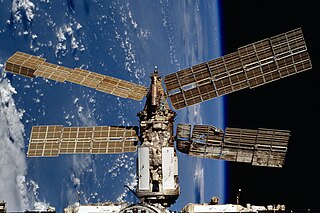
Spektr damaged by the collision

Spektr damaged by the collision

We were also shown some of the comparatively mundane realities of living in space. Videos were shown of Foale exercising with bungee straps in lieu of gravity, and of drinking water from a floating sphere. The students also saw a fly-through tour of another space station, showing crew at work and internal walls lined with sacks of spare underwear.

When the presentation proper concluded, Dr Foale took questions from his audience. I asked him what he saw in the future of manned space travel, and he told me to look out for inflatable hotels arriving next year. He also said that things would really kick off when valuable materials could be mined from other planets.

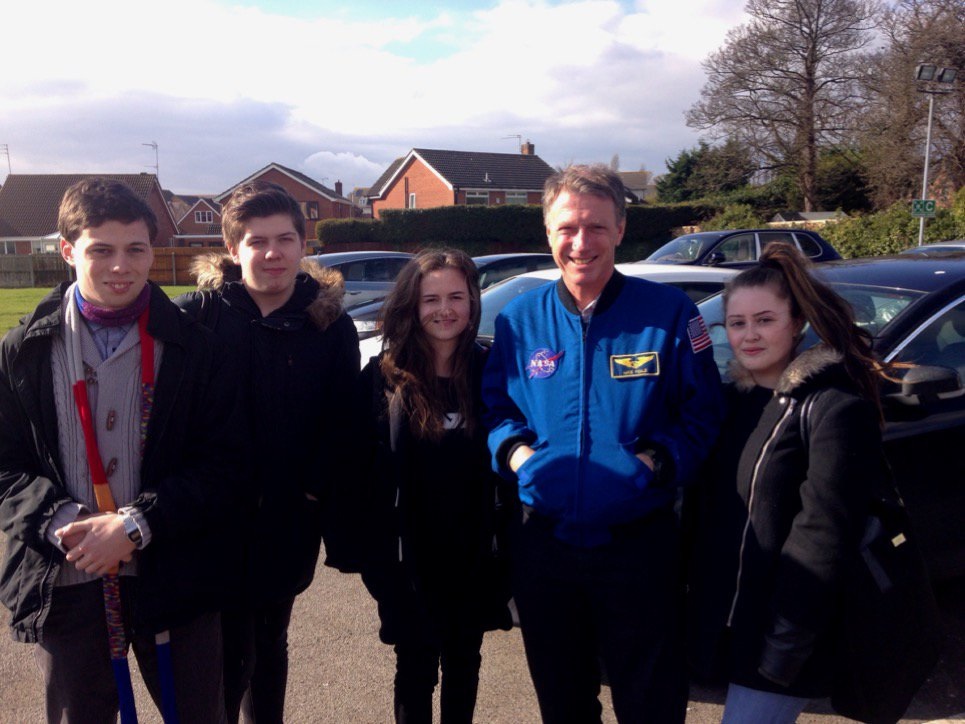
After about ten minutes of questions and answers, the fire alarm went off. In contrast to the instant evacuations which that noise would normally trigger, staff went out to investigate before confirming that we had to leave. The presentation informally concluded in the car park, where Dr Foale took some more questions from passers-by and stopped for some group photographs. Following the all-clear, our guest went back indoors for an interview with BBC Radio Humberside. I and three other students followed him so that we could be interviewed as well.

That evening our visitor did another presentation, though for paying external guests rather than Wilberforce students. Throughout the day we also had a planetarium, lent to us by the University of Hull, set up in the atrium, and visiting pupils from other schools in the area.
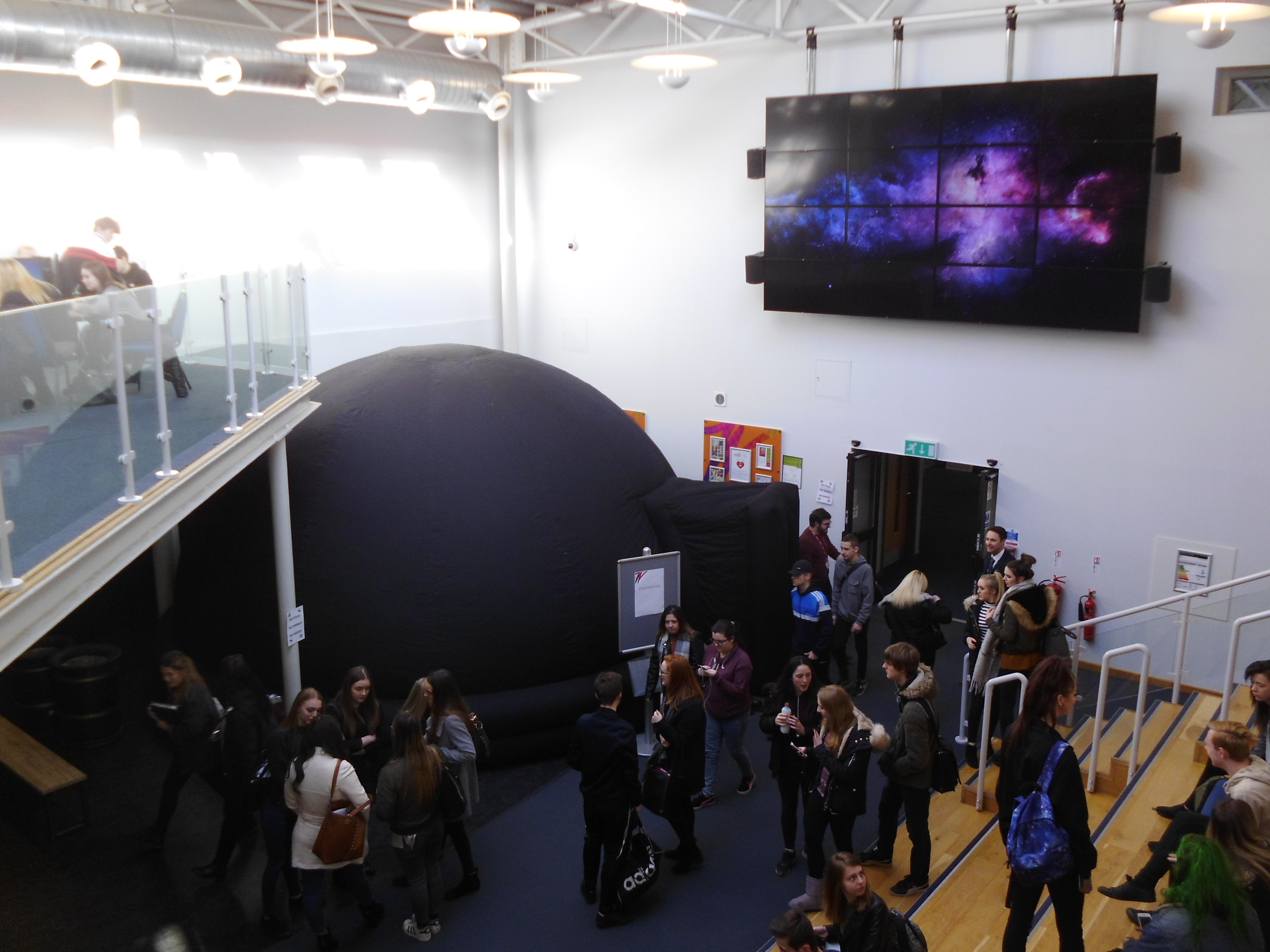
A large black igloo-like structureDr Foale was accompanied in his visit by Chris Barber of the International Space School Educational Trust. He advised us that if ever we set up an organisation we should look for a more memorable name. He also remarked that the demolition of two of his former residences showed the degree to which Hull honoured his legacy.

FURTHER READING

First Time Meeting Philip Norton

A modern library - a bald man stands before a crowd of adolescents.

Our visitor before his crowd.

So far in my time at Wilberforce College I have met two Labour MPs (Diana Johnson and Alan Johnson), one UKIP MEP (Mike Hookem) and an archbishop (Dr John Sentamu). Today the college welcomed Professor Philip Norton, who was both the first Lord Temporal and the first Conservative.

When told at a council meeting two weeks ago of his pending visit I imagined it would be a round-table discussion in the conference room similar to that with Mrs Johnson. Instead his lordship’s appearance bore more in common with that of Sentamu eight months prior, as a hoard of student delegations from various classes (I recall Sociology and Law being singled out) filled out the library to watch his presentation. Whereas for the archbishop’s visit I had been at the edge of the front row, on this occasion I was almost directly in front of our guest, and indeed may have caught some of his saliva at various points in the speech.

His lordship began by asking us all “What Is Politics?” and taking shows of hands from the audience on various contentious political issues. There were majorities in favour of same-sex marriage, assisted dying, and EVEL. Prison suffrage was rather less popular. That done, Norton moved on to explain the role of Parliament in making laws and regulating Her Majesty’s Government. He told us of the work done by the House of Lords in reviewing legislation at great length and in fine detail which the Commons would not have had the capability to manage. He also talked of the value brought to the chamber by the ennoblement of certain surgeons and medical professionals (he brought up The Lord Winston as an example he hoped we would recognize*) and recounted the tale of the Human Fertilisation and Embryology debate in 2007, during which The Lord Brennan collapsed shortly after giving his speech. Norton said that this was the best time and place to do so, as there were numerous leading medical professionals (including the minister leading the debate, The Lord Darzi of Denham) able to rush to his aid.

Once the formal presentation had concluded, Professor Norton held a brief question and answer session. One of my ex-classmates from the history department asked if it was a source of frustration to know that a measure not to his liking was going to pass through parliament. The peer replied that it was a natural part of a parliamentary career, but it at least was not as bad as in the Commons where a member not of the majority party is practically powerless in terms of major legislation. I then asked if, in light of the recent High Court ruling, he believed there was a strong chance of his noble friends and colleagues ultimately blocking Britain’s exit from the European Union. He replied that although the house would certainly subject the decision to a heavy level of scrutiny and criticism, there was little chance of them blocking the move outright. The professor went so far as to suggest that the House of Commons might even resort to the use of the Parliament Acts to ensure that the result of the referendum was implemented.

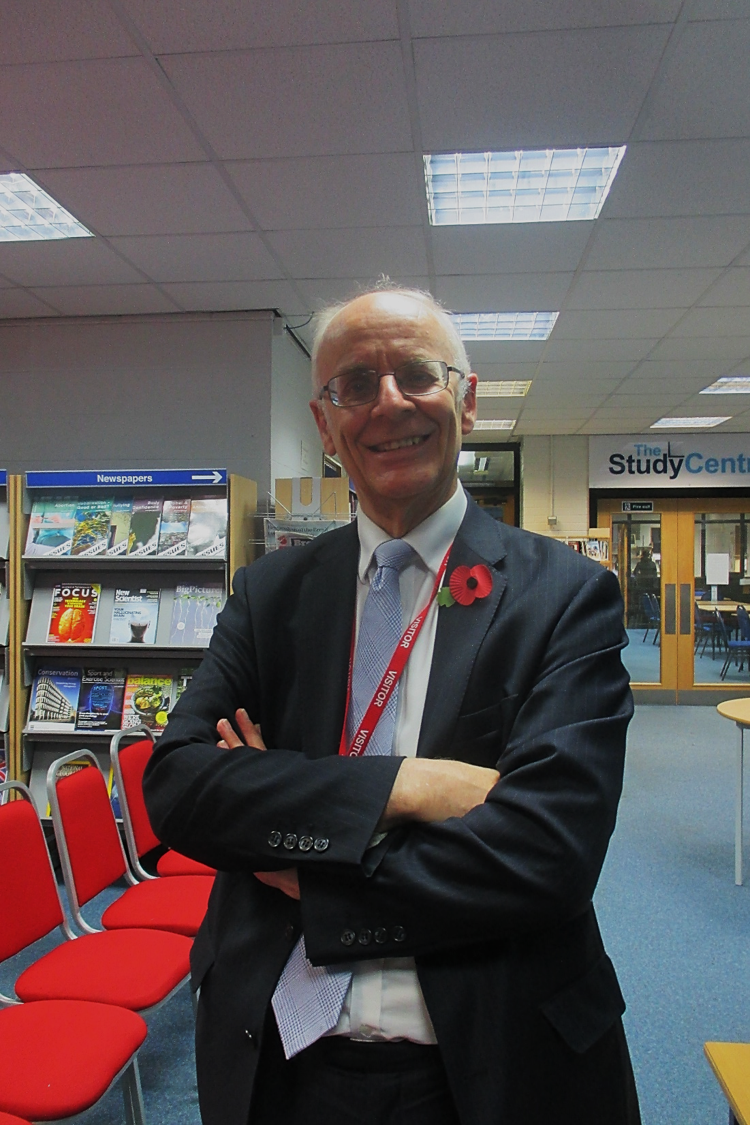
A bald man in a suit with a poppy and lanyard smiles while crossing his arms.

Sadly my camera found more light in the background than on his lordship’s face.

As the meeting drew to a close and students filed out of the library, I convinced his lordship to pose for a photograph, so that his Wikipedia page could have a profile picture – which it and many others currently lack due to the difficulty of finding public domain images. Now that I have obtained such an image, I can ensure that today’s meeting will have some significance in Norton’s public image.

*I had previously seen Professor Winston at GCSE Science Live in January 2013, but I hesitate to claim I met him given that the enormous lecture hall allowed a substantial chasm between his podium and my upper-gallery seat.

UPDATE (December 2016)

Katherine Oldershaw, the staff member in charge of the student council, requested that I write a report on Norton’s visit in my capacity as secretary. That report was later published in the college’s internal magazine. Through a chain of emails (with so many forwards and replies that it resembled an archaeological dig) I learned that Katherine had passed it on to business liaison manager Clare Shaw, who in turn sent it to Gina Page, assistant private secretary at the Lord Speaker’s office. Miss Page arranged for me to be sent a stack of information booklets from the Palace of Westminster. I wonder what I’d have to write to get a free Bertie sent to me?

UPDATE (April 2018)

My photograph has been made redundant as the Parliamentary Digital Service has released several hundred new free-licence portraits of members of the House of Lords by Chris McAndrew, who did the same for MPs just after the 2017 general election. As of posting, my illustration of the noble lord’s shield of arms is still there.

UPDATE (December 2019)

I have changed the post title from “Meeting Philip Norton FRSA” to “First Time Meeting Philip Norton” and added the tag “Norton of Louth”. When I originally made this post I expected that the presentation would be a one-off event. Since I matriculated at the University of Hull I have found myself attending quite a few events involving the professor and thus have decided that, in retrospect, this post is better viewed as the prelude to a series instead of a standalone occasion.

A Date for the Calendar

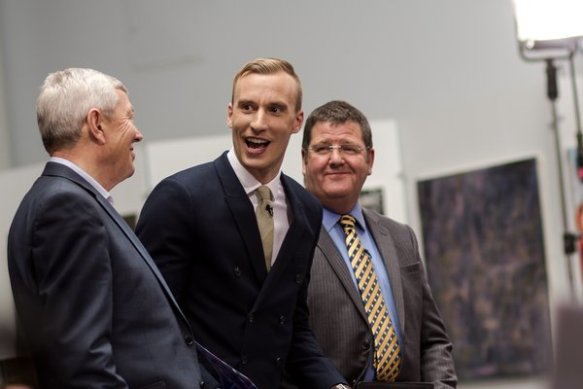
Left: Rt Hon Alan Johnson MP (a white-haired man in a grey suit); Middle: Paul Brand (short blonde hair, black suit, pale yellow/green tie); Right: Mike Hookem MEP (spectacles, short brown hair, grey suit with blue shirt and yellow/black stripy tie).

Paul Brand of Independent Television introduces the pundits.

Britain’s relationship with the European Union has been highly controversial since before it even began. Forty-one years ago after the original referendum on whether to stay in the European Economic Community, the question “Should the United Kingdom remain a member of the European Union or leave the European Union?” has been put to the people, to be answered on 23rd June. This has been the biggest talking point in British politics generally, and it has also been a recurring issue at Wilberforce College.

For a long time we knew relatively little about the debate. We knew that ITV Calendar would be covering it and that students were invited to ask questions, but we had no certain knowledge of the politicians in attendance. At various points we thought we might have David Davis, Karl Turner, Diana Johnson or Graham Stuart. Then we heard that we would have Alan Johnson and a UKIP MEP (we never knew which one). A few days before the debate we even heard that Johnson had “wobbled” and might pull out. The afternoon before the debate, as the atrium was evacuated and closed off to begin the conversion to a makeshift television studio, we still were none the wiser. On the morning of Friday 13th I was finally told that we had “Mike from UKIP” and subsequently I deduced that this was Mike Hookem, member of the European Parliament for Yorkshire & the Humber.

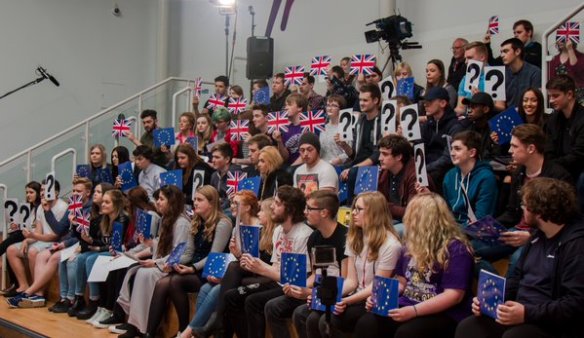
It was at 2pm that students were finally allowed into the atrium, and there we were introduced to Paul Brand, who was hosting the installment. We had all been provided with a pair of laminated cards: the first bore a black question mark, while the second was a choice between the Union Flag and the EU’s circle of stars. Several takes were expended before Brand managed not to say “Union Jack”. We were asked to hold up the image which represented our position before and after the debate. Eventually (around 3pm) we had our panellists arrive. The seating arrangement was unusual – we thought that Johnson and Hookem would be on the floor seating opposite the students on the steps, but instead they were positioned in our midst, with some other students filling up the additional seats. Nobody could quite understand this decision.

A crowd of adolescents on stepped seating. They hold up cards with Union Flags, EU Flags or Question Marks.

The students show their voting intentions.

The politicians began by making introductory speeches on the merits of staying or leaving. Johnson made the emotional appeal to the European project, saying that the Union had been a safeguard against war on the continent. He questioned the use of the Union flag for the Leave vote, saying that Brexit was not the patriotic British option. Hookem dismissed the romanticism of “Remainians” and warned the students about TTIP. We noticed that he was relying quite a lot on his iPad.

I was the first to ask a question, which was whether Brexit would revive Hull’s fishing industry. I seem to always end up on that topic when appearing on television. Other questions followed on immigration (naturally), terrorism, commerce and the obligatory quip that “You can’t go back to the British Empire.”. Throughout the debate it became clear that the two contestants were not evenly matched – Johnson had spent many years on the front line of politics including a period in the cabinet, whereas Hookem was a fairly obscure figure whose career in the European Parliament did not even stretch two years. He was rather obviously out of his depth during much of the debate and struggled to maintain a smooth flow of words when giving answers – whereas Johnson had spent decades polishing his speeches, Hookem often communicated in short, fragmented sentences.

The debate ended with a reprise of the flag display. By this point, Johnson had clearly proven the more effective debater as there had been a clear swing from Leave to Remain among the students in attendance. Six days later, the college launched its own referendum on-line, with the result that 63% of respondents preferred to remain. The result of the actual referendum (including for the Hull area) are likely to be much different.

Meeting Diana Johnson MP

johnson_diana-112028229

Diana Johnson, Member of Parliament for Kingston upon Hull North 2005-present.

As we move into the month of May 2016, we are nearly at the anniversary of the most recent general election. Four days from now, there will be a smorgasbord of other elections taking place: the Scottish Parliament, the National Assembly for Wales, the Northern Ireland Assembly, the Police & Crime Commissioners, the Mayor of London and some 125 local councils. Additionally there will be two by-elections to the House of Commons – one in Ogmore, the other in Sheffield Brightside and Hillsborough. Not long afterwards, of course, there will also be a UK-wide referendum on our membership of the European Union.

While many of these elections are relatively low-key affairs (certainly, it will be on Holyrood that media attention is focused), there is to me a special significance to the Police & Crime Commissioners because they represent the first occasion on which I am eligible to vote. There are four candidates standing and, whereas the original elections back in 2012 were notable for the large number of independent candidates (who actually won 12 positions compared to Labour’s 13 and the Conservatives’ 16), in my Humberside area this time there are only four, and they represent what are now established as England’s four main parties: Matthew Grove (Conservative and Unionist), Denis Healy (Liberal Democrat), Keith Hunter (Labour) and Michael Whitehead (United Kingdom Independence). The system used is the supplementary vote, which means I will be voting for as many candidates as I am turning down.

On the last Friday of April, I took part in a meeting with the honourable lady the member for Kingston upon Hull North. The subject of discussion was the upcoming EU referendum. A point which came up notably in the session was eligibility for voting – our delegation contained two students from outside the United Kingdom (but inside the European Union) who were not entitled to vote in the referendum. Several others were also barred for failure to attain the age of eighteen years. There had been much clamouring for the voting age to be lowered to sixteen, as had been done for the Scotland referendum, but these were thrice rejected by the House of Commons. Our guest was quite openly displeased about this fact, and stressed that it was vital for those of us who could vote to do so, lest our generation’s voice be politically ignored – she noted that pensioners had done quite well out of recent budgets because they tend to have the highest voting turnouts.

The honourable lady was quite insistent upon her party’s unity with regards to this issue: she explained that whereas in the previous referendum (She repeatedly said 1974, and none of us thought it pertinent to say it was actually 1975.) the Conservatives had been uniformly in favour of membership of the European Community and Labour divided, in this present era the situation had been reversed and that it was now the Conservatives who were thus fractured. I might have detected more than a grain of salt in this sentiment given that her current leader (The Right Honourable Jeremy Bernard Corbyn MP) was adamantly Euroskeptic for most of his life, and has only very recently (and rather meekly) proclaimed his support for our continued membership. There are, too, a handful of Labour officeholders campaigning to leave (Kate Hoey, Graham Stringer, Kelvin Hopkins and Roger Godsiff). Perhaps her position in the Shadow Foreign Office compels our visitor to gloss over this issue in public.

Returning to the area of youth engagement in politics, Mrs Johnson talked about the popularity of the President of the United States (His Excellency Barack Hussein Obama) – “He’s just so cool!” – and lamented, in her view that neither his charisma nor that of the Prime Minister of Canada (The Right Honourable Justin Pierre Trudeau MP PC), could be matched by our own statesmen, explicitly giving unfavourable status to Boris Johnson MP and Nigel Farage MEP. The point she was keen to make was that most elections – especially the EU referendum – affected the young more than the old (as they would not live to see out its full effects).

One memorable moment came when the honourable lady went around the table asking each of us our intention with regards to future studies and careers. Several people mentioned biology (which struck the elders in the room as unusual) and several others law (which did not, especially given the explanation that the college did not offer politics & government or economics). I said my pursuit was chemistry, which caused Mrs Johnson to remark that I could be the next Margaret Thatcher – though she moved quickly to eliminate any inferred suggestion of thinking me a Conservative.

At this point, perhaps far too late into this post, explain what was actually discussed about the European Union – that being the topic around which the meeting was centered. Ironically it is this component of the visit of which I have the least clarity in recollection. The points which stick out the most are that the EU has guaranteed decades of peace between European countries unseen before its development, that international cooperation is increasingly necessary for dealing with global threats and that the uncertainty of Britain’s existence following a Brexit would be dangerous to the economy. She did, though, confess to an agreement with the statement that few in Britain truly love the EU.

It remains to be seen if the fear of uncertainty or the gratitude for peace will ultimately prevail as the leading motive for remaining in the European Union. Indeed, that the Remain campaign should be victorious with either strategy cannot yet be confirmed. Most polling for this referendum has shown the balance shifting daily, such that a decisive victory for either camp seems improbable if not impossible. Already, many are stirring rumours of a second plebiscite to follow should the first attempt fail to yield the result they desire. Certainly, the United Kingdom’s constitutional identity is likely to be the subject of great debate for a long time to come.