
Lady Mary Peters by Nedkennedy and her armorial achievement by Heralder (CC BY-SA 4.0)
Earlier this year Dame Mary Peters, Gold Medalist in the Pentathlon at the 1972 Munich Summer Olympics, was appointed a Lady Companion of the Most Noble Order of the Garter. Last year the same honour was conferred on Dame Mary Fagan, former Lord Lieutenant of Hampshire. The Garter is England’s oldest order of chivalry. Membership is marked by, among other things, a carving of one’s crest atop a stall in the quire of St George’s Chapel Windsor. Here a problem emerges – women don’t have crests!
English heraldry grants crests only to men (“men” includes Queens Regnant), and they are transmissible only through the agnatic line unless by special warrant. This is consistent throughout the armorial traditions of most countries where crests are used at all – Canada being a notable exception, for its heraldic authority was founded relatively recently and is subject to that country’s stringent equality laws. What, then, do Garter ladies put atop their stalls?
Up until this point, the absence of female crests has been worked around by using their coronets instead, though in many cases this leads to a loss of uniqueness. Margaret Thatcher, Mary Soames and Elizabeth Manningham-Buller have been represented by baronial coronets, Lavinia Fitzalan-Howard by a ducal one. Queens Alexandra, Mary and Elizabeth used the royal crown, while the Princess Royal and the Honourable Lady Ogilvy used lesser crowns appropriate to a child or grandchild of the sovereign respectively. It is not just women to whom this applies – many times the Garter has been given to foreign princes (more on them later) to whose native heraldry the crest is unknown, and they too have simply used their crowns or coronets in its place – although Japanese kamon are sufficiently dissimilar that Emperor Akihito had to improvise a little with his chrysanthemum seal.
The challenge that Fagan and Peters present is that they are neither princesses nor peeresses, and thus would not have coronets to put above their shields (or indeed lozenges) either. The solution was to grant them each a badge – a paraheraldic device that is normally worn by the owner’s staff and retainers rather than the owner herself. This is not as revolutionary as may first appear, for in the mists of time the badge may well have been the origin of the crest and they are sometimes used interchangeably. Though a blazon is not readily available, Fagan’s badge shows a blue boar standing on a red cap of maintenance and Peters’s shows a Ulysses butterfly on the dome of Belfast City Hall. Their armorial achievements still omit the helm, torse and mantling which normally go between the crest and the shield.
At this point it is worth a mention of these Marys’ Caledonian counterpart Lady Marion Fraser. In 1996 she was appointed to the Order of the Thistle, essentially Scotland’s equivalent to the Garter, whose members’ crests are similarly displayed at the High Kirk of Edinburgh. As with the Garter, Ladies of the Thistle before Fraser had invariably been peeresses and/or princesses, so could use their coronets instead. Lady Marion was a special exception in receiving a grant to use a helm and crest (A demi-female richly attired holding in her dexter hand at the shoulder a thistle slipped and leaved all Proper and in her sinister hand at the hip a fraise Argent), which are displayed on her stall in the same way as the men’s.
Moving back to the foreign princes, in 1988 King Juan Carlos of Spain was made a Stranger Knight of the Garter. In 1989 Queen Beatrix of the Netherlands was made a Stranger Lady. As monarchs, they bore the undifferenced royal arms of their respective countries. Beatrix abdicated in 2013 and Juan Carlos in 2014, in favour of their sons Willem-Alexander and Felipe VI. The new king of Spain was admitted to the order himself in 2017, and the Dutch king in 2018. The decision to appoint these two monarchs while their predecessors are still alive means that the royal banners of their countries will now appear twice each in the chapel. Beatrix, reverting to Princess, has since adopted a differenced version of her arms (quartering with the arms of the former Principality of Orange, then surmounting them with an inescutcheon of the arms of her father Prince Bernhard), though it remains to be seen if her Garter banner will be updated. Juan Carlos, still styling himself King (though not The King as with British Queens Dowager) has adopted new external ornamentation but his shield remains the same. The only domestic example of this was Edward VIII, whose honours all merged into the crown upon his accession and were granted anew following his abdication. As Duke of Windsor he differenced the royal arms with a label of three points Argent, the centre bearing the Imperial Crown Proper.
EXTERNAL LINKS
UPDATE (April 2021)
I have come across some documentation of the Spanish kings’ banners – that of Juan Carlos has a lion Gules and a pomegranate Gules seeded Or, whereas Felipe’s has a lion Purpure and a pomegranate Proper seeded Gules. There are also subtle differences in the artistic depictions of the castle and the chain orle. In the footage of Prince Philip’s funeral you can see the two versions either side of the banner of King Harald V of Norway.

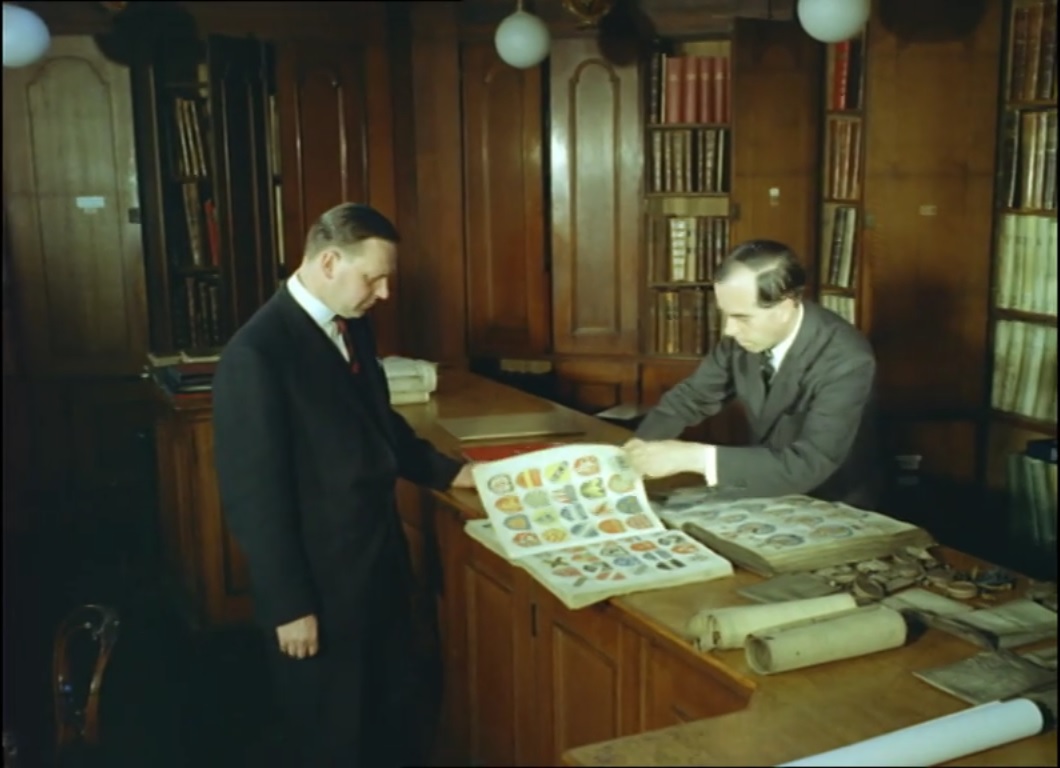 The York Herald’s Twitter feed recently led me to discover the 1960 short documentary series Look at Life, episode 7 of which is State Occasions. It follows the then-Earl Marshal (Bernard, 16th Duke of Norfolk) around the State Opening of Parliament and the Garter Day procession, as well as giving a tour inside the college of arms.
 Robin Stanley Taylor
#/media/File:Coat_of_Arms_of_Japanese_Emperor_(Knight_of_the_Garter_Variant).svg)
