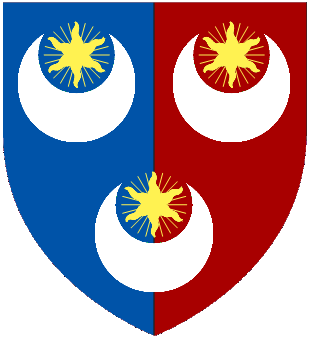
The digital illustration of coats of arms, and the uploading of such illustrations on Wikipedia, has been a pursuit of mine for more than seven years now. My productivity in this hobby has not been uniform. There have been some months in which I have uploaded nothing at all (e.g. October 2020) and others in which I have uploaded a great many (e.g. more than a hundred in August 2018).
The four months of 2024 so far have been at the low end, with only thirteen illustrations in the year so far – and April in particular having just one – that being the nineteenth-century judge Arthur, Lord Hobhouse.
This is not likely to improve any time soon, as I have long since exhausted the opportunities afforded by Burke, Cracroft and Debrett.
As I have mentioned before, I eagerly await the publication once every three months of the College of Arms’s newsletter, and the prospect of new blazons within, only to be regularly underwhelmed by the reality.
Yesterday’s edition did little to break the trend: Four new blazons were announced, of which only one applied to a person with a Wikipedia page. That person was Aamer, Lord Sarfraz, whose arms were actually granted two years ago and illustrated by me not long after based on the photograph shown on his website.
Much more interesting, and substantial, was the section about corporate heraldry. Two examples were given, one being the British Airways Board (again, already known). The newsletter was supplemented by a booklet about corporate grants, which was a substantial read in itself. Though the general principles described are those already articulated elsewhere on the college’s website, the style of the publication is radically different to what I am used to seeing from them and perhaps represents a significant change in approach. One might almost think they were advertising…
St George’s Day – 23rd April – is the traditional day for announcing new appointments to the Order of the Garter. The King today named three new ordinary knights and one new royal lady:
The Lord Peach, Chief of the Defence Staff 2016-18. This is fairly unsurprising as another former chief, Lord Stirrup, is also part of the order, as were many other (though not all) chiefs before him.
The Lord Kakkar, former Chairman of the Appointments Commissions for both the House of Lords and the Judiciary. He is most prominently known for his work in business and medicine.
The Lord Lloyd-Webber, one of the musical composers for the coronation, is probably the most famous. It is perhaps a little surprising that he went directly to the Garter and was not offered the Royal Victorian Order first.
The Duchess of Gloucester, President of the Royal Academy of Music since 1997. This appointment is a bit of a departure from convention as, while royals by birth are nearly all given the Garter as a matter of course (Princess Margaret and Prince Michael being odd exceptions), royals by marriage (unless their spouse be first in line to the throne or already sitting on it) generally are not. This honour is presumably in thanks for the additional duties the duchess has taken on since the winding down of Elizabeth II’s reign, and in particular during Charles III’s recent illness. It remains to be seen if the Duchess of Kent will be extended the same.
In addition to these appointments, there was some reshuffling of honorary offices among the other orders of chivalry which in recent years had fallen vacant or merged with the crown: The Queen was made Grand Master of the Order of the British Empire (last held by the Prince Philip, 1953-2021) while the Prince of Wales was made Great Master of the Order of the Bath (last held by Charles himself from 1974 until his accession).
The most revolutionary of today’s changes regards the Order of the Companions of Honour. This was created in 1917 alongside the Order of the British Empire and designed to reward outstanding achievements in art, science, medicine or public service among people who would not accept titular dignities. Appointments are made on ministerial advice. Currently the order has a quota of sixty-five ordinary members, of which two places are currently vacant. There is also one honorary member, the Indian economist Amartya Sen. Until now, no member of the royal family had been appointed a Companion of Honour. Given the origins of the institution, it seems a little odd that His Majesty (or the Prime Minister) would choose to create the supernumerary category of Royal Companion (similar to that in the Garter), and to make his daughter-in-law the Princess of Wales the first incumbent. This stands in contrast to the Order of Merit, in which Elizabeth II appointed both her husband and her son as full members on the same basis as all the others.
In armorial terms, obviously this will mean four new banners to hang in St George’s Chapel. The Duchess of Gloucester’s arms are well-known, and I have already found and illustrated those of Lord Kakkar (though doubtless his increased prominence will lead to a better rendering by a different artist soon enough), but Peach and Lloyd-Webber are a mystery – the former having been ennobled too recently to appear in the last print of Debrett’s.
UPDATE (24th April)
There are now three vacancies among the Companions of Honour, as it transpires that the Lord Field of Birkenhead died while I was writing this post.
On St George’s Day last year His Majesty appointed two new companions of the Order of the Garter – Lady Ashton of Upholland and Lord Patten of Barnes. Obviously that would mean their banners of arms would at some point be erected at St George’s Chapel in Windsor Castle. At the time it was not public knowledge what their lordships’ arms actually were, if indeed they had any, and given how long it was taking to find out about Blair and Amos I was not optimistic of learning any time soon.
Today they were revealed by Major Alastair Bruce of Crionaich via what used to be called a Tweet. He shows photographs of two banners of arms along with an excerpt from an online article, which I will quote below:
Baroness Ashton served in the Ministry of Justice and later as the EU’s first High Representative for Foreign Affairs and Security policy. She contributed towards negotiating a peace settlement between Serbia and Kosovo. Red roses reflect the fact that Upholland, which forms part of Baroness Ashton’s title, is in Lancashire.
On Lord Patten’s banner the pearls allude to the crest of Hong Kong where he was Governor from 1992 to 1997. The blue field and crowns replicate the arms of Oxford University where Lord Patten has been Chancellor since 2003.
It is not clear precisely where Bruce found this information, as the message includes the web address of St George’s Chapel but does not specify an exact page. I have looked through the site to find a recent update about Patten and Ashton but found nothing. I hope this will be resolved soon.
As for the heraldic designs themselves: Patten’s arms are perfectly dignified if a little unoriginal. Having the shield resemble that of his university could make for a confusing sight should he try to impale them. Ashton’s banner is an overloaded mess redolent of the worst excesses of the early nineteenth century.
That the reveal of these arms took only nine months instead of eighteen is a positive sign. I hope that future grants of arms will become public even faster.
UPDATE (15th January)
Baz Manning informs me that the images and quoted text are from The Dragon, the community newsletter of St George’s Chapel.
Cameron’s ennoblement got me thinking about the general trend of honours given to former prime ministers. Combing through Wikipedia, I have produced a list of them. To keep it from becoming overly long (and to avoid ambiguities about who counts as a prime minister), I have restricted it to honours conferred after the end of Victoria’s reign.
Although their legal status is much the same, British orders of chivalry can be politically divided into two categories: The Baronetage, Knights Bachelor, the Orders of the Bath, St Michael & St George, the Companions of Honour and the British Empire are appointed on the advice of government ministers, while the Royal Victorian Order, the Order of the Hospital of St John of Jerusalem and the Order of Merit are conferred at the monarch’s personal whim. The Orders of the Garter and Thistle fell into the former category in the early eighteenth century but were changed to the latter in 1946. Peerages both life and hereditary are presumed to be in the former category.
Here is a simplified list of who received which kind of honour and when. Honours which a person held before ascending to the premiership are not included:
HONOURS IN THE MONARCH’S GIFT
Garter (post-’46)
Churchill in 1953 (while still prime minister, in advance of the coronation)
Attlee in 1956 (resigned as Labour leader the previous year)
Wilson in 1976 (three weeks after leaving office)
Callaghan in 1987 (three weeks before stepping down from the Commons)
Thatcher in 1995
Major in 2005
Blair in 2021 (New Year’s Eve)
Merit
Balfour in 1916
Lloyd George in 1919 (while still prime minister)
Churchill in 1946 (while opposition leader)
Attlee in 1951 (while opposition leader, ten days after premiership’s end)
Macmillan in 1976
Thatcher in 1990 (nine days after premiership’s end)
St John
Thatcher in 1991 (Dame of Justice)
HONOURS ON MINISTERS’ ADVICE
Garter (pre-’46)
Balfour in 1922 (backbench MP) (adv. Lloyd George)
Asquith in 1925 (adv. Baldwin)
Baldwin in 1937 (adv. Chamberlain) (immediately after resignation)
Companion of Honour
Attlee in 1945 (adv. Churchill) (shortly after resigning as Deputy PM)
Major in 1998 (adv. Blair)
Hereditary peerage
Balfour in 1922 (adv. Lloyd George)
Asquith in 1925 (adv. Baldwin)
Baldwin in 1937 (adv. Chamberlain)
Lloyd George in 1945 (adv. Churchill)
Attlee in 1955 (adv. Churchill)
Eden in 1961 (adv. Macmillan)
Macmillan in (adv. Thatcher)
Life peerage
Douglas-Home in 1974 (adv. Wilson)
Wilson in 1983 (adv. Thatcher) (dissolution honours)
Callaghan in 1987 (adv. Thatcher) (dissolution honours)
Thatcher in 1992 (adv. Major) (dissolution honours)
Cameron in 2023 (adv. Sunak)
It may also be worth considering honours given to the spouses of prime ministers, whether for achievements in their own right or by right of marriage.
Margaret Lloyd George: GBE in 1918 (adv. her husband)
Lucy Baldwin: GBE and DStJ in 1937 (former adv. Chamberlain)
Clementine Churchill: GBE in 1946 (adv. Attlee), life peer in 1965 (adv. Wilson)
Dorothy Macmillan: GBE in 1964 (adv. Douglas-Home)
Denis Thatcher: TD in 1982, baronet in 1990 (adv. Major), CStJ in 1991.
Norma Major: DBE in 1999 (adv. Blair)
Cherie Booth/Blair: CBE in 2013 (adv. Cameron)
Philip May: Knight bachelor in 2020 (adv. Johnson)
Unless I’ve missed any, no current or former prime minister (or their spouse) has, from 1901 onward, been appointed to the Order of the Bath, the Order of St Michael and St George, the Order of the Thistle or the Royal Victorian Order.
UPDATE (August 2024)
Theresa May has received a life peerage, for which she was nominated by Rishi Sunak in the dissolution honours last month.
Long-time readers will be familiar with my frustrations in discovering the heraldic achievements of former ministers and recent Garter companions Lady Amos and Sir Tony Blair. Now, at last, some progress is being made.
My guess at Amos’s lozenge.
Almost a month ago the Right Reverend Graham Usher, Bishop of Norwich, Tweeted a photograph of the inside of St George’s Chapel. Among the familiar Garter banners I noticed one I had not seen before – per saltire Gules and Or, two of the sections charged with counterchanged circular devices. Presumably the other two sections had them as well, but Sir Thomas Dunne’s banner obscured them. I wasn’t entirely sure what the symbols were – Jukudlick, another Wikipedian, reckoned they were gyroscopes. Without any specific, reliable matching of the arms to the person I was not prepared to add the graphic to her page.
Today’s update comes from the website of Ian G. Brennan, the man who actually constructs the wooden models of knights’ crests to go above their stalls. He includes a photographic gallery of all the crests he has made… and now Blair’s is among them. I had not been paying much attention to his website as it did not look to be frequently updated – indeed the overall design looks to be stuck around the middle of Blair’s premiership. Judging by what I saw when checking the Wayback Machine, this update happened within the last ten days.
No blazon is given, but my best guess for Blair’s crest is a mute swan’s head erased Proper holding in the beak a rose Gules seeded Or barbed slipped and leaved Vert.
The torse is depicted as Azure, Or and Gules, which gives some hints as to the principal tinctures of the shield. The red rose is almost certainly a reference to his thirteen-year leadership of the Labour Party.
The website also has a photograph of Amos’s crest. Whether this actually is a crest or just a badge is yet to be seen – I note that the photograph is framed so as not to reveal the presence or absence of a torse. Here the round object looks more clearly like a gyroscope, while the beast holding it is, I would say, a panther sejant guardant Proper. As always with heraldry, you can’t be sure until you’ve read the blazon.
This year’s Garter ceremony was held on Monday. Blair and Amos attended for the second time, as did first-timers Lady Ashton of Upholland and Lord Patten of Barnes. Ashton is already King of Arms for the Order of St Michael and St George (even attending the coronation in that capacity), yet her own bearings are not recorded in any issue of Debrett’s I’ve seen. Patten has no record either. Based on this, I don’t expect any revelation until 2025.
Today and yesterday, Charles III was formally proclaimed as King across the world, following the meeting of his accession council. This is only the fourth accession in Britain since the invention of the television, and the first time that the council itself has been broadcast live. Indeed, to my knowledge the only other time that any meeting of the council in Britain has been recorded was for the 1993 documentary Days of Majesty, and even then only a small clip was shown. There was supposed to have been a meeting (probably done virtually) some days ago for the swearing in of Liz Truss’s new cabinet, but the fading of Queen Elizabeth’s health prevented it. When that session will eventually take place is unknown. We are in an odd situation where the new monarch is having his accession confirmed by a set of ministers whose own office-holding has not been fully confirmed either. The ceremony was something of a consolation prize for Penny Mordaunt, who lost the bid to become Prime Minister but was instead appointed Lord President. She took the lead role in the day’s proceedings. Once the proclamation had been approved and various oaths had been taken it was read out by David White, Garter King of Arms, on the palace’s balcony. Not long later it was repeated by Timothy Duke (Clarenceux) on the steps of the royal exchange. The next day it was read by Robert Noel (Norroy & Ulster) at Hillsborough Castle. Joseph Morrow (Lyon) read it at Mercat Cross, as did Morfudd Meredith (Lord Lieutenant of South Glamorgan) and Thomas Lloyd (Wales Herald) in Cardiff. The other proclamations made around the British Isles, and the Commonwealth, are far too numerous to list.
Times such as this are a rare opportunity (others being state openings and, next year, the coronation) to see officers of arms in their full finery. They will be very busy over the coming months.
It can be taken as read that, following his ascent to the throne, the undifferenced arms of the United Kingdom, and those of all his other realms and territories, now belong to His Majesty. The arms of his siblings, niblings and cousins have no reason to change from what they were before. The arms of his wife, sons, and daughters-in-law are all due for upgrades.
Probable arms of Camilla, Queen Consort
Camilla, as Queen Consort, can now be expected to impale the Shand arms with those of the King. Given that William now has all of the statuses and titles that his father held a week ago, it is most probable that he will bear the same heraldic achievement, with which Catherine will impale the Middleton arms. It is yet to be seen (and there are conflicting precedents) of the Duke & Duchess of Sussex will similarly upgrade by swapping their five-point cadency label for one of three points, and removing the strawberry leaves from their coronets. The ever-present yet ever-uncredited Sodacan has already uploaded multiple illustrations of how he expects the revised armorial achievements to look.
Probable arms of Catherine, Princess of Wales
There is some controversy over whether Charles will change the heraldic depiction of the crown from St. Edward’s (depressed arch) to Tudor (no depression). There is a perception that St. Edward’s Crown is for queens and the Tudor crown for kings (due to the latter being preferred from 1901 to 1952) but this is not binding and St. Edward’s was regularly used by kings before Victoria’s reign.
I’ve just finished readingCharles III: New King. New Court. The Inside Story by Robert Hardman. Chapter Three: London Bridge explains that the Truss ministry was supposed to be sworn in on 7th September with the politicians meeting in Westminster and Queen Elizabeth attending by audio-only link from Balmoral, but the meeting was cancelled at short notice when her health took a downturn.
UPDATE (September 2025)
Historian Jason Loch has published this article analysing the intricacies of the accession council and the legal status of Truss’s cabinet.
Five and a half months since the announcement of their appointments, the installation of the Duchess of Cornwall, the Baroness Amos and Sir Tony Blair in the Order of the Garter finally took place today. Suspended for two years due to the pandemic, the ceremony was revived with the knights, ladies, heralds and soldiers marching through the grounds of Windsor Castle in all their finery.
Getting photographs of this event has proven annoyingly difficult. The Royal Household itself has not made a proper film of it, nor have the major news networks covered it in much detail, so I have had to piece it together from commercial photographers (whose shots I would not risk directly embedding here), crowd-members short films and attendees’ Tweets. The end result is less than satsifactory.
Most importantly, I have yet to see any photographs from inside the chapel since the new members were installed, so remain none the wiser as to the appearance of their armorial banners – my main reason for waiting so expectantly all this time! Sir David Amess and Sir Lindsay Hoyle remain similarly elusive.
While we’re here, it’s worth mentioning yet another podcast I have discovered: the Commonwealth Poetry Podcast by Gyles & Aphra Brandreth, whose first episode features the Duchess of Cornwall and Dame Joanna Lumley as its guest stars.
For the last few Decembers I have eagerly awaited the release of the new year honours list. Normally they arrive a few days before the actual new year, but this time around they came with barely an hour to spare.
There were, as to be expected, a great many awards given on ministerial advice for those involved in fighting COVID, but at the very top were three new appointments made at Her Majesty’s personal discretion to the Order of the Garter: Camilla, Duchess of Cornwall, her daughter-in-law; Valerie, Baroness Amos, former Lord President of Her Privy Council; and Tony Blair, her former Prime Minister.
While sons (and in modern times also daughters) of the reigning monarch are appointed to the order routinely it is rare for royals by marriage. The only examples in the past two hundred years are of those married to the sovereigns themselves – Albert two months in advance of his wedding, Alexandra, Mary and Elizabeth shortly after their husbands’ accessions. Camilla and the late Prince Philip are the only consorts to receive the garter while their spouses were not yet on the throne. I wonder if she shall use the same stall that he did?
Amos is a former leader of the House of Lords (like Lord Salisbury, and indeed others of that title before him). She also served a brief term as High Commissioner to Australia and an even briefer one as International Development Secretary.
Tony Blair appointed Amos to most of those offices. It used to be the norm for former Prime Ministers to join the order, up to and including John Major in 2005 it became rare to see party politicians appointed. It was long assumed that Blair had declined any honours if indeed he was ever offered them, whether that was due to his personal distaste for them (he portrayed himself as a moderniser rather than a traditionalist, and was often observed to behave more like a US President than a British minister), or potential public backlash over controversies stemming from his premiership. What has persuaded him to accept the award now, fifteen years on, is not yet known.
These are the first appointments to the order since 2019. There were no Garter Day ceremonies in 2020 or 2021 due to the pandemic. This year is set to be Elizabeth II’s Platinum Jubilee, so one presumes that the Firm will be keen to make up for lost time.
Today’s news will have interesting ramifications heraldry-wise: Camilla has of course been openly armigerous since 2005, and Sodacan has already updated his graphic of her arms to include the Garter circlet. Amos has been a peeress all my life, and typically appears early on in the pages of Burke’s and Debrett’s, but has never been shown with any armorial design. She may therefore receive a brand new grant in the coming months. Blair is especially confusing, though he is joining an English order of chivalry, he may be Scottish for heraldic purposes and so it would be Lyon not Garter arranging his grant.
The York Herald’s Twitter feed recently led me to discover the 1960 short documentary series Look at Life, episode 7 of which is State Occasions. It follows the then-Earl Marshal (Bernard, 16th Duke of Norfolk) around the State Opening of Parliament and the Garter Day procession, as well as giving a tour inside the college of arms.
The narrator gives a concise but comprehensive overview of the college’s work and of heraldry as an artform, with ample footage of officers and artists going about their business as well as detailed closeups of the fruits of their labour.
Just a day after York’s presentation, I attended yet another heraldic zoom lecture, this time by Dr Andrew Gray for the Heraldry Society, concerning Ladies of the Order of the Garter. I made a post about this topic two years ago and advertised it in the chat box. Unusually the host actually drew attention to it, and my site traffic is already seeing an uptick.
The lecture began with the special statute enacted by the newly-ascendant Edward VII in 1901 to appoint his wife Alexandra to the order, followed by a similar instrument in 1910 for Queen Mary. Gray noted that this was unusual at the time but not unprecedented. In 1358, just ten years into the order’s creation, Edward III made Philippa of Hainault a lady of it. Gray mentions that the early gentlemen of the Garter had ladies in their company on ceremonial occasions, though their status – and even identity – is vague. In the period of 1358-1495 Gray identified seventy-four Ladies of the Garter in the records, most of whom were wives of the knights and/or members of the royal family. He notes that there were probably a lot more but the necessary records are missing. The ladies received robes, and wore the garter itself on the upper arm (whereas the men wore it on the leg).
There then followed an examination of the ladies appointed in that time, their arms, and their relation to the contemporary monarchs. One of those highlighted was Jacquetta, Countess Rivers, whom Gray noted had been made famous by Philippa Gregory. She was allegedly descended from the water goddess Melusine and gifted psychic powers, which the present monarch has presumably inherited.
The appointments of ladies of the order ended in 1495 with Margaret, Countess of Richmond and mother of Henry VII. Over the next few centuries there were five female sovereigns of the Garter but no female appointees until the sudden spurt in the twentieth century. There was also some discussion of the issues I raised in my aforementioned 2019 post regarding female crests and helms.
While I enjoyed the presentation it still left me a little confused – I don’t recall learning any explanation as to why the installation of ladies was discontinued in the sixteenth century, nor the precise distinction between plain “Lady” and “Lady Companion”. Still, at least I got to flog the blog rather effectively this time.
The society’s lecture series is taking a break now, and will return on 24th September.