Early Summer Heraldic News

10th June is International Heraldry Day. It’s not a widely-known occasion, of course, and I don’t have any particular way of celebrating it, but it felt like the occasion to post some updates.

Humphrey Lyttelton

Over the last few months I have been listening obsessively to the archives of the classic panel show I’m Sorry, I Haven’t A Clue (which, incidentally, is back for a new series this week). Among the hundreds of hours of babble and bickering, I picked up on a couple of heraldic references in Humphrey Lyttelton’s introductory monologues:

William Laud, Archbishop of Canterbury from 1633, was born in broad street where WH Smith stands, which is evidenced by the Laud family crest of a crossed pen and pencil set Argent topped by readers’ wives rampant.

(S37E1, 28th May 2001)


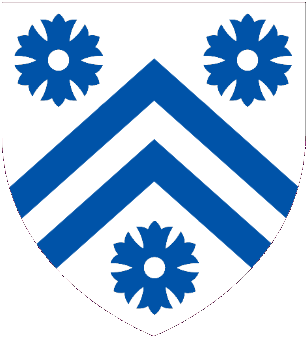
The story of Darlington’s history is neatly encompassed in its coat of arms. The Cross of St Cuthbert represents the town’s resistance to Viking raids, a bull’s head signifies the local breeding of fine cattle, and white chevrons with black lines indicate no overtaking on an urban freeway.

(S41E1, 26th May 2003)

If I manage to find enough of these, I could create a new armorial page called Humph’s Heraldry or I’m Sorry, I Haven’t A Crest.

Humph himself would be no stranger to heraldry, coming as he did from the aristocratic Lyttelton family. Humph was the only son of Hon. George William Lyttelton, himself the second son of Charles George Lyttelton, 8th Viscount Cobham. He was too far removed from the peerage to gain any style or honorific from it, but he still would have been an esquire by some of the traditional definitions, and of course that would make him an armiger too.

Lord Cobham’s arms were Argent a chevron between three escallops Sable and his crest was a Moor’s head in profile couped at the shoulders Proper wreathed about the temples Argent and Sable. Humph would have presumably displayed these with a crescent for difference, if following the rules of cadency.

The mention of William Laud prompted me to look for his actual heraldic bearings. The blazon I uncovered for his shield was Sable on a chevron between three estoiles Or three crosses pattee fitchy Gules. I cannot find the blazon for his crest, though as a clergyman he obviously would not have used one. That means I cannot explicitly disprove Humph’s suggestion, though as Laud died over a century before the establishment of the WH Smith company I suspect a direct homage is unlikely.

Anglican Archbishops

I was surprised to find that Laud’s personal arms, and those of several other Anglican bishops, were listed on Heraldry of the World, which normally only carries corporate arms. I then went about adding as many blazons as were available to their owners’ Wikipedia pages. When I got to William Temple I discovered that the arms were already cited, and the link was to the book The Blazon of Episcopacy by William Bedford, 1897. I don’t know how I missed this before. I have long been frustrated by the fact that Burke’s and Debrett’s only list the Lords Spiritual by the corporate arms of their sees instead of the personal arms of the incumbents, so this book was a revelation, if you’ll pardon the pun. This has given the the opportunity to start illustrating arms en masse again, having run low on material in the last few years. It also pushed my edit count past 24000, allowing me to upgrade my user rank to Senior Editor or Labutnum.

I have now set about creating an Armorial of the Archbishops of Canterbury, and after that will probably do so for all the other bishoprics in Bedford’s book too. Five years ago I created one for the Bishops of Chester because there was already a website which collated them, but did not have the necessary resources to go any further.

Articles on Other Sites

Yesterday The Atlantic published an article by British journalist Helen Lewis about the phenomenon of Americans applying to the College of Arms in London for honorary grants. Despite the timing, no mention is made of IHD and the article is clearly intended more as part of the commemorations for the 250th Anniversary of the Declaration of Independence. It includes snippets of interviews from several American armigers, as well as Dominic Ingram (Chester Herald) and an account of Lewis’s own visit to the College’s headquarters. Ingram makes a comment about his heart sinking when a client asks for lions due to their overuse. David White, now Garter, made the same comment a while back.

On 1st April the retired rector Ian Gomersall posted about receiving his letters patent, and even included some photographs of the artistic process. Four days ago Ian Leslie posted a long article which included a paragraph about William Shakespeare’s quest for heraldry, something which I have also discussed before.

Miscellaneous

In less exciting news, it has now been an entire year since the College posted a new edition of its own newsletter. The message in the sidebar still insists that the letter is produced every three months, but that has not been true for quite a while now.

On a quasi-related note, today would also have been the 105th birthday of the late Prince Philip, Duke of Edinburgh (he was eighteen days younger than Humph). Recently I inherited a copy of H.R.H. Prince Philip, Duke of Edinburgh: A Portrait by his Valet. The book was curiously undated, but Google Books tells me it was published in 1954. That feels remarkably early to be writing a biography like this, given that he would go on to live until 2021. The use of “Prince” in the title is also interesting, given that this book came out after he relinquished his Greek & Danish princely title but before he was granted his British one. Of course, I will have to get around to actually reading the book before I can make further judgement.

UPDATE (13th June)

The King’s Birthday Honours were published late last night. David Vines White, Garter since 2021, has been appointed a KCVO. This is routine for holders of his office, though it is interesting that he got it at what must be about the halfway point of his tenure, whereas his predecessors Woodcock and Gwynne-Jones didn’t get theirs until very near the end.

UPDATE (16th June)

Birkbeck College has published an interview with Timothy Noad, exploring the creative process behind the creation of the new royal cypher.

An Expulsion, and Afterwards an Encore

At the end of the previous Parliamentary session late last month, those members of the House of Lords sitting by virtue of hereditary peerages lost that membership. Today, on the eve of the new session, the government announced that twenty-six of them will be given life peerages to allow them to be reintroduced. Fifteen of these are Conservatives, nine Crossbenchers and two Labour. There were no Liberal Democrats on the list, though two of their hereditary representatives — the Earl Russell and the Lord Addington — had already received the same gift in a different honours list in December.

The timing of this has some interesting implications: As Addington and Russell received their life peerages before their hereditary tickets were annulled, their membership of the upper house is continuous. The two-dozen reappointed after the event technically have had a break in service, so may need to undergo the introduction ceremony of a new peer to resume their seats. The standing orders prohibit more than six introductions per week, so re-seating all of these peers could take over a month. Some of the choices are pretty obvious, such as the Conservatives’ former leader Strathclyde and current deputy leader Howe. Others are less obvious. I presume there must have been a lot of backstage haggling between parties over how many life peerages would be awarded, as well as within parties to determine who would get them. In recent years the government has tended to publish “citations” for new life peers, including those who were peers already, but that element was absent from this list.

In 1999 when the bulk of hereditary peers were removed to leave only 92 elected representatives therefrom, a handful of such peers were given life peerages to exempt them from having to seek election. This broadly amounted to those who were former leaders of the house (such as Cranborne and Longford) and those who were the first of their title (such as Snowdon). I cannot work out any specifics that this rump-of-a-rump have in common, so I assume there was an informal ballot among the group or they were chosen at the leader/convener’s discretion.

Notably absent were the Duke of Norfolk and the Lord Carrington, who hold respectively the offices of Earl Marshal and Lord Great Chamberlain. The 1999 Act had a special provision for these two to remain ex officio. The Earl Marshal is a hereditary title entailed to the Dukes of Norfolk since 1672 whereas the Lord Great Chamberlain position has, since Edwardian times, rotated at each demise of the crown. During Elizabeth II’s reign it was held by the Marquesses of Cholmondeley. David, 7th Marquess, held the tole from the death of his father in 1990 to the death of Queen Elizabeth in 2022. Parliament.UK makes clear that he lost his membership of the upper house on Charles III’s accession. Carrington assumed the office at that point, but he had already been elected as a Conservative peer in 2018. After 2022 he appears to have been occupying two seats at once as there was not a by-election for his previous position. On a similar note, it’s not clear if Addington and Russell (or, for that matter, Kinnoull) continued to be counted as representative hereditary peers after their life peerages had been conferred. The only meaningful way to test this would have been to call by-elections, but these had all been suspended when the recent legislation was been processed during the 2024-6 session. A handful of hereditary peers died or retired during this time without being replaced, so that the delegation was substantially below strength by the time the session ended.

There is, of course, already a Wikipedia page under construction for this list.

New Garter Knights for 2026

There were no new appointments made to the Order of the Garter in 2025, the most recent addition being the off-cycle appointment of the Emperor of Japan as a Stranger Knight on his state visit in 2024.

Today three new Knights Companion were announced, leaving just one vacancy among the ordinary category: Lord Hennessy of Nympsfield, Lord O’Donnell and Lord Burnett of Maldon. All three are crossbench life peers. Actually, all of the non-royal recipients of the Garter so far this reign have been life peers. By contrast, the fifteen still-living members added by Elizabeth II comprise seven life peers, four hereditary peers and four commoners. It may be too early to determine if this represents a significant trend.

O’Donnell was Cabinet Secretary from 2005 to 2011. From lectures and documentaries I get the sense that he was a particularly-revered holder of that office. It is also notable that he was the last in a long string to be simultaneously Head of the Home Civil Service, Cabinet Secretary and Permanent Secretary to the Cabinet Office, after which there was an attempt to split these into three separate roles (though the first two were reunited not long afterwards). His first name is formally Augustine, but in practice is nearly always given as Gus, giving him the initials G.O.D. Ironically, while he is now a Knight of the Garter and has since 2005 been a Knight of the Bath as well, he has not been appointed to the Order of St Michael and St George, which denies him the opportunity to live out this classic joke from Yes, Minister.

Burnett was Lord Chief Justice of England & Wales from 2017 to 2023, his six-year tenure making him the longest-serving LCJ since Geoffrey Lane (1980-1992).

He doesn’t seem to be as famous as O’Donnell, though I note he was part of the divisional court of the Queen’s Bench Division for the Miller 2 case in 2019. After retiring from the English judiciary he became Chief Justice of a commercial court based in Kazakhstan.

Both Burnett and O’Donnell are the sort of people one could expect to receive the Garter based on their offices as the existing membership included Lord Butler of Brockwell and Lord Phillips of Worth Matravers, though neither office guarantees the award and there are plenty of emeriti from each who have not received it.

Hennessy is the exception here, as although a parliamentarian he does not seem to have held any particular public office, whether governmental, ministerial, diplomatic, judicial or vice-regal. There have been a handful of people like this, like Mary Soames and Edmund Hillary, but they are definitely a rarity. He co-founded the Institute of Contemporary British History in 1986 and has been Attlee Professor of Contemporary British History since 1992 at QMUL since 1992. He has written at least two-dozen books on history and politics, making him the most (first?) prominent academic to receive the nation’s highest order. Norton must be quietly seething.

I illustrated Hennessy’s shield for Wikimedia Commons in 2022. It is about what one would expect for a man who has worked in academia. I suspect that Rs-nouse will be re-illustrating it in his characteristic style fairly shortly. Neither O’Donnell nor Burnett had arms listed in Debrett’s 2019, so the hanging of their banners in St George’s Chapel will be an exciting revelation.

Garter appointments are traditionally announced on 23rd April because it is St George’s Day, St George of Lydda being the patron saint of the Order of the Garter since its inception in 1348 and of England more generally thereafter. In modern times, today is also the eighth birthday of Prince Louis of Wales. I can’t help wondering if the Duke & Duchess of Cambridge quietly kicked themselves for having already given the name George to their July-born first son, thus missing another chance for poetic alignment.

Louis & George in June 2023

On another note, we are approaching the tenth anniversary of the EU Referendum, and with it the tenth anniversary of when Theresa May succeeded David Cameron as Prime Minister of the United Kingdom. It is also the year that he turns sixty and she seventy. Both have been ennobled relatively recently but neither has received any British order of chivalry. I had thought that this would be a good occasion for one of them to receive the Garter, but evidently that will have to wait for some time yet.

For Gareth and the Empire!

Recently Gareth Ratcliffe, who represents Hay-on-Wye on Powys County Council, Tweeted a photograph of the royal warrant by which he was appointed an Ordinary Member of the Civil Division of the Most Excellent Order of the British Empire.

I have seen photographs and scans of similar documents before, but usually they were from a great many decades ago. I was interested to look at an up-to-date example.

The warrant begins with the sovereign’s full style (in English, of course) and concludes with the place and date. Notably it is accredited to St James’s Palace (which, rather than Buckingham, is the true headquarters of the crown), though I am quite certain that neither the monarch nor his clerks were actually in that place on New Year’s Eve signing thousands of such warrants in one go.

King Charles’s signature appears at the top of the page and Queen Camilla (in her capacity as Great Master of the Order) signs at the bottom. Six months ago I was told by the Foreign, Commonwealth & Development Office that warrants of appointment to these orders of chivalry do not depict a coat of arms, only the seal of the respective order. Embossed at the top of this warrant I can see that the seal itself actually contains the royal arms of the United Kingdom in the English arrangement, so the critical question of whether the design changes when in other realms is not necessarily resolved.

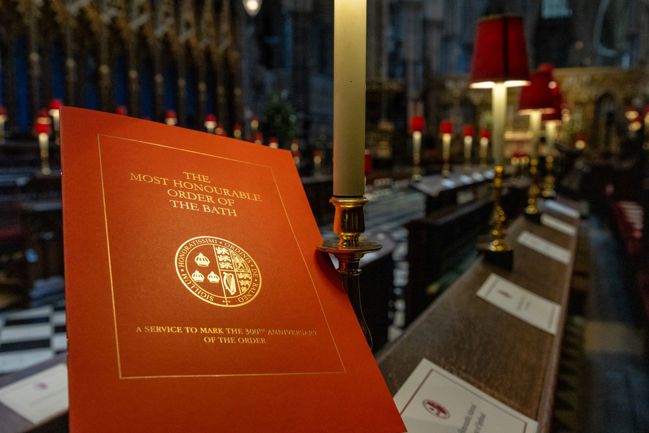
Also in the news this week was the 300th anniversary (or Tercentenary) of the Most Honourable Order of the Bath. The King (as Sovereign) and the Prince of Wales (as Great Master) attended a service in Westminster Abbey to commemorate. The cover of the Order of Service shows the seal of the order, which likewise has the British royal arms. I even found a photograph of a bound copy of the Statutes of the Order, which has the seal illustrated in full colour. There were also photographs taken of the stallplates of current and former Knights Grand Cross, including Great Masters. One hopes to see Prince William’s plate appear there too at some point, if only to get visual evidence of his full heraldic achievement as heir apparent.

Jumping the Gun Again

It is normal, following the dissolution of a parliament of the United Kingdom, for a Dissolution Honours list to be published, conferring peerages, knighthoods and other decorations on members of the former legislature.

Sometimes these have been published swiftly following the dissolution itself, early in the general election campaign. In more modern times these lists have tended not to emerge until many months after the new parliament has already been formed.

This time the list has been published on polling day itself, very close to the publication of the exit poll.

There are nineteen new life peers included, most of whom are recently-retired MPs (including Theresa May, the former prime minster). There are also five knightly awards – Oliver Dowden, Julian Smith and Ben Wallace all become KCBs, Alister Jack a KBE and Thérèse Coffey a DBE. The latter is especially intriguing because she is the one still standing for re-election in Suffolk Coastal, meaning her name as it appears on the ballot paper will have become out-of-date while people were crossing it.

The Wikipedia pages of the latter five were already updated before I even came across the announcement, but of course the titles of the new peers will take several weeks to confirm. It is still up in the air whether this is the last squeezing of the font of honour by Rishi Sunak or if a separate list of resignation honours will arrive later on.

That Time of Year Again

Lord Kakkar by Roger Harris, 2019 (CC-BY-3.0)

St George’s Day – 23rd April – is the traditional day for announcing new appointments to the Order of the Garter. The King today named three new ordinary knights and one new royal lady:

  • The Lord Peach, Chief of the Defence Staff 2016-18. This is fairly unsurprising as another former chief, Lord Stirrup, is also part of the order, as were many other (though not all) chiefs before him.
  • The Lord Kakkar, former Chairman of the Appointments Commissions for both the House of Lords and the Judiciary. He is most prominently known for his work in business and medicine.
  • The Lord Lloyd-Webber, one of the musical composers for the coronation, is probably the most famous. It is perhaps a little surprising that he went directly to the Garter and was not offered the Royal Victorian Order first.
  • The Duchess of Gloucester, President of the Royal Academy of Music since 1997. This appointment is a bit of a departure from convention as, while royals by birth are nearly all given the Garter as a matter of course (Princess Margaret and Prince Michael being odd exceptions), royals by marriage (unless their spouse be first in line to the throne or already sitting on it) generally are not. This honour is presumably in thanks for the additional duties the duchess has taken on since the winding down of Elizabeth II’s reign, and in particular during Charles III’s recent illness. It remains to be seen if the Duchess of Kent will be extended the same.

In addition to these appointments, there was some reshuffling of honorary offices among the other orders of chivalry which in recent years had fallen vacant or merged with the crown: The Queen was made Grand Master of the Order of the British Empire (last held by the Prince Philip, 1953-2021) while the Prince of Wales was made Great Master of the Order of the Bath (last held by Charles himself from 1974 until his accession).

The most revolutionary of today’s changes regards the Order of the Companions of Honour. This was created in 1917 alongside the Order of the British Empire and designed to reward outstanding achievements in art, science, medicine or public service among people who would not accept titular dignities. Appointments are made on ministerial advice. Currently the order has a quota of sixty-five ordinary members, of which two places are currently vacant. There is also one honorary member, the Indian economist Amartya Sen. Until now, no member of the royal family had been appointed a Companion of Honour. Given the origins of the institution, it seems a little odd that His Majesty (or the Prime Minister) would choose to create the supernumerary category of Royal Companion (similar to that in the Garter), and to make his daughter-in-law the Princess of Wales the first incumbent. This stands in contrast to the Order of Merit, in which Elizabeth II appointed both her husband and her son as full members on the same basis as all the others.

In armorial terms, obviously this will mean four new banners to hang in St George’s Chapel. The Duchess of Gloucester’s arms are well-known, and I have already found and illustrated those of Lord Kakkar (though doubtless his increased prominence will lead to a better rendering by a different artist soon enough), but Peach and Lloyd-Webber are a mystery – the former having been ennobled too recently to appear in the last print of Debrett’s.

UPDATE (24th April)

There are now three vacancies among the Companions of Honour, as it transpires that the Lord Field of Birkenhead died while I was writing this post.

In Honour of the Occasion

Photograph by sbclick, 2011 (CC-BY-1.0)

In theory the monarch can bestow practically any accolade on any person at any time and for any reason. In practice, since the late Victorian age there has been a trend towards grouping announcements into two big lists each year – one in June for the sovereign’s official birthday, one in December for the upcoming new year. There are also smaller lists issued at irregular intervals to commemorate particular events e.g. the deaths of senior royals, the dissolutions of parliaments and the resignations of prime ministers. The latter two types tend to be particularly controversial.

Wikipedians have generally maintained pages for all of the lists, great and small. They  have also created an annual page called “Special Honours”, which they use as a catch-all term for those titles and decorations which were issued outside of any named occasion.

Today’s announcement is a little confusing for those seeking categorisation – the Prime Minister’s office has released a list of honours and appointments for March 2024. The document as a whole does not have any particular name, but paragraphs within it do: Creative Industries Honours, Technology & Artificial Intelligence Honours, and Political Honours. The former has provoked the most recognition, appointing film producer Emma Thomas as a DBE and her husband Christopher Nolan (already a CBE since 2019) as a knight bachelor. There is also a short list new privy counsellors (e.g. Vaughan Gething, recently appointed as First Minister of Wales), though whether these count as honours in the way knighthoods do is debatable.

This new publication comes just forty-eight days after the list of “Political Peerages” (e.g. yet more new members of the House of Lords). It eludes me why today’s list was not brought forward to be merged with that one, or pushed back to fold in with the Birthday Honours in June. The only likely explanation is that these were Rishi Sunak’s personal picks and he (or His Majesty) wanted that distinction made clear in the public mind. Of course, that could also have been achieved by waiting for the looming dissolution honours at this year’s general election – or indeed Sunak’s resignation honours, which may well come earlier!

Edward gets the Thistle

The Prince Edward seems to have made a habit of collecting new titles on his birthdays. For the occasion of his wedding in 1999 he was ennobled as Earl of Wessex and Viscount Severn. These both refer to places in England, in contrast with the normal convention for royal peerages. On his fifty-fifth birthday he gained a surprise Scottish title – Earl of Forfar – and then for his fifty-ninth he gained another, long-awaited and far more prestigious one – Duke of Edinburgh. Now that his primary title refers to a Scottish place – and the capital at that – it would seem a little strange for him not to join Scotland’s highest order of chivalry.

It was not exactly surprising, then, to learn that on his sixtieth birthday he had been appointed an Extra Knight of the Order of the Thistle. In this category he joins his nephew the Duke of Rothesay and his sisters the Queen and the Princess Royal. We can expect that soon his banner of arms will be hung alongside theirs at the High Kirk in his namesake city.

The King also announced three new appointments among the ordinary membership of the order – the Baroness Black of Strome, the Baroness Kennedy of The Shaws and Sir Godfrey “Geoff” Palmer – all of whom, curiously, have academic careers. This brings the order up to its full complement of sixteen members (excluding royals). It is unusual for all the appointments to be made today as traditionally they are announced on 18th June.

Finally, a concurrent press release confirmed that the duke had been appointed to a second term as Lord High Commissioner to the General Assembly of the Church of Scotland, a post which he last held in 2014-15. In the Scottish order of precedence he will rank immediately below the sovereign himself, rather than his natural precedence as a brother thereof.

A Note on the Honours Given to Prime Ministers

Cameron’s ennoblement got me thinking about the general trend of honours given to former prime ministers. Combing through Wikipedia, I have produced a list of them. To keep it from becoming overly long (and to avoid ambiguities about who counts as a prime minister), I have restricted it to honours conferred after the end of Victoria’s reign.

Although their legal status is much the same, British orders of chivalry can be politically divided into two categories: The Baronetage, Knights Bachelor, the Orders of the Bath, St Michael & St George, the Companions of Honour and the British Empire are appointed on the advice of government ministers, while the Royal Victorian Order, the Order of the Hospital of St John of Jerusalem and the Order of Merit are conferred at the monarch’s personal whim. The Orders of the Garter and Thistle fell into the former category in the early eighteenth century but were changed to the latter in 1946. Peerages both life and hereditary are presumed to be in the former category.

Here is a simplified list of who received which kind of honour and when. Honours which a person held before ascending to the premiership are not included:

HONOURS IN THE MONARCH’S GIFT

Garter (post-’46)

  • Churchill in 1953 (while still prime minister, in advance of the coronation)
  • Attlee in 1956 (resigned as Labour leader the previous year)
  • Wilson in 1976 (three weeks after leaving office)
  • Callaghan in 1987 (three weeks before stepping down from the Commons)
  • Thatcher in 1995
  • Major in 2005
  • Blair in 2021 (New Year’s Eve)

Merit

  • Balfour in 1916
  • Lloyd George in 1919 (while still prime minister)
  • Churchill in 1946 (while opposition leader)
  • Attlee in 1951 (while opposition leader, ten days after premiership’s end)
  • Macmillan in 1976
  • Thatcher in 1990 (nine days after premiership’s end)

St John

  • Thatcher in 1991 (Dame of Justice)

HONOURS ON MINISTERS’ ADVICE

Garter (pre-’46)

  • Balfour in 1922 (backbench MP) (adv. Lloyd George)
  • Asquith in 1925 (adv. Baldwin)
  • Baldwin in 1937 (adv. Chamberlain) (immediately after resignation)

Companion of Honour

  • Attlee in 1945 (adv. Churchill) (shortly after resigning as Deputy PM)
  • Major in 1998 (adv. Blair)

Hereditary peerage

  • Balfour in 1922 (adv. Lloyd George)
  • Asquith in 1925 (adv. Baldwin)
  • Baldwin in 1937 (adv. Chamberlain)
  • Lloyd George in 1945 (adv. Churchill)
  • Attlee in 1955 (adv. Churchill)
  • Eden in 1961 (adv. Macmillan)
  • Macmillan in (adv. Thatcher)

Life peerage

  • Douglas-Home in 1974 (adv. Wilson)
  • Wilson in 1983 (adv. Thatcher) (dissolution honours)
  • Callaghan in 1987 (adv. Thatcher) (dissolution honours)
  • Thatcher in 1992 (adv. Major) (dissolution honours)
  • Cameron in 2023 (adv. Sunak)

It may also be worth considering honours given to the spouses of prime ministers, whether for achievements in their own right or by right of marriage.

  • Margaret Lloyd George: GBE in 1918 (adv. her husband)
  • Lucy Baldwin: GBE and DStJ in 1937 (former adv. Chamberlain)
  • Clementine Churchill: GBE in 1946 (adv. Attlee), life peer in 1965 (adv. Wilson)
  • Dorothy Macmillan: GBE in 1964 (adv. Douglas-Home)
  • Denis Thatcher: TD in 1982, baronet in 1990 (adv. Major), CStJ in 1991.
  • Norma Major: DBE in 1999 (adv. Blair)
  • Cherie Booth/Blair: CBE in 2013 (adv. Cameron)
  • Philip May: Knight bachelor in 2020 (adv. Johnson)

Unless I’ve missed any, no current or former prime minister (or their spouse) has, from 1901 onward, been appointed to the Order of the Bath, the Order of St Michael and St George, the Order of the Thistle or the Royal Victorian Order.

UPDATE (August 2024)

Theresa May has received a life peerage, for which she was nominated by Rishi Sunak in the dissolution honours last month.

FURTHER READING

The Matter of Sir Martin

Yesterday the London Gazette published the list of British honours conferred to commemorate the sovereign’s official birthday. Among those appointed as Knights Bachelor was the writer and academic Martin Amis. This announcement was notable for two reasons, the most prominent being that he died almost a month ago.

Britain doesn’t generally do posthumous honours, but occasionally people who have accepted them die before the official announcement and the chancery (or Cabinet Office) decides to keep their names on the list.

In this case the supplement specifies “To be dated 18 May 2023” and from what has been reported so far, officials contacted Amis early last month then rushed through the administrative process to confer the award before he died, but asked his family to keep it secret until now. We can presume that no physical accolade was given, since he was in Florida at the time.

The second reason this raises eyebrows is that Amis never seemed like the sort of person who would desire a knighthood – in much the same way that it would feel strange for George Orwell or Christopher Hitchens to get one. He even said outright in a 2011 interview that he would never accept any honour from the crown. It is not clear what caused this apparent deathbed conversion, and I have seen comments from some people speculating what mental state he was in during his final days.

Obviously Sir Martin himself will have no opportunity to enjoy the trappings of knighthood, but his widow and daughters will, and the backdating means that they will have precedence above the wives and children of other Knights Bachelor appointed yesterday, or indeed in the Resignation Honours last week.