Reading the Room

The Queen’s Reading Room today celebrated its second annual festival at Hampton Court Palace.

Rather than focus on the festival event specifically, of which I could not find much footage, I wanted to use the opportunity to write more broadly about the reading room as a concept.

At the start of 2021 Camilla, then Duchess of Cornwall, launched the reading room under her title as an online book club. In 2023, her husband having acceded to the throne, she reconstituted it as a charity and updated the name to reflect her change in status.1

I had been intrigued by the royal couple’s literary interests since the pandemic forced so much of public interaction into the virtual space, and the bookshelf backdrop became an important element of one’s self-presentation. Conferences held from her study at Birkhall show her with at least three books by J. K. Rowling and six by Philippa Gregory2 — the latter suggesting an unorthodox approach to family history. Charles’s shelf was also the subject of some news articles.

The website contains numerous video interviews with authors, celebrity readings and, of course, a weekly podcast.

The most intriguing part of the enterprise, naturally, is in the particular choice of books: There is a page dedicated to Her Majesty’s own picks, which are named in batches of four every season (i.e. sixteen per year). As of June 2024 there have been fourteen literary seasons, resulting in a list of fifty-six books so far. I have listed them here oldest to newest.

Pride & Prejudice Austen, Jane 1813
Frankenstein Shelley, Mary 1818
A Christmas Carol Dickens, Charles 1843
The Queen’s Necklace Dumas, Alexandre 1849
A Tale of Two Cities Dickens, Charles 1859
The Woman in White Collins, Wilkie 1859
Black Beauty Sewell, Anna 1877
Dracula Stoker, Bram 1897
A Book of Food Shand, P. Morton 1927
Rebecca Maurier, Daphne du 1938
I Capture the Castle Smith, Dodie 1948
My Family and Other Animals Durrell, Gerald 1956
Mrs ‘Arris Goes to Paris Gallico, Paul 1958
The Far Pavilions Kaye, M. M. 1978
War Horse Morpurgo, Michael 1982
Love in the Time of Cholera Márquez, Gabriel García 1988
The Remains of the Day Ishiguro, Kazuo 1989
The Light Years Howard, Elizabeth Jane 1990
A Suitable Boy Seth, Vikram 1993
Charlotte Gray Faulks, Sebastian 1998
The Poisonwood Bible Kingsolver, Barbara 1998
Atonement McEwan, Ian 2001
The Secret Life of Bees Kidd, Sue Monk 2001
The Kite Runner Hasseini Khaled 2003
Suite Française Némirovsky, Irène 2004
The Various Haunts of Men Hill, Susan 2004
Labyrinth Mosse, Kate 2005
The Island Hislop, Victoria 2005
Half of a Yellow Sun Adichie, Chimamanda Ngozi 2006
Restless Boyd, William 2006
The Book Thief Zusak, Marcus 2006
The Lords’ Day Dobbs, Michael 2007
The Year of Eating Dangerously Parker Bowles, Tom 2007
My Brilliant Friend Ferrante, Elena 2012
The Architect’s Apprentice Shafak, Elif 2013
The Red Notebook Laurain, Antoine 2015
A Gentleman in Moscow Towles, Amor 2016
Magpie Murders Horowitz, Anthony 2016
The Little Library Cookbook Young, Kate 2017
Where the Crawdads Sing Owens, Delia 2018
City of Girls Gilbert, Elizabeth 2019
Girl O’Brien, Edna 2019
Girl, Woman, Other Evaristo, Bernadine 2019
Lady in Waiting Glenconner, Anne, Baroness 2019
The Secret Commonwealth Pullman, Philip 2019
A Half Baked Idea Potts, Olivia 2020
Dark Tides Gregory, Philippa 2020
Hamnet O’Farrell, Maggie 2020
Miss Benson’s Beetle Joyce, Rachel 2020
The Mirror & the Light Mantel, Hilary 2020
Great Circle Shipstead, Maggie 2021
Left You Dead James, Peter 2021
The Fair Botanists Sheridan, Sara 2021
The Paper Palace Heller, Miranda Cowley 2021
Lessons in Chemistry Garmus, Bonnie 2022
The Whalebone Theatre Quinn, Joanna 2022

The selection skews modern. While there are some obvious classics in there (e.g. Dickens and Austen) the majority of entries are from the present century. In this long list the only one which I personally recall reading in full is The Book Thief, about eleven years ago. Fittingly enough, that story is itself about the importance of literacy for intellectual development and freedom, in the context of living through World War II under the German regime that encouraged book-burning.

There are many others from which I have at least read extracts (or listened to them in audiobooks) or which I know by reputation.

The one which sticks out to me the most, given the regal patronage of the Reading Room is The Lords’ Day (2007) by Michael Dobbs. This is a political thriller about the Palace of Westminster being captured by terrorists on the day of the State Opening of Parliament, with fictionalised versions of Elizabeth II and her then-Prince of Wales among the characters. Dobbs (himself ennobled in 2010) earlier wrote the famous House of Cards/To Play the King/The Final Cut trilogy whose second instalment also features a fictionalised version of Charles — ascending to the throne thirty years earlier than in real life and then swiftly being forced to abdicate after a losing a constitutional battle against an evil prime minister. Also featured is Lady in Waiting (2019) by the Lady Glenconner (which I bought at a charity shop last year but haven’t gotten around to reading yet), a memoir which goes into great detail about her time with the Princess Margaret.

The historical novels also often touch on potentially-sensitive topics: e.g. Dumas’s The Queen’s Necklace and Dickens’s A Tale of Two Cities both centre on the French Revolution while Towles’s A Gentleman in Moscow deals with the Russian one. Seth and Kaye both write about British India, Kingsolver about the Belgian Congo. It would be hard to find a set of popular historical books set in Britain (whether fictional or factual) without encountering at least one about the royal family themselves. In this case Her Majesty chose Mantel’s The Mirror & the Light, the last in a trilogy about the career of Thomas Cromwell in the court of Henry VIII. There are quite a lot more books about Word War II as well.

The King also gets a look-in. Before his accession to the throne, the Prince Charles shared five of his favourite books: The Battle of the Atlantic by Jonathan Dimbleby, Along the Enchanted Way by William Blacker, Lustrum by Robert Harris, Travels with Myself and Another by Martha Gellhorn and Napoleon by Adam Zamoyski. That second book is likely particularly important to Charles, given his attempts to live that life himself.

There is a further section dealing specifically with children’s books, figureheaded by the Princess of Wales.3 On World Book Day 2022 Catherine similarly made five personal recommendations, and there are dozens more recommended by other friends of the charity. The proportion of these which I have personally read is higher than in the adult section but there are fewer interesting points I have to make about them.

It is also worth noting that while quite a few of the entries end up being about the royal family, there are so far as I can tell none of the books by them e.g. A Vision of Britain, The Old Man of Lochnagar, Crowned in a Far Country or Budgie the Little Helicopter. The Queen did, however, recommend one book by her non-royal son.

I daresay that Her Majesty is at times being a little, well, courageous in associating herself with some of these books. The monarchy strives to be above politics, yet literature is fundamentally about ideas and politics are never far away. A reading room project which took a wide berth from any possible controversy would probably end to watered-down to be worth doing, so Camilla has taken the riskier but more rewarding path. This was exemplified by her Clarence House speech in 2023 for the relaunch of the project, at which she told writers collectively to “remain true to your calling, unimpeded by those who may wish to curb the freedom of your expression or impose limits on your imagination” in what was widely perceived as an intervention in an ongoing controversy over the proposed Bowdlerisation of some classic Roald Dahl books. The edits ultimately did not go ahead.

FURTHER READING

UPDATE (June 2025)

I originally meant the title of this post to be a weak pun on the project’s actual name, but lately I have discovered that there actually is a newly-launched podcast called Reading the Room.

UPDATE (October 2025)

The Queen has, reportedly, gotten herself included in The Hawk is Dead, an upcoming crime novel by Peter James.

FOOTNOTES

1 It went straight from “The Duchess of Cornwall’s Reading Room” to “The Queen’s Reading Room” without being called “The Queen Consort’s Reading Room” in between, perhaps the earliest hint at the eventual abandonment of this honorific crutch at the coronation.

2 I can’t get a perfect view even in 1080p, but I think I recognised The Lady of the Rivers, The Red Queen, The Kingmaker’s Daughter and Three Sisters, Three Queens. What Camilla chose for the above list, however, was Dark Tides, one of the non-royal Fairmile series.

3 Catherine’s URL slug has been updated for the new reign but Charles’s has not, giving the impression that they are husband and wife instead of father and daughter-in-law.

Why stop when you’re on a roll?

Today marks the first anniversary of Their Majesties’ coronation, and there have been some public ceremonies to commemorate.

A few days ago the coronation roll was unveiled, serving as a written record of the proceedings that took place in the abbey (and some of the key events leading up to it) as well as listing all the prominent attendees. As this was the first British coronation to take place in the internet age, a digital version of the roll has also been set up, interlaced with video interviews from many of the core participants.

David Torrance has produced a lengthy briefing document for the House of Commons library about it.

While I’m here, there is another aspect of the coronation on which I’d like to look back – the status of the chairs on which Their Majesties sat during the ceremony. Some weeks before the event the antiquarian Dr Allan Barton put out a video called When Is a Chair a Throne? The answer, essentially, is that it must be on some form of dais to raise it above the floor.

At the business end of the abbey during the coronation there are five seats of special importance: Closest to the alter is St Edward’s Chair, the ancient wooden relic on which the monarch is actually crowned. A few metres behind, in the crossing, sit two “throne chairs”, in this case a pair of X-framed armchairs (almost looking like something a film director would use) originally made for George VI & Elizabeth Bowes-Lyon. Perpendicular to these are chairs of estate, these ones originally made for Elizabeth II and Philip Mountbatten, allowing the couple to sit behind their respective faldstools.

From what I can see in images of past coronations, both painted and photographic, a pattern is clear – the consort’s throne sits on three steps and the monarch’s throne on five, while the chairs of estate and St Edward’s chair sit directly on the floor. The 2023 coronation breaks the trend – the monarch’s X-framed chair has just one block underneath it while the consort’s counterpart has none at all (though it still has upholstered footstools in front). Does this mean that, technically, only one of these chairs counts as a throne?

IMAGE REFERENCES

Review: Charles III by Robert Hardman

Robert Hardman is no stranger to royal biography, having already penned quite a handful about Elizabeth II in the last decade or so of her life, including Queen of Our Times which came out in March 2022 as part of her Platinum Jubilee season and then in December of the same year was released again in a “commemorative edition” to update for the fact that she’d died. Now he moves into the present reign with a biography of her eldest son. I am a little confused about the title of this one as the British publication is called “Charles III: New King. New Court. The Inside Story”1 but on Google Books I can see that the United States version is called “The Making of a King: King Charles III and the Modern Monarchy”. I suspect the titles must be written this way for SEO purposes, or perhaps he just couldn’t decide which description he wanted so used all of them at once. It must be quite a fraught process to come up with a distinctive and meaningful name for a biography when you know that lots of other biographies will be documenting the same person and all competing to emerge in future history as the one definitive authority thereon. Most likely in the long run the general public (maybe academics too) will discard the pretentious subtitle and just remember it as “[AUTHOR] on [SUBJECT]” (e.g. “Jenkins on Churchill”) instead.
Hardman’s lengthy volume covers the first year of the New Carolean era. As one might expect, this period in royal history was particularly dominated by two big ceremonial events: His mother’s funeral and his own coronation. In the book, the funeral (as well as the period of Operation London Bridge leading up to it) takes up chapters 3, 4 and 5 while the planning and execution of the coronation takes 9, 10, 11, 12, 13 and 14. That makes for nine chapters out of a total of eighteen across the whole book. The coronation section in particular is loaded with dense historical comparisons, detailing not just the crowning of Charles III but also quite a lot about those of George VI an Elizabeth II. A less charitable reader may accuse Hardman of padding here, though doubtless a lot of the innovations (and omissions) of 2023 cannot be fully appreciated without an understanding of what came before. Anyone buying this book at first printing will, doubtless, have already watched the public side of these events on television as they were happening, so the real value of these chapters is in reading the personal accounts of the people involved as to what went on behind the scenes, such as the aide who spontaneously hugged Princess Anne to console her in her grief, the brigadier getting a summons back to London while giving a speech at his daughter’s wedding in Corfu, the Duke of Norfolk getting his GCVO investiture in a rush so he could wear his sash in the procession or the royal pages being packed off into a side room with some video games. It is worth mentioning as well that Hardman directed a BBC documentary about the coronation and some other aspects of royal life that year which aired at Christmas and can be seen in some ways as the prelude to this book.

The other chapters are about the personalities of Charles & Camilla, the looming political challenges for the institution of the crown and some of the other projects in which the sovereign couple have engaged themselves (such as the Prince’s Trust/Charity/Foundation organisations which now all have to be renamed). The running thread is the process of establishing Charles’s approach to kingship and the need to assert, like most new incumbents whose predecessors served an unusually-long time, that he is his own person and is not obliged to become a clone of his forbear with whom the institution had become synonymous. Charles, of all our sovereigns, had the longest pre-accession life and a brings with him a much more complete (and publicly-known) individual persona, which makes this task all the more pressing. I was amused to read in Chapter 15 that an unnamed senior courtier refers to this as “Doctor Who syndrome”, showing that the habit of explaining the British constitution in terms of that franchise is one that runs all the way to the top. Given the relative perceptions of the new king and his late mother, I would especially see parallels to Colin Baker succeeding Peter Davidson, or Capaldi following Tennant and Smith.

Being acutely aware of some of the less-sympathetic perceptions that have swirled around the royal family as a whole in recent years, and around Charles in particular for many decades, Hardman occasionally includes explicit references to and arguments against ideas emanating from either that acclaimed Netflix drama or statements by the exiled Duke & Duchess of Sussex. At times it can feel as if he has a bit of an axe to grind. It’s probably redundant in any event, as the people likely to be credulous of the claims he’s refuting are not likely to picking up his book in the first place. I’d like to think this is merely a demonstration of Hardman’s passion for truth over sensationalism, but I can’t entirely trust him on that front given he writes for the Daily Mail after all.

These minor quibbles aside, New King New Court is an engaging and enlightening work which I would recommend to anyone interested in the topic area, though any customer (or library) sinking their money into the original edition now may wind up feeling short-changed he does another expanded version in the near future.

1The use of full stops means that the title mercifully evades what TV Tropes calls “Colon Cancer”, though I would have preferred commas.

Waving the White Flag

In recent weeks there has been some reshuffling of responsibilities within the royal family: The King and the Princess of Wales have both been undergoing cancer treatment, limiting their ability to carry out public engagements away from their residences. Consequently, a greater burden has fallen on His Majesty’s wife and ever-trusty sister.

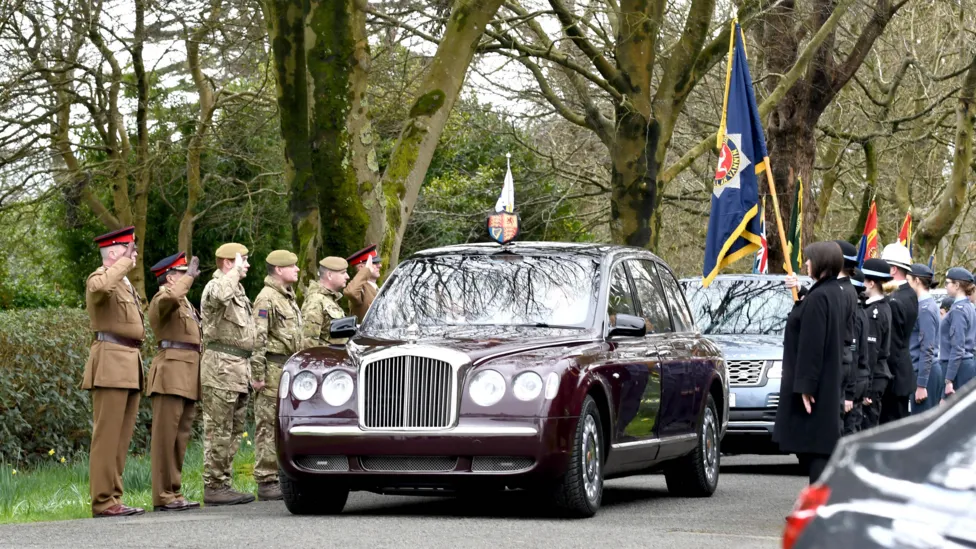
The Queen’s recent sole engagements have included Douglas City Hall on the Isle of Man (for the presentation of the letters patent to confer city status), and Worcester Cathedral (for the Maundy service ahead of Easter).

As was noted in Mark Scott’s lecture a month ago, the granting of banners of arms to members of the royal family is a separate event from the granting of the armorial achievement itself (rather than being automatic as it would be for lesser armigers). Eighteen months into her tenure as queen consort, it appears that Camilla’s own banner has not been granted, for I have repeatedly seen the Bentley State Limousine flying the ermine-bordered version of the royal standard used for lesser members of the firm who had not been granted personalised heraldic flags of their own, while the shield affixed to the roof shows the arms of the sovereign undifferenced.

As is so often the case, the Wikimedia Community have moved much faster than reality – a graphic representing Camilla’s banner as queen consort was uploaded preemptively way back in 2016 and has been used in multiple articles since her husband’s accession. Perhaps this will need to be revised in light of new evidence.

PHOTOGRAPHIC REFERENCES

With Heart and Voice to Sing

The coronation, in addition to its visual majesty, is an opportunity for musical expression. In addition to the long list of traditional pieces, there were twelve brand new compositions commissioned for the day. The whole has been turned into an album, which was uploaded to YouTube and various streaming services on the same day. It is also due to go on sale in CD format on 15th May.

Naturally I took it upon myself to arrange it all into a convenient table for the coronation’s Wikipedia page, which another editor shortly afterwards redesigned almost entirely.

THE OLD

  • Johann Sebastian Bach: Magnificat in D Major; Sunday After New Year; Singet dem Herrn ein neues Lied; Alla breve in D Major.
  • William Boyce: The King Shall Rejoice: Opening Chorus
  • Anton Bruckner: Ecce sacerdos magnus.
  • William Byrd: Prevent Us, O Lord; Gloria; Earl of Oxford’s March.
  • Walford Davies: Confortare.
  • Edward Elgar: Nimrod; March No. 4.
  • Orlando Gibbons: Threefold Amen
  • John Goss:
  • George Friderich Handel: The Arrival of the Queen of Sheba; Oh, had I Jubal’s lyre; Care selve; Zadok the Priest.
  • William Henry Harris: Flourish for an Occasion.
  • Gustav Holst: Jupiter, the Bringer of Jollity.
  • Hubert Parry: I was glad; March from the Birds; Chorale Fantasia on “The Old Hundredth”.
  • Henry Purcell: Trumpet Tune; Christ Is Made The Sure Foundation.
  • Richard Georg Strauss: Wiener Philharmoniker Fanfare;
  • William Walton: Crown Imperial; Coronation Te Deum.
  • Thomas Weelkes: O Lord, Grant the King a Long Life.
  • Ralph Vaughan Williams: Fantasia on Greensleeves; Prelude on Rhosymedre.

THE NEW

  • Karl Jenkins: Crossing the Stone.
  • Sarah Class: Sacred Fire.
  • Patrick Doyle: King Charles III Coronation March.
  • Iain Farrington: Voices of the World.
  • Nigel Hess, Roderick Williams & Shirley Thompson: Be Thou My Vision.
  • Paul Mealor: Kyrie Eleison.
  • Roxanna Panufnik: Coronation Sanctus.
  • Tarik O’Regan: Coronation Agnus Dei.
  • Christopher Robinson: The Recognition; Homage Fanfare.
  • Andrew Lloyd-Webber: Make A Joyful Noise.
  • Judith Weir: Brighter Visions Shine Afar.
  • Debbie Wiseman: Alleluia.

Personally, I’m a little disappointed at the lack of Howard Shore.

State of Change

May I see the wine list?

Late last night it was announced that, due to episodic mobility issues, Queen Elizabeth would not be personally present for the state opening of Parliament today. While the shortness of notice is unusual, it is far from unprecedented for a parliamentary session to begin without the monarch. The present queen missed the openings of 1959 and 1963 due to pregnancy. Victoria loathed to visit Parliament at all during her forty years of mourning. On those occasions the standard procedure was to open the session by commission, with the Lord Chancellor reading the speech. This time, perhaps in consequence of the shortness of notice, the full state ceremony went ahead but with the Prince of Wales reading the speech instead of his mother.

The last time an heir apparent opened Parliament in this way was 23rd November 1819, when the Prince Regent opened the second session of the sixth Parliament on behalf of George III, a mere nine weeks before actually ascending to the throne. Charles, of course, is not full regent, and performed today’s ceremony in his capacity as counsellor of state. Such counsellors are required to act in pairs, hence the first appearance of the Duke of Cambridge at the event.

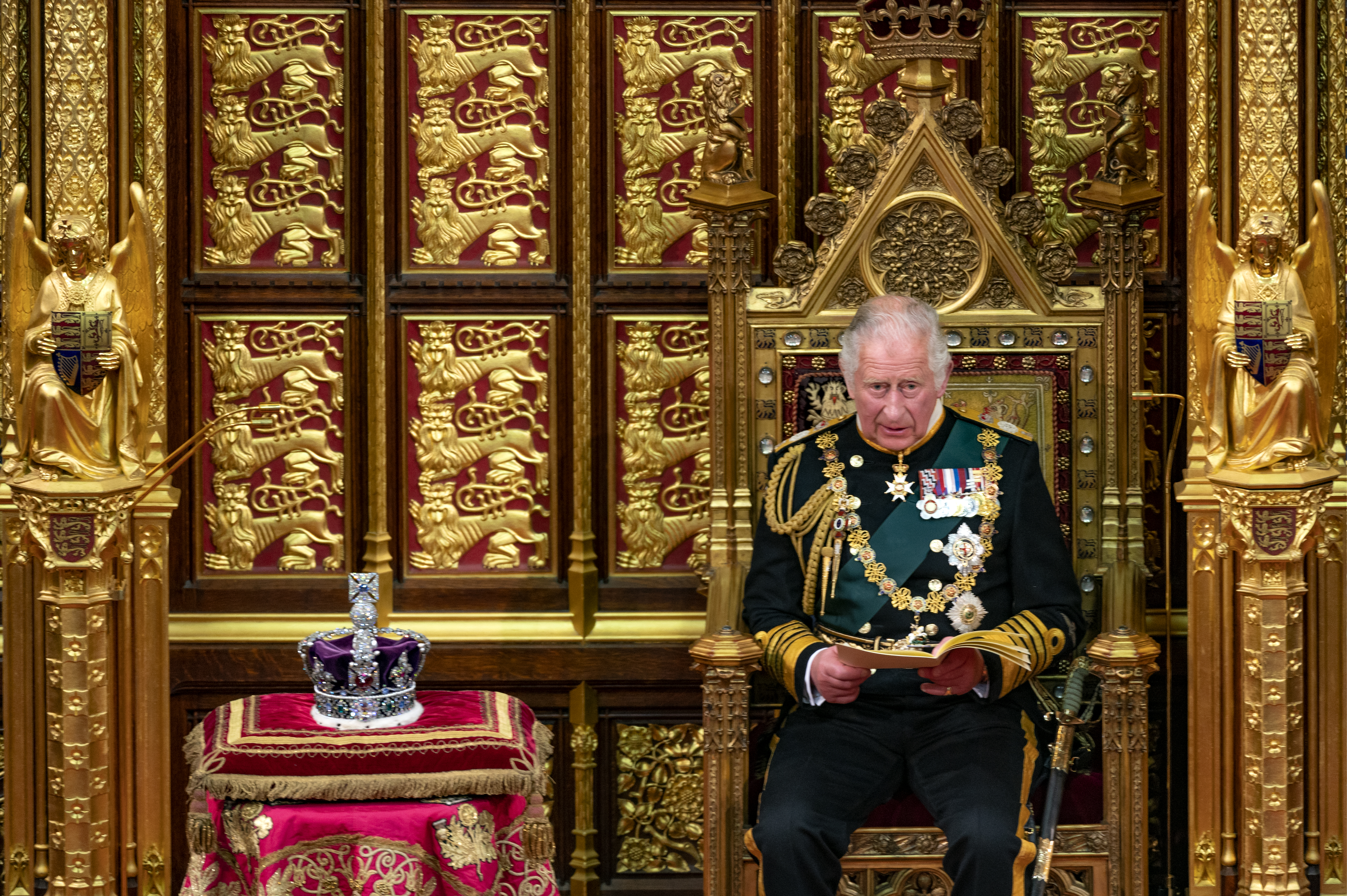
It was reported in the BBC coverage that Charles was sitting on the consort’s throne, with the monarch’s throne being removed from the chamber completely. The Imperial State Crown was displayed on a small table to his right where the monarch’s throne would normally be, while his wife and son sat on the smaller chairs in the alcoves either side.

Convention has long been for the peer reading the speech to do so in first person, as the sovereign herself would have done, but Charles opted to switch to third person, repeatedly describing the government and its ministers as “Her Majesty’s” instead of “my”*. I do not know if he was making the substitution mentally or if the speech was actually printed again with altered wording – which would require a downgrade in materials.

Also last night it was announced that Professor Anne Curry had been appointed Arundel Herald Extraordinary. This did not make her a member of the College of Arms, but did allow her to take part in the procession with the other heralds.

This afternoon the House of Lords Flickr account published twenty photographs of the ceremony, taken by Annabel Moeller and licensed as CC BY 2.0, enabling me to quickly absorb them into Wikimedia Commons. It is unusual for us to have such number and quality of images for events like these. The trend towards releasing photographs in this way is encouraging, even if it is intermittent.

Given that this if the first time counsellors of state have been used to open a legislative session, and that the decision was not known until thirteen hours prior, one has to wonder how much improvisation was employed in today’s ceremony, for example:

  • Their Royal Highnesses travelled entirely by motorcar. Had there previously been plans to use the horse-drawn carriages?
  • The Prince of Wales was in full military uniform as for most state openings, but his wife and son were in morning suits as for the “dress down” occasions in June 2017 and December 2019. The inconsistency is inexplicable.
  • There was no mention of the Union Flag over the Victoria Tower being swapped for the royal standard. Was a banner of the heir apparent’s arms available?
  • The limousine carrying Charles had his own shield of arms mounted on the roof, but that carrying William used the generic red shield with a crown. Has a shield of William’s arms been made for this purpose?
  • The carpet on the lowest step to the throne was plain red, whereas previously the pattern of lions and roses continued all the way.
  • Sir Lindsay Hoyle is wigless for the third consecutive state opening, despite promising to wear it before his election. It can’t still be missing, can it?

When the ceremony is over, both houses debate a response to the address. Tradition dictates that the motion be introduced by a long-serving older member and seconded by a younger, recently-elected one. The role of the “old duffer” was this time fulfilled by my own MP, the “shy and retiring” Graham Stuart. He said of his constituency:

Beverley and Holderness comprises four towns—Beverley, Hornsea, Withernsea and Hedon—and many other hamlets and villages that are dotted across east Yorkshire. It is a beautiful part of the world and has history as well as charm. Beverley has contributed more than most places to the improvement of our democratic system over the years—admittedly chiefly by running elections in such a corrupt manner that the law had to be changed afterwards. After the unseating of the victorious candidate in 1727 by a petition, his agents were imprisoned and Parliament passed a whole new bribery Act. But Beverley’s notorious freemen were not to be put off so easily. Beverley continued to be a byword for electoral malpractice. The novelist Anthony Trollope stood in the Liberal interest, unsuccessfully, in 1868, and such was the level of wrongdoing that a royal commission was established especially and a new law passed disenfranchising the town and barring it from ever returning a Member of Parliament again. Obviously the law did change. Free beer and cash inducements were the electoral controversies then, rather than, say, beer and curry today. Never in the history of human conflict has so much karma come from a korma.

FURTHER READING

*The version used on the Hansard website for both the Commons and the Lords is in third person as Charles delivered it, while that on the government’s site is in first person, as well as annotated with the names of the bills being described.