Jimmy Wales, the co-founder of Wikipedia, yesterday gave an interview about the challenges of keeping the project running, including maintaining fidelity in the age of misinformation and staying neutral in the face of (often bad faith) bias allegations from both sides of a paranoid partisan divide. These are of course issues with which the BBC itself is all too familiar.
Today I was a virtual attendee at the annual Mick Aston lecture by Dr Julian Richards. No write-up is needed this time because Cotswold Archaeology put the whole recording online.
After ten months of inactivity, the Lyon Court’s YouTube channel has at last released another video – this is a recording of a virtual lecture by George Way of Plean, the Rothesay herald, on the topic of Scottish heraldic flags.
A week after the event, the royal YouTube channel has uploaded a seventeen-minute video of the state banquet given at Buckingham Palace. The footage itself is the same as found on commercial news channels, but what catches my attention is the little animation at the end – the title card shows the line drawing of the royal arms that appears on the header of royal.uk, including St Edward’s Crown. I am a little perplexed that this is still being used for these purposes given that a new illustration with the Tudor crown now appears for the channel’s logo. This little animation does not appear at the ends of earlier videos, making it an innovation that only debuted after the artwork itself had already become obsolete.
Heraldry is not a topic much-covered on YouTube, so I cherish what scraps I can find. Recently I found this video from seven years ago of Timothy Noad, illuminator of many heraldic patents, giving a short lecture on his career and craft to the World Calligraphy Museum.
The presentation is actually only half as long as it seems, for as Noad has finished reading out each paragraph in English he has to stop while it is translated into Russian. This results in the whole performance having a stilted cadence redolent of schoolchildren performing class assemblies.
Still, it is nice to actually see and hear from the man who for so long has existed only as a name. I suspect that events in the last two years will make joint ventures like this rather difficult to replicate in the foreseeable future.
It has been a while since I attended any virtual events by the Royal Heraldry Society of Canada. Today’s was rather different in style to the ones I remember during the COVID years.
The speaker was Ann Marie Rasmussen, Professor and Diefenbaker Memorial Chair in German Literary Studies at the University of Waterloo. Her lecture was divided into three parts.
Badges are small devices found mainly in north west Europe. They were easy and cheap to make, usually from pewter in moulds carved from stone. We have an example of a surviving stone mould in Mont-Saint-Michel showing the image of St Michael slaying the dragon. Pewter can show fine details well, but it has the weakness of tarnishing easily. Currently there are more than twenty-thousand medieval badges surviving in museums, and during the middle ages there were probably more than a million in existence. Badges were designed to be decoded. Pilgrim badges were one type, made and sold at holy sites showing religious imagery (e.g. one from Canterbury shows Thomas Becket, one from the Vatican shows crossed keys with a tiara). There survives an anonymous painting of Christ himself among the pilgrims, all of them wearing badges.
Almost all retainers and employees would have a badge to show the identity of the lord, household or organisation for which they worked. There are even examples of badges made of children’s toys. A 1432 portrait of the poet Oswald von Wolkenstein shows him wearing a badge of a dragon and griffin.
The separation of the spiritual and temporal realms is a modern idea. The types of badges often crossed over. Not all imagery was reverential – there are some humourous ones designed to resemble unsightly body parts, and there are records from medieval times of people complaining about indecent badges being worn and distributed around festival times.
A virtual conference by the Department of Political Science at University College London. The speakers were Ilaria Di Gioia, Rachel Potter and James Tierney.

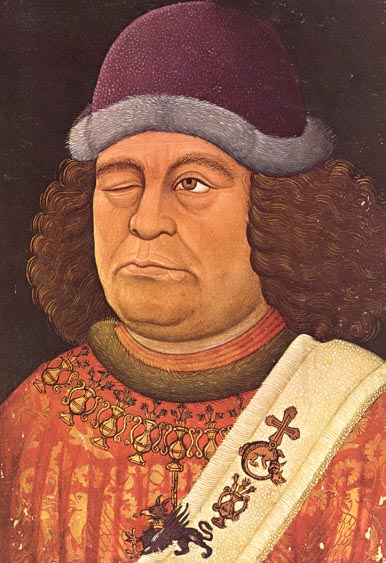
 Robin Stanley Taylor