Belize, Paddington and Royal Variety

The Royal Variety Performance for 2025 was held last night, though it won’t be broadcast until next month. This time the Prince & Princess of Wales attended, as they have done in every odd-numbered year since 2015. I mentioned last year that the Royal Variety Charity was extensively using Sodacan’s Wikipedia illustration of Elizabeth II’s British heraldic achievement. Looking at this year’s photographs it appears nothing has changed.

I mentioned last week the oddity of having the Prince of Wales and his aunt the Princess Royal both undertaking prominent overseas diplomatic visits to different places at the same time. This week the Firm leaned further into this by having a married couple, the Duke & Duchess of Edinburgh, simultaneously touring different continents.

The Duke flew to Nigeria to meet with the President and attend a meeting of the Duke of Edinburgh’s International Award programme, founded by and named after his father Prince Philip.

The Duchess went on a tour of South and Central America. She visited the Republics of Peru, Panama and Guatemala, finishing in Belize. The first three were standard-fare bilateral diplomatic visits on behalf of Britain, with the Palace news page explicitly saying they were requested by the Foreign, Commonwealth & Development Office (specifically the Foreign part in this instance). In some of the photographs we can see her meeting the host president with a Union Flag prominently displayed beside that of the host state.

The visit to Belize is the more interesting one as, unlike the others, this is a Commonwealth Realm, and indeed this is highlighted multiple times in the press releases, with the Palace Twitter feed even calling it “the Realm of Belize” despite the country having no official long name. By strict Commonwealth constitutional logic Sophie should have been there in her capacity as sister-in-law to the King of Belize, acting on the advice of the Belizean government. Despite this, many of the official reports mentioned bilateral ties between Belize and the United Kingdom, which suggests a deliberate straddling of both thrones. I can’t see any royal standard flown by the Duchess on the other visits, but in Belize she was clearly photographed flying the generic ermine-bordured version. As I have lamented before, royals other than the sovereign himself do not have dedicated heraldic flags for each specific realm save Canada so must default to their British arms even where this causes constitutional confusion.

It is also worth remembering that recently there have been reports of Guatemalan military personal making illegal incursions onto Belizean territory, which was condemned by the Commonwealth. It is a little strange, therefore, that a senior royal should visit both countries in such rapid succession without the incident being brought up.

On a final note, two of the aforementioned stories featured appearances by Paddington Bear: The Duchess of Edinburgh posed with a plush toy of him at the British Embassy in Lima (Peru of course being the character’s country of origin), then the Prince & Princess of Wales greeted an actor in costume at the Royal Albert Hall. Paddington Bear has long been an international icon of British culture. Since his appearance in a video for the Platinum Jubilee celebrations in 2022, he has been particularly associated with the royal family. Some have criticised an apparent cult forming around him. This year Spitting Image created a parody of him to appear alongside the Duke of Sussex in a spoof podcast, which at time of writing is the subject of a lawsuit by Studio Canal.

EXTERNAL LINKS

DUke of Edinburgh

Duchess of Edinburgh

Paddington Bear

Royals and Remembrance

Once Halloween and Guy Fawkes Night have passed, poppy season is all that remains to block Christmas from achieving total domination for the rest of the year. There are, of course, two separate dates for this occasion — Armistice Day (always 11th November, the exact anniversary of the end of the First World War) and Remembrance Sunday (second Sunday in November, a broader commemoration of war dead). Both of these events involve two-minute national silences… assuming, of course, that a silence actually falls. Due to the logistics and practicalities of the working week, some organisations have to hold subsidiary events outside the universal dates. Silences here can be hard to regulate if everyone around isn’t coordinated with it. I remember quite a few occasions from childhood when a reverent, contemplative peace was anything but. Even the highest are not immune to this: The Queen attended a service at Westminster Abbey last Thursday, but it was immediately outside rather than inside the main building. As you would expect from an open-air event in central London on a weekday, the “silence” was actually filled with a lot of traffic noise as well as two different emergency sirens. The only blessing was that at least there were no dogs barking. I’m actually a little surprised that this phenomenon hasn’t been the subject of a Family Guy cutaway by now, given that it would be an easy way to get two minutes of padding with minimal animation.

Another big event in November is the United Nations Climate Change Conference, now taking place in Belém, Brazil. The Prince of Wales flew down some days in advance to present his Earthshot Prize, which Sir Keir Starmer also attended, though neither stayed for COP30 itself. This is the latest in a long line of solo overseas engagements undertaken by the heir apparent since his wife’s cancer diagnosis last year*. William was back in time for the Sunday cenotaph service but he missed the Festival of Remembrance at the Royal Albert Hall on Saturday night. Prince George attended for the first time, in his father’s place. The festival includes the religious and patriotic music expected for a solemn occasion, but also a handful of modern entries. One of these was a cover of Avicii’s The Nights. I can’t work out whether it adds to or detracts from the spirit of the event to know that Avicii himself, err, left this world behind some years ago, his life clearly remembered but tragically brief, and predeceased his father. He was from Sweden, a country formally neutral in both world wars. The festival featured multiple performances from Sir Rod Stewart, who sported the unusual sartorial combination of a knight bachelor’s badge hung from an open shirt.

The cenotaph ceremony in Whitehall traditionally involves the laying of wreaths by senior royals, senior servicemen, cabinet ministers, diplomats, various officials representing the British Overseas Territories and Crown Dependencies, and leaders of the significant political parties in the House of Commons. This has always been a bugbear for Nigel Farage, because his parties have so far never met the threshold of six MPs needed to qualify. UKIP in 2015 got 12.6% of the popular vote but only one seat. Douglas Carswell, as the party’s sole representative in the Commons, was regarded for procedural purposes as an independent rather than a leader. Reform in 2024 got 14.3% of the vote and five seats. The cruel twist here is that since the election the Reform caucus has gained two members (one from defection, one from by-election) but also lost two of the originals, so that when November came they were back as they started. It should be noted that the six-member rule, introduced in 1984, has exceptions for the Northern Ireland parties to avoid the appearance of sectarian bias. It is also possible for two or more parties to coalesce for this purpose, as Plaid Cymru and the Scottish National Party have done since 2001**.

The Princess Royal was also absent from the London commemorations, having gone on a royal tour of Australia. She instead paid her respects at the ANZAC memorial in Sydney. It is a little extraordinary for two royal overseas visits to take place at the same time, especially when both of those away from the United Kingdom are counsellors of state. Recently I have been constructing a Wikipedia page listing all of Anne’s official overseas travel (similar to those which already exist for other senior royals) but it has quickly become a little overwhelming to see just how busy she is, with twenty such journeys listed in the Court Circular just for the last two years.

One ought probably to discuss heraldic matters now. In some of the photographs of Anne’s visit I can see her two crosses and a heart flying in various places. I didn’t see William or Camilla flying theirs in the outings aforementioned. Close-up shots of the wreaths laid and crosses planted also show royal symbols. The Queen’s monogram appeared on hers, complete with the Tudor crown. William’s, even now, still uses the pre-Carolean design (note the oak leaves and lack of arch on the coronet). The King’s wreath did not use his monogram, but instead the full royal achievement with BUCKINGHAM PALACE underneath. Once again it was the old-style illustration with St Edward’s crown.

Sir Lindsay Hoyle is something of a vexillophile and has taken to Tweeting whenever a new flag is flown from New Palace Yard. In 2021 he began making a point of raising the flags of the Overseas Territories. His most recent example was the flag of the British Indian Ocean Territory, allegedly celebrating its national day. I can’t find photographic evidence (including on Parliament.UK) of the flag actually flying in the yard, so I can only go on the image shown in the Tweet itself. The BIOT flag includes the Imperial crown, sometimes with a cap of maintenance and sometimes without, but always in the St Edward form. Hoyle’s picture had a Tudor crown. I cannot find this version on the territory’s website or any other source. Is it a custom make? The BIOT is currently the subject of a slow-moving but high-stakes political controversy as Starmer’s government intends to cede sovereignty of the landmasses to Mauritius. This would mean that the territory as a political entity ceases to exist, hence no point updating the flag. I notice that there was not a representative of the BIOT among all the other BOT representatives laying wreaths at the cenotaph. The flag of the BIOT has been widely used in the campaign against the handover, including by the displaced islanders themselves. The bill to ratify the handover passed the House of Commons and recently had its second reading in the Lords, but then there were reports that the government has paused its progress due to public resistance. In this context it is tempting to read Mr Speaker’s Tweet as a not-so-subtle dig at the Prime Minister.

Finally, a point about Flickr: The cenotaph ceremony and the Earthshot prize both produced plenty of government photographs which can be moved onto Wikimedia Commons. The former had two photographers: Simon Dawson for the Prime Minister’s Office and Gunter Hofer for the DCMS. After migrating both albums across I quickly realised that the time stamps given in the metadata were wrong. Dawson’s were one hour too late (probably not adjusted for daylight savings) while the DCMS ones were in some cases out by a whole year! This feels like an elementary mistake for a professional photographer. Sadly there are not likely to be many photographs of Anne’s excursion to Sydney for the reasons I explained last year.

FOOTNOTES

*The Princess of Wales appears not to have gone abroad on official business since 15 October 2023.
**The SNP alone has won at least six seats in every subsequent general election, so in practice the utility of this alliance is one-sided.

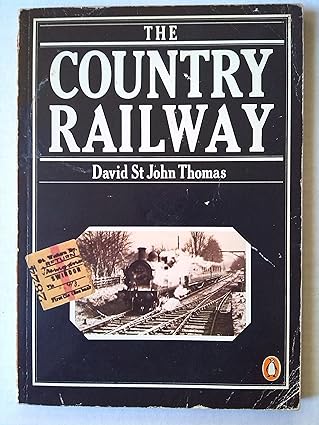
Review: The Country Railway by David St John Thomas

After a tumultuous voyage through Dead Europe I needed a rest on more familiar literary ground. The most obvious choice was another railway book. This one was printed in 1979 with an original price of £1.50. I picked it up from Dovehouse Hospice earlier this year for £1.00. The book is a few years older than The Penguin Guide to the Railways of Britain and rather different in scope: It is only really looking at the past rather than the present and it focuses, as the name implies, specifically on the rural lines rather than the urban ones. This book also doesn’t trouble itself to recap the evolution of locomotives and rolling stock from the beginning, assuming the reader already knows the broad strokes and only bringing up the details where directly necessary. Instead this book is mainly about the experience of daily life for the workers and passengers, as well as the financial aspects of operating the organisation.

The phrase “Country Railway” feels inherently nostalgic precisely because, following the Beeching Axe, there are not many of them around anymore (save heritage lines). A recurring theme of books like this is that the railways were vital to the survival of rural communities yet paradoxically those rural communities tended to be a dead loss to the railways. Closures of country lines would be bitterly mourned despite few people actually riding on them. There is an element of the rotten boroughs about some of the remote services where trains were run back and forth daily with full signalling operations and well-built stations even though the carriages would were at low capacity at the best of times and frequently had no passengers at all. The opening paragraphs of Chapter 8 (starting page 120) lay this out in most striking terms, and it is difficult to avoid simply quoting the entire page verbatim: Rural railways companies insisted on building and staffing their lines, stations and signal boxes to the same standards of quality — as well as safety — that would be expected on urban routes despite the far lower ticket revenue, in contrast to Continental Europe where country railways were far more cheaply constructed. As Thomas sums up:

“An army could have been carried in safety where only scores of people ever travelled. Because stations were so costly, they were often not provided at all where there might still have been useful traffic; and one could argue that in the motor age more lives would have been saved had the railways reduced safety standards — more people would have gone by train, which would still have been safer than buses and cars.”

It may feel a little odd to read someone explicitly argue for the moral virtue of cutting corners in public safety, but a robust case is made that the builders’ noble aspirations actually doomed their projects in the long run. Thomas notes another major obstacle in the need for the company to get a special Act of Parliament passed and/or secure the consent of all the landowners along the route, which an attempted streamlining of the process in 1864 failed to fix. The result was that construction costs per mile of track ended up being many times the original estimates and the railway companies frequently found themselves financially sunk before operations even started. These problems are entirely familiar in the present day. Indeed, I was struck when reading this section by how much the prose of a book on such a genteel topic, written nearly fifty years ago and describing events almost a hundred years before that, bore so much resemblance to that by Ezra Klein & Derek Thompson in Abundance, released earlier this year and addressing the same problems on a larger scale in the present — even including the building of railway lines!

On the flipside, the book also emphasises the death and destruction that results when strict safety protocols are not followed, the appendix retelling the tale of the Abermule Disaster of 1921, in which a quartet of negligent station staff got a pair of signalling tablets swapped around so that two trains collided head-on. The final sentence draws parallels with RMS Titanic:

“Time and again one or other of these mistakes had been made with impunity, but at Abermule on that disastrous day, like the scattered pieces of a jigsaw puzzle, these trifling faults fitted one into another until the sombre picture was complete.”

The book looks over the lifestyle of the rural stationmaster, isolated from the station’s local community, assailed from above as well as below and occupying a liminal, uncertain position within the British class system of the time. The ticket prices were no less convoluted then than now with a dizzying array of tariffs, rates, discounts, equivalences and exceptions. Thomas further looks at the advancement of new technologies and working practices in railway operations, particularly as regards the directions of trains — from turntables to passing loops to runarounds to push-pull to double-ended railcars. A recurrent problem for this sector was that, although the stationery infrastructure was kept to the same standard as the urban lines, the moving parts were not. Whereas the intercity main lines were upgraded to diesel and electric multiple units, the country branches were stuck with antiquated steam engines and their threadbare coaches. Even getting electric lighting on the platforms instead of gas was a struggle. Continuing with old-fashioned systems kept these lines more labour-intensive than they could otherwise have been, which only widened the gap in profitability compared to the main lines. Speed was also an issue for a lot of country lines, particularly in pre-war times, due to the low power of the locomotives and the mixing of passengers with goods on stopping trains.

In contrast to a lot of books of this type, which only look at Great Britain, this one also includes sections set in Ireland. Mostly these serve to tell us how the Irish rural railways were even more spendthrift, disorganised and ramshackle than the English, Scottish and Welsh ones. Attention is drawn to the larger gauges on this island (standard 5’6” and “narrow” typically 3′) which further increased expenditure. Timekeeping too was even worse and page 141 has an amusing anecdote relayed from Punch wherein a local dignitary was surprise to see his train actually leaving on time, only to be informed that it was the train from the previous day.

Despite the myriad problems in running the railways, Thomas is keen to point out that the local communities held great affection for them, staging elaborate celebrations when they were opened and even grander funerals at their closure. That books such as this (and indeed films, magazines and television series) about old railways and the engines that ran on them are so numerous and constitute such a well-established genre is testament to the high regard in which the British hold at least the idea of the railways, even if in practice relatively few get to make regular use of them.

Rolling Coverage

It quickly became apparent that the Duke of York’s dedication on 17th October to cease the use of his titles and honours was not enough to satisfy the public mood and so, not even a fortnight later, a further announcement was made that His Majesty would be taking measures to enact these changes in a formal way, and also that the changes would go further by removing his princely title as well so that he became Andrew Mountbatten Windsor. No notice to this effect has yet appeared in the London Gazette, but then it is fairly normal for that publication to lag by a few days and indeed for these processes themselves to take a few days to carry out. This is the first time since 1917 that a Prince of the United Kingdom has had that dignity removed in this way.

Less than a day after this announcement it was noted that the Roll of the Peerage had been updated to omit his name*. This is not actually a roll of parchment but rather a PDF. It is uploaded on and accessed through the website of the College of Arms but is actually controlled by the Ministry of Justice. As the page explains, the Roll was created as a government register of everyone who possessed a peerage of any rank of the United Kingdom or its predecessor states, the Roll of the Lords Spiritual and Temporal having been rendered quite inadequate for that purpose following the House of Lords Act 1999. Newly-created peers are added to the Roll automatically but those who have inherited their titles but those who inherit their titles are responsible for writing to the Secretary of State with the necessary documentation to prove their succession. It is also possible for those already listed to request their own removal. The absence of a peer from the Roll does not actually cause his peerages to cease to exist but does effectively mean that the state in its official capacity will cease to recognise him as holding them. This is probably as close as Andrew can get to fully giving up his dukedom and its subsidiaries without an Act of Parliament being passed specially for that purpose.

This has of course led to another flurry of edits on the former prince’s Wikipedia page. Some commentators noted how quickly the page had been moved from “Prince Andrew” to “Andrew Mountbatten Windsor“, but actually this was against procedure so the page name was reverted and not moved again until editor consensus was established. It would have been a lot more convenient for us if both of last month’s announcements had been made as one so that two separate page moves (and thus two separate discussions) would not have been needed. Of course, this still doesn’t entirely resolve matters because there is still some confusion as to whether “Mountbatten Windsor” needs a hyphen, as the royal warrant from 1960 includes one but the recent announcement does not. There is a further important, if largely academic, point to be made that even if Andrew has agreed to simply go by Mr from now on, he could still be called Sir until his knighthoods are fully removed, or indeed Lord as the younger son of a duke.

FOOTNOTES

*Contrast this version (archived on 16th December last year) to this one (archived yesterday): The first two pages list the principal peerages of members of the royal family, then the rest of the document lists all the non-royal peers. Within both groups the titles are listed alphabetically, so “York” was previously the last of the royals. Now he doesn’t appear at all. I note that the current version omits the “Latest revision” date underneath the Crown Copyright line on the first page, which makes me think that yesterday’s update was done in a hurry.

EXTERNAL LINKS

UPDATE (5th November)

The Gazette website has now published (as of noon today) notices confirming the removal of Andrew’s titles:

  • THE KING has been pleased by Letters Patent under the Great Seal of the Realm dated 3 November 2025 to declare that Andrew Mountbatten Windsor shall no longer be entitled to hold and enjoy the style, title or attribute of “Royal Highness” and the titular dignity of “Prince”.
  • THE KING has been pleased by Warrant under His Royal Sign Manual dated 30 October 2025 to direct His Secretary of State to cause the Duke of York to be removed from the Roll of the Peerage with immediate effect.

The first appears only in the London Gazette, while the second also appears in the Edinburgh and Belfast. So far I have not seen any of the usual experts dissecting these, although that will likely come in a few days. These are of course only the Gazette notices and not the full texts of the relevant documents, for which I have already seen some of them say they will file FOI requests. I will note that the removal of princely titles does not take the form of a royal licence, and refers to its target as already being named Andrew Mountbatten Windsor. The second, despite its triple publication, only refers to the Dukedom of York so the removal of the subsidiary earldom and barony must be read as implicit. It says that His Majesty directed the action rather than the Duke himself requesting it as the original warrant laid out, so presumably the new warrant must be amending the original in some way.