Notes on the England Coast Path

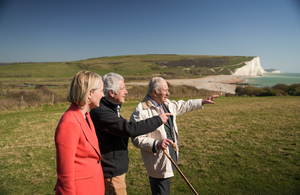
The King, fresh off his farewell to President Tinubu, made headlines on the cliffs of Seven Sisters, Sussex, on Thursday by officially opening what may physically be his largest namesake, the King Charles III England Coast Path.

Charles’s coat looks quite like the sort of thing my grandmother would have worn.

As the government’s press release explains, the project actually long predates his reign, his name being appended to it in 2023 as part of his coronation celebrations. It resulted from the Marine and Coastal Access Act passed all the way back in 2009 and, as all the updates on this other government webpage indicate, it was supposed to be completed by 2030, then optimistically brought forward to 2020, then pushed back again during the pandemic.

The ambition was to link up all the existing footpaths, as well as carving out new ones where needed, to create a continuous walking trail which covered the entirety of the English coast line. Of course, the English coast line itself is not continuous, as England has sizeable land borders with Scotland and Wales. A Wales Coast Path, proposed in 2006 and completed in 2012, links up to the English one in two places and there is also a Scottish Coastal Way in the pipeline. As this is a devolved matter, the institutions are not entirely alike and it is not certain if the other two will ever bear the monarch’s name, or if Northern Ireland will attempt something similar. Even now, despite the official opening this week, the English path has 20% still to go and is expected to be completed at the end of 2026. “Coast” is also being used in quite a broad sense, as the path incorporates trails along not only the seas, but also the rivers — including the Humber, which runs quite close to my house and along which I walk fairly regularly.

The situation with the naming and timing has some echoes of the Elizabeth Line, the commuter railway through Greater London from Reading to Shenfield, which likewise was a combination of new paths built from scratch and old ones appropriated. The proposals had been floated as far back as the 1940s and work finally began in 2009. The construction project was called Crossrail, and this by default might have become the name of the completed railway. It was only in 2016, in the run up to Elizabeth II’s ninetieth birthday, that the line was named after her. The name was slightly controversial as it gave the false impression of being part of the London Underground rather than a different railway in its own right. The completion was originally scheduled for 2018 but, inevitably, there were delays and services did not run until 2022. The repeated schedule slips raised concerns over whether Elizabeth herself would live to open her namesake line. In the event she did open the first section in May that year, but had died by the time the rest opened in November.

Hopefully His Present Majesty will not exhibit the same phenomenon.


The Use of Academic Dress in Heraldry

This was a virtual lecture put on by The Heraldry Society. It was presented by Duncan Sutherland, with an introduction by David Phillips, the latter being actually present this time. Sutherland said that he was connecting from Albania. When he started researching heraldry he came across academic dress a few times and managed to record about twenty examples.

Academic gowns in corporate arms usually reference the founder of the organisation. Academic robes date to the middle ages when most if not all students were there to train for the holy orders. The medieval university tunic was the forerunner of both the academic robe and the clerical cassock. Hoods were included because at the time they were common across all classes. When they fell out of general usage they were supplanted with skullcaps, which then evolved into a wide variety of specialised hats.

British academic styles reflected the influences of the Reformation, Republican and Restoration periods.

Sutherland then went through his examples, both personal and corporate. I have looked up free-licence images and the textual blazons wherever I can.

The Earls of Aberdeen

Dexter an Earl  and sinister a Doctor of Laws both habited in their robes Proper.

The earliest known grant of supporters to include academic robes was to the 1st Earl in 1683, with both dressed as doctors. The 4th Earl swapped them for the Hamilton antelopes. The 7th Earl was granted the present supporters. He was later elevated to Marquess but the dexter supporter was not changed to match.

William Thompson, 1st Baron Kelvin (g.1892)

On the dexter side a student of the University of Glasgow habited holding in his dexter hand a marine voltmeter all Proper. On the sinister side a sailor habited holding in the dexter hand a coil the rope passing through the sinister, and suspended therefrom a sinker of a sounding machine also all Proper.

Kelvin was the first British scientist to be elevated to the House of Lords. He served as Professor of Natural Philosophy at Glasgow for fifty-three years and was an important contributor to the Transatlantic Telegraph Project. His supporters were granted by the College of Arms in 1892 but the arms themselves had been granted by the Lyon Court.

Leonard Courtney, 1st Baron Courtney of Penwith (g.1906)

On either side a doctor of civil law of the University of Cambridge, vested in his robes, the dexter holding in his right hand an open book, the sinister in the right hand a pen, in the left hand a scroll all Proper.

Courtney was Second Wrangler at St John’s College, Cambridge.

Alfred Mond, 1st Baron Melchett (g.1928)

Dexter a Doctor of Science of the University of Oxford holding in the exterior hand a chemical measure glass sinister a labourer holding in the exterior hand a pick resting on the shoulder all Proper.

Melchett’s arms were granted in 1910 and revised in 1928. He studied at St John’s College, Cambridge and later was Chairman of Imperial Chemical Industries.

Sir Alfred Keogh

Keogh was Director-General of the Army Medical Services. His supporters were a Voluntary Aid Detachment nurse and a doctor in gown.

John Maynard Keynes, 1st Baron Keynes (g.1944)

Keynes was a scholar at both Eton College and King’s College, Cambridge. (CA Ms Grants 107/253)

Archibald Wavell, 1st Earl Wavell (g.1944)

Dexter a soldier of the Black Watch in field service uniform supporting with his exterior hand a rifle sinister a Scholar of Winchester College in his gown holding in his exterior hand a closed book all Proper.

Wavell was himself a scholar of Winchester College. He had his first army commission in the Black Watch in 1901. He was Colonel of the Regiment from 1946 to 1950.

He had protracted correspondence with Garter over the correct illustration of the academic dress. They are displayed at Winchester Cathedral.

Alfred Webb-Johnson, 1st Baron Webb-Johnson (g.1948)

I cannot find a blazon for them, but Sutherland said they were displayed in the King’s Chapel of the Savoy as well as the Fitzrovia Chapel.

Jack Simon, Baron Simon of Glaisdale (g.1977)

Dexter a man habited in the robes of a Doctor of Civil Law in the University of Cambridge Proper and holding in his dexter hand a book Or sinister a man habited in the robes of the President of the Probate Divorce and Admiralty Division of the High Court Proper. (Debrett’s 2003, P1476)

Simon was President of the Probate, Divorce and Admiralty Division from 1962 to 1971. He studied at Trinity Hall, Cambridge, before his call to the bar.

Stewart Sutherland, Baron Sutherland of Houndwood (g.2004)

Dexter a male figure in the attire of the Vice-Chancellor of Edinburgh University sinister a male figure in the attire of an honorary graduate of Aberdeen University and wearing the hat appropriate to an honorary doctor of the University of Uppsala.

Sutherland was himself Vice-Chancellor of the University of Edinburgh. He also had a Master of Arts degree from Aberdeen and an honorary doctorate from Uppsala, both in theology.

Jocelyne Roy-Vienneau (g.2015)

In this case the academic references are in the crest rather than the supporters.

Two blue jays each holding in its beak a sprig of balsam fir and standing on a bed of daylilies and purple violets Proper.

The Public Register explains the symbolism: The mortar and diploma symbolize Ms. Roy Vienneau’s career in post-secondary education, particularly as assistant deputy minister with New Brunswick’s Department of Education and as dean, department head, professor, manager and director general of the community college in Bathurst. They also symbolize her husband’s career as a teacher in public schools.

Worshipful Company of Framwork Knitters (g. 1933)

On the dexter side a student of the University of Cambridge in academical costume of the seventeenth century Proper and on the sinister side a female figure also in seventeenth century costume habited Azure cuffs cap neckerchief and apron Argent holding in the dexter hand a knitting needle Proper and in the sinister hand a piece of worsted knit Gules.

Worshipful Company of Scientific Instrument Makers (g.1956)

On the dexter side a figure representing Michael Faraday habited in a festal gown of a Doctor of Civil Law of the University of Oxford and holding in the exterior hand a representation of his coil Proper and on the sinister side a figure representing Sir Isaac Newton habited in a gown of a Master of Arts of the University of Cambridge and holding in the exterior hand his telescope also Proper.

Royal College of Anaesthetists (g.1991)

The supporters are representations of John Snow and Joseph Thomas Clover.

Royal College of Paediatrics and Child Health (g.1999)

Blazon missing.

University of Ballarat (g.1997)

I can’t find the blazon for this one.

New College, University of Edinburgh (g.2021)

Two human figures representing diversity one dressed in the academic gown and hood of a Master of Divinity and one dressed in the academic gown and hood of a Master of Arts (Religious Studies) both from the University of Edinburgh all Proper.

Liverpool John Mores University (g.1989)

Dexter a peregrine falcon and sinister a raven each statant on a doctoral hat upon a compartment comprising a grassy mount all Proper.

Worshipful Company of Educators (g.2014)

On the dexter a dragon wings elevated and addorsed Argent holding in the dexter foreclaws an abacus Azure the beads Gules and on the sinister a barn owl wings elevated and addorsed proper the wings charged with an escallop Azure charged with two swords in saltire proper hilts and pommels Or and holding in the beak by the tail a mouse Sable each statant upon a book Or bound Gules.

University College of Cape Breton (g.1995)

Here again the reference is in the crest.

Rising from a wreath of mayflowers Proper a Canterbury cap Gules.

A Place In the Country:- The Castle as Holiday Home

Today’s virtual presentation as at the Cleveland & Teeside Local History Society. The speaker was Erik Matthews.

The main purpose of the lecture was to present an alternative perspective on the fundamental nature and purpose of medieval castles. While they are popularly believed to be first and foremost military strongholds, with luxury and decoration being a later development, research since the 1980s has found that even in their Medieval heyday a lot of these buildings were primarily status symbols and luxury homes with actual defensive capability being a distant afterthought.

Matthews’s main case study was Whorlton Castle in North Yorkshire. Whorlton was developed in three stages, the first beginning shortly after the Norman Conquest. The town of Whorlton developed at the foot of the castle in the thirteenth century, but decline in the seventeenth due to the growth of nearby Stokesley, which had better access to the Tees.

With few exceptions, Whorlton was not generally employed as a defensive building, and Matthews identified several features which gave this away, most notably the gatehouse with its wooden portcullis which would not have stopped an army, or the false gun ports through which a proper sight would have been impossible. He also noticed other features of the estate’s former grandeur, such as the elaborate water gardens supplied by an artificial leat and dam, or the compartmented gardens where high-status guests could socialise. There were also signs of earthwork boundaries which would have been dug to divide the estate into smaller burghages. He highlighted an outer enclosure, which could have been the site of the town’s fair.

He spoke more briefly about other locations, such as Sigston Castle, set in the kind of watery landscape which was often crafted to create optical illusions which would make the estate look bigger than it really was. He also said that the moat around a castle was not necessarily to keep out human invaders but rather to deter pest animals and form a liminal space which marked the boundaries between places of different social status. Also included was Harewood Castle, constructed in 1340 by Sir William Aldeburgh, then split in abeyance between his daughters with a timeshare arrangement, then Barnard Castle, then Dunstaburgh, then finally Pendragon Castle in Mallerstang, which he noted was surrounded by hills from which an attacking army could claim the advantage of high ground.

I was reminded of the BBC Radio 4 series “Short History Of…”, whose episode on British Castles also made the point that most of them were mainly used as comfortable residences for the wealthy and thus the conversion of so many of them into hotels in the modern age should be no surprise.

Paull Holme Tower, my own family’s castle (or at least part thereof) has yet to reach a habitable state, but hotel conversion is one of the options regularly suggested as an endpoint for its restoration.

Commonwealth Day 2026

The Commonwealth of Nations traditionally has its annual day of celebration on the second Monday in March. This is marked in many ceremonies around the world, but most prominent is a special service at Westminster Abbey, put on by the Royal Commonwealth Society, attended by the Head of the Commonwealth and several members of his family, along with diplomatic and cultural representatives from the various member countries. The service includes some speeches, some religious readings, a parade of member states’ flags and a series of musical performances from groups representing different global regions.

For all of this century so far the Abbey service has been broadcast live by the BBC (specifically “BBC Studio Events”), and the last few have been archived on iPlayer, as well as the Corporation’s YouTube channel. This year, however, the highly controversial announcement was made that the service would not be aired, the time-slot being given instead to a rerun of Escape to the Country. Allegedly this was made on cost grounds. Although the headlines initially only referred to live broadcasts, it later became apparent that the service had not been properly filmed at all. This is a rather baffling decision on the embattled BBC’s part. Given how much experience they have shooting in the Abbey — not just for these services, but also for weddings, coronations, funerals and military commemorations — it really should be second nature by now. Also, given that they have recently lost the rights to broadcast this year’s Commonwealth Games in Glasgow, as well as some other high-profile sporting events, one might have expected them to defend their remaining prerogatives with all their might.

The service did not go totally unrecorded: There are stills available on Getty Images, the order of service can be read from the Abbey’s website and the ITN Royal Family Channel has a 25-minute montage. Unfortunately the latter does not compare to the BBC productions of previous years, being rather crudely shot from a handheld camera and focusing more on the arrivals and departures at the doorway than on the event itself.

While those interested in the content of the speeches can obviously read them from the handout, and those wishing to inspect the outfits of the royals and dignities in attendance can do so from the stills, the elaborate music and dance routines cannot really be enjoyed in this manner. The whole experience is akin to watching a Telesnap reconstruction of a missing Doctor Who episode.

If the BBC does not reverse this decision next year, perhaps the Society (or whichever body is actually in charge of this decision) will offer it to another broadcaster, or even setting up their own in-house film unit to either sell to the networks or publish online. The knock-on effects for the airing of other royal events could be severe.

UPDATE (16th March)

Happily it turns out at least some of the event was professionally recorded, as the RCS’s website has released a handful of clips. Even more happily, my comparison to missing Doctor Who turned out to be apt as it was revealed on Friday that two more episodes have been found.

Newsletters and New Lectures

Long-time readers may recall that in late 2024 I submitted some Freedom of Information requests to various state bodies concerning the award of certain British orders of chivalry. One of the questions I asked was how many people currently hold each grade of each order, if such statistics even existed. I was advised that the Central Chancery of the Order of Knighthood might hold such information, but cautioned that they were not subject to FOI requests.

The website of the Chancery was, for its first few years, ridiculously amateur in appearance. Thankfully sometime between May and September 2023 it underwent a revamp and now looks far more respectable. Between 15th February and 26th March last year the site finally got around to using the new Noad illustration of the royal arms instead of the old Sodacan one (although I’d rather not start talking about that topic again). It was only recently that I noticed (although in retrospect I see it was there for sometime) the presence of Annual Reports for both the Royal Victorian Order and the Order of St Michael & St George (sadly not the Bath or the British Empire though). These PDFs include recitations of the histories of the orders, a list of events related to them that had happened over the past year and a rundown of the order’s financial accounts, mostly relating to the upkeep of their respective chapels. Most importantly for my purposes, they also answer the question of membership totals by including an annual register: That for St Michael & St George says that as of 11th July 2025 there were 71 Knights & Dames Grand Cross, 224 Knights & Dames Commander and 935 Companions. The limits for those grades are, respectively, 125, 375 and 1750. That means the ranks are a long way from being saturated. The Royal Victorian Order does not have formal quotas on appointments at any grade, and its much glossier newsletters do not contain that information.

The seal of the Order of St Michael & St George, as seen on the cover of its annual reports.

In addition to this, the latest edition of The Dragon, the newsletter for St George’s Chapel at Windsor Castle where the Order of the Garter is headquartered, mentioned the Lent Lecture for 2026, and included a link to the Vimeo page. That got me wondering how many other heraldry lectures might have become available online since the last time I looked. Restricting the YouTube search results to the past twelve months got me a surprising bounty. I have put here a list of the videos I found:

  • “Between Two Turks:” Racialization and the Heraldry of Esclabor Le Méconnu (Royal Heraldry Society of Canada, 3rd March)
  • Scottish Heraldry: A (Surprisingly?) Egalitarian Tradition by Prof. Gillian Black (St Mungo Festival, 22nd January)
  • Tolkien Tuesday: Heraldic Overtones (Prancing Pony Podcast, 6th January)
  • Preble Lecture: Flags of Canada (North American Vexillological Association, 10th December)
  • The Simchat Torah Flag: From Biblical Roots to Modern Israeli Icon with Prof. Shalom Sabar (Community Scholar Program, 16th October)
  • Folklore in Heraldry with Samantha Cook (Augustan Society, 9th October)
  • Stitching a Lineage: Embroidered Coats of Arms in Eighteenth-Century Boston (American Ancestors, 22nd August)
  • Heraldic Collections from Medieval Times to the Digital Age by Ralf Hartemink (Genealogical Society of Ireland, 26th May)
  • Aspects of Heraldry in Drogheda and its Vicinity (clahs Louth, 28th March)
  • Webinar – Origin + Meaning of O’Molloy Coat of Arms and Crest (O’Molloy Clan, 21st March)

That’s probably not even a complete list, but it’s more than enough to keep me entertained for a while and I’m glad to see more activity in this field as just a few years ago the offerings were very sparse.