Thistle Day 2024

Today was the last in a string of high-profile royal engagements that went ahead despite the ongoing general election – although there are reports that the traditional “royal week” has been shortened due to the need for His Majesty to run back to London on Friday to meet the prime minister.

Unlike last year’s Presentation of the Honours of Scotland, this was a standard ceremony of the Order of the Thistle. The Queen and the Duke of Edinburgh were due to have their banners installed at the High Kirk.

This excursion also featured the Ceremony of the Keys – which will be Alastair Bruce’s last as Governor of Edinburgh Castle.

It would be nice if I could include some photographs of either event, but it seems that unlike last year (when the Scottish Government Flickr account uploaded many) there are only commercial ones to be found. I hope that perhaps some amateur ones may be released under the right licensing arrangements soon. I also hope that we will soon get a good look at the Scottish arrangement of Her Majesty’s coat of arms – not that we don’t already know exactly what it should look like, but just to get proof that it exists!

The Emperor’s New Collar

Naruhito & Masako, Emperor & Empress of Japan, conducted a three day visit to the United Kingdom this week. It was the third state visit to Britain during the present reign, and the first monarchical one since that by the King & Queen of the Netherlands in 2018.

The visit consisted of the expected activities – a state banquet at Buckingham Palace, then another banquet at the London Guildhall, as well as military parades and presentations.

According to the Court Circular for 25 June, the palace guest list included “Mr. Christopher Broad (Founder of YouTube channel, Abroad in Japan)”. This is thought to be the first time that a prominent YouTuber has been invited to a state event specifically in that capacity.

As is customary during state visits, the monarchs exchanged appointments to their respective orders of chivalry: Charles received the Collar of the Supreme Order of the Chrysanthemum while Naruhito became a Stranger Knight of the Most Noble Order of the Garter. It is a shame that his visit was not a few days earlier, or he could have marched in the procession.

File:Coat of Arms of Japanese Emperor (Knight of the Garter Variant).svg

Sodacan’s representation of the Japanese Garter arms.

Naruhito ascended the imperial throne in 2019 when his father Akihito abdicated. Japan now joins Spain and the Netherlands in having two Garter stalls simultaneously. What makes the Japanese representation different to the Spanish and Dutch is the different style of heraldry. The Japanese Imperial Seal is a mon representing a stylised chrysanthemum flower. Mon are normally standalone objects without a background – more visually similar to a Western crest or livery badge than a shield of arms. To make the symbol compatible with European heraldic customs for use in St George’s Chapel it is typically presented as the lone charge on a red background for the shield and banner, then again without a background as the crest atop the helm. The Emperor paid a private visit to Windsor Castle to view his predecessors’ stall plates there and to lay a floral wreath on Elizabeth II’s tomb.

The state banquet also marked the first appearance of the Royal Family Order of Charles III. Dating back to the reign of George IV, the royal family orders are an informal and highly personal decoration restricted to senior royal women. Each consists of a silk ribbon from which hangs a jeweled miniature portrait of the sovereign. The orders do not always have formal classes but their badges tend to come in different sizes which correlate to the seniority of the recipient. The colour of the ribbon varies: Charles III follows George V in using pale blue, whereas Victoria used white, Edward VII blue and red lined with gold, George VI pink and Elizabeth II yellow. The Queen was seen wearing the new Carolean order immediately above the Elizabethan one she received as Duchess of Cornwall in 2007, and there is a clear difference in size. The Duchess of Edinburgh also wore Elizabeth’s order to the banquet.

This state visit was a little unusual in that it happened during a general election campaign. Some changes had to be made to the itinerary to cut out the more obviously political elements: Unlike previous visiting sovereigns, the Emperor did not make an address to Parliament (since their isn’t one) and while the cabinet and opposition leaders attended the state banquet they did not have individual meetings with him. Notably Sir Keir Starmer and Sir Edward Davey were not wearing their respective knightly insignia.

Garter Day 2024

Today saw yet another of the royal public events that were too big to cancel – the procession of the Knights of the Garter to St George’s Chapel, Windsor. As with other big public events, I primarily experienced it in the form of the passive livestream on YouTube.

The cameras followed the knights, heralds and other officers as they marched on foot from the castle to the chapel, then went back again by carriage. They also filmed a large procession of what I assumed to be security cars following along the same stretch of road, which took something away from the splendour of the occasion. The cameras did not go inside the chapel, instead just showing the crowds and guards waiting outside for the duration, but the microphones (wherever the may have been positioned) were able to pick up a reasonable audio feed of the speeches, sermons and hymns.

The new members being installed today were royal lady the Duchess of Gloucester and knights companions the Lords Peach, Kakkar and Lloyd-Webber.

Stall plates and banners as photographed in The Dragon. Artist unknown.

Earlier this year, at the prompting of Baz Manning, I subscribed to The Dragon, the community newsletter of St George’s Chapel. Although this mainly covers religious events, it is also often where knights’ armorial bearings are leaked for the first time. The edition of 9th June included photographs of the newly-delivered stall plates for Lady Ashton of Upholland and Lord Patten of Barnes, while that of 16th June showed the banners of Lords Peach and Kakkar. Apparently Peach’s must have been granted fairly recently, for the article claims that the sword is a reference to him carrying Curtana at the coronation last year. That means Lloyd-Webber is the only current member who remains at present armorially anonymous.

UPDATE (20th June)

The video I originally linked at the top of the article has been removed from Associated Press’s YouTube channel. All the other channels that also uploaded the same video seem to have removed it as well. For now I have replaced it with an amateur video by David Dumbrăveanu. The Daily Mail curiously still seems to have the full video up, and most other channels have at least small snippets.

The Proclamation in Public

Yesterday I wrote about the text of the royal proclamation for the dissolution of Parliament appearing on the Privy Council website. Today it was actually read out in public.

Traditionally there are two public readings of the proclamation – the first is by the Common Cryer of the City of London (Major Peter Oweh, his first time doing this) on the steps of the Royal Exchange, the second is by the Lord Lyon King of Arms (Canon Joseph Morrow, now on his fourth general election) from the Mercat Cross in Edinburgh.

As with many ceremonial events like this it has been frustratingly difficult to find good visual recording – despite most big news outlets doing rolling coverage of the general election for the past few days. The London proclamation was filmed by The Daily Mirror as seen above and had a few still photographs taken by Getty. For the Edinburgh version I am limited to the Lyon Court’s own blog and this amateur video by Haizhen’s Hut. To make matters worse, the United Kingdom is far from the only country having a national general election this year and even just searching for “dissolution of parliament” often brings up articles about Israel.

Yesterday I received a campaign letter from the Conservative candidate for Beverley & Holderness, Rt Hon Graham Stuart. Cannily, I would presume, he had them printed and sent out on 29th May so that at time of writing he could still use the MP post-nominals on the return address of the envelope, even though he would cease to be one by the time most recipients of his letter actually read it. Electoral projections that I can find at this time are conflicted as to whether he will be returned or replaced by the Labour candidate Margaret Pinder.

Also of note are the writs of election, which of course the Lord High Chancellor has as per said proclamation caused to be issued. Medway Council recently published a photograph of the writs for the three constituencies for which it was responsible. These are, of course, the first writs for these constituencies to be issued in the name of Charles the Third.

That brings me on to another point – while dissolving Parliament is a routine part of the election process in many democratic countries, the return of the regnal name Charles in relation to such matters provokes some historical sniggering in reminiscence of the civil wars of the seventeenth century. It is curious, therefore, that the first British dissolution in this reign should be immediately after Oak Apple Day, the now-obscure commemoration of the restoration of the monarchy after the fall of Cromwell’s republic. The name refers to the Royal Oak, a tree in Boscobel Wood which Charles II used to hide from the Roundheads in 1651. Given that the oak tree went on to become the symbol of the Conservative Party, it is perhaps a little surprising that no senior figures in the party (or in the headline-hungry media) have made a prominent reference to it. Of course, once suspects that his present Majesty would prefer not to be drawn into partisanship in that way.

A Proliferation of Signs: Badges in the Medieval World

Video

It has been a while since I attended any virtual events by the Royal Heraldry Society of Canada. Today’s was rather different in style to the ones I remember during the COVID years.

The speaker was Ann Marie Rasmussen, Professor and Diefenbaker Memorial Chair in German Literary Studies at the University of Waterloo. Her lecture was divided into three parts.

Badges are small devices found mainly in north west Europe. They were easy and cheap to make, usually from pewter in moulds carved from stone. We have an example of a surviving stone mould in Mont-Saint-Michel showing the image of St Michael slaying the dragon. Pewter can show fine details well, but it has the weakness of tarnishing easily. Currently there are more than twenty-thousand medieval badges surviving in museums, and during the middle ages there were probably more than a million in existence. Badges were designed to be decoded. Pilgrim badges were one type, made and sold at holy sites showing religious imagery (e.g. one from Canterbury shows Thomas Becket, one from the Vatican shows crossed keys with a tiara). There survives an anonymous painting of Christ himself among the pilgrims, all of them wearing badges.

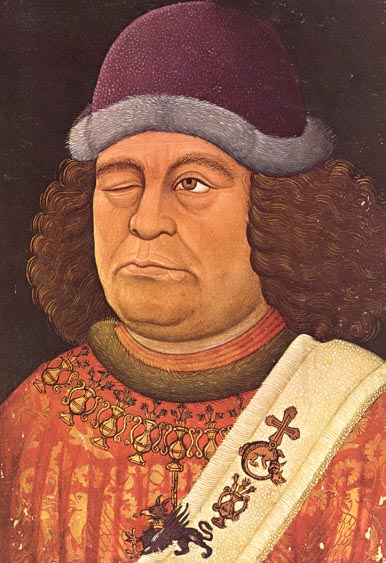
Almost all retainers and employees would have a badge to show the identity of the lord, household or organisation for which they worked. There are even examples of badges made of children’s toys. A 1432 portrait of the poet Oswald von Wolkenstein shows him wearing a badge of a dragon and griffin.

The separation of the spiritual and temporal realms is a modern idea. The types of badges often crossed over. Not all imagery was reverential – there are some humourous ones designed to resemble unsightly body parts, and there are records from medieval times of people complaining about indecent badges being worn and distributed around festival times.

EXTERNAL LINKS

UPDATE (June 13th)

The Society has uploaded the lecture to its YouTube channel, so I am spared from writing out a long description of its contents.

Honour in the Eyes of Others

The Oxford University Heraldry Society’s May lecture was given by Vicky Fletcher. It was a study of pseudo-heraldic shield motifs in historic church graffiti and medieval personal seals. She began by confessing that she was not a heraldic expert, and so “heraldic” was here used in a broader than usual sense.

The idea of chivalric knighthood was significant in the late middle ages. Heraldry was a free-for-all until Richard III gave a charter to the College of Arms in 1484. Large amounts of land became available during the reign of Edward III due to, among other factors, population disruption from plague and famine. Labourers could demand higher wages and much arable land was converted to pastoral. New landowners used heraldry to bolster their social status. This was the age of the burgeoning “middling sort”.

Her in-depth study was of All Saints Church in Worlington, Suffolk. The parish church was the centre of medieval life, although the new rich were also prone to establishing private chapels. All Saints Church would be one of the first buildings encountered by people who arrived from the river. Fletcher had looked in depth at the many motifs carved into the church’s walls but decided to confine herself to those which were shield-shaped. There were an estimated 390 inscriptions were found in the church, of which around 10% were heraldic in nature.

Heraldic graffiti was mainly clustered around four of six piers in the south arcade. Motifs do not cut across each other and defacement is rare, though a lot of it would have been whitewashed during the Reformation and then clumsily scraped off by the Victorians. The most common motifs were the bend, the chevron and the quarter (which in Fletcher’s terms included crosses and saltires).

There are many prominent examples of the arms of Jerusalem, probably used by returning pilgrims. Peasant rebels in Richard II’s time used the arms of St George. Heraldic symbols were widely used by merchants. There were also “personal seals” used by individuals in a private capacity. Peasants who rose in status might want to disguise their low ancestry to escape the notice of their former masters (and thus avoid having to pay tax to them).

A link to the full paper can be found here.

In for the short haul

The digital illustration of coats of arms, and the uploading of such illustrations on Wikipedia, has been a pursuit of mine for more than seven years now. My productivity in this hobby has not been uniform. There have been some months in which I have uploaded nothing at all (e.g. October 2020) and others in which I have uploaded a great many (e.g. more than a hundred in August 2018).

The four months of 2024 so far have been at the low end, with only thirteen illustrations in the year so far – and April in particular having just one – that being the nineteenth-century judge Arthur, Lord Hobhouse.

This is not likely to improve any time soon, as I have long since exhausted the opportunities afforded by Burke, Cracroft and Debrett.

As I have mentioned before, I eagerly await the publication once every three months of the College of Arms’s newsletter, and the prospect of new blazons within, only to be regularly underwhelmed by the reality.

Yesterday’s edition did little to break the trend: Four new blazons were announced, of which only one applied to a person with a Wikipedia page. That person was Aamer, Lord Sarfraz, whose arms were actually granted two years ago and illustrated by me not long after based on the photograph shown on his website.

Much more interesting, and substantial, was the section about corporate heraldry. Two examples were given, one being the British Airways Board (again, already known). The newsletter was supplemented by a booklet about corporate grants, which was a substantial read in itself. Though the general principles described are those already articulated elsewhere on the college’s website, the style of the publication is radically different to what I am used to seeing from them and perhaps represents a significant change in approach. One might almost think they were advertising…

That Time of Year Again

Lord Kakkar by Roger Harris, 2019 (CC-BY-3.0)

St George’s Day – 23rd April – is the traditional day for announcing new appointments to the Order of the Garter. The King today named three new ordinary knights and one new royal lady:

  • The Lord Peach, Chief of the Defence Staff 2016-18. This is fairly unsurprising as another former chief, Lord Stirrup, is also part of the order, as were many other (though not all) chiefs before him.
  • The Lord Kakkar, former Chairman of the Appointments Commissions for both the House of Lords and the Judiciary. He is most prominently known for his work in business and medicine.
  • The Lord Lloyd-Webber, one of the musical composers for the coronation, is probably the most famous. It is perhaps a little surprising that he went directly to the Garter and was not offered the Royal Victorian Order first.
  • The Duchess of Gloucester, President of the Royal Academy of Music since 1997. This appointment is a bit of a departure from convention as, while royals by birth are nearly all given the Garter as a matter of course (Princess Margaret and Prince Michael being odd exceptions), royals by marriage (unless their spouse be first in line to the throne or already sitting on it) generally are not. This honour is presumably in thanks for the additional duties the duchess has taken on since the winding down of Elizabeth II’s reign, and in particular during Charles III’s recent illness. It remains to be seen if the Duchess of Kent will be extended the same.

In addition to these appointments, there was some reshuffling of honorary offices among the other orders of chivalry which in recent years had fallen vacant or merged with the crown: The Queen was made Grand Master of the Order of the British Empire (last held by the Prince Philip, 1953-2021) while the Prince of Wales was made Great Master of the Order of the Bath (last held by Charles himself from 1974 until his accession).

The most revolutionary of today’s changes regards the Order of the Companions of Honour. This was created in 1917 alongside the Order of the British Empire and designed to reward outstanding achievements in art, science, medicine or public service among people who would not accept titular dignities. Appointments are made on ministerial advice. Currently the order has a quota of sixty-five ordinary members, of which two places are currently vacant. There is also one honorary member, the Indian economist Amartya Sen. Until now, no member of the royal family had been appointed a Companion of Honour. Given the origins of the institution, it seems a little odd that His Majesty (or the Prime Minister) would choose to create the supernumerary category of Royal Companion (similar to that in the Garter), and to make his daughter-in-law the Princess of Wales the first incumbent. This stands in contrast to the Order of Merit, in which Elizabeth II appointed both her husband and her son as full members on the same basis as all the others.

In armorial terms, obviously this will mean four new banners to hang in St George’s Chapel. The Duchess of Gloucester’s arms are well-known, and I have already found and illustrated those of Lord Kakkar (though doubtless his increased prominence will lead to a better rendering by a different artist soon enough), but Peach and Lloyd-Webber are a mystery – the former having been ennobled too recently to appear in the last print of Debrett’s.

UPDATE (24th April)

There are now three vacancies among the Companions of Honour, as it transpires that the Lord Field of Birkenhead died while I was writing this post.

New World Heraldry with Bruce Patterson

The Oxford University Heraldry Society often plays host to reasonably esteemed academics in their field, but incumbent officers of arms themselves are a rare treat. This evening our guest speaker was Bruce Patterson, Saint-Laurent Herald of Arms in Ordinary and Deputy Chief Herald of Canada. He gave us an overview of the history of Canadian heraldry from the sixteenth century to the twenty-first.

Canada began as a colony within New France, and thus naturally used the French royal arms. In the 1760s sovereignty was taken over by the Kingdom of Great Britain and exercised by the Hudson Bay Company. In 1826 the Canada Company was created to recruit Brits to emigrate to the under-developed parts of the colony. Both of these corporations had grants of arms.

Grants of arms to Canadian citizens were mostly the responsibility of the College of Arms and the Lyon Court until 4th June 1988 when the Canadian Heraldic Authority was established as part of the Governor-General’s office. The government at the time deemed the existence of a home-owned heraldic authority to be an essential feature of a sovereign nation. The physical headquarters of the CHA are found at La Salle Academy complex, along with the rest of the Canadian honours system. The individual offices of arms within the authority are named after Canada’s rivers. The Chief Herald has a blue and black tabard, but the other heralds merely wear morning dress in contrast to their British counterparts (as illustrated by a photograph from the Diamond Jubilee pageant in 2012). The CHA has an arrangement with the CoA regarding the supply of drawings of older grants, and the former lacks the latter’s vast genealogical remit.

The Authority issues grants on letters patent and, like its parent institutions, allows recipients to choose the level of extravagance and ornamentation in their design. A distinctly Canadian feature is that the blazon is written in both French and English, with grantees able to choose which language takes precedence. Other distinctive Canadian features are that male and female armigers use identical arrangements of elements and that cadency is determined on a personal basis rather than according to any standardised convention. Canadian grants often combine symbols familiar in European and Inuit traditions – most prominently in the arms of Mary Simon.

Patterson rounded off with some illustrations of the royal achievement of Canada itself, as well as the sovereign’s banner of arms and the new variant of the Tudor crown.

The lecture aimed for breadth rather than depth (as this blog post likely reflects), and served better as an introduction for beginners than a deep dive for the devout. If this proves to be the teaser for a long-running series I would be overjoyed, especially as I have not found many session of the Royal Canadian Heraldry Society advertised on Eventbrite for quite some time.

Waving the White Flag

In recent weeks there has been some reshuffling of responsibilities within the royal family: The King and the Princess of Wales have both been undergoing cancer treatment, limiting their ability to carry out public engagements away from their residences. Consequently, a greater burden has fallen on His Majesty’s wife and ever-trusty sister.

The Queen’s recent sole engagements have included Douglas City Hall on the Isle of Man (for the presentation of the letters patent to confer city status), and Worcester Cathedral (for the Maundy service ahead of Easter).

As was noted in Mark Scott’s lecture a month ago, the granting of banners of arms to members of the royal family is a separate event from the granting of the armorial achievement itself (rather than being automatic as it would be for lesser armigers). Eighteen months into her tenure as queen consort, it appears that Camilla’s own banner has not been granted, for I have repeatedly seen the Bentley State Limousine flying the ermine-bordered version of the royal standard used for lesser members of the firm who had not been granted personalised heraldic flags of their own, while the shield affixed to the roof shows the arms of the sovereign undifferenced.

As is so often the case, the Wikimedia Community have moved much faster than reality – a graphic representing Camilla’s banner as queen consort was uploaded preemptively way back in 2016 and has been used in multiple articles since her husband’s accession. Perhaps this will need to be revised in light of new evidence.

PHOTOGRAPHIC REFERENCES