On Admirals and Arundells

The Queen turned seventy-eight today. That’s not traditionally considered one of the big birthdays and so commemorations have been fairly muted. The most significant announcement was her appointment as Vice-Admiral of the United Kingdom.

The Vice-Admiral is the deputy to the Lord High Admiral, and it may be prudent to recap the outline of that office first: The Lord High Admiral is the ultimate head (originally operational, but later just ceremonial) of the Royal Navy. Appointments have been made since the late fourteenth century in the Kingdoms of England and Scotland, then later Great Britain. Occasionally in Stuart times, and almost permanently from Anne’s reign onwards, the singular office was not filled and instead the post was instead put “In Commission” – i.e. delegated to the Board of Admiralty with the First Lord of the Admiralty (a cabinet minister) as its chair. The creation of the modern Ministry of Defence in 1964 saw the Board with its First Lord dissolved and the title of Lord High Admiral resumed in the person of Queen Elizabeth II. In 2011, on his ninetieth birthday, she conferred the office upon her husband Philip. The status of the office following his death in 2021 is a little ambiguous but the general assumption is that it defaulted back to the sovereign and now resides in King Charles III. I had wondered if Vice-Admiral Sir Timothy Laurence would be appointed on his seventieth birthday this March, but this did not occur. The King perhaps intends to retain the top office for himself and have his wife as runner-up.

The Queen is both the first female and the first royal holder of the office of Vice-Admiral, whose previous recipients have all been career navy men (and indeed tended to hold the actual rank Full Admiral). Her Majesty’s most recent predecessor was the Lord Boyce, who was appointed in 2021 and died in 2022.

Below the Vice-Admiral is another deputy, the Rear-Admiral. This office is currently held by Sir Gordon General, a General in the Royal Marines who was formerly Vice-Chief of the Defence Staff and also served as Lord High Constable at the 2023 coronation.

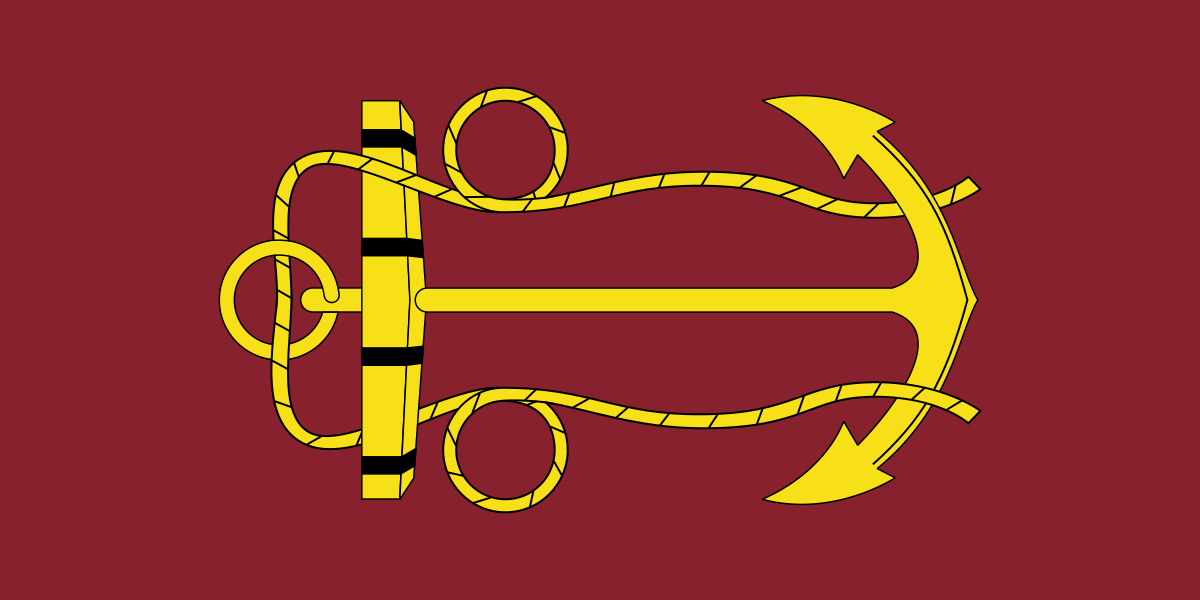
The Lord High Admiral has a flag of office – a fouled golden anchor on a crimson field. The Queen was presented with a “burgee” (pennant) with a red anchor on a white background when she visited HMNB Devonport. I just about saw Camilla’s impaled banner of arms as well.

On another note, today is also the twentieth anniversary of the death of Sir Edward Heath, Prime Minister 1970-1974. His military career was on land, though he was a noted yachtsman in later life. He stayed in the House of Commons for twenty-seven years after his premiership had ended, which is considerably longer than all his successors combined. He is the most recent Father of the House to have served more than one term, as well as the most recent to have formerly been Prime Minister.* He is also the most recent example of the Order of the Garter being conferred upon an incumbent member of the House of Commons**.

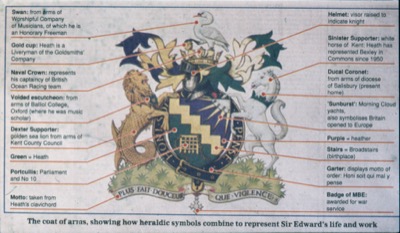
Wikimedia Commons has long had a vector graphic (by Sodacan, of course) of Sir Edward’s shield of arms, but it was only recently that I discovered, through the website of the Heraldry Society, a photograph of the heralds’ illustration of the full achievement. Heath had no offspring, so the arms as a hereditament became extinct.

This anniversary means that Arundells, his house in Salisbury, will now have been his museum for longer than he actually lived there. He bequeathed the building to his namesake charitable foundation who then opened it to the public. There was a fear in 2010 that the house would need to be sold due to high running costs, which then developed into a legal battle, but as of 2025 the estate seems to be running as normal again.

It should be noted that the spelling is Arundells with two Ls, not Arundels with one. Incidentally, it was an Earl of Arundel who is listed as England’s earliest Lord High Admiral, so everything links up I suppose!

*I’m phrasing it that way because Heath is not the most recent Prime Minister to be Father of the House – that was Callaghan.

**I hesitate to say “sitting member” because St George’s Day in 1992 fell in the interlude after the general election (9th April) but before the new Parliament actually assembled (27th April).

Another Condolence Note

Yesterday the Prime Minister and the Mayor of London attended the memorial at Hyde Park commemorating the London bombings of 7th July 2005.

As with the Auschwitz memorial earlier this year, Sir Keir left a wreath of flowers with a card attached. The card uses the old version of the government arms. I’m guessing the pile of these cards printed during the previous reign has still not been exhausted.

A mere four days earlier, the Prime Minister, Secretary of State for Health & Social Care and Chancellor of the Exchequer had visited the Sir Ludwig Guttmann Health Centre, where they spoke from a lectern clearly adorned with the new, Tudor crown, illustration.

I’m afraid I don’t have anything profound to say about the bombing attacks themselves. I had yet to ever visit London in person at the time and my main memory of that month is that of a school assembly in which our headmistress asked pupils what they’d seen on the news and a few had followed the story enough to relay it. I also remember a CBBC drama being made about the event a year later, but that’s about it.

More Crowns, More Confusion

Recently the office of the Lieutenant Governor of the Canadian province of Nova Scotia released photographs of the erection of a decorative shield on the wall of the Drawing Room at Government House, featuring the cypher of Charles III. Aside from the violation of the rule of tincture (by having a golden cypher on a silver background), I was struck by the fact that it used the Tudor Crown, not the Trudeau Crown as at the federal level.

Photographs from as far back as the coronation in 2023 show that the Tudor Crown was already in use by the provincial government at that time, with the Trudeau Crown nowhere to be seen. Ironically Nova Scotia, as the name and shield both quickly give away, was founded as a Scottish colony long before the Acts of Union and was granted arms by Charles I in his Scottish rather than English capacity, using the Scottish heraldic style with the motto scroll above the shield rather than below. The unicorn supporter even wears the Scottish crown. Perhaps it would have made more sense for the cypher to use that one instead.

It might be prudent at this point to make a note about Canada’s viceregal flags. Until Elizabeth II’s accession all the lieutenant governors used the Union Flag defaced by their heraldic badge on a white circle in the centre. Quebec changed in 1952, using the provincial coat of arm on a large white disk on a plain blue background. The arms are topped by the Tudor crown. It seems the province never adopted St Edward’s Crown despite Elizabeth’s stated preference for it. In the 1980s the other provinces switched to a similar-but-slightly-different design with the shield topped by St Edward’s Crown on a blue background with ten golden maple leaves. As far as I can tell they have not changed over since Charles III’s accession. Nova Scotia was the last holdout with the Union Flag design, only changing over in 2024. This creates the paradox whereby the Scottish and French provinces of Canada are the only ones using the crown design named after an English & Welsh dynasty.

Closer to home, but also wider afield, The Queen’s Commonwealth Trust, a charity set up in 2018, announced on Friday that it would be rebranding itself. Anything set up during that reign (or the reigns of previous female sovereigns) with “Queen’s” in the name inevitably had some ambiguity about what would happen in the next one – did “The Queen” mean Elizabeth II personally and permanently, did it mean the incumbent sovereign (in which case it should have become “The King’s” in her son’s reign) or did it mean the incumbent queen whether regnant or consort (in which case it would now belong to Camilla, but in the reign of a king with no wife there might be no namesake at all). The trust has gone with the first option, renaming itself The Queen Elizabeth II Commonwealth Trust and changing its initialism from QCT to QECT. The press release said that existing social media handles would not change, although it didn’t specify if the website’s domain name would do so. Presumably this gives them an excuse not to change St Edward’s Crown to the Tudor Crown in their logo.

Some Heraldic Snippets

Today the Royal Household released the Sovereign Grant Report. I will discuss the actual substance of it – especially the planned retirement of the royal train – in a later article. For now I will note that the front cover and title page of the report both continue to use the old version of the royal arms with St Edward’s Crown. This was also true of the Birthday Honours published last month in the Gazette.

The Queen opened the Ratho Library in Edinburgh today. She travelled in the newly-acquired BMW G70 (also a topic for a later article) which had her banner flying from the bonnet. It was difficult to get a good look in the footage and the press stills don’t show it at all, but I think I could make out the impalement line, with the dexter side having a yellow top half while the sinister side was white on top and blue on bottom. That would indicate it to be the English marshalling of the royal quarters, surely an armorial faux-pas for an event taking place in the Scottish capital!

The Duke of Edinburgh is in Canada visiting his namesake island and regiment. The royal website’s page on the event depicts his Canadian banner of arms flying in at least one photograph, though again I can’t find it shown in any of the stills on Getty or Alamy.

Also last month another German car manufacturer, Mercedes-Benz, was recognised as a royal warrant-holder. I presume it will be the new Tudor crown illustration that they show, but I haven’t seen any photographs of it yet.

Sealing the Deal

This is the old one, obviously.

A mere thirty-two months into the New Carolean era, a new Great Seal of the Realm has been unveiled. The design is largely the same as the version made for Elizabeth II in 2001 – the obverse shows the monarch enthroned, the reverse shows the royal armorial achievement (as illustrated by Noad).

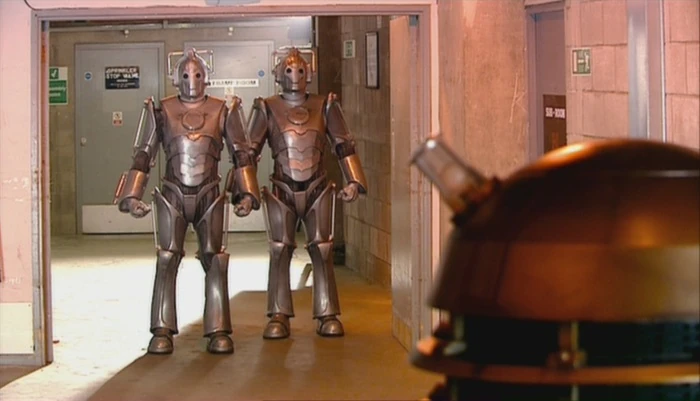
Noad’s heraldic drawing is well-known by now. The depiction of Charles on the front* has attracted some criticism: The King is, as at his actual coronation, wearing trousers rather than the more traditional stockings, and his shoes appear to jut out too much. Personally, I think they resemble the feet of 2006-era Cybermen. It is also notable that the crown shown on the monarch’s head is the idealised depiction of the Tudor crown, as opposed to the Imperial State Crown or the Crown of St Edward which he wore at the coronation itself.

The inscription around the outer rim is CHARLES III DEI GRATIA BRITANNIARUM REGNORUMQUE SUORIMQUE CETERORUM REX COSORTIONIS POPULARUM PRINCEPS FID DEF.

This is the official Latin equivalent of CHARLES III BY THE GRACE OF GOD OF THE UNITED KINGDOM OF GREAT BRITAIN AND NORTHERN IRELAND AND OF HIS OTHER REALMS AND TERRITORIES KING HEAD OF THE COMMONWEALTH DEFENDER OF THE FAITH, and the formulation is similar to that used by British sovereigns for centuries, though even I, eleven years on from having formally studied Latin, can see that it is not a perfectly literal translation.

Judging by the talk pages for both the English and Latin Wikipedias, it is clear I am not the only one to notice this. Britanniarum Regnorum just means “Kingdom of the Britains”** with no specific reference to Hibernia Septentrionalis.

Oddly it seems that the seals used from 1930 to 1953 actually did specify MAG BR and  HIB, short for Magnae Britanniae and Hiberniae as distinct items, but seals used both before and after do not. Uniti does not appear in any of them. The exact name in English of the polity ruling these isles has, of course, gone through many changes due to the evolution of our constitutional arrangements and is very confusing even to natives, but it is interesting to note that the Latin title doesn’t exactly move in step with the English one.

The use of Consortionis Populorum Princeps to mean Head of the Commonwealth of Nations is also a bit odd – “princeps” is of course whence we derive the words “prince” and “principal”, but it originally meant “chief” or “first in rank”. “Consortio Populorum” (“Partnership of the Peoples”?) is probably used because a more literal translation would probably be something more like “Respublica”, but of course in modern English (or British English at any rate), the words commonwealth and republic have diverged almost entirely to where the former means an organisation headed by a monarch and the latter means precisely not that.

Perhaps it is fitting that this event should take place just as a new Pope emerges – we’ll be seeing a lot of official Latin in use very soon!

*The many news articles I have found relating to this story all seem to be nearly word-for-word the same, and none of them identify the portrait artist.
**This is distinct from “King of the Britons”, which would be “Regnum Brittanorum”

On Terence Etherton

Official parliamentary portrait from 2021 by Roger Harris (CC-BY-3.0)

The Lord Speaker today announced the death of Terence, Lord Etherton.

Etherton only took his seat in the House of Lords in 2021, having recently retired from the office of Master of the Rolls. Aged 73, he was only slightly older than the median for the Upper House, and still below the recently re-raised mandatory judicial retirement age.

Etherton is another of those people whose armorial bearings I know to exist but have never seen: That he received a grant was noted in the College of Arms newsletter no. 65, and a vague description is given on the Birkbeck, University of London website, which is repeated in Joshua Rozenberg’s obituary for him. While we are told that the motto was the Hebrew word הננ (Hineini) – “Here I Am.” we are not given any blazon for the rest of the achievement, only that it features sapphires and a sword.

Etherton’s career in fencing was, of course, also mentioned in the infamous “Enemies of the People” headline published by the Daily Mail in 2016.

I will have to hope that a photograph of the late noble and learned lord’s arms emerges at some point, for he was created too late to appear in the final print edition of Debrett’s Peerage and so it may be impossible to find out in the traditional way.

Carney Summons The King

In the lead-up to, and immediate aftermath of, the Canadian general election, there were a few news pieces about the prospect of King Charles visiting in person to open the new Parliament. Most of these seemed like mere idle speculation or, indeed wishful thinking.

Today, however, it has been confirmed by both Buckingham Palace and the Office of the Prime Minister that Their Majesties will indeed be visiting for that purpose. This is unusually short notice for an overseas trip, particularly given the sovereign’s ongoing health problems and the length of the journey. As the couple are due to arrive on May 26th and leave on May 27th, it looks as if this will be a flying visit to Ottawa to perform the state opening and not much else, in contrast to last month’s state visit in Italy or last year’s royal tour of Australia. There has been no further detail about the hinted royal tour in 2026, but I presume any more elaborate plans are still delayed until then.

I know nothing at this point of the actual contents of the speech, and indeed suspect that the text will not be especially interesting from a literary perspective (throne speeches rarely are). Their Majesty’s attire may prove the more politically-contentious topic: When Elizabeth II opened Parliament in 1957 and 1977 she prominently wore the Order of the Garter, while Prince Philip wore a military uniform with his many decorations on it.

This will be the first time that the monarch has opened Parliament in person since the Patriation of the Constitution and, as much as Mark Carney is obviously an Anglophile, the purpose of this excursion is to reassert Canada’s sovereignty and national identity in the face of aggression from the United States. The King & Queen of Canada will need to find a distinctly Canadian look for themselves. This will be difficult as the Crown of Canada, before or after Trudeau’s controversial redesign, does not exist in real life as a physical object. Nor, for that matter, does the snowflake diadem. A separate set of Canadian royal robes does not exist either. To make matters worse, this won’t even be taking place in the real Parliament building, as that has been closed for major renovation works over the past few years. Currently the Senate meets in a repurposed railway station and the House of Commons in the West Block. These two buildings are a ten-minute walk apart, which could make the summoning of MPs a rather tedious ordeal. In 2021 shuttle buses were used for the 700m journey.

If maximum splendour is the goal then I suspect that Charles will wear a ceremonial military uniform (with corresponding hat) and Camilla either her coronation gown or a generic white dress with a tiara, both with all their Canadian medals as well as the sash of the Royal Victorian Order (since that is not realm-specific).

Finally, a point about Palace press releases – whereas the public sees these announcements on Royal.UK as text on a webpage, they seem to be sent to journalists as PDFs (which I only know because of how often I see journalists Tweeting them). Even now the old red outline illustration of Elizabeth II’s British arms (with St Edward’s Crown) is still used, despite this announcement relating to Canada. It’s also typed in Calibri, which irks me even more.

This story by Sky News includes a screenshot of an earlier version of the Tweet, in which the bullet points are punctuated with the French and British flags instead of the flag of Canada. Was this a clumsy attempt at representing Canada’s dual heritage, or had the template been mixed up with something intended for Macron’s state visit due this month?

A Very Late Announcement

Today is St George’s Day. It was delayed in the church calendar from its usual date of 23rd April so as not to clash with Easter, though this was not well publicised in advance and in practice not widely observed. The movement also means that St George’s Day clashes with Ed Balls Day!

I was disappointed to see no new appointments to the Order of the Garter either today or last Wednesday. Currently there are four vacancies among the ordinary Knights and Ladies Companion.

I was a little surprised to see that the News page on GOV.UK included “Prime Minister Liz Truss’s statement on the death of Her Majesty Queen Elizabeth II“, given that said prime minister resigned thirty months ago. Upon inspection of the Updates section, it seems the page was originally published with only the video link, and the transcription has now very belatedly been added. Amusingly, the note doesn’t even say “transcription”, but rather “translation”. Surely, Truss’s thoughts weren’t that incomprehensible, were they?

Observations on ANZAC Commemorations

As the eightieth anniversary of VE Day in World War II approaches, it would be easy to miss that there were also commemorations for World War I still going on.

The ceremonies carried out today in honour of the Gallipoli campaign were of a notably lower key, but still quite interesting.

The Australian & New Zealand Army Corps fought at the time as part of the British Empire under George V. Today Charles III is monarch of all three realms in separate capacities.

His Majesty put out messages relating to the anniversary, which the Royal Twitter feed illustrated with photographs and flags. The letterhead uses the new illustration of the British royal arms with the New Zealand and Australian flags (both containing the Union Flag in the canton) are displayed diagonally in the top corners.

The Palace also Tweeted links to separate messages for Australian and New Zealand veterans, but there is clearly a mistake in the Tweet as the New Zealand link is given twice. Luckily the Australian message is easily findable from that page on the website.

The Princess Royal, President of the Commonwealth War Graves Commission, attended services in Turkey (where the Gallipoli campaign actually took place). While there it appears she left a note from her brother attached to a wreath. The card still uses the old illustration of the arms. I didn’t see the princess’s own banner flying anywhere. The Master of Ceremonies introduced her as “senior member of the British royal family” alongside Sam Mostyn as Governor General of Australia, Christopher Luxon as Prime Minister of New Zealand and Ömer Toroman as Governor of Çanakkale Province. He then moved onto introducing the senior representatives of each country’s armed forces, including First Sea Lord Sir Ben Key. That Britain had a specific national representative among the latter group but not the former implies by default that Anne must be representing the United Kingdom in particular**. When it came to the laying of the wreaths, Toroman went first representing the host nation, then Anne lay hers “on behalf of the British royal family” while Mostyn and Luxon lay theirs “on behalf of the government and people” of their respective countries. Wreaths for Austria, Canada, France, Germany, Hungary, India, Ireland, South Africa and the United Kingdom were laid by their various diplomatic and military representatives, Britain’s being Ambassador Jill Morris. The order of precedence is interesting – most of the countries listed are simply in English alphabetical order***, but it is interesting that “the British royal family” as an institution got to be in the special group higher up the chain while the United Kingdom itself did not. The Australian Broadcasting Corporation has been livestreaming the Gallipoli Dawn Service (and many others) for the past several years and the YouTube videos are still up, allowing one to compare the small variations in the ceremony over time. It doesn’t appear that Britain normally has any representative, royal or otherwise, among the first section of attendees, and indeed the Australian and New Zealand representatives are usually a bit lower-ranking than the ones who attended this time.

The Duchess of Edinburgh was the principal royal representative for services in London – both at Hyde Park and at Westminster Abbey. Getty has a photograph of the order of service for the Hyde Park event. It is a less-than-impressive affair, the title being typed in bold, block capitals Calibri font (the default now on Microsoft Office) and the illustrations of the royal arms of Australia and New Zealand, the latter (still using St Edward’s Crown) clearly being taken from Wikimedia Commons. The order of service for the Abbey event uses the same illustrations.

ITN’s Royal Family Channel on YouTube has, as usual, provided a great deal of raw feed. I particularly enjoyed the wobbly footage of the camera operator navigating behind the Abbey’s arches.

In the stream for the Hyde Park service we can see at 5:42 that one of the wreaths has two cards on it bearing the conjugal arms of the Duke & Duchess – two separate shields slightly angled beneath a single princely coronet.

These events also bring up an interesting conundrum about the use of national anthems in the Commonwealth Realms – at the 12:08 mark in the same video, it is announced that “…an Australian soprano*, a music educator based here in London. This morning she will sing the national anthems of the United Kingdom and Australia. I’m also delighted to welcome Lance Corporal Bryony Williams of the New Zealand Army to sing the national anthem of New Zealand.”

The British anthem used here is God Save The King!, the Australian Advance Australia Fair! and the New Zealand God Defend New Zealand! sung in both Maori and English. Trouble is, New Zealand officially has two national anthems, the other being… God Save The King! That same song is also officially the royal anthem of Australia. For the hymn to be used to represent one realm against another feels a little diplomatically questionable. Perhaps it would be better in these kinds of circumstances to use the royal anthem to represent all realms together and/or use an alternative patriotic song to represent Britain in particular – probably the best choice would be Rule, Britannia! The abbey service has the British anthem at the beginning then the other two at the end. The service also includes a prayer “for His Majesty The King; for the Governors
General of Australia and New Zealand, and for all who govern the nations of the world”.

A minor point to note here is that New Zealand’s High Commissioner to the United Kingdom, Phil Goff, was dismissed last month after making critical comments about Donald Trump. A permanent successor has yet to be appointed so Chris Seed, a retired diplomat, is currently filling in.

The ceremony at the Whitehall cenotaph was attended by David Lammy and therefore produced a dozen photographs on the FCDO Flickr feed which are able to be uploaded to Wikimedia Commons. Sir Lindsay Hoyle also features prominently in these.

*Unfortunately the editing of the video cuts off the soprano’s name.

**Whether the multinational nature of the monarchy extends beyond the sovereign himself to the rest of the royal family is a long-running philosophical conundrum among Wikipedians and others.

***Ironically this tends to mean that the birthplace of said language comes at or near the end. I won’t rehash the tired joke about searching for Britain, Great Britain or United Kingdom on drop-down menus, but I will note this article by Michael Reiners for The Critic which was published coincidentally on the same day.

Two Former Dominions, Two Federal Dissolutions

We find ourselves in the unusual situation where two of the large Commonwealth realms are simultaneously having federal general elections, with polling days in the same week. I was interested to compare the ways in which Canada and Australia go about dissolving one parliament and electing another.

In Australia, the relevant discussion is done in writing, with the government publishing both the Prime Minister’s letter and the Governor-General’s. These are not pro forma text, but there is little personal character in the prose which comprises mainly the essential technical details (especially the dates) and constitutional obligations. The proclamation itself is, compared to its British counterpart, remarkably short and unadorned. The Governor-General’s badge of office as seen in this letterhead still uses St Edward’s Crown. The monochrome government coat of arms in the Prime Minister’s letterhead is too small and low-resolution to determine, but probably the same.

The Canadian version has the dissolution of the old parliament, the issuance of writs of election and the meeting date of the new parliament done as three separate proclamations. Each individually is quite short, with apparent length padded out by the need to restate the monarch’s and governor’s style each time as well as the bilingual requirement. The familiar depiction of the Canadian royal arms is used, embedded as a vector image that loaded piece by piece. The crown here too is still St Edward’s, rather than the Tudor or Trudeau crown.

I know from previous examples that it is customary for the Australian dissolution proclamation to have a public reading, though have yet to find the video for this particular election.