My Political Life So Far

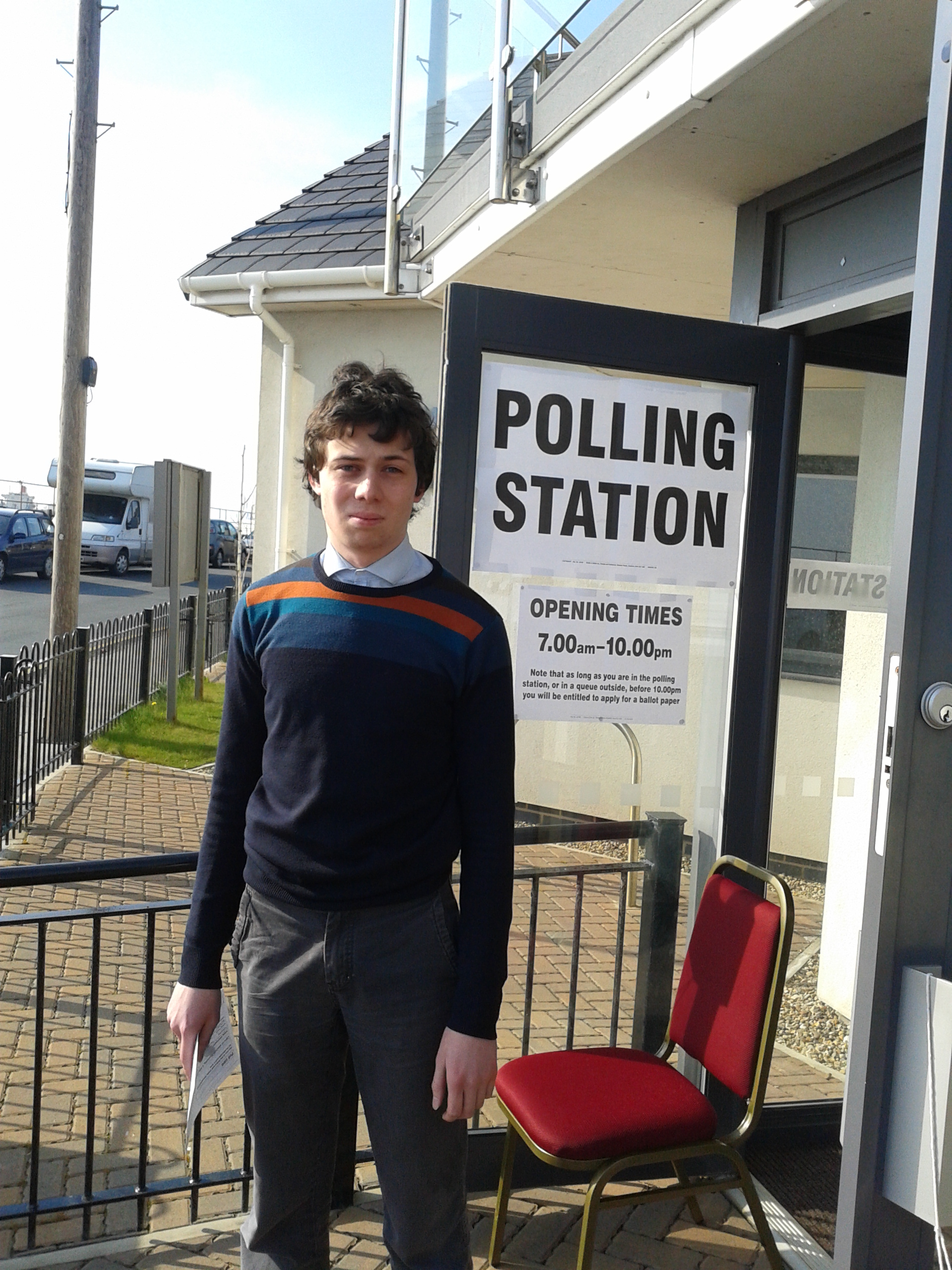
Thursday 5th May 2016, © my father.

Sir Keir Starmer’s appointment as Prime Minister, following the general election in which the Labour party won a landslide victory and the Conservatives lost almost everything, leads naturally to recollections of (and generally unfavourable comparisons against) the Blair landslide of May 1997. Many people will cite this as a defining moment in the course of their lives. In particular, many ask “Were you up for Portillo?”.

I wasn’t. I only know this period from documentaries and diaries. I hadn’t quite been born yet.

I think it was around 2003-ish that I remember hearing mentions of the name Tony Blair and the office of Prime Minister for the first time, as well as of George W. Bush as President of the United States. Blair cropped up a few times in fictional television, such as his cameos with the Simpsons and Catherine Tate. Expy versions of him also appeared, most famously in Little Britain, but also the titular “Sinister Prime Minister” in the premiere of M. I. High and in the first revived series of Doctor Who, the latter as a hollowed-out skin suit. That whole two-parter, of course, was a fairly explicit parody of the events leading up to the invasion of Iraq.

When Blair resigned and was succeeded by Gordon Brown there were quite a few skits on television about it. I mentioned it in an ICT lesson that week (the task being the formatting of a newspaper). As far as specific events, the aforementioned Iraq invasion is something I only really learned about years later and I have no contemporary memories at all of 9/11, only learning about it from a documentary in the late noughties discussing conspiracy theories about it, but I was very aware of newspaper and television reports about the “Credit Crunch” and parliamentary expenses scandal as they happened. The bird flu and swine flu pandemics late in that decades were recurrent stories.

I think most of my political knowledge probably came from Jeremy Clarkson, both in the form of his many “World According To” books we’d accumulated at home and to the references he would make on Top Gear, frequently complaining about Blair, Brown and Prescott for their ideology in general and their approach to motoring and environmentalism in particular. Though I recognised Prescott’s name and face I probably did not appreciate that he was Deputy Prime Minister and represented a constituency very close to where I lived – nor that Alan Johnson, Secretary of State for a great many things, was also next door. The series includes quite a few references to (and impressions of) Margaret Thatcher, who was also mentioned in at least one storybook read in school, but it was not until years later that I heard of John Major.

Despite not really being that interested in politics as a subject, I still ended up watching a lot of political comedy – especially Have I Got News For You and Mock the Week. Possibly Russell Howard’s Good News was in there as well.

I dimly followed the 2010 general election, by which time I was in secondary school. I didn’t know or care what the parties were but there were a few others in my year who had already nailed their colours to the mast. Graham Stuart’s campaign posters could be seen at several points along the route of the school bus. I and a friend of mine would count these as we went back and forth. We would also comment “Vote Tory!” upon the disembarking of another pupil, purely because he’d ranted negatively about them beforehand. We kept that up for some years afterwards.

Of course, the 2010 election was not a clean break between Labour and Conservative – it produced a hung parliament, so there ensued a five day hiatus while coalition negotiations went on. David Cameron did not actually get to the lectern outside Number 10 until late Tuesday evening, with Nick Clegg not being named as his deputy until Wednesday and other ministerial appointments completed on Thursday.

Recently I went back through the records to see what I was up to in that week. In theory that should have been easy since I’ve kept all my school books from that time as the source material for Homework Direct. Unfortunately it seems that there are no entries at all for that month, with only one each for April and June. This is likely to be because we were headed towards the end of the year with internal examinations looming so much of our activity at that time would have been centred on revision. I look through my exercise books again is not so revealing:

Food Technology
Nothing at all from this period, it seems.
French
6-13: Some vocabulary tests and a series of answers to textbook exercises. I don’t have the textbook anymore and the test questions were given orally so I don’t really have any contextual detail.
Geography
7-12: The exercise book runs out here and the new one doesn’t start until September. All I found were a crude diagram of the courses in a river showing where erosion takes place and a wordsearch for related key terms.
History
6-13: An analysis of sources on the role of the monasteries in England and Henry VIII’s reasons for dissolving them, then about the wider consequences of the break with Rome.
Latin
6-12: A crossword (although the worksheet bizarrely calls it a “criss-cross puzzle”) translating some vocabulary from Latin into English and a wordsearch vice-versa. A short scene from the textbook translated.
Mathematics
10: A small paragraph of notes about surface areas of cuboids.
Music
Nothing at all from this period, it seems.
Science
10-13: I actually change exercise books on 13th May itself. Lots of worksheets and quizzes about the rock cycle, the three different kinds of rock and the types of weathering to which they can be subjected.

It should be noted that I could not actually find my Religious Studies exercise book. I’m sure I don’t have my English book for that year, as our teacher took them home for marking in February and mysteriously never handed them back. My planner page from that week is little more than a list of textbook chapters.

Even so, it is good that I kept so many paper records from this time as the digital trail almost disappears before 2011 (at least until I can hunt down the old memory sticks on which it was saved). Looking through my school’s online records from that time through the Wayback Machine is hopeless due to link rot. I have some surviving copies of the school’s newsletter from that year, but none from the time of the election. The closest edition is the one sent out on 15th March, on the back of which is a group photograph from BBC School Report 2010 (not to be confused with BBC School Report 2011, which actually got me on television).
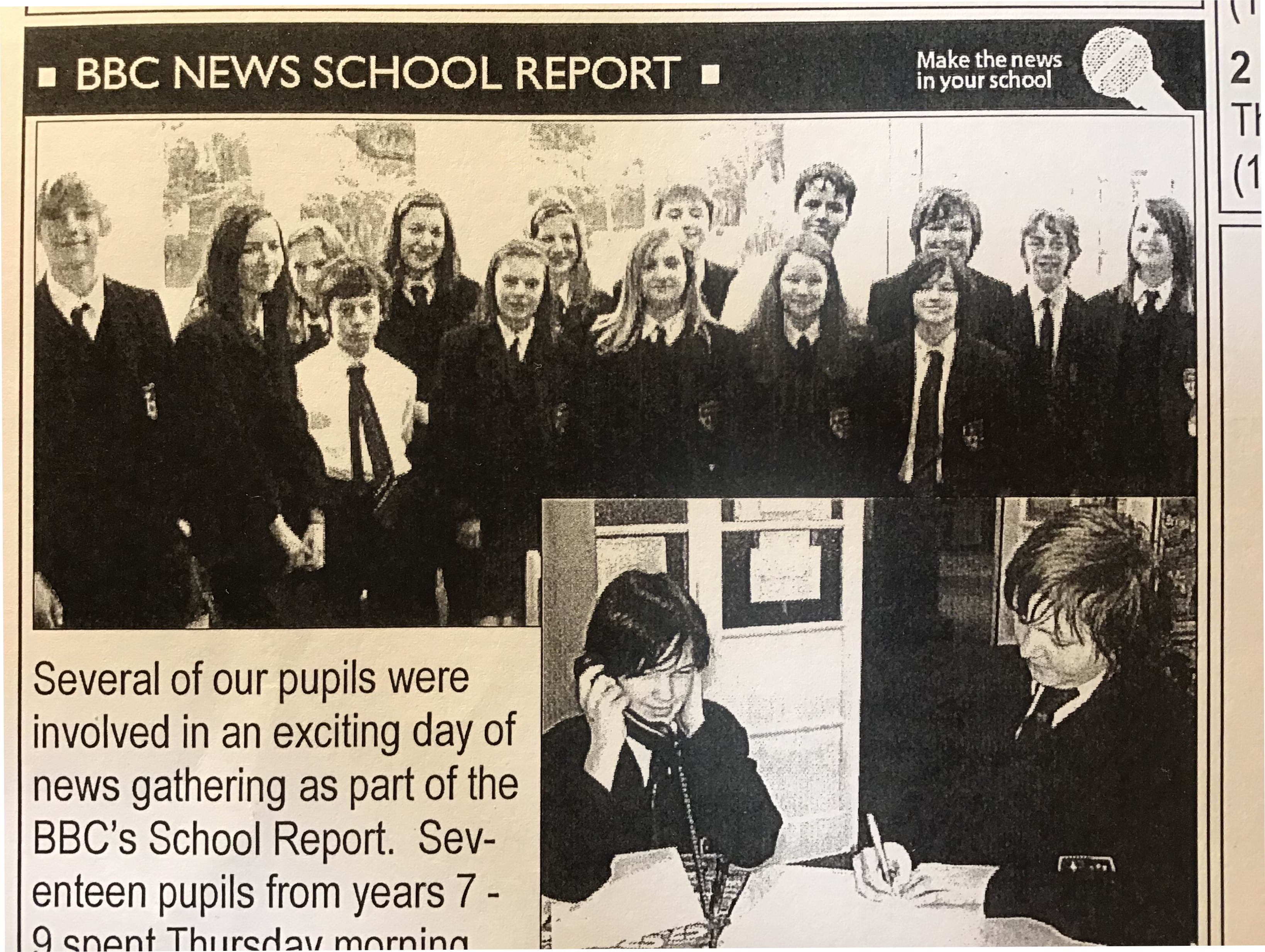
It’s a shame I couldn’t straighten my tie. From the poor quality of this photograph you might well think this came from a much earlier era than it really did.

For most of the period of 2010-11 I followed American politics more closely than British, mainly through the YouTube extracts of Real Time with Bill Maher. American issues, and some that were international, came to me indirectly – a lot of my favourite reviewtainment channels were facing constant blocks and deletions due to copyright policy, and this was the age of PIPA and SOPA (later followed by CISPA and ACTA) which threatened the whole existence of such a hobby, as well as online freedom more generally.

2012 had the big British events of the Diamond Jubilee and the London Olympics, followed by the Obama-v-Romney election in the states. Late in that year I started the GCSE course on Russia & the Cold War which was the first time I had studied recent(-ish) politics in detail. As Bolshevism and its fallout continues to cast shadows on world affairs even today, naturally this was a segue into a great many other adjacent topics. Not only did I carry my reading forward to the end of the twentieth century and into the twenty-first to see the lingering effects of e.g. the Russian Revolution and the Word Wars, I also went backwards to the eighteenth and nineteenth to find their roots. I also discovered the Russia Today channel at this time. It was of course in RT’s interests to look for and present stories (not always true) that Western media would avoid. Obviously it was during this time that I had my first experience reading Orwell.

By 2013 this had led me back around to the politics and government of the United Kingdom. I followed contemporary stories as they came out and filled myself in on what I’d earlier missed using whatever documentaries I could find. Sacrilegious as this may be to some, you really can teach yourself a lot just by reading (and later writing) the relevant Wikipedia pages.

This all happened during the tenure of the Cameron-Clegg coalition, explicitly not a normal time in politics (not that “normal” ever truly exists, of course). Cameron is therefore “my” prime minister in that sense, though I was not eligible to actually vote for or against him during that time. The 2015 general election was the first one that I watched live.

My first actual ballot cast, as pictured above, was for Humberside Police & Crime Commissioner (not otherwise that important), followed swiftly by the EU referendum. At that point the story might as well end, for it was during Cameron’s second term that this very blog got going, and thus memory lane merges back into the main road.

Last year (around 20th May) the Conservatives from Cameron onwards passed the point where they had been in power for longer than New Labour. Slightly ahead of that they passed the point of having been in power for more than half my life.

The purpose of this exercise is to recall what I was up to the last time the Labour party governed Britain, to determine what parts of my life already came about before Brown’s resignation and what would come after.

Much of the comparison is not really a political comparison of Labour vs Conservative but more a cultural comparison of the noughties vs the new tens. As aforesaid, the first red years included Top Gear up to Series 15, as well as the first five series of revived Doctor Who (with The Vampires of Venice airing during the post-election negotiation period and Amy’s Choice being the first under Cameron). They also involved all three films of The Lord of the Rings, plus all seven Harry Potter books and the first six film adaptations. The blue years included The Hobbit trilogy and an explosion of new Star Trek spinoffs. Charlie Brooker’s Screenwipe and Newswipe came before the switch with Weekly Wipe coming after. 8 Out of 10 Cats dates back to 2005 but ‘Does Countdown only to 2012. David Starkey’s Monarchy series (as well as many smaller documentaries about the Tudors) came in the noughties whereas Lucy Worsley started in the tens. Peep Show skews to the Labour end and is strongly associated with that era. That Mitchell and Webb Sound and Look had four seasons each made under New Labour, while John Finnemore’s Souvenir Programme exclusively exists under the Conservatives. This isn’t a perfect guide, though, since many of the programmes made in the former period are ones I didn’t actually watch until the latter. I’m also fudging the lines a bit for series whose production and broadcast dates fall either side of the border.

On a personal level Conservative government has been a constant throughout adolescent and adult life while Labour had the whole of my childhood. I’m obviously not in the same frame of body or mind now as in 2010, and I’ll be following Starmer’s government in real time in a way that I didn’t for Brown or Blair. There are some psychological tricks at play here – if, during the 2010-24 period, you recalled something that happened during the Thatcher-Major years, it would be easy to feel on some level that there was continuity in the partisan situation and forget that the Labour government interrupted it. Conversely, it might now be possible to think back to 1997-2010 and forget about Cameron-Sunak. This is especially the case if policies, styles of government and indeed people are carried over and political situations from long ago are restored, which is often the case. For some people it may be like finding the last decade was all a dream, for others the nightmare is just beginning.

Time to sleep… or are you waking up?

Jumping the Gun Again

It is normal, following the dissolution of a parliament of the United Kingdom, for a Dissolution Honours list to be published, conferring peerages, knighthoods and other decorations on members of the former legislature.

Sometimes these have been published swiftly following the dissolution itself, early in the general election campaign. In more modern times these lists have tended not to emerge until many months after the new parliament has already been formed.

This time the list has been published on polling day itself, very close to the publication of the exit poll.

There are nineteen new life peers included, most of whom are recently-retired MPs (including Theresa May, the former prime minster). There are also five knightly awards – Oliver Dowden, Julian Smith and Ben Wallace all become KCBs, Alister Jack a KBE and Thérèse Coffey a DBE. The latter is especially intriguing because she is the one still standing for re-election in Suffolk Coastal, meaning her name as it appears on the ballot paper will have become out-of-date while people were crossing it.

The Wikipedia pages of the latter five were already updated before I even came across the announcement, but of course the titles of the new peers will take several weeks to confirm. It is still up in the air whether this is the last squeezing of the font of honour by Rishi Sunak or if a separate list of resignation honours will arrive later on.

The Emperor’s New Collar

Naruhito & Masako, Emperor & Empress of Japan, conducted a three day visit to the United Kingdom this week. It was the third state visit to Britain during the present reign, and the first monarchical one since that by the King & Queen of the Netherlands in 2018.

The visit consisted of the expected activities – a state banquet at Buckingham Palace, then another banquet at the London Guildhall, as well as military parades and presentations.

According to the Court Circular for 25 June, the palace guest list included “Mr. Christopher Broad (Founder of YouTube channel, Abroad in Japan)”. This is thought to be the first time that a prominent YouTuber has been invited to a state event specifically in that capacity.

As is customary during state visits, the monarchs exchanged appointments to their respective orders of chivalry: Charles received the Collar of the Supreme Order of the Chrysanthemum while Naruhito became a Stranger Knight of the Most Noble Order of the Garter. It is a shame that his visit was not a few days earlier, or he could have marched in the procession.

File:Coat of Arms of Japanese Emperor (Knight of the Garter Variant).svg

Sodacan’s representation of the Japanese Garter arms.

Naruhito ascended the imperial throne in 2019 when his father Akihito abdicated. Japan now joins Spain and the Netherlands in having two Garter stalls simultaneously. What makes the Japanese representation different to the Spanish and Dutch is the different style of heraldry. The Japanese Imperial Seal is a mon representing a stylised chrysanthemum flower. Mon are normally standalone objects without a background – more visually similar to a Western crest or livery badge than a shield of arms. To make the symbol compatible with European heraldic customs for use in St George’s Chapel it is typically presented as the lone charge on a red background for the shield and banner, then again without a background as the crest atop the helm. The Emperor paid a private visit to Windsor Castle to view his predecessors’ stall plates there and to lay a floral wreath on Elizabeth II’s tomb.

The state banquet also marked the first appearance of the Royal Family Order of Charles III. Dating back to the reign of George IV, the royal family orders are an informal and highly personal decoration restricted to senior royal women. Each consists of a silk ribbon from which hangs a jeweled miniature portrait of the sovereign. The orders do not always have formal classes but their badges tend to come in different sizes which correlate to the seniority of the recipient. The colour of the ribbon varies: Charles III follows George V in using pale blue, whereas Victoria used white, Edward VII blue and red lined with gold, George VI pink and Elizabeth II yellow. The Queen was seen wearing the new Carolean order immediately above the Elizabethan one she received as Duchess of Cornwall in 2007, and there is a clear difference in size. The Duchess of Edinburgh also wore Elizabeth’s order to the banquet.

This state visit was a little unusual in that it happened during a general election campaign. Some changes had to be made to the itinerary to cut out the more obviously political elements: Unlike previous visiting sovereigns, the Emperor did not make an address to Parliament (since their isn’t one) and while the cabinet and opposition leaders attended the state banquet they did not have individual meetings with him. Notably Sir Keir Starmer and Sir Edward Davey were not wearing their respective knightly insignia.

The Proclamation in Public

Yesterday I wrote about the text of the royal proclamation for the dissolution of Parliament appearing on the Privy Council website. Today it was actually read out in public.

Traditionally there are two public readings of the proclamation – the first is by the Common Cryer of the City of London (Major Peter Oweh, his first time doing this) on the steps of the Royal Exchange, the second is by the Lord Lyon King of Arms (Canon Joseph Morrow, now on his fourth general election) from the Mercat Cross in Edinburgh.

As with many ceremonial events like this it has been frustratingly difficult to find good visual recording – despite most big news outlets doing rolling coverage of the general election for the past few days. The London proclamation was filmed by The Daily Mirror as seen above and had a few still photographs taken by Getty. For the Edinburgh version I am limited to the Lyon Court’s own blog and this amateur video by Haizhen’s Hut. To make matters worse, the United Kingdom is far from the only country having a national general election this year and even just searching for “dissolution of parliament” often brings up articles about Israel.

Yesterday I received a campaign letter from the Conservative candidate for Beverley & Holderness, Rt Hon Graham Stuart. Cannily, I would presume, he had them printed and sent out on 29th May so that at time of writing he could still use the MP post-nominals on the return address of the envelope, even though he would cease to be one by the time most recipients of his letter actually read it. Electoral projections that I can find at this time are conflicted as to whether he will be returned or replaced by the Labour candidate Margaret Pinder.

Also of note are the writs of election, which of course the Lord High Chancellor has as per said proclamation caused to be issued. Medway Council recently published a photograph of the writs for the three constituencies for which it was responsible. These are, of course, the first writs for these constituencies to be issued in the name of Charles the Third.

That brings me on to another point – while dissolving Parliament is a routine part of the election process in many democratic countries, the return of the regnal name Charles in relation to such matters provokes some historical sniggering in reminiscence of the civil wars of the seventeenth century. It is curious, therefore, that the first British dissolution in this reign should be immediately after Oak Apple Day, the now-obscure commemoration of the restoration of the monarchy after the fall of Cromwell’s republic. The name refers to the Royal Oak, a tree in Boscobel Wood which Charles II used to hide from the Roundheads in 1651. Given that the oak tree went on to become the symbol of the Conservative Party, it is perhaps a little surprising that no senior figures in the party (or in the headline-hungry media) have made a prominent reference to it. Of course, once suspects that his present Majesty would prefer not to be drawn into partisanship in that way.

Comparing Dissolution Proclamations

The Fifty-Eighth Parliament of the United Kingdom is no more. It dissolved just after midnight… or did it?

Parliament’s own website and guidance documents seem to indicate that dissolution took effect at 00:01 today, but I doubt the factual accuracy of this and I am not the only one.

I spent much of today keeping a close eye on the Privy Council website to see when there would be an update about today’s meeting. It arrived sometime before 13:00. The PDF records that His Majesty ordered the Lord Chancellor to affix the Great Seal of the Realm to the proclamation, and also (alongside the Secretary of State for Northern Ireland) to arrange the issuance of writs of summons and election. The text of the proclamation itself is reproduced below:

Whereas We have thought fit, by and with the advice of Our Privy Council, to dissolve this
present Parliament, which stands prorogued to Friday, the thirty-first day of May: We do, for
that End, publish this Our Royal Proclamation, and do hereby dissolve the said Parliament
accordingly: And the Lords Spiritual and Temporal, and the Members of the House of
Commons, are discharged from further Attendance thereat: And We being desirous and
resolved, as soon as may be, to meet Our People, and to have their Advice in Parliament, do
hereby make known to all Our loving Subjects Our Royal Will and Pleasure to call a new
Parliament: and do hereby further declare, that, by and with the advice of Our Privy Council,
We have given Order that Our Chancellor of Great Britain and Our Secretary of State for
Northern Ireland do respectively, upon Notice thereof, forthwith, issue out Writs, in due Form
and according to Law, for calling a new Parliament: And We do hereby also, by this Our
Royal Proclamation under Our Great Seal of Our Realm, require Writs forthwith to be issued
accordingly by Our said Chancellor and Secretary of State respectively, for causing the Lords
Spiritual and Temporal and Commons who are to serve in the said Parliament to be duly
returned to, and give their Attendance in, Our said Parliament on Tuesday, the ninth day of
July next, which Writs are to be returnable in due course of Law.

Given at Our Court at Buckingham Palace, this thirtieth day of May in the Year of our Lord
two thousand and twenty four and in the second year of Our Reign.

The Privy Council website does not give texts like these for 2010 and earlier, but sound recordings of those earlier occasions confirm that the same wording was in use. The most notable feature of these proclamations is that they specify dissolution taking place immediately upon the date given and also fix the date for the new parliament to assemble, but don’t actually say when polling day will be.

The FTPA Era

The Fixed-term Parliaments Act 2011 substantially altered the mechanics of British general elections. No longer could the sitting prime minister simply “go to the country” whenever he pleased, instead the date of the general election would be fixed as the first Thursday in May in the fifth year since the previous general election, unless two thirds of the House of Commons voted to have one earlier. Dissolution of the outgoing legislature would occur automatically twenty-five working days before polling.

In a moment of supreme constitutional pettiness, the act even transferred the authority for writs of election for MPs (though curiously not writs of summons for peers) to the Lord Chancellor and Northern Ireland Secretary to act without the monarch’s instruction, so that this element was taken out of the proclamation.

Three general elections occurred while the FTPA was in force – the fifty-fifth Parliament was allowed to run its natural course, the fifty-sixth was dissolved early by the two thirds motion and the fifty-seventh by a special act of its own passage. Despite these very different constitutional circumstances, the proclamations in all cases were identical (save of course the specific dates mentioned). Below is the text of the proclamation from 2019:

Whereas We, by and with the advice of Our Privy Council, being desirous and
resolved, as soon as may be, to meet Our People, and to have their Advice in
Parliament, do publish this, Our Royal Proclamation, and do hereby make known to
all Our loving Subjects Our Royal Will and Pleasure to call a new Parliament to be
holden at Westminster on Tuesday the seventeenth day of December next: And We do
hereby also, by this Our Royal Proclamation under Our Great Seal of Our Realm,
require Writs to be issued by Our Lord High Chancellor for causing the Lords
Spiritual and Temporal who are to serve in the said Parliament to give their
Attendance in Our said Parliament on the said date.

Given at Our Court at Buckingham Palace, this sixth day of November in the Year of
our Lord two thousand and nineteen and in the sixty-eighth year of Our Reign.

The 2017 version can be read here, and that of 2015 heard here. The 2017 election also had a different proclamation nine days earlier to appoint the polling date, though this proclamation did not enjoy any of the latter’s accompanying ceremony despite clearly being the more politically important of the two.

As you can see, this version of the proclamation is a pathetic sliver of its former self – the issuance of writs refers entirely to the House of Lords and thus doesn’t actually say anything to the general public about participating in an election. The only substantive agency which Her Majesty retained was in choosing the date on which the new Parliament met – and per the other provisions of the FTPA this no longer had any knock-on effect for subsequent elections. Even the name was changed – it became simply “A Proclamation for declaring the calling of a new Parliament” instead of “A Proclamation for dissolving the present Parliament and declaring the calling of another”.

Changes in Procedure

Although it may seem a question of semantics, there is an important difference in the sequence of events between FTPA-era elections and earlier ones: Traditional practice involves a proclamation to dissolve Parliament with immediate effect, then an election happening a certain time after that. FTPA practice was for the election date to be fixed far in advance (whether by the other type of proclamation or by statute) and dissolution would happen a certain number of days before that. In the old system a privy council comprising incumbent parliamentarians would convene to cause their own dissolution and the other matters connected, whereas in under the FTPA they would meet to arrange the other matters several hours after dissolution had already occurred.

That brings us to the key point of this article – the time of day at which dissolution actually takes effect: With the FTPA in place and thus the dissolution date pre-ordained without the need for further action, it was logical to treat it as happening as soon as that date arrived*, which would also have been the case under the old system if a Parliament had been allowed to run its full course. When Parliament is being dissolved by a specific proclamation for that purpose, then it obviously must stay in existence until the proclamation is actually produced – and it is rare for a privy council to be convened at midnight. None of the proclamations specified delaying their effects until the end of the date, and obviously they cannot be retroactive to the beginning of the date because, as mentioned in the previous post, there have been instances of Parliaments still sitting earlier on the same date as that on which they would be dissolved, and retroactive dissolution would have meant that the sitting (including any acts passed and royal assents given thereat) was invalid.

In today’s example, the fifty-eighth Parliament had already been prorogued from 24th May to 31st, but until the privy council held around noon there had been nothing in law to cause it to dissolve, and its natural expiration was still many months away. If Sunak’s government had suddenly gotten cold feet about calling an election, or if His Majesty was somehow prevented from attending (for the sake of the hypothetical let us assume he could not arrange any counsellors of state to be there either) and thus the meeting to approve the proclamation had not gone ahead, then Parliament would have remained in existence and reconvened the next day for the beginning of a fifth session.

Given that the Dissolution and Calling of Parliament Act 2022 repealed the Fixed-term Parliaments Act with the explicit intention to revert to pre-2011 procedure as far as possible, it does not make sense for parliamentary authorities to declare in their guidance and press briefings that the legislature had dissolved many hours before any such thing had actually taken place. The most logical explanation (pending further research) that comes to mind is that that the guidance was written during the 2011-22 period and not updated thereafter, so that the FTPA mentality remains in force even though the law itself does not.

This whole business also caused some difficulty for me as a Wikipedia editor, since I noticed upon rising this morning that another editor had, just after midnight, already changed the tense of my disclaimer flairs on the biographies of still-current MPs. I reverted the change and did not set it forward again until many hours later when I had actually seen the proclamation published online. In all fairness the other editor was merely following reliable sources as we are bound to do. Unfortunately this goes to show that there are many times when the reliable sources can still get things wrong.

*There is a secondary deliberation as to whether this means exactly midnight or, to avoid ambiguity, one minute later. I will not quibble with that particular question here as it does not affect the primary matter I am discussing.

UPDATE (May 2024)

David Torrance has produced a research briefing for the House of Commons Library. Page 7 cites this post and states that “This timing was intended for operational purposes rather than as a statement of the legal position.” with page 10 confirming that the actual dissolution occurred at 11:57am with the application of the Great Seal to the proclamation.

Washing Up, Washing Out

Yesterday evening the fifty-eighth Parliament of the United Kingdom was prorogued for the fourth and final time, pending dissolution next Thursday. This meant that MPs had just two days of “wash up” in which any bills already in the pipeline are either hurried to completion or abandoned altogether.

Parliament is not always prorogued before dissolution, sometime it is merely adjourned – in the past fifty years the 46th, 47th, 48th, 49th, 52nd, 53rd and 57th parliaments were all open-ended. Irrespective of whether or not a prorogation was involved, the time elapsed between a parliament’s last sitting day and its dissolution varies highly: For the second general election of 1974 it seems that the 46th Parliament sat last on 31st July before rising for the summer recess then got dissolved on 20th September just before it could convene again, whereas in 1992 the 50th Parliament sat last and was dissolved on the same day.*

Rishi Sunak’s motivation for this particular timetable is unclear – if he had let the legislature sit on 28th and 29th May it would have allowed four days instead of two to finish business, so that fewer bills would have needed to be dropped. Perhaps Sunak felt it would be a waste of commuting time to sit for just two days between the bank holiday and the dissolution. Some have also speculated that he wanted Parliament closed as soon as possible to reduce the opportunity for his backbenchers to unseat him as party leader. A precedent might be found in John Major in 1997, who had the 51st Parliament prorogued more than a fortnight before it was dissolved and was suspected of doing so to block the publication of a select committee report against Neil Hamilton.

When a general election is looming, incumbent MPs have to make a decision: Step down and make one’s valedictory speech in the chamber before prorogation, or stand again and risk having to make it instead from the returning officer’s podium in the early hours after polls close. By the time the house closed more than a hundred members (over seventy of them Conservatives) had chosen the first option. The valedictory debate lasted nearly seven hours and obviously I have not yet been able to properly take in all of the speeches. So far my favourites were Sir James Duddridge (with its interventions by both Alicia Kearns and Dame Eleanor Laing), Julian Knight (who took the chance to lash out at former colleagues who had wronged him) and Tim Loughton (differentiating knowledge from wisdom in terms of putting tomatoes in fruit salads).

The prorogation ceremony was carried out in the usual way. There were two substitutions among the Lords Commissioners – Liberal Democrat leader Lord Newby was replaced by his deputy Lord Dholakia (as in 2019) while Convenor of the Crossbench peers Lord Kinnoull (still not a privy council member) stayed on the crossbenches and left his place on the woolsack to his predecessor-but-two Lord Laming. Eleven acts received assent.

As in the prorogation last November, the letters patent acknowledged that there had been a demise of the crown since the last general election, hence the phrase

…whereas Queen Elizabeth The Second did lately for divers difficult and pressing affairs concerning Us the State and defence of Our United Kingdom and Church ordain this Our present Parliament to begin and be holden at Our City of Westminster the seventeenth day of December in the sixty-eighth year of Her Reign on which day Our said Parliament was begun and holden and is there now holden…

which as Jack Blackburn of The Times aptly pointed out is the last time that the former monarch will be mentioned in Parliament in this context.

As I have mentioned before, the dissolution of Parliament creates a headache for Wikipedia editors as hundreds of people who for years or even were incumbent members of the House of Commons cease to be so for a matter of weeks, then (most of them) become so again after polling day. This time, rather than have many of us hurriedly scouring hundreds of pages to remove any trace of incumbency, I am trialing a solution I piloted at the devolved elections three years ago by placing a disclaimer tag at the top of each affected article. The beauty of this trick is that the template can be centrally edited, so I can go at a more leisurely pace adding it to MPs’ articles in the days before dissolution with the notice written in future tense and then on the day of dissolution change it to present tense. Of course, that still leaves a lot of work making long-term edits to the pages of those members who will permanently leave the house at this election (whether willingly or not) and creating new pages for their successors.

EXTERNAL LINKS

House of Commons Library

Privy Council Office

UPDATE (2nd June)

When looking through the Hansard records for this sitting, I noticed an interesting mistake:

End of the Fifth Session (opened on 7 November 2023) of the Fifty-Eighth Parliament of the United Kingdom of Great Britain and Northern Ireland in the Second Year of the Reign of His Majesty King Charles the Third.

The last sitting day before 7th November 2023 was 26th October, and the record for that day says it was the end of the third session. Quite when the fourth session came and went I have no idea.

*The 1993 documentary Days of Majesty covers the prorogation and dissolution process.

Calling it a day

Today, after many months of speculation, the Prime Minister announced that a parliamentary general election will be held on Thursday 4th July. In advance of this the current fifty-eighth parliament will be prorogued on 24th May and dissolved on 30th May. Sunak had previously said that the general election would be “in the second half of 2024”. This date just barely qualifies, being the 186th day out of 366. Some ministers had hinted at a “working assumption” that the election would be in October.

This is the first time a prime minister has been able to “call an election” in this manner since Gordon Brown in 2010, with those in between being constrained by the Fixed-Term Parliaments Act 2011, which was finally repealed in 2022. This timing means that it is obviously not a “snap” election like those of 2017 and 2019, but also doesn’t have quite as long a build-up as those of 2010 and 2015.

One consequence of having the campaign period throughout the month of June is that the royal family, as per tradition, will postpone any high-profile events from that period to avoid distracting attention from the politicians. Exactly how many events will be rescheduled is not yet confirmed: It has been said that the 80th anniversary D-Day commemorations will be going ahead as planned, but no word yet on the timing of Trooping the Colour, Garter Day or the King’s Birthday Honours.

This election will also be the first since 2010 to see significant boundary reforms enacted. My own constituency of Beverly & Holderness will be slightly reduced in size, the North Holderness Ward being transferred to the new seat of Bridlington & the Wolds.

In Honour of the Occasion

Photograph by sbclick, 2011 (CC-BY-1.0)

In theory the monarch can bestow practically any accolade on any person at any time and for any reason. In practice, since the late Victorian age there has been a trend towards grouping announcements into two big lists each year – one in June for the sovereign’s official birthday, one in December for the upcoming new year. There are also smaller lists issued at irregular intervals to commemorate particular events e.g. the deaths of senior royals, the dissolutions of parliaments and the resignations of prime ministers. The latter two types tend to be particularly controversial.

Wikipedians have generally maintained pages for all of the lists, great and small. They  have also created an annual page called “Special Honours”, which they use as a catch-all term for those titles and decorations which were issued outside of any named occasion.

Today’s announcement is a little confusing for those seeking categorisation – the Prime Minister’s office has released a list of honours and appointments for March 2024. The document as a whole does not have any particular name, but paragraphs within it do: Creative Industries Honours, Technology & Artificial Intelligence Honours, and Political Honours. The former has provoked the most recognition, appointing film producer Emma Thomas as a DBE and her husband Christopher Nolan (already a CBE since 2019) as a knight bachelor. There is also a short list new privy counsellors (e.g. Vaughan Gething, recently appointed as First Minister of Wales), though whether these count as honours in the way knighthoods do is debatable.

This new publication comes just forty-eight days after the list of “Political Peerages” (e.g. yet more new members of the House of Lords). It eludes me why today’s list was not brought forward to be merged with that one, or pushed back to fold in with the Birthday Honours in June. The only likely explanation is that these were Rishi Sunak’s personal picks and he (or His Majesty) wanted that distinction made clear in the public mind. Of course, that could also have been achieved by waiting for the looming dissolution honours at this year’s general election – or indeed Sunak’s resignation honours, which may well come earlier!

A Cluster of Camerons

Donald Andrew John Cameron was elected to the devolved Scottish Parliament in 2016 on the regional list for Highlands & Islands. He served in many roles in the shadow cabinet at Holyrood, but last month resigned his seat upon appointment as Parliamentary Under-Secretary of State for Scotland in the national government at Westminster. To facilitate these duties he was ennobled yesterday as Baron Cameron of Lochiel, of Achnacarry in the County of Inverness. Although this is a life peerage, he also holds the hereditary chieftancy of Clan Cameron, of which two other members currently sit in the upper house – and both of them acted as supporters to his introduction ceremony.

Ewan James Hanning Cameron, Baron Cameron of Dillington, has sat as a crossbencher since 2004, having previously worked in semi-political rural advocacy roles during the premiership of Tony Blair. He is a grandson of Sir Donald Walter Cameron, the 25th Clan Chief, thus making him an agnatic first cousin once removed of Lord Cameron of Lochiel.

David William Donald Cameron, Baron Cameron of Chipping Norton, should already be familiar to most readers as the former prime minister and current foreign secretary. His consanguinity to the new peer is very distant, his great-great-grandfather Sir Ewen Cameron having claimed descent from the Camerons of Erracht, themselves being descended from a younger son of the 13th Lochiel and branching from the main clan in the sixteenth century.

The arms of Clan Cameron are Gules three bars Or. Lochiel naturally bears these undifferenced, while Dillington differences with in the honour point an escallop of the second. Chipping Norton differences with four bezants in chief.

The House of Commons also saw an introduction ceremony yesterday when George Galloway returned after a nine year absence having been elected MP for Rochdale. MPs who win by-elections are also traditionally escorted to the clerks’ table by two incumbent members. There were reports that Galloway had asked Jeremy Corbyn (Islington North) and Sir David Davis (Haltemprice & Howden) to act as his sponsors but both had turned him down. He was instead accompanied by Sir Peter Bottomley (Worthing West) and Neale Hanvey (Kirkcaldey & Cowdenbeath).

EXTERNAL LINKS

A Patten Emerges


On St George’s Day last year His Majesty appointed two new companions of the Order of the Garter – Lady Ashton of Upholland and Lord Patten of Barnes. Obviously that would mean their banners of arms would at some point be erected at St George’s Chapel in Windsor Castle. At the time it was not public knowledge what their lordships’ arms actually were, if indeed they had any, and given how long it was taking to find out about Blair and Amos I was not optimistic of learning any time soon.

Today they were revealed by Major Alastair Bruce of Crionaich via what used to be called a Tweet. He shows photographs of two banners of arms along with an excerpt from an online article, which I will quote below:

Baroness Ashton served in the Ministry of Justice and later as the EU’s first High Representative for Foreign Affairs and Security policy. She contributed towards negotiating a peace settlement between Serbia and Kosovo. Red roses reflect the fact that Upholland, which forms part of Baroness Ashton’s title, is in Lancashire.

On Lord Patten’s banner the pearls allude to the crest of Hong Kong where he was Governor from 1992 to 1997. The blue field and crowns replicate the arms of Oxford University where Lord Patten has been Chancellor since 2003.

It is not clear precisely where Bruce found this information, as the message includes the web address of St George’s Chapel but does not specify an exact page. I have looked through the site to find a recent update about Patten and Ashton but found nothing. I hope this will be resolved soon.

As for the heraldic designs themselves: Patten’s arms are perfectly dignified if a little unoriginal. Having the shield resemble that of his university could make for a confusing sight should he try to impale them. Ashton’s banner is an overloaded mess redolent of the worst excesses of the early nineteenth century.

That the reveal of these arms took only nine months instead of eighteen is a positive sign. I hope that future grants of arms will become public even faster.

UPDATE (15th January)

Baz Manning informs me that the images and quoted text are from The Dragon, the community newsletter of St George’s Chapel.