When writing and reviewing textbooks, encyclopedia entries and anything else to be considered authoritative, it is important to be able to cite one’s sources of information. You may learn and know things from what you’ve heard and seen in person (or, in my case, on Zoom meetings) but this is almost worthless if it cannot be verified by the rest of the public – or at least the academic community.
For matters which relate to government and politics, Parliamentary questions and statements are very useful in this regard as they are recorded in Hansard. Of course, such statements are only made at all if MPs and peers are minded to discuss those topics. For the lay citizen, an alternative can be found in Freedom of Information requests, the principal avenue for which is the website WhatDoTheyKnow.
I recently tried my hand at resolving three questions through this method, with varying degrees of success:
Scottish Arms of the Royal Family
I have blogged many times before about the uncertainty of the armorial status of Queen Camilla, Prince William and various other royals in Scotland since the end of Elizabeth II’s reign. The obvious body to ask was the Lyon Court. WDTK lists the Court as a body which is not subject to the FOI act but which they believe ought to be. I have of course, interacted virtually with some Scottish officers of arms before, but that was in a much less formal context. It appears that I am the first person to attempt to contact the Court through this avenue. As expected, my request was refused. I found Kevin Greig’s use of the term “research” a little ill-fitting in this particular instance, though understandable if dictated by consistency with more general policy. He suggested that Scotland’s People would be the more appropriate place to look. The most surprising part of his response was the final sentence, implying that the Court only controls the sovereign’s undifferenced arms and that those of the other royals, including the Scottish versions, are held by the College in London.
Membership Quotas on Orders of Chivalry
After the death of Dame Maggie Smith got me thinking about the topic, I sent the question to the Cabinet Office, as they are the government department responsible for the management of the larger honours list. They got back to me a month later to say that while they maintain statistics on the numbers of new appointments to each order each time, they have none relating to the cumulative totals. They suggested that the Central Chancery of the Orders of Knighthood might know, but their data were probably also incomplete and that in any case they are not subject to the FOI Act either.
The King’s Honours in His Other Realms
This request also concerned the honours system, or rather systems, for I noted that many “British” honours (such as the Royal Victorian Order, or the Order of St Michael & St George) are also awarded in other countries with Charles III as monarch. I wanted to know whether his awards given to e.g. Canadians and Papuans were formally granted in his capacity as monarch of those countries or as monarch of this one – including what royal style and insignia were used on the relevant letters patent.
I initially sent this one to the Cabinet Office as well. They didn’t hold the necessary information here either, recommending that I instead ask the Crown Office in Chancery (within the Ministry of Justice) and if that failed then the Foreign, Commonwealth & Development Office. I askedboth simultaneously to save time. The Crown Office held none of the information at all, but the FCDO was able to supply most of what I wanted. Crucially, they confirmed the the sovereign honours the other realms’ subjects in his relevant local capacity not his British one. They also clarified that these appointments are done by warrant rather than by patent and that the documents don’t display coats of arms but do include the seals of the orders of chivalry themselves.
It was a long trek but it was nice to eventually get something out of all of these requests. I will consider chasing up the Chancery at a later date.
The King & Queen in Sydney (NSW Gov, CC BY 4.0). The King’s mouth is unfortunately hanging open in this shot, which combined with the opaque glasses makes for a bit of a Hubert Farnsworth look.
The King & Queen have just spent the past nine days on a tour of Australia and Samoa. Bizarrely, the Palace’s press release called this an “Autumn Tour” even though in the destination countries it was spring. The tour was originally supposed to have included New Zealand as well, but His Majesty’s cancer diagnosis earlier this year forced the itinerary to be severely reduced.
Charles wore three distinct metaphorical “hats” during the course of the tour: First as King of Australia conducting domestic business, second as King of Great Britain & Northern Ireland conducting a bilateral state visit, and third as Head of the Commonwealth presiding over the biennial Heads of Government Meeting.
Photographs of the sovereign couple at these events are unfortunately few and far between. Australian governments both federal and state lack official Flickr accounts with clear licensing indications as their British counterparts have, and the paltry few hosted on their websites are also of uncertain origin – at time of posting a handful have been accepted on Wikimedia Commons but these all look so suspiciously similar to those on Getty and Alamy that I wouldn’t be surprised if they ended up getting deleted shortly afterwards. There seem to be no free-licence photographs of the state visit to Samoa at all. Number 10 and the FCDO both have albums from the CHOGM, but only one picture of the lot actually shows Charles and none at all show Camilla.
I do not know the full details of the travel arrangements, but what I can gather is that Their Majesties and a small entourage took a commercial flight from Heathrow to Singapore, whence they were picked up by the Royal Australian Air Force and taken to Sydney Kingsford Smith Airport in New South Wales.
The tour marked the first in-the-fabric appearance of the Australian royal banner of arms (known officially as “The King’s Flag for Australia”), which was seen flying from the cockpit window and then later from several road and watercraft. The Australian banner follows Canada’s example by reverting to showing the national arms undifferenced, in contrast to the practice followed during Elizabeth II’s reign of defacing the banner with her own personal cypher. The King approved the present version on 30th August.
The current coat of arms of Australia was formalised in 1912. The shield is a composite in “quarterly of six” format, representing the six constituent states of the federation. The states of South Australia and Western Australia did not yet have full coats of arms at the time but all had heraldic badges (which are also shown on their respective civil flags) so these were used instead. The whole is surrounded by a bordure ermine.
The whole federal armorial achievement is normally depicted with the crest on a torse hovering some distance above the shield – omitting helm, mantling or coronet – but the Imperial Crown appears as a charge on the badges of Victoria and Queensland, notably at different sizes.
As in Britain (though unlike Canada) the depiction of the crown in Australian royal symbols has changed from St Edward’s Crown to the Tudor Crown, though this has not yet entirely filtered through to all the state arms and flags themselves. I dimly remember – but can no longer find the proof – that the flag as approved on the government’s website in August still showed St Edward’s Crown, and that the graphic on Wikimedia Commons did likewise until photographs of the real flag caused an update.
The King at several points on the tour wore the sovereign’s badge of the Order of Australia along with a hefty line of other honours I will need time to identify. The Governor-General gave him honorary commissions at the top ranks of all three branches of the Australian armed forces. This is is a little perplexing from a legal perspective: One would have thought that the reigning monarch would hold these ranks substantively ex officio and would not need to be appointed to them by his own deputy.
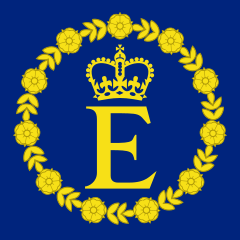
The Queen is another story: For months now I have been looking out for signs of Camilla being granted the use of her own banner of arms – being the royal arms of the sovereign impaling those of her father Bruce Shand. This was finally seen to be the case during the Australian tour, flying from the bonnet of her car on a few occasions when she travelled without her husband. The videos did not show the flag long enough (and the stills tended to have it covered by the watermark) but from what little I can determine of the artistic subtleties of its design I reckon it is actually a printout of the vector file on the Commons. The car itself was a black Audi (I think a Q8) and the regular numberplates were obscured with plates bearing an image of the Tudor Crown. That image looks to have been taken from Wikimedia too, though I can’t find the exact image. The glaring problem here, of course, is that this banner shows Shand impaled by the British royal arms rather than the Australian, resulting in a mismatch with her husband. There is a burning irony that after all this time, the one occasion Camilla can be seen using a personalised banner of arms as Britain’s royal consort is the one occasion in which it was not appropriate to do so.
This unfortunately seems to be far for the course with royal tours – with the notable exception of Canada (probably because that country has its own heraldic authority), banners of royal arms in the other Commonwealth Realms seem to only be made for the reigning sovereign himself, with the restoftheroyal family defaultingto their British blazons instead of coming up with a local variant. This may be marginally more convenient from a logistical and fiscal perspective, but it can be constitutionally misleading as it implies that they are representing a foreign state instead of that country’s own crown. If creating a personal one for each prince or princess is too onerous, it at least would be relatively easy to create a generic ermine-bordered version which they could all use when in the country. Admittedly that might not work in Australia where the sovereign’s own shield and banner have an ermine bordure already. For the royal wives, it might even make more sense to use banners of their paternal arms unimpaled so that they needn’t change based on location at all.
During the visit, His Majesty attended a service at St Thomas’s Anglican Church in North Sydney, made addresses to both the state Parliament of New South Wales and the national Parliament of Australia (sadly not from the throne in either case) and undertook a review of the fleet. God Save The King was played by a brass band while Charles inspected the troops and also by a solo amateur flautist during his walkabout but I can’t find any clip of it actually being sung at any point, in contrast to Advance Australia Fair which was sung by a children’s choir at Parliament House. That the monarch made no remark about his late friend Barry Humphries (a.k.a Dame Edna Everage) was also a little surprising.
When the royal party landed in Samoa they switched back to their British identities and the British royal banner was flown from the cockpit window alongside the Samoan flag, although the aeroplane itself was still very obviously branded as Australian.
While in Samoa Charles was invested with two honorific titles – Tui Taumeasina (King of Taumeasina) and Toa’iga o Tumua (Paramount Chief). The Queen was seen using a hand-fan with her royal cypher printed on it, which was given to her by Stewart Parvin in February. Both switched for much of the visit to bespoke white outfits in the local style.
Charles attended the CHOGM in his capacity as Head of the Commonwealth. Elizabeth II adopted a personal flag to represent herself in this capacity with no reference to any particular country. Her son so far appears not to have done so, which is a pity.
The official royal YouTube channel has uploaded some videos from these events. Not only are they continuing to use the outline of the British royal arms as the channel logo, they have also taken to including a new drawing of the arms in the thumbnails of individual videos. This, again, is a little problematic when the contents of the videos relate to other realms. I am left to wonder what recognisable symbol could be used here to avoid this problem. The livery badge of the House of Windsor might work, but even that technically has the British banner of arms included in it. The only solution that would truly work is, I suppose the CIIIR cypher on its own, without even a crown above it. Indeed, that could work for other family members’ flags and banners too.
Ahead of Their Majesties’ visit to Samoa, the Royal Family’s official YouTube channel released a short video from a reception of Samoan delegates at Buckingham Palace. It’s a short video and oddly-trimmed at both ends, as is often the case for this channel, but that’s not the thing that struck me. What struck me is that, for the first time in at least a decade (at least as far as I remember), the video has the comment section enabled.
Looking back at a random selection of other videos on the channel, this seems to be a universal change. Given the sort of comments that normally come up in replies to royal Tweets, this decision – if indeed it was consciously made – seems a rather courageous one to say the least.
Another thing I noticed was the change of channel logo – until recently the logo was a photograph from behind their Majesties’ robed backs, looking out from the Buckingham Palace balcony after the coronation. This is still the logo for the Twitter account. Now it has been replaced by a white outline of the royal arms on a blue background. It looks to be the same drawing as used on both the top bar and the background of the royal family website (distinct from the blue-tinted Sodacan illustration appearing in the footer), but with a tincture change. The image is in raster rather than vector form with rather low resolution which fuzzes the fine line details, and the blue square has white outlines on the top and right edges which are still partly visible when cropped into a circle. The overall look is not especially polished, one has to say.
Many times I have written about the travails involved in finding free-licence images for Wikimedia Commons, but this time it is sound files that concern me.
When Charles III acceded to the throne two years ago, the royal anthem of the Commonwealth Realms changed from “God Save the Queen” to “God Save the King”, having been in the feminine form for longer than the internet had existed. Extant recordings of the masculine form were hard to find, and those that did exist were inevitably very old.
Lacking the budget to form my own choir or hire a recording studio, I went looking for recordings of the song in the place it seemed most likely to find them – videos of His Majesty’s outdoor accession proclamations.
Of the dozens (perhaps hundreds) of these which actually took place, I managed to find just four for which either the venue host or a charitable bystander had uploaded the video to YouTube under Creative Commons. I firstly copied these videos themselves to Wikimedia Commons, then set about extracting the audio of people singing. Both of these involved a bit of a learning curve and the use of some third-party tools.
This is the most high-profile of the four, and the one with the best sound quality. The band are playing (I think) Sir Henry Wood’s arrangement of the anthem (which is good because the composition itself is public domain) and the crowd are all in time. There is some noise due to wind, local dogs and the sliding of camera shutters.
This version is sung a cappella. Most of the crowd have picked up by the third syllable and stay remarkably in time for the rest, though not necessarily in tune – one in particular says “noble” and “victorious” in a way that sounds almost like a dog yawning.
One of the recurrent themes of this blog is the inconsistency of licensing in British governmental and parliamentary photographs. Without rehearsing the entire story again, I will note that yesterday I made a wonderful discovery:
Since the day of the event itself I had thought that the only photograph of the 2024 State Opening of Parliament to be released under a free licence was this one of His Majesty in procession through the royal gallery. It is fairly tightly framed, with only the middle ground in focus so that Charles and the page boys to his flanks appear a little too sharp while the Duke of Norfolk in front and the Marchioness of Lansdowne behind are entirely blurred.
The House of Lords Flickr account had a generous album of high quality shots, but these were released under a Non-Commercial and No Derivatives licence, rendering them useless for Wikimedia Commons*. When this happened last year I was able to get around it by using those which had been re-issued under a looser licence by the Oireachtas, although some other Wikipedians challenged the legitimacy of these. No such republication existed this time around.
Happily, yesterday when strolling through the relevant category on Wikimedia Commons I came across a second photograph of the event, taken from inside the upper chamber and showing the speech being read. The source was given as parliament.assetbank-server.com, and the link revealed a page from what seemed to be an official Parliament-owned website with twenty-eight of the forty-five photographs in the Flickr album, but this time very explicitly licensed under Attribution 3.0 Unported (CC BY 3.0), which meant they could be used on Wikimedia Commons. Of course, I took the opportunity offered by the handy “DOWNLOAD ALL AS ZIP” button to transfer the lot of them. I had to give new names to all of them as the file originals were mostly gibberish and I noticed that the metadata were inconsistent as well (some had timestamps and others didn’t, some were taken by Roger Harris and others by Annabel Moeller). Some more editing may well be required in future to rectify this.
Though I am reluctant to look this gift horse in the mouth, I am a little perplexed by the existence of this website, which bears the UK Parliament logo but is not at the parliament.uk domain, and whose individual pages can be seen freely once you have the direct link but which cannot be navigated without a login. It could be the case that the majority – or indeed entirety – of the recent House of Lords photograph collection is actually released under a usable licence and these pages would prove it, if only we ever manage to find them.
*The irritating thing about photographing licensing in a parliamentary context is that one must continually differentiate between Wikimedia Commons, Creative Commons and the House of Commons. The presence of Their Majesties in these images means that “royalty-free” isn’t very practical either.
Fresh from attending special sittings of the States of Jersey and the States of Deliberation in Guernsey, today Their Majesties returned to Westminster for the opening of the first session of the fifty-ninth Parliament of the United Kingdom.
This was the first King’s Speech under a Labour government since 1950. There is some symmetry, perhaps, between Charles III’s second speech and George VI’s second-to-last.
This is the only free-licence photograph of the event so far.
While the content of the speech was very lengthy and stood in radical contrast to the one delivered for Sunak’s government in November, in ceremonial terms there was very little change. The King’s getup was identical to that worn last time. The Queen’s changed a little – instead of her coronation gown, she has reverted to the style of dress she wore in 2019 and earlier. Reeta Chakrabarti, presenting the BBC’s coverage, described it as “very fine, off-white silk crepe embroidered by Fiona Claire”. She has not taken to wearing a sash again, but the star of the Order of the Garter appears around her left hip. This was also, incidentally, her 77th birthday.
Shabana Mahmood appeared as Lord Chancellor. Being a barrister, she wore the full-bottomed wig. This is the first time a woman has performed this role at a state opening, for Liz Truss’s brief tenure in the role did not include one. Justin Welby, the Archbishop of Canterbury, can be seen for the first time wearing the collar of the Royal Victorian Order.
The most striking visual difference was in the change of pages – last time King Charles’ train was carried by Nicholas Barclay, Ralph Tollemache, Charles van Cutsem and Lord Oliver Cholmondeley (three of whom also appeared at the coronation). This time Tollemache returned but the other three were replaced by William Sackville, Alfred Wellesley and Guy Tryon. I don’t know any biographical detail about them beyond what I can guess from their surnames but they all appeared to be several years younger than the boys whom they replaced. Queen Camilla continued to use William Keswick and Arthur Elliott as before. As at last year’s ceremony Her Majesty’s two pages held her robe in the middle rather than at the end so that the end still dragged along the carpet, whereas His Majesty’s four pages kept the whole garment elevated (despite it being longer than his wife’s).
Some other things of note – as is custom after the first state opening of a new parliament, the lower house appointed three temporary deputy speakers. The senior of these is Sir Edward Leigh. I don’t think a Father of the House has ever been appointed as a deputy speaker before. These three will hold office for the brief period until new deputies are elected. All three of the deputy speakers sitting before dissolution have now left the house (one against his will), which was last the case in 1997. There will thus be no continuity except for Sir Lindsay Hoyle himself. Also today the first life peerages of Sir Keir Starmer’s premiership were patented – Lord Vallance of Balham and Lady Smith of Malvern. It appears that the ministerial appointments will be taking priority over the dissolution honours after all.
A few months ago I noted that, during the illness of her husband, Queen Camilla had been carrying out royal engagements solo, and had been flying the generic ermine-bordered version of the royal banner of arms.
The King has since recovered at least enough to be allowed out, and today Their Majesties jointly visit the Bailiwick of Jersey – a crown dependency in the English channel. Although a self-governing country with its own coat of arms, Jersey is part of the realm of the United Kingdom (i.e. it doesn’t count as a separate crown from the British one) and the sovereign’s heraldic identity is the same as in England.
In the disappointingly-limited series of photographs and videos I have found so far (none of them free-licence) I could not see much evidence of the sovereign’s banner flying over buildings, though I did see it on the roof of the Bentley State Limousine. What intrigued me was seeing (at 2m08s in the video above) some enthusiasts who had brought their own banner of Her Majesty’s arms and draped it over the railing. Based on the art style, I am dead certain it is a printout of this creation by Fry1989. The King actually reacts to it, though I can’t quite make out the words he says. The presumed owner of the flag says to him “I hope you enjoyed France last year.” in what I take to be a French accent.
Rolling coverage by the BBC. It has a segment on James Landale, whom I’m fairly sure is the same person as appears next to the speaker I referenced in the video above.
In the eight years and two weeks since the EU referendum, Sir Keir Starmer is the fifth person to be appointed Prime Minister of the United Kingdom. This means we have a lot of recent precedents against which to compare the events of the last few days.
The Palace
Up to and including 2010 it was the norm for the invitation of a new premier to form a government to take place entirely off-camera, with the politicians only being seen as they came in and out of the door and the monarch not to be seen at all.
Beginning in 2016 it became custom for the monarch and the new prime minister to be photographed at the start of their meeting and for this photograph to be shared with the press (May, Johnson, Truss, Sunak). Starmer’s appointment goes a little further by even having a short video clip of His Majesty speaking to him. I’m not familiar enough with internal layout of Buckingham Palace to know precisely where each meeting takes place (and the photographs themselves are not labelled in that way) but it’s clear that May, Johnson and Starmer all met the sovereign in the same room while Sunak was in a different part of the palace. Truss’s, of course, took place at Balmoral Castle and is famous as the last time Elizabeth II was photographed before she died. The sight of the two men in adjacent armchairs is reminiscent of scenes with outgoing and incoming Presidents of the United States in the Oval Office.
The Cars
From Thatcher until Johnson the cars used by Prime Ministers were various generations of Jaguar XJs. During Johnson’s tenure the government began phasing these out in favour of Range Rover Sentinels and then Audi A8Ls. In this instance Sunak arrived at the Palace in an Audi (KN23 XFE). Starmer arrived in a Range Rover (0Y20 CFU), then left in the same Audi. It is not clear where the limousine was hiding between Sunak’s meeting and Starmer’s, or which type of car was used to drive the Conservative leader away as his departure was apparently by a rear exit, off-camera. At some point I may do another post comparing the vehicles used in all these moments.
The Cabinet
At this point the full extent of Starmer’s first cabinet is known, though there is still some way to go with the appointment of all the junior ministers. New cabinet ministers overwhelmingly occupy the same post they had been shadowing before the election, with exceptions few enough to list individually:
Thangam Debbonaire (Culture, Media & Sport) and Jonathan Ashworth (Paymaster General) lost their seats, replaced by Lisa Nandy and Nick Thomas-Symonds respectively.
Anneliese Dodds (Women & Equalities) was a Shadow Secretary of State but is now only a Minister of State (both for that portfolio and at the FCDO).
Emily Thornberry (Attorney General) was dropped from the frontbench and replaced by Richard Hermer. She doesn’t seem to have been offered Debbonaire’s or Ashworth’s place either, and now sits as a backbencher.
Some of those who were full members of the shadow cabinet have been demoted to “also attending” the real one. Starmer has followed David Cameron’s example from 2010 in avoiding immediate changes to the machinery of government – while new ministers have been appointed, the ministerial departments themselves are as the previous government left them.
Whereas Blair’s cabinet of 1997 was desperately short of prior ministerial experience (the late Lord Morris of Aberavon being the only veteran of the Wilson-Callaghan years), Starmer’s cabinet of 2024 has quite a few people who served under Blair and Brown. The most prominent example is Ed Miliband, who returns to his old job as energy secretary. Home Secretary Yvette Cooper was previously Chief Secretary to the Treasury and then head of the DWP, Northern Ireland Secretary Hilary Benn formerly headed DfID and DEFRA while a few others held multiple junior roles.
Some other New Labour grandees have returned to Parliament after a long absence to serve as lesser ministers e.g. Douglas Alexander (Business & Trade) back in the Commons, (although not for the same constituency) and Jacqui Smith (Education) to be appointed to the Lords.
Smith’s is not the only peerage required to facilitate a ministerial appointment – Hermer is not currently in Parliament either, nor are Sir Patrick Vallance (Minister of State for Science, Research & Innovation) or James Timpson (Minister of State for Prisons, Parole & Probation). It is not clear if these last three are expected to actually join the Labour Party as they were not in political roles before. Vallance in particular (famous from the COVID-era press conferences) has spent five years as a civil servant in the position of Government Chief Scientific Adviser. It is also not clear if these peerages will be created before or after those already announced in the dissolution honours.
The Council
Secretaries of State and some other officeholders are appointed at plenary sessions of the privy council. This time, unusually, the installation of the new cabinet seems to have been spread over two meetings.
The first meeting, on Saturday 6th July, saw Lucy Powell declared Lord President of the Council, then Rayner, Lammy, Cooper, Healey, Mahmood, Kendal and Nandy appointed secretaries of state. Lady Smith of Basildon was appointed Lord Keeper of the Privy Seal. The contents page preceding the actual orders in council (an innovation since the last government) splits the secretaries of state into four sections rather than as one bloc so as to have Rayner (the Deputy Prime Minister) above Reeves (the Chancellor of the Exchequer), with Mahmood given her own section due to her distinction of also being Lord High Chancellor. The contents page (though not the actual order in council) also bizarrely describes the Chancellor of the Exchequer as being a Secretary of State, which it isn’t. To make matters worse, the tab header for the PDF says “Lis of Business” rather than “List of Business”! I suspect the Privy Council Office needed some extra proofreading here.
The order in council refers to the new head of government himself as follows:
This day the Right Honourable Sir Keir Starmer KCB KC (Prime Minister) did, by His Majesty’s command, make solemn affirmation as First Lord of the Treasury.
Writing it this way depicts Sir Keir as already being Prime Minister at the time of his appointment as First Lord, making clear that these are distinct titles. Notably Rayner is not described as (Deputy Prime Minister) in the same fashion. Rishi Sunak’s appointment on 27th October 2022 is written the same way, as were Liz Truss’s on 12th October 2022 and Theresa May’s on 19th July 2016. Boris Johnson’s presumably happened on 25th July 2019 but the file seems to be missing. David Cameron’s happened on 13th May 2010 but the document only shows the contents summary. I find it interesting that May and Truss both delayed their swearings-in as First Lord until the meeting after that in which most of their cabinet ministers were sworn, with Truss’s in particular being so delayed that it was closer to the end of her premiership than to the beginning.
The second meeting, on Wednesday 10th July, shows the appointment of secretaries Streeting, Phillipson, Miliband, Reynolds, Kyle, Haigh, Reed, Benn, Murray and Stevens, followed by Reynolds again as President of the Board of Trade – this showing a contrasting approach to the ordering of business.
The ‘Clature (alright, I’m reaching here)
In keeping with David Cameron’s example as already mentioned, Starmer has still renamed one ministerial department even if he hasn’t seriously reorganised any: At the Saturday council Angela Rayner was sworn Secretary of State for Levelling Up, Housing and Communities. At the Wednesday council she was sworn again as Secretary of State for Housing, Communites and Local Government.
This department has been in existence since 2001 without major changes to its functions but it has had multiple changes of name. I will list all of them now.
2001 – Office of the Deputy Prime Minister (ODPM)
2006 – Department for Communites and Local Government (DCLG)
Notably GOV.UK treats the 2018 and 2024 establishments as distinct entities despite them having the same name. The (il)logic of when to say “office”, “ministry” or “department” is probably worth an article in itself at some later date. To change the Department for Children, Schools and Families into the Department for Education in 2010 required an eight-page statutory instrument. To change the MHCLG into the DLUHC in 2021 required twenty pages. Who knows how long it will take to change back again. The problem of “shopping list” department names has been noted for some time. It was reported that the “Levelling Up” part of the name was dropped because it was regarded as merely an empty slogan. Personally I would prefer that the vague “Communities” part be dropped as well, to restore the 1951-1970 name.
I mentioned in a previous post that most of my written and photographic output (online and off) post-dates Gordon Brown’s resignation. I should note now that this is also the case for most of the present digital profile of His Majesty’s Government. GOV.UK itself only dates back to 2012 (although Martha Lane Fox had started working on the project in 2009), and online minutes of the Privy Council only go back to the start of 2010. ParliamentLive.TV only dates back to December 2007 and most government Flickr accounts were in their infancy or non-existent at the time of the 2010 general election. Parliament.uk was very heavily redesigned during the later New Tens. This is not a perfect correlation, let alone a causal relationship, but it does indicate how novel it is to have all these online accounts operating under a Labour regime rather than a Conservative one.
Today was the last in a string of high-profile royal engagements that went ahead despite the ongoing general election – although there are reports that the traditional “royal week” has been shortened due to the need for His Majesty to run back to London on Friday to meet the prime minister.
Unlike last year’s Presentation of the Honours of Scotland, this was a standard ceremony of the Order of the Thistle. The Queen and the Duke of Edinburgh were due to have their banners installed at the High Kirk.
This excursion also featured the Ceremony of the Keys – which will be Alastair Bruce’s last as Governor of Edinburgh Castle.
It would be nice if I could include some photographs of either event, but it seems that unlike last year (when the Scottish Government Flickr account uploaded many) there are only commercial ones to be found. I hope that perhaps some amateur ones may be released under the right licensing arrangements soon. I also hope that we will soon get a good look at the Scottish arrangement of Her Majesty’s coat of arms – not that we don’t already know exactly what it should look like, but just to get proof that it exists!
Naruhito & Masako, Emperor & Empress of Japan, conducted a three day visit to the United Kingdom this week. It was the third state visit to Britain during the present reign, and the first monarchical one since that by the King & Queen of the Netherlands in 2018.
According to the Court Circular for 25 June, the palace guest list included “Mr. Christopher Broad (Founder of YouTube channel, Abroad in Japan)”. This is thought to be the first time that a prominent YouTuber has been invited to a state event specifically in that capacity.
As is customary during state visits, the monarchs exchanged appointments to their respective orders of chivalry: Charles received the Collar of the Supreme Order of the Chrysanthemum while Naruhito became a Stranger Knight of the Most Noble Order of the Garter. It is a shame that his visit was not a few days earlier, or he could have marched in the procession.
Sodacan’s representation of the Japanese Garter arms.
Naruhito ascended the imperial throne in 2019 when his father Akihito abdicated. Japan now joins Spain and the Netherlands in having two Garter stalls simultaneously. What makes the Japanese representation different to the Spanish and Dutch is the different style of heraldry. The Japanese Imperial Seal is a mon representing a stylised chrysanthemum flower. Mon are normally standalone objects without a background – more visually similar to a Western crest or livery badge than a shield of arms. To make the symbol compatible with European heraldic customs for use in St George’s Chapel it is typically presented as the lone charge on a red background for the shield and banner, then again without a background as the crest atop the helm. The Emperor paid a private visit to Windsor Castle to view his predecessors’ stall plates there and to lay a floral wreath on Elizabeth II’s tomb.
The state banquet also marked the first appearance of the Royal Family Order of Charles III. Dating back to the reign of George IV, the royal family orders are an informal and highly personal decoration restricted to senior royal women. Each consists of a silk ribbon from which hangs a jeweled miniature portrait of the sovereign. The orders do not always have formal classes but their badges tend to come in different sizes which correlate to the seniority of the recipient. The colour of the ribbon varies: Charles III follows George V in using pale blue, whereas Victoria used white, Edward VII blue and red lined with gold, George VI pink and Elizabeth II yellow. The Queen was seen wearing the new Carolean order immediately above the Elizabethan one she received as Duchess of Cornwall in 2007, and there is a clear difference in size. The Duchess of Edinburgh also wore Elizabeth’s order to the banquet.
This state visit was a little unusual in that it happened during a general election campaign. Some changes had to be made to the itinerary to cut out the more obviously political elements: Unlike previous visiting sovereigns, the Emperor did not make an address to Parliament (since their isn’t one) and while the cabinet and opposition leaders attended the state banquet they did not have individual meetings with him. Notably Sir Keir Starmer and Sir Edward Davey were not wearing their respective knightly insignia.


.jpg)




 Robin Stanley Taylor
.jpg)


