Washing Up, Washing Out

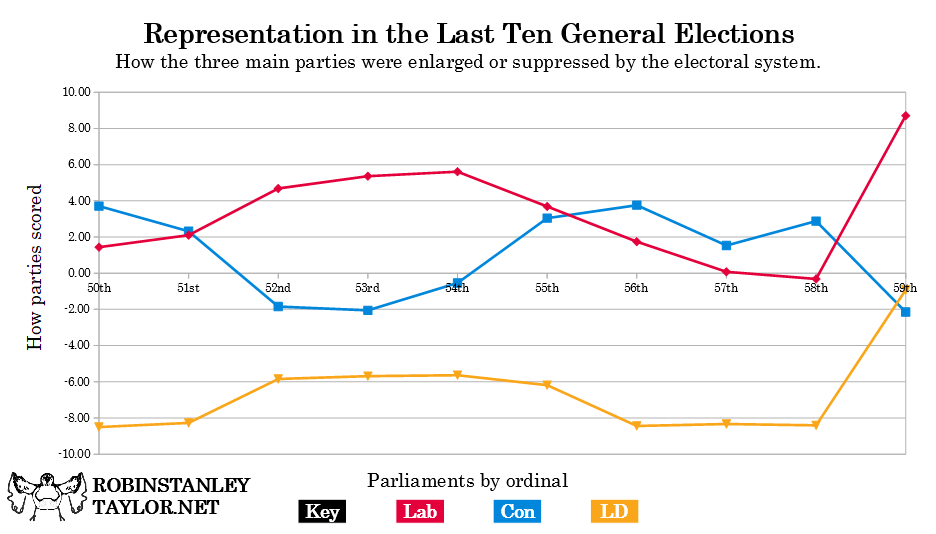
Yesterday evening the fifty-eighth Parliament of the United Kingdom was prorogued for the fourth and final time, pending dissolution next Thursday. This meant that MPs had just two days of “wash up” in which any bills already in the pipeline are either hurried to completion or abandoned altogether.

Parliament is not always prorogued before dissolution, sometime it is merely adjourned – in the past fifty years the 46th, 47th, 48th, 49th, 52nd, 53rd and 57th parliaments were all open-ended. Irrespective of whether or not a prorogation was involved, the time elapsed between a parliament’s last sitting day and its dissolution varies highly: For the second general election of 1974 it seems that the 46th Parliament sat last on 31st July before rising for the summer recess then got dissolved on 20th September just before it could convene again, whereas in 1992 the 50th Parliament sat last and was dissolved on the same day.*

Rishi Sunak’s motivation for this particular timetable is unclear – if he had let the legislature sit on 28th and 29th May it would have allowed four days instead of two to finish business, so that fewer bills would have needed to be dropped. Perhaps Sunak felt it would be a waste of commuting time to sit for just two days between the bank holiday and the dissolution. Some have also speculated that he wanted Parliament closed as soon as possible to reduce the opportunity for his backbenchers to unseat him as party leader. A precedent might be found in John Major in 1997, who had the 51st Parliament prorogued more than a fortnight before it was dissolved and was suspected of doing so to block the publication of a select committee report against Neil Hamilton.

When a general election is looming, incumbent MPs have to make a decision: Step down and make one’s valedictory speech in the chamber before prorogation, or stand again and risk having to make it instead from the returning officer’s podium in the early hours after polls close. By the time the house closed more than a hundred members (over seventy of them Conservatives) had chosen the first option. The valedictory debate lasted nearly seven hours and obviously I have not yet been able to properly take in all of the speeches. So far my favourites were Sir James Duddridge (with its interventions by both Alicia Kearns and Dame Eleanor Laing), Julian Knight (who took the chance to lash out at former colleagues who had wronged him) and Tim Loughton (differentiating knowledge from wisdom in terms of putting tomatoes in fruit salads).

The prorogation ceremony was carried out in the usual way. There were two substitutions among the Lords Commissioners – Liberal Democrat leader Lord Newby was replaced by his deputy Lord Dholakia (as in 2019) while Convenor of the Crossbench peers Lord Kinnoull (still not a privy council member) stayed on the crossbenches and left his place on the woolsack to his predecessor-but-two Lord Laming. Eleven acts received assent.

As in the prorogation last November, the letters patent acknowledged that there had been a demise of the crown since the last general election, hence the phrase

…whereas Queen Elizabeth The Second did lately for divers difficult and pressing affairs concerning Us the State and defence of Our United Kingdom and Church ordain this Our present Parliament to begin and be holden at Our City of Westminster the seventeenth day of December in the sixty-eighth year of Her Reign on which day Our said Parliament was begun and holden and is there now holden…

which as Jack Blackburn of The Times aptly pointed out is the last time that the former monarch will be mentioned in Parliament in this context.

As I have mentioned before, the dissolution of Parliament creates a headache for Wikipedia editors as hundreds of people who for years or even were incumbent members of the House of Commons cease to be so for a matter of weeks, then (most of them) become so again after polling day. This time, rather than have many of us hurriedly scouring hundreds of pages to remove any trace of incumbency, I am trialing a solution I piloted at the devolved elections three years ago by placing a disclaimer tag at the top of each affected article. The beauty of this trick is that the template can be centrally edited, so I can go at a more leisurely pace adding it to MPs’ articles in the days before dissolution with the notice written in future tense and then on the day of dissolution change it to present tense. Of course, that still leaves a lot of work making long-term edits to the pages of those members who will permanently leave the house at this election (whether willingly or not) and creating new pages for their successors.

EXTERNAL LINKS

House of Commons Library

Privy Council Office

UPDATE (2nd June)

When looking through the Hansard records for this sitting, I noticed an interesting mistake:

End of the Fifth Session (opened on 7 November 2023) of the Fifty-Eighth Parliament of the United Kingdom of Great Britain and Northern Ireland in the Second Year of the Reign of His Majesty King Charles the Third.

The last sitting day before 7th November 2023 was 26th October, and the record for that day says it was the end of the third session. Quite when the fourth session came and went I have no idea.

*The 1993 documentary Days of Majesty covers the prorogation and dissolution process.

In for the short haul

The digital illustration of coats of arms, and the uploading of such illustrations on Wikipedia, has been a pursuit of mine for more than seven years now. My productivity in this hobby has not been uniform. There have been some months in which I have uploaded nothing at all (e.g. October 2020) and others in which I have uploaded a great many (e.g. more than a hundred in August 2018).

The four months of 2024 so far have been at the low end, with only thirteen illustrations in the year so far – and April in particular having just one – that being the nineteenth-century judge Arthur, Lord Hobhouse.

This is not likely to improve any time soon, as I have long since exhausted the opportunities afforded by Burke, Cracroft and Debrett.

As I have mentioned before, I eagerly await the publication once every three months of the College of Arms’s newsletter, and the prospect of new blazons within, only to be regularly underwhelmed by the reality.

Yesterday’s edition did little to break the trend: Four new blazons were announced, of which only one applied to a person with a Wikipedia page. That person was Aamer, Lord Sarfraz, whose arms were actually granted two years ago and illustrated by me not long after based on the photograph shown on his website.

Much more interesting, and substantial, was the section about corporate heraldry. Two examples were given, one being the British Airways Board (again, already known). The newsletter was supplemented by a booklet about corporate grants, which was a substantial read in itself. Though the general principles described are those already articulated elsewhere on the college’s website, the style of the publication is radically different to what I am used to seeing from them and perhaps represents a significant change in approach. One might almost think they were advertising…

Waving the White Flag

In recent weeks there has been some reshuffling of responsibilities within the royal family: The King and the Princess of Wales have both been undergoing cancer treatment, limiting their ability to carry out public engagements away from their residences. Consequently, a greater burden has fallen on His Majesty’s wife and ever-trusty sister.

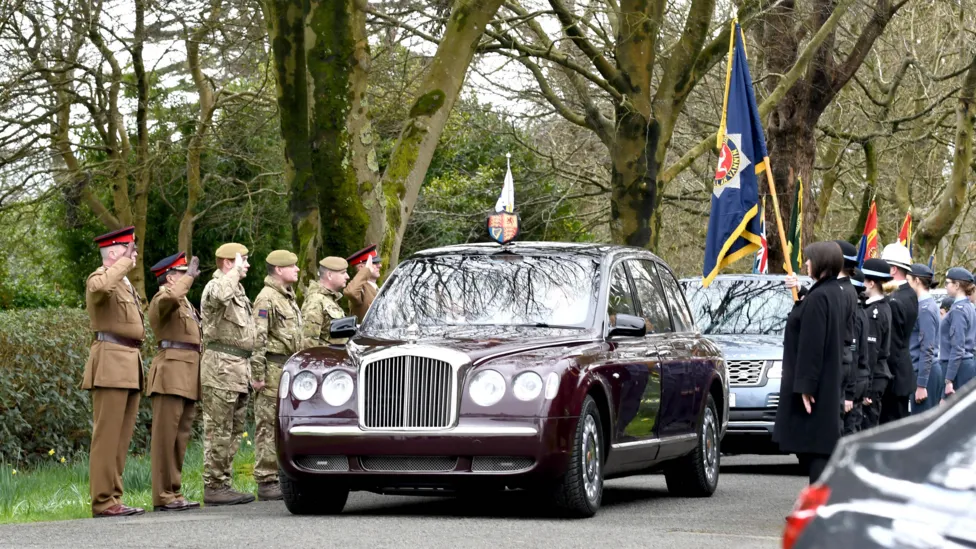
The Queen’s recent sole engagements have included Douglas City Hall on the Isle of Man (for the presentation of the letters patent to confer city status), and Worcester Cathedral (for the Maundy service ahead of Easter).

As was noted in Mark Scott’s lecture a month ago, the granting of banners of arms to members of the royal family is a separate event from the granting of the armorial achievement itself (rather than being automatic as it would be for lesser armigers). Eighteen months into her tenure as queen consort, it appears that Camilla’s own banner has not been granted, for I have repeatedly seen the Bentley State Limousine flying the ermine-bordered version of the royal standard used for lesser members of the firm who had not been granted personalised heraldic flags of their own, while the shield affixed to the roof shows the arms of the sovereign undifferenced.

As is so often the case, the Wikimedia Community have moved much faster than reality – a graphic representing Camilla’s banner as queen consort was uploaded preemptively way back in 2016 and has been used in multiple articles since her husband’s accession. Perhaps this will need to be revised in light of new evidence.

PHOTOGRAPHIC REFERENCES

In Honour of the Occasion

Photograph by sbclick, 2011 (CC-BY-1.0)

In theory the monarch can bestow practically any accolade on any person at any time and for any reason. In practice, since the late Victorian age there has been a trend towards grouping announcements into two big lists each year – one in June for the sovereign’s official birthday, one in December for the upcoming new year. There are also smaller lists issued at irregular intervals to commemorate particular events e.g. the deaths of senior royals, the dissolutions of parliaments and the resignations of prime ministers. The latter two types tend to be particularly controversial.

Wikipedians have generally maintained pages for all of the lists, great and small. They  have also created an annual page called “Special Honours”, which they use as a catch-all term for those titles and decorations which were issued outside of any named occasion.

Today’s announcement is a little confusing for those seeking categorisation – the Prime Minister’s office has released a list of honours and appointments for March 2024. The document as a whole does not have any particular name, but paragraphs within it do: Creative Industries Honours, Technology & Artificial Intelligence Honours, and Political Honours. The former has provoked the most recognition, appointing film producer Emma Thomas as a DBE and her husband Christopher Nolan (already a CBE since 2019) as a knight bachelor. There is also a short list new privy counsellors (e.g. Vaughan Gething, recently appointed as First Minister of Wales), though whether these count as honours in the way knighthoods do is debatable.

This new publication comes just forty-eight days after the list of “Political Peerages” (e.g. yet more new members of the House of Lords). It eludes me why today’s list was not brought forward to be merged with that one, or pushed back to fold in with the Birthday Honours in June. The only likely explanation is that these were Rishi Sunak’s personal picks and he (or His Majesty) wanted that distinction made clear in the public mind. Of course, that could also have been achieved by waiting for the looming dissolution honours at this year’s general election – or indeed Sunak’s resignation honours, which may well come earlier!

Awdry Arms Again

Back in November I discovered the coat of arms of Sir John Wither Awdry, paternal grandfather of children’s author Wilbert Vere Awdry. The illustration was based on a blazon found in Burke’s Landed Gentry, 1862.

Page 39 of that book gives the shield Argent three cinquefoils Or on a bend Azure cotised of the same and crest out of a ducal coronet a lion’s head Azure for AWDRY OF SEEND.

The next entry is AWDRY OF NOTTON, and it is this one which includes Sir John. For the arms and crest of this branch, Burke merely says “same as AWDRY, of Seend”.

Today I have found the family referenced in the Burke’s Landed Gentry 1921. Page 53 of this book gives a slightly different blazon – shield Argent on a bend Azure cottised Sable between two crescents of the second a crescent between two cinquefoils Or and crest on a wreath of the colours in front of a lion’s head erased Azure gorged with a collar gemel Argent a cinquefoil between two crescents fesseways Or. Curiously the entry for Awdry of Seend in this edition gives no armorial details at all. Wilbert was ten years old when this version came out, and his date of birth is given in his father’s paragraph but no other detail about him personally is included.

The Awdrys are also mentioned at least twice by Arthur Charles Fox-Davies in his Armorial Families series. Page 51 of the 1895 book gives entries for multiple Awdry men, each time with the same information about Sir John’s arms – shield Argent on a bend cottised Azure three cinquefoils Or a crescent of the second for difference and crest out of a ducal coronet Or a lion’s head Azure. He also takes care to note that these are armorial bearings as used, and as quoted in Burke’s “Landed Gentry”, but for which no authority has been established. These comply with the blazon as I first encountered it, except that the crescent for difference was not originally there. The crescent, of course, is the traditional English mark of cadency for an armiger’s second son. I find it a little odd that Fox-Davies types the exact same information out for each of Sir John’s many sons whom he records, but does not say if any of them added extra cadency marks for their own position in the family tree. Pages 55 and 56 of the 1910 book gives the exact same blazon as Burke’s 1921.

For now I will accept the later version as the correct one and I have modified my illustration accordingly. Pending further research, I would speculate that the Awdrys of Seend are the senior branch of the family with the relatively simple arms while the Awdrys of Notton are the long-established offshoot with permanent (although inconsistently recorded) augmentations.

FURTHER VIEWING

The Audley Beast with David Phillips

Thomas’s daughter Margaret, painted in 1562, with the beast in the background.

After a long-ish break – the January lecture failing due to technical glitches – I returned to the Oxford University Heraldry Society for a lecture about the Tudor era nobleman Thomas Audley, 1st Baron Audley of Walden, and the mysterious animal that features as his heraldic supporter.


At the end of the lecture I asked a question that had been intriguing me for a while – why, in the early Tudor period, was there such an explosion of historically-prominent senior officials with the first name Thomas?

Phillips gave the answer that, prior to the reformation, Thomas Becket was one of England’s most venerated saints and so of course a high proportion named their sons after him. That just left me with the new question of why there weren’t so many Thomases in high office between Henry II and Henry VII’s reigns, but I didn’t get time to ask that one.


On an unrelated note, today marks the tenth anniversary of my registration as a Wikipedia editor. In terms of edit count rankings, I have climbed to number 5452. There was no grand celebration – not even an automated reminder – but I did discover a Ten Year Society to join, albeit one with little activity thus far.

Liberating a musical relic

In discussions of artistic and intellectual property it is often remarked that “There is nothing new under the sun.” in reference to the frequency with which works under copyright turn out themselves to have been copied or derived from older material which may or may not have been public domain already – such as popular film scores taking cues from classical compositions.

One example is Howard Shore’s In Dreams, part of his soundtrack to The Fellowship of the Ring. The melody, especially the first seven notes, came from the 1901 hymn This Is My Father’s World.

The lyrics were written by Presbyterian minister Maltie Babcock and set to music by composer Franklin Sheppard. Despite the musical similarity, thematically they are entirely different: Babcock’s lyrics are mainly about the beauty of natural creation, with a few explicit references to scripture, and obviously multiple references to the Christian deity. Shore’s song, in common with everything else in Jackson’s films, avoids any direct mention of Eru Ilúvatar. Principally the song seems to be about perseverance through adversity and the emotional pain of separation from close friends. Given how the story ends, it could be interpreted as anticipating reunification after death. That the song should allude to spiritual principles without actually naming a real religion is in keeping with Tolkien’s conception of the book (albeit he was Catholic not Presbyterian).

This was the favourite childhood church song of prominent atheist Penn Jillette, who even parodied it for the opening them of his podcast. Personally I only discovered the hymn when searching backwards from the FOTR score, and on further investigation it does not seem to have made much of a cultural penetration outside North America. Searching for it on YouTube mainly brings up American religious schools.

Given the song’s publication and Babcock’s death both occurred in 1901, with Sheppard dying in 1930, the music and lyrics have both been in the public domain for some time, so I was a little surprised to see that Wikimedia Commons did not have an audio file. I set about creating one, based on a photograph they did have of a printout of the sheet music. It had been a long time since last I used MuseScore, but in about an hour I had relearned enough to copy out the page, render it as a sound file and upload it. Obviously mine is instrumental only as MuseScore does not have a singing function and I did not wish to record my own voice for this.

EXTERNAL LINKS

  • This Is My Father’s World, performed by pupils of Fountainview Academy, British Columbia. They really seem to be leaning into the LOTR comparisons with the rowboats and the fallen leaves.
  • Extract from LOTR making-of documentary, showing the recording of In Dreams.
  • Rendition by Sean Holshouser. Twelve years and forty videos later (many of them being actual Christian songs), this remains by far his most popular.

Public Domain Day 2024

Public Domain Day this year is a little different: Relatively few artists of interest (to me, at least) have been released from copyright in Britain (probably the most culturally significant is the poet Dylan Thomas), but there have been major happenings overseas.

J. R. R. Tolkien died on 2 September 1973, so The Hobbit and The Lord of the Rings are set free today in countries with copyright terms of fifty years – most notably New Zealand, where Sir Peter Jackson adapted them for film. This might also have been the case in Canada, but the law was changed with effect from the end of 2022 to extend Canada’s posthumous copyright duration from fifty to seventy years. Tolkien’s works were thus among the first cohort to be delayed in their release. Of course, this only applies to works published in J. R. R.’s own lifetime – the great many posthumous works which were “edited” by his son Christopher (such as The Silmarillion and The Children of Húrin) will likely remain copyrighted until 2091 and those after Christopher’s death edited by Brian Sibley (e.g. The Fall of Númenor) could stay well into the twenty-second century (that’s before we even consider any other significant involved persons who may wish to claim co-authorship credit). The absurdity of this situation is compounded when one remembers that John Tolkien originally wrote some of these story ideas as early as the First World War.

The other big IP-related news story this year is the very long-awaited expiration of the copyright on Steamboat Willie, the 1928 cartoon film in which Mickey and Minnie Mouse made their first proper appearances. This film is now arguably less famous as an artistic work than as a symbol of copyright disputes, with the copyright term having been extended multiple times by acts of the United States Congress. From 2007 onwards Disney has been using an excerpt of the film as part of its production logo, which many perceived as a shift in strategy to have the image protected as a trademark once their luck with copyright extensions ran out. The Wikipedia page for the film has undergone a vast series of edits in the past twenty-four hours as multiple screenshots and stills are newly available on Wikimedia Commons.

Back in the Library

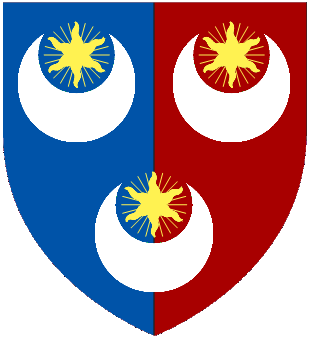
The arms of Lord Loomba, drawn by Cakelot1

After more than two years of waiting, this month I finally found the opportunity to go into the reference floor of Hull Central Library, where there sit a few physical volumes of Burke’s and Debrett’s Peerage. My particular quarry was the 2015 edition. I have, of course, already perused the Google Books sample of Debrett’s 2019, but there were a great number of pages omitted from that (the 2015 edition has no sample at all), and indeed there were some peerages which had become extinct before the writing of the 2019 edition so did not feature in it.

Over two long sessions of careful copying out, for which I prepared by compiling a list of peers of the time whose ensigns armorial I did not already have on record, I have been able to update Wikipedia with thirty-three new blazons, which were:

I have already illustrated some of these by myself, but I also gave the list to the relevant WikiProject community for the benefit of our other artists, some of whom have already enriched these peers’ pages with their own illustrations.

There were some interesting findings among them. Lord Deighton’s blazon includes three London 2012 Olympic torches Or enflamed Proper, which I assume must have been cleared with the International Olympic Committee for intellectual property reasons. Lord Forsyth has a square block of roughly dressed sandstone. Lord Ramsbotham takes the radical step of specifying that the tincture Vert should be the shade thereof being known as rifle green, against the heraldic convention that one shade of a colour is as good as any other.

This is my most significant haul of new material for quite some time. I must hope that my next discovery will not take even longer.

I Might Have Known

Three years ago I had a stab at designing a coat of arms for the Reverend Wilbert Vere Awdry, believing that he never had one officially granted or descended to him. Now, however, I discover that he most likely did.

When searching through the Internet Archive I found a digital copy of The Thomas The Tank Engine Man, a biography of Awdry by Brian Sibley (who also edited The Fall of Númenor and wrote several companion books about Tolkien’s legendarium and its cinematic adaptations).

The early pages recount some of the vicar’s family history, including his uncle William and grandfather Sir John. Sir John Wither Awdry spent three years as Chief Justice of the Supreme Court of Judicature at Bombay and William Awdry spent twelve as Bishop of South Tokyo. I quickly found that these two men already had their own Wikipedia biographies, both of which mentioned their kinship to Wilbert. If only there had been links in the other direction I might have discovered this information much earlier.

William, August 1900

Unfortunately Debrett’s Peerage would be of no use here as it tends to list only the corporate and not the personal arms of the Lords Spiritual, and even then only those diocesan bishops within the United Kingdom – Awdry meeting neither condition. Happily, Sir John did have an entry in Burke’s Landed Gentry 1862, which lists his dynastic arms of unspecified antiquity as Argent three cinquefoils Or on a bend Azure cotised of the same with crest Out of a ducal coronet a lion’s head Azure and motto Nil Sine Deo.

William and Wilbert being legitimate agnatic descendants of Sir John, it naturally follows that whatever armorial ensigns he possessed, they possessed also. It is curious, therefore, to have found so little record of him or his son Christopher actually using them. This is amplified by the fact that the fact that he and his brother George clearly had an active interest in and working knowledge of heraldic blazon, which Sibley’s book even notes:

George…was exploring matters of heraldry and coats of arms ‘A real beauty occured to me for Tidmouth,’ he wrote to his brother, ‘It ought to be rather elaborate, as it is relatively new, and the simple ones are doubtless allotted already.’ The proposed arms for Tidmouth were to feature a smith’s hammer and tongs, a lymphad (a heraldic ship), three herrings and a wheel. ‘This,’ George explained, ‘covers all Tidmouth’s titles to importance: shipping, transport, fishing, engineering…’

I did, of course, illustrate Tidmouth’s arms two years ago as well.