Heraldry is not a topic much-covered on YouTube, so I cherish what scraps I can find. Recently I found this video from seven years ago of Timothy Noad, illuminator of many heraldic patents, giving a short lecture on his career and craft to the World Calligraphy Museum.
The presentation is actually only half as long as it seems, for as Noad has finished reading out each paragraph in English he has to stop while it is translated into Russian. This results in the whole performance having a stilted cadence redolent of schoolchildren performing class assemblies.
Still, it is nice to actually see and hear from the man who for so long has existed only as a name. I suspect that events in the last two years will make joint ventures like this rather difficult to replicate in the foreseeable future.
Many times I have written about the travails involved in finding free-licence images for Wikimedia Commons, but this time it is sound files that concern me.
When Charles III acceded to the throne two years ago, the royal anthem of the Commonwealth Realms changed from “God Save the Queen” to “God Save the King”, having been in the feminine form for longer than the internet had existed. Extant recordings of the masculine form were hard to find, and those that did exist were inevitably very old.
Lacking the budget to form my own choir or hire a recording studio, I went looking for recordings of the song in the place it seemed most likely to find them – videos of His Majesty’s outdoor accession proclamations.
Of the dozens (perhaps hundreds) of these which actually took place, I managed to find just four for which either the venue host or a charitable bystander had uploaded the video to YouTube under Creative Commons. I firstly copied these videos themselves to Wikimedia Commons, then set about extracting the audio of people singing. Both of these involved a bit of a learning curve and the use of some third-party tools.
This is the most high-profile of the four, and the one with the best sound quality. The band are playing (I think) Sir Henry Wood’s arrangement of the anthem (which is good because the composition itself is public domain) and the crowd are all in time. There is some noise due to wind, local dogs and the sliding of camera shutters.
This version is sung a cappella. Most of the crowd have picked up by the third syllable and stay remarkably in time for the rest, though not necessarily in tune – one in particular says “noble” and “victorious” in a way that sounds almost like a dog yawning.
One of the recurrent themes of this blog is the inconsistency of licensing in British governmental and parliamentary photographs. Without rehearsing the entire story again, I will note that yesterday I made a wonderful discovery:
Since the day of the event itself I had thought that the only photograph of the 2024 State Opening of Parliament to be released under a free licence was this one of His Majesty in procession through the royal gallery. It is fairly tightly framed, with only the middle ground in focus so that Charles and the page boys to his flanks appear a little too sharp while the Duke of Norfolk in front and the Marchioness of Lansdowne behind are entirely blurred.
The House of Lords Flickr account had a generous album of high quality shots, but these were released under a Non-Commercial and No Derivatives licence, rendering them useless for Wikimedia Commons*. When this happened last year I was able to get around it by using those which had been re-issued under a looser licence by the Oireachtas, although some other Wikipedians challenged the legitimacy of these. No such republication existed this time around.
Happily, yesterday when strolling through the relevant category on Wikimedia Commons I came across a second photograph of the event, taken from inside the upper chamber and showing the speech being read. The source was given as parliament.assetbank-server.com, and the link revealed a page from what seemed to be an official Parliament-owned website with twenty-eight of the forty-five photographs in the Flickr album, but this time very explicitly licensed under Attribution 3.0 Unported (CC BY 3.0), which meant they could be used on Wikimedia Commons. Of course, I took the opportunity offered by the handy “DOWNLOAD ALL AS ZIP” button to transfer the lot of them. I had to give new names to all of them as the file originals were mostly gibberish and I noticed that the metadata were inconsistent as well (some had timestamps and others didn’t, some were taken by Roger Harris and others by Annabel Moeller). Some more editing may well be required in future to rectify this.
Though I am reluctant to look this gift horse in the mouth, I am a little perplexed by the existence of this website, which bears the UK Parliament logo but is not at the parliament.uk domain, and whose individual pages can be seen freely once you have the direct link but which cannot be navigated without a login. It could be the case that the majority – or indeed entirety – of the recent House of Lords photograph collection is actually released under a usable licence and these pages would prove it, if only we ever manage to find them.
*The irritating thing about photographing licensing in a parliamentary context is that one must continually differentiate between Wikimedia Commons, Creative Commons and the House of Commons. The presence of Their Majesties in these images means that “royalty-free” isn’t very practical either.
In the past fortnight there have been a handful of significant developments in the world of British heraldry.
Firstly, on 15th August the College of Arms published the 76th edition of its newsletter. Much of the text deals with topics already explained (such as the coronation roll and the year’s garter appointments) but there were some new details, such as the grant of arms to the University for the Creative Arts, which will be another addition to my list on Wikipedia.
Secondly, there are two long-form videos on YouTube of armorial interest: On August 20th a video by the White House Historical Association about the making of the Presidential Seal and on August 23rd by American Ancestors interviewing the York Herald Peter O’Donoghue. These videos speak for themselves so I will not elaborate them.
Thirdly, and of most interest, is a Tweet from 24th August by Alastair Bruce. It includes three photographs from inside the High Kirk of Edinburgh, showing the stallplate and banner of Queen Camilla. There is not much of surprise about the composition of the arms – they show the arms of King Charles impaling the arms of Bruce Shand – but it is reassuring to have confirmation that both shield and banner exist in formal usage, given the persistent uncertainties of Her Majesty’s status in England.
The most intriguing of the three photographs is the one which shows Camilla’s stallplate accompanied by five other royal ones: In the left column are Prince William, Earl of Strathearn (middle) and Olav V, King of Norway (bottom). In the right column are Queen Elizabeth Bowes-Lyon (top) the Prince Philip, Duke of Edinburgh (middle) and the Prince Albert, Duke of York (bottom). The fact that these six achievements are put together like this is itself a little confusing since some of those members of the order had overlapping tenures so could not have occupied the same stall. Also noteworthy is the way in which the artistic styles have changed over the years:
The Prince Albert, (later King George VI) was appointed to the order by his father in 1923 and presumably this is what it says on the scroll underneath (although it’s not legible in the photograph). He uses the royal arms differenced by a label of three points argent the centre bearing an anchor Azure. He has the coronet of a child of the sovereign sitting on top of a forward-facing golden helmet, and the coronet itself is topped by the lion crest, gorged at the neck by another label of three points argent – although that one doesn’t have the anchor in the middle. While that could be dismissed as an omission by the painter (perhaps too small to draw properly) it is unmissable that this stallplate clearly uses the English version of the royal arms and crest as well as referring to the prince by his England-based title (Duke of York) instead of his Scottish-based one (Earl of Inverness).
Queen Elizabeth was appointed by her husband in 1937. Her stallplate shows his arms impaling those of Claude Bowes-Lyon. Again the English arrangement of the royal arms is used, especially confusing as Elizabeth was herself of Scottish ancestry. The shield is topped by the royal crown. I can’t work out if it is the English or Scottish version of the crown shown, given the vagaries of the art style.
The Prince Philip was appointed by his wife in 1952. His stallplate shows his arms as granted in 1949. He used the same coronet as his sons and uncles-in-law, but here it is depicted beneath the helm rather than atop it as in the other examples. Philip apparently used the same arms in every heraldic jurisdiction, as well as the same title. His personal motto “God Is My Help” appears on a scroll above the crest, as is the Scottish tradition.
Prince William was appointed by his grandmother in 2012. Earl of Strathearn was his secondary peerage, his primary being Duke of Cambridge. His arms are in the Scottish arrangement. He uses the coronet of a son of the heir apparent on top of a front-facing grey helmet with gold bars, itself topped by the Scottish royal crest. Both crest and shield are differenced by his label of three points Argent, the centre bearing an escallop Gules. The Scottish motto “In Defens” flies over the crest. The tinctures used for this stallplate look a little off, with the Or in particular being shown as a much darker shade of yellow than that used for all the others.
Queen Camilla was appointed by her husband in 2023. Her shield uses the Scottish arrangement of the arms. The royal crown is drawn rather differently to that used by her grandmother-in-law, but it’s still just as unclear which one it is supposed to be.
Olav V, the only foreign member here, was appointed by his first cousin one removed in 1962. Crests are not a traditional feature of Norwegian heraldry, but the royal crown of Norway is placed atop a forward-facing grey helm with gold bars. The mantling is Gules doubled Or whereas the British princes here use Or doubled Ermine. Domestic depictions of the Norwegian arms tend to omit helm and mantling altogether or use a pavillion Purpure doubled ermine.
Every summer the diminutive parish of Sunk Island puts on a heritage event, displaying billboards about the social and environmental history of the place, as well as selling a few mementos. I was invited to attend today’s to help with carrying some of the materials in and out.
The event is hosted at Holy Trinity Church, which ceased to operate as a place of worship in 1983 but remains open as a community centre (especially since the demolition of the village hall nearby). The history of the church itself (including the contest between rival Christian denominations for recruitment of parishioners) was a major theme of the display. The other big theme was the dredging up of the mud banks, followed by the cutting of new drains and the building of the sluice gates.
Some of the displays looked like they had been made many years ago and brought out unedited each time. There is a familiar style common to these kinds of displays by churches, village halls and primary schools in small settlements in rural Britain around the turn of the millennium. In particular I noticed a poster about the Crown Estate, which still referred to it paying for the civil list (as opposed to the sovereign grant).
What particularly piqued my interest was a patchwork quilt entitled “Treasures of Holderness”, each patch made by a member of a local sewing group. That by Sue Daniels showed the shield of arms of Holderness Borough Council. The full achievement was also shown on a wooden plaque affixed to the wall of the entrance hall. The borough itself, along with its governing council,was dissolved in 1996 and merged into the East Riding of Yorkshire unitary authority. Holderness no longer has a heraldic personhood distinct from the rest of the county but the old arms carry on informally by force of cultural inertia. None of the individual parishes seem to have arms individually granted.
Fresh from attending special sittings of the States of Jersey and the States of Deliberation in Guernsey, today Their Majesties returned to Westminster for the opening of the first session of the fifty-ninth Parliament of the United Kingdom.
This was the first King’s Speech under a Labour government since 1950. There is some symmetry, perhaps, between Charles III’s second speech and George VI’s second-to-last.
This is the only free-licence photograph of the event so far.
While the content of the speech was very lengthy and stood in radical contrast to the one delivered for Sunak’s government in November, in ceremonial terms there was very little change. The King’s getup was identical to that worn last time. The Queen’s changed a little – instead of her coronation gown, she has reverted to the style of dress she wore in 2019 and earlier. Reeta Chakrabarti, presenting the BBC’s coverage, described it as “very fine, off-white silk crepe embroidered by Fiona Claire”. She has not taken to wearing a sash again, but the star of the Order of the Garter appears around her left hip. This was also, incidentally, her 77th birthday.
Shabana Mahmood appeared as Lord Chancellor. Being a barrister, she wore the full-bottomed wig. This is the first time a woman has performed this role at a state opening, for Liz Truss’s brief tenure in the role did not include one. Justin Welby, the Archbishop of Canterbury, can be seen for the first time wearing the collar of the Royal Victorian Order.
The most striking visual difference was in the change of pages – last time King Charles’ train was carried by Nicholas Barclay, Ralph Tollemache, Charles van Cutsem and Lord Oliver Cholmondeley (three of whom also appeared at the coronation). This time Tollemache returned but the other three were replaced by William Sackville, Alfred Wellesley and Guy Tryon. I don’t know any biographical detail about them beyond what I can guess from their surnames but they all appeared to be several years younger than the boys whom they replaced. Queen Camilla continued to use William Keswick and Arthur Elliott as before. As at last year’s ceremony Her Majesty’s two pages held her robe in the middle rather than at the end so that the end still dragged along the carpet, whereas His Majesty’s four pages kept the whole garment elevated (despite it being longer than his wife’s).
Some other things of note – as is custom after the first state opening of a new parliament, the lower house appointed three temporary deputy speakers. The senior of these is Sir Edward Leigh. I don’t think a Father of the House has ever been appointed as a deputy speaker before. These three will hold office for the brief period until new deputies are elected. All three of the deputy speakers sitting before dissolution have now left the house (one against his will), which was last the case in 1997. There will thus be no continuity except for Sir Lindsay Hoyle himself. Also today the first life peerages of Sir Keir Starmer’s premiership were patented – Lord Vallance of Balham and Lady Smith of Malvern. It appears that the ministerial appointments will be taking priority over the dissolution honours after all.
A few months ago I noted that, during the illness of her husband, Queen Camilla had been carrying out royal engagements solo, and had been flying the generic ermine-bordered version of the royal banner of arms.
The King has since recovered at least enough to be allowed out, and today Their Majesties jointly visit the Bailiwick of Jersey – a crown dependency in the English channel. Although a self-governing country with its own coat of arms, Jersey is part of the realm of the United Kingdom (i.e. it doesn’t count as a separate crown from the British one) and the sovereign’s heraldic identity is the same as in England.
In the disappointingly-limited series of photographs and videos I have found so far (none of them free-licence) I could not see much evidence of the sovereign’s banner flying over buildings, though I did see it on the roof of the Bentley State Limousine. What intrigued me was seeing (at 2m08s in the video above) some enthusiasts who had brought their own banner of Her Majesty’s arms and draped it over the railing. Based on the art style, I am dead certain it is a printout of this creation by Fry1989. The King actually reacts to it, though I can’t quite make out the words he says. The presumed owner of the flag says to him “I hope you enjoyed France last year.” in what I take to be a French accent.
Rolling coverage by the BBC. It has a segment on James Landale, whom I’m fairly sure is the same person as appears next to the speaker I referenced in the video above.
In the eight years and two weeks since the EU referendum, Sir Keir Starmer is the fifth person to be appointed Prime Minister of the United Kingdom. This means we have a lot of recent precedents against which to compare the events of the last few days.
The Palace
Up to and including 2010 it was the norm for the invitation of a new premier to form a government to take place entirely off-camera, with the politicians only being seen as they came in and out of the door and the monarch not to be seen at all.
Beginning in 2016 it became custom for the monarch and the new prime minister to be photographed at the start of their meeting and for this photograph to be shared with the press (May, Johnson, Truss, Sunak). Starmer’s appointment goes a little further by even having a short video clip of His Majesty speaking to him. I’m not familiar enough with internal layout of Buckingham Palace to know precisely where each meeting takes place (and the photographs themselves are not labelled in that way) but it’s clear that May, Johnson and Starmer all met the sovereign in the same room while Sunak was in a different part of the palace. Truss’s, of course, took place at Balmoral Castle and is famous as the last time Elizabeth II was photographed before she died. The sight of the two men in adjacent armchairs is reminiscent of scenes with outgoing and incoming Presidents of the United States in the Oval Office.
The Cars
From Thatcher until Johnson the cars used by Prime Ministers were various generations of Jaguar XJs. During Johnson’s tenure the government began phasing these out in favour of Range Rover Sentinels and then Audi A8Ls. In this instance Sunak arrived at the Palace in an Audi (KN23 XFE). Starmer arrived in a Range Rover (0Y20 CFU), then left in the same Audi. It is not clear where the limousine was hiding between Sunak’s meeting and Starmer’s, or which type of car was used to drive the Conservative leader away as his departure was apparently by a rear exit, off-camera. At some point I may do another post comparing the vehicles used in all these moments.
The Cabinet
At this point the full extent of Starmer’s first cabinet is known, though there is still some way to go with the appointment of all the junior ministers. New cabinet ministers overwhelmingly occupy the same post they had been shadowing before the election, with exceptions few enough to list individually:
Thangam Debbonaire (Culture, Media & Sport) and Jonathan Ashworth (Paymaster General) lost their seats, replaced by Lisa Nandy and Nick Thomas-Symonds respectively.
Anneliese Dodds (Women & Equalities) was a Shadow Secretary of State but is now only a Minister of State (both for that portfolio and at the FCDO).
Emily Thornberry (Attorney General) was dropped from the frontbench and replaced by Richard Hermer. She doesn’t seem to have been offered Debbonaire’s or Ashworth’s place either, and now sits as a backbencher.
Some of those who were full members of the shadow cabinet have been demoted to “also attending” the real one. Starmer has followed David Cameron’s example from 2010 in avoiding immediate changes to the machinery of government – while new ministers have been appointed, the ministerial departments themselves are as the previous government left them.
Whereas Blair’s cabinet of 1997 was desperately short of prior ministerial experience (the late Lord Morris of Aberavon being the only veteran of the Wilson-Callaghan years), Starmer’s cabinet of 2024 has quite a few people who served under Blair and Brown. The most prominent example is Ed Miliband, who returns to his old job as energy secretary. Home Secretary Yvette Cooper was previously Chief Secretary to the Treasury and then head of the DWP, Northern Ireland Secretary Hilary Benn formerly headed DfID and DEFRA while a few others held multiple junior roles.
Some other New Labour grandees have returned to Parliament after a long absence to serve as lesser ministers e.g. Douglas Alexander (Business & Trade) back in the Commons, (although not for the same constituency) and Jacqui Smith (Education) to be appointed to the Lords.
Smith’s is not the only peerage required to facilitate a ministerial appointment – Hermer is not currently in Parliament either, nor are Sir Patrick Vallance (Minister of State for Science, Research & Innovation) or James Timpson (Minister of State for Prisons, Parole & Probation). It is not clear if these last three are expected to actually join the Labour Party as they were not in political roles before. Vallance in particular (famous from the COVID-era press conferences) has spent five years as a civil servant in the position of Government Chief Scientific Adviser. It is also not clear if these peerages will be created before or after those already announced in the dissolution honours.
The Council
Secretaries of State and some other officeholders are appointed at plenary sessions of the privy council. This time, unusually, the installation of the new cabinet seems to have been spread over two meetings.
The first meeting, on Saturday 6th July, saw Lucy Powell declared Lord President of the Council, then Rayner, Lammy, Cooper, Healey, Mahmood, Kendal and Nandy appointed secretaries of state. Lady Smith of Basildon was appointed Lord Keeper of the Privy Seal. The contents page preceding the actual orders in council (an innovation since the last government) splits the secretaries of state into four sections rather than as one bloc so as to have Rayner (the Deputy Prime Minister) above Reeves (the Chancellor of the Exchequer), with Mahmood given her own section due to her distinction of also being Lord High Chancellor. The contents page (though not the actual order in council) also bizarrely describes the Chancellor of the Exchequer as being a Secretary of State, which it isn’t. To make matters worse, the tab header for the PDF says “Lis of Business” rather than “List of Business”! I suspect the Privy Council Office needed some extra proofreading here.
The order in council refers to the new head of government himself as follows:
This day the Right Honourable Sir Keir Starmer KCB KC (Prime Minister) did, by His Majesty’s command, make solemn affirmation as First Lord of the Treasury.
Writing it this way depicts Sir Keir as already being Prime Minister at the time of his appointment as First Lord, making clear that these are distinct titles. Notably Rayner is not described as (Deputy Prime Minister) in the same fashion. Rishi Sunak’s appointment on 27th October 2022 is written the same way, as were Liz Truss’s on 12th October 2022 and Theresa May’s on 19th July 2016. Boris Johnson’s presumably happened on 25th July 2019 but the file seems to be missing. David Cameron’s happened on 13th May 2010 but the document only shows the contents summary. I find it interesting that May and Truss both delayed their swearings-in as First Lord until the meeting after that in which most of their cabinet ministers were sworn, with Truss’s in particular being so delayed that it was closer to the end of her premiership than to the beginning.
The second meeting, on Wednesday 10th July, shows the appointment of secretaries Streeting, Phillipson, Miliband, Reynolds, Kyle, Haigh, Reed, Benn, Murray and Stevens, followed by Reynolds again as President of the Board of Trade – this showing a contrasting approach to the ordering of business.
The ‘Clature (alright, I’m reaching here)
In keeping with David Cameron’s example as already mentioned, Starmer has still renamed one ministerial department even if he hasn’t seriously reorganised any: At the Saturday council Angela Rayner was sworn Secretary of State for Levelling Up, Housing and Communities. At the Wednesday council she was sworn again as Secretary of State for Housing, Communites and Local Government.
This department has been in existence since 2001 without major changes to its functions but it has had multiple changes of name. I will list all of them now.
2001 – Office of the Deputy Prime Minister (ODPM)
2006 – Department for Communites and Local Government (DCLG)
Notably GOV.UK treats the 2018 and 2024 establishments as distinct entities despite them having the same name. The (il)logic of when to say “office”, “ministry” or “department” is probably worth an article in itself at some later date. To change the Department for Children, Schools and Families into the Department for Education in 2010 required an eight-page statutory instrument. To change the MHCLG into the DLUHC in 2021 required twenty pages. Who knows how long it will take to change back again. The problem of “shopping list” department names has been noted for some time. It was reported that the “Levelling Up” part of the name was dropped because it was regarded as merely an empty slogan. Personally I would prefer that the vague “Communities” part be dropped as well, to restore the 1951-1970 name.
I mentioned in a previous post that most of my written and photographic output (online and off) post-dates Gordon Brown’s resignation. I should note now that this is also the case for most of the present digital profile of His Majesty’s Government. GOV.UK itself only dates back to 2012 (although Martha Lane Fox had started working on the project in 2009), and online minutes of the Privy Council only go back to the start of 2010. ParliamentLive.TV only dates back to December 2007 and most government Flickr accounts were in their infancy or non-existent at the time of the 2010 general election. Parliament.uk was very heavily redesigned during the later New Tens. This is not a perfect correlation, let alone a causal relationship, but it does indicate how novel it is to have all these online accounts operating under a Labour regime rather than a Conservative one.
The fifty-ninth Parliament of the United Kingdom assembled for the first time today. As usual the first business was the re-election of the Speaker of the House of Commons.
The custom is that proceedings for the election of a speaker are presided over by the member, present in the chamber and not being a minister, with the longest continuous service. As of last week’s general election that member is Sir Edward Leigh, an MP since 1983. His predecessor, Sir Peter Bottomley (MP since 1975) sought re-election but was defeated. Had Leigh also been defeated then the task would have fallen to Jeremy Corbyn of Islington North (formerly Leader of the Labour Party, but now sitting as an independent).
This person also usually has the honorific title “Father of the House”. I say usually because the Father need only be the member with the longest continuous service, and there can be times when that person is also a minister and/or not present in the chamber for the speaker’s election. So far the title has always been Father and never Mother, for no woman has yet achieved this distinction.
In 2015 Harriet Harman declared herself Mother of the House on account of being the female MP with the longest continuous service (since 1982 in her case) and this caught on with a few other senior members (including prime ministers Cameron and May). It is not quite clear why Harman only claimed the status in 2015 given that it was already true a parliament earlier, nor whether this title ought to be applied retroactively all the way to Nancy Astor.
Harman would have been the actual Mother of the House and the member presiding had she been returned at this election, but she chose to retire and ascend to the Lords instead, as did runner-up Dame Margaret Beckett. That left Diane Abbott, MP for Hackney North and Stoke Newington since 1987, the most senior female member and the fifth most senior overall. She was called Mother of the House several times during speeches, and given a place of high precedence during the day’s events – i.e. taking the oath before the cabinet ministers did.
Despite the timetable not being as urgent, the fifty-ninth Parliament copied the fifty-eighth in having two royal commissions on the same day, one to actually open the session and the other to give the speaker-elect his approbation. In previous parliaments the approbation commission was deferred to the next day of sitting. As in 2019, the letters patent appointing the Lords commissioners were not read again the second time MPs arrived at the bar.
I noticed that the expedition from the lower house to the upper for the first commission was unusually small, consisting only of Leigh, Abbott and six other members (plus Black Rod and the Clerk of the House of course).
Finally I will note that the coordination of the hat-doffing by the commissioners themselves was frankly woeful. On the first occasion Lords Laming and True forgot to do it at all!
My 2020 article on the Political Colour Wheel has proven to be one of the most popular on this blog, so today I thought I’d try another idea in that vein.
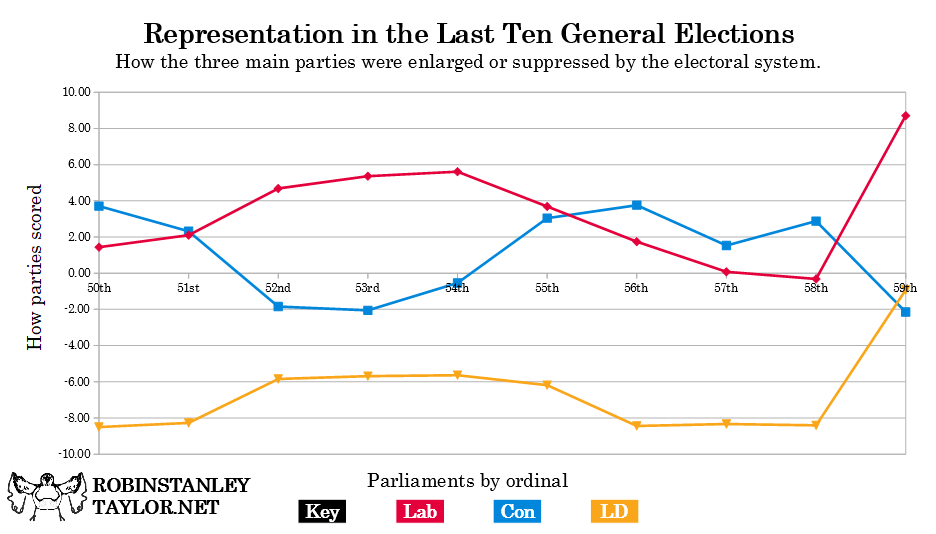
The results of this month’s general election have generated another series of discussions about proportionality, given the historically-low vote share on which Sir Keir Starmer’s party has ridden to victory. I have put together a graph showing how far the Conservative, Labour and Liberal Democratic parties have risen or fallen above or below the waterline at the last ten general elections.
The data themselves are scraped off Wikipedia. I have cheated a little by backdating the name “Liberal Democrat” to 1987, when it was still the alliance between the old Liberal Party and the Social Democrats under Davids Steel and Owen. The “divide” column is of course the seat share divided by vote share. The formula to produce the score is a little arbitrary – to make the final numbers a little nicer (and perhaps more memorable) I have subtracted 1 from each answer in the Divide column then multiplied the result by 10.
CONSERVATIVE
Election
Parliament
Vote Share
Seat Share
Divide
Score
1987
50th
42.2%
57.85%
1.37
3.71
1992
51st
41.9%
51.61%
1.23
2.32
1997
52nd
30.7%
25.04%
0.82
-1.84
2001
53rd
31.7%
25.19%
0.79
-2.05
2005
54th
32.4%
30.65%
0.95
-0.54
2010
55th
36.1%
47.08%
1.30
3.04
2015
56th
36.9%
50.77%
1.38
3.76
2017
57th
42.3%
48.77%
1.15
1.53
2019
58th
43.6%
56.15%
1.29
2.88
2024
59th
23.7%
18.62%
0.79
-2.15
LABOUR
Election
Parliament
Vote Share
Seat Share
Divide
Score
1987
50th
30.8%
35.23%
1.14
1.44
1992
51st
34.4%
41.63%
1.21
2.10
1997
52nd
43.2%
63.43%
1.47
4.68
2001
53rd
40.7%
62.52%
1.54
5.36
2005
54th
35.2%
54.95%
1.56
5.61
2010
55th
29.0%
39.69%
1.37
3.69
2015
56th
30.4%
35.69%
1.17
1.74
2017
57th
40.0%
40.31%
1.01
0.08
2019
58th
32.1%
31.08%
0.97
-0.32
2024
59th
33.8%
63.23%
1.87
8.71
LIBERAL DEMOCRAT
Election
Parliament
Vote Share
Seat Share
Divide
Score
1987
50th
22.6%
3.38%
0.15
-8.50
1992
51st
17.8%
3.07%
0.17
-8.27
1997
52nd
16.8%
6.98%
0.42
-5.85
2001
53rd
18.3%
7.89%
0.43
-5.69
2005
54th
22.0%
9.60%
0.44
-5.64
2010
55th
23.0%
8.77%
0.38
-6.19
2015
56th
7.9%
1.23%
0.16
-8.44
2017
57th
7.4%
1.23%
0.17
-8.34
2019
58th
11.6%
1.85%
0.16
-8.41
2024
59th
12.2%
11.08%
0.91
-0.92
COMBINED
Election
Parliament
Conservative
Labour
Liberal Democrat
1987
50th
3.71
1.44
-8.50
1992
51st
2.32
2.10
-8.27
1997
52nd
-1.84
4.68
-5.85
2001
53rd
-2.05
5.36
-5.69
2005
54th
-0.54
5.61
-5.64
2010
55th
3.04
3.69
-6.19
2015
56th
3.76
1.74
-8.44
2017
57th
1.53
0.08
-8.34
2019
58th
2.88
-0.32
-8.41
2024
59th
-2.15
8.71
-0.92
It is striking that the Labour and Liberal Democrat lines are almost parallel throughout, while the Conservative line neither follows nor mirrors them. The Conservatives fell below the waterline during the Blair years, then were inconsistently high above it from 2010 to 2019, falling below again in 2024. The Labour party were always above except for 2019 (albeit very slightly). The Liberal Democrats have always been below, albeit very nearly touching this year. 2024 is also the first time that they have been less disadvantaged than the Conservatives were. Labour’s score in 2024 is of course a record high.


 Some of the displays looked like they had been made many years ago and brought out unedited each time. There is a familiar style common to these kinds of displays by churches, village halls and primary schools in small settlements in rural Britain around the turn of the millennium. In particular I noticed a poster about the Crown Estate, which still referred to it paying for the civil list (as opposed to the sovereign grant).

 Robin Stanley Taylor


