Public Domain Day 2026

It’s that time of year again. Here’s a look at some of the stuff which has just gone out of copyright in the United Kingdom (and other countries with a copyright term of author’s life plus 70 years) are novelists Ruby M. Ayres, Beatrice Chase, Joseph Jefferson Farjeon, Constance Holme, Clemence Housman, Roger Mais and Thomas Mann (though in the latter’s case this only applies to his original writings in German, not to subsequent translations by other people); composers Alfredo Cuscinà, Isaak Dunayevsky, George Enescu, Arthur Honegger, Jaime Ovalle, James P. Johnson and Francesco Balilla Pratella; and scientists Albert Einstein and Sir Alexander Fleming; all of whom died in the year 1955.

As usual in recent years, the most intriguing load comes from works made in the United States in the year 1930, expiring under the term of publication plus 95 years. These include the first Betty Boop film Dizzy Dishes, the first Three Stooges film Soup to Nuts and the first major John Wayne film The Big Trail. There are also some works originating outside the United States in that year which now are public domain there but not here, such as Sir Alfred Hitchcock’s film Juno and the Paycock, which will remain under copyright in Britain and most of Europe until 2053. There is also a film adaptation of All Quiet on the Western Front, which was made in the United States but adapted from a book first published in Germany, whose author lived until 1970.

Conversely, there are some American works first published after 1930 by authors who died in 1955, which thus are public domain here but not in their home country. Most prominent of these is Dale Carnegie’s How to Win Friends and Influence People (1936).

There is a further category of works which were already public domain in their home countries but are now entering it in the United States, such Composition with Red, Blue and Yellow by Piet Mondrian of the Netherlands (d. 1944) and Animal Friendship by Paul Klee of Switzerland (d. 1940).

We still have one more year to wait for the expiry of A. A. Milne’s copyright, and ten years for that of Sir Winston Churchill!

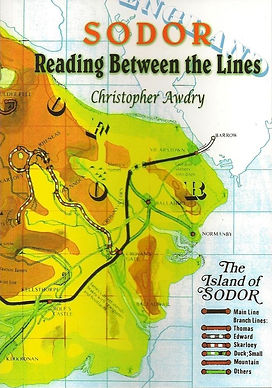
Review: Sodor — Reading Between the Lines by Christopher Awdry (2005)

As we reach the end of the Railway Series’s 80th anniversary year, I take a look at this companion book put out by Christopher Awdry in 2005 as part of the franchise’s Diamond Jubilee. That of course means the book itself has now had its own 20th anniversary, and indeed last month an updated edition went out in celebration of that occasion. I have yet to read it, though, so my review here is only concerned with the original version. “Between the Lines” can be considered the literary equivalent of “behind the scenes” for the book recounts in brief the origin of the franchise, answers some frequently-asked questions, goes through each of the stories and prominent characters clarifying their details in the RWS canon as well as their real-life inspirations. It also includes some commentary by the author about the Sudrian endeavour as a whole. This book represents the second attempt at such a publication; the first was in 1987 when Wilbert Awdry wrote The Island of Sodor — Its People, History and Railways. Christopher wrote this book because PH&R was becoming scarce and the publishers would not agree to another print run, as well as to take account of new material in the series itself since then.

The introduction recounts the well-told tale (by his own admission) of Christopher being confined to bed with measles in 1942 and his father making up railway stories to entertain him, then getting involved with his own model railway, then being encouraged to turn the stories into proper books, then publishers’ requests for multiple sequels until a substantial corpus had been produced. Once said corpus had established itself, questions about lore and continuity were inevitable, from Wilbert’s own children and from the paying audience. He therefore set about creating a detailed fictional world in which his stories could take place. He took the name Sodor from the Diocese of Sodor and Man, drawing the island itself as an expansion of the the isle of Walney. Over time he and his brother George undertook a project of serious research into history, geography, geology and etymology to flesh out an authentic and plausible setting for the stories. Comparisons to Tolkien and the “sub-creation” of Arda are obvious, though mercifully Awdry’s legendarium is much more manageable in volume and scope. The main difference, of course, is that rather than fading millennia into distant past, the history of Sodor continues into the present day.

The biographies of the major characters (both mammal and metal) are generally written from a diagetic perspective, though often leaning quite heavily on the fourth wall (“Percy defies certain identification, and it sometimes appears that he was put together by using any appropriate parts that came to hand…”) and other times walking through it (“[Sir Topham Hatt] is, in fact, based on no-one in particular.”).

Four important figures in Sodor’s railway operations are established as hereditary identities: The “Fat Controller” of the North Western Railway represents three generations of the Hatt baronets, the present of whom was born in 1941; ownership of the Skarloey Railway is by two Sir Handel Browns (also baronets) with a third in waiting; the “Thin Controller” of said railway is a post given to the Sam family and even then foreman “Mr Mugh” is really father Ivo and son David. A noted exception is Francis Duncan, the “Small Controller” of the Arlesdale Railway, who is said to be a lifelong bachelor planning to retire soon with no successor named.

The recap of all the stories notes where on the island they were meant to take place (sometimes highlighting improbabilities such as Toby being at Wellsworth goods yard in Dirty Objects) and the incidents on which they were based: Thomas Goes Fishing derives from a story about a Glasgow & South Western driver putting fish in his engine’s tank “to keep the water clean”; Percy’s Predicament from an accident at Swanley Junction in 1876; Smokescreen from a real wedding disaster on the Bluebell Railway.

Though most of the book is an earnest retelling of the facts (err… fictions) there are occasions where Christopher veers into satire and polemic: On the matter of electrification he says “since a change of locomotive would be necessary there anyway — or at least until the route from Carnforth to Barrow is electrified (“Fat chance!” do I hear you say?) — The Fat Controller has shelved the plan.”; on the disuse of the nickname “Fat Controller”, in Canada and the United States, “I cannot feel that down at grass roots the PC movement on this point, even over there, is really as strong as it must have been made out to be.”.

There are many points in the book where the author is surprisingly candid about his frustrations with both the book publishers and the television studios:

  • “despite their classic status many of these books have been out of print for up to 10 years, a scandalous situation… the publishers, as you will read here, decided to change direction. The author is greatly saddened…” (inside cover)
  • “we are thus forced to conclude that responsibility for the perceived lack of sales that I have been told about by the publisher must rest with their own sales methodology.” (p2)
  • “some bizarre TV stories… elaborate dockside cranage at a port which has nothing like the amount of business to warrant it… for one who had made such a point of authenticity… such flights of fancy left a bitter taste.” (p4)
  • “the publishers — Egmont Children’s Books — have claimed that falling sales make them commercially unviable. But if they aren’t there for people to buy in the first place no one can possibly know how viable they are, can they?” (p26)
  • “The fact that the feature film Thomas and the Magic Railroad used the Isle of Man for locations was based, I suspect, more on tax breaks than because of any historical significance” (p30)
  • [The name “Fat Controller” was dropped] “purely for “politically correct” reasons. In my view it is a great pity that Britt Allcroft was co-erced by the Americans into using the character’s proper name in order to sell her TV product over there.” (p31)
  • “though when HIT Entertainment took over the rights in 2002 it was suggested that a return to original authorship was their policy nothing has so far (as at February 2005) happened.” (p31)
  • “The story… gradually became watered down between fears of fright to readers from the publishers… until it became a shadow of its former self. A pity” (p65)
  • “a last-minute publisher’s unilateral decision altered it [the book title] — it wouldn’t have been so galling had they not owed me t the annual sales conference to talk about it beforehand.” (p68)

The whole of the epilogue “Thomas:  A Crown Worth Fighting For” is a heartfelt plea for the new rights holders not to let the books disappear from print or the quality of the TV series continue to decline.

As I said at the beginning of this review, I am reading the book with the benefit of two decades’ hindsight. This means that some of the open ends in the original have since been closed: On pages 32-3 Christopher considers that his own son Richard may one day take over the series, but says “I do not propose to hang a millstone that he may not want around his neck, and I certainly don’t take it for granted that he will carry on.”. It emerged earlier this year that Richard, now aged 45, has indeed taken over as “lore keeper” of the franchise and is giving lectures on the present state of the island, though whether he intends to write any more books is yet to be seen. On page 71 he hints that there are two new RWS books to come. He ultimately managed to get Thomas and Victoria published in 2007, followed by Thomas and his Friends in 2011. More concerning are the comments on page 72 about “the quality of the stories emanating from the Gullane company over the last few years”. He is presumably referring to seasons 5-7 (when Allcroft stopped adapting his stories) and 8 (when HIT imposed a new format). He had no idea of what was to come with the early CGI seasons, “Big World, Big Adventures!” and “All Engines Go”.

While Reading Between the Lines is not a particularly famous work among the general public, its audience, however niche, appreciates its existence greatly. Though there are some embarrassing proofreading errors (such as missing out The Twin Engines from the recap section, then giving the next book the wrong date) and inconsistencies with PH&R (such as calling the Small Controller Francis instead of Fergus), on the whole is is considered an authoritative, faithful and canonical testament to the wondrous world the Awdry clan created, and which continues to captivate so many of us to this day.

Finally, it is worth remembering that today marks one year since the death of Britt Allcroft. Despite the occasional controversial creative decisions she made (some of which are detailed above) she remains an invaluable figure in Sudrian history in her own right.

Footnotes

†Of course, that also then happened to RBtL itself, which is precisely why the new edition has had to be released. I was fortunate to be able to access digital copies of both books (although the scan of this one was quite crude) through the Internet Archive.

‡I was able to read this book, and PH&R, from my computer screen in a few days each and I’m fairly confident about . By contrast, I started reading my physical copies of The History of Middle-earth before this summer started. They felt like the sort of books best enjoyed by daylight when sitting in the orchard, which has become challenging in the winter months but I persevere. Even now I’m only at page 270 of Volume II and I still don’t entirely know my Eldalië from my Edain.

David Lammy and Bleak House

David Lammy, in his new role as Lord High Chancellor of Great Britain and Secretary of State for Justice, has recently announced plans to tackle a long-running backlog of cases in the English & Welsh judicial system by severely narrowing the circumstances in which juries are used for deciding the verdicts in criminal cases, transitioning trials for less serious offences to relying solely on the judge. These plans are highly controversial, with detractors expressing suspicion that he will undermine long-standing principles of English constitutionalism as well as scepticism that the move will actually save any time or money.

Lammy has attracted particular ridicule for a comment in an interview that was reported in The Times two days ago:

I remember studying Bleak House for my A-levels, and the Jarndyce and Jarndyce case that went on and on and on. We cannot go back to a Victorian system in which all new people who are the victims of crime don’t get justice.

The 1853-2 novel Bleak House is a satire of the English court system of the early nineteenth century and is credited with spurring on reforms later in that century, but to use the Jarndyce case (or any of the real one inspiring it) as a justification for Lammy’s proposals is nonsensical as this was a probate case in the Court of Chancery (later succeeded by the Chancery Division in the High Court of England & Wales) not a criminal case, and crucially it did not involve any juries!

Then again, the Lord Chancellor is not the only one to fail to understand that story: Over recent years (well, decades really) there have been growing concerns among the intellectual classes that their own numbers may functional literacy among the populations of developed countries is going into decline. One particular alarm bell was sounded last year in A Study of the Reading Comprehension Skills of English Majors at Two Midwestern Universities, entitled “They Don’t Read Very Well“, which used the first seven paragraphs of Bleak House as the yardstick. A worrying proportion of English majors (for whom reading literature should really be a specialist skill) struggled to understand it.

I listened to the LibriVox recording of Bleak House in 2022 and watched the BBC adaptation of it in 2024. I know from reading through Great Expectations that Dickens, being paid by the word, had a habit of using far too many when far fewer would do, but the idea that his works may be slipping out of human comprehension, even among those who have specifically chosen literature as a course of study, has implications which themselves are bleaker than the house could ever be.

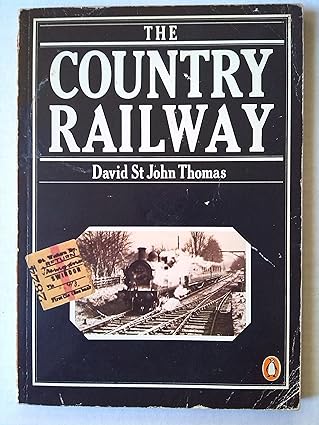
Review: The Country Railway by David St John Thomas

After a tumultuous voyage through Dead Europe I needed a rest on more familiar literary ground. The most obvious choice was another railway book. This one was printed in 1979 with an original price of £1.50. I picked it up from Dovehouse Hospice earlier this year for £1.00. The book is a few years older than The Penguin Guide to the Railways of Britain and rather different in scope: It is only really looking at the past rather than the present and it focuses, as the name implies, specifically on the rural lines rather than the urban ones. This book also doesn’t trouble itself to recap the evolution of locomotives and rolling stock from the beginning, assuming the reader already knows the broad strokes and only bringing up the details where directly necessary. Instead this book is mainly about the experience of daily life for the workers and passengers, as well as the financial aspects of operating the organisation.

The phrase “Country Railway” feels inherently nostalgic precisely because, following the Beeching Axe, there are not many of them around anymore (save heritage lines). A recurring theme of books like this is that the railways were vital to the survival of rural communities yet paradoxically those rural communities tended to be a dead loss to the railways. Closures of country lines would be bitterly mourned despite few people actually riding on them. There is an element of the rotten boroughs about some of the remote services where trains were run back and forth daily with full signalling operations and well-built stations even though the carriages would were at low capacity at the best of times and frequently had no passengers at all. The opening paragraphs of Chapter 8 (starting page 120) lay this out in most striking terms, and it is difficult to avoid simply quoting the entire page verbatim: Rural railways companies insisted on building and staffing their lines, stations and signal boxes to the same standards of quality — as well as safety — that would be expected on urban routes despite the far lower ticket revenue, in contrast to Continental Europe where country railways were far more cheaply constructed. As Thomas sums up:

“An army could have been carried in safety where only scores of people ever travelled. Because stations were so costly, they were often not provided at all where there might still have been useful traffic; and one could argue that in the motor age more lives would have been saved had the railways reduced safety standards — more people would have gone by train, which would still have been safer than buses and cars.”

It may feel a little odd to read someone explicitly argue for the moral virtue of cutting corners in public safety, but a robust case is made that the builders’ noble aspirations actually doomed their projects in the long run. Thomas notes another major obstacle in the need for the company to get a special Act of Parliament passed and/or secure the consent of all the landowners along the route, which an attempted streamlining of the process in 1864 failed to fix. The result was that construction costs per mile of track ended up being many times the original estimates and the railway companies frequently found themselves financially sunk before operations even started. These problems are entirely familiar in the present day. Indeed, I was struck when reading this section by how much the prose of a book on such a genteel topic, written nearly fifty years ago and describing events almost a hundred years before that, bore so much resemblance to that by Ezra Klein & Derek Thompson in Abundance, released earlier this year and addressing the same problems on a larger scale in the present — even including the building of railway lines!

On the flipside, the book also emphasises the death and destruction that results when strict safety protocols are not followed, the appendix retelling the tale of the Abermule Disaster of 1921, in which a quartet of negligent station staff got a pair of signalling tablets swapped around so that two trains collided head-on. The final sentence draws parallels with RMS Titanic:

“Time and again one or other of these mistakes had been made with impunity, but at Abermule on that disastrous day, like the scattered pieces of a jigsaw puzzle, these trifling faults fitted one into another until the sombre picture was complete.”

The book looks over the lifestyle of the rural stationmaster, isolated from the station’s local community, assailed from above as well as below and occupying a liminal, uncertain position within the British class system of the time. The ticket prices were no less convoluted then than now with a dizzying array of tariffs, rates, discounts, equivalences and exceptions. Thomas further looks at the advancement of new technologies and working practices in railway operations, particularly as regards the directions of trains — from turntables to passing loops to runarounds to push-pull to double-ended railcars. A recurrent problem for this sector was that, although the stationery infrastructure was kept to the same standard as the urban lines, the moving parts were not. Whereas the intercity main lines were upgraded to diesel and electric multiple units, the country branches were stuck with antiquated steam engines and their threadbare coaches. Even getting electric lighting on the platforms instead of gas was a struggle. Continuing with old-fashioned systems kept these lines more labour-intensive than they could otherwise have been, which only widened the gap in profitability compared to the main lines. Speed was also an issue for a lot of country lines, particularly in pre-war times, due to the low power of the locomotives and the mixing of passengers with goods on stopping trains.

In contrast to a lot of books of this type, which only look at Great Britain, this one also includes sections set in Ireland. Mostly these serve to tell us how the Irish rural railways were even more spendthrift, disorganised and ramshackle than the English, Scottish and Welsh ones. Attention is drawn to the larger gauges on this island (standard 5’6” and “narrow” typically 3′) which further increased expenditure. Timekeeping too was even worse and page 141 has an amusing anecdote relayed from Punch wherein a local dignitary was surprise to see his train actually leaving on time, only to be informed that it was the train from the previous day.

Despite the myriad problems in running the railways, Thomas is keen to point out that the local communities held great affection for them, staging elaborate celebrations when they were opened and even grander funerals at their closure. That books such as this (and indeed films, magazines and television series) about old railways and the engines that ran on them are so numerous and constitute such a well-established genre is testament to the high regard in which the British hold at least the idea of the railways, even if in practice relatively few get to make regular use of them.

The Queen’s Austen Faux Pas

The Queen’s Reading Room has just had its annual festival at Chatsworth House. In this video as shown on the ITN royal family YouTube channel, she makes a speech about Jane Austen (who turns 250 this year), a segment of which I will now quote:

We are provided with this magnificent backdrop that was her inspiration for Pemberley in Pride and Prejudice, and who can forget the infamous scene of Mr Darcy emerging from the lake in the BBC version?

There have been quite a few BBC adaptations, but of course she is referring to the 1995 version where Darcy is played by Colin Firth. I have not yet gotten around to reading the book or watching any of its adaptations, but immediately this line pinged something in my head. I was sure I’d read somewhere, many years ago, that this is an example of the Mandela Effect — that the infamous scene that none can forget was never actually in the episode!

Happily I didn’t need to go through the entire series on iPlayer because the Lake Scene is the subject of multiple YouTube videos, including at least two by the BBC itself.

Sure enough, we see him jumping in, then him swimming beneath the surface, then cut to Bennet in Pemberley’s garden, then to Darcy walking along the grassy hills still damp. The actual moment of his emergence from the water is not included.

Just three months ago there was a YouGov article describes this as a prime example of collective false memory: Their study showed 49% remembered the scene happening even though it didn’t. The televisual non-event is so famous that there was even a giant fibreglass statue of Firth erected in Hyde Park in 2013.

I wonder if anyone at Clarence House had to check Her Majesty’s speech in advance of the event. This is the sort of thing which should have been caught and corrected before it went public.

Review: The Queen and Mrs Thatcher by Dean Palmer

The Queen and Mrs ThatcherOf all the post-Churchill prime ministers who have governed the United Kingdom, there is one whose personality and policy stick out particularly strongly in the national – and indeed global – consciousness. Margaret Thatcher is the longest-serving British premier in living memory, and also the one whose tenure is often considered the most transformative. Even now, twelve years after her death, her legacy remains a potent force in determining the course of British politics both inside and outside her own party. As I mentioned in my article about memoirs, a lot of MPs define their status in relation to Thatcher in a way that doesn’t happen with Macmillan, Wilson or even Blair. Perhaps, then, it is only natural that her royal audiences, more than anyone else’s, should be a source of such fascination. Palmer isn’t the only one to single out this relationship – there’s also Moira Buffini’s comedy play Handbagged. Thatcher also marks a turning point in Elizabeth II’s reign (the halfway point of which occurred about the time of her third election victory): When the monarch came to the throne her ministers were often people nearly as old as her grandparents, by the end they were people born well within her reign and sometimes younger than her grandchildren. Thatcher was only four months older – had the Princess Elizabeth gone to school they would have been in the same academic year. On top of that, there was the obvious novelty of having the heads of state and government both be female, which still hadn’t happened again when this book came out.

The theme of the book is that despite the superficial similarity in sex and age, the two protagonists (or should that be antagonists) were fundamentally poles apart in class and philosophy – Elizabeth representing the genteel, leisurely aristocracy and Margaret the ambitious middle-class strivers. The chapters on their childhoods are where this difference is laid out most starkly (and also where Palmer’s sympathies are most obvious): Alfred & Beatrice Roberts had high aspirations for their offspring, which little Maggie displayed superhuman intelligence and stamina in pursuing, even to the extent of hiring a private tutor to teach her Latin because her grammar school didn’t offer it but Oxford required it. Palmer says that in a few months she picked up what normally takes five years. Lilibet, by contrast, barely got any formal education as her mother Elizabeth Bowes-Lyon did not value it at all. Mary of Teck intervened to rectify her granddaughters’ shortcomings but even she agreed that it would be undesirable to have them be particularly studious1. That said, it was assured that the princess took seriously her status as heiress presumptive, and that this sometimes gave her an “imperious” attitude, even to the point of criticising a priest’s sermon or a guard unit’s attire (ironically that part is like Thatcher later on). The longstanding political trope of “authenticity” comes up here: Thatcher, having worked her way from middle to upper class, had taken elocution lessons and adopted other affectations which often caused sniggering from both above and below. The Queen, having been born and raised at the top, naturally avoided this. That Thatcher did not share Her Majesty’s (or really any) sense of humour was another cause of friction. It would be wrong, however, to say that such friction is inherent due to the differences in social class, or even to political differences – among the grammar school generation of prime ministers Elizabeth II got along well with Wilson, Callaghan, Major and Brown but not so well with Heath.2

I shall attempt now to go through, in no particular order, the key reasons which Palmer identifies for the disagreement between the two leading ladies. The first is the subversion of the traditional relationship between crown and government: The British constitution employs a separation of the Dignified and Efficient parts of the state so that patriotic adulation can safely be directed at a figurehead who does not exercise real executive power, while the person who does exercise it is kept in a position of symbolic subservience. Furthermore, the Prime Minister is supposed to be first-among-equals, with all the other ministers around the cabinet table deciding on policy collectively. Thatcher’s domineering personality and immaculate sense of style often got her called “Presidential”. She would insist on immediately visiting the scene after a disaster to meet survivors (whereas the royals would wait a day or two in case their presence obstructed rescue and clean-up operations), and taking military salutes in preference to the monarch – something even Churchill couldn’t have done. It was seen that she was usurping her queen’s role as the symbolic personification of the nation. She also had a tendency to ride roughshod over her political colleagues, gradually purging all but the staunchest loyalists from the front bench, then later neglecting even these in favour of a small cabal of special advisers. This, Palmer notes, is what ultimately brought about her political downfall in 1990.

The second point of contention was Thatcher’s political philosophy: Although she was the Leader of the Conservative Party, many commentaries and histories of her tenure remark that it was really the Labour Party at this time which was “small-c conservative” in so far as it sought to maintain the prevailing status quo in Britain’s economic order. Thatcher thought that the policies of the last dozen governments had led Britain into terminal stagnation and that radical reforms were needed to find prosperity again – the welfare state, the nationalised industries and the trade unions were all dead weights which throttled growth, therefore they had to be destroyed. There was to be a ruthless drive for efficiency and productivity above all else. This did not sit well with the sedate and sentimentalist approach to life favoured by the royal household and the rest of the aristocracy. Despite the outward deference of Thatcher herself, the Firm could well have feared for their own survival against the forces she sought to unleash. The traditionalist wing of the Conservative Party, many of whose members were also from aristocratic backgrounds and who supported a paternalistic approach, likewise balked at much of this. A division erupted between One-Nation/Wet and Thatcherite/Dry parliamentarians which continues to this day.

The third division was over the pair’s approach to division itself: Thatcher realised that in order to be an effective political leader she often had to make decisions which would be unpopular even if they were necessary (and ultimately beneficial). A government can survive on the support of a surprisingly-low proportion of the population (given turnout and constituency distribution) and even that need technically only be mustered once every four or five years when a general election comes around. Party leaders need to make strategic calculations about which demographics matter and which don’t, as well as what they can accomplish in the limited time available to them. Thatcher to this day is legendarily divisive, making enemies of large swathes of the country, but not really caring as long as she beat them. The Queen, by contrast, needed to be monarch for everyone, everywhere, forever, no matter their creed or their breed. The position of the crown was more comfortable in the age of consensus than when the people were polarised. This distinction is especially stark in international affairs because Thatcher was only head of government in one country whereas Elizabeth was head of the enormous Commonwealth of Nations, many of which were demographically and economically very different to the United Kingdom. At times of crisis, such as over Rhodesia and South Africa, Thatcher often found herself at odds with the majority of her overseas counterparts, leaving Her Majesty in a difficult position scrambling to hold the organisation together. The Queen greatly valued her extended Commonwealth family, whereas Thatcher saw many of them (particularly the African countries) as ungrateful leeches. This rift also continues in the Conservative Party to this day.

Finally, many pages are devoted to Thatcher’s dealings with the news empire of Rupert Murdoch. He achieved his dominance of the British press during Thatcher’s premiership thanks in no small part to her continued and determined support. Murdoch’s many papers and other outlets would ensure the widespread distribution of the Thatcherite perspective. Murdoch shared Thatcher’s hatred of trade unions and strikers. He also had a loathing of Buckingham Palace, and his reporters would go to great lengths to dig up (or indeed create) dirt on the Windsors, intruding on their private lives where the British press theretofore had restrained themselves from treading. Thatcher may not have actively approved of such practices, but she tacitly tolerated them in exchange for Murdoch’s support to her government. To this day, many on the left and right (though mostly left) identify “The Murdoch Press” as the root of a great deal of Britain’s political and social instability – his antics in the 1980s encouraged an overall lowering of the tone which has yet to rise back up.

I picked up my copy of Palmer’s book from a throw-out sale at Hull Central Library on the 1st of this month at a price of 50p. I noticed there was a more recent edition of the same title still on the shelves for lending. In mine, I spotted an alarming number of proofreading errors, some of which I will now list for your amusement:

  • Page 43: “Alfred Roberts sought to make something of himself beyond the realm of his little business by taking an active role in both his local Methodist church and by serving on the local council.” – The word “both” should immediately follow “business”.
  • Page 61: “Mothers throughout the country were astonished that a women would take free milk from children.” – That should be “a woman” not “a women”.
  • Page 93: “Not since Elizabeth I and Mary, Queen of Scots had two “queen regnants” lived in the British Isles.” – That should be “queens regnant” not “queen regnants”.
  • Page 138: “Prurient interest in the royal family’s private lives were off-limits.” – That should be either “interests” or “was off-limits”.
  • Page 165: “Scargill was a socialist hero after helping to bring down the Tory Government in 1984.” – I would assume that meant to say 1974.
  • Page 166: “It cost £44 to mine a metric ton of British coal, while the rest of the world were selling it for £32 per ton.” – That should probably be “was selling” and metric tons are more commonly called tonnes.
  • Page 192: “At Buckingham Palace, Her Majesty waited for the third time to invited Mrs Thatcher to form her government.” – That should be “to invite” not “to invited”.
  • Page 221: “embarrassment” is used twice in the same paragraph.
  • Page 271: “King William and Queen Katherine would certainly sparkle” – That should be “Catherine” not “Katherine”.

Also, throughout the book Palmer refers to “the queen” rather than “The Queen” or “the Queen” which are more usual in most style guides.

I was intrigued too by the reference on page 153 to “the first Elizabethan period”, obviously identifying 1952-2022 as the second such era. This usage has not really caught on widely in academia or among the general public. I wonder whether “New Carolean” will do so.

On that note, the political attitudes of the then-Prince of Wales are also covered. He is described as being more “Wet” than his mother, and even as being sympathetic to the Social Democratic Party under David Owen. There is mention on page 195 of a meeting between prince and premier about increasing the former’s constitutional role. Thatcher turned down planning for any regency arrangements. She said he could open parliamentary sessions in his mother’s absence if need be, but only as a Lord Commissioner on the woolsack instead of from the throne (ironically the former was made impossible in 1999 and the latter wound up happening of Elizabeth II’s own volition in 2022). The most surprising thing mentioned was the stance of Queen Elizabeth the Queen Mother – apparently (page 207) she was an ultra-Thatcherite and fully supported the prime minister’s ideology, which is a little at odds with what was said about her attitude to raising her daughters as aforementioned or what the book also said about her dealings with Charles.

A few days ago I mentioned three new royal biographies coming out. While I have yet to read any of them in full (and may never do so) I read some of the previews on Google Books. Excepting where the later books describe events too recent for the earlier ones to cover, I expected that there would be a fair bit of overlap. Sure enough I noticed a lot of the same quotations and anecdotes appearing. This book has a very lengthy endnotes section which links back repeatedly to a large number of earlier royal and political biographies. Since most members of the family rarely (and the monarchs themselves never) give tell-all interviews (and those who do are often unreliable in what they say), nearly all of the publications on this subject will be pieced together from the same handful of sources, stories and speculations, with the original part being the author’s decision on which way to arrange them, what narrative arc to infer from them, and what commentary to add. Palmer does an adequate job of that, I suppose, but I can’t see this ever being considered one of the greats.


FOOTNOTES

1The term for this was “bluestocking”, which is also the name of Helen Lewis’s blog.

2The book came out too early to learn what she thought of May, let alone Truss.

Accession Day 2025

Today marks three years since the passing of Elizabeth II and thus the commencement of the fourth year of the New Carolean era. Here is a quick round-up of recent developments.

New Royal Biographies

The stream of these is continuous and too large to notice all of them, but three in particular have generated news coverage:

  • Entitled: The Rise and Fall of the House of York by Andrew Lownie (14th August, HarperCollins). The title alludes to the Wars of the Roses, but really it’s about the personal, professional and financial lives of the most recent Duke & Duchess. The book is overwhelmingly derogatory and might have been considered scandalous had not most of the topics therein been raised already some years ago (while the other claims are usually less-than-credible). Many reviewers and columnists have said words to the effect that it would be devastating to its targets’ reputations if only they had reputations left to devastate. The people who didn’t already believe the things Downie asserts here probably won’t read this book anyway so despite a few sensational headlines I doubt in the long run it will really change anyone’s position.
  • Power and the Palace: The Inside Story of the Monarchy and 10 Downing Street by Valentine Low (11th September, Headline). Low has already written Courtiers in 2022, which I have in my collection but have not gotten around to reading yet. I’m not sure I’ll ever read this one either since, as is often the case with this kind of book, the newspapers have already spent weeks running headlines explaining all the important bits. The book is about the relationship between senior members of the royal family and senior members of successive governments. The most outlandish part is the attempt to lift the lid on Schrödinger’s box regarding Elizabeth II’s political beliefs, long a source of speculation to all and sundry. Low, quite remarkably, claims that Her Late Majesty was much more candid than formerly thought and that everyone else around her was more studiously discreet. The most prominent assertion (in terms of news coverage) concerns her views on the 2016 EU referendum. Private Eye has this amusing summary:
GALLAGHER’S GALL
ORDERED by press watchdog Ipso to print a correction to his pre-referendum front-page headline “QUEEN BACKS BREXIT”, which was found to breach its accuracy rules since there was nothing in the story to show it was true, then-Sun editor Tony Gallagher was defiant.I don’t accept that we made an error at all,” he huffed to the BBC. “We made a judgement that the headline was right and that it was backed up by the story. We knew more than we put into the public domain. The sources were so impeccable that we had no choice but to run the story in the way that we did.”
Nine years on, Gallacher has been promoted to edit almost-as-respectable sister sheet the Times, which is serialising Power and the Palace, the new book by the paper’s retired royal-watcher Valentine Low. And what headline appeared on Saturday’s front page flagging the first revelations from the impeccably sourced tome? “The Queen was a Remainer.” (Eye 1657 page 7)
  • Charles III: New King. New Court. The Inside Story by Robert Hardman (Pan Macmillan). It actually made most of its headlines last year but apparently he has a new edition coming out soon. I’m not sure if this is the second edition or if there’s already been one in the interim that I’ve missed, as I found a version on Google Books which claims to have been published on 7th November 2024 yet includes photographs of events from 2025. It has three extra chapters compared to the one I borrowed from Hull Central Library, and these cover the two royal cancer crises as well as the D-Day Commemorations and the general election. This latest version is obviously too early to include Trump’s state visit or the Duchess of Kent’s funeral, so probably yet another version will be needed next year. Pan Macmillan ought to have a trade-in scheme so people who already bought the old edition can get discounts off the new one. In an interview with journalist Patricia Treble he said Charles is “just the King” now as opposed to “the new king” so perhaps the very name of the book is now redundant and it would be better in the long run to wait until he has enough extra material for a full-length sequel instead of endless retroactive add-ons.

The Tudor Crown

Yes, that old chestnut again. I note that HM Goverment is still not entirely consistent here: When Rushanara Ali resigned last month the Prime Minister’s typed response had the new Noad illustration on its letterhead but when Angela Rayner resigned last week Starmer’s handwritten reply was topped by the old image, as was the letter from the Standards Adviser. Recently Charles wrote a letter to King Mswati III of Eswatini (formerly Swaziland) congratulating his country on fifty-seven years of independence. That letter was Tweeted by the British High Commission in Mbabane, showing the new emblazonment. It uses the “lesser” version of the arms in blue instead of the greater version in red, so it perhaps it should be understood as an FCDO letterhead instead of a royal one.

State Visits

Britain has already received a state visit from France this year and is about to host one for America also. As far as outbound visits go, there doesn’t seem to be anything scheduled for the rest of this year. In 2026 Their Majesties are expected to travel to Canada again (for an extended royal tour), to the United States (for a British state visit) and to Antigua & Barbuda (for CHOGM). There is still no announcement as to when they will visit New Zealand, which must be frustrating to those who’ve been waiting well over a year now!

Review: Discovering Watermills by John Vince

At eighty pence and eighty pages, this is among the lightest book purchases I have made in the past few years. I picked it up from the Dovehouse Hospice shop in Hedon two weeks ago. An inscription on the title page indicates it was previously owned by a J. Richardson. Little explanation is required for the topic of the book. Vince recounts, in a very compact format, the emergence of the practice of grinding grains for food, from the prehistoric world to the ancient, then medieval, then modern, from hand tools to human-powered wheels to the titular watermills and the various substances — including copper, paper, snuff and lead, which were extracted or refined with their aid. There follows a similarly-compressed explanation of the materials and construction techniques — the different ways in which the pins, braces and clasps can be arranged, as well as the financial considerations involved in switching from wood to cast iron (or some hybrid arrangement) in the eighteenth century. After that came an explanation of how the mill apparatus actually works; not just the internal interaction of all the cogs and pulleys, but also the way the external landscape has to be manipulated to direct the water to the mill. The main piece of information that I picked up from here is the distinction between an undershot wheel where the water pushes along the bottom and an overshot wheel where it pushes along the top. There were also two warnings, perhaps slightly contradictory, about mills left unattended: A waterwheel left locked into a stationary state can suffer rotting in its lower half which results in the whole construction disintegrating over time, yet a wheel left unlocked is liable to spin too quickly under heavy wind or rain so that the dry components inside fly apart or even catch fire. This part of the book was accompanied by mechanical diagrams as well as a brief table of statistics about the machines’ power, speed and output.

All that I have just described was concluded on page 20. The rest of the book, apart from the index and a few pages of photographs (on glossier paper but still monochrome), was a list of “some notable watermills” (with “some” here meaning many dozens) in the United Kingdom. Each had a short paragraph about its history, construction, operation, current ownership and opening times. Since this edition was published in 1987 I don’t imagine much of what was written in that chapter is still true. I would be minded nowadays to look these places up on the internet before dialling any of the telephone numbers Vince has given. What struck me most about this section is that, among all the counties of England, Scotland, Wales and Northern Ireland (and even the Isle of Man) that were documented there was no mention of East Yorkshire, whether under that name or as “Humberside”. If there aren’t any, surely that itself is worthy of mention? I can only infer that none of our mills met Vince’s standard of notability!

Review: Captain James Cook by Richard Hough

The paperback edition of this book was first published in 1995 and sold for £6.99. I picked up my copy in 2024 for £1. It follows the conventional format for a biography, beginning with the circumstances of the subject’s birth and running all the way to the aftermath of his death. That Cook has a tragic death relatively young is probably to Hough’s advantage as it prevents the book becoming overlong.

Cook is among Britain’s most celebrated sailors and explorers. This biography covers the whole of his maritime career, particularly his three Pacific voyages. Cook makes multiple visits to New Zealand, Tahiti, Hawaii and the Society Islands. He gets close to both the North and South Poles. A lot of the book is dedicated to Cook’s interactions with the Maoris and the many Polynesian tribes. There is a recurrent schizophrenia in the stories of these encounters – one minute the islanders will be treating Cook and his crew like gods, the next they will be plundering his vessels for anything not nailed down (and often even stealing the nails themselves). This reaches its apotheosis at Kealakekua Bay in 1779: On his first visit in January Cook is hailed as Orono, God of the Season of Abundance, and is showered with lavish praise, but when he returns in February the mood is of cold hostility and it is not long before a war breaks out which leads to his own gruesome death. Cook’s own personality charts a more linear decline from a civil, optimistic attitude on his original voyage to a cruel, irrational and vindictive one by the end. Partly this is the result of the great many infuriating setbacks suffered on that trip but there is also an analysis by a twentieth-century surgeon reckoning that Cook picked up an intestinal infection which impaired his brain function.

This book highlights how much of the world prior to Cook was still uncharted: As well as looking for new navigational passages (such as around the Arctic), Cook is also sent on a mission to prove or disprove the existence of Terra Australis Incognita, a much-fabled supercontinent in the Southern hemisphere that would have linked Australia together with Antarctica. There are also references to other scientific advances at the time, such as Cook’s own dietary and sanitary innovations to combat scurvy or the excursion to Tahiti to observe the transit of Venus.

The accounts of events aboard His Majesty’s Ships Adventure, Discovery and Resolution are pieced together from those diaries and letters that survived to be archived. These include Cook’s own logs, but also those of his contemporaries Joseph Banks, William Bligh, Charles Clerke, John Gore and a host of others. As is usual with these kinds of works, we get first-hand accounts of the action and occasionally the dialogue, but the thoughts and feelings of these men can only be speculation, save the rare occasions when they speak them outright. At this period real-time communication was impossible over long distances and letters could travel no faster than the mariners themselves, so the Admiralty back in Britain would not have any meaningful understanding of what happened on these voyages until the ships completed their return journey (if they ever did at all) and gave accounts retrospectively. This also meant that sailors would be cut off from events at home for months or even years at a time. In the final chapter Hough says that James & Elizabeth Cook, having married in 1762, only spent an aggregate of four years together before his death in 1779. Most of his children rarely if ever got to see their father either. After Cook’s death, Clerke became Captain and he penned the letter back to London explaining as much. It did not arrive until 1780, by which point Clerke himself had died too and it was Gore who held command by the time the survivors got home.

I bought this book principally for my father and we read it together in short bursts over the course of a year. I would recommend it to anyone with an interest in sailing, but the story is probably easier to follow and remember when taken at a faster pace.

Review: The Victoria Letters by Helen Rappaport

After spending nearly two months struggling through Dan Franck’s The Bohemians, I needed something of an intellectual palette cleanser, preferably back in a subject area where I already had some prior grounding. I settled on this large hardback picture book that was released as a companion to the 2016 ITV series.

As the title implies, this is composed mainly of the private letters and journals that Victoria herself wrote from her early childhood until around the time she first gave birth (which is when the first season of the TV show ends). Victoria is unusual among British monarchs in the fact that so many of her personal written thoughts have been maintained and made public – some even during her own lifetime.

The book runs to three hundred pages, but the text density is rather low so I got through the entire book in just four days. The final twenty-eight pages are about the making of the TV series, with everything up to that point being about the real life of Victoria with the fictional series rarely acknowledged.

The book overall is both visually lavish and textually engaging, though I found a few errors along the way:

  • The photograph of a palace interior on pages 44-5 exposes part of the metal ceiling of the hangar in which the set was built.
  • The photographs on pages 144 and 228 show overhead power lines in the background.
  • Page 131 describes Victoria’s uncle Ernest Augustus as “heir apparent” instead of “heir presumptive”.
  • Page 294 says of Prince Albert that “as Victoria’s husband he automatically became a member of the Order of the Garter” which was not true; he was appointed to the order almost two months before the wedding.
  • Page 294 also includes a quote from costume designer Rosalind Ebbutt claiming “The garter traditionally went round the knee, but Queen Victoria was the first woman to be elevated to the Order of the Garter and she couldn’t wear it on her leg because it wouldn’t be visible. So she had a special one made that buckled around her arm, over her sleeve.” which is a bit misleading: Victoria was never “elevated to” the order, rather she became its sovereign automatically when acceding to the throne. The custom of wearing the garter on the arm instead of the leg was also exhibited by Anne, Britain’s previous queen regnant*. There were, of course, Ladies of the Garter before her.
  • The cast list on page 300 includes Nicholas Agnew as Prince George twice.

A further note is really more a problem with the series itself than the tie-in book: Victoria & Albert’s wedding is noted to have taken place in the Chapel Royal at St James’s Palace, but the set shown in the episode looks nothing like that and bears far more resemblance to St George’s Chapel at Windsor Castle instead.

Heraldic banners show up in multiple photographs in the book, I have already written an article about one particular instance, but perhaps an armorial viewing of the series in general is in order at some point. I notice also that when personal letters are reproduced they are topped by an illustration of the royal arms which came into use during Victoria’s reign, indicated by the lack of the Hanoverian inescutcheon, even when the letter is meant to predate her accession. Of course, little Drina was never actually granted differenced arms prior to that so I don’t know what image would have been appropriate here!

It is a shame that no similar books were written for seasons 2 and 3, and indeed that the TV series as a whole seems to have been quietly dropped after 2019, for I would have enjoyed seeing the whole of the Victorian age covered this way.

*See “The Orders of Knighthood and the Formation of the British Honours System, 1660-1760” by Antti Matikkala, pp 324-6.