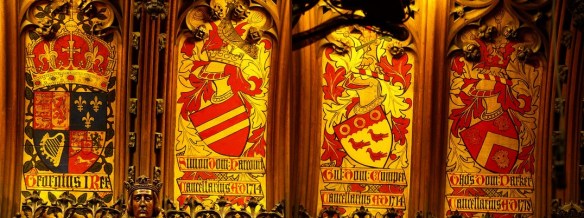
The Use of Academic Dress in Heraldry

This was a virtual lecture put on by The Heraldry Society. It was presented by Duncan Sutherland, with an introduction by David Phillips, the latter being actually present this time. Sutherland said that he was connecting from Albania. When he started researching heraldry he came across academic dress a few times and managed to record about twenty examples.

Academic gowns in corporate arms usually reference the founder of the organisation. Academic robes date to the middle ages when most if not all students were there to train for the holy orders. The medieval university tunic was the forerunner of both the academic robe and the clerical cassock. Hoods were included because at the time they were common across all classes. When they fell out of general usage they were supplanted with skullcaps, which then evolved into a wide variety of specialised hats.

British academic styles reflected the influences of the Reformation, Republican and Restoration periods.

Sutherland then went through his examples, both personal and corporate. I have looked up free-licence images and the textual blazons wherever I can.

The Earls of Aberdeen

Dexter an Earl  and sinister a Doctor of Laws both habited in their robes Proper.

The earliest known grant of supporters to include academic robes was to the 1st Earl in 1683, with both dressed as doctors. The 4th Earl swapped them for the Hamilton antelopes. The 7th Earl was granted the present supporters. He was later elevated to Marquess but the dexter supporter was not changed to match.

William Thompson, 1st Baron Kelvin (g.1892)

On the dexter side a student of the University of Glasgow habited holding in his dexter hand a marine voltmeter all Proper. On the sinister side a sailor habited holding in the dexter hand a coil the rope passing through the sinister, and suspended therefrom a sinker of a sounding machine also all Proper.

Kelvin was the first British scientist to be elevated to the House of Lords. He served as Professor of Natural Philosophy at Glasgow for fifty-three years and was an important contributor to the Transatlantic Telegraph Project. His supporters were granted by the College of Arms in 1892 but the arms themselves had been granted by the Lyon Court.

Leonard Courtney, 1st Baron Courtney of Penwith (g.1906)

On either side a doctor of civil law of the University of Cambridge, vested in his robes, the dexter holding in his right hand an open book, the sinister in the right hand a pen, in the left hand a scroll all Proper.

Courtney was Second Wrangler at St John’s College, Cambridge.

Alfred Mond, 1st Baron Melchett (g.1928)

Dexter a Doctor of Science of the University of Oxford holding in the exterior hand a chemical measure glass sinister a labourer holding in the exterior hand a pick resting on the shoulder all Proper.

Melchett’s arms were granted in 1910 and revised in 1928. He studied at St John’s College, Cambridge and later was Chairman of Imperial Chemical Industries.

Sir Alfred Keogh

Keogh was Director-General of the Army Medical Services. His supporters were a Voluntary Aid Detachment nurse and a doctor in gown.

John Maynard Keynes, 1st Baron Keynes (g.1944)

Keynes was a scholar at both Eton College and King’s College, Cambridge. (CA Ms Grants 107/253)

Archibald Wavell, 1st Earl Wavell (g.1944)

Dexter a soldier of the Black Watch in field service uniform supporting with his exterior hand a rifle sinister a Scholar of Winchester College in his gown holding in his exterior hand a closed book all Proper.

Wavell was himself a scholar of Winchester College. He had his first army commission in the Black Watch in 1901. He was Colonel of the Regiment from 1946 to 1950.

He had protracted correspondence with Garter over the correct illustration of the academic dress. They are displayed at Winchester Cathedral.

Alfred Webb-Johnson, 1st Baron Webb-Johnson (g.1948)

I cannot find a blazon for them, but Sutherland said they were displayed in the King’s Chapel of the Savoy as well as the Fitzrovia Chapel.

Jack Simon, Baron Simon of Glaisdale (g.1977)

Dexter a man habited in the robes of a Doctor of Civil Law in the University of Cambridge Proper and holding in his dexter hand a book Or sinister a man habited in the robes of the President of the Probate Divorce and Admiralty Division of the High Court Proper. (Debrett’s 2003, P1476)

Simon was President of the Probate, Divorce and Admiralty Division from 1962 to 1971. He studied at Trinity Hall, Cambridge, before his call to the bar.

Stewart Sutherland, Baron Sutherland of Houndwood (g.2004)

Dexter a male figure in the attire of the Vice-Chancellor of Edinburgh University sinister a male figure in the attire of an honorary graduate of Aberdeen University and wearing the hat appropriate to an honorary doctor of the University of Uppsala.

Sutherland was himself Vice-Chancellor of the University of Edinburgh. He also had a Master of Arts degree from Aberdeen and an honorary doctorate from Uppsala, both in theology.

Jocelyne Roy-Vienneau (g.2015)

In this case the academic references are in the crest rather than the supporters.

Two blue jays each holding in its beak a sprig of balsam fir and standing on a bed of daylilies and purple violets Proper.

The Public Register explains the symbolism: The mortar and diploma symbolize Ms. Roy Vienneau’s career in post-secondary education, particularly as assistant deputy minister with New Brunswick’s Department of Education and as dean, department head, professor, manager and director general of the community college in Bathurst. They also symbolize her husband’s career as a teacher in public schools.

Worshipful Company of Framwork Knitters (g. 1933)

On the dexter side a student of the University of Cambridge in academical costume of the seventeenth century Proper and on the sinister side a female figure also in seventeenth century costume habited Azure cuffs cap neckerchief and apron Argent holding in the dexter hand a knitting needle Proper and in the sinister hand a piece of worsted knit Gules.

Worshipful Company of Scientific Instrument Makers (g.1956)

On the dexter side a figure representing Michael Faraday habited in a festal gown of a Doctor of Civil Law of the University of Oxford and holding in the exterior hand a representation of his coil Proper and on the sinister side a figure representing Sir Isaac Newton habited in a gown of a Master of Arts of the University of Cambridge and holding in the exterior hand his telescope also Proper.

Royal College of Anaesthetists (g.1991)

The supporters are representations of John Snow and Joseph Thomas Clover.

Royal College of Paediatrics and Child Health (g.1999)

Blazon missing.

University of Ballarat (g.1997)

I can’t find the blazon for this one.

New College, University of Edinburgh (g.2021)

Two human figures representing diversity one dressed in the academic gown and hood of a Master of Divinity and one dressed in the academic gown and hood of a Master of Arts (Religious Studies) both from the University of Edinburgh all Proper.

Liverpool John Mores University (g.1989)

Dexter a peregrine falcon and sinister a raven each statant on a doctoral hat upon a compartment comprising a grassy mount all Proper.

Worshipful Company of Educators (g.2014)

On the dexter a dragon wings elevated and addorsed Argent holding in the dexter foreclaws an abacus Azure the beads Gules and on the sinister a barn owl wings elevated and addorsed proper the wings charged with an escallop Azure charged with two swords in saltire proper hilts and pommels Or and holding in the beak by the tail a mouse Sable each statant upon a book Or bound Gules.

University College of Cape Breton (g.1995)

Here again the reference is in the crest.

Rising from a wreath of mayflowers Proper a Canterbury cap Gules.

Arms and the Woman

The heraldic achievements of the Baronesses Hornsby-Smith (left) and Miller of Hendon (right)

This evening I returned to the Yorkshire Heraldry Society for a virtual lecture by Duncan Sutherland, detailing the arms which were sought and borne by Britain’s female parliamentarians since 1958. This is far from the first time that he has made this presentation – in 2019 he performed it in person at the Palace of Westminster. Today, however, was my first time to witness it, thanks to the virtual format.

The majority of these cases were baronesses for life, but there were some others, including the posthumous grant of arms that was made to the late Jo Cox for display in the chamber of the Commons.

In other news, yesterday Ruth Davidson finally took her seat in the Lords, with the title Baroness Davidson of Lundin Links, of Lundin Links in the County of Fife. Also yesterday I made a disappointing excursion to Hull Central Library: some months ago I found in their online catalogue a copy of Debrett’s Peerage 2015 – a much more recent edition than the ones in the university’s library – but of course as the libraries were still under semi-lockdown conditions I could not actually go there to access it. Once the restrictions were lifted I went there hoping to scoop up hundreds of new(er) blazons only to discover that, while the ground floor of the library was open again, the reference section on the first floor was closed for a refurbishment and the staff had no idea when it would open again. Blast!

UPDATE (September 2021)

The Heraldry Society has updated the publication section of its website. Sutherland’s presentation can be read as a PDF.

More Armorials

Photographs by Baz Manning, 2014

A month ago I mentioned that I was creating a Wikipedia armorial page for schools in the United Kingdom. Since then I have moved the page from Draft to Mainspace. Whether it can be called successful is not yet clear – nobody has attempted to delete it, but few have come to contribute to it either. Having run out of obvious categories of corporate arms, I went back to a personal one. Having already created a page for Speakers of the House of Commons, earlier this year I drafted one for their old counterparts, the Lord Chancellors. These were generally easier to source than those of the speakers of the lower house, for the chancellors acceded to the peerage – and thus the pages of Burke or Debrett – at the beginning of their tenures rather than the end. The Constitutional Reform Act 2005 complicates matters somewhat, as the office has since been given to a disturbingly rapid succession of MPs, none of whom are yet armigerous as far as I know. The new, separate office of Lord Speaker has only had three incumbents so far and I have no information on any of their heraldic bearings or lack thereof.

That page having apparently worked, yesterday I embarked on yet another armorial, this time for the Chancellors of the Exchequer. Already I have filled in most of the entries for those who have held the office since the dawn of the eighteenth century, helped in part because the list significantly overlaps with that of the prime ministers. Now I am unsure of how to tread further, for the office is not as simple as it appears. The Chancellor of the Exchequer of the United Kingdom is a merger (confusingly not done until sixteen years after the kingdoms themselves were merged) of the Chancellor of the Exchequer of Ireland with the Chancellor of the Exchequer of Great Britain. The latter was itself a merger of the Chancellor of the Exchequer of England with the Treasurer-depute of Scotland. The Lord Chancellorship similarly has existed in various forms in multiple polities. I am not sure that it would be possible to make armorial pages for all of them, for some of the lists stretch back to the high medieval era and there are many uncertain entries. If even their names are not remembered then it is not likely that their blazons would be.

On a slightly different note, most major media sources have determined beyond reasonable doubt (though reason has been tested in the last few years) that Joe Biden is the President-elect of the United States. Parliamentary democracies tend to have a full-time shadow cabinet whose members are ready to form the real cabinet at moment’s notice should their party win power. In the states there is a lengthy period between election and inauguration during which the outgoing and incoming presidents negotiate the transfer of power and decisions can be made in advance about the composition of the new administration. In at least the last three instances the transition team has been construed as a formal office with its own website and its own insignia. Obama’s team used a wide rectangle with the national coat of arms adjacent to the name in a stylised typeface, notable in that it shows the heraldic achievement separated from the context of the round seal, and rather resembles the departmental branding seen in Roadkill. Trump used an oval with a depiction of the White House in the centre and his own title around the border. Biden’s team is currently using a minimalist version of the presidential seal with the number 46 at the base. Though its cause was ultimately jossed, in 2012 a Romney transition was planned, its logo being a conjoined circle and oval, the former showing what I assume to be an eagle volant, though the resolution is too poor to make out. I have yet to find one for Hillary Clinton in 2016. It remains to be seen if future presidential transitions will settle on a standardised emblem, for it seems a pity to put so much work into a brand that will only be used for a couple of months. Personally I would quite like to see the shield differenced by the three-point label of an heir apparent – though actually that could belong to the Vice-President as well. Another thing to note is that, at noon on inauguration day the White House website and all associated social media accounts are wiped clean ready for the new president to start again, with all previous content copied swiftly onto an archive site. This is necessary so that communications by an earlier administration are not attributed to those of a later one. I have a faint memory of this being a problem for the Mayor of London’s account on Twitter, where if you crawl back far enough you can see Boris Johnson’s words alongside Sadiq Khan’s face, with somewhat confusing results. It is interesting that since the launch of the World Wide Web there have not yet between two consecutive POTUSes from the same party, and I wonder how the digital transition would then be handled – especially if the new leader had been a senior figure in the administration of his predecessor.

Back to the main topic, recently I discovered (though how recently it happened I cannot say for certain) that the Heraldry Society has released its 2019 articles from The Coat of Arms as downloadable pdfs. The 2020 article titles are listed but presumably the content will remain reserved for members only until next year. The most tantalising of these is Arms and the woman: the heraldry of women parliamentarians by Duncan Sutherland, which I had already seen advertised as a live event but obviously did not have the means to attend. If the lecture was recorded then the video is not one to which I have access.

UPDATE (13th November)

No sooner had I completed the pages than a user by the name of Fram prodded several of them for deletion, as well as a few earlier such armorials that I did not create, on the grounds that the lists of coats of arms are not notable in their own right. I have a week to argue my case. So far nobody else from the heraldry and vexillology project seems to have noticed. Just in case I fail, I have backed up the code for all the affected pages in my own userspace – which was not possible for the Sudrian material on account of the non-free photographs.

UPDATE (August 2022)

Though I did not create the page Armorial of prime ministers of the United Kingdom, I have contributed a fair amount of its content. Recently a thread was opened on the Heraldry Subreddit about Prime Ministers’ coats of arms, which included a few of my illustrations.