Charles the Third, by the Grace of God, of the United Kingdom of Great Britain and Northern Ireland and of His other Realms and Territories King, Head of the Commonwealth, Defender of the Faith.
Almost from birth I have had a strong aversion to even thinking about rugby and this was not assuaged during the few terms at secondary school when I had to learn to play it. This article is not about the sport, but about the peculiarity of a Buckingham Palace Tweet.
The use of “following” here is a bit strange, since the message was put out eight hours before the game had even started. The King’s message is shown as an attached image, depicted against the backdrop of a rugby pitch with the England flag at the top and the Canadian flag at the bottom.
My wife and I send our warmest good wishes to both the
England Red Roses and Canada Women's Rugby Team as
you prepare for your World Cup final.

What a remarkable achievement for both teams to have
reached this pinnacle of the sport. I know that supporters
on both sides of the Atlantic will be cheering with equal
and tremendous pride.

May the best team win, and may you both play with the
spirit of sportsmanship, determination and true grit that
makes rugby such a wonderful game to watch. Whatever
the result, you have already done your countries proud.

Good luck to you all.

Charles R.
The message, of course, has to congratulate both teams equally for getting to the final and then be studiously neutral as to which of them will win it. I would plaintively suggest that including the Canadian coat of arms alongside the British one would have helped in this regard.
Earlier this year Their Majesties made a state visit on Britain’s behalf to the Italian Republic. The trip was supposed to include a state visit to the Holy See in Vatican City as well, but things went awry when Pope Francis fell seriously ill. Eventually they managed to get a low-key private meeting on their anniversary, but anything grander was beyond His Holiness’s health. He died twelve days later. About a week ago, a few newspapers were reportingwas going ahead with Leo XIV as host. Today the Palace confirmed it. The exact date has not been given yet, only “late October”. This will be the fourth British royal visit to the Vatican this year, as the Prince of Wales attended Francis’s funeral and the Duke of Edinburgh attended Leo’s inaugural mass. Those aforementioned news articles said it would be Charles III’s final overseas journey for 2025. That is very disappointing as it means there won’t be a royal tour of New Zealand this year. Given that 2026 is a general election year — in which royal tours are conventionally avoided — and that the sovereign is already expected to fly to Canada, the United States and Antigua & Barbuda at various points, it might not happen now until 2027, a full three years after it was originally planned.
The 47th President of the United States has now completed his much-anticipated second state visit to Britain. Here are my observations on it.
Time and Place
This time the state visit was at Windsor Castle instead of Buckingham Palace. Trump himself said that this was because Windsor was better. While most (including the royals themselves) would agree that Windsor is the superior setting by most metrics, the real reason for the change of location is that Buckingham Palace is undergoing major renovations so won’t be available for these kinds of events for some time. Trump had previously visited the castle on his Official (not state) visit in 2018.
There had been some speculation about the idea of the second state visit being held in Scotland rather than England. The King’s letter to him in February even speculated he could come to Balmoral, but this did not come to pass. Trump did make a visit to Scotland this summer while the monarch was also there, but it was a private rather than a political visit and the two men did not meet.
The timing of the visit was a little tight, as it was sandwiched betweenthe Duchess of Kent’s funeraland the Queen’s Reading Room Festival. The Duke & Duchess of Edinburgh were not present due to clashing commitments — commemorating Independence Dayin Papua New Guinea, then representing Britain ata business summit in Japan.
Ceremony and Security
What made this visit a little surreal is that, due to the intense unpopularity of Donald Trump among most of the British population and the scale of protests against him, this was the paradoxical phenomenon of a state visit done almost in secret. There were no “public-facing” events, with the foreign visitor instead being flown in his own presidential helicopter directly from Stansted airport to his ambassador’s residence, then to Windsor Castle, then to Chequers, then to Stansted again, thus avoiding the public roads (although his motorcade was still driven there without him in it).
What particularly stood out here was the carriage ride: For the state visitor to be pulled by horse through the streets of Windsor (or the Mall in Westminster) is a standard part of the tradition — witness Macron two months ago, the sovereigns of Japan and Qatar last year, and even Vladimir Putin in 2003 — but the enormous additional security requirements for American leaders had previously rendered this impractical. The solution here was for the carriage ride, like everything else, to happen entirely within the castle grounds. There were still soldiers lining the route, but no cheers from adoring crowds (or, more likely, jeers from abhorring crowds instead). The emptiness of the background gave the scene a visual quality reminiscent of much of the COVID years, especially Prince Philip’s funeral.
Other Parts
The First Lady had a tour of the Windsor Castle library with Queen Camilla, followed by a Scouts Squirrels event with the Princess of Wales. Her facial expressions throughout these events are noticeably different to when she is pictured with her husband.
Attire
As the state banquet was at Windsor, naturally the royal men were wearing the Windsor uniform while everyone else wore white tie. The King & Queen wore the sash of the Order of the Garter, as did the Duke & Duchess of Gloucester, the Prince of Wales and the Princess Royal, while the Princess of Wales and Sir Tim Laurence wore that of the Royal Victorian Order. Trump’s chest was noticeable for its lack of adornment, which is a little odd as he seems exactly the sort of person who would most covet medals and sashes. There was no exchange of honours between the two heads of state, which one would normally expect to see here if it hadn’t been done already.
I also spotted that, when first meeting each other, the sovereign and the president both wore ties the same colour as the hats worn by their respective consorts, which was a nice touch.
Music
We had copious renditions of God Save The King and The Star-Spangled Banner. I was a little surprised we never heard the presidency’s own anthem Hail to the Chief. Protocol aside, it would have been more artistically-apposite to have that one paired with the royal anthem while the national anthem was paired with something like Rule, Britannia!
Progress and Politics
Having completed his Dignified stay at Windsor, the President then moved to Chequers for the Efficient part of the visit. The British and American governments produced a Memorandum of Understanding regarding cooperation on advanced information technologies and, most intriguingly, nuclear energy. That last one is something that Britain has direly needed for a while, though the other parts have yet to fully escape the realm of folly.
Photographs
One of the main perks, for me at least, of having a US Government visit to the UK is that there will be a series of official photographs released into the public domain. I was a little disappointed on this occasion to see that the White House Flickr account didn’t publish any photographs of the visit, while the State Department only published one of Marco Rubio meeting Yvette Cooper on the runway. The collection on Wikimedia Commons is mainly made up of images found on White House Twitter and Instagram feeds. The White House YouTube channel also uploaded some nice long videos of the key events (albeit with a banner over much of the screen). There is less clarity on these platforms as to the copyright status, and it may later turn out that they are commercial photographs rather than government ones, in which case they will have to be removed. The Downing Street Flickr account published three dozen photographs of the event at Chequers but the only one from Windsor was the group shot shown above. This means there are no free photographs of the state dinner itself, so these will have to be sourced from screencaps of the aforementioned videos.
The Future
Already there have been further news articles hinting that Trump intends to invite Charles & Camilla to Washington D.C. next year, on a reciprocal state visit coinciding with the 250th anniversary of the United States’ independence. That should be interesting to see!
UPDATE (22nd September)
The White House Flickr account has now released an album of the state banquet with 27 photographs at time of typing, as well as 83 of the arrival ceremony and 48 of the Chequers conference, which sure makes my life a lot easier.
The funeral took place today at Westminster Cathedral. It was not televised, but there was a press-pool camera outside which livestreamed to YouTube. Unfortunately the camera feed only covered the outside of the cathedral, and our view of the inside was limited to a handful of still images (which seem to be of guests filing in rather than the ceremony itself), and what could be seen from the outside once the doors were opened. Since it was broad daylight from the outside, it took a while for the camera’s light sensitivity to adjust so that proceedings inside were actually visible. This was briefly undone every time someone in a white cassock walked across the camera’s field of vision outside, so that the interior became a black void again. I will make here what few observations I can, mainly about flags and cars.
When viewed from the piazza, the flagpole on the left of the main door normally flies the flag of the Holy See (or Vatican City) while that on the right flies the Union Flag (or Jack). This time the Vatican flag flew full-mast throughout while the right pole flew the sovereign’s banner of arms at full-mast in his presence and the Union Flag at half-mast in his absence.
Katharine did not have the use of a banner of her own arms (the Duke of Kent impaling Sir William Worsley) so her coffin was draped in the generic royal banner with the ermine bordure. Attendees on departure could be seen clutching the printed order of service with Katharine’s royal cypher (the letter K topped by a coronet of crosses and strawberry leaves, curiously notthe version shown on Wikimedia Commons). The order of service itself has not been released, but the royal family website has this article explaining events that took place. An announcement on the cathedral’s website uses Sodacan’s illustration of the late duchess’s heraldic achievement.
The doors opened as the piper was walking out, after which the national anthem was played. Two verses were sung, preceded by Gordon Jacob’s fanfare. It was played on the cathedral’s organ but I don’t think any brass players were present.
I took notes on which royals arrived in which car:
The Duke & Duchess of Gloucester in OY20FUL (a dark red diesel Jaguar)
Prince & Princess Michael in a blue BMW (probably YK74MHB, electric)
The Duke & Duchess of York in KN74EFK (a green hybrid Range Rover)
Sir Tim Laurence & The Princess Anne in DK74CMV (a blue petrol Bentley Bentayga)
The Prince & Princess of Wales in KU25UPR (a blue hybrid Range Rover)
The Duke of Kent & Lady Helen Taylor in a blue Jaguar (registration not shown in footage)
The King and Sir Clive Alderton in the Bentley State Limousine (no numberplate needed).
The Duke of York looked a little confused on the way out, walking towards the cars, then back to the cathedral, then to the car again, as if not sure which one he was meant to be using. A short wheelbase bus was used for several other family members, including Lord & Lady Frederick Windsor.
The Duke of Kent, aged 89, understandably looked rather frail and shrivelled. His siblings Prince Michael and Princess Alexandra were both seen in wheelchairs at some points, then walking with canes at others. The Queen did not attend, having pulled out at the last minute due to a sudden bout of acute sinusitis. It is not confirmed if she will still be attending the imminent American state visit.
Today marks three years since the passing of Elizabeth II and thus the commencement of the fourth year of the New Carolean era. Here is a quick round-up of recent developments.
New Royal Biographies
The stream of these is continuous and too large to notice all of them, but three in particular have generated news coverage:
Entitled: The Rise and Fall of the House of York by Andrew Lownie (14th August, HarperCollins). The title alludes to the Wars of the Roses, but really it’s about the personal, professional and financial lives of the most recent Duke & Duchess. The book is overwhelmingly derogatory and might have been considered scandalous had not most of the topics therein been raised already some years ago (while the other claims are usually less-than-credible). Many reviewers and columnists have said words to the effect that it would be devastating to its targets’ reputations if only they had reputations left to devastate. The people who didn’t already believe the things Downie asserts here probably won’t read this book anyway so despite a few sensational headlines I doubt in the long run it will really change anyone’s position.
Power and the Palace: The Inside Story of the Monarchy and 10 Downing Street by Valentine Low (11th September, Headline). Low has already written Courtiers in 2022, which I have in my collection but have not gotten around to reading yet. I’m not sure I’ll ever read this one either since, as is often the case with this kind of book, the newspapers have already spent weeks running headlines explaining all the important bits. The book is about the relationship between senior members of the royal family and senior members of successive governments. The most outlandish part is the attempt to lift the lid on Schrödinger’s box regarding Elizabeth II’s political beliefs, long a source of speculation to all and sundry. Low, quite remarkably, claims that Her Late Majesty was much more candid than formerly thought and that everyone else around her was more studiously discreet. The most prominent assertion (in terms of news coverage) concerns her views on the 2016 EU referendum. Private Eye has this amusing summary:
GALLAGHER’S GALLORDERED by press watchdog Ipso to print a correction to his pre-referendum front-page headline “QUEEN BACKS BREXIT”, which was found to breach its accuracy rules since there was nothing in the story to show it was true, then-Sun editor Tony Gallagher was defiant.
“I don’t accept that we made an error at all,” he huffed to the BBC. “We made a judgement that the headline was right and that it was backed up by the story. We knew more than we put into the public domain. The sources were so impeccable that we had no choice but to run the story in the way that we did.”Nine years on, Gallacher has been promoted to edit almost-as-respectable sister sheet the Times, which is serialising Power and the Palace, the new book by the paper’s retired royal-watcher Valentine Low. And what headline appeared on Saturday’s front page flagging the first revelations from the impeccably sourced tome? “The Queen was a Remainer.” (Eye 1657 page 7)
Charles III: New King. New Court. The Inside Story by Robert Hardman (Pan Macmillan). It actually made most of its headlines last year but apparently he has a new edition coming out soon. I’m not sure if this is the second edition or if there’s already been one in the interim that I’ve missed, as I found a version on Google Books which claims to have been published on 7th November 2024 yet includes photographs of events from 2025. It has three extra chapters compared to the one I borrowed from Hull Central Library, and these cover the two royal cancer crises as well as the D-Day Commemorations and the general election. This latest version is obviously too early to include Trump’s state visit or the Duchess of Kent’s funeral, so probably yet another version will be needed next year. Pan Macmillan ought to have a trade-in scheme so people who already bought the old edition can get discounts off the new one. In an interview with journalist Patricia Treble he said Charles is “just the King” now as opposed to “the new king” so perhaps the very name of the book is now redundant and it would be better in the long run to wait until he has enough extra material for a full-length sequel instead of endless retroactive add-ons.
The Tudor Crown
Yes, that old chestnut again. I note that HM Goverment is still not entirely consistent here: When Rushanara Ali resigned last month the Prime Minister’s typed response had the new Noad illustration on its letterhead but when Angela Rayner resigned last week Starmer’s handwritten reply was topped by the old image, as was the letter from the Standards Adviser. Recently Charles wrote a letter to King Mswati III of Eswatini (formerly Swaziland) congratulating his country on fifty-seven years of independence. That letter was Tweeted by the British High Commission in Mbabane, showing the new emblazonment. It uses the “lesser” version of the arms in blue instead of the greater version in red, so it perhaps it should be understood as an FCDO letterhead instead of a royal one.
State Visits
Britain has already received a state visit from France this year and is about to host one for America also. As far as outbound visits go, there doesn’t seem to be anything scheduled for the rest of this year. In 2026 Their Majesties are expected to travel to Canada again (for an extended royal tour), to the United States (for a British state visit) and to Antigua & Barbuda (for CHOGM). There is still no announcement as to when they will visit New Zealand, which must be frustrating to those who’ve been waiting well over a year now!
Today the Royal Household released the Sovereign Grant Report. I will discuss the actual substance of it – especially the planned retirement of the royal train – in a later article. For now I will note that the front cover and title page of the report both continue to use the old version of the royal arms with St Edward’s Crown. This was also true of the Birthday Honours published last month in the Gazette.
The Queen opened the Ratho Library in Edinburgh today. She travelled in the newly-acquired BMW G70 (also a topic for a later article) which had her banner flying from the bonnet. It was difficult to get a good look in the footage and the press stills don’t show it at all, but I think I could make out the impalement line, with the dexter side having a yellow top half while the sinister side was white on top and blue on bottom. That would indicate it to be the English marshalling of the royal quarters, surely an armorial faux-pas for an event taking place in the Scottish capital!
The Duke of Edinburgh is in Canada visiting his namesake island and regiment. The royal website’s page on the event depicts his Canadian banner of arms flying in at least one photograph, though again I can’t find it shown in any of the stills on Getty or Alamy.
Also last month another German car manufacturer, Mercedes-Benz, was recognised as a royal warrant-holder. I presume it will be the new Tudor crown illustration that they show, but I haven’t seen any photographs of it yet.
Recently Gareth Ratcliffe, who represents Hay-on-Wye on Powys County Council, Tweeted a photograph of the royal warrant by which he was appointed an Ordinary Member of the Civil Division of the Most Excellent Order of the British Empire.
I have seen photographs and scans of similar documents before, but usually they were from a great many decades ago. I was interested to look at an up-to-date example.
The warrant begins with the sovereign’s full style (in English, of course) and concludes with the place and date. Notably it is accredited to St James’s Palace (which, rather than Buckingham, is the true headquarters of the crown), though I am quite certain that neither the monarch nor his clerks were actually in that place on New Year’s Eve signing thousands of such warrants in one go.
King Charles’s signature appears at the top of the page and Queen Camilla (in her capacity as Great Master of the Order) signs at the bottom. Six months ago I was told by the Foreign, Commonwealth & Development Office that warrants of appointment to these orders of chivalry do not depict a coat of arms, only the seal of the respective order. Embossed at the top of this warrant I can see that the seal itself actually contains the royal arms of the United Kingdom in the English arrangement, so the critical question of whether the design changes when in other realms is not necessarily resolved.
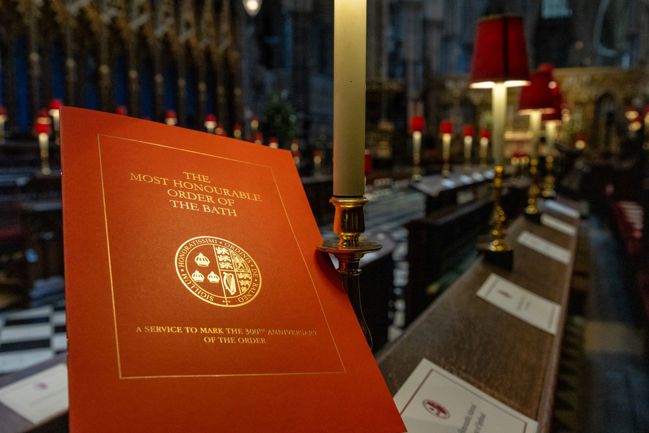
Also in the news this week was the 300th anniversary (or Tercentenary) of the Most Honourable Order of the Bath. The King (as Sovereign) and the Prince of Wales (as Great Master) attended a service in Westminster Abbey to commemorate. The cover of the Order of Service shows the seal of the order, which likewise has the British royal arms. I even found a photograph of a bound copy of the Statutes of the Order, which has the seal illustrated in full colour. There were also photographs taken of the stallplates of current and former Knights Grand Cross, including Great Masters. One hopes to see Prince William’s plate appear there too at some point, if only to get visual evidence of his full heraldic achievement as heir apparent.
A mere thirty-two months into the New Carolean era, a new Great Seal of the Realm has been unveiled. The design is largely the same as the version made for Elizabeth II in 2001 – the obverse shows the monarch enthroned, the reverse shows the royal armorial achievement (as illustrated by Noad).
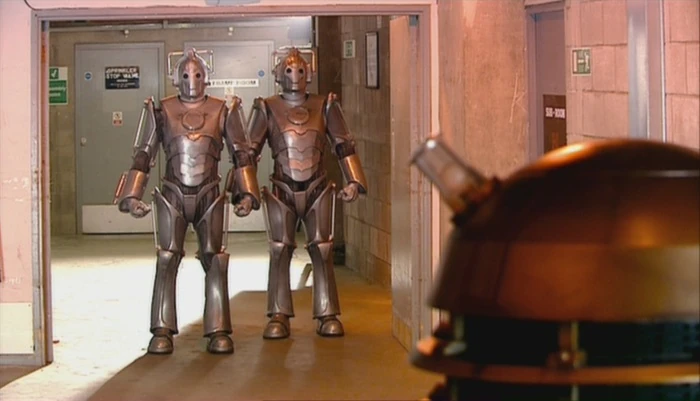
Noad’s heraldic drawing is well-known by now. The depiction of Charles on the front* has attracted some criticism: The King is, as at his actual coronation, wearing trousers rather than the more traditional stockings, and his shoes appear to jut out too much. Personally, I think they resemble the feet of 2006-era Cybermen. It is also notable that the crown shown on the monarch’s head is the idealised depiction of the Tudor crown, as opposed to the Imperial State Crown or the Crown of St Edward which he wore at the coronation itself.
The inscription around the outer rim is CHARLES III DEI GRATIABRITANNIARUM REGNORUMQUESUORIMQUE CETERORUM REX COSORTIONIS POPULARUM PRINCEPS FID DEF.
This is the official Latin equivalent of CHARLES III BY THE GRACE OF GOD OF THE UNITED KINGDOM OF GREAT BRITAIN AND NORTHERN IRELAND AND OF HIS OTHER REALMS AND TERRITORIES KING HEAD OF THE COMMONWEALTH DEFENDER OF THE FAITH, and the formulation is similar to that used by British sovereigns for centuries, though even I, eleven years on from having formally studied Latin, can see that it is not a perfectly literal translation.
Judging by the talk pages for both the English and Latin Wikipedias, it is clear I am not the only one to notice this. Britanniarum Regnorum just means “Kingdom of the Britains”** with no specific reference to Hibernia Septentrionalis.
Oddly it seems that the seals used from 1930 to 1953 actually did specify MAG BR and HIB, short for Magnae Britanniae and Hiberniae as distinct items, but seals used both before and after do not. Uniti does not appear in any of them. The exact name in English of the polity ruling these isles has, of course, gone through many changes due to the evolution of our constitutional arrangements and is very confusing even to natives, but it is interesting to note that the Latin title doesn’t exactly move in step with the English one.
The use of Consortionis Populorum Princeps to mean Head of the Commonwealth of Nations is also a bit odd – “princeps” is of course whence we derive the words “prince” and “principal”, but it originally meant “chief” or “first in rank”. “Consortio Populorum” (“Partnership of the Peoples”?) is probably used because a more literal translation would probably be something more like “Respublica”, but of course in modern English (or British English at any rate), the words commonwealth and republic have diverged almost entirely to where the former means an organisation headed by a monarch and the latter means precisely not that.
Perhaps it is fitting that this event should take place just as a new Pope emerges – we’ll be seeing a lot of official Latin in use very soon!
*The manynewsarticles I have found relating to this story all seem to be nearly word-for-word the same, and none of them identify the portrait artist. **This is distinct from “King of the Britons”, which would be “Regnum Brittanorum”
In the lead-up to, and immediate aftermath of, the Canadian general election, there were a few news pieces about the prospect of King Charles visiting in person to open the new Parliament. Most of these seemed like mere idle speculation or, indeed wishful thinking.
Today, however, it has been confirmed by both Buckingham Palace and the Office of the Prime Minister that Their Majesties will indeed be visiting for that purpose. This is unusually short notice for an overseas trip, particularly given the sovereign’s ongoing health problems and the length of the journey. As the couple are due to arrive on May 26th and leave on May 27th, it looks as if this will be a flying visit to Ottawa to perform the state opening and not much else, in contrast to last month’s state visit in Italy or last year’s royal tour of Australia. There has been no further detail about the hinted royal tour in 2026, but I presume any more elaborate plans are still delayed until then.
I know nothing at this point of the actual contents of the speech, and indeed suspect that the text will not be especially interesting from a literary perspective (throne speeches rarely are). Their Majesty’s attire may prove the more politically-contentious topic: When Elizabeth II opened Parliament in 1957 and 1977 she prominently wore the Order of the Garter, while Prince Philip wore a military uniform with his many decorations on it.
This will be the first time that the monarch has opened Parliament in person since the Patriation of the Constitution and, as much as Mark Carney is obviously an Anglophile, the purpose of this excursion is to reassert Canada’s sovereignty and national identity in the face of aggression from the United States. The King & Queen of Canada will need to find a distinctly Canadian look for themselves. This will be difficult as the Crown of Canada, before or after Trudeau’s controversial redesign, does not exist in real life as a physical object. Nor, for that matter, does the snowflake diadem. A separate set of Canadian royal robes does not exist either. To make matters worse, this won’t even be taking place in the real Parliament building, as that has been closed for major renovation works over the past few years. Currently the Senate meets in a repurposed railway station and the House of Commons in the West Block. These two buildings are a ten-minute walk apart, which could make the summoning of MPs a rather tedious ordeal. In 2021 shuttle buses were used for the 700m journey.
If maximum splendour is the goal then I suspect that Charles will wear a ceremonial military uniform (with corresponding hat) and Camilla either her coronation gown or a generic white dress with a tiara, both with all their Canadian medals as well as the sash of the Royal Victorian Order (since that is not realm-specific).
Finally, a point about Palace press releases – whereas the public sees these announcements on Royal.UK as text on a webpage, they seem to be sent to journalists as PDFs (which I only know because of how often I see journalists Tweeting them). Even now the old red outline illustration of Elizabeth II’s British arms (with St Edward’s Crown) is still used, despite this announcement relating to Canada. It’s also typed in Calibri, which irks me even more.
This story by Sky News includes a screenshot of an earlier version of the Tweet, in which the bullet points are punctuated with the French and British flags instead of the flag of Canada. Was this a clumsy attempt at representing Canada’s dual heritage, or had the template been mixed up with something intended for Macron’s state visit due this month?
As the eightieth anniversary of VE Day in World War II approaches, it would be easy to miss that there were also commemorations for World War I still going on.
The ceremonies carried out today in honour of the Gallipoli campaign were of a notably lower key, but still quite interesting.
The Australian & New Zealand Army Corps fought at the time as part of the British Empire under George V. Today Charles III is monarch of all three realms in separate capacities.
His Majesty put out messages relating to the anniversary, which the Royal Twitter feed illustrated with photographs and flags. The letterhead uses the new illustration of the British royal arms with the New Zealand and Australian flags (both containing the Union Flag in the canton) are displayed diagonally in the top corners.
The Palace also Tweeted links to separate messages for Australian and New Zealand veterans, but there is clearly a mistake in the Tweet as the New Zealand link is given twice. Luckily the Australian message is easily findable from that page on the website.
The Princess Royal, President of the Commonwealth War Graves Commission, attended services in Turkey (where the Gallipoli campaign actually took place). While there it appears she left a note from her brother attached to a wreath. The card still uses the old illustration of the arms. I didn’t see the princess’s own banner flying anywhere. The Master of Ceremonies introduced her as “senior member of the British royal family” alongside Sam Mostyn as Governor General of Australia, Christopher Luxon as Prime Minister of New Zealand and Ömer Toroman as Governor of Çanakkale Province. He then moved onto introducing the senior representatives of each country’s armed forces, including First Sea Lord Sir Ben Key. That Britain had a specific national representative among the latter group but not the former implies by default that Anne must be representing the United Kingdom in particular**. When it came to the laying of the wreaths, Toroman went first representing the host nation, then Anne lay hers “on behalf of the British royal family” while Mostyn and Luxon lay theirs “on behalf of the government and people” of their respective countries. Wreaths for Austria, Canada, France, Germany, Hungary, India, Ireland, South Africa and the United Kingdom were laid by their various diplomatic and military representatives, Britain’s being Ambassador Jill Morris. The order of precedence is interesting – most of the countries listed are simply in English alphabetical order***, but it is interesting that “the British royal family” as an institution got to be in the special group higher up the chain while the United Kingdom itself did not. The Australian Broadcasting Corporation has been livestreaming the Gallipoli Dawn Service (and many others) for the past several years and the YouTube videos are still up, allowing one to compare the small variations in the ceremony over time. It doesn’t appear that Britain normally has any representative, royal or otherwise, among the first section of attendees, and indeed the Australian and New Zealand representatives are usually a bit lower-ranking than the ones who attended this time.
The Duchess of Edinburgh was the principal royal representative for services in London – both at Hyde Park and at Westminster Abbey. Getty has a photograph of the order of service for the Hyde Park event. It is a less-than-impressive affair, the title being typed in bold, block capitals Calibri font (the default now on Microsoft Office) and the illustrations of the royal arms of Australia and New Zealand, the latter (still using St Edward’s Crown) clearly being taken from Wikimedia Commons. The order of service for the Abbey event uses the same illustrations.
ITN’s Royal Family Channel on YouTube has, as usual, provided a great deal of raw feed. I particularly enjoyed the wobbly footage of the camera operator navigating behind the Abbey’s arches.
In the stream for the Hyde Park service we can see at 5:42 that one of the wreaths has two cards on it bearing the conjugal arms of the Duke & Duchess – two separate shields slightly angled beneath a single princely coronet.
These events also bring up an interesting conundrum about the use of national anthems in the Commonwealth Realms – at the 12:08 mark in the same video, it is announced that “…an Australian soprano*, a music educator based here in London. This morning she will sing the national anthems of the United Kingdom and Australia. I’m also delighted to welcome Lance Corporal Bryony Williams of the New Zealand Army to sing the national anthem of New Zealand.”
The British anthem used here is God Save The King!, the Australian Advance Australia Fair! and the New Zealand God Defend New Zealand! sung in both Maori and English. Trouble is, New Zealand officially has two national anthems, the other being… God Save The King! That same song is also officially the royal anthem of Australia. For the hymn to be used to represent one realm against another feels a little diplomatically questionable. Perhaps it would be better in these kinds of circumstances to use the royal anthem to represent all realms together and/or use an alternative patriotic song to represent Britain in particular – probably the best choice would be Rule, Britannia! The abbey service has the British anthem at the beginning then the other two at the end. The service also includes a prayer “for His Majesty The King; for the Governors
General of Australia and New Zealand, and for all who govern the nations of the world”.
A minor point to note here is that New Zealand’s High Commissioner to the United Kingdom, Phil Goff, was dismissed last month after making critical comments about Donald Trump. A permanent successor has yet to be appointed so Chris Seed, a retired diplomat, is currently filling in.
The ceremony at the Whitehall cenotaph was attended by David Lammy and therefore produced a dozen photographs on the FCDO Flickr feed which are able to be uploaded to Wikimedia Commons. Sir Lindsay Hoyle also features prominently in these.
*Unfortunately the editing of the video cuts off the soprano’s name.
**Whether the multinational nature of the monarchy extends beyond the sovereign himself to the rest of the royal family is a long-running philosophical conundrum among Wikipedians and others.
***Ironically this tends to mean that the birthplace of said language comes at or near the end. I won’t rehash the tired joke about searching for Britain, Great Britain or United Kingdom on drop-down menus, but I will note this article by Michael Reiners for The Critic which was published coincidentally on the same day.
Yesterday Mark Carney made his first international trips as Prime Minister of Canada, visiting first France and then Britain. He held bilateral talks with Emmanuel Macron and Sir Keir Starmer, as well as an audience with Charles III.
The meeting with Starmer was snapped by Downing Street photographers and uploaded on Flickr. I have already copied them to Wikimedia Commons. These appear to be the first free-licence photographs of Carney’s premiership, as Canada’s own government’s policy on official copyright is some way behind Britain’s.
The conversation at Buckingham Palace had among the strangest opening exchanges I’ve heard from any of these:
Bit of a disaster today sir. My Order of Canada pin broke.
Oh.
Yes. It fell on the tarmac… which is proof that (among) our founding people (are) the British.
Do you want mine?
I’m not of that rank.
Obviously, the more substantive discussion in all cases was kept off-camera.
Lest it be forgotten that the royals have other duties, today the Palace revealed more detail about Their Majesties’ state visits to Italy and the Vatican, ending speculation that the latter would be postponed due to the Pope’s recent hospitalisation. The press release explicitly states that there will be an audience with Francis, but it tactfully does not specify where said audience will take place. It would be an interesting (if also tragic) subversion of the concept of a state visit if the host head of state was not actually in his home state at the time of the meeting.


_Obverse.png)
 I know nothing at this point of the actual contents of the speech, and indeed suspect that the text will not be especially interesting from a literary perspective (throne speeches rarely are). Their Majesty’s attire may prove the more politically-contentious topic: When Elizabeth II opened Parliament in 1957 and
 Robin Stanley Taylor