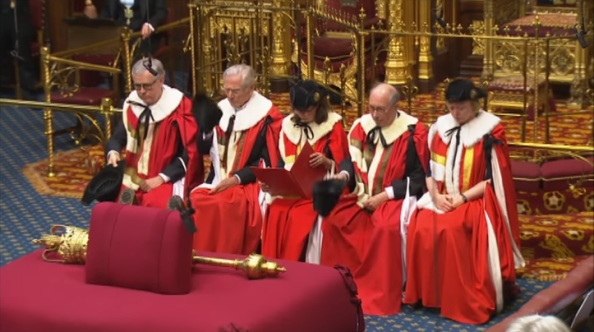
A bit quicker there, Norman!
Keen scholars of British politics will know that Parliament has three fundamental components – the monarch, the Lords and the Commons. Most of the time MPs and peers debate in separate chambers, while the monarch merely signs off the the papers which are brought to her. There are, however, special occasions on which it is necessary for all three components to come together. These are done in the chamber of the House of Lords – normally described as the upper house, but in this context more like the middle – with the monarch enthroned at the south end of the room, MPs standing behind the bar at the north, and peers themselves on their usual red benches in between.
The most famous of these is the state opening, which commences a new parliamentary session. The others are prorogation (the end of a session), granting royal assent to new acts (often combined with prorogation), the opening of a new parliament (in which the first state opening is delayed until MPs and peers are sworn) and the approbation of the lower house’s speaker (done on the second day of a new parliament, and/or after the old speaker departs). The state opening gets more attention than the others partly because it unveils the government’s main legislative agenda – and is thus the main battleground for the presence or absence of parliamentary confidence in the ministry – and partly because in modern practice it is the only event which the monarch attends in person.
The Lords and Commons have three-figure memberships with respective quora of just 30 and 40, so the absence of even large numbers of members – especially backbenchers – does not threaten to invalidate such events as these. The Queen is only one person, and thus physically invisible. Fortunately, methods have been devised which allow Her Most Excellent Majesty to be projected into the legislature while her most singular body remains elsewhere. Enter the Lords Commissioners.
The Queen, by letters patent under the Great Seal of the Realm, appoints a team of three to seven privy counsellors (who are nearly always peers) to carry out these parliamentary functions on her behalf.
There are variations depending on the specific type of ceremony, but certain details are common to all: The Leader of the House of Lords announces that, it not being convenient for Her Majesty to be personally present there that day, a commission has been passed appointing several Lords therein named to do whatever is needed on her behalf. The Lord Speaker rises from the woolsack and vacates the chamber along with several other peers. The commissioners, robed and hatted, then file in and sit adjacent on a temporary bench before the steps of the throne. Black Rod is sent to summon the Commons, and then MPs come to the bar of the house, exchanging bows with their lordships (at which point the male commissioners doff their hats with varying levels of synchronisation). A parliamentary clerk reads out the letters patent to verify that the commissioners have the required authority, each one bowing (and doffing) invididually as his name is mentioned. At the end bows are exchanged again while MPs back out.
In one of the most pointless projects ever undertaken, I have gone through the online Hansard archives noting down all the named members of various commissions in the last two hundred years, and put them into a colour-coded spreadsheet. A few explanatory notes first:
- Hansard, and thus the spreadsheet, only lists those who physically attended. Archbishops and Lord Chancellors are named in the patent ex officio but do not actually take part are omitted.
- On some occasions the record only says that there was a commission, rather than specifying who was in it. For these I obviously have no information to include. Annoyingly there is a huge stretch from 1905 to 1916 about which I can only guess.
- I have listed New Parliaments, Approbations, Sessions Opened and Prorogations. Unless combined with the latter I have not listed Royal Assents, for these are not intuitive to locate in the timeline and, when I have found them, they have uniformly declined to mention commissioners by name.
From what information I have managed to gather, a curious tale can be told:
In the nineteenth century it was the norm for all Lords Temporal involved in the commission to be from the governing party, and even for most or all of them to be government ministers, though the leader of the house (perhaps not yet a well-defined office) was not normally among them. In the first half of the century it was reasonably common for the Archbishop of Canterbury to personally attend, but in the second half this tailed off. Very occasionally the Bishop of London appears. There is even one instance, when setting up the fifth UK parliament in 1812, of the Prince Regent’s younger brothers taking part. Their formal political affiliation is unclear.
The World Wars, and the interbellum period, saw an abnormal frequency of complex and confusing multi-party governments, whether confidence-and-supply or full coalition. This is reflected in the composition of the royal commissions, which frequently include peers from more than one party and even a few whom I took to be Crossbenchers. The approbation of Captain Edward Fitzroy as Commons Speaker in 1928 is the first instance I can find of a Labour peer taking part – Kenneth Muir Mackenzie, between terms as a junior government whip. The general election of 1929 saw the Labour Party win a plurality of seats in the Commons for the first time (though the Conservatives won the popular vote), and Ramsay MacDonald formed a minority government which lasted just over two years (Ramsay had earlier governed for nine months in 1924, but in that instance the transition of power occured after the session had already started). The two commissions at the start of that parliament feature Labour’s John Sankey as Lord Chancellor, but flanked by two Conservatives and two Crossbenchers. The absence of other Labour peers may be explained by their small presence in the upper house at the time, but the preference of opposition Conservatives over allied Liberals is not so clear.
By the time of the 1931 general election a three-way coalition had been formed, with senior Conservative and Liberal figures included. This coalition fought the election together and won by an overwhelming landslide. The specifics of this would be too great a digression from the purpose of this article, but the main Labour Party expelled MacDonald and others who remained in his government. They formed a splinter group called the National Labour Organisation. For convenience I have kept Sankey in red here although the party actually fought in green. The commissions for 3rd and 4th November that year both featured Sankey as Lord Chancellor, but that for the new parliament straddled him with three Conservatives plus the Crossbench Sumner, then that for the Speaker’s approbation involved another three Conservatives plus the Liberal Islington. Stanley Baldwin replaced MacDonald as Prime Minister before the 1935 election, and the two commissions beginning that parliament were mostly Conservative, with one Liberal each and once a crossbencher but no Labour peers.
The commission for Douglas Clifton-Brown’s approbation in 1943 (by which time another wartime grand coalition had been formed) involved Lords Crewe and Addison, leaders of the Liberal and Labour parties in the upper house. Curiously, then-Conservative leader Cranborne was left out in favour of his father and predecessor Salisbury.
Attlee’s 1945 landslide saw the beginning of the modern two-party system. The commission opening that parliament was led by Lord Chancellor Jowitt, accompanied by house leader Addison. Salisbury and Cranborne represented the Conservatives (Yes, father and son together!) while Samuel took part as Liberal leader. Oddly the approbation commission the next day had only Jowitt in common, the others being Air Secretary Stansgate (Tony Benn’s father) and one Conservative and two Liberals. The two commissions at the beginning of Attlee’s second term in 1950 approach what would eventually become the norm, with one member each from the Conservative, Liberal and Crossbench factions.
From the 1955 general election until Wilson’s accession in 1964, the commissioners tended to be three Conservative and two Labour. After that a fairly consistent pattern emerged – albeit with occasional substitutions – a royal commission comprised the Lord Chancellor, the Leader of the House, the leaders of the two main opposition parties, and a third peer from the government side chosen seemingly at random. This convention lasted until 1993. In the prorogation commission that year the Chancellor and three leaders attended as before, but instead of the rotating government peer Lord Weatherill was appointed to complete the group. Speaker of the Commons until the year before, he became Convenor of the Crossbenchers. From then on it became the norm to have a crossbencher in the commissions – usually the Convenor, but if (s)he was not a privy counsellor then someone else might act in his stead.
The next change occured followed the Constitutional Reform Act 2005, and the establishment in the following year of the elected office of Lord Speaker, separated from the Chancellorship. Lady Hayman took office in July and the next commission took place in November. On that occassion the Chancellor (Lord Falconer of Thoroton) still led the commission as before and Hayman effectively replaced the crossbench representative. A reshuffle in 2007 saw Falconer replaced by Jack Straw, the first MP to hold that office for centuries. As with the Archbishop of Canterbury the Lord Chancellor continued to be named in the letters patent, but a technicality of the Standing Orders of the House of Lords meant he could not perform prorogations in person. From then on nearly all commissions (exceptions to be specified) were led by the Leader of the House – for which there were precedents in earlier ceremonies when the Chancellor could not attend, or even where the office was vacant for a while – accompanied by the Lord Speaker, the opposition leaders and the convenor – all members thus having different affiliations.
The restriction did not apply to approbations, so Straw was able to lead the commission for John Bercow in 2009, with the Lord Speaker waiting outside the chamber. The other commissions in 2009-10 followed the new pattern. There was no commission in 2011 due to the session being extended. The prorogation ceremony in 2012 saw Lord Shutt of Greetland, on his last day as Deputy Chief Whip, substitute for Lord McNally as Liberal Democrat leader. That of 2013 saw Labour leader Lady Royall of Blaisdon absent, though she was still named in the patent. The commissions of 2014-17 were unremarkable. In 2018 there was again no new session, nor did Bercow resign his speakership as originally promised. The bicorn hats were thus not seen at all that year. In the latter third of 2019, however, the commissioners would be very busy.
Boris Johnson’s attempted five-week prorogation was so controversial that the opposition peers all boycotted the ceremony, including those who would have been commissioners. The procedure was thus performed to a nearly-empty chamber in the small hours of the morning by the minimal quorum of three – Evans of Bowes Park (Leader), Fowler (Speaker) and Hope of Craighead (Convenor). That prorogation was annulled by the Supreme Court, but Johnson was eventually permitted to try again – although only for the usual few days this time. The second attempt went normally with Smith and Newby attending as normal (though Lord Judge had replaced Hope as Convenor).
On the penultimate day of that parliament Bercow finally retired and his deputy Sir Lindsay Hoyle was elected to replace him as Speaker. Following Straw’s precedent a decade earlier, Robert Buckland performed the approbation, though his hat had to be precariously perched upon his wig rather than fitting around it. Lord Dholakia subsituted for Newby, and doffed a few times more than necessary.
Following the snap December general election, the 58th Parliament had to be set up in something of a hurry. For what appears to be the first time in at least two hundred years, both of the normal commissions were performed on the same day – presumably to allow MPs to start swearing in earlier. Both commissions involved the standard lineup, though there was an awkward moment when Evans forgot to turn over the page in her script.
This session is due to run until May 2021, and thus we seem to be in for another doff-free year, which the commissioners themselves may find a relief, though for some viewers at home it is no doubt a disappointment.
| Key |
|
| * |
Lord Chancellor |
| ^ |
Leader of the House of Lords |
| ~ |
Lord Speaker |
| |
Tory, Conservative, Unionist, National |
| |
Whig, Liberal, Liberal Democrat |
| |
Labour |
| |
Spiritual |
| |
Impartial |
| |
Affiliation unclear |
| |
Crossbench |
| |
Social Democratic |
| |
|
| Notes |
|
| -1 |
The Baroness Royall of Blaison was named in the patent but did not appear in the ceremony and was not mentioned in Hansard. |
aengoaenrgioneroinoh
| Date |
Type |
1st |
2nd |
3rd |
4th |
5th |
6th |
| 12/07/05 |
Prorogation |
Canterbury |
Eldon* |
Camden |
Hawkesbury^ |
|
|
| 15/12/06 |
New Parliament |
Canterbury |
Erskine* |
Aylesford |
Walsingham |
|
|
| 16/12/06 |
Approbation |
Erskine* |
Aylesford |
Spencer |
Walsingham |
|
|
| 27/04/07 |
Prorogation |
Eldon* |
Camden |
Hawkesbury^ |
|
|
|
| 22/06/07 |
Approbation |
Canterbury |
Eldon* |
Aylesford |
Hawkesbury^ |
|
|
| 14/08/07 |
Prorogation |
Canterbury |
Eldon* |
Camden |
Hawkesbury^ |
|
|
| 21/01/08 |
Session Opened |
Canterbury |
Eldon* |
Camden |
Aylesford |
Dartmouth |
|
| 04/07/08 |
Prorogation |
Canterbury |
Eldon* |
Camden |
Westmorland |
Montrose |
|
| 19/01/09 |
Session Opened |
Canterbury |
Eldon* |
Camden |
Montrose |
|
|
| 21/06/09 |
Prorogation |
Eldon* |
Canterbury |
Camden |
Dartmouth |
Westmorland |
|
| 23/01/10 |
Session Opened |
Canterbury |
Eldon* |
Camden |
Aylesford |
Dartmouth |
|
| 24/07/11 |
Prorogation |
Canterbury |
Eldon* |
Camden |
Westmorland |
Aylesford |
|
| 07/01/12 |
Session Opened |
Canterbury |
Eldon* |
Wellesley |
Camden |
Westmorland |
|
| 24/11/12 |
New Parliament |
York & Albany |
Cumberland & Teviotdale |
Eldon* |
Liverpool^ |
Westmorland |
|
| 02/06/17 |
Approbation |
Eldon* |
Cholmondeley |
Shaftesbury |
Bathurst |
Liverpool^ |
|
| 14/01/19 |
New Parliament |
Harrowby |
Westmorland |
Wellington |
Shaftesbury |
Liverpool^ |
|
| 21/04/20 |
New Parliament |
Eldon* |
Canterbury |
Wellington |
Westmorland |
Shaftesbury |
|
| 14/11/26 |
New Parliament |
Eldon* |
Wellington |
Westmorland |
Liverpool^ |
Harrowby |
|
| 04/02/30 |
Session Opened |
Lyndhurst* |
Bathurst |
Rosslyn |
Wellington^ |
Aberdeen |
|
| 26/10/30 |
New Parliament |
Lyndhurst* |
Canterbury |
Buckingham |
Rosslyn |
Bathurst |
|
| 27/10/30 |
Approbation |
Lyndhurst* |
Rosslyn |
Bathurst |
Ellenborough |
Melville |
|
| 14/06/31 |
New Parliament |
Canterbury |
Brougham & Vaux* |
Wellesley |
Grey^ |
Durham |
|
| 15/06/31 |
Approbation |
Brougham & Vaux* |
Richmond |
Lansdowne |
Durham |
|
|
| 29/01/33 |
New Parliament |
Brougham & Vaux* |
Grey^ |
Richmond |
Lansdowne |
Auckland |
|
| 31/01/33 |
Approbation |
Brougham & Vaux* |
Richmond |
Lansdowne |
Albermarle |
Auckland |
|
| 19/02/35 |
Session Opened |
Canterbury |
Lyndhurst* |
Rosslyn |
Wharncliffe |
Jersey |
|
| 31/01/37 |
Session Opened |
Canterbury |
Cottenham* |
Lansdowne |
Duncannon |
Melbourne^ |
|
| 15/11/37 |
New Parliament |
Cottenham* |
Lansdowne |
Conygham |
Mulgrave |
Duncannon |
|
| 28/05/39 |
Approbation |
Cottenham* |
Lansdowne |
Duncannon |
Shaftesbury |
Falkland |
|
| 07/10/41 |
Prorogation |
Lyndhurst* |
Wellington^ |
Buckingham & Chandos |
Shaftesbury |
Wharncliffe |
|
| 02/02/43 |
Session Opened |
Lyndhurst* |
Canterbury |
Wharncliffe |
Buccleugh |
Shaftesbury |
|
| 05/09/44 |
Prorogation |
Lyndhurst* |
Wharncliffe |
Buccleugh |
Wellington^ |
Del La Warr |
Dalhousie |
| 18/11/47 |
New Parliament |
Canterbury |
Cottenham* |
Lansdowne^ |
Spencer |
Auckland |
|
| 19/11/47 |
Approbation |
Lansdowne^ |
Langdale |
Grey |
Auckland |
Campbell |
|
| 01/08/49 |
Prorogation |
Lansdowne^ |
Minto |
Clanricarde |
Saint Germans |
Campbell |
|
| 31/01/50 |
Session Opened |
Cottenham* |
Lansdowne |
Minto |
Breadalbane |
London |
|
| 04/11/52 |
New Parliament |
St Leonards* |
Lonsdale |
Salisbury |
Montrose |
Northumberland |
|
| 05/11/52 |
Approbation |
St Leonards* |
Salisbury |
Montrose |
Eglinton |
Colchester |
|
| 20/08/53 |
Prorogation |
Cranworth* |
Granville |
Argyll |
Breadalbane |
Newcastle |
|
| 14/08/55 |
Prorogation |
Cranworth* |
Granville |
Argyll |
Stanley of Alderley |
Harrowby |
|
| 29/07/56 |
Prorogation |
Cranworth* |
Harrowby |
Stanley of Alderley |
Willoughby D’Eresby |
Monteagle of Brandon |
|
| 30/04/57 |
New Parliament |
Cranworth* |
Harrowby |
Spencer |
Stanley of Alderley |
Argyll |
|
| 01/05/57 |
Approbation |
Cranworth* |
Granville^ |
Harrowby |
Spencer |
Argyll |
|
| 28/08/57 |
Prorogation |
Canterbury |
Cranworth* |
Granville^ |
Harrowby |
Panmure |
|
| 02/08/58 |
Prorogation |
Chelmsford* |
Salisbury |
Hardwicke |
De La Warr |
Beaufort |
|
| 13/08/59 |
Prorogation |
Campbell* |
Granville^ |
Somerset |
Saint Germans |
Sydney |
|
| 28/08/60 |
Prorogation |
Campbell* |
Somerset |
Sydney |
Stanley of Alderley |
Monteagle of Brandon |
|
| 06/08/61 |
Prorogation |
Westbury* |
Granville^ |
Saint Germans |
Sydney |
Monteagle of Brandon |
|
| 06/02/62 |
Session Opened |
Westbury* |
Saint Germans |
Sydney |
Stanley of Alderley |
|
|
| 07/08/62 |
Prorogation |
Westbury* |
Saint Germans |
Russell |
Kingsdown |
|
|
| 05/02/63 |
Session Opened |
Westbury* |
Argyll |
Saint Germans |
Sydney |
Stanley of Alderley |
|
| 28/07/63 |
Prorogation |
Westbury* |
Saint Germans |
Newcastle |
Stanley of Alderley |
Wensleydale |
|
| 04/02/64 |
Session Opened |
Westbury* |
Argyll |
Saint Germans |
Sydney |
Stanley of Alderley |
|
| 29/07/64 |
Prorogation |
Westbury* |
Saint Germans |
De Grey |
Sydney |
Wensleydale |
|
| 07/02/65 |
Session Opened |
Westbury* |
Somerset |
Saint Germans |
Sydney |
Stanley of Alderley |
|
| 06/07/65 |
Prorogation |
Granville^ |
Saint Germans |
Sydney |
Eversley |
Wensleydale |
|
| 01/02/66 |
New Parliament |
Cranworth* |
Argyll |
Sydney |
Bessborough |
Stanley of Alderley |
|
| 02/02/66 |
Approbation |
Cranworth* |
Argyll |
Sydney |
Bessborough |
Dalhousie |
|
| 10/08/66 |
Prorogation |
Chelmsford* |
Buckingham & Chandos |
Malmesbury |
Bradford |
Cadogan |
|
| 21/08/67 |
Prorogation |
Chelmsford* |
Richmond |
Bradford |
Beaufort |
Devon |
|
| 19/11/67 |
Session Opened |
Chelmsford* |
Marlborough |
Malmesbury |
Buckingham |
Cadogan |
|
| 31/07/68 |
Prorogation |
Cairns* |
Malmesbury |
Beaufort |
Buckingham |
Devon |
|
| 10/12/68 |
New Parliament |
Hatherley* |
De Grey |
Kimberley |
Sydney |
Ailesbury |
|
| 11/12/68 |
Approbation |
Hatherley* |
De Grey |
Kimberley |
Sydney |
Argyll |
|
| 16/02/69 |
Session Opened |
Hatherley* |
De Grey |
Kimberley |
Sydney |
Ailesbury |
|
| 11/08/69 |
Prorogation |
Hatherley* |
Kimberley |
Granville |
Sydney |
Foley |
|
| 08/02/70 |
Session Opened |
Hatherley* |
De Grey |
Kimberley |
Bessborough |
Sydney |
|
| 10/08/70 |
Prorogation |
Hatherley* |
Halifax |
Kimberley |
Normanby |
Sydney |
|
| 21/08/71 |
Prorogation |
Hatherley* |
Halifax |
Saint Albans |
Cowper |
Cork |
|
| 06/02/72 |
Session Opened |
Hatherley* |
Ripon |
Halifax |
Sydney |
Bessborough |
|
| 12/02/72 |
Approbation |
Hatherley* |
Halifax |
Bessborough |
Cork |
Eversley |
|
| 10/08/72 |
Prorogation |
Hatherley* |
Ailesbury |
Granville^ |
Kimberley |
London |
|
| 06/02/73 |
Session Opened |
Selborne* |
Ripon |
Halifax |
Kimberley |
Cork |
|
| 05/08/73 |
Prorogation |
Selborne* |
Granville^ |
Cowper |
Sydney |
Bessborough |
|
| 05/03/74 |
New Parliament |
Cairns* |
Richmond^ |
Hertford |
Beauchamp |
Bradford |
|
| 06/03/74 |
Approbation |
Cairns* |
Richmond^ |
Beauchamp |
Skelmersdale |
|
|
| 07/08/74 |
Prorogation |
Cairns* |
Beauchamp |
Derby |
Bradford |
Skelmersdale |
|
| 05/02/75 |
Session Opened |
Cairns* |
Malmesbury |
Hertford |
Beauchamp |
Skelmersdale |
|
| 13/08/75 |
Prorogation |
Cairns* |
Richmond^ |
Beauchamp |
Shrewsbury |
Hardwicke |
|
| 15/08/76 |
Prorogation |
Cairns* |
Richmond^ |
Hardwicke |
Hertford |
Bradford |
|
| 14/08/77 |
Prorogation |
Cairns* |
Richmond |
Salisbury |
Harrowby |
Skelmersdale |
|
| 17/01/78 |
Session Opened |
Cairns* |
Richmond |
Hertford |
Beauchamp |
Skelmersdale |
|
| 16/08/78 |
Prorogation |
Cairns* |
Richmond |
Northumberland |
Hertford |
Skelmersdale |
|
| 05/12/78 |
Session Opened |
Cairns* |
Richmond |
Northumberland |
Beauchamp |
Skelmersdale |
|
| 15/08/79 |
Prorogation |
Cairns* |
Northumberland |
Beauchamp |
Hardwicke |
Skelmersdale |
|
| 07/09/80 |
Prorogation |
Selborne* |
Sydney |
Kenmare |
Kimberley |
Cork |
|
| 27/08/81 |
Prorogation |
Selborne* |
Spencer |
Cork |
Kenmare |
Monson |
|
| 07/02/82 |
Session Opened |
Selborne* |
Sydney |
Kenmare |
Cork |
Monson |
|
| 02/12/82 |
Prorogation |
Selborne* |
Granville^ |
Kimberley |
Carrington |
Monson |
|
| 15/02/83 |
Session Opened |
Selborne* |
Carlingford |
Sydney |
Cork |
Monson |
|
| 25/08/83 |
Prorogation |
Selborne* |
Derby |
Sydney |
Kenmare |
Monson |
|
| 05/02/84 |
Session Opened |
Selborne* |
Sydney |
Kenmare |
Monson |
Carrington |
|
| 14/08/84 |
Prorogation |
Selborne* |
Sydney |
Derby |
Kenmare |
Monson |
|
| 23/10/84 |
Session Opened |
Selborne* |
Carlingford |
Kimberley |
Kenmare |
Monson |
|
| 14/08/85 |
Prorogation |
Halsbury* |
Lathom |
Waterford |
Coventry |
Hardwicke |
|
| 12/01/86 |
New Parliament |
Halsbury* |
Cranbrook |
Iddesleigh |
Coventry |
Barrington |
|
| 13/01/86 |
Approbation |
Halsbury* |
Cranbrook |
Iddesleigh |
Coventry |
Barrington |
|
| 25/09/86 |
Prorogation |
Halsbury* |
Iddesleigh |
Stanley of Preston |
Kintore |
Barrington |
|
| 27/01/87 |
Session Opened |
Halsbury* |
Lathom |
Cross |
Kintore |
Coventry |
|
| 16/09/87 |
Prorogation |
Halsbury* |
Cross |
Stanley of Preston |
Brownlow |
Lothian |
|
| 09/02/88 |
Session Opened |
Halsbury* |
Lathom |
Cross |
Kintore |
Rosslyn |
|
| 24/12/88 |
Prorogation |
Halsbury* |
Coventry |
Kintore |
Colville of Culross |
Esher |
|
| 21/02/89 |
Session Opened |
Halsbury* |
Cranbrook |
Kintore |
Lathom |
Cross |
|
| 11/02/90 |
Session Opened |
Halsbury* |
Mount Edgcumbe |
Limerick |
Cross |
Knutsford |
|
| 25/11/90 |
Session Opened |
Halsbury* |
Lathom |
Coventry |
Brownlow |
Knutsford |
|
| 09/02/92 |
Session Opened |
Halsbury* |
Portland |
Coventry |
Mount Edgcumbe |
Cross |
|
| 04/08/92 |
New Parliament |
Halsbury* |
Rutland |
Cross |
Knutsford |
Lathom |
|
| 05/08/92 |
Approbation |
Halsbury* |
Rutland |
Cross |
Knutsford |
Balfour of Burleigh |
|
| 18/08/92 |
Prorogation |
Herschell* |
Kimberley |
Spencer |
Ripon |
Oxenbridge |
|
| 31/01/93 |
Session Opened |
Herschell* |
Spencer |
Kimberley |
Breadalbane |
Carrington |
|
| 25/08/94 |
Prorogation |
Herschell* |
Kimberley |
Breadalbane |
Carrington |
Chesterfield |
|
| 05/02/95 |
Session Opened |
Herschell* |
Spencer |
Tweedmouth |
Breadalbane |
Carrington |
|
| 22/04/95 |
Approbation |
Herschell* |
Kimberley |
Spencer |
Carrington |
Kensington |
|
| 05/09/95 |
Prorogation |
Halsbury* |
Cross |
Norfolk |
Limerick |
Belper |
|
| 11/02/96 |
Session Opened |
Halsbury* |
Cross |
Lathom |
Ashbourne |
Kintore |
|
| 14/08/96 |
Prorogation |
Halsbury* |
Cross |
Coventry |
Balfour of Burleigh |
James of Hereford |
|
| 19/01/97 |
Session Opened |
Halsbury* |
Cross |
Pembroke |
Balfour of Burleigh |
Kintore |
|
| 06/08/97 |
Prorogation |
Halsbury* |
Norfolk |
Cross |
Ashbourne |
|
|
| 12/08/98 |
Prorogation |
Halsbury* |
Norfolk |
Coventry |
Waldegrave |
Rathmore |
|
| 07/02/99 |
Session Opened |
Halsbury* |
Hopetoun |
Coventry |
Balfour of Burleigh |
James of Hereford |
|
| 17/10/99 |
Session Opened |
Halsbury* |
Pembroke |
Marlborough |
Coventry |
Balfour of Burleigh |
|
| 30/01/00 |
Session Opened |
Halsbury* |
Cross |
Hopetoun |
Kintore |
Belper |
|
| 03/12/00 |
New Parliament |
Halsbury* |
Clarendon |
Kintore |
Pembroke |
Belper |
|
| 20/06/05 |
Approbation |
Halsbury* |
Waldegrave |
Kintore |
|
|
|
| 15/02/16 |
Session Opened |
Buckmaster* |
Devonshire |
Lincolnshire |
Sandhurst |
Farquhar |
|
| 04/02/19 |
New Parliament |
Birkenhead* |
Crawford |
Donoughmore |
Farquhar |
Sandhurst |
|
| 05/02/19 |
Approbation |
Birkenhead* |
Crawford |
Donoughmore |
Ribblesdale |
Newton |
|
| 28/04/21 |
Approbation |
Birkenhead* |
Lincolnshire |
Kintore |
Sandhurst |
Balfour of Burleigh |
|
| 08/01/24 |
New Parliament |
Cave* |
Cromer |
Shaftesbury |
Desart |
Somerleyton |
|
| 09/01/24 |
Approbation |
Cave* |
Cromer |
Desart |
Fitzalan of Derwent |
Huntly |
|
| 02/12/24 |
New Parliament |
Cave* |
Shaftesbury |
Kintore |
Donoughmoure |
Newton |
|
| 03/12/24 |
Approbation |
Cave* |
Donoughmore |
Kintore |
Fitzalan of Derwent |
Finlay |
|
| 21/06/28 |
Approbation |
Hailsham* |
Kintore |
Strachie |
Muir Mackenzie |
Darling |
|
| 25/06/29 |
New Parliament |
Sankey* |
Stanhope |
Kintore |
Atkin |
Southborough |
|
| 26/06/29 |
Approbation |
Sankey* |
Stanhope |
Kintore |
Atkin |
Southborough |
|
| 03/11/31 |
New Parliament |
Sankey* |
Sumner |
Somerleyton |
Darling |
Stonehaven |
|
| 04/11/31 |
Approbation |
Sankey* |
Londonderry |
Onslow |
Stanhope |
Islington |
|
| 26/11/35 |
New Parliament |
Hailsham* |
Stanmore |
Thankerton |
Russell of Killowen |
Rennell |
|
| 27/11/35 |
Approbation |
Hailsham* |
Crawford |
Goschen |
Stonehaven |
Rhayader |
|
| 09/03/43 |
Approbation |
Simon* |
Salisbury |
Crewe |
Fitzalan of Derwent |
Addison |
|
| 01/08/45 |
New Parliament |
Jowitt* |
Salisbury |
Samuel |
Addison |
Cranborne |
|
| 02/08/45 |
Approbation |
Jowitt* |
Fitzalan of Derwent |
Stansgate |
Stanmore |
Mottistone |
|
| 01/03/50 |
New Parliament |
Jowitt* |
Addison^ |
Mersey |
Hardinge of Penthurst |
Llewellin |
|
| 02/03/50 |
Approbation |
Jowitt* |
Addison^ |
Mersey |
Swinton |
Hardinge of Penthurst |
|
| 31/10/51 |
New Parliament |
Simonds* |
Mersey |
Swinton |
Hall |
Ismay |
|
| 01/11/51 |
Approbation |
Simonds* |
Mersey |
Swinton |
Hall |
Llewellin |
|
| 07/06/55 |
New Parliament |
Kilmuir* |
Home |
Hall |
Woolton |
Ogmore |
|
| 08/06/55 |
Approbation |
Kilmuir* |
Home |
Hall |
Woolton |
Ogmore |
|
| 20/10/59 |
New Parliament |
Kilmuir* |
Hailsham |
Saint Aldwyn |
Stansgate |
Silkin |
|
| 21/10/59 |
Approbation |
Kilmuir* |
Hailsham |
Saint Aldwyn |
Stansgate |
Silkin |
|
| 27/10/64 |
New Parliament |
Gardiner* |
Longford^ |
Carrington |
Listowel |
Rea |
|
| 28/10/64 |
Approbation |
Gardiner* |
Longford^ |
Carrington |
Listowel |
Rea |
|
| 26/10/65 |
Approbation |
Gardiner* |
Dilhorne |
Listowel |
Henderson |
Ogmore |
|
| 18/04/66 |
New Parliament |
Gardiner* |
Longford^ |
Carrington |
Rea |
Donovan |
|
| 19/04/66 |
Approbation |
Gardiner* |
Longford^ |
Carrington |
Rea |
Morris of Borth-y-Gest |
|
| 29/06/70 |
New Parliament |
Hailsham of Saint Marylebone* |
Jellicoe^ |
Listowel |
Rea |
Shackleton |
|
| 30/06/70 |
Approbation |
Hailsham of Saint Marylebone* |
Jellicoe^ |
Listowel |
Rea |
Shackleton |
|
| 12/01/71 |
Approbation |
Hailsham of Saint Marylebone* |
Jellicoe^ |
Listowel |
Rea |
Shackleton |
|
| 06/03/74 |
New Parliament |
Elwyn-Jones* |
Listowel |
Windlesham |
Shackleton |
Byers |
|
| 07/03/74 |
Approbation |
Elwyn-Jones* |
Shepherd^ |
Listowel |
Saint Aldwyn |
Byers |
|
| 22/10/74 |
New Parliament |
Elwyn-Jones* |
Shepherd^ |
Listowel |
Windlesham |
Byers |
|
| 23/10/74 |
Approbation |
Elwyn-Jones* |
Champion |
Listowel |
Saint Aldwyn |
Byers |
|
| 03/02/76 |
Approbation |
Elwyn-Jones* |
Shepherd^ |
Listowel |
Byers |
Hailsham of Sain Marylebone |
|
| 09/05/79 |
New Parliament |
Hailsham of Saint Marylebone* |
Soames^ |
Aberdare |
Byers |
Elwyn-Jones |
|
| 10/05/79 |
Approbation |
Hailsham of Saint Marylebone* |
Soames^ |
Aberdare |
Byers |
Elwyn-Jones |
|
| 15/06/83 |
New Parliament |
Hailsham of Saint Marylebone* |
Aberdare |
Belstead |
Byers |
Cledwyn of Penrhos |
|
| 16/06/83 |
Approbation |
Hailsham of Saint Marylebone* |
Aberdare |
Belstead |
Byers |
Cledwyn of Penrhos |
|
| 07/11/86 |
Prorogation |
Hailsham of Saint Marylebone* |
Whitelaw^ |
Llewelyn-Davies of Hastoe |
Diamond |
Elwyn-Jones |
|
| 17/06/87 |
New Parliament |
Havers* |
Whitelaw^ |
Seear |
Aberdare |
Cledwyn of Penrhos |
|
| 18/06/87 |
Approbation |
Havers* |
Whitelaw^ |
Seear |
Aberdare |
Cledwyn of Penrhos |
|
| 15/11/88 |
Prorogation |
Mackay of Clashfern* |
Belstead^ |
Nugent of Guildford |
Cledwyn of Penrhos |
Jenkins of Hillhead |
|
| 16/11/89 |
Prorogation |
Mackay of Clashfern* |
Belstead^ |
Aberdare |
Cledwyn of Penrhos |
Jenkins of Hillhead |
|
| 01/11/90 |
Prorogation |
Mackay of Clashfern* |
Aberdare |
Denham |
Cledwyn of Penrhos |
Jenkins of Hillhead |
|
| 22/10/91 |
Prorogation |
Mackay of Clashfern* |
Aberdare |
Waddington^ |
Cledwyn of Penrhos |
Jenkins of Hillhead |
|
| 16/03/92 |
Prorogation |
Mackay of Clashfern* |
Aberdare |
Waddington^ |
Cledwyn of Penrhos |
Jenkins of Hillhead |
|
| 27/04/92 |
New Parliament |
Mackay of Clashfern* |
Caithness |
Aberdare |
Seear |
Cledwyn of Penrhos |
|
| 28/04/92 |
Approbation |
Mackay of Clashfern* |
Ferrers |
Aberdare |
Cledwyn of Penrhos |
Jenkins of Hillhead |
|
| 05/11/93 |
Prorogation |
Mackay of Clashfern* |
Wakeham^ |
Richard |
Seear |
Weatherill |
|
| 03/11/94 |
Prorogation |
Mackay of Clashfern* |
Cranborne^ |
Richard |
Seear |
Weatherill |
|
| 08/11/95 |
Prorogation |
Mackay of Clashfern* |
Cranborne^ |
Ampthill |
Jenkins of Hilhead |
Richard |
|
| 17/10/96 |
Prorogation |
Mackay of Clashfern* |
Cranborne^ |
Jenkins of Hilhead |
Richard |
Weatherill |
|
| 21/03/97 |
Prorogation |
Mackay of Clashfern* |
Cranborne^ |
Jenkins of Hilhead |
Ampthill |
Richard |
|
| 07/05/97 |
New Parliament |
Irvine of Lairg* |
Richard^ |
Jenkins of Hilhead |
Cranborne |
Weatherill |
|
| 08/05/97 |
Approbation |
Irvine of Lairg* |
Richard^ |
Thomson of Monifieth |
Cranborne |
Weatherill |
|
| 19/11/98 |
Prorogation |
Irvine of Lairg* |
Cranborne |
Rodgers of Quarry Bank |
Jay of Paddington^ |
Chalfont |
|
| 11/11/99 |
Prorogation |
Irvine of Lairg* |
Strathclyde |
Rodgers of Quarry Bank |
Jay of Paddington^ |
Weatherill |
|
| 23/10/00 |
Approbation |
Irvine of Lairg* |
Jay of Paddington^ |
Mackay of Ardbrecknish |
Rodgers of Quarry Bank |
Weatherill |
|
| 30/11/00 |
Prorogation |
Irvine of Lairg* |
Jay of Paddington^ |
Marsh |
Strathclyde |
Rodgers of Quarry Bank |
|
| 13/06/01 |
New Parliament |
Irvine of Lairg* |
Williams of Mostyn^ |
Strathclyde |
Moore of Wolvercote |
Jenkins of Hillhead |
|
| 14/06/01 |
Approbation |
Irvine of Lairg* |
Williams of Mostyn^ |
Moore of Wolvercote |
Strathclyde |
Williams of Crosby |
|
| 07/11/02 |
Prorogation |
Irvine of Lairg* |
Williams of Mostyn^ |
Williams of Crosby |
Strathclyde |
Molyneaux of Killead |
|
| 20/11/03 |
Prorogation |
Falconer of Thoroton* |
Amos^ |
Strathclyde |
Thomson of Monifieth |
Donaldson of Lymington |
|
| 18/11/04 |
Prorogation |
Falconer of Thoroton* |
Amos^ |
Blatch |
Donaldson of Lymington |
Williams of Crosby |
|
| 11/05/05 |
New Parliament |
Falconer of Thoroton* |
Amos^ |
Strathclyde |
Donaldson of Lymington |
Roper |
|
| 12/05/05 |
Approbation |
Falconer of Thoroton* |
Amos^ |
Strathclyde |
Roper |
Donaldson of Lymington |
|
| 08/11/06 |
Prorogation |
Falconer of Thoroton* |
Amos^ |
Hayman~ |
Strathclyde |
McNally |
|
| 30/10/07 |
Prorogation |
Ashton of Upholland^ |
Hayman~ |
Strathclyde |
McNally |
Williamson of Horton |
|
| 26/11/08 |
Prorogation |
Royall of Blaisdon^ |
Hayman~ |
Strathclyde |
McNally |
Williamson of Horton |
|
| 22/06/09 |
Approbation |
Royall of Blaisdon^ |
Strathclyde |
McNally |
D’Souza |
Jack Straw* |
|
| 12/11/09 |
Prorogation |
Hayman~ |
Strathclyde |
McNally |
Royall of Blaisdon^ |
D’Souza |
|
| 08/04/10 |
Prorogation |
Royall of Blaisdon^ |
Hayman~ |
Strathclyde |
Shutt of Greetland |
D’Souza |
|
| 18/05/10 |
New Parliament |
Strathclyde^ |
Hayman~ |
McNally |
Royall of Blaisdon |
D’Souza |
|
| 19/05/10 |
Approbation |
Strathclyde^ |
Hayman~ |
McNally |
Royall of Blaisdon |
D’Souza |
|
| 01/05/12 |
Prorogation |
Shutt of Greetland |
D’Souza~ |
Strathclyde^ |
Williamson of Horton |
Royall of Blaisdon |
|
| 25/04/13 |
Prorogation |
Williamson of Horton |
D’Souza~ |
Hill of Oareford^ |
McNally |
-1 |
|
| 14/05/14 |
Prorogation |
Butler of Brockwell |
D’Souza~ |
Hill of Oareford^ |
Royall of Blaisdon |
Wallace of Tankerness |
|
| 26/03/15 |
Prorogation |
D’Souza~ |
Hunt of Kings Heath |
Laming |
Newby |
Stowell of Beeston^ |
|
| 18/05/15 |
New Parliament |
Stowell of Beeston^ |
D’Souza~ |
Royall of Blaisdon |
Wallace of Tankerness |
Laming |
|
| 19/05/15 |
Approbation |
Stowell of Beeston^ |
D’Souza~ |
Royall of Blaisdon |
Laming |
Wallace of Tankerness |
|
| 12/05/16 |
Prorogation |
Wallace of Tankerness |
D’Souza~ |
Stowell of Beeston^ |
Hope of Craighead |
Smith of Basildon |
|
| 27/04/17 |
Prorogation |
Evans of Bowes Park^ |
Hope of Craighead |
Fowler~ |
Newby |
Smith of Basildon |
|
| 13/06/17 |
New Parliament |
Evans of Bowes Park^ |
Fowler~ |
Smith of Basildon |
Newby |
Hope of Craighead |
|
| 14/06/17 |
Approbation |
Evans of Bowes Park^ |
Fowler~ |
Smith of Basildon |
Newby |
Hope of Craighead |
|
| 09/09/19 |
Prorogation |
Evans of Bowes Park^ |
Fowler~ |
Hope of Craighead |
|
|
|
| 08/10/19 |
Prorogation |
Evans of Bowes Park^ |
Fowler~ |
Newby |
Judge |
Smith of Basildon |
|
| 04/11/19 |
Approbation |
Robert Buckland* |
Evans of Bowes Park^ |
Dholakia |
Judge |
Smith of Basildon |
|
| 17/12/19 |
New Parliament |
Evans of Bowes Park^ |
Fowler~ |
Smith of Basildon |
Newby |
Judge |
|
| 17/12/19 |
Approbation |
Evans of Bowes Park^ |
Fowler~ |
Smith of Basildon |
Newby |
Judge |
|
UPDATE (March 2020)
I recently came across the Journals of the House of Lords which, unlike Hansard, do list all the commissioners and even describe their seating order. I will not be remaking the spreadsheet though. Firstly I just can’t be bothered, and secondly only certain years of the journals are available online, so the updated recored would have several serious gaps.

 I know nothing at this point of the actual contents of the speech, and indeed suspect that the text will not be especially interesting from a literary perspective (throne speeches rarely are). Their Majesty’s attire may prove the more politically-contentious topic: When Elizabeth II opened Parliament in 1957 and 1977 she prominently wore the Order of the Garter, while Prince Philip wore a military uniform with his many decorations on it.

 Robin Stanley Taylor

