Royals and Remembrance

Once Halloween and Guy Fawkes Night have passed, poppy season is all that remains to block Christmas from achieving total domination for the rest of the year. There are, of course, two separate dates for this occasion — Armistice Day (always 11th November, the exact anniversary of the end of the First World War) and Remembrance Sunday (second Sunday in November, a broader commemoration of war dead). Both of these events involve two-minute national silences… assuming, of course, that a silence actually falls. Due to the logistics and practicalities of the working week, some organisations have to hold subsidiary events outside the universal dates. Silences here can be hard to regulate if everyone around isn’t coordinated with it. I remember quite a few occasions from childhood when a reverent, contemplative peace was anything but. Even the highest are not immune to this: The Queen attended a service at Westminster Abbey last Thursday, but it was immediately outside rather than inside the main building. As you would expect from an open-air event in central London on a weekday, the “silence” was actually filled with a lot of traffic noise as well as two different emergency sirens. The only blessing was that at least there were no dogs barking. I’m actually a little surprised that this phenomenon hasn’t been the subject of a Family Guy cutaway by now, given that it would be an easy way to get two minutes of padding with minimal animation.

Another big event in November is the United Nations Climate Change Conference, now taking place in Belém, Brazil. The Prince of Wales flew down some days in advance to present his Earthshot Prize, which Sir Keir Starmer also attended, though neither stayed for COP30 itself. This is the latest in a long line of solo overseas engagements undertaken by the heir apparent since his wife’s cancer diagnosis last year*. William was back in time for the Sunday cenotaph service but he missed the Festival of Remembrance at the Royal Albert Hall on Saturday night. Prince George attended for the first time, in his father’s place. The festival includes the religious and patriotic music expected for a solemn occasion, but also a handful of modern entries. One of these was a cover of Avicii’s The Nights. I can’t work out whether it adds to or detracts from the spirit of the event to know that Avicii himself, err, left this world behind some years ago, his life clearly remembered but tragically brief, and predeceased his father. He was from Sweden, a country formally neutral in both world wars. The festival featured multiple performances from Sir Rod Stewart, who sported the unusual sartorial combination of a knight bachelor’s badge hung from an open shirt.

The cenotaph ceremony in Whitehall traditionally involves the laying of wreaths by senior royals, senior servicemen, cabinet ministers, diplomats, various officials representing the British Overseas Territories and Crown Dependencies, and leaders of the significant political parties in the House of Commons. This has always been a bugbear for Nigel Farage, because his parties have so far never met the threshold of six MPs needed to qualify. UKIP in 2015 got 12.6% of the popular vote but only one seat. Douglas Carswell, as the party’s sole representative in the Commons, was regarded for procedural purposes as an independent rather than a leader. Reform in 2024 got 14.3% of the vote and five seats. The cruel twist here is that since the election the Reform caucus has gained two members (one from defection, one from by-election) but also lost two of the originals, so that when November came they were back as they started. It should be noted that the six-member rule, introduced in 1984, has exceptions for the Northern Ireland parties to avoid the appearance of sectarian bias. It is also possible for two or more parties to coalesce for this purpose, as Plaid Cymru and the Scottish National Party have done since 2001**.

The Princess Royal was also absent from the London commemorations, having gone on a royal tour of Australia. She instead paid her respects at the ANZAC memorial in Sydney. It is a little extraordinary for two royal overseas visits to take place at the same time, especially when both of those away from the United Kingdom are counsellors of state. Recently I have been constructing a Wikipedia page listing all of Anne’s official overseas travel (similar to those which already exist for other senior royals) but it has quickly become a little overwhelming to see just how busy she is, with twenty such journeys listed in the Court Circular just for the last two years.

One ought probably to discuss heraldic matters now. In some of the photographs of Anne’s visit I can see her two crosses and a heart flying in various places. I didn’t see William or Camilla flying theirs in the outings aforementioned. Close-up shots of the wreaths laid and crosses planted also show royal symbols. The Queen’s monogram appeared on hers, complete with the Tudor crown. William’s, even now, still uses the pre-Carolean design (note the oak leaves and lack of arch on the coronet). The King’s wreath did not use his monogram, but instead the full royal achievement with BUCKINGHAM PALACE underneath. Once again it was the old-style illustration with St Edward’s crown.

Sir Lindsay Hoyle is something of a vexillophile and has taken to Tweeting whenever a new flag is flown from New Palace Yard. In 2021 he began making a point of raising the flags of the Overseas Territories. His most recent example was the flag of the British Indian Ocean Territory, allegedly celebrating its national day. I can’t find photographic evidence (including on Parliament.UK) of the flag actually flying in the yard, so I can only go on the image shown in the Tweet itself. The BIOT flag includes the Imperial crown, sometimes with a cap of maintenance and sometimes without, but always in the St Edward form. Hoyle’s picture had a Tudor crown. I cannot find this version on the territory’s website or any other source. Is it a custom make? The BIOT is currently the subject of a slow-moving but high-stakes political controversy as Starmer’s government intends to cede sovereignty of the landmasses to Mauritius. This would mean that the territory as a political entity ceases to exist, hence no point updating the flag. I notice that there was not a representative of the BIOT among all the other BOT representatives laying wreaths at the cenotaph. The flag of the BIOT has been widely used in the campaign against the handover, including by the displaced islanders themselves. The bill to ratify the handover passed the House of Commons and recently had its second reading in the Lords, but then there were reports that the government has paused its progress due to public resistance. In this context it is tempting to read Mr Speaker’s Tweet as a not-so-subtle dig at the Prime Minister.

Finally, a point about Flickr: The cenotaph ceremony and the Earthshot prize both produced plenty of government photographs which can be moved onto Wikimedia Commons. The former had two photographers: Simon Dawson for the Prime Minister’s Office and Gunter Hofer for the DCMS. After migrating both albums across I quickly realised that the time stamps given in the metadata were wrong. Dawson’s were one hour too late (probably not adjusted for daylight savings) while the DCMS ones were in some cases out by a whole year! This feels like an elementary mistake for a professional photographer. Sadly there are not likely to be many photographs of Anne’s excursion to Sydney for the reasons I explained last year.

FOOTNOTES

*The Princess of Wales appears not to have gone abroad on official business since 15 October 2023.
**The SNP alone has won at least six seats in every subsequent general election, so in practice the utility of this alliance is one-sided.
Princes and Passports

The King and the Prince of Wales made an unusual joint appearance on Thursday night – at a “Countdown to COP30” event at the Natural History Museum. I was a little perplexed to see them both getting out of the same car, given that security protocols often require the incumbent monarch and the heir apparent to travel separately. Perhaps that was itself an environmental statement, but in that case they surely would have turned up in His Majesty’s new electric BMW instead of the petrol-powered State Bentley. The limousine was, of course, displaying the undifferenced royal shield and banner.

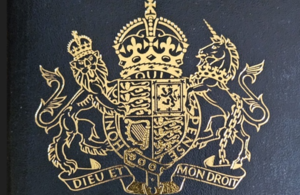
Today the Home Office announced that British passports had been updated to, among other things, display Timothy Noad’s illustration of the British royal arms, replacing the old Reynolds Stone illustration as it has in so many other contexts. Stone’s illustration, at time of writing, still appears on Acts of Parliament.

In other heraldic news, it has been five months since the last newsletter by the College of Arms and six since the last blog post by the Heraldry Society. Still, at least there’s another virtual Oxford lecture coming up in a fortnight’s time!

Accession Day 2025

Today marks three years since the passing of Elizabeth II and thus the commencement of the fourth year of the New Carolean era. Here is a quick round-up of recent developments.

New Royal Biographies

The stream of these is continuous and too large to notice all of them, but three in particular have generated news coverage:

  • Entitled: The Rise and Fall of the House of York by Andrew Lownie (14th August, HarperCollins). The title alludes to the Wars of the Roses, but really it’s about the personal, professional and financial lives of the most recent Duke & Duchess. The book is overwhelmingly derogatory and might have been considered scandalous had not most of the topics therein been raised already some years ago (while the other claims are usually less-than-credible). Many reviewers and columnists have said words to the effect that it would be devastating to its targets’ reputations if only they had reputations left to devastate. The people who didn’t already believe the things Downie asserts here probably won’t read this book anyway so despite a few sensational headlines I doubt in the long run it will really change anyone’s position.
  • Power and the Palace: The Inside Story of the Monarchy and 10 Downing Street by Valentine Low (11th September, Headline). Low has already written Courtiers in 2022, which I have in my collection but have not gotten around to reading yet. I’m not sure I’ll ever read this one either since, as is often the case with this kind of book, the newspapers have already spent weeks running headlines explaining all the important bits. The book is about the relationship between senior members of the royal family and senior members of successive governments. The most outlandish part is the attempt to lift the lid on Schrödinger’s box regarding Elizabeth II’s political beliefs, long a source of speculation to all and sundry. Low, quite remarkably, claims that Her Late Majesty was much more candid than formerly thought and that everyone else around her was more studiously discreet. The most prominent assertion (in terms of news coverage) concerns her views on the 2016 EU referendum. Private Eye has this amusing summary:
GALLAGHER’S GALL
ORDERED by press watchdog Ipso to print a correction to his pre-referendum front-page headline “QUEEN BACKS BREXIT”, which was found to breach its accuracy rules since there was nothing in the story to show it was true, then-Sun editor Tony Gallagher was defiant.I don’t accept that we made an error at all,” he huffed to the BBC. “We made a judgement that the headline was right and that it was backed up by the story. We knew more than we put into the public domain. The sources were so impeccable that we had no choice but to run the story in the way that we did.”
Nine years on, Gallacher has been promoted to edit almost-as-respectable sister sheet the Times, which is serialising Power and the Palace, the new book by the paper’s retired royal-watcher Valentine Low. And what headline appeared on Saturday’s front page flagging the first revelations from the impeccably sourced tome? “The Queen was a Remainer.” (Eye 1657 page 7)
  • Charles III: New King. New Court. The Inside Story by Robert Hardman (Pan Macmillan). It actually made most of its headlines last year but apparently he has a new edition coming out soon. I’m not sure if this is the second edition or if there’s already been one in the interim that I’ve missed, as I found a version on Google Books which claims to have been published on 7th November 2024 yet includes photographs of events from 2025. It has three extra chapters compared to the one I borrowed from Hull Central Library, and these cover the two royal cancer crises as well as the D-Day Commemorations and the general election. This latest version is obviously too early to include Trump’s state visit or the Duchess of Kent’s funeral, so probably yet another version will be needed next year. Pan Macmillan ought to have a trade-in scheme so people who already bought the old edition can get discounts off the new one. In an interview with journalist Patricia Treble he said Charles is “just the King” now as opposed to “the new king” so perhaps the very name of the book is now redundant and it would be better in the long run to wait until he has enough extra material for a full-length sequel instead of endless retroactive add-ons.

The Tudor Crown

Yes, that old chestnut again. I note that HM Goverment is still not entirely consistent here: When Rushanara Ali resigned last month the Prime Minister’s typed response had the new Noad illustration on its letterhead but when Angela Rayner resigned last week Starmer’s handwritten reply was topped by the old image, as was the letter from the Standards Adviser. Recently Charles wrote a letter to King Mswati III of Eswatini (formerly Swaziland) congratulating his country on fifty-seven years of independence. That letter was Tweeted by the British High Commission in Mbabane, showing the new emblazonment. It uses the “lesser” version of the arms in blue instead of the greater version in red, so it perhaps it should be understood as an FCDO letterhead instead of a royal one.

State Visits

Britain has already received a state visit from France this year and is about to host one for America also. As far as outbound visits go, there doesn’t seem to be anything scheduled for the rest of this year. In 2026 Their Majesties are expected to travel to Canada again (for an extended royal tour), to the United States (for a British state visit) and to Antigua & Barbuda (for CHOGM). There is still no announcement as to when they will visit New Zealand, which must be frustrating to those who’ve been waiting well over a year now!

August Armorial Announcements

The Queen’s heraldic banner continues to be a bugbear: Late last month, Sky Sports Racing Tweeted a short video of Her Majesty arriving (by helicopter) at Ascot. The commentator pointed out that upon Her Majesty’s appearance the royal standard was flown, but I noticed that it was again the generic ermine-bordered version and not that impaled with the arms of Bruce Shand, which has been seen in official usage recently. Perhaps the venue simply didn’t have a copy of that one yet?

The slow rollout of the Tudor Crown continues — on 1st August the Australian Department of Defence announced that all three service branches had updated their logos to use the new crown, as well as making other small adjustments to the rest of the graphics.

On the same day, the British Army announced a new cap badge for The King’s Gurkha Artillery Regiment, which likewise has the Tudor Crown on in. Since this regiment did not exist until this year, there was no St Edward’s version to remove in this case.

The King himself appeared at RAF Lossiemouth on 6th August to present a new standard to 42 (Torpedo Bomber) Squadron. I would assume that the Tudor Crown appeared on it, but none of the photographs or footage of the event gave a clear view of the standard itself — which is ironic given that was the whole point of the event!

Progress in the judiciary is less clear. I should remind readers that I am only speaking here about the judiciary of England and Wales, since that in Scotland uses the other version of the royal arms with the Crown of Scotland while that in Northern Ireland is reluctant to use explicit national symbols at all. The United Kingdom Supreme Court, and the Privy Council, have already been discussed.

From the PDFs of recent judgments, it appears that both civil and criminal divisions of the Court of Appeal are still using the old and rather ugly Royal Courts of Justice logo, with the almost-triangular royal shield topped by St Edward’s Crown, as are all three divisions of the High Court. Other courts are less consistent.

I have seen the Crown Court using several different ideas:

It looks as if every different court location has its own document template.

Another Condolence Note

Yesterday the Prime Minister and the Mayor of London attended the memorial at Hyde Park commemorating the London bombings of 7th July 2005.

As with the Auschwitz memorial earlier this year, Sir Keir left a wreath of flowers with a card attached. The card uses the old version of the government arms. I’m guessing the pile of these cards printed during the previous reign has still not been exhausted.

A mere four days earlier, the Prime Minister, Secretary of State for Health & Social Care and Chancellor of the Exchequer had visited the Sir Ludwig Guttmann Health Centre, where they spoke from a lectern clearly adorned with the new, Tudor crown, illustration.

I’m afraid I don’t have anything profound to say about the bombing attacks themselves. I had yet to ever visit London in person at the time and my main memory of that month is that of a school assembly in which our headmistress asked pupils what they’d seen on the news and a few had followed the story enough to relay it. I also remember a CBBC drama being made about the event a year later, but that’s about it.

More Crowns, More Confusion

Recently the office of the Lieutenant Governor of the Canadian province of Nova Scotia released photographs of the erection of a decorative shield on the wall of the Drawing Room at Government House, featuring the cypher of Charles III. Aside from the violation of the rule of tincture (by having a golden cypher on a silver background), I was struck by the fact that it used the Tudor Crown, not the Trudeau Crown as at the federal level.

Photographs from as far back as the coronation in 2023 show that the Tudor Crown was already in use by the provincial government at that time, with the Trudeau Crown nowhere to be seen. Ironically Nova Scotia, as the name and shield both quickly give away, was founded as a Scottish colony long before the Acts of Union and was granted arms by Charles I in his Scottish rather than English capacity, using the Scottish heraldic style with the motto scroll above the shield rather than below. The unicorn supporter even wears the Scottish crown. Perhaps it would have made more sense for the cypher to use that one instead.

It might be prudent at this point to make a note about Canada’s viceregal flags. Until Elizabeth II’s accession all the lieutenant governors used the Union Flag defaced by their heraldic badge on a white circle in the centre. Quebec changed in 1952, using the provincial coat of arm on a large white disk on a plain blue background. The arms are topped by the Tudor crown. It seems the province never adopted St Edward’s Crown despite Elizabeth’s stated preference for it. In the 1980s the other provinces switched to a similar-but-slightly-different design with the shield topped by St Edward’s Crown on a blue background with ten golden maple leaves. As far as I can tell they have not changed over since Charles III’s accession. Nova Scotia was the last holdout with the Union Flag design, only changing over in 2024. This creates the paradox whereby the Scottish and French provinces of Canada are the only ones using the crown design named after an English & Welsh dynasty.

Closer to home, but also wider afield, The Queen’s Commonwealth Trust, a charity set up in 2018, announced on Friday that it would be rebranding itself. Anything set up during that reign (or the reigns of previous female sovereigns) with “Queen’s” in the name inevitably had some ambiguity about what would happen in the next one – did “The Queen” mean Elizabeth II personally and permanently, did it mean the incumbent sovereign (in which case it should have become “The King’s” in her son’s reign) or did it mean the incumbent queen whether regnant or consort (in which case it would now belong to Camilla, but in the reign of a king with no wife there might be no namesake at all). The trust has gone with the first option, renaming itself The Queen Elizabeth II Commonwealth Trust and changing its initialism from QCT to QECT. The press release said that existing social media handles would not change, although it didn’t specify if the website’s domain name would do so. Presumably this gives them an excuse not to change St Edward’s Crown to the Tudor Crown in their logo.

Some Heraldic Snippets

Today the Royal Household released the Sovereign Grant Report. I will discuss the actual substance of it – especially the planned retirement of the royal train – in a later article. For now I will note that the front cover and title page of the report both continue to use the old version of the royal arms with St Edward’s Crown. This was also true of the Birthday Honours published last month in the Gazette.

The Queen opened the Ratho Library in Edinburgh today. She travelled in the newly-acquired BMW G70 (also a topic for a later article) which had her banner flying from the bonnet. It was difficult to get a good look in the footage and the press stills don’t show it at all, but I think I could make out the impalement line, with the dexter side having a yellow top half while the sinister side was white on top and blue on bottom. That would indicate it to be the English marshalling of the royal quarters, surely an armorial faux-pas for an event taking place in the Scottish capital!

The Duke of Edinburgh is in Canada visiting his namesake island and regiment. The royal website’s page on the event depicts his Canadian banner of arms flying in at least one photograph, though again I can’t find it shown in any of the stills on Getty or Alamy.

Also last month another German car manufacturer, Mercedes-Benz, was recognised as a royal warrant-holder. I presume it will be the new Tudor crown illustration that they show, but I haven’t seen any photographs of it yet.

Sealing the Deal

This is the old one, obviously.

A mere thirty-two months into the New Carolean era, a new Great Seal of the Realm has been unveiled. The design is largely the same as the version made for Elizabeth II in 2001 – the obverse shows the monarch enthroned, the reverse shows the royal armorial achievement (as illustrated by Noad).

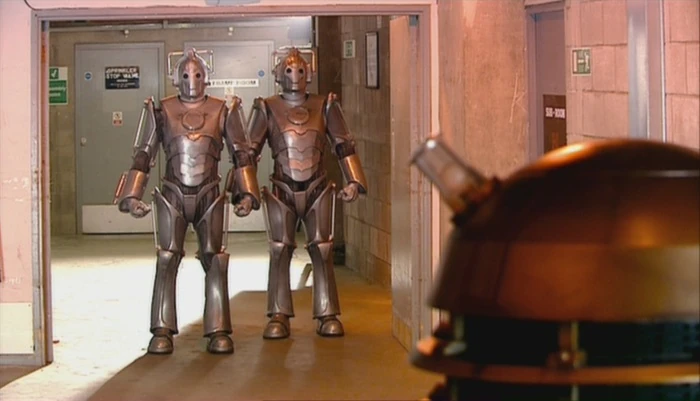
Noad’s heraldic drawing is well-known by now. The depiction of Charles on the front* has attracted some criticism: The King is, as at his actual coronation, wearing trousers rather than the more traditional stockings, and his shoes appear to jut out too much. Personally, I think they resemble the feet of 2006-era Cybermen. It is also notable that the crown shown on the monarch’s head is the idealised depiction of the Tudor crown, as opposed to the Imperial State Crown or the Crown of St Edward which he wore at the coronation itself.

The inscription around the outer rim is CHARLES III DEI GRATIA BRITANNIARUM REGNORUMQUE SUORIMQUE CETERORUM REX COSORTIONIS POPULARUM PRINCEPS FID DEF.

This is the official Latin equivalent of CHARLES III BY THE GRACE OF GOD OF THE UNITED KINGDOM OF GREAT BRITAIN AND NORTHERN IRELAND AND OF HIS OTHER REALMS AND TERRITORIES KING HEAD OF THE COMMONWEALTH DEFENDER OF THE FAITH, and the formulation is similar to that used by British sovereigns for centuries, though even I, eleven years on from having formally studied Latin, can see that it is not a perfectly literal translation.

Judging by the talk pages for both the English and Latin Wikipedias, it is clear I am not the only one to notice this. Britanniarum Regnorum just means “Kingdom of the Britains”** with no specific reference to Hibernia Septentrionalis.

Oddly it seems that the seals used from 1930 to 1953 actually did specify MAG BR and  HIB, short for Magnae Britanniae and Hiberniae as distinct items, but seals used both before and after do not. Uniti does not appear in any of them. The exact name in English of the polity ruling these isles has, of course, gone through many changes due to the evolution of our constitutional arrangements and is very confusing even to natives, but it is interesting to note that the Latin title doesn’t exactly move in step with the English one.

The use of Consortionis Populorum Princeps to mean Head of the Commonwealth of Nations is also a bit odd – “princeps” is of course whence we derive the words “prince” and “principal”, but it originally meant “chief” or “first in rank”. “Consortio Populorum” (“Partnership of the Peoples”?) is probably used because a more literal translation would probably be something more like “Respublica”, but of course in modern English (or British English at any rate), the words commonwealth and republic have diverged almost entirely to where the former means an organisation headed by a monarch and the latter means precisely not that.

Perhaps it is fitting that this event should take place just as a new Pope emerges – we’ll be seeing a lot of official Latin in use very soon!

*The many news articles I have found relating to this story all seem to be nearly word-for-word the same, and none of them identify the portrait artist.
**This is distinct from “King of the Britons”, which would be “Regnum Brittanorum”

Two Former Dominions, Two Federal Dissolutions

We find ourselves in the unusual situation where two of the large Commonwealth realms are simultaneously having federal general elections, with polling days in the same week. I was interested to compare the ways in which Canada and Australia go about dissolving one parliament and electing another.

In Australia, the relevant discussion is done in writing, with the government publishing both the Prime Minister’s letter and the Governor-General’s. These are not pro forma text, but there is little personal character in the prose which comprises mainly the essential technical details (especially the dates) and constitutional obligations. The proclamation itself is, compared to its British counterpart, remarkably short and unadorned. The Governor-General’s badge of office as seen in this letterhead still uses St Edward’s Crown. The monochrome government coat of arms in the Prime Minister’s letterhead is too small and low-resolution to determine, but probably the same.

The Canadian version has the dissolution of the old parliament, the issuance of writs of election and the meeting date of the new parliament done as three separate proclamations. Each individually is quite short, with apparent length padded out by the need to restate the monarch’s and governor’s style each time as well as the bilingual requirement. The familiar depiction of the Canadian royal arms is used, embedded as a vector image that loaded piece by piece. The crown here too is still St Edward’s, rather than the Tudor or Trudeau crown.

I know from previous examples that it is customary for the Australian dissolution proclamation to have a public reading, though have yet to find the video for this particular election.

Canada, Carney and Commonwealth

Sixty-two days after Trudeau announced his intention to step down, the leadership contest for the Liberal Party of Canada concluded last night. The winner, to the surprise of almost nobody, was former bank governor Mark Carney. He garnered 85.9% of the vote, albeit on only a 37% turnout, which really shows how uninspiring the other candidates must have been.

Carney’s Wikipedia page is already describing him as “Prime Minister Designate”, though the exact date at which the Governor General will formally appoint him to that office has not yet been decided. Canada tends to do governmental transitions at a rather slower pace than Britain does, with the time between leadership elections (or indeed general elections) and ministerial appointments often being measured in weeks rather than hours, but most indications are that this one will take place unusually quickly.

That the leadership election should eschew two experienced cabinet veterans in favour of someone who isn’t even an MP is a little surprising. In the Canadian constitution, as in the British, it is not illegal for a non-Parliamentarian to be appointed to a ministerial office, but it is considered improper and, above all, politically impractical. The nearest British precedent for Carney’s situation, and even then it is a very poor one, would be the much-discussed case of Sir Alec Douglas-Home disclaiming his peerages to jump back to the Commons in 1963. A more thorough comparison of these two situations may be worth a separate article.

Accession to the premiership will, of course, give Carney the right to constitutionally advise the King of Canada, including advising him to speak on Canadian matters.

For the moment, Charles continues in a state of political limbo. Following a long-established royal tradition, he must express himself in a cryptic, plausibly-deniable way, often through subtle sartorial cues.

Today is Commonwealth Day, which includes a service at Westminster Abbey and the publication of a message by His Majesty. As the position of Head of the Commonwealth has no formal powers at all, it is not subject to “advice” from the secretariat in the way that ministers advise their monarchs, and thus this is a rare opportunity for Charles to speak his own mind. Of course, the message is meant to broadly encompass all fifty-six-and-counting members of the organisation, so is still a poor venue for a determined diatribe about any particular one of them, so any comment about the defence of Canadian sovereignty must again be inferred rather than stated outright.

Sir Keir Starmer has been similarly cautious, Tweeting about “further deepening the UK-Canada relationship together” but not saying anything specific about what that would entail. It was also announced two days ago that the Department of National Defence had commissioned a fleet of new destroyers based on a British design, but this is likely unrelated to the state of relations with the White House.

Returning to more familiar territory, I notice that where the Commonwealth Day message has been quoted in photographic form, the coat of arms in the letterhead is now the new Timothy Noad illustration with the Tudor crown. Said illustration has also now replaced the earlier versions on the royal website as well. As I noted to Sodacan, the change was done at some point in the morning of Wednesday 5th March.

During the abbey service itself, I distinctly noticed Their Majesties sitting behind ornate wooden faldstools with what looked like the old-style royal arms of Canada on them. This is not in itself the cryptic clue that it might seem – they were donated by the Canada Club in 1949.

The most surprising recent development in the past few days has been the launch of another royal podcast. Whereas Camilla has been patronising The Queen’s Reading Room (of which a podcast is but one part) for some years, Charles has only just announced The King’s Music Room (probably named that way for congruence with his wife’s project), but it has already generated a lot more headlines. The format is very different from the Reading Room, being very explicitly the product of a partnership with Apple and only available to their subscribers, among which I am not.