Some News At Last!

Long-time readers will be familiar with my frustrations in discovering the heraldic achievements of former ministers and recent Garter companions Lady Amos and Sir Tony Blair. Now, at last, some progress is being made.

My guess at Amos’s lozenge.

Almost a month ago the Right Reverend Graham Usher, Bishop of Norwich, Tweeted a photograph of the inside of St George’s Chapel. Among the familiar Garter banners I noticed one I had not seen before – per saltire Gules and Or, two of the sections charged with counterchanged circular devices. Presumably the other two sections had them as well, but Sir Thomas Dunne’s banner obscured them. I wasn’t entirely sure what the symbols were – Jukudlick, another Wikipedian, reckoned they were gyroscopes. Without any specific, reliable matching of the arms to the person I was not prepared to add the graphic to her page.

Today’s update comes from the website of Ian G. Brennan, the man who actually constructs the wooden models of knights’ crests to go above their stalls. He includes a photographic gallery of all the crests he has made… and now Blair’s is among them. I had not been paying much attention to his website as it did not look to be frequently updated – indeed the overall design looks to be stuck around the middle of Blair’s premiership. Judging by what I saw when checking the Wayback Machine, this update happened within the last ten days.

No blazon is given, but my best guess for Blair’s crest is a mute swan’s head erased Proper holding in the beak a rose Gules seeded Or barbed slipped and leaved Vert.

The torse is depicted as Azure, Or and Gules, which gives some hints as to the principal tinctures of the shield. The red rose is almost certainly a reference to his thirteen-year leadership of the Labour Party.


The website also has a photograph of Amos’s crest. Whether this actually is a crest or just a badge is yet to be seen – I note that the photograph is framed so as not to reveal the presence or absence of a torse. Here the round object looks more clearly like a gyroscope, while the beast holding it is, I would say, a panther sejant guardant Proper. As always with heraldry, you can’t be sure until you’ve read the blazon.

This year’s Garter ceremony was held on Monday. Blair and Amos attended for the second time, as did first-timers Lady Ashton of Upholland and Lord Patten of Barnes. Ashton is already King of Arms for the Order of St Michael and St George (even attending the coronation in that capacity), yet her own bearings are not recorded in any issue of Debrett’s I’ve seen. Patten has no record either. Based on this, I don’t expect any revelation until 2025.

The Matter of Sir Martin

Yesterday the London Gazette published the list of British honours conferred to commemorate the sovereign’s official birthday. Among those appointed as Knights Bachelor was the writer and academic Martin Amis. This announcement was notable for two reasons, the most prominent being that he died almost a month ago.

Britain doesn’t generally do posthumous honours, but occasionally people who have accepted them die before the official announcement and the chancery (or Cabinet Office) decides to keep their names on the list.

In this case the supplement specifies “To be dated 18 May 2023” and from what has been reported so far, officials contacted Amis early last month then rushed through the administrative process to confer the award before he died, but asked his family to keep it secret until now. We can presume that no physical accolade was given, since he was in Florida at the time.

The second reason this raises eyebrows is that Amis never seemed like the sort of person who would desire a knighthood – in much the same way that it would feel strange for George Orwell or Christopher Hitchens to get one. He even said outright in a 2011 interview that he would never accept any honour from the crown. It is not clear what caused this apparent deathbed conversion, and I have seen comments from some people speculating what mental state he was in during his final days.

Obviously Sir Martin himself will have no opportunity to enjoy the trappings of knighthood, but his widow and daughters will, and the backdating means that they will have precedence above the wives and children of other Knights Bachelor appointed yesterday, or indeed in the Resignation Honours last week.

Arms, Flags, Paint Pots & Queens

Having written a few times now about heraldry as featured in The Railway Series, as well as significant events in that franchise, I felt that now would be a good time to do a spotlight on the most particularly heraldry-heavy story.

Today is the seventieth anniversary of the UK publication of Gordon the Big Engine, the eighth book in the series, came just fifteen days after Elizabeth II’s coronation. I will, of course be focusing on the fourth chapter in the book (and its 1995 television adaptation), in which the monarch herself visits the big station.

The written story has seven illustrations by Clarence Reginald Dalby, of which only the last three are relevant here. The television episode obviously has a large number of potential screenshots. The images used below are linked from the bountiful gallery on ttte.fandom.com and are labelled by their timestamp within the episode (not counting opening credits) in case of future link rot.

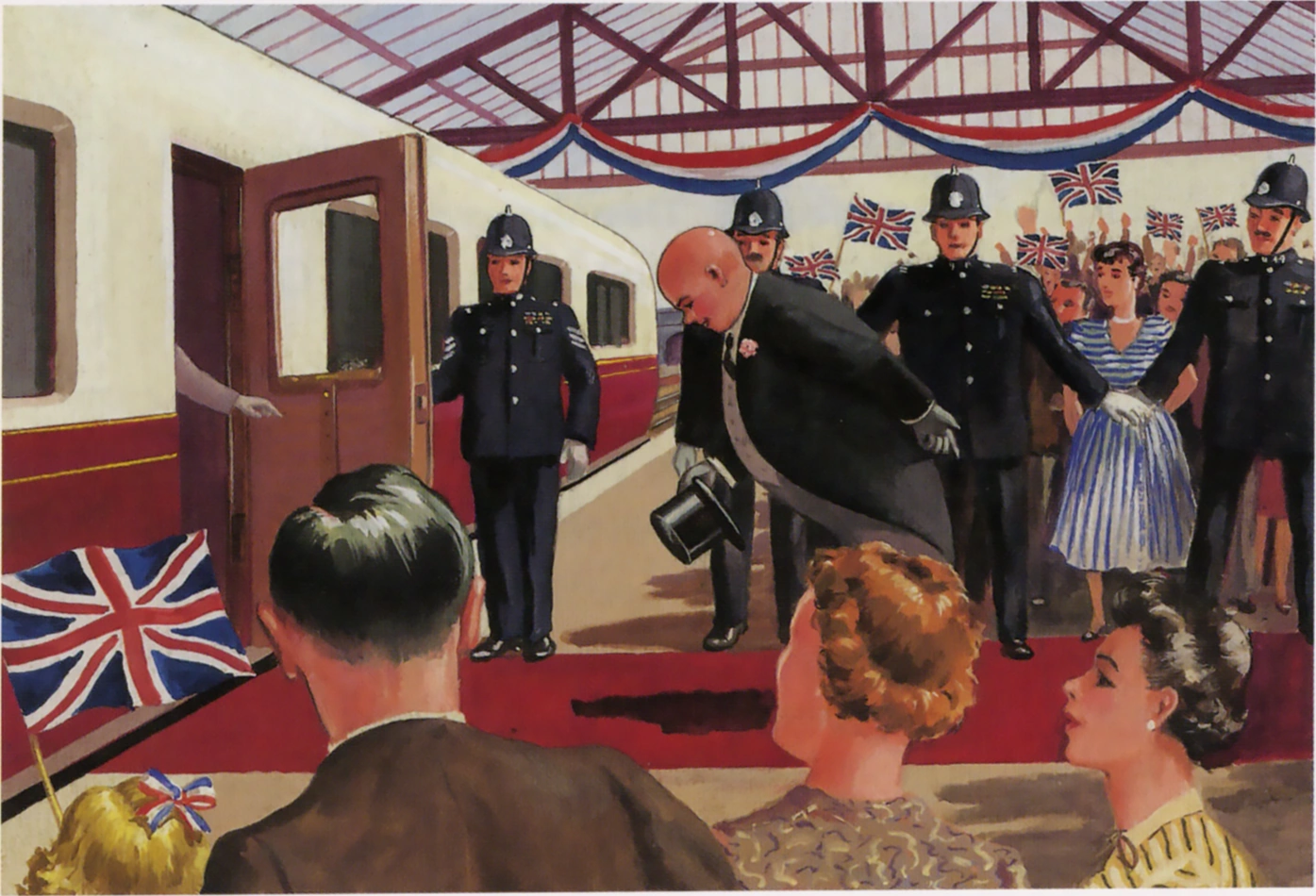
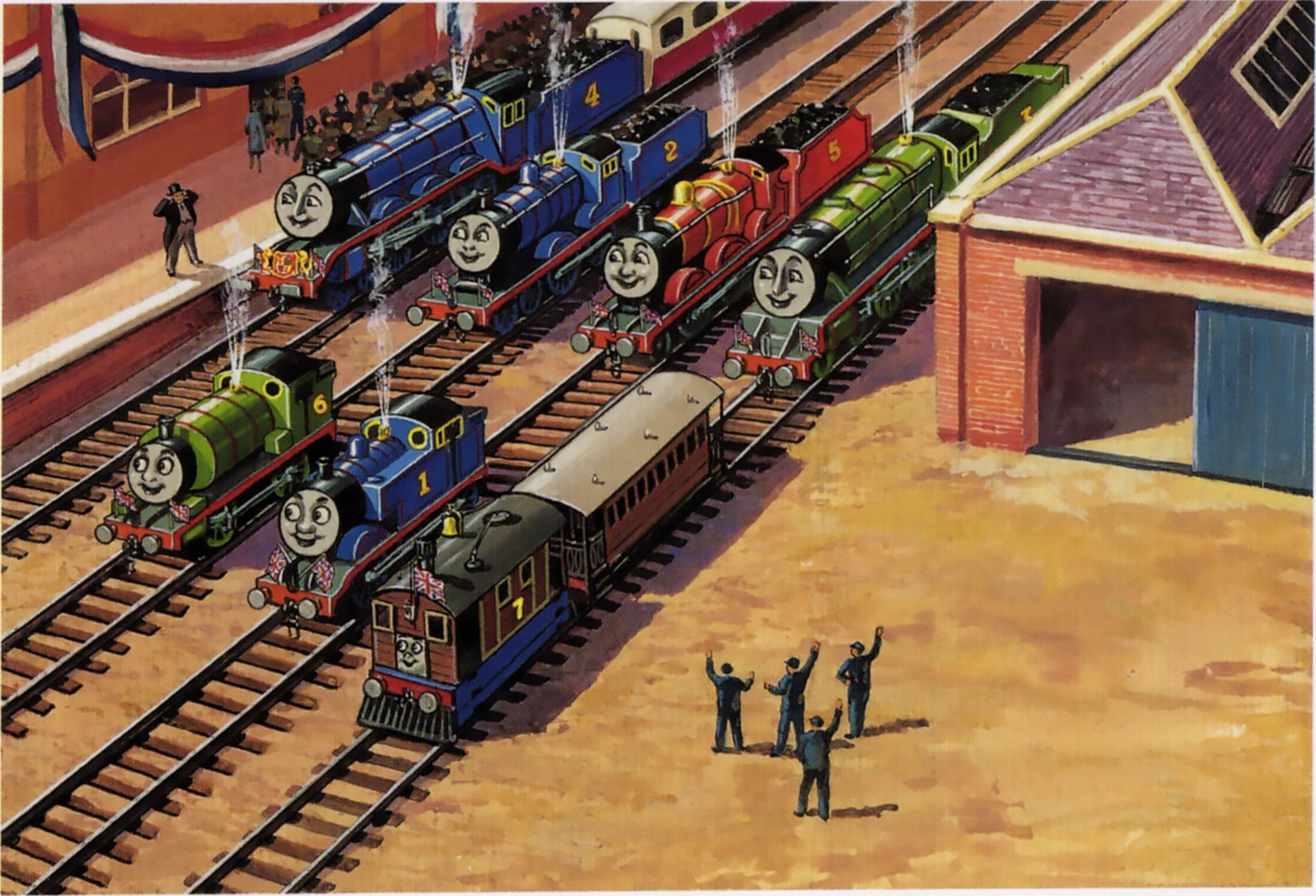
5th illustration

6th illustration

7th illustration

The text of the story says:

Edward steamed in, looking smart with flags and bright paint.
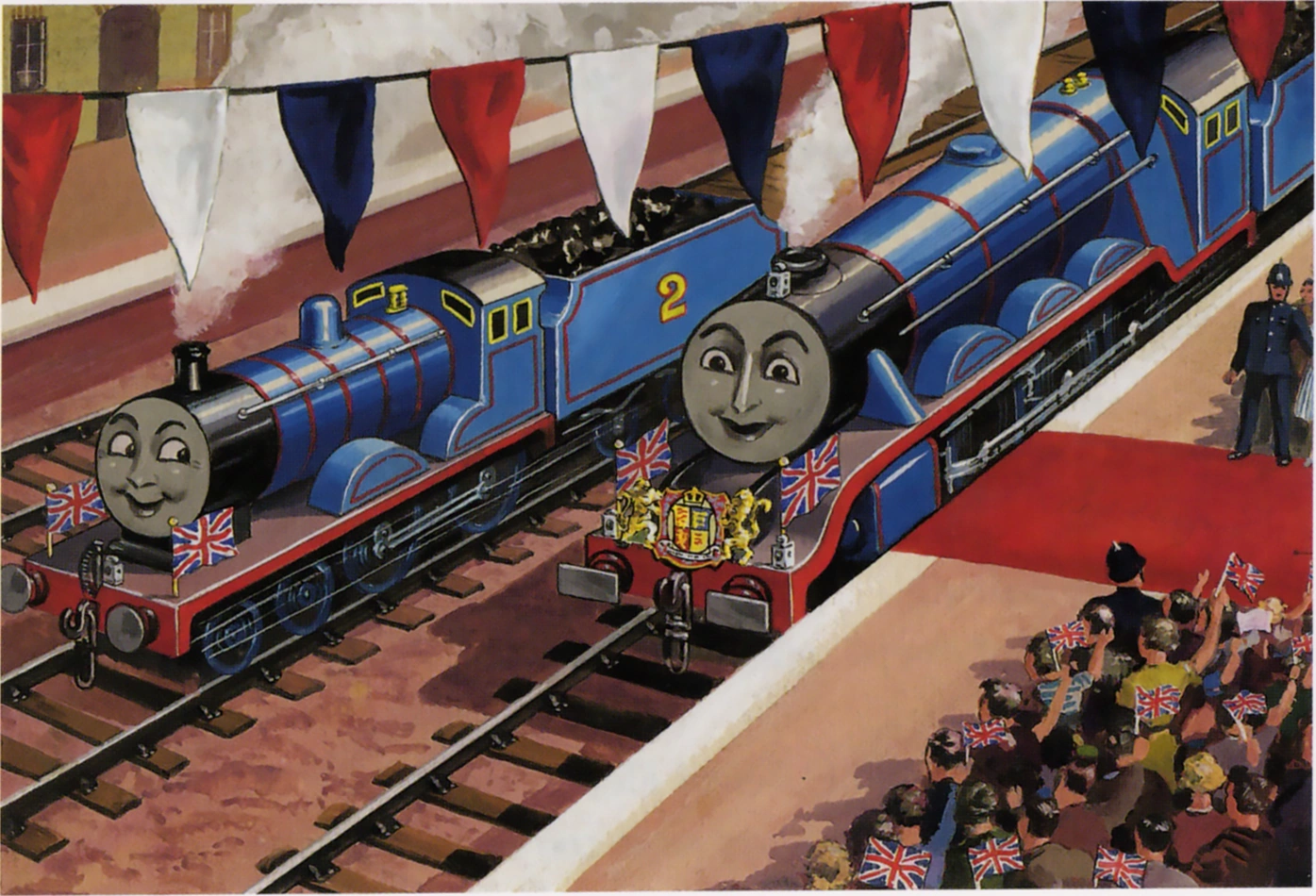
…the Queen’s train glided into the station. Gordon was spotless, and his brass shone. Like Edward, he was decorated with flags, but on his buffer beam he proudly carried the Royal Arms.

In the illustrations themselves we can see Union Flags galore, as well as a string of pennons in the national colours.There is also a tricolor drape across the frame of the station which runs the risk of inadvertently looking French or Dutch. Gordon’s carving of the royal arms is obviously the centrepiece here: It looks to have a lion Or as the supporter on both sides with the quarterings being first and fourth Or, second Azure third Gules. The actual charges on them cannot be deciphered but the crown looks like a reasonable approximation of either the Tudor crown or St Edward’s (the former likely still being in wide usage at this early stage of Elizabeth’s reign).

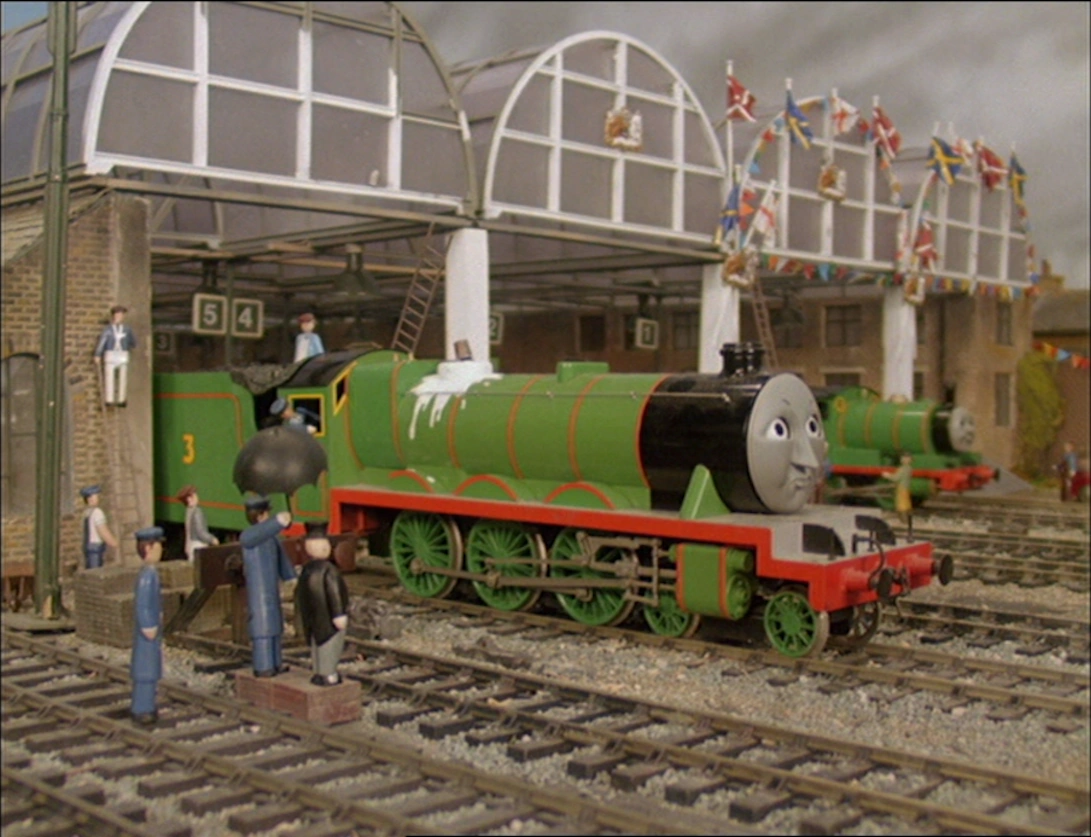
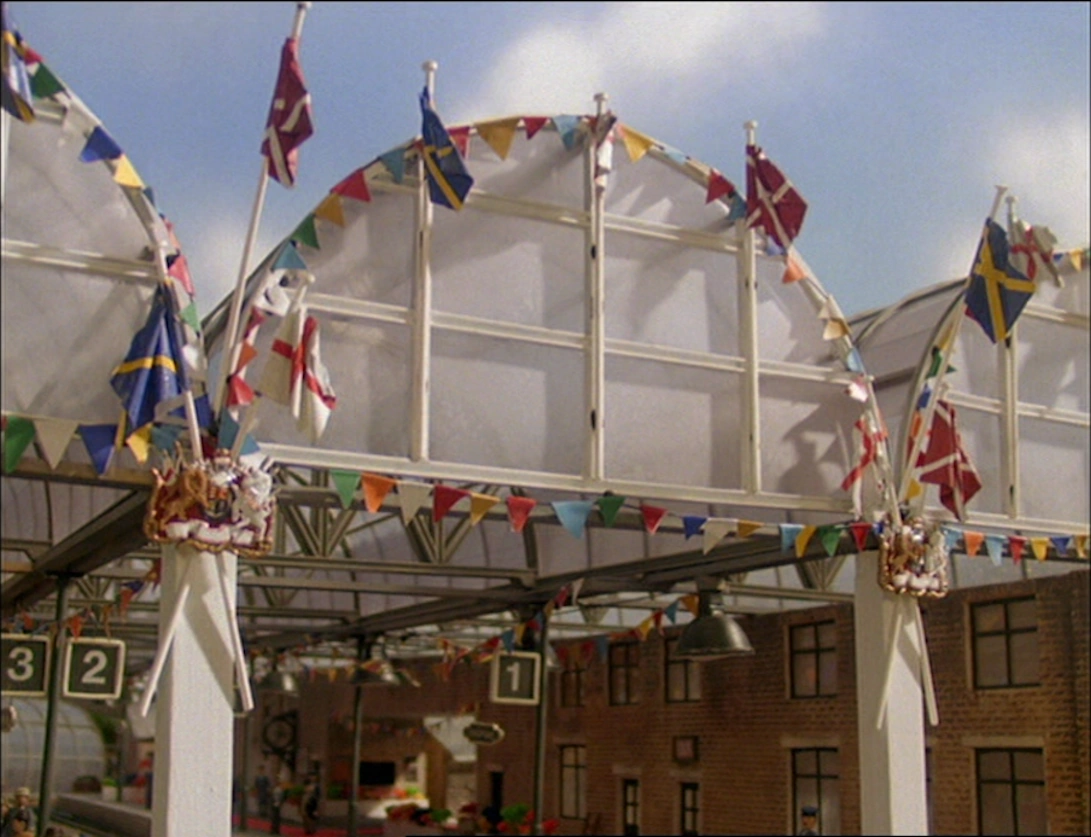
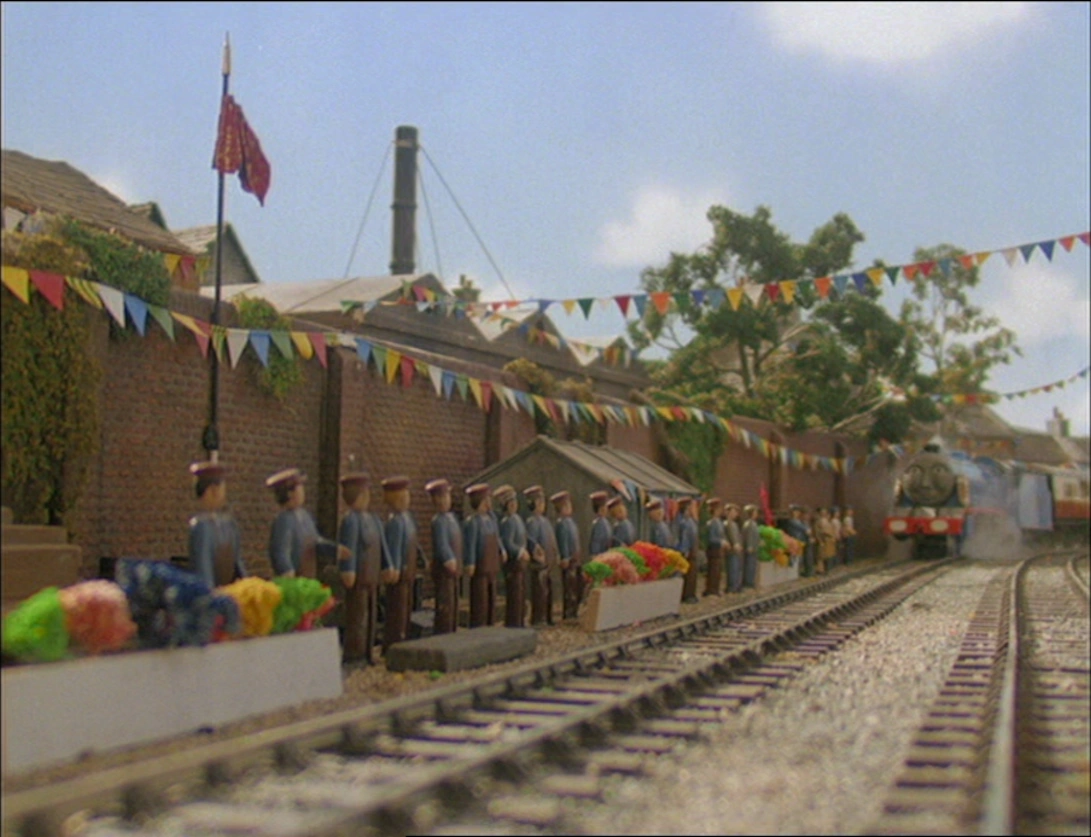
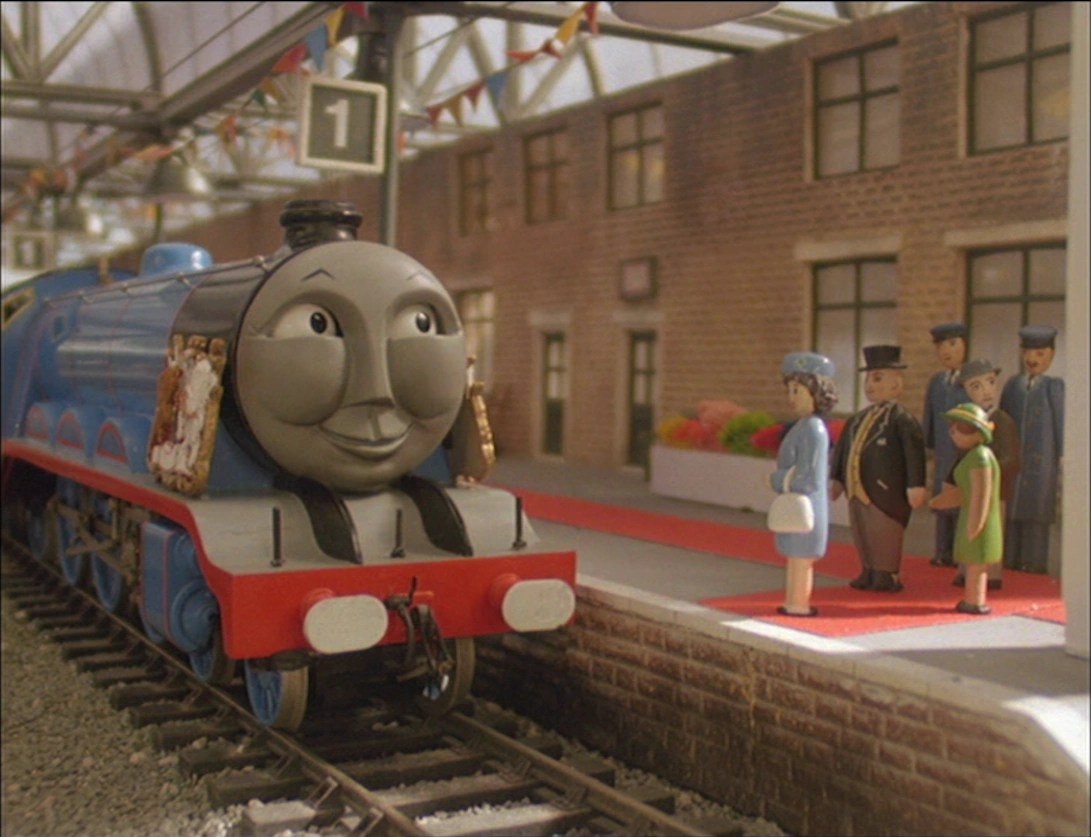
The television adaptation depicts things a little differently – Britt Allcroft at this stage was keen to present Sodor as a mystical fantasy land and dissociate it from the United Kingdom (although clearly not from the monarch), so the Union Flags are entirely absent and the bunting is generically technicoloured. We do, however, see multiple carvings of the royal arms – one leaning on either side of Gordon’s smokebox and at least four more attached to the station itself – originally on the glass of the canopy but later moving to the pillars and a nearby lamppost.

2m02s

2m43s

3m24s

4m20s

Also flying from the canopy are three flags of more definite designs, the first Argent a cross Gules, the second Azure a saltire Or and the third Murrey a saltire Argent. The first is obviously the flag of England but I don’t know the origin of the other two. We don’t get a close-up shot of the royal arms, but they are clearly supported by a golden lion and a white unicorn in the right arrangement. The shield itself looks to be blue in both the lower quarters but the upper quarters for England and Scotland are potentially correct. A red banner with indecipherable golden embroidering also flies outside the station as Gordon approaches.

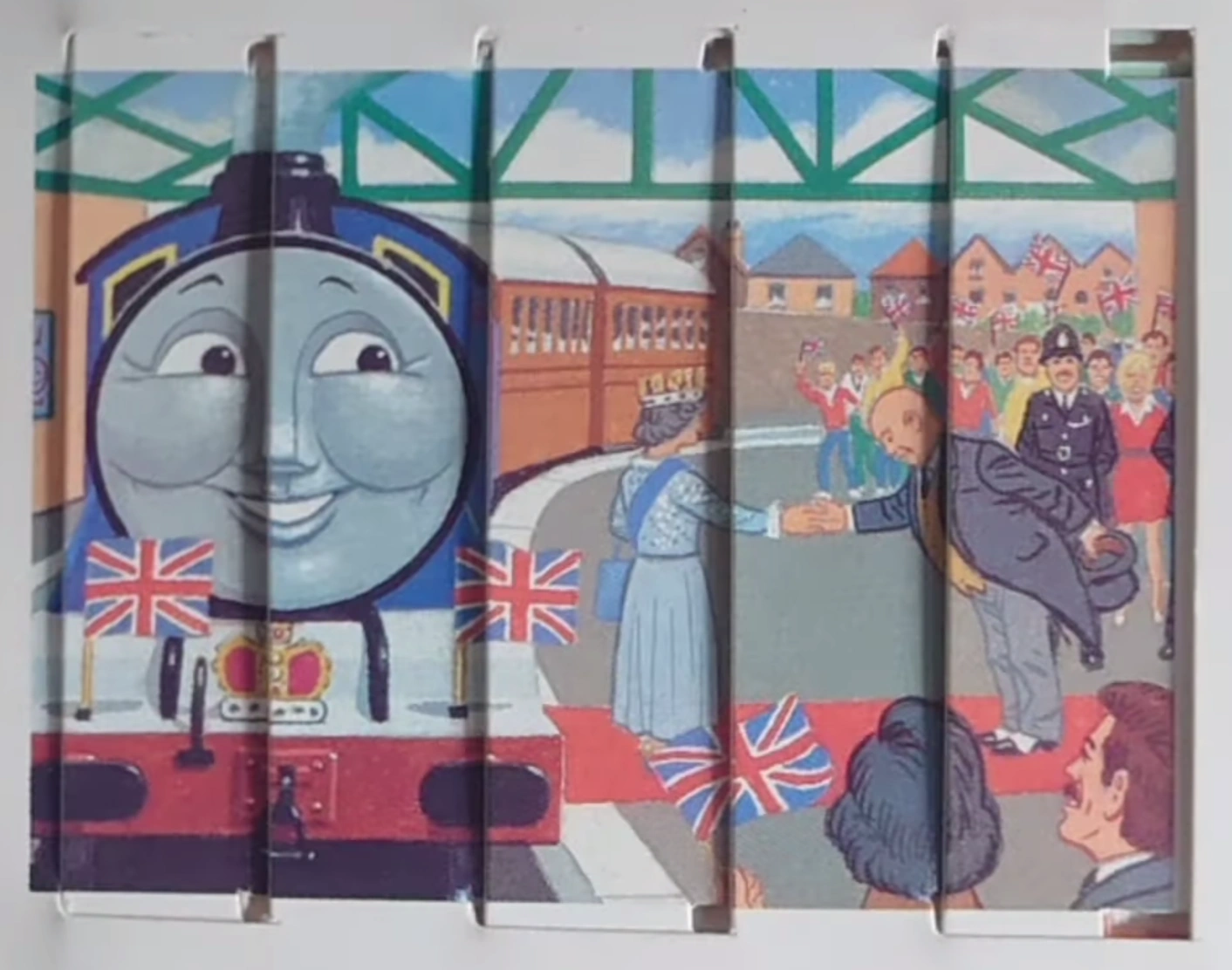
This, incidentally, was not the first adaptation of the source material, for the story was republished as part of a series of Changing Picture Books called Busy Engines in 1994. The illustrations here (by Arkadia Illustration Ltd.) show many Union Flags as in the original book but no royal arms. Gordon’s footplate instead carries a large facsimile of St Edward’s Crown (perhaps foreshadowing the Duchess of Loughborough).

The Queen’s own appearance also changes – in the 1953 book she is shown only as an arm emerging from her carriage, in the 1994 book wearing a golden circlet trimmed with ermine and a thick blue sash from her right shoulder (very formal for a day trip on a steam train) and in the 1995 episode in a light blue dress with matching hat. It has been suggested but never confirmed that the man in the brown jacket is meant to be her husband and the short woman in the green dress her mother, which might be the clue as to why the story title implies that more than one queen visited.

Armory and Architecture

This evening I attended a virtual lecture at Arts University Bournemouth. The presenter was David Lund and the subject was the history of architectural model-making, particularly that of John Brown Thorp.

Modelling is an invisible profession to most people as the model-makers are largely executing the ideas of architects, who thus take all the credit for the design. British model-making kicked off in the late sixteenth century with the arrival of trends from Italy. The earliest record is of a 1567 model of Longleat House, made for Sir John Finn. Sir Christopher Wren would go on to commission architectural miniatures on a regular basis.

Originally timber was favoured for model-building, but card proved to be more adaptable. Thorp is considered the grandfather of architectural model-making. He had his headquarters near to the Inns of Court, and his extremely-detailed scale models were used in court cases. By 1940 his firm was employing forty other modellers. The emergence of modelling as a dedicated profession allowed an increase in the size and standards of their creations.

Modelling boomed in the 1950s and ’60s, with the material fashions of the models changing in line with those of the buildings themselves – card representing brick was replaced by perspex representing glass and steel. The economic slump of the 1970s caused a change in clientele, with modellers working for private developers instead of state architects. Nowadays it is common for models to be designed on computers and then 3D-printed, incorporating lighting and even animation.

In the Q&A session, Lund was asked about the phenomenon of public disappointment when a finished construction fails to live up to what the model promised. Lund conceded that models and artistic renderings often gave a sanitised, optimistic prediction of the built environment, replete with happy people and clean surfaces, whereas the reality (especially in modernist constructions) proved quite different. Developers and the public often unfairly blame the artists and modellers for this, even though they are only following what the developers tell them to do.

On an entirely unrelated note, late last night I discovered that Sir Lindsay Hoyle, Speaker of the House of Commons since 2019, has finally been granted a coat of arms. I was relieved to come across this news at all, yet also a little perplexed to realise that the news articles were from almost a month ago. I don’t know how I missed this, given that I have been obsessively looking out for this ever since his election. The not-so-grand reveal came at the unveiling of a new set of stained-glass windows in the Palace of Westminster, the other panels of which were decorated with the arms of British Overseas Territories.

None of the news articles I have uncovered so far gave the blazon for the new achievement, so my illustration for Wikimedia Commons is based on visual inspection of the artwork in the photograph. It indeed includes the red rose of Lancaster, “busy bee” and rugby references as Sir Lindsay hinted two years ago. The use of the parliamentary mace Or on a fess conjoined to a bordure Vert is almost certainly copied from the arms of Sir Harry Hylton-Foster, who became speaker sixty years before Hoyle did – though one has to hope that Hoyle does not end his tenure quite so abruptly. The window shows mantling Gules and Argent (rather than Vert to match the shield), so I have copied that. It is not clear exactly when the grant was made, nor whether the grant was to Sir Lindsay himself or to his noble father (the mace makes the latter seem unlikely).

The search for other new grants continues. Last month I got a pretty strong hint about the arms of Lady Amos, but those of Sir Tony Blair remain as elusive as ever.