Waving the White Flag

In recent weeks there has been some reshuffling of responsibilities within the royal family: The King and the Princess of Wales have both been undergoing cancer treatment, limiting their ability to carry out public engagements away from their residences. Consequently, a greater burden has fallen on His Majesty’s wife and ever-trusty sister.

The Queen’s recent sole engagements have included Douglas City Hall on the Isle of Man (for the presentation of the letters patent to confer city status), and Worcester Cathedral (for the Maundy service ahead of Easter).

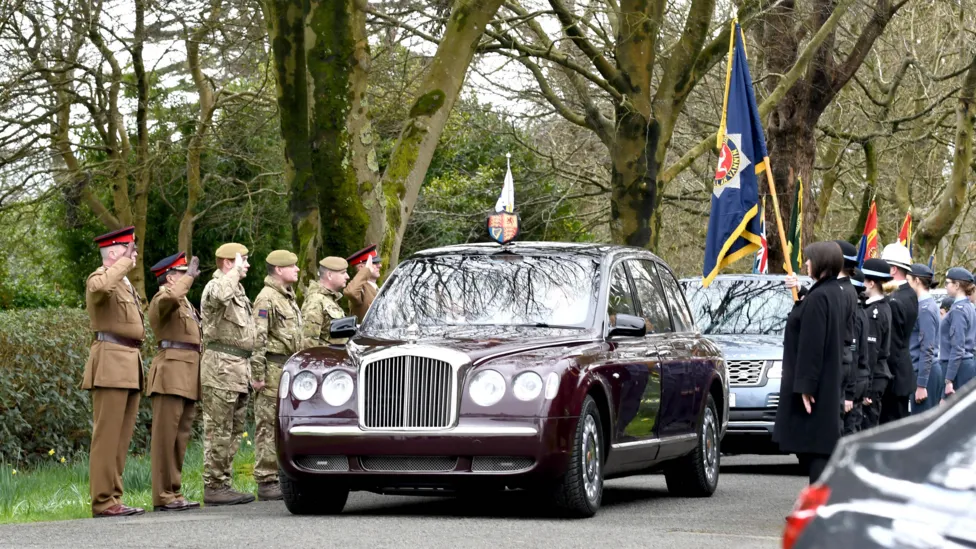
As was noted in Mark Scott’s lecture a month ago, the granting of banners of arms to members of the royal family is a separate event from the granting of the armorial achievement itself (rather than being automatic as it would be for lesser armigers). Eighteen months into her tenure as queen consort, it appears that Camilla’s own banner has not been granted, for I have repeatedly seen the Bentley State Limousine flying the ermine-bordered version of the royal standard used for lesser members of the firm who had not been granted personalised heraldic flags of their own, while the shield affixed to the roof shows the arms of the sovereign undifferenced.

As is so often the case, the Wikimedia Community have moved much faster than reality – a graphic representing Camilla’s banner as queen consort was uploaded preemptively way back in 2016 and has been used in multiple articles since her husband’s accession. Perhaps this will need to be revised in light of new evidence.

PHOTOGRAPHIC REFERENCES

In Honour of the Occasion

Photograph by sbclick, 2011 (CC-BY-1.0)

In theory the monarch can bestow practically any accolade on any person at any time and for any reason. In practice, since the late Victorian age there has been a trend towards grouping announcements into two big lists each year – one in June for the sovereign’s official birthday, one in December for the upcoming new year. There are also smaller lists issued at irregular intervals to commemorate particular events e.g. the deaths of senior royals, the dissolutions of parliaments and the resignations of prime ministers. The latter two types tend to be particularly controversial.

Wikipedians have generally maintained pages for all of the lists, great and small. They  have also created an annual page called “Special Honours”, which they use as a catch-all term for those titles and decorations which were issued outside of any named occasion.

Today’s announcement is a little confusing for those seeking categorisation – the Prime Minister’s office has released a list of honours and appointments for March 2024. The document as a whole does not have any particular name, but paragraphs within it do: Creative Industries Honours, Technology & Artificial Intelligence Honours, and Political Honours. The former has provoked the most recognition, appointing film producer Emma Thomas as a DBE and her husband Christopher Nolan (already a CBE since 2019) as a knight bachelor. There is also a short list new privy counsellors (e.g. Vaughan Gething, recently appointed as First Minister of Wales), though whether these count as honours in the way knighthoods do is debatable.

This new publication comes just forty-eight days after the list of “Political Peerages” (e.g. yet more new members of the House of Lords). It eludes me why today’s list was not brought forward to be merged with that one, or pushed back to fold in with the Birthday Honours in June. The only likely explanation is that these were Rishi Sunak’s personal picks and he (or His Majesty) wanted that distinction made clear in the public mind. Of course, that could also have been achieved by waiting for the looming dissolution honours at this year’s general election – or indeed Sunak’s resignation honours, which may well come earlier!

Edward gets the Thistle

The Prince Edward seems to have made a habit of collecting new titles on his birthdays. For the occasion of his wedding in 1999 he was ennobled as Earl of Wessex and Viscount Severn. These both refer to places in England, in contrast with the normal convention for royal peerages. On his fifty-fifth birthday he gained a surprise Scottish title – Earl of Forfar – and then for his fifty-ninth he gained another, long-awaited and far more prestigious one – Duke of Edinburgh. Now that his primary title refers to a Scottish place – and the capital at that – it would seem a little strange for him not to join Scotland’s highest order of chivalry.

It was not exactly surprising, then, to learn that on his sixtieth birthday he had been appointed an Extra Knight of the Order of the Thistle. In this category he joins his nephew the Duke of Rothesay and his sisters the Queen and the Princess Royal. We can expect that soon his banner of arms will be hung alongside theirs at the High Kirk in his namesake city.

The King also announced three new appointments among the ordinary membership of the order – the Baroness Black of Strome, the Baroness Kennedy of The Shaws and Sir Godfrey “Geoff” Palmer – all of whom, curiously, have academic careers. This brings the order up to its full complement of sixteen members (excluding royals). It is unusual for all the appointments to be made today as traditionally they are announced on 18th June.

Finally, a concurrent press release confirmed that the duke had been appointed to a second term as Lord High Commissioner to the General Assembly of the Church of Scotland, a post which he last held in 2014-15. In the Scottish order of precedence he will rank immediately below the sovereign himself, rather than his natural precedence as a brother thereof.

Awdry Arms Again

Back in November I discovered the coat of arms of Sir John Wither Awdry, paternal grandfather of children’s author Wilbert Vere Awdry. The illustration was based on a blazon found in Burke’s Landed Gentry, 1862.

Page 39 of that book gives the shield Argent three cinquefoils Or on a bend Azure cotised of the same and crest out of a ducal coronet a lion’s head Azure for AWDRY OF SEEND.

The next entry is AWDRY OF NOTTON, and it is this one which includes Sir John. For the arms and crest of this branch, Burke merely says “same as AWDRY, of Seend”.

Today I have found the family referenced in the Burke’s Landed Gentry 1921. Page 53 of this book gives a slightly different blazon – shield Argent on a bend Azure cottised Sable between two crescents of the second a crescent between two cinquefoils Or and crest on a wreath of the colours in front of a lion’s head erased Azure gorged with a collar gemel Argent a cinquefoil between two crescents fesseways Or. Curiously the entry for Awdry of Seend in this edition gives no armorial details at all. Wilbert was ten years old when this version came out, and his date of birth is given in his father’s paragraph but no other detail about him personally is included.

The Awdrys are also mentioned at least twice by Arthur Charles Fox-Davies in his Armorial Families series. Page 51 of the 1895 book gives entries for multiple Awdry men, each time with the same information about Sir John’s arms – shield Argent on a bend cottised Azure three cinquefoils Or a crescent of the second for difference and crest out of a ducal coronet Or a lion’s head Azure. He also takes care to note that these are armorial bearings as used, and as quoted in Burke’s “Landed Gentry”, but for which no authority has been established. These comply with the blazon as I first encountered it, except that the crescent for difference was not originally there. The crescent, of course, is the traditional English mark of cadency for an armiger’s second son. I find it a little odd that Fox-Davies types the exact same information out for each of Sir John’s many sons whom he records, but does not say if any of them added extra cadency marks for their own position in the family tree. Pages 55 and 56 of the 1910 book gives the exact same blazon as Burke’s 1921.

For now I will accept the later version as the correct one and I have modified my illustration accordingly. Pending further research, I would speculate that the Awdrys of Seend are the senior branch of the family with the relatively simple arms while the Awdrys of Notton are the long-established offshoot with permanent (although inconsistently recorded) augmentations.

FURTHER VIEWING

A Cluster of Camerons

Donald Andrew John Cameron was elected to the devolved Scottish Parliament in 2016 on the regional list for Highlands & Islands. He served in many roles in the shadow cabinet at Holyrood, but last month resigned his seat upon appointment as Parliamentary Under-Secretary of State for Scotland in the national government at Westminster. To facilitate these duties he was ennobled yesterday as Baron Cameron of Lochiel, of Achnacarry in the County of Inverness. Although this is a life peerage, he also holds the hereditary chieftancy of Clan Cameron, of which two other members currently sit in the upper house – and both of them acted as supporters to his introduction ceremony.

Ewan James Hanning Cameron, Baron Cameron of Dillington, has sat as a crossbencher since 2004, having previously worked in semi-political rural advocacy roles during the premiership of Tony Blair. He is a grandson of Sir Donald Walter Cameron, the 25th Clan Chief, thus making him an agnatic first cousin once removed of Lord Cameron of Lochiel.

David William Donald Cameron, Baron Cameron of Chipping Norton, should already be familiar to most readers as the former prime minister and current foreign secretary. His consanguinity to the new peer is very distant, his great-great-grandfather Sir Ewen Cameron having claimed descent from the Camerons of Erracht, themselves being descended from a younger son of the 13th Lochiel and branching from the main clan in the sixteenth century.

The arms of Clan Cameron are Gules three bars Or. Lochiel naturally bears these undifferenced, while Dillington differences with in the honour point an escallop of the second. Chipping Norton differences with four bezants in chief.

The House of Commons also saw an introduction ceremony yesterday when George Galloway returned after a nine year absence having been elected MP for Rochdale. MPs who win by-elections are also traditionally escorted to the clerks’ table by two incumbent members. There were reports that Galloway had asked Jeremy Corbyn (Islington North) and Sir David Davis (Haltemprice & Howden) to act as his sponsors but both had turned him down. He was instead accompanied by Sir Peter Bottomley (Worthing West) and Neale Hanvey (Kirkcaldey & Cowdenbeath).

EXTERNAL LINKS