On Admirals and Arundells

The Queen turned seventy-eight today. That’s not traditionally considered one of the big birthdays and so commemorations have been fairly muted. The most significant announcement was her appointment as Vice-Admiral of the United Kingdom.

The Vice-Admiral is the deputy to the Lord High Admiral, and it may be prudent to recap the outline of that office first: The Lord High Admiral is the ultimate head (originally operational, but later just ceremonial) of the Royal Navy. Appointments have been made since the late fourteenth century in the Kingdoms of England and Scotland, then later Great Britain. Occasionally in Stuart times, and almost permanently from Anne’s reign onwards, the singular office was not filled and instead the post was instead put “In Commission” – i.e. delegated to the Board of Admiralty with the First Lord of the Admiralty (a cabinet minister) as its chair. The creation of the modern Ministry of Defence in 1964 saw the Board with its First Lord dissolved and the title of Lord High Admiral resumed in the person of Queen Elizabeth II. In 2011, on his ninetieth birthday, she conferred the office upon her husband Philip. The status of the office following his death in 2021 is a little ambiguous but the general assumption is that it defaulted back to the sovereign and now resides in King Charles III. I had wondered if Vice-Admiral Sir Timothy Laurence would be appointed on his seventieth birthday this March, but this did not occur. The King perhaps intends to retain the top office for himself and have his wife as runner-up.

The Queen is both the first female and the first royal holder of the office of Vice-Admiral, whose previous recipients have all been career navy men (and indeed tended to hold the actual rank Full Admiral). Her Majesty’s most recent predecessor was the Lord Boyce, who was appointed in 2021 and died in 2022.

Below the Vice-Admiral is another deputy, the Rear-Admiral. This office is currently held by Sir Gordon General, a General in the Royal Marines who was formerly Vice-Chief of the Defence Staff and also served as Lord High Constable at the 2023 coronation.

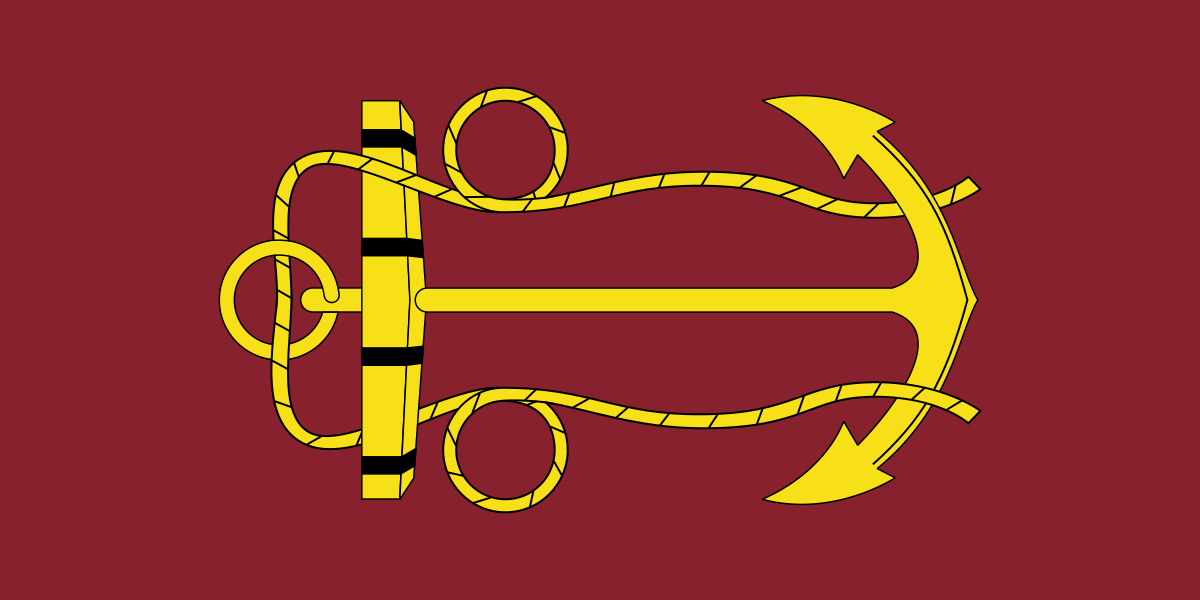
The Lord High Admiral has a flag of office – a fouled golden anchor on a crimson field. The Queen was presented with a “burgee” (pennant) with a red anchor on a white background when she visited HMNB Devonport. I just about saw Camilla’s impaled banner of arms as well.

On another note, today is also the twentieth anniversary of the death of Sir Edward Heath, Prime Minister 1970-1974. His military career was on land, though he was a noted yachtsman in later life. He stayed in the House of Commons for twenty-seven years after his premiership had ended, which is considerably longer than all his successors combined. He is the most recent Father of the House to have served more than one term, as well as the most recent to have formerly been Prime Minister.* He is also the most recent example of the Order of the Garter being conferred upon an incumbent member of the House of Commons**.

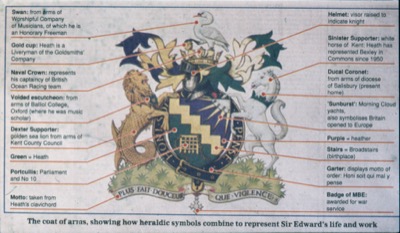
Wikimedia Commons has long had a vector graphic (by Sodacan, of course) of Sir Edward’s shield of arms, but it was only recently that I discovered, through the website of the Heraldry Society, a photograph of the heralds’ illustration of the full achievement. Heath had no offspring, so the arms as a hereditament became extinct.

This anniversary means that Arundells, his house in Salisbury, will now have been his museum for longer than he actually lived there. He bequeathed the building to his namesake charitable foundation who then opened it to the public. There was a fear in 2010 that the house would need to be sold due to high running costs, which then developed into a legal battle, but as of 2025 the estate seems to be running as normal again.

It should be noted that the spelling is Arundells with two Ls, not Arundels with one. Incidentally, it was an Earl of Arundel who is listed as England’s earliest Lord High Admiral, so everything links up I suppose!

*I’m phrasing it that way because Heath is not the most recent Prime Minister to be Father of the House – that was Callaghan.

**I hesitate to say “sitting member” because St George’s Day in 1992 fell in the interlude after the general election (9th April) but before the new Parliament actually assembled (27th April).

More Crowns, More Confusion

Recently the office of the Lieutenant Governor of the Canadian province of Nova Scotia released photographs of the erection of a decorative shield on the wall of the Drawing Room at Government House, featuring the cypher of Charles III. Aside from the violation of the rule of tincture (by having a golden cypher on a silver background), I was struck by the fact that it used the Tudor Crown, not the Trudeau Crown as at the federal level.

Photographs from as far back as the coronation in 2023 show that the Tudor Crown was already in use by the provincial government at that time, with the Trudeau Crown nowhere to be seen. Ironically Nova Scotia, as the name and shield both quickly give away, was founded as a Scottish colony long before the Acts of Union and was granted arms by Charles I in his Scottish rather than English capacity, using the Scottish heraldic style with the motto scroll above the shield rather than below. The unicorn supporter even wears the Scottish crown. Perhaps it would have made more sense for the cypher to use that one instead.

It might be prudent at this point to make a note about Canada’s viceregal flags. Until Elizabeth II’s accession all the lieutenant governors used the Union Flag defaced by their heraldic badge on a white circle in the centre. Quebec changed in 1952, using the provincial coat of arm on a large white disk on a plain blue background. The arms are topped by the Tudor crown. It seems the province never adopted St Edward’s Crown despite Elizabeth’s stated preference for it. In the 1980s the other provinces switched to a similar-but-slightly-different design with the shield topped by St Edward’s Crown on a blue background with ten golden maple leaves. As far as I can tell they have not changed over since Charles III’s accession. Nova Scotia was the last holdout with the Union Flag design, only changing over in 2024. This creates the paradox whereby the Scottish and French provinces of Canada are the only ones using the crown design named after an English & Welsh dynasty.

Closer to home, but also wider afield, The Queen’s Commonwealth Trust, a charity set up in 2018, announced on Friday that it would be rebranding itself. Anything set up during that reign (or the reigns of previous female sovereigns) with “Queen’s” in the name inevitably had some ambiguity about what would happen in the next one – did “The Queen” mean Elizabeth II personally and permanently, did it mean the incumbent sovereign (in which case it should have become “The King’s” in her son’s reign) or did it mean the incumbent queen whether regnant or consort (in which case it would now belong to Camilla, but in the reign of a king with no wife there might be no namesake at all). The trust has gone with the first option, renaming itself The Queen Elizabeth II Commonwealth Trust and changing its initialism from QCT to QECT. The press release said that existing social media handles would not change, although it didn’t specify if the website’s domain name would do so. Presumably this gives them an excuse not to change St Edward’s Crown to the Tudor Crown in their logo.

Some Heraldic Snippets

Today the Royal Household released the Sovereign Grant Report. I will discuss the actual substance of it – especially the planned retirement of the royal train – in a later article. For now I will note that the front cover and title page of the report both continue to use the old version of the royal arms with St Edward’s Crown. This was also true of the Birthday Honours published last month in the Gazette.

The Queen opened the Ratho Library in Edinburgh today. She travelled in the newly-acquired BMW G70 (also a topic for a later article) which had her banner flying from the bonnet. It was difficult to get a good look in the footage and the press stills don’t show it at all, but I think I could make out the impalement line, with the dexter side having a yellow top half while the sinister side was white on top and blue on bottom. That would indicate it to be the English marshalling of the royal quarters, surely an armorial faux-pas for an event taking place in the Scottish capital!

The Duke of Edinburgh is in Canada visiting his namesake island and regiment. The royal website’s page on the event depicts his Canadian banner of arms flying in at least one photograph, though again I can’t find it shown in any of the stills on Getty or Alamy.

Also last month another German car manufacturer, Mercedes-Benz, was recognised as a royal warrant-holder. I presume it will be the new Tudor crown illustration that they show, but I haven’t seen any photographs of it yet.

For Gareth and the Empire!

Recently Gareth Ratcliffe, who represents Hay-on-Wye on Powys County Council, Tweeted a photograph of the royal warrant by which he was appointed an Ordinary Member of the Civil Division of the Most Excellent Order of the British Empire.

I have seen photographs and scans of similar documents before, but usually they were from a great many decades ago. I was interested to look at an up-to-date example.

The warrant begins with the sovereign’s full style (in English, of course) and concludes with the place and date. Notably it is accredited to St James’s Palace (which, rather than Buckingham, is the true headquarters of the crown), though I am quite certain that neither the monarch nor his clerks were actually in that place on New Year’s Eve signing thousands of such warrants in one go.

King Charles’s signature appears at the top of the page and Queen Camilla (in her capacity as Great Master of the Order) signs at the bottom. Six months ago I was told by the Foreign, Commonwealth & Development Office that warrants of appointment to these orders of chivalry do not depict a coat of arms, only the seal of the respective order. Embossed at the top of this warrant I can see that the seal itself actually contains the royal arms of the United Kingdom in the English arrangement, so the critical question of whether the design changes when in other realms is not necessarily resolved.

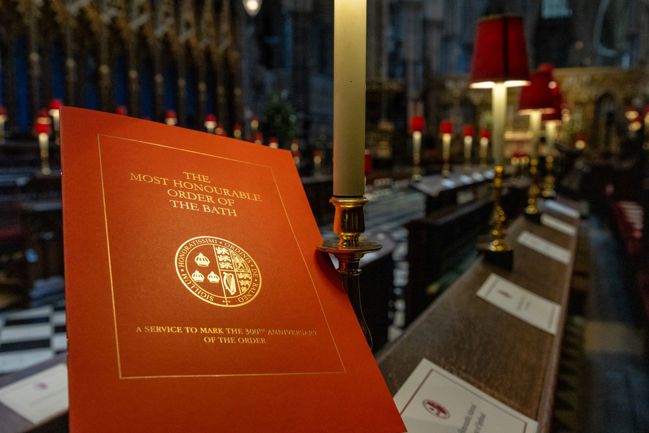
Also in the news this week was the 300th anniversary (or Tercentenary) of the Most Honourable Order of the Bath. The King (as Sovereign) and the Prince of Wales (as Great Master) attended a service in Westminster Abbey to commemorate. The cover of the Order of Service shows the seal of the order, which likewise has the British royal arms. I even found a photograph of a bound copy of the Statutes of the Order, which has the seal illustrated in full colour. There were also photographs taken of the stallplates of current and former Knights Grand Cross, including Great Masters. One hopes to see Prince William’s plate appear there too at some point, if only to get visual evidence of his full heraldic achievement as heir apparent.

Sealing the Deal

This is the old one, obviously.

A mere thirty-two months into the New Carolean era, a new Great Seal of the Realm has been unveiled. The design is largely the same as the version made for Elizabeth II in 2001 – the obverse shows the monarch enthroned, the reverse shows the royal armorial achievement (as illustrated by Noad).

Noad’s heraldic drawing is well-known by now. The depiction of Charles on the front* has attracted some criticism: The King is, as at his actual coronation, wearing trousers rather than the more traditional stockings, and his shoes appear to jut out too much. Personally, I think they resemble the feet of 2006-era Cybermen. It is also notable that the crown shown on the monarch’s head is the idealised depiction of the Tudor crown, as opposed to the Imperial State Crown or the Crown of St Edward which he wore at the coronation itself.

The inscription around the outer rim is CHARLES III DEI GRATIA BRITANNIARUM REGNORUMQUE SUORIMQUE CETERORUM REX COSORTIONIS POPULARUM PRINCEPS FID DEF.

This is the official Latin equivalent of CHARLES III BY THE GRACE OF GOD OF THE UNITED KINGDOM OF GREAT BRITAIN AND NORTHERN IRELAND AND OF HIS OTHER REALMS AND TERRITORIES KING HEAD OF THE COMMONWEALTH DEFENDER OF THE FAITH, and the formulation is similar to that used by British sovereigns for centuries, though even I, eleven years on from having formally studied Latin, can see that it is not a perfectly literal translation.

Judging by the talk pages for both the English and Latin Wikipedias, it is clear I am not the only one to notice this. Britanniarum Regnorum just means “Kingdom of the Britains”** with no specific reference to Hibernia Septentrionalis.

Oddly it seems that the seals used from 1930 to 1953 actually did specify MAG BR and  HIB, short for Magnae Britanniae and Hiberniae as distinct items, but seals used both before and after do not. Uniti does not appear in any of them. The exact name in English of the polity ruling these isles has, of course, gone through many changes due to the evolution of our constitutional arrangements and is very confusing even to natives, but it is interesting to note that the Latin title doesn’t exactly move in step with the English one.

The use of Consortionis Populorum Princeps to mean Head of the Commonwealth of Nations is also a bit odd – “princeps” is of course whence we derive the words “prince” and “principal”, but it originally meant “chief” or “first in rank”. “Consortio Populorum” (“Partnership of the Peoples”?) is probably used because a more literal translation would probably be something more like “Respublica”, but of course in modern English (or British English at any rate), the words commonwealth and republic have diverged almost entirely to where the former means an organisation headed by a monarch and the latter means precisely not that.

Perhaps it is fitting that this event should take place just as a new Pope emerges – we’ll be seeing a lot of official Latin in use very soon!

*The many news articles I have found relating to this story all seem to be nearly word-for-word the same, and none of them identify the portrait artist.
**This is distinct from “King of the Britons”, which would be “Regnum Brittanorum”

On Terence Etherton

Official parliamentary portrait from 2021 by Roger Harris (CC-BY-3.0)

The Lord Speaker today announced the death of Terence, Lord Etherton.

Etherton only took his seat in the House of Lords in 2021, having recently retired from the office of Master of the Rolls. Aged 73, he was only slightly older than the median for the Upper House, and still below the recently re-raised mandatory judicial retirement age.

Etherton is another of those people whose armorial bearings I know to exist but have never seen: That he received a grant was noted in the College of Arms newsletter no. 65, and a vague description is given on the Birkbeck, University of London website, which is repeated in Joshua Rozenberg’s obituary for him. While we are told that the motto was the Hebrew word הננ (Hineini) – “Here I Am.” we are not given any blazon for the rest of the achievement, only that it features sapphires and a sword.

Etherton’s career in fencing was, of course, also mentioned in the infamous “Enemies of the People” headline published by the Daily Mail in 2016.

I will have to hope that a photograph of the late noble and learned lord’s arms emerges at some point, for he was created too late to appear in the final print edition of Debrett’s Peerage and so it may be impossible to find out in the traditional way.

Carney Summons The King

In the lead-up to, and immediate aftermath of, the Canadian general election, there were a few news pieces about the prospect of King Charles visiting in person to open the new Parliament. Most of these seemed like mere idle speculation or, indeed wishful thinking.

Today, however, it has been confirmed by both Buckingham Palace and the Office of the Prime Minister that Their Majesties will indeed be visiting for that purpose. This is unusually short notice for an overseas trip, particularly given the sovereign’s ongoing health problems and the length of the journey. As the couple are due to arrive on May 26th and leave on May 27th, it looks as if this will be a flying visit to Ottawa to perform the state opening and not much else, in contrast to last month’s state visit in Italy or last year’s royal tour of Australia. There has been no further detail about the hinted royal tour in 2026, but I presume any more elaborate plans are still delayed until then.

I know nothing at this point of the actual contents of the speech, and indeed suspect that the text will not be especially interesting from a literary perspective (throne speeches rarely are). Their Majesty’s attire may prove the more politically-contentious topic: When Elizabeth II opened Parliament in 1957 and 1977 she prominently wore the Order of the Garter, while Prince Philip wore a military uniform with his many decorations on it.

This will be the first time that the monarch has opened Parliament in person since the Patriation of the Constitution and, as much as Mark Carney is obviously an Anglophile, the purpose of this excursion is to reassert Canada’s sovereignty and national identity in the face of aggression from the United States. The King & Queen of Canada will need to find a distinctly Canadian look for themselves. This will be difficult as the Crown of Canada, before or after Trudeau’s controversial redesign, does not exist in real life as a physical object. Nor, for that matter, does the snowflake diadem. A separate set of Canadian royal robes does not exist either. To make matters worse, this won’t even be taking place in the real Parliament building, as that has been closed for major renovation works over the past few years. Currently the Senate meets in a repurposed railway station and the House of Commons in the West Block. These two buildings are a ten-minute walk apart, which could make the summoning of MPs a rather tedious ordeal. In 2021 shuttle buses were used for the 700m journey.

If maximum splendour is the goal then I suspect that Charles will wear a ceremonial military uniform (with corresponding hat) and Camilla either her coronation gown or a generic white dress with a tiara, both with all their Canadian medals as well as the sash of the Royal Victorian Order (since that is not realm-specific).

Finally, a point about Palace press releases – whereas the public sees these announcements on Royal.UK as text on a webpage, they seem to be sent to journalists as PDFs (which I only know because of how often I see journalists Tweeting them). Even now the old red outline illustration of Elizabeth II’s British arms (with St Edward’s Crown) is still used, despite this announcement relating to Canada. It’s also typed in Calibri, which irks me even more.

This story by Sky News includes a screenshot of an earlier version of the Tweet, in which the bullet points are punctuated with the French and British flags instead of the flag of Canada. Was this a clumsy attempt at representing Canada’s dual heritage, or had the template been mixed up with something intended for Macron’s state visit due this month?

Two Former Dominions, Two Federal Dissolutions

We find ourselves in the unusual situation where two of the large Commonwealth realms are simultaneously having federal general elections, with polling days in the same week. I was interested to compare the ways in which Canada and Australia go about dissolving one parliament and electing another.

In Australia, the relevant discussion is done in writing, with the government publishing both the Prime Minister’s letter and the Governor-General’s. These are not pro forma text, but there is little personal character in the prose which comprises mainly the essential technical details (especially the dates) and constitutional obligations. The proclamation itself is, compared to its British counterpart, remarkably short and unadorned. The Governor-General’s badge of office as seen in this letterhead still uses St Edward’s Crown. The monochrome government coat of arms in the Prime Minister’s letterhead is too small and low-resolution to determine, but probably the same.

The Canadian version has the dissolution of the old parliament, the issuance of writs of election and the meeting date of the new parliament done as three separate proclamations. Each individually is quite short, with apparent length padded out by the need to restate the monarch’s and governor’s style each time as well as the bilingual requirement. The familiar depiction of the Canadian royal arms is used, embedded as a vector image that loaded piece by piece. The crown here too is still St Edward’s, rather than the Tudor or Trudeau crown.

I know from previous examples that it is customary for the Australian dissolution proclamation to have a public reading, though have yet to find the video for this particular election.

Canada, Carney and Commonwealth

Sixty-two days after Trudeau announced his intention to step down, the leadership contest for the Liberal Party of Canada concluded last night. The winner, to the surprise of almost nobody, was former bank governor Mark Carney. He garnered 85.9% of the vote, albeit on only a 37% turnout, which really shows how uninspiring the other candidates must have been.

Carney’s Wikipedia page is already describing him as “Prime Minister Designate”, though the exact date at which the Governor General will formally appoint him to that office has not yet been decided. Canada tends to do governmental transitions at a rather slower pace than Britain does, with the time between leadership elections (or indeed general elections) and ministerial appointments often being measured in weeks rather than hours, but most indications are that this one will take place unusually quickly.

That the leadership election should eschew two experienced cabinet veterans in favour of someone who isn’t even an MP is a little surprising. In the Canadian constitution, as in the British, it is not illegal for a non-Parliamentarian to be appointed to a ministerial office, but it is considered improper and, above all, politically impractical. The nearest British precedent for Carney’s situation, and even then it is a very poor one, would be the much-discussed case of Sir Alec Douglas-Home disclaiming his peerages to jump back to the Commons in 1963. A more thorough comparison of these two situations may be worth a separate article.

Accession to the premiership will, of course, give Carney the right to constitutionally advise the King of Canada, including advising him to speak on Canadian matters.

For the moment, Charles continues in a state of political limbo. Following a long-established royal tradition, he must express himself in a cryptic, plausibly-deniable way, often through subtle sartorial cues.

Today is Commonwealth Day, which includes a service at Westminster Abbey and the publication of a message by His Majesty. As the position of Head of the Commonwealth has no formal powers at all, it is not subject to “advice” from the secretariat in the way that ministers advise their monarchs, and thus this is a rare opportunity for Charles to speak his own mind. Of course, the message is meant to broadly encompass all fifty-six-and-counting members of the organisation, so is still a poor venue for a determined diatribe about any particular one of them, so any comment about the defence of Canadian sovereignty must again be inferred rather than stated outright.

Sir Keir Starmer has been similarly cautious, Tweeting about “further deepening the UK-Canada relationship together” but not saying anything specific about what that would entail. It was also announced two days ago that the Department of National Defence had commissioned a fleet of new destroyers based on a British design, but this is likely unrelated to the state of relations with the White House.

Returning to more familiar territory, I notice that where the Commonwealth Day message has been quoted in photographic form, the coat of arms in the letterhead is now the new Timothy Noad illustration with the Tudor crown. Said illustration has also now replaced the earlier versions on the royal website as well. As I noted to Sodacan, the change was done at some point in the morning of Wednesday 5th March.

During the abbey service itself, I distinctly noticed Their Majesties sitting behind ornate wooden faldstools with what looked like the old-style royal arms of Canada on them. This is not in itself the cryptic clue that it might seem – they were donated by the Canada Club in 1949.

The most surprising recent development in the past few days has been the launch of another royal podcast. Whereas Camilla has been patronising The Queen’s Reading Room (of which a podcast is but one part) for some years, Charles has only just announced The King’s Music Room (probably named that way for congruence with his wife’s project), but it has already generated a lot more headlines. The format is very different from the Reading Room, being very explicitly the product of a partnership with Apple and only available to their subscribers, among which I am not.

A Look at Some Letterheads

In the past five days President Trump has in rapid succession hosted bilateral meetings at the White House with Emmanuel Macron, Sir Keir Starmer and Volodymyr Zelenskyy. I have not watched any of these events in full in order to write a proper political analysis – frankly, the small snippets I did see were already enough to leave me rocking in a corner – so am instead simply focusing on some aspects of government heraldry.

During a meeting in the oval office, Starmer gave Trump a letter from Charles III inviting him on a second state visit to the United Kingdom. The letter was marked “Private and Confidential”, yet presenting it in this way meant nearly all the words were caught on camera. I have copied out the text below (keeping the line breaks and punctuation the same) with equals signs representing the words that got obscured:

Dear Donald,

I just wanted to write and thank you for receiving====
in Washington so soon after your Inauguration. Given the====
breadth of challenges across the world, I can only think that====
of our two countries has a vital role to play in promoting and====
the values which matter so much to us all.

I remember with great fondness your visits to the United Kingdom
during your previous Presidency, and recall our nascent plan for you to
visit Dumfries House, in Scotland, as the global pandemic began and all
bets – and flights! – were off… I can only say that it would be a great
pleasure to extend that invitation once again, in the hope that you might at
some stage be visiting Turnberry and a detour to a relatively near
neighbour might not cause you too much inconvenience. An alternative
might perhaps be for you to visit Balmoral, if you are calling in at Menie.
There us much on both Estates which I think you might find interesting
and enjoy – particularly as my Foundation at Dumfries House provides
hospitality skills-training for young people who often end up as staff in
your own establishments!

Quite apart from this presenting an opportunity to discuss a wide
range of issues of mutual interest, it would also offer a valuable chance to
plan a historic second State Visit to the United Kingdom. As you will
====, this is unprecedented by a U.S. President. That is why I would find
it helpful for us to be able to discuss, together, a range of options for

location and programme content. In so doing, working together, I know
we will further enhance the special relationship between our two countries,
of which we are both so proud.

Yours Most Sincerely

Charles R

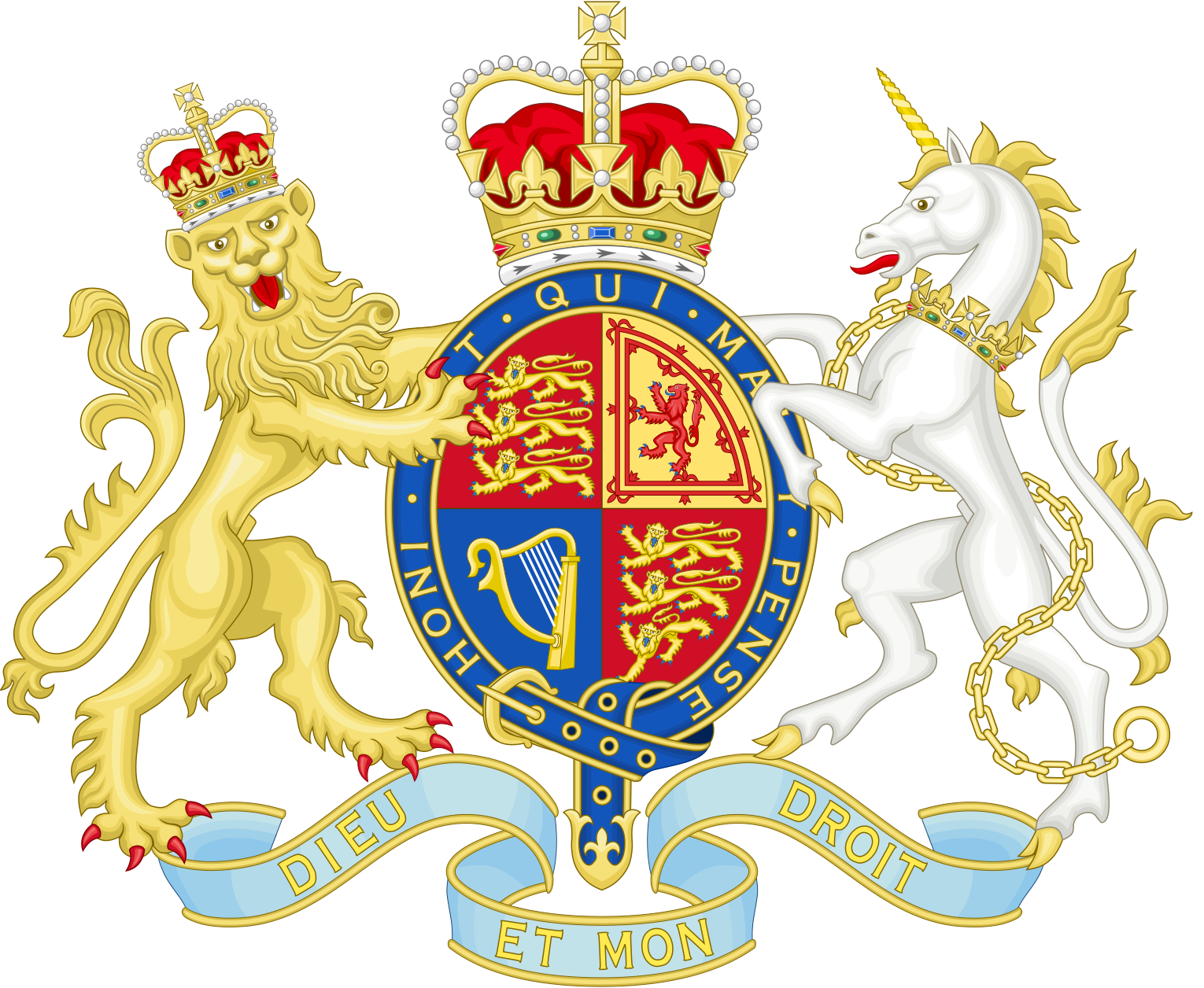
The letter is described as emanating from Buckingham Palace, and is topped by the familiar red outline of the British royal arms, still the old version with St Edward’s Crown.

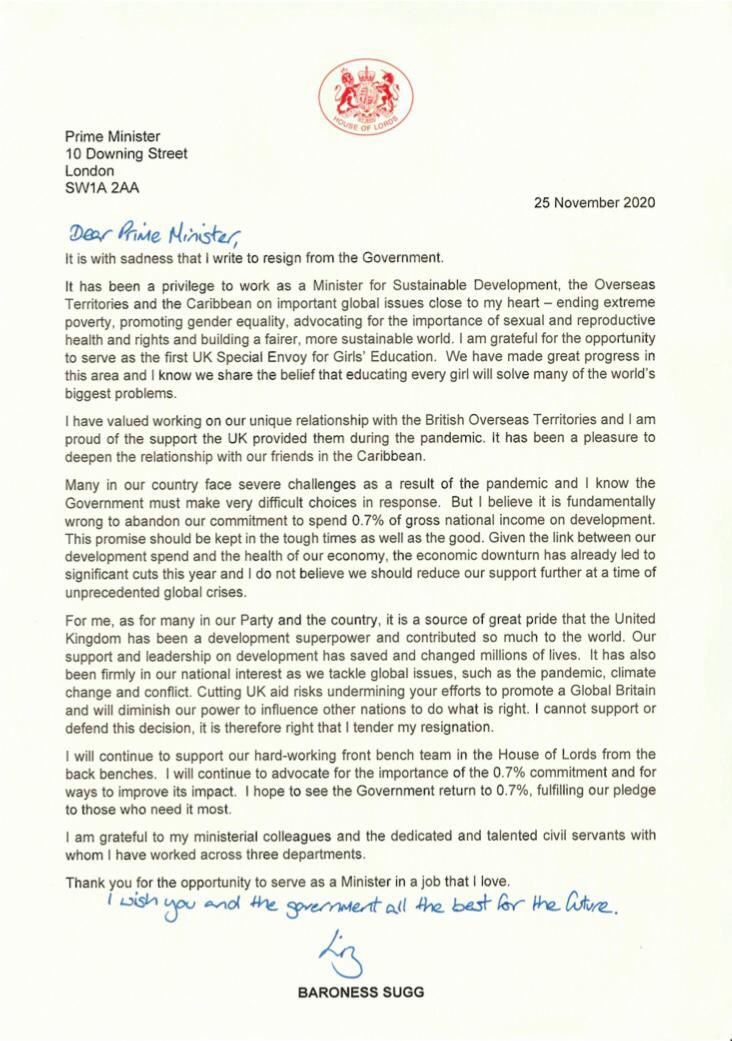
On a related note, Starmer recently announced that, owing to the escalation of international military tensions, his government would be redirecting funds from international aid to defence. Anneliese Dodds, Minister of State for Development, resigned from the government in protest. The Prime Minister’s response to her resignation is published on Gov.UK as a PDF. His letterhead is the lesser version of the arms, again still using St Edward’s Crown.

One place (or rather a great many places) where the Tudor crown can now be seen in use is in the arms of Queen Camilla, as used by companies to which her royal warrant was granted late last year. The first example I’ve actually seen (through other heraldists pointing it out online, rather than in person) is Heaven Skincare, which proudly displays the warrant in the navigation bar of its website. Deborah Mitchell, the owner, Tweeted a photograph of the coat of arms on her branded packaging earlier today.