The Heraldry of Haiti

Malcolm Lobley’s lecture tonight for the Yorkshire Heraldry Society concerned the country which has long been a source of cult fascination among armory enthusiasts.

He began with a short history of how the country came to be – which was, by his own admission, a way of padding the event’s length.

Henry Christophe founded the Kingdom of Haiti in 1811. In addition to proclaiming himself as monarch, he established a native nobility on the European model consisting of four princes, eight dukes, twenty-two counts, thirty-seven barons and forty chevaliers. He assumed arms of dominion for his realm, and also created a heraldic authority to assign arms to his appointees.

Lobley noted that as in Britain there was a convention on helmet usage according to rank – nobles used a barred helmet, the most senior affrontee and the rest facing dexter. Some of the titles of the peers, based on contemporary local place names, sounded comical to English speakers, such as the Duc de la Marmelade and the Duc de Limonade. Lobley was especially drawn to the Duc de l’Anse, which he translated to “jug handle”. Hyenas were a common choice as supporters. The contents of the shield tended to a medieval degree of simplicity though incorporating more modern imagery, such as Baron de Beliard with his rake and watering can.

The lecture was also used as an opportunity to advertise the Armorial Général du Royaume d’Hayti, which the College of Arms has been trying to flog for more than a decade.

Elizabeth I: A tale of betrayal and deception

Continuing the Treason theme pursued by the archives for the past year, Tracy Borman tonight gave a presentation about how the life of Good Queen Bess was shaped by the ever-present threat of insurrection against the crown.

The Tudors are among England’s (and perhaps the world’s) most celebrated dynasties, often associated with ideas of absolutism and supreme power, but in reality they were always fundamentally insecure on the throne. Henry VII’s descent from John of Gaunt and his mistress made a weak claim to the throne, and anyone outright seizing it by force would forever suffer the taint of usurpation. Henry played on the idea of treason right from the start – legally backdating his reign to the day before Bosworth so that Richard III’s supporters would be the traitors.

Henry VIII would take the concept further, regularly hurling treason charges at his ministers, blood relatives and even wives once they had fallen out of his favour. An example highlighted was the treatment of Anne Boleyn and Henry Norris – accusing them of adultery was not enough, it was also alleged based on an offhand joke that he was plotting to assassinate the king. The real motivation, of course, was that Anne had failed to birth a living son and thus Henry needed rid of her. That she would be beheaded was a foregone conclusion before the start of the trial. This is posited as one reason her daughter Elizabeth avoided conjugal attachments.

Another came after Henry’s death when her stepmother Katharine Parr swiftly remarried to Thomas, Lord Seymour of Sudeley. He is rumoured to have behaved inappropriately toward Elizabeth, even plotting to marry her (without Edward VI’s permission) after Katharine’s death. He too was executed as a traitor following an incident where he shot one of the king’s dogs and broke into the royal bedchamber.

During the unpopular reign of Mary I & Philip of Spain, Elizabeth was used involuntarily as the figure head for Sir Thomas Wyatt’s rebel movement. Mary imprisoned her sister for a time and only narrowly avoided killing her. Lady Jane Grey was not so lucky.

Once Elizabeth had actually ascended the throne, another Queen Mary proved similarly dangerous. Deposed in Scotland, Mary Stuart still possessed the strongest claim to the English throne. She sought Elizabeth’s mercy but instead became her prisoner. Her very presence made her a focal point for revolutionary intentions by English Catholics, made worse when Pious V actually issued a Papal Bull encouraging them to rise up. This led to the Treason Act 1571, which expanded the offence to include intent of harm against the monarch. Elizabeth ultimately executed Mary, but had to put on a show of reluctance about it, scapegoating her ministers to distance herself from regicide.

In the question period that followed, Borman rejected the theory that Henry VIII had been nice until his 1536 jousting accident. She said that he had always been paranoid and vicious. She also said that Cromwell and Wolsey were the only deaths for which Henry demonstrated any remorse.

Asked about Elizabeth, she said there were hints by a midwife about a lovechild with Seymour, but no evidence of substance. The Queen had to be subtle in her attempts to rehabilitate her mother’s legacy, for Anne was still hated by most of the English populace. Borman cited Miranda Richardson in Blackadder II as her favourite onscreen portrayal.

An Evening with Philippa Gregory

I have virtually visited the National Archives many times to hear talks from authors of historical fact. This time I got to see an author of historical fiction.

Shikha Sharma, the Events Manager, introduced the talk as part of the “What’s Online?” series. The interview was primarily centred on Dawnlands, part of the Fairmile series taking place in England in the seventeenth century, but there were questions and observations about Gregory’s other works as well.

Gregory said that a lot of people think they don’t know the Stuarts very well, and that it is much easier to convince publishers to print books about the Tudors. It was the notion of a family story developing into global affairs that got them interested.

Sharma reminded us that the talk was part of the Treason exhibition. The accusation of treason was the state’s supreme weapon to suppress rebellion and scrub out subversive ideas. She asked about the character of Ned Ferryman, who sticks to his personal ideals throughout but is considered a traitor by the law. Gregory said Ned was an old Cromwellian soldier who thought he was fighting for a new world of liberty. None of them could have predicted the restoration of the king so soon. Most of Cromwell’s soldiers were pardoned by Charles II, but those who had been directly involved in his father’s execution were pursued across the world. Ned is contrasted with Lyvia, who joins a long line of ambitious, manipulative women (nearly always Catholic and Italian), ingratiating herself at court, with occasional warm feelings never prioritised. Gregory said it was always helpful to have someone who can observe important historical events.

Sharma asked why it was important to tell these stories, and how the research is done. Gregory said that the life stories of lower-class women were not often recorded except as character assassinations when they stepped out of line, official records often differing sharply from personal accounts. Around 1660-80 there was a prominent increase in the number of women writing and publishing. The range of subjects on which books can be written was widened by the English Marxist historians of the 1950s. Each character presents a different research problem – she could find only two biographies about Mary of Modena, both very old and out of print. The working-class characters are usually composites from historical records rather than directly based on specific individuals. Her favourite character is always the one she’s just finished working on. Gregory covers her study with maps and drawings relevant to the book she’s writing, meaning she redecorates for each new book. She doesn’t want to delay the creative process for research – typically each new book takes 18-24 months in all, though by now she has a large stockpile of research from all the books she’s done before. We are separated from the Stuarts by generations of Whig historians, but you can often find hidden treasures in local museums.

Sharma noted that the books were prone to “painterly” descriptions, and asked if that was deliberate. Gregory said that if you pick up any historical fiction you know the author’s narrative voice. One’s idea of historical Venice is heavily mediated by Canaletto, as is London by Gustave Doré.

On the topic of historical accuracy and the grand sweep of her plots, she said that she doesn’t plan much for the series – it’s dictated by the real history but she has to decide as she goes along how her characters fit into it. Most family lineages start as peasants in the mud, much as they’d like to be aristocrats. If somebody points out an error in a book she corrects it in the next edition. She claims this has only happened 3-4 times in over thirty publications.

Sharma often asked questions from the audience but she did not name the members and often merged several similar questions together. I asked how close to the present day Gregory would consider setting her books. She said she had originally considered taking the Fairmile series as late as 1920, where British society was plagued by a fear of moral decay after the First World War and a sense that the prosperity of empire had reached its limits. Her plan had been to write two books per century, but she now finds herself writing four or five which may require the breadth of her series to be reduced.

The obvious question to ask of these kinds of authors is when they would go if they could travel through time. Gregory said she was less interested in specific eras than in solving historical mysteries, such as the Princes in the Tower or Amy Robsart.

Sharma asked specifically about the baby in the warming pan. Gregory said we know what happened in the birthing chamber because James VII was forced to hold a public inquiry. Princesses Mary and Anne both claimed to believe the story in order to justify the later coup, but the books written now cannot present it as fact.


A Blackmailer at Frogmore

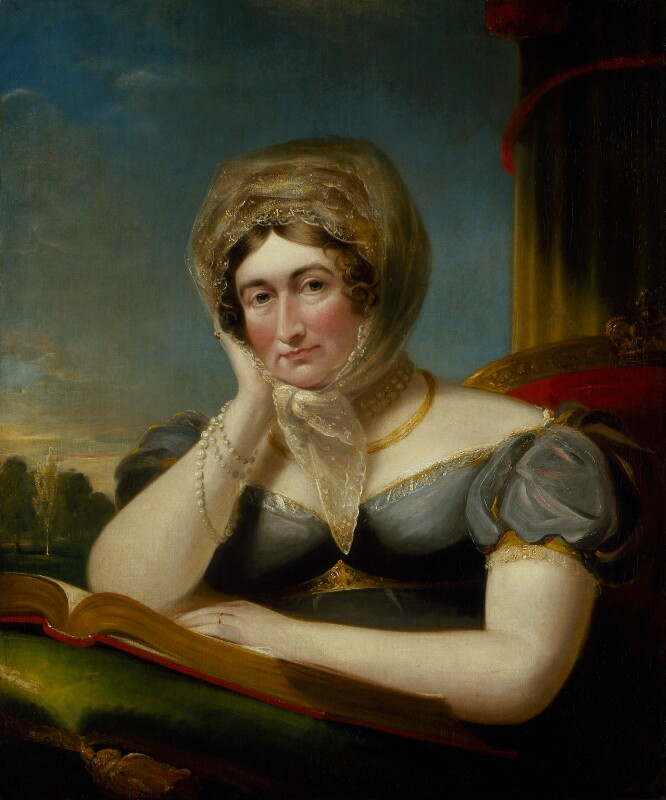
Today’s virtual outing was with the National Archives again. James Travers, Cultural Property Manager, was promoting his new book on the “ghost” of Caroline of Brunswick, Queen of George IV.

The centrepiece of the book, and the lecture, was Thomas Ashe, whom the injured consort had commissioned to write her memoirs. His book The Claustral Palace was suppressed from publication, for it would have revealed the intimate life stories of her sisters-in-law who were confined at Frogmore House.

How much of the novel was true is unclear, but it put Ashe in conflict with the government as well as George IV’s brother the Duke of Cumberland (later Ernest Augustus I of Hanover).

Travers’s lecture was quite convoluted in its story, which combined with his soft way of speaking and some technical glitches at my end meant it wasn’t always easy to follow the plot, so reading the book itself is probably necessary to get a full understanding.

Link

Today’s virtual lecture was by the York Festival of Ideas, starring Eleanor Parker.

I asked her at what point in English history the Saxons and Normans were no longer considered different races/nations. She replied that the Normans quickly came to call themselves English, but that twelfth century sources still indicate a cultural and linguistic split, with non-Francophones held back in life.

EXTERNAL LINKS

Power and pageantry: The coronation of King Richard III and Queen Anne

Another date with the National Archives, this time featuring Dr Sean Cunningham,the head of Medieval Records.

I was faintly amused when he brought up a still from The White Queen (2013) featuring Aneurin Barnard and Faye Marsay, if only so he could point out the inaccuracies. Then again, this coronation does not have many other televisual depictions to my knowledge.

Accessions and Assumptions

Today was another virtual double-helping. The first was a Teams presentation from The National Archives in which Dr Tracy Borman, Joint Chief Curator of Historic Royal Palaces, plugged her new book Crown & Sceptre: a new history of the British Monarchy.

Borman gave a synopsis of her publication, which essentially amounted to a summary of English and then British royal history since 1066. That part I will not type out again. She called Elizabeth I a brilliant propagandist and “the greatest monarch of all time”. She thought less of Victoria, who spent so much time in retirement after Albert’s death that the institution of the crown was nearly disbanded. She also called Edward VIII’s abdication a lucky escape, noting the callous attitude he had both to the institution and his family members. She spotted a theme that the best monarchs were those never originally supposed to reign – including the present one. Another important point was that after the Civil War and the Glorious Revolution, Britain’s monarchs were reduced to ceremonial figureheads, focusing their efforts on charity and patronage instead of direct political power. This earned them mockery from other still-absolute monarchs at the time, but seems in the long term to have greatly contributed to outlasting them.

In the Q&A, I asked how much the present day royal family was influenced by the Scottish half of their pre-C17 ancestry, since her book was focused on the English side. Borman said that the constitutional model which Britain still has today (and has exported around the world) largely resulted from the absolutist attitudes of the House of Stuart clashing with the English parliamentary system, without which its seminal conflicts would likely never have happened.

While I enjoyed the presentation I am not sure that I will end up buying the book. While Borman claimed to be “inspired” by the Platinum Jubilee giving the opportunity to look back over the last millennium, I suspect it was more a matter of judging the point in the media cycle when such a book would get most sales. I am reminded of J. P. Nettl’s preface to his 1967 book The Soviet Achievement, beginning with “Anyone should have serious doubts before adding to the mountain of literature on the Soviet Union. The fiftieth anniversary of the October revolution provides an occasion, perhaps, but no automatic excuse.”, a sentiment that could apply equally well here.

The second event was a Zoom lecture by the Heraldry Society. Marcus Meer‘s talk “And No Recently Assumed Arms…” was about the display of, and attitudes around, heraldry in medieval German cities, and something of a sequel to his “Lest They Pass to the Peasants” lecture to the Scottish society in March.

Urban centres in the Middle Ages were festooned with heraldic marks of the municipalities themselves as well as the guilds, corporations and individuals resident within. They would be set in stained glass, carved into stone walls or moulded on cutlery. The use of such images was a shared focal point for citizens’ attention, helping to maintain communal stability. They were also used to demarcate sections of the urban space, and to claim control of said sections on behalf of their owners. Delegated authority was rendered visible as government officials wore the state or city’s badge, and armorial marks would be painted on items produced in the city as a sign of quality control. Heraldry was also a mark of power struggles – guilds would fight for precedence in civic processions and conquerors of a town would displace existing shields with their own.

Meer spoke of a departure in scholarship from analysis of heraldry as a fixed symbol of meaning, towards a study of medieval perspectives.

The Gossembrot Armorial of 1469 was an attempt by the author to shore up his family’s status against the threat from social climbers. It collected the arms of all the families into whom Gossembrots had married, but it omitted arms which had come into use too recently in favour of those long-established. Others would embellish their own heritage beyond plausibility, such as Ulman Stramer who, in his Book of my Lineage and Adventure (1360-1400), claimed that his ancestor Gerhart of Reichenbach was granted arms by King Conrad, even though Conrad reigned in an age before it became customary to have arms formally granted by a sovereign. In the fifteenth century there was a social distinction between arms officially sanctioned and arms privately assumed. Urban grantees, much like their contemporaries in England, sought to consolidate their status. Also similar to England, “confirmations” of supposedly-old arms were preferred to grants of clearly-new ones, for armigers wanted proof that they and their agnates had always belonged to the gentry instead of recently joining it. Sometimes grants were sought from foreign rulers, such as Henry VIII of England to Lorenz Stauber of Nuremberg in 1521.

There were accounts of legal disputes over heraldic ownership, such as unrelated armigers bearing the same shield, and the city authorities deciding that they must be long-lost family. A case study was the Church of St Anne in Augsburg, where Ulrich, Georg and Jakob Fugger had endowed a family chapel. When the male-line of the dynasty died out the female-line descendants were allowed to inherit the chapel but not the Fugger arms.

I asked Dr Meer what was the lowest social rank at which one could get away with assuming arms. He replied that there were no hard rules, and that at Nuremberg there is evidence of armigerous peasants, albeit probably the wealthier peasants. Emperors were known to complain of non-nobles assuming arms, but there wishes were not enforced.

10th June is International Heraldry Day (though as little recognised as all the other National Whatever Days) and the society was proud to unveil its new logo, courtesy of Quentin Peacock. Also today it was announced that Her Majesty had appointed two new members of the Order of the Thistle – former Lord Advocate Dame Elish Angiolini and former Presiding Officer of the Scottish Parliament Sir George Reid. Their arms, if yet they have them, will at some point be displayed at the High Kirk. Meanwhile, with just three days to go until the Garter service, I am still none the wiser as to the arms of Amos and Blair.