On What Authority

A sign welcoming drivers to Humberside, defaced by black and white splatters.

By Adpopulum, 1992 (CC-BY-SA-3.0)

The people of Yorkshire have an unusually strong local identity compared to those of other English regions, and Kingston-upon-Hull a greater notability (or perhaps notoriety?) compared to other cities.

Around 208 CE York was established by Emperor Septimius Severus as the provincial capital of Lower Britain. A reorganisation in 296 made it the probable capital of Second Britain. From around 450 to 654 it was the capital of the Anglian Kingdom of Deira, which then became the southern half of the Anglo-Saxon Kingdom of Northumbria. From 867 to 954 it was known as Jórvík and was under Danish rule. It was during this period that the North, West and East Ridings* were established to subdivide the area. The territory was absorbed into the unified Kingdom of England in 954, then from 966 to 1055 an Earl of York was appointed to govern on the monarch’s behalf.

Prior to the Norman conquest the earls of England had each ruled multiple shires and considered themselves of equal stature to continental dukes, but William of Normandy did not want to be outranked and so diminished them to one shire each, putting the earls level with European counts and so leading to their administrations being called counties. The county system emerging from this time remained fairly stable until Victoria’s reign.

Parts of Cumberland, Lancashire of Westmorland were split off from Yorkshire in the twelfth century, but by the time of the 1831 census it was still by far the largest of England’s forty then-counties, having more than more than twice the acreage of Lincolnshire or Devon and nearly thrice of Norfolk. The Local Government Act 1888 removed many administrative duties from the courts of quarter sessions and invented county councils to take them on instead. The three ridings, already given separate sessions, also had their own separate councils. The next big reform was the Local Government Act 1972, which sought to radically alter the county map of England and Wales so that the borders corresponded to the modern – rather than medieval – population distribution. Yorkshire’s three ridings were abandoned. A few smaller parts around the edges were given to other neigbouring counties, and the rest reconstituted as four entities – North Yorkshire, South Yorkshire, West Yorkshire, and Humberside.

The non-metropolitan county of Humberside mainly replaced the East Riding, but also incorporated parts of the West Riding and northern Lincolnshire. It was subdivided into nine districts, all of which obtained borough status: North Wolds, Holderness, Kingston-upon-Hull, Beverley, Boothferry, Scunthorpe, Glanford, Grimsby and Cleethorpes. Although the government had used the term Humberside in planning since 1964 and the BBC had launched Radio Humberside in 1971, the creation of a county by that name was strongly disliked by a significant proportion of its residents. In 1981 North Wolds renamed itself East Yorkshire and Beverley became the East Yorkshire Borough of Beverley. Already by the 1990s it was clear that the county could not last. With effect from 1996 the area was reformed yet again. Those parts which had been in Lincolnshire were returned, while the Yorkshire part was made into the new ceremonial county (also called a lieutenancy area) called East Riding of Yorkshire. The governance of the new county was split between two unitary authorities – Kingston-upon-Hull became one, while Beverley, Boothferry, Holderness and North Wolds were merged into the other, which confusingly was also called East Riding of Yorkshire.

Even though Humberside has now been dead longer than it was ever alive (as well as longer than I have been) the name continues to haunt us in the aforementioned radio station, the fire service, the airport, the scouts and the police force. There was even a Humberside Police & Crime Commissioner created in 2012. A lot of junk mail continues to put Humberside in our address, and many official notices put up by the former borough councils are still in place.

Hull itself has a place in the national consciousness – particularly in comedy – long before its designation as City of Culture. By the end of the thirteenth century the King’s town upon the River Hull had an active market, a travelling funfair, a seat in the House of Commons and a royal charter. From 1331 the burgesses had the power to elect a mayor. Another charter in 1440 created the municipal corporation and made Hull a county of itself (an early version of the same idea that a unitary authority today expresses). Seven years later the county’s boundaries were widened to include some nearby villages, which were sometimes called Hullshire. These were removed in 1835. The 1888 act made Hull a county borough. Victoria bestowed city status on the town to commemorate her diamond jubilee. George V upgraded the mayor to lord mayor after opening King George Dock. The city council replaced the corporation in 1972.

Readers may be wondering why I have bothered to tell them all of this. Well, in Eye 1540 I came across this passage in the Rotten Boroughs section:

HOW DEMOCRACY WORKS (1): Labour Hull city council is keen to get into bed with Tory East Riding of Yorkshire Council to set up a combined authority. Jumping on the devolution bandwagon with an elected mayor and all could bring in a hoped-for £1.6bn in Whitehall funding.
Under the planned timetable for the creation of the combined authority, a deal will be signed off by 31 March. But public “consultation” on any agreement will not start until late June at the earliest. How might the (meaningless) public consultation go?
Back in 2014, Hull wanted to extend its boundary to take over part of East Riding, so a referendum was held. Fewer than 2,000 voters were in favour, with more than 51,000 against, so the plan was ditched. But this time the public may not have any effective say in the matter.

Looking back I found a story about the plan in the Hull Daily Mail from October, with other hints still earlier but public interest only really seems to have picked up a few days ago. The gist of the plan seems to be that the existing councils will remain, but they will pool their resources to form a combined authority similar to that used by metropolitan counties, and on top will be a directly-elected “metro mayor”. It is not clear if the mayor will absorb the role of the existing Police & Crime Commissioner, as has been the case in other regions. It will also be interesting to see what name the combined authority will take – most have been named after the counties in which their constituent districts are situated, and indeed the county councils which used to be there before 1986, but in this case one of the districts has the same name as the overall county, so most likely the combination will be called something like “Hull & East Riding”, a redundancy akin to saying “Parliament and the Lords” or “Europeans and the French”.

The existence of directly-elected executives is a new development in Britain, and one at odds with the traditions of our constitution. This has long been a nation of parliamentary government, not presidential. The scramble for local and regional devolution has not been without controversy, especially the PCCs. The cost of and confusing of so many reorganisations in local administration also tends to provoke public anger. Many mock the patchwork of differing political structures across the United Kingdom, but attempts to standardise them never really seem to work. In particular it is noted that local personal identity tends to align more with the pre-Heath counties than with the modern ones, which were designed around administrative efficiency rather than emotional allegiance.

In this instance any controversy over the merits of the plans themselves is accompanied by anger at the secretive manner in which negotiations were carried out, and in the apparent intention of both central and local government to impose the new system without public consent. Two items arrived in my postbox today: Issue 39 of Your East Riding, and a campaign leaflet. The first is keen to announce that East Riding won Council of the Year 2020, but makes no mention of the new combined authority, merely having a brief segment about the Humber Local Enterprise Partnership on page 5. The second is credited to Matthew Grove, who was Conservative PCC from 2012 to 2016 but has since defected to the Liberal Democrats. Half of the front page is dedicated to a large-lettered condemnation of the deal and its negotiation process.

There is also a partisan component to consider here, which the Eye briefly mentioned. Generally it is observed that urban voters lean to the left and rural voters to the right. This is clear in recent election results for the two districts.

Hull City Council, 2018: Labour 31, Liberal Democrats 24, Conservatives 2.
East Riding Council, 2019: Conservative 49**, Liberal Democrat 8, Yorkshire Party 2.

The latter result is particularly impressive given that the UK-wide results were disastrous for the Conservative party. While there have been times when the Liberal Democrats gained significant footholds, the norm has been for Labour to have a majority within City of Hull and the Conservatives an ascendancy without. By contrast, the metro mayoral elections across the combined county would be very tight races. I wonder if, without the promise of such a large payment, the existing council leaders would have been more reluctant to relinquish such secure areas of control.

As this blog is so often about heraldry, I will end with some of the arms of the authorities I have been discussing.

Kingston-upon-Hull: Azure three ducal coronets in pale Or. Certified in 1879 but seen in use as early as the fifteenth century.

York: Argent on a Cross Gules five Lions passant guardant Or. Recorded in the 1584 visitation but in use as early as Edward III’s reign.

On 11th February 2004 Hull was also granted a badge of Three coronets in pale Or without the blue background.

The creation of county councils in the nineteenth century led to a proliferation of county heraldry, which previously had been inapplicable. In medieval times it was considered that helmets and crests were appropriate only for human men not impersonal corporations, so older grants of arms are of just a shield, though York obtained semi-official permission to ornament its arms with sword, mace and cap of maintenance in 1396. By Victoria’s reign this principle had been abandoned and so later civic grants of arms frequently include crests, supporters and mottoes. In contrast to the city arms which have been carried through multiple reconstitutions, the county arms have been designed anew as often as the counties themselves.

East Riding County Council (1889-1974): Escutcheon Per chevron Argent and Or in chief two garbs Proper and in base an eagle displayed Azure on a chief Sable three Roses of the first barbed and seeded Proper; crest On a wreath of the colours on a garb fessewise Or an eagle displayed Azure; motto Solis Ortum Conspicere. Granted 28th February 1945.

Humberside County Council (1974-1996): Escutcheon Per fess Sable and Gules on a fess wavy Argent between in chief a coronet Or between two roses Argent barbed and seeded Proper and in base two fleurs de lis Or a bar wavy Azure; crest On a wreath Or and Gules rising from flames Proper a demi-eagle Azure goutté d’Or armed also Gold holding in the beak a sword point downwards Proper hilt and pommel Or; supporters On the dexter a dolphin Argent finned Or charged on the shoulder with a terrestrial globe Azure the land masses Or supporting an anchor Proper and on the sinister a female figure habited representing Ceres with cornucopia all Proper upon a compartment per pale water barry wavy Azure and Argent and a grassy field Proper; motto United We Flourish. Granted 28th July 1976.

Holderness Borough Council (1974-1996): Escutcheon Per saltire the chief Azure charged with a sun in splendour Or the base barry wavy Argent and Azure the dexter flaunch per fess Vert and Sable the sinister flaunch per fess Sable and Vert each charged with a rose Argent barbed and seeded Proper; crest On a wreath Or Vert and Sable within a mural crown Argent charged with a saltire Gules an ancient ship with one mast and two sails set standing on the poop a man with cocked hat and telescope beneath his sinister arm Sable mantled parted Vert and Sable doubled Or.; supporters On the dexter side a mermaid on her head a Roman helm proper and holding in her exterior hand a trident Or and on the sinister side a Triton on his head a horned Danish helm Proper and brandishing with his exterior hand a sword Argent pommel and hilt Or; motto Think Right Do Right; badge A Viking ship with sail and pennon flying within an annulet compony Or and Argent. Granted 30th March 1978.

East Riding of Yorkshire District Council (1996-present): Escutcheon Barry Vert and Or on a chevron engrailed plain cotised Gules three roses Argent barbed and seeded Proper; crest Issuing from a mural crown Argent an eagle displayed Gules armed and langued Azure supporting with the dexter talons a sword hilt upwards and with the sinister talons a crozier in saltire Or mantled Gules doubled Argent.; supporters On the dexter a lion Azure guardant armed and langued Gules gorged with a wreath of barley supporting between the forelegs a trident Or on the sinister a demi-horse Argent langued Gules maned Or the feet webbed Vert conjoined to the lower half of a hippocampus Vert supporting between the forelegs set upon a staff a cross fleury Gules.; motto Tradition and Progress. Granted August 1996.
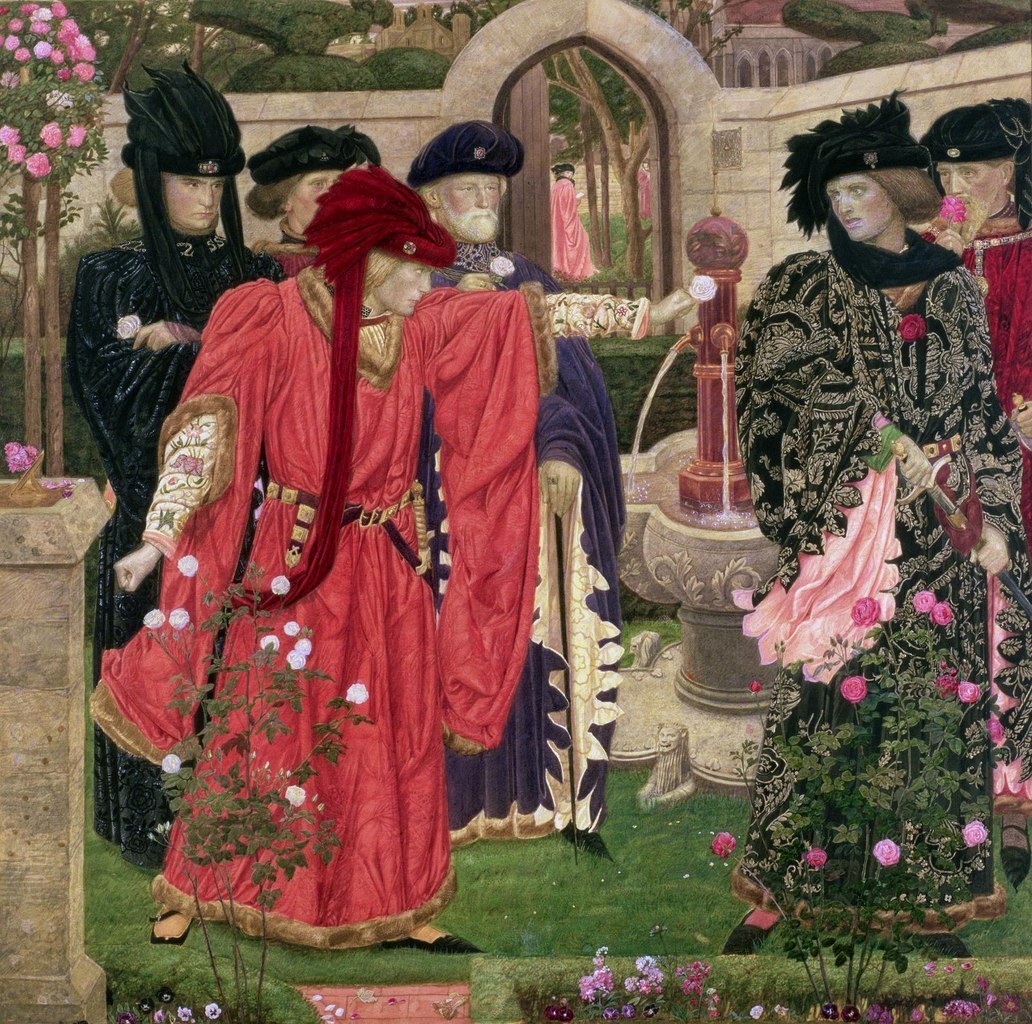
https://upload.wikimedia.org/wikipedia/commons/7/7e/Choosing_the_Red_and_White_Roses.jpgFinally a note about the roses: while the white rose was indeed a badge used by many heads of the House of York, and the red rose a badge used by many heads of the House of Lancaster, the status of each as the badge of its respective faction was imposed retroactively by Henry VII’s creation of the Tudor rose upon his marriage to Elizabeth of York, then bolstered by William Shakespeare’s writing of the Temple Gardens scene in Henry VI, Part 1. The name “Wars of the Roses” came into common use after 1829 in reference to said scene. Their use of symbols for the counties of Yorkshire and Lancashire emerged still later. Notably the roses appear frequently in municipal grants of arms since the 1888 reforms but not in earlier ones. In spite of what some may claim today, the conflict was not a petty rivalry between two northern counties.

EXTERNAL LINKS

UPDATE (13th September)

The latest episode of Jay Foreman’s Map Men covers many of the same topics I have done in this article. Indeed, the resemblance is almost suspicious…

UPDATE (1st November)

For those interested in the region’s past more broadly, I have just found the channel Hull History Nerd. Most of the videos are focused on transport and infrastructure rather than governance.

*The term riding literally means one third (in contrast to the farthings used prominently by a different famous shire) so one of the compass directions had to be left out. Much like the Diocese of Sodor and Man, the name was eventually adopted for a fictional location in Winifred Holtby’s novel. The BBC adapted the novel in 2011 for a miniseries, some parts of which were filmed close to my house.
**Two of them, Leo Hammond and Benjamin Weeks, were at university with me at the time of the election.
More Podcasts

For the whole of January I wondered when the third episode of the House of Lords podcast was going to arrive. On 10th February it finally did so. The Lord Patel, Chair of the Science & Technology Committee, was interviewed about healthy ageing. The Lord Cashman, former MEP and actor, recalled his role in founding Stonewall. I hope that new episodes will be produced more frequently in future so that momentum is not lost among potential listeners.

The Heraldry Society recently started a podcast of its own, the first episode being an interview of Quentin Peacock about Digital Heraldry. Peacock spoke about the time and difficulty of creating high-quality vector graphics. Notice was also taken of the growth of online heraldist communities in recent years.

Back on Wikipedia, I have spent the last week constructing another armorial page – that for Anglican Bishops of the Diocese of Chester. The bulk of the necessary information was found on the website of the now-defunct Cheshire Heraldry Society. The vast majority of the escutcheons (no crests or mottoes listed) were simple enough to recreate in a short time, so that it only took a few days to illustrate and upload the whole lot. Creating the list page itself was also quite easy, given that I am well used to the template by now. It is too early to say if the page will survive. At present no other editor appears to have noticed it at all. If it is accepted then I may go on to produce armorials for the more senior bishoprics of Canterbury and York, though so far I have not found the relevant information so conveniently assembled.

UPDATE (15th February)

Searching around I uncovered this presentation by Dr Adrian Ailes for the National Archives, recorded a decade ago.

It’s Just Not Cricket

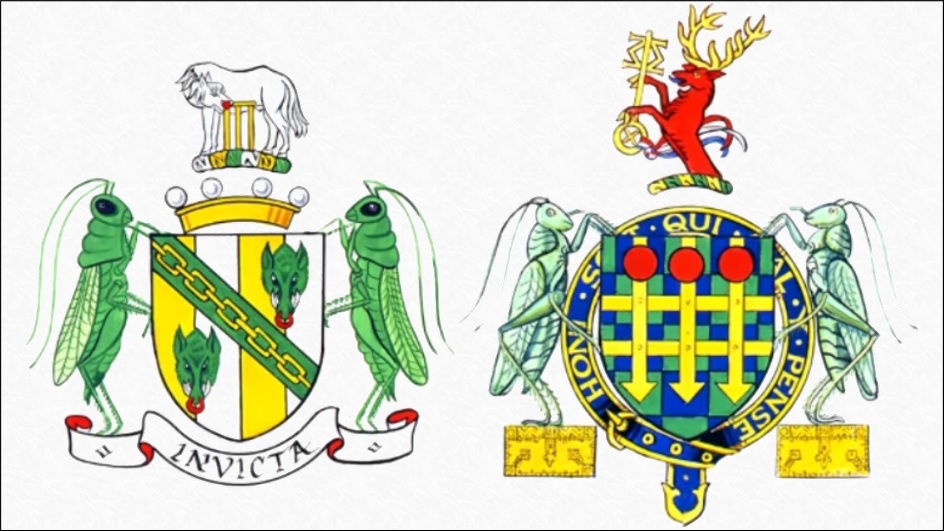
Armorial achievements of the Lord Cowdrey of Tonbridge (left) and Sir John Major (right)

Having exhausted what I could glean from the available editions of Burke’s and Debrett’s, I am ever on the lookout for new material on heraldry. Last week the College of Arms published its latest newsletter (which now regrettably appears only to print in October and January), but as usual the actual exemplifications of new armorial bearings were few.

I was delighted yesterday to discover this lecture on the development of English heraldry, given by the Somerset Herald David White in 2014. It is far from the only heraldry-related lecture video I have encountered online. Unfortunately I commonly find that the piece rarely goes beyond the basics of armorial composition and a brief overview of medieval chivalry, thus not telling me much beyond what I knew already – indeed it’s probable that the people making them are reliant on the same online and/or public domain resources that I am. This was not one of those, for it went beyond the Middle Ages to cover modern heraldry and much in between.

White’s lecture studied the artistic phases of heraldry, from the very simple designs of the medieval period to the more crowded ones of the early Tudors – when the nouveau riche were acquiring arms to display where they could be studied up close instead of glimpsed in motion – followed by a deliberate return to simplicity in the later Tudor and Stuart eras. There was a section on the infamous “landscape” and “seascape” heraldry of the Georgian years, with particular emphasis on Horatio Nelson, whose absurdly augmented escutcheon is often considered the nadir of the art. The Victorian era is not discussed in as much detail, save for a vague assertion that they went back to earlier styles as a result of the blossoming Gothic revival. Along the way he gave examples of families assuming arms and then later trying to get similar ones granted, or appropriating those of namesakes who were not actually related. The relative popularity of certain charges was also shown, with an ordinary or arms from the mid-1500s showing that already by then there were dozens of pages of lions (indeed a double-page spread shows thirty-two separate shields just with white lions on a red backdrop). White said that in modern times “one’s heart sinks” if a new applicant for arms requests a lion be included due to the difficulty of inventing an original design. He also speculated that the utility of heraldry as a system of identification might have been undermined by the preponderance of so many near-identical blazons.

Near the end of the lecture he showed some examples of reasonably recent grants of arms. Of particular interest was that of the cricket-player Colin Cowdrey, who was ennobled by John Major in 1997. His shield has a paly of four defaced by a bend dexter, representing the tallying of points. His crest had a set of wickets nosed by the white horse of Kent. Just to quash any remaining uncertainty, he also had crickets as supporters. Major himself became entitled to supporters upon his appointment as a Knight of the Garter in 2005. He too wished to have crickets, but was required to distinguish them from Cowdrey’s and so had them stand upon despatch boxes. Heraldry, of course, has no sense of scale. White called it a “slightly depressing thing” that the portcullis symbol was increasingly used on the shields of retired politicians to represent their profession.

The lecture I found was part of a collection of public lectures archived online by Newcastle University. The range of topics is as wide as you would find at Gresham, so well worth checking out.

UPDATE (March 2026)

White’s lecture can no longer be viewed directly from the link I originally posted as the university has deleted it from their website, but a record of it can be found on the Wayback Machine. For the Panopto recording itself the link within the crawled page does not work either, but miraculously the video is still accessible, and I’ve made sure to archive that as well.

The Chris Whitty Collection

Since about 2015 I have been an avid consumer of the public lectures put out by Gresham College. Initially the main draw for me was Vernon Bogdanor’s lectures on politics, followed by Simon Thurley’s series on the history of British architecture. The college has a sizeable online back-catalogue in addition to a high rate of new updates, so I was rarely stuck for something to watch.

By 2019 (or maybe it was 2018) I was branching out into lectures about medicine. I do not recall exactly which such video it was that I chose first and nor, until last year, did I remember much about the speaker. When the coronavirus crisis began and the government began doing daily press conferences, I did not think of Professor Whitty as a familiar name or face. Occasionally I think this of a public figure only to discover that I have edited their Wikipedia page years prior, but even that was not the case here. It was only upon searching for him on YouTube and finding familiar thumbnails that I realised I had seen him before.

Sure enough, Whitty spent some years as Visiting Professor of Public Health, and is currently Professor of Physic. He has produced seven series of lectures for the college since 2013, and continues to do so even during the pandemic.

In addition to these he has been the star – or at least a participant – of quite a few other videos over the years.

As far back as July 2012 he gave the Walker Institute Annual Lecture for the University of Reading, talking about Climate Change & Development in Africa.

In February 2013 he gave a speech at the STEPS Centre Symposium about the importance of evidence in health policy. In contrast to his eventual catchphrase, he makes a point here of deliberately including no slides at all. There was also a Q&A session.

In September 2014 he told the Science & Development Network why synthesis is key to science influence.

In late January 2015 he lectured the Royal Society of Tropical Medicine & Hygiene on forty years of fighting Malaria. That October he returned to talk about the pitfalls of eradication attempts.

In March he was a team of speakers lecturing the Royal Society of London about the inside story of the ongoing Ebola epidemic.

In June 2015 he chaired a panel discussion on the control of Malaria, presented by the Faculty of 1000.

In this one from five years ago he is interviewed alongside Professor Dame Sally Davies (his predecessor as Chief Medical Officer for England) about the experience of giving medical advice to the government.

In 2016 he gave a speech to launch the Centre for Global Health Research for Brighton & Sussex Medical School, in which he talks about global demography and its implications for the prevalence of various diseases.

The next week he appeared alongside Nicola Blackwood MP (then Chair of the Science & Technology Select Committee) and others in a panel discussion on Ebola vaccination.

Two months later he recorded a short message for International Nurses day, played by the National Institute for Health Research. Another month after that he gave a presentation commemorating the last ten years of the institute’s work.

In July 2017 he was asked how UKCDS contributes to development.

In April 2018 he launched the King’s Global Health Institute. In May he gave the George Griffin Lecture for the Association of Physicians of Great Britain & Ireland, talking about the direction of health research. That December he gave a short speech at the IDEAL International Conference about the importance of scientific evaluation of innovation.

In September 2019 he was filmed by the Medical Research Council advising on how to influence policy and practice in health prevention.

The most interesting videos are those from the first two months of 2020, just before the pandemic made him famous nationwide. On 23rd January he was interviewed for Public Health England about the importance of physical activity – a theme which has remained prominent in government policy since. On 27th February he appeared at the summit session for the Nuffield Trust to talk about health trends and projections over the next twenty years. At this stage the virus is a looming threat but has not yet taken over. Whitty is asked how he plans to deal with the coming epidemic. His answers are still abstract but already there are references to school closures, banning of mass gatherings and “flattening the peak”.

Leaving YouTube aside for the moment I also found two brief clips of him on DailyMotion: on 31st January he told ODN it was too early to tell if the virus would spread, and outlined the plans the government had in place to stop it. On 6th February he gave advice for those showing symptoms to self-isolate.

On 3rd March the Prime Minister held the first of what would turn out to be a very long series of press conferences on the coronavirus outbreak. Chris Whitty stood to his right and Sir Patrick Vallance (Chief Scientific Adviser) to his left. You might expect me to close here by saying “the rest is history” but, unfortunately, this particular piece of history is far from over yet.

The Next State Opening

There has been a lot of uncertainty over the last few years with respect to the beginnings and endings of parliamentary sessions. It might have been hoped that in 2021 the process would go back to normal, with a speech from the throne each May (typically the third Wednesday, with prorogation the week before). Now, alas, the pandemic could have thrown that out as well. A Cheapo’s Guide to London currently hints that it will take place in October, while Parliament’s own website gives no information at all. It is likely that any planned date could be changed many times depending on how events unfold in the coronavirus saga.

The key difference between this year and last is that now we have a smorgasbord of vaccines to thwart the disease and – in contrast to our poor performance in controlling the outbreak – are distributing them much faster than most other countries. Priority for vaccination is given largely in descending order of age, which could mean that for a few months of this year we have the paradoxical situation in which the elderly are safe to mingle outside while the young have to remain shielded. Overall this bodes well for the House of Lords, the majority of whose members are aged 70 and over. The Lord Speaker went for his first vaccine back in December. The Queen received hers in January. If the government’s target of 2 million vaccinations per week is maintained then the majority of Britain’s population, including nearly all peers, should have received at least one vaccine dose by the start of May.

Still, that doesn’t mean the ceremony will be plain sailing: likely there will still be some social distancing required and face coverings will remain prominent, which could dampen the splendour a little. In particular the crowding of MPs in the cramped space behind the bar of the upper chamber could prove dangerous, and it may be required that only a small delegation from the lower house is allowed to come. Of the frontal foursome it is probable that Mr Speaker (63), Black Rod (55) and the Commons Clerk (62-ish) will have immunity but the Serjeant-at-Arms (44) might not. As with the introduction ceremonies there could be some subtle changes in choreography to allow the key players to stand further apart.

The preceding prorogation would need to have such tweaks as well – although attendance for that is usually quite a lot lower anyway. Lady Evans of Bowes Park is by far the youngest of the five commissioners and thus probably the last to be immunised, unfortunate given that as the Leader of the House she is the one least able to be substituted, as well as the one who sits in the middle and the one doing all the talking. It could be that this year’s prorogation is again done with just three commissioners in attendance rather than five. It is hard to find the dimensions of the chamber online but I think there might just be room to space them out properly, though perhaps it may have to be contrived so that they sit in a triangular instead of linear formation.

To make matters worse, the devolved legislatures in Cardiff and Holyrood are expected to go up for election in the same month. They traditionally welcome the monarch for an opening ceremony in the summer months – though unlike in Wesminster the speech is not a prerequisite for the commencement of parliamentary business. As with so much in this phenomenon, all we can do is wait and see.

UPDATE (22nd March)

The government has put out a press release announcing that the state opening will be on Tuesday 11th May, “adapted, with reduced ceremonial elements and attendees to ensure it is COVID-secure”.

A Clean Slate

Four years ago, when watching Donald Trump’s inauguration on the television, my eyes kept flicking to the White House website. It proclaimed “Yes we did. Yes, we can.”, the triumphal culmination of eight years of Obama’s presidency. There were pages upon pages of policies, speeches, appointments and events. No sooner had the 12 noon mark passed (or 5pm for us in Britain) than it all was gone. In its place was a “transitionsplash” page showing Trump & Pence together and a link to sign up for updates. Continuing to the main site one saw that, while the template was still the same (though a more substantial redesign was done some months later), all of the old content had been removed and the biographies about the first and second couples had been changed to reflect the new incumbents. As the news was quick to point out, this was planned long in advance as part of the post-electoral transition process. The same had occurred, albeit less smoothly, when Obama first entered office in 2009. Sure enough it happened again in 2021, despite all the shenanigans over the previous ten weeks. Biden’s new site has been the subject of much excitement and a little intrigue. The old sites haven’t gone of course, rather they have been moved to the archives – preserved forever in digital aspic.

Really, changing over the website itself is the easy part – a relatively simple matter of swapping the domains around. More difficult is the treatment of the many associated official accounts on various other platforms. These are similarly archived and wiped, which I assume requires the intervention of the platform owners (as it would in many cases be beyond the capabilities of the ordinary user) to move all of the existing material to a different account name and then opening a new account under the old name. This means that the incumbent president always possesses the undifferentiated “whitehouse” address while his predecessors are specifically named or numbered, important for both practical and symbolic reasons. This only appears to apply to the presidency, however, and not to the other cabinet departments, whose websites and other outlets all carry on regardless.

The World Wide Web became available to the public in 1991, during the tenure of George Bush Sr. Since then there have been five presidential transitions, all of them occurring on 20th January of a leap year and all seeing a change of party – from Republican Bush Sr to Democratic Clinton in 1993, to Republican Bush Jr in 2001, to Democratic Obama in 2009, to Republican Trump in 2017, to Democratic Biden in 2021. Interestingly, Biden is the first challenger with a website to win. Each entailed a change of most if not all senior executive offices, making a clean break from what existed before. Not all transitions, though, are quite so discrete. Imagine that the web had launched four years earlier and that the White House had its main website up by the end of Reagan’s term. He was succeeded by his own Vice President of the last eight years and quite a few cabinet officials (such as Nicholas Brady, Dick Thornburgh and Lauro Cavazos) remained the same. Would it have made sense to wipe the slate at that point, given that much of the work being erased would have been the new president’s own? Alternatively, one could have asked the same question in 2001 had the Florida recount gone differently and Al Gore succeeded Clinton. Indeed sometimes the transition cannot even be planned – such as with Nixon’s resignation in 1974 or Kennedy’s assassination in 1963. Would Johnson and Ford have been given new accounts immediately, or would they have continued with the old? Given Biden’s advanced years and hints that he will only serve one term, this question could shortly become pertinent again.

In Britain, at least for the last decade, there has been little in the way of neatness. In 2010, following an inconclusive general election and days of tense negotiation, the New Labour government of Gordon Brown was replaced by the coalition government of David Cameron and Nick Clegg (beginning what many term “ConDemNation”). That government had no continuity with its predecessor – every single minister being replaced and no party continuing in power. The coalition survived with reasonably little churn until the long-awaited 2015 election, in which the Conservatives won a majority in the House of Commons while the Liberal Democrats were all but obliterated. Clegg and his ministers resigned from the government, to be replaced by an all-blue team. There was surprisingly little change in the cabinet lineup at this point – out of 30 members (22 full and 8 extras), 17 continued in the same post they held prior to the election, including all four great offices of state. Of those new appointments that were made, four were to replace the excised Liberal Democrats and three more to replace Conservatives who had ceased (voluntarily or not) to be MPs. Cameron’s second government lasted only 14 months, brought down by the EU referendum and replaced by Theresa May. Her reshuffle in July 2016 was a great deal more substantial than that of the previous year – 20 cabinet posts changing hands (including all four great offices of state) as well as one office dissolved and two created. May’s first government was to be even shorter-lived, for the next year there was a snap general election. Contrary to her intentions, this resulted in a small net loss of seats for the Conservatives, forcing her to form a minority government with confidence & supply from the Democratic Unionists. This prompted a fairly small reshuffle of just seven changes, though the next two years saw a high rate of turnover due to fallouts, scandals and protests. In July 2019 the leader herself finally resigned, replaced by Boris Johnson. That reshuffle saw 27 cabinet ministers replaced (again, including all four greats). Johnson’s first government technically still enjoyed supply from the DUP, but in practice had no majority as a large number of Conservatives defected (indeed, party discipline on important votes had broken down long before). It was only fifteen weeks before the chaotic 57th Parliament was dissolved. The Conservatives won a large majority at the ensuing election, allowing Johnson to form a second government without the need for DUP support. Fearful of too much disruption so close to the Brexit deadline, he purposely kept his existing ministers in place until February before carrying out a reshuffle, even ennobling Nicky Morgan so that she could continue her role in the other place for a few weeks.

The purpose of the preceding paragraph’s whistle-stop tour through the politics of the New Tens is to demonstrate that in the past eleven years this country has technically had six changes of government, only the first of which represented a clean break of the kind shown by recent US Presidential transitions. What’s more, looking further back we see little improvement: Brown took over in the middle of the 54th Parliament from Tony Blair, who had been in charge for over ten years of Labour rule. Before that we find an even longer period of Conservative rule, featuring during the 50th Parliament the substitution of John Major for Margaret Thatcher due to a backbench revolt. Only Blair’s succession from Major in 1997 represents a total renewal, which means that in the average Briton’s lifetime* what we imagine as the normal way of regime change – an opposition wins a majority in the House of Commons, then its leader is swiftly appointed Prime Minister – has really only happened once.

How, then, do our government’s websites adapt to events? The online presence of the Her Majesty’s Government has had several incarnations, beginning in 1994 with the Government Information Service, then moving in 2001 to UKonline, a portal allowing the public to search various smaller departments. In 2004 this was in turn replaced by Directgov, and the next month a website was established for Business Link, a service which gave advice for the commercial sector. In 2012, under the coalition, both of these websites were scrapped in favour of the unified GOV.UK, a process which I have discussed here before. Old documentation going back decades is incorporated into the site, with notices such as “This was published under the 1983 to 1987 Conservative government.”  slapped on the tops of the pages. Prior to the move, the Prime Minister’s office could be found at number10.gov.uk (or sometimes number-10, just to confuse you). After Brown left office it appears that posts relating to his tenure were hidden to make space for Cameron. It can be seen that many other accounts were changed at this point, in the aim of “reducing potential confusion to users”. I am disinclined to go through every social media account for every ministerial department, but a little checking shows that HM Treasury has been on Flickr and YouTube since 2008 (albeit the only pictures from pre-2010 are apolitical shots of the building). The Home Office likewise established a YouTube channel in 2008 but its earliest videos are from 2012. The Department for Transport’s channel, established in 2009, averts this a little.

Of course, the US President is head of state as well as head of government, so perhaps a comparison with the royal family would be more appropriate. On the other hand, the most recent demise of the crown occurred when computer science had barely emerged as an academic discipline, and long before the creation of the internet. The earliest government crawls make reference to royal.gov.uk, but the first time I can find it is 1998. The site was redesigned a few times over the following years and then, in 2016, was replaced entirely by royal.uk. A YouTube channel debuted in 2007. Of course, the firm is rather large and contains many subsidiary households, such as for the Prince of Wales, or the Duke of Cambridge. There was a minor headline some years ago when it emerged that the family had been buying up domain names to prevent them being used for cyber-squatting. Most now simply redirect to the main homepage. A massive archiving and wiping operation upon the current monarch’s decease is unlikely, put perhaps the Prince of Wales site will be handed over to Prince William at the time of his investiture. Let us be thankful that the Duke of Windsor never had a Twitter account.

If Britain has any office that functionally resembles a presidency, it would be the directly elected mayors – be they for cities, counties or regions. The most obvious case, naturally, is the Mayor of Greater London, and not just because its most recent holder is now Prime Minister. Its official Twitter account just says “Tweets before 9 May 2016 are from the previous Mayor.” and hopes you won’t be too confused by the appearance of Sadiq Khan’s face next to Boris Johnson’s words. It could be worse, I suppose.

*Worldometers has the median age of the UK population at 40.5 years, which puts Thatcher’s accession in 1979 a little out of reach.

UPDATE (2nd February)

Shortly after departing, Trump established the “Office of the Former President”. While the establishment is routine, the name is not – the many other former presidents have generally named the office after themselves. There has been some controversy around Trump’s use of the bald eagle, though I note that other presidents have continued to use similar devices on their stationery long after leaving office. The discussion is a little reminiscent of Margaret Thatcher in the nineties. So far I have not found a website for Trump’s new office, and indeed he may struggle to find the right domain, as officeoftheformerpresident.org currently redirects to an Atlantic article calling him the worst president in history.

UPDATE (January 2022)

A year after he left the White House I have found Trump’s new website. It is oddly titled “45 Office” and uses a monochrome version of the Great Seal.


The Long Arms of the Law

The Lord Kerr of Tonaghmore died on the first of this month, having retired on the last of September. He was both the last Lord of Appeal in Ordinary appointed to the Appellate Committee of the House of Lords under the Appellate Jurisdiction Act 1876 (just ninety-four days before their respective dissolution and appeal took effect) and the last of that group’s veterans to retire from the successor Supreme Court.

Undeterred by the recent obliteration of so many such pages, I wondered if the law lords were worth an armorial list on Wikipedia, and so have begun to draft one. As with my article last year on Speakers of the House of Commons, I found that there were quite a few names on the list who died so soon after being ennobled that they miss out being recorded in the genealogy books (and the law lords are of course life peers, so no heirs or successors can hold the place). What’s more, those books themselves are in shorter supply than they were last year – whereas Wikipedians used to have access to online scans of Burke’s Peerage from 1949 (on The Internet Archive) and 1959 (on Hathitrust), those files have been removed in the latter half of this year. Our earliest edition now is a copy of Debrett’s Peerage from 1936, and that is a poor-quality scan with many sections of prose missing.

Of course, nowadays the country’s highest judges would not be mentioned in such volumes at all: The Constitutional Reform Act 2005 which brought about the change barred those justices already holding peerages from resuming their seats in the House of Lords until their time on the court had ended. Further, a political decision was made that subsequent appointments to the new court would not be ennobled at all, but merely granted courtesy titles akin to those of hereditary peers’ heirs apparent. An exception was made at the start of this year when the new President of the Supreme Court Robert Reed, who had already used the courtesy title Lord Reed since his appointment to the College of Justice in 1998, was substantively created Baron Reed of Allermuir, of Sundridge Park in the London Borough of Bromley, under the Life Peerages Act 1958. It remains to be seen whether this favour will be repeated for his successors in that office.

How then, do I find the missing entries? My experience hunting down the speakers’ arms taught me the importance of looking for unofficial records, especially fan labour. I discovered some time ago the Flickr account of Baz Manning, an older heraldist who has carefully photographed a lot of armorial art and architecture over the years. In particular he has uploaded a scrupulous catalogue of the coats of arms displayed on the walls and windows of Lincoln’s Inn, where so many of Britain’s senior lawyers and judges are trained. The collection of shields of the institution’s alumni stretches back centuries, and proved very helpful to me in resuming my contributions to the Commons, which had petered out in the previous month due to running out of source material. The main real drawback to using this method is that I have no access to the text of the original blazon, and so can only copy what the previous artist has done, and if any charge or ordinary is unclear in the image I see then it is not possible to identify it. I would not attempt to reverse engineer the blazon from the depiction and risk getting any parts wrong.

Obviously not all of the UK’s judiciary went to Lincoln’s Inn – or even necessarily to the other Inns of Court – but the proportion who did is significant enough to keep my hobby going for the present, and hopefully the presence of such a large armorial display in such a prestigious location dedicated specifically to legal professionals should bolster my case (ahem) for the notability of an armorial list for the law lords, so that it would not be so casually junked as were the others.

EXTERNAL LINKS

More Armorials

Photographs by Baz Manning, 2014

A month ago I mentioned that I was creating a Wikipedia armorial page for schools in the United Kingdom. Since then I have moved the page from Draft to Mainspace. Whether it can be called successful is not yet clear – nobody has attempted to delete it, but few have come to contribute to it either. Having run out of obvious categories of corporate arms, I went back to a personal one. Having already created a page for Speakers of the House of Commons, earlier this year I drafted one for their old counterparts, the Lord Chancellors. These were generally easier to source than those of the speakers of the lower house, for the chancellors acceded to the peerage – and thus the pages of Burke or Debrett – at the beginning of their tenures rather than the end. The Constitutional Reform Act 2005 complicates matters somewhat, as the office has since been given to a disturbingly rapid succession of MPs, none of whom are yet armigerous as far as I know. The new, separate office of Lord Speaker has only had three incumbents so far and I have no information on any of their heraldic bearings or lack thereof.

That page having apparently worked, yesterday I embarked on yet another armorial, this time for the Chancellors of the Exchequer. Already I have filled in most of the entries for those who have held the office since the dawn of the eighteenth century, helped in part because the list significantly overlaps with that of the prime ministers. Now I am unsure of how to tread further, for the office is not as simple as it appears. The Chancellor of the Exchequer of the United Kingdom is a merger (confusingly not done until sixteen years after the kingdoms themselves were merged) of the Chancellor of the Exchequer of Ireland with the Chancellor of the Exchequer of Great Britain. The latter was itself a merger of the Chancellor of the Exchequer of England with the Treasurer-depute of Scotland. The Lord Chancellorship similarly has existed in various forms in multiple polities. I am not sure that it would be possible to make armorial pages for all of them, for some of the lists stretch back to the high medieval era and there are many uncertain entries. If even their names are not remembered then it is not likely that their blazons would be.

On a slightly different note, most major media sources have determined beyond reasonable doubt (though reason has been tested in the last few years) that Joe Biden is the President-elect of the United States. Parliamentary democracies tend to have a full-time shadow cabinet whose members are ready to form the real cabinet at moment’s notice should their party win power. In the states there is a lengthy period between election and inauguration during which the outgoing and incoming presidents negotiate the transfer of power and decisions can be made in advance about the composition of the new administration. In at least the last three instances the transition team has been construed as a formal office with its own website and its own insignia. Obama’s team used a wide rectangle with the national coat of arms adjacent to the name in a stylised typeface, notable in that it shows the heraldic achievement separated from the context of the round seal, and rather resembles the departmental branding seen in Roadkill. Trump used an oval with a depiction of the White House in the centre and his own title around the border. Biden’s team is currently using a minimalist version of the presidential seal with the number 46 at the base. Though its cause was ultimately jossed, in 2012 a Romney transition was planned, its logo being a conjoined circle and oval, the former showing what I assume to be an eagle volant, though the resolution is too poor to make out. I have yet to find one for Hillary Clinton in 2016. It remains to be seen if future presidential transitions will settle on a standardised emblem, for it seems a pity to put so much work into a brand that will only be used for a couple of months. Personally I would quite like to see the shield differenced by the three-point label of an heir apparent – though actually that could belong to the Vice-President as well. Another thing to note is that, at noon on inauguration day the White House website and all associated social media accounts are wiped clean ready for the new president to start again, with all previous content copied swiftly onto an archive site. This is necessary so that communications by an earlier administration are not attributed to those of a later one. I have a faint memory of this being a problem for the Mayor of London’s account on Twitter, where if you crawl back far enough you can see Boris Johnson’s words alongside Sadiq Khan’s face, with somewhat confusing results. It is interesting that since the launch of the World Wide Web there have not yet between two consecutive POTUSes from the same party, and I wonder how the digital transition would then be handled – especially if the new leader had been a senior figure in the administration of his predecessor.

Back to the main topic, recently I discovered (though how recently it happened I cannot say for certain) that the Heraldry Society has released its 2019 articles from The Coat of Arms as downloadable pdfs. The 2020 article titles are listed but presumably the content will remain reserved for members only until next year. The most tantalising of these is Arms and the woman: the heraldry of women parliamentarians by Duncan Sutherland, which I had already seen advertised as a live event but obviously did not have the means to attend. If the lecture was recorded then the video is not one to which I have access.

UPDATE (13th November)

No sooner had I completed the pages than a user by the name of Fram prodded several of them for deletion, as well as a few earlier such armorials that I did not create, on the grounds that the lists of coats of arms are not notable in their own right. I have a week to argue my case. So far nobody else from the heraldry and vexillology project seems to have noticed. Just in case I fail, I have backed up the code for all the affected pages in my own userspace – which was not possible for the Sudrian material on account of the non-free photographs.

UPDATE (August 2022)

Though I did not create the page Armorial of prime ministers of the United Kingdom, I have contributed a fair amount of its content. Recently a thread was opened on the Heraldry Subreddit about Prime Ministers’ coats of arms, which included a few of my illustrations.

Lords of the Pod

Today the House of Lords launched a new podcast, hosted by internal communications officer Amy Green and head of research services Matt Purvis.

The first episode focused on the way in which the house had reorganised itself due to the pandemic. The hosts began by talking among themselves to get novice listeners up to speed on the basics, as well as plugging the House of Lords Library. The Lord Speaker was then interviewed about his role and that of the institution more generally in scrutinising government and amending laws.

The Baroness Penn, currently Baby of the House, was appointed a Baroness-in-Waiting and Government Whip on 9 March, told of how her first speech in that capacity was made not from the despatch box in the chamber but from her own kitchen.

The Baroness McIntosh of Hudnall, a deputy speaker, spoke of the difficulties of adjusting at short notice to the new working conditions, with some of the woolsack team not being able to physically attend and others having to be hurriedly trained in the new system without ever having learned the old one.

The Baroness Armstrong of Hill Top, Chair of the Public Services Committee, talks about Britain’s ill-preparedness for the pandemic due to lack of prior action on issues such as poverty and obesity, which otherwise might have softened the effects of the virus.

The next episode is due a month from now. The topic has not yet been announced.

The Curious Case of Barron Trump

There are many strange phenomena associated with Donald Trump and his immediate family, who spent many years in business and reality TV before acceding to the heart of government. The one that I will discuss today is the fandom that has developed in the last few years around his youngest son.

Donald Junior (1977) and Eric have been both executives in The Trump Organization and judges on The Apprentice. They are active in their father’s election campaigns and engaged in international business dealings. Ivanka (1981) was a board member of the Donald J. Trump Foundation now serving as Advisor to the President. She participated alongside her father at international conferences and diplomatic meetings. Her husband Jared (1981) was appointed Senior Advisor and Director of the Office of American Innovation, among other things. 2006-born Barron, of course, is too young to be involved in such matters, and his mother has made efforts to maintain for him an appropriate level of distance from public scrutiny. He is rarely heard to speak, and reportedly is not allowed a social media presence, so little can be known about him outside of what few snippets are uttered to the press by his parents and what can be spotted when he is brought to public events.

His relative anonymity gives Barron a fascinating quality – he becomes a sort of blank state onto which others can project their own imagination. Above all, his fans feel a pity for him having to grow up in the shadow of his dysfunctional elders, and a hope that he can be “saved” from their fates as an adult. As is to be expected, there are rumours of autism, with some even suggesting that this could have influenced his father’s credulity to anti-vaccination ideas. It is at least faintly plausible given that the president was fifty-nine years old when he conceived his last son (advanced paternal age being a known risk factor), but I would be more inclined to believe it were this not a trendy claim to make about seemingly everyone in the public eye nowadays. Of course, the common perceptions of those on the spectrum (some true, some false) often overlap with those of the people in these kinds of online communities, which could go some way to explaining why they feel a natural affinity with Barron – or at any rate more of an affinity than they feel for the rest of the entourage.

Prior to Barron in 2017, the last minor son of an incumbent POTUS was John F. Kennedy Junior, who was frequently under the spotlight during his years at the White House and is immortalised in the photograph of him saluting his father’s coffin. Generally speaking most presidents’ children in the last century or so reached their majority some time before their fathers’ election, so a dependent First Son is a rarity, which of course adds to the excitement whenever it does occur.

As with much about the Trump family, certain precedents can be found in royal dynasties of centuries ago: Edward of Middleham, lone son of Richard III & Anne Neville, lived so brief and so ill-recorded a life that there is even an uncertainty of four years as to when he was born, and of about forty miles as to where he was buried. Had he not died so young then the course of British history would have been very different – the House of York might have been secured on the throne for many more decades and the Tudor coup of 1485 averted. He is important in that sense, and obviously would have been well-documented had he survived to become king, but as it is he serves as little more than a placeholder. The only contemporary likeness is a crude cartoon on the Rous Roll, and the only personal characteristic recorded was his sickliness. Two other namesake Princes of Wales fare little better: He of Lancaster was active military (and indeed was England’s only heir apparent to die in battle) so we can at least record his movements, but what we know of his personality is limited to a few sensationalist excerpts and is almost certainly exaggerated for propaganda purposes. He of Warwick survived into adulthood, but spent most of his life hidden away in the Tower of London. Again he was important as a placeholder, for Yorkist forces rallied around him as a potential replacement for Henry VII, but almost nothing is known about the man himself except that he had a mental illness, and even that is based on a one-off line written years after his death. He of the Sanctuary fares a little better in this regard, perhaps because he actually made it to the throne if (of only for eleven weeks) and spent nearly all of his life before that as heir apparent. Details were therefore recorded of his upbringing and his education, and we even have a few snippets describing his character. Even so, he is more remembered for his death than for his life. His brother Richard is a case in point – except for his child marriages and peerage there is very little in his biography that would not also apply to Edward V, and it is suggested that so many more pretenders posed as Richard than Edward precisely because the younger son was less well-documented and so granted wider latitude for invention.

For a modern example, one possible candidate is Prince John, youngest son of George V & Mary of Teck. Like Edward of Middleham his health was poor and, like Barron Trump, many suspect autism. In 1916 he was removed from public life and sent to live at Wood Farm on the Sandringham Estate (where the Duke of Edinburgh has lived since retiring in 2017) due to his increasingly-frequent epileptic seizures. He died in 1919. He has been the subject of some intrigue since his death, styled as The Lost Prince or The Windsors’ Tragic Secret. Unlike the earlier examples there was plenty of contemporary documentation of his life, but it was made public for a long time after his death. The void encouraged fiction, and some writers liked to exaggerate John’s seclusion so as to paint the family in a negative light, but later revelations indicate that he was treated as well as could be expected for the time, especially given that the First World War was in full swing.

If I had to single out one example of a historical antecedent for Barron my choice would fall upon Gioffre Borgia, youngest son (if he was his son at all) of Pope Alexander VI, who lacked his relatives’ political ambition. He is generally regarded as the innocent one in a dynasty renowned for its depravity. This is best illustrated in the Horrible Histories song about the family from 2012, in which Gioffre sits in mute confusion while his father and siblings go on about their various crimes, scandals and machinations. Gioffre lived into his thirties, playing a modest role in the Second Italian War and ruling indirectly over the city principality of Squillace.

Barron, at this point, has already outlived most of the people to whom I have referred, and his encounter with SARS-CoV-2 appears not to have caused any harm. Nor, for that matter, has there been any sign of an assassination attempt. Only time will tell which path he ultimately takes, and whether his fans’ hopes will be fulfilled or betrayed. All we can say for certain at this point is that he’ll be extremely tall, which might be an omen for the Cambridge and Sussex children, too.