The Political Colour Wheel

It’s becoming almost cliché to say that the traditional left-right political scale is out of date, or that it doesn’t reflect reality, or that people don’t understand it. Attempts have been made to produce more sophisticated models, such as the ever-popular compass which takes the existing left-right economic axis and adds a vertical one for authoritarian-libertarian. Then you have the horseshoe, separating moderates from extremists.

Today I make my debut on the market with my invention (unless someone else has already done this, but I couldn’t find any examples online) based on the colour wheel (the subtractive one used in art rather than the additive one used in physics, since I know of few political parties that use cyan or magenta livery). The three primary colours represent the three largest political groupings in Western democracies – liberalism in yellow, conservatism in blue and socialism in red. Of course, there are other political subdivisions which can be perceived as hybrids between any two of the big three, and these are represented by the secondary colours.

Of course, despite my best efforts, this one still has major problems:

For one thing I’m not entirely sure that “Populism” is the right name for the purple section. Purple is, in this country, the colour of the United Kingdom Independence Party, which is often described as populist and which drew support from disaffected traditionalist members of the Labour and Conservative parties who did not approve of the economically and socially liberal turns those parties had taken over recent decades. Much of present discourse identifies Liberalism and Populism as the main adversarial forces in worldwide political trends, which corresponds to yellow and purple being opposite on the wheel. Of course, populism can also be described as a style rather than a substance, and one which can be applied to any existing ideology, so some may dispute its appearance here as a discrete category.

Social Democracy is here coloured orange – the hybrid of yellow liberalism and red socialism. Older readers will remember that in the 1980s the Social Democrats were a group that split away from Labour (red) and eventually merged with the Liberals (yellow) to become the party now called the Liberal Democrats (rather than the name referring to the ideology of Liberal Democracy as you might otherwise assume). They have demonstrated some confusion over the years as to what their colour should be, with orange and yellow both in use, sometimes simultaneously. To make matters worse the “Orange Bookers” among the Liberal Democrats are, generally speaking, those on the right of the party who supported to coalition with the Conservatives in 2010, rather than the left who would have preferred to ally with Labour.

Finally the green section for Libertarianism is starkly contrasted with observed practice, where most Libertarians use the same yellow livery that Liberals do. As the names imply, Liberals and Libertarians have similar roots, but in the present day would regard themselves as distinct sects. Libertarians favour maximising personal freedom and minimising the power and influence of government in all aspects of life, often crudely characterised as left-wing on social issues but right-wing on economic ones. This placement on the wheel gives it green by default, but of course in real life that colour is strongly associated with environmentalism, and most parties calling themselves “The Green Party” aim to achieve their anti-pollution goals through highly socialistic economic means (often earning them the epithet “Watermelon“). This makes them the polar opposite of Libertarians on the wheel, and indeed Libertarians in real life tend to oppose most Green policies.

If I had access to a more sophisticated graphics package I might have done the colours on a gradient so that the middle was white and the outer rim black, or vice versa. Of course, those colours are not political opposites either – white normally representing pacifism and black the orthogonal anarchism (or fascism, also seen in brown, which tends to preclude both of these).

Back to the drawing board, I suppose.

FURTHER READING

UPDATE (July 2024)

This has proven to be one of my most popular articles, so I’ve made a spiritual sequel of sorts.

The New Spitting Image

I was born a year and a half too late to see the original Spitting Image when it aired on television. My first encounter with the series was, if I recall correctly, in late 2013 when I discovered clips from it on YouTube (a great many of which have recently been purged). Occasionally a clip show would include snippets of it, or there would be a nostalgic documentary, but watching the series properly was unfeasible.

Over my lifetime there have been a few attempts to provide a spiritual successor, but none had the staying power – or indeed the cultural weight – of the original. 2DTV (2001-2004) with its crude animation, was eventually cancelled due to low viewing figures. Headcases (2008) ran for just eight episodes. Newzoids, which used physical puppets with CG faces, appeared in advance of the 2015 general election and returned for a second series in late 2016, but then unceremoniously faded away.

Just over a year ago news broke that Spitting Image itself would be returning. Three weeks ago, it finally did. However, as before, I haven’t actually seen it. As with so many new productions, the creators have opted to bypass standard television and go directly to a streaming service. In this instance, the satirical puppet show will be the first original commission on BritBox, which was set up in 2017. It seems that Spitting Image is intended to be the “flagship” of the service which will tempt new viewers aboard. From what I have seen on various forums, there is some skepticism of this approach, with many expressing fatigue at having to juggle so many online subscriptions to get what they previously would have done from broadcast television.

The upshot of all this is that, as with the classic series, I must rely on the clips that are steadily dribbled out on the series’ YouTube channel. I had mixed views about the first few clips – while the visual design was on form, many of the vocal impressions felt lackluster and forgettable, with the action and dialogue not quite having the energy of the original. Still, it was nice to see a few nods to the older series, such as the giant portrait of Margaret Thatcher, Priti Patel reprising Edwina Currie’s role vampire portrayal, or Mike Pence copying John Major’s grey face aesthetic.

Many question now whether political satire is even possible nowadays, when public figures are rarely granted any dignity in the first place and various sectors of society are so offense-prone that any seriously biting comedy is liable to be swiftly shut down. We will have to wait and see whether this franchise is able to weather that storm. Already there is one instance of a sketch being withdrawn – whereas the original dropped a parody of “Tomorrow Belongs To Me” from its 1987 election special, the new one has quickly removed a Supercalifragilisticexpialidocious parody about Jacinda Ardern because the sketch ended with her decapitating a COVID patient, shortly before a real beheading took place in France. A similar incident befell the Doctor Who episode Robot of Sherwood due to the murders of James Foley and Steven Sotloff.

Can the new Spitting Image succeed? Only time will tell.


Visual Details in the BBC’s Roadkill

This slideshow requires JavaScript.

Recently I watched the new BBC drama series Roadkill, starring Hugh Laurie as ambitious but morally-unsound cabinet minister Peter Laurence. Many have wondered how it would be possible to set political fiction in the 2016-2020 era without Brexit, Trump and now Coronavirus (although this series was filmed a little to early to know of that last one) completely dominating every character’s every thought, or indeed without those certain real names and faces with whom such events are so intimately intertwined. This series has the innovative solution of moving an unspecified time into the future, by which point these issues have supposedly been resolved and everything is back to normal. That alone would surely make it a utopian invention, but the purpose of this post is not to review the series on a dramatic basis. Instead, I wish to draw attention to the ways in which government location and insignia – including the royal arms – are depicted in television.

Television program-makers have to tread very carefully when depicting real life brand names, trademarks, uniforms or other insignia. This often leads to them creating slightly off-model versions for their fictional purposes, in the hope that the result will be different enough to avoid legal liability but similar enough for viewers to understand.

In Roadkill there are multiple shots in this miniseries of the grand staircase at 10 Downing Street, with its display of the portraits of former prime ministers. Exactly when the political history of this work diverges from real life is unknown, but the most recent leader seen on the stairs is Margaret Thatcher (whose premiership is likewise something of a fixed point in time). Comparisons to virtual tours of the real staircase (both taken during Cameron’s tenure) reveal that the portraits on set were from different photographs. They are also quite literally larger than life, as the real portraits from Baldwin onwards are seen to be rather diminutive within their frames.

Laurence begins the episode as Minister of Transport, and there is a shot of him pulling up outside his headquarters, with “Ministry of Transport” on plaques either side of the main entrance. In real life Britain last had an organisation by that name in 1970. Since 2002 it has been called the Department for Transport, though the initialism MOT is still used for vehicle safety tests. Later in the episode Laurence is moved to Justice. In his meeting with the Prime Minister she refers to “the Ministry of Justice” which is what it has been called in real life since 2007, yet later when we see our protagonist at his new desk his screensaver says “Department of Justice” instead. For the rest of the series he is called “Minister” rather than “Secretary of State” and there is no mention of him holding the office of Lord Chancellor. What’s striking about these examples is the subtlety of the change – the typeface doesn’t look any different, nor does the coat of arms, only the arrangement of the arms to the left of the text instead of above.

The current template for government letterheads debuted in 2012, alongside the rolling out of GOV.UK, in a drive to rationalise the costly and confusing sprawl of departmental websites and logos which had emerged over the past twenty years. Prior to that there was no consistency in branding – while some departments did use the royal arms, others just put their names in stylised lettering, or had some other unrelated imagery. While this looked rather poor for the real life institutions, it probably made things easier for creators of political fiction, who could plausibly make up just about any title design for their invented offices without having to carefully alter the official insignia. The DoSAC logo as used in The Thick of It, for example, is perfectly believable as part of the Whitehall lineup of that period.

A long time ago there was a Doctor Who episode called The Aliens of London, in which much of the action takes place at Number 10. There was an attempt at recreating the grand staircase – in this version the helical staircase ascends anticlockwise and the walls are red, with the portraits few and far between. A coat of arms can be seen printed on the window, but too distant for much clarity. A later scene shows a conference room in which the royal arms appear on a backlit screen. The crown, motto, garter circlet and shield are correct (albeit the tinctures are changed), but the supporters are swapped around so that the unicorn stands to the dexter of the shield and the lion to the sinister – as if in the Scottish version. The lion is chained this time while the unicorn wears the crown of Scotland. The unicorn is still gorged with a circlet at the neck.

This slideshow requires JavaScript.

I also have a distant recollection of a scene in Torchwood series 3 or 4 in which a much worse state emblem is seen – the supporters and motto of the royal arms but the shield just shown the Parliamentary portcullis badge. Unfortunately I haven’t been able to track down a screencap in order to check.

On Peers’ Websites (or Lack Thereof)

The Right Honourable The Lord Walney (formerly Mr John Woodcock)

Members of the House of Commons generally have a personal website where constituents can contact them and get an overview of their representative’s work. These websites are variable in quality and effort. If you look through a large number of them in a short time, you’ll notice that a lot of them are practically identical, having presumably been created en masse from the same template (though different templates are favoured by different parties).

Members of the House of Lords generally lack any websites at all. There are some who were famous for other things prior to their ennoblement and who have websites about those (Dobbs for his novels, Lloyd-Webber for his operas) but few have sites that are specifically about their roles as peers.

Particularly interesting is that a large proportion (too large, by many reckonings) of the upper house’s membership comes from recent emeriti of the lower. Quite a lot of these ex-MPs have at some point used personal websites for that role, but these are nearly always abandoned once their owners move upstairs, sitting stagnant for months and then disappearing altogether when the domain registrations lapse (they might still be around having reverted to their subdomains, but I can’t find them). My best guess at the reason for this phenomenon is that MPs’ personal websites are maintained by constituency staff rather than the politicians themselves, and thus are not sustainable once those staff are no longer in service – or the peers just think that nobody will be interested in reading them.

Here is a summary of the personal websites of those ex-MPs whose life peerages have already been gazetted this year, omitting those who don’t appear to have had a website in the first place.

2020 Special Honours

2019 Dissolution Honours

2020 Political Honours

New Ap-peer-ances

The Right Honourable The Lord Vaizey of Didcot PC

Today the House of Commons resumes sitting after the summer recess. Tomorrow the Lords will follow. A lot of new members will be joining shortly.

On the ultimate day of July the belated Dissolution Honours list for last year’s general election was finally published. Confusingly, a separate Political Honours list was published on the same day. The two lists between them announced thirty-six new life peers. On top of that baronies were also promised to the outgoing Cabinet Secretary Sir Mark Sedwill and the incoming National Security Adviser David Frost.

It saddened many to see the size of the upper house increase so suddenly after a few years of carefully-managed reduction, though this year’s intake is noticeably smaller than the forty-five appointed in the dissolution honours for 2015, or the fifty-six appointed in those of 2010.

While knights, dames, and recipients of lesser awards know their new honorifics immediately, a new peer or peeress must negotiate with the Garter King of Arms before their precise title can be decided. Even without COVID-19 disrupting business, there can often be a substantial delay between the publication of the honours list and the sealing of the letters patent. This can be a nuisance for Wikipedians, as the biographies of those promised peerages must be held in awkward purgatory until their ennoblement actually arrives, while well-meaning but ill-informed editors try to describe them as already being members of the house, or even make guesses at what their titles should be.

To make matters worse still, the London Gazette, which is normally taken as the gold standard of official record, frequently lags days or even weeks behind Parliament’s own website, which tends to include new peers among the Lords’ membership immediately, though we must still wait for the former in order to know their territorial designations.

The online parliamentary calendar suggests that introductions of these new peers will not begin until next week. The majority of the new members are still described by plain name rather than title, indicating that their elevation has not yet occurred.

  • 07th Sep – The Lord Bishop of Manchester (David Walker)
  • 08th Sep – Lord Frost & Lord Herbert of South Downs
  • 10th Sep – Lord Vaizey of Didcot & James Wharton
  • 14th Sep – Ian Austin & Dame Helena Morrissey
  • 15th Sep – Kathryn Clark & John Woodcock
  • 17th Sep – Kenneth Clarke & Gisela Stuart
  • 28th Sep – Lorraine Fullbrook & Aamer Sarfraz
  • 29th Sep – Sir Patrick McLoughlin & Susan Hayman

It seems likely that the inductions will spread well into October, though the calendar does not yet go that far. It will be interesting to see if these ceremonies are done in the same no-frills manner as those of Grimstone and Greenhalgh earlier this year and, if so, how long it will be before the normal accompaniments return.

EXTERNAL LINKS

  • 30th Aug – Professor Norton’s blog on the new appointments.
  • 29th Jul – Constitution Committee discusses the functioning of Parliament during the pandemic and the implications of adding new peers.
  • 2005 – An overview of the induction process.
  • 1963 – A short account of Ernest Simon’s choice of title.

UPDATE (8th September)

Introductions of the new peers to the upper house have begun. The Lord Frost and the Lord Herbert of South Downs took their seats today. Unfortunately those in charge of the video stream neglected to enable sound until the former’s ceremony was nearly over. More curiosities emerge here:

  1. Herbert wore the scarlet robe in the traditional manner whereas Frost went without.
  2. The letters patent used to be large sheets of what might be vellum, whereas now they are using ordinary A4 printouts (Herbert’s even had a post-it note stuck to it!). Perhaps the full-size versions are being kept away from potential contamination?
  3. Hansard is again crediting supporters for the new peers, even though they are still not seen taking part in the procession. Shinkwin, at least, can be spotted watching from the steps of the throne. This would seem equivalent to being an honorary pallbearer at a funeral.

UPDATE (14th September)

Today The Lord Austin of Dudley and the Baroness Morrissey were introduced. Supporters are physically participating again, though the choreography is rather different now.

UPDATE (29th September)

The Lord McLoughlin was introduced between the Lord Cormack and the Lord Randall of Uxbridge, all three robed. McLoughlin paused before exiting the chamber to allow Randall to get ahead of him – though I think in previous practice it was the senior supporter who walked in front at this stage rather than the junior. The Baroness Hayman of Ullock was then introduced in a robe but her supporters (the Baronesses Jones of Whitchurch and Smith of Basildon) forewent them. Hayman walked ahead of both supporters to exit the chamber and did not even give the deputy speaker a cursory nod along the way.

UPDATE (5th October)

The Lords Moyland and Botham were introduced today. My fascination on this occasion was less with the introductions themselves and more with the technical difficulties which delayed them for several minutes – and delayed all the chamber’s other business for over an hour. I could hear just fine through ParliamentLive, but apparently the sound was failing through other channels. There was a lot of idle chatter among peers and the sitting was adjourned during pleasure several times – with Fowler stumbling through the vote each time. Most notably you can hear someone (maybe the reading clerk Simon Burton or the chief whip Lord Ashton of Hyde) saying “testing, testing, one, two three” many times, once even going over sixty.

UPDATE (9th November)

The Lords Stewart of Dirleton, another supernumerary, took his seat today. The footage didn’t cut in until Burton was already some way into the patent. Once Stewart had left the chamber proceedings were delayed while the clerk, another staff-member and a shadow minister fumbled around rearranging the clutter on the table and wiping it with sanitiser. Fowler remarked “No more cleaning?” when they appeared to have finished. To make matters worse, once Burton stood up to give the Lord Speaker the customary nod, a large black object (a cushion, presumably) could be seen to fall from his chair.

Pictures in Unexpected Places (Part 2)

Last year I made a post looking at some of the ways in which my free-licence photographs were being used online. Since then a couple more examples have turned up:

This article in The Boar uses my photograph of the laundry room at The Lawns Centre to head an article about the student union at Warwick changing their laundry contractor. Interestingly the image clearly shows signage with Hull branding on it. The article says “Card or credits will not be required to use their service, which will reportedly also handle potential machine breakdowns with quicker response times.“, which is of great interest to me, as I found the laundry facilities at The Lawns to be insufficient, overcomplicated, unreliable. After the first fortnight I opted to put my worn clothes into a travel bag and haul them to Rex Launderette just under a mile away.

The UK Human Rights Blog credited me for a photograph of Lord Sumption. I merely uploaded the screenshot to Wikimedia Commons, the video was actually produced by the Cambridge Law Faculty.

The Green Chair Quartet

The Ways & Means Committee was, and in some countries still is, a subgroup of the national legislature responsible for proposing changes to fiscal policy. In the House of Commons a tradition developed whereby the Chairman of Ways & Means, rather than the Speaker, would preside over the chamber during the annual budget statement. From 1853 the Chairman took on the role of the Speaker’s deputy in general. This was codified by the Deputy Speakers Act of 1855. The Chairman was given his own Deputy in 1902.

The committee itself was abolished in 1967, with full authority over fiscal matters going to the Chancellor of the Exchequer, but the chairmen retained their functions as deputy speakers. Like the main Speaker they do not speak in the chamber except on matters of procedure, nor vote unless to break a tie. Unlike him they remain members of their respective parties and must fight as party candidates at general elections. Traditionally the Speaker was elected at the first sitting day after each general election, whereas the deputies were appointed just after the first State Opening.

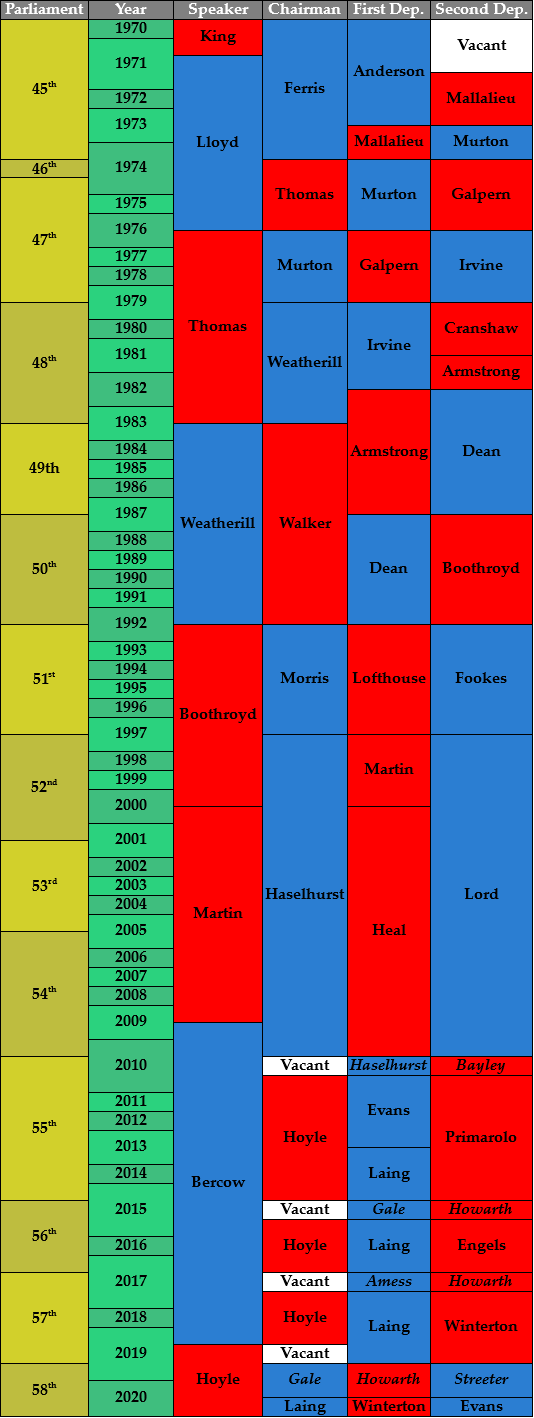
The table that I have created shows all of the speakers and their deputies since the beginning of the 45th Parliament in 1970.

The Commons assembled on 29th June and Dr Horace King, member for Southampton Itchen, was elected to a third term as Speaker, having taken office following the death of Sir Harry Hylton-Foster in 1965. On 2nd July he was given Sir Robert Grant-Ferris (Conservative, Nantwich) as Chairman and Betty Harvie Anderson (Conservative, East Renfrewshire) as Deputy.

On 12th January 1971 King retired and former Foreign Secretary Selwyn Lloyd was, with a bit of difficulty, elected to replace him. This briefly resulted in an all-blue speakership trio. Ten months later the post of Second Deputy Chairman was established and conferred upon the Labour backbencher Sir Lancelot Mallalieu. Anderson resigned her post at the end of the third session. After the state opening Mallalieu was promoted to replace her and his position given to Oscar Murton, Conservative member for Poole.

Ferris and Mallalieu both retired from the Commons at the general election of February 1974. The short-lived 46th Parliament saw Lloyd re-elected as speaker and Murton promoted to First Deputy, with former Secretary of State for Wales George Thomas becoming chairman. Seemingly no Second Deputy was appointed that time. After the October election Lloyd, Thomas and Murton were restored, with Sir Myer Galpern (Labour, Glasgow Shettleston) becoming Second Deputy. This arrangement persisted until 3rd February 1976 when Lloyd retired and Thomas was elected to replace him. That same day Murton and Galpern were promoted one step each, with Sir Godman Irvine brought in at the bottom.

At the 1979 general election Murton and Galpern both retired from the Commons and were kicked upstairs that summer. Anderson, a backbencher since her resignation, did the same with the unusual title Baroness Skrimshire of Quarter, of Dunipace in the District of Falkirk, but she suffered a fatal asthma attack just a week after her introduction to the Lords. Thomas resumed his place, with Irvine becoming First Deputy under Bernard Weatherill (Conservative, Croydon North East). Richard Cranshaw (Labour, Liverpool Toxteth) was then appointed Second Deputy. Cranshaw vacated the post in February 1981 when he defected to the Social Democratic Party. He was replaced by Ernest Armstrong (Labour, North West Durham). On 28 May 1982 Armstrong was promoted after Irvine’s resignation, with Paul Dean (Conservative, North Somerset) appointed below him.

At the 1983 general election Cranshaw was defeated while Thomas and Irvine both retired. The former two were ennobled. Weatherill then became Speaker and Harold Walker (Labour, Doncaster Central) became Chairman. Armstrong and Dean stayed still.

In 1987 Armstrong retired. Weatherill and Walker remained, with Dean made First Deputy and Betty Boothroyd (Labour, West Bromwich West) Second. In 1992 Weatherill, Walker and Dean all stood down. Boothroyd beat Peter Brooke to the Speaker’s chair. She acquired a new team of Michael Morris (Conservative, Northampton South), Geoffrey Lofthouse (Labour, Pontefract & Castleford) and Dame Janet Fookes (Conservative, Plymouth Drake). They too departed on masse in 1997 – the latter two voluntarily, the former less so.

Their replacements were Alan Haselhurst (Conservative, Saffron Walden), Michael Martin (Labour, Glasgow Springburn) and Michael Lord (Conservative, Central Suffolk and North Ipswich). Martin succeeded Boothroyd upon her retirement in 2000, and was himself replaced by Sylvia Heal (Labour, Halesowen and Rowley Regis). This team remained stable for most of the noughties.

Martin resigned in 2009. Haselhurst and Lord both contested the ensuing election, the former getting a measly sixty-six votes and the latter just nine. The winner was outsider John Bercow (Conservative, Buckingham). That knocked off the party balance for the first time in thirty-five years. At the 2010 general election Heal left politics behind and Lord moved upstairs, taking the title Baron Framlingham, of Eye in the County of Suffolk, to avoid the obvious joke.

At the start of the 55th Parliament Bercow was re-elected Speaker, and new rules took effect requiring deputies to be elected a ballot of members rather than appointed in the old manner. Haselhurst was no longer eligible to be Chairman, only First Deputy, so he became Chairman of the Administration Committee instead. Those elected were Lindsay Hoyle (Labour, Chorley), Nigel Evans (Conservative, Ribble Valley) and Dawn Primarolo (Labour, Bristol South). Evans resigned as First Deputy in September 2013, and the next month Eleanor Laing (Conservative, Epping Forest) took his place.

In 2015 Primarolo left for benches redder. Bercow, Hoyle and Laing continued, with Natasha Engel (Labour, North East Derbyshire) taking the junior spot in a rather noncompetitive election. Engel was defeated in the 2017 snap election. Haselhurst stood down, accepting a life peerage the next year. The new Second Deputy was Dame Rosie Winterton (Labour, Doncaster Central).

Some awkwardness ensued in 2019 when another snap election was imposed. Bercow resigned his seat in the 57th House of Commons two days before it was due to dissolve. All three deputies sought to succeed him as Speaker, with Hoyle ultimately prevailing. His former position as Chairman of Ways & Means was left vacant on the one remaining sitting day.

The present parliament assembled on 17th December and Hoyle was swiftly re-instated, but the deputies were not elected until January. Laing was made Chairman, with Winterton becoming First Deputy unopposed and Evans coming back in as second. How long this team will stay together is to be determined.

You may notice that there are some italicised names not yet mentioned. The new arrangements for electing deputies contained a caveat that the old system could still be used to appoint up to three temporary placeholders from among the surviving members of the previous house’s Panel of Chairs so that the Speaker was not left to carry the whole workload alone for the first few days. Haselhurst was kept on in 2010 with Hugh Bayley (York Central). In 2015 the appointments were Sir Roger Gale (Conservative, North Thanet) and George Howarth (Labour, Knowsley). In 2017 they were Howarth and Sir David Amess (Conservative, Southend West). In these instances the documentation of was hard to find, and I really only know who served as temporary deputies from the Speaker thanking them once the permanent deputies were elected. In no case was it made clear which member acted in which particular office, so I have assigned them to the roles for which they would have been eligible to contest in the elections, and according to seniority of service in the house.

For 2019-2020 it was much clearer, with an explicit statement in the appointment motion that Gale would be Chairman, Howarth would be First Deputy and Sir Gary Streeter (Conservative, South West Devon) would be Second.

FURTHER READING

Commons Deputy Speakers – UK Parliament

Need No Introductions

Are we missing something?

After an unusually long recess today was the day that Parliament finally resumed, but everything was far from back to normal.

Social distancing measures require MPs and peers to be spaced 2 metres apart, which significantly diminished the capacity of the main chambers. Plenaries can no longer be physically attended by more than a few dozen members at a time. Every other bench has been ruled out of bounds. In the Lords this is indicated by a red cloth placed over the length, while in the Commons there are slabs of cardboard bordered by hazard tape blocking access. The small white cards on the frames of the green benches, normally used by honourable members to reserve a place in advance, were replaced by either red cards with a no entry sign or green cards with a tick to indicate which spots could or could not be used. The red benches have no corresponding external frames, so instead the tick signs were attached to small pillars propped up behind. Two of the three cross benches had disappeared, as had two of the three seats for the upper house’s clerks, and both chambers had lines of tape on the floor marking standing distances.

Last month, without much fanfare, two new junior ministers were appointed to the government with a promise that they would be made life peers. One was Sir Gerry Grimstone, former chairman of Barclays Bank; the other was Stephen Greenhalgh, former Deputy Mayor of London. Today they finally had their introduction ceremonies, which fell short of what they had probably been led to expect. Black Rod still wore semi-state dress, but Garter did not wear his tabard, nor did the newcomers themselves wear the familiar robe. The supporters – existing members of the house who accompany the new one – were omitted entirely. The reading clerk began with the letters patent already in his hand rather than the inductee delivering it to him, then stepped back to give their lordships space to swear the oath and sign in – though Greenhalgh almost forgot the latter step and had to quickly double back. After bowing to the throne from behind the clerk’s table as usual, the procession exited through the content lobby, with the peer only nodding to the acting speaker on the woolsack instead of shaking hands. One cannot tell from the footage, but it can reasonably be reckoned that friends and family of the new members were not given the usual invitation to watch from the gallery, nor to attend any kind of reception afterwards.

Of course, this is still the early stage of transition. Both houses are moving to conduct much of their business virtually, so shortly it may be the case that the empty benches are filled with monitor screens, or even that the chambers are not used at all.

Turn Right and Change the World!

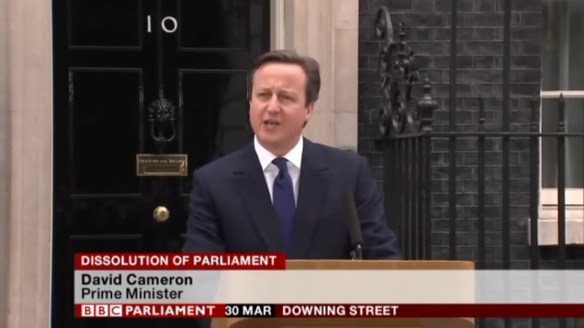
Cameron 2015 Dissolution

We are turning our country around… we must see this through together.

Five years ago, the fifty-fifth Parliament of the United Kingdom dissolved, commencing the general election campaign. As usual, proclamations were read out from the steps of the Royal Exchange in London, and from the Mercat Cross in Edinburgh, but on this occasion the text was quite a bit shorter than had been the norm before. The substance of the revised version concerns only the convocation date for the newborn legislature and the issue of writs of summons to the Lords Spiritual and Temporal. The act of dissolution itself was omitted, as was any reference to writs of election.

The reason for this was, of course, the Fixed-Term Parliaments Act 2011, which curtailed the monarch’s prerogative to make and break parliaments whenever her prime minister said so. From then on, a general election would happen on the first Thursday in May of the fifth year since the previous election took place, with dissolution occurring twenty-five working days in advance. There were of course some exceptions, but they will be detailed later.

For the first time, the date of the next general election was known years in advance. Even better, the death date of the 56th Parliament was known before it was even born: the five years after 2015 included two leap days to bring the days of the week right around, so this year the general election timetable is exactly the same as last time. Some commentators lamented that the element of surprise had been lost from British politics.

That at least was the dream, now to the reality: The second Cameron ministry did not gracefully live out a full term. Nor, for that matter, did the next three governments. The fifty-sixth Parliament dissolved on 3rd May 2017, after Cameron’s successor Theresa May successfully sought a two-thirds majority in the Commons for an early election motion under Section 2 of the Act. The fifty-seventh parliament was dissolved on 6th November 2019 by a special act of its own creation, May’s own successor Boris Johnson having tried a Section 2 motion several times and failed miserably. We are now in the time of the 58th Parliament, which is currently expected to expire on 25th March 2024, though that expectation has little solidity given that the present government intends to repeal the FTPA altogether at some point.

Jeremy Corbyn, who emerged from three decades of backbench obscurity to become Leader of the Labour Party in the aftermath of the 2015 general election, is due imminently to retire again. The result of the leadership election is due to be announced on Saturday, though the large conference originally planned has had to be scaled back dramatically due to the world events which have transpired in the meantime. It strikes me that, of the six Labour MPs who originally set out to be Corbyn’s replacement, four only joined the House of Commons in 2015. Had politics gone normally they would only now be at the end of their first term, instead of well into their third.

Obviously, it may have been awkward now if those snap elections hadn’t taken place, since all elections scheduled to take place on 7th May this year have been pushed back to 6th May 2021. Presumably the general election would have had to be delayed too*, the first instance of such an action since 1944.

As noted in my posts about Paul Danahar and Terence Casey, it has become common to remark that we currently inhabit the dark timeline, or words to that effect. Neither man could decide precisely on the point of divergence. Until someone else can suggest a better point, I will choose 2015. Obviously the COVID-19 pandemic is an entirely separate issue, but the issues that most prompted the calamitous musings prior to the outbreak were the presidency of Donald Trump in the United States and the exit of the United Kingdom from the European Union. These phenomena both had their gestation five years ago. It was in May that the Conservative & Unionist Party won the general election outright with a manifesto that included an In-Out referendum, which would likely have been dropped in coalition negotiations had that parliament been hung as expected. It was in June that Donald Trump came down that escalator and announced his desire for the GOP nomination.

Life would never be the same again. Still, at least I got to rack up my edit count in the past few years.

*Section 1 of the FTPA allows the prime minister to delay polling by statutory instrument, but only for two months as opposed to the twelve now in place.

UPDATE (9th November)

Turn Left is apparently trending on Twitter. It’s not entirely clear, but I think it’s something to do with the US presidential election.

UPDATE (March 2022)

The Dissolution and Calling of Parliaments Act has received Royal Assent, restoring the prerogative to call elections upon ministerial request.

The New Regime

YouTube comment three days ago: “For once, I know exactly how this ended up in the suggested list.”

Hello, good evening and remain indoors. Today I expected to be closing out the second trilogy of Parliamentary Studies lectures with Simon Burton. That lecture has been cancelled, as has everything else.

Four days into the university’s shutdown, the situation is getting bleak. On Tuesday and Wednesday there was still a smattering of traffic on campus but today nearly all the buildings are locked and barely a soul can be seen. Today the vast majority of British children are going home sine die and now many other types of establishments – pubs, clubs, restaurants and so on – are being advised to close too.

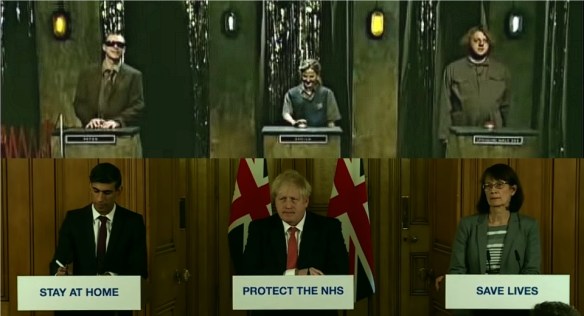
Providing the image for this article, COVID-19 announcements have replaced Brexit votes as the nation’s top daily political fix. I mentioned on Tuesday that the pandemic has destroyed what looked like a return to political stability, but the irony extends far beyond.

For much of 2019 the foremost fear was of Britain leaving the European Union without a deal. Many on the remain side made catastrophic forecasts of borders being locked down, supply lines failing, the pound collapsing, businesses closing down and the imposition of martial law. Many leavers, by contrast, seemed to take a perverse pleasure in the prospect, talking excitedly of a reenactment of the Second World War… or at least the version they had seen in films. This year those anxieties and delights have been transposed to the coronavirus, though the political demographics of the two camps are not necessarily the same. Three months ago the emergence of a large Conservative majority caused many to predict that Boris Johnson would become an authoritarian dictator. In the last few weeks he has been criticised for not being authoritarian enough.

Rishi Sunak became an MP less than five years ago and was still unknown to most of the public until mid-February. Chris Whitty did not have a Wikipedia page until 7th July last year. So far it has been edited 154 times, of which 120 were since 1st March. Even I would not have remembered his name unprompted, though I now realise I’ve watched him several times presenting Gresham lectures. Sir Patrick Vallance does a little better, having a page since 2017, though the edit spike is similar.

Parliament has been looking emaciated this week, with both chambers showing a lot of empty space. Prime Minister’s Questions, normally a heated and passionate cacophony of noise in a room overflowing with attendees, became a subdued and timid affair as many honourable members decided to stay away. Later that afternoon the upper house adjourned during pleasure for ten minutes so that noble Lords who had come for oral questions could clear the chamber before the arrival of those who came to debate the budget, thus keeping the benches well below capacity and allowing peers to maintain social distance. Yesterday the Lord Speaker himself announced that he would be going into isolation. He intends to continue the majority of his duties remotely, though the task of presiding on the woolsack must of course be left to his deputies.