Accession Day 2025

Today marks three years since the passing of Elizabeth II and thus the commencement of the fourth year of the New Carolean era. Here is a quick round-up of recent developments.

New Royal Biographies

The stream of these is continuous and too large to notice all of them, but three in particular have generated news coverage:

  • Entitled: The Rise and Fall of the House of York by Andrew Lownie (14th August, HarperCollins). The title alludes to the Wars of the Roses, but really it’s about the personal, professional and financial lives of the most recent Duke & Duchess. The book is overwhelmingly derogatory and might have been considered scandalous had not most of the topics therein been raised already some years ago (while the other claims are usually less-than-credible). Many reviewers and columnists have said words to the effect that it would be devastating to its targets’ reputations if only they had reputations left to devastate. The people who didn’t already believe the things Downie asserts here probably won’t read this book anyway so despite a few sensational headlines I doubt in the long run it will really change anyone’s position.
  • Power and the Palace: The Inside Story of the Monarchy and 10 Downing Street by Valentine Low (11th September, Headline). Low has already written Courtiers in 2022, which I have in my collection but have not gotten around to reading yet. I’m not sure I’ll ever read this one either since, as is often the case with this kind of book, the newspapers have already spent weeks running headlines explaining all the important bits. The book is about the relationship between senior members of the royal family and senior members of successive governments. The most outlandish part is the attempt to lift the lid on Schrödinger’s box regarding Elizabeth II’s political beliefs, long a source of speculation to all and sundry. Low, quite remarkably, claims that Her Late Majesty was much more candid than formerly thought and that everyone else around her was more studiously discreet. The most prominent assertion (in terms of news coverage) concerns her views on the 2016 EU referendum. Private Eye has this amusing summary:
GALLAGHER’S GALL
ORDERED by press watchdog Ipso to print a correction to his pre-referendum front-page headline “QUEEN BACKS BREXIT”, which was found to breach its accuracy rules since there was nothing in the story to show it was true, then-Sun editor Tony Gallagher was defiant.I don’t accept that we made an error at all,” he huffed to the BBC. “We made a judgement that the headline was right and that it was backed up by the story. We knew more than we put into the public domain. The sources were so impeccable that we had no choice but to run the story in the way that we did.”
Nine years on, Gallacher has been promoted to edit almost-as-respectable sister sheet the Times, which is serialising Power and the Palace, the new book by the paper’s retired royal-watcher Valentine Low. And what headline appeared on Saturday’s front page flagging the first revelations from the impeccably sourced tome? “The Queen was a Remainer.” (Eye 1657 page 7)
  • Charles III: New King. New Court. The Inside Story by Robert Hardman (Pan Macmillan). It actually made most of its headlines last year but apparently he has a new edition coming out soon. I’m not sure if this is the second edition or if there’s already been one in the interim that I’ve missed, as I found a version on Google Books which claims to have been published on 7th November 2024 yet includes photographs of events from 2025. It has three extra chapters compared to the one I borrowed from Hull Central Library, and these cover the two royal cancer crises as well as the D-Day Commemorations and the general election. This latest version is obviously too early to include Trump’s state visit or the Duchess of Kent’s funeral, so probably yet another version will be needed next year. Pan Macmillan ought to have a trade-in scheme so people who already bought the old edition can get discounts off the new one. In an interview with journalist Patricia Treble he said Charles is “just the King” now as opposed to “the new king” so perhaps the very name of the book is now redundant and it would be better in the long run to wait until he has enough extra material for a full-length sequel instead of endless retroactive add-ons.

The Tudor Crown

Yes, that old chestnut again. I note that HM Goverment is still not entirely consistent here: When Rushanara Ali resigned last month the Prime Minister’s typed response had the new Noad illustration on its letterhead but when Angela Rayner resigned last week Starmer’s handwritten reply was topped by the old image, as was the letter from the Standards Adviser. Recently Charles wrote a letter to King Mswati III of Eswatini (formerly Swaziland) congratulating his country on fifty-seven years of independence. That letter was Tweeted by the British High Commission in Mbabane, showing the new emblazonment. It uses the “lesser” version of the arms in blue instead of the greater version in red, so it perhaps it should be understood as an FCDO letterhead instead of a royal one.

State Visits

Britain has already received a state visit from France this year and is about to host one for America also. As far as outbound visits go, there doesn’t seem to be anything scheduled for the rest of this year. In 2026 Their Majesties are expected to travel to Canada again (for an extended royal tour), to the United States (for a British state visit) and to Antigua & Barbuda (for CHOGM). There is still no announcement as to when they will visit New Zealand, which must be frustrating to those who’ve been waiting well over a year now!

The Deputy & The Duchess

The Duchess’s Heraldic Achievement

Documentaries about the stormy second premiership of Harold Wilson (1974-6) often mention his determination to take the nation by surprise after months of all his government’s secrets being leaked to a vicious press. In the end he pulled off the particularly-impressive trick of resigning on the same day that the Princess Margaret finalised her divorce from the Earl of Snowdon, and therefore knocked the latter story off the front pages. No doubt this spared the royal family a lot of grief.

Today a similar coincidence has been achieved in reverse – Angela Rayner resigned as Deputy Prime Minister, and Buckingham Palace announced the death of the Duchess of Kent. There is something a little uncanny in these events happening so close to the anniversary of Liz Truss’s accession to the premiership and Charles III’s accession to the throne. The public mourning over the deceased Queen Elizabeth obviously didn’t save the Truss government, but did at least postpone its inevitable disintegration. Neither of today’s events are quite on the scale of those but, even so, the cabinet will likely be glad of the news – and Parliament – having a different story to occupy their time.

I will deal with Rayner first. Obviously her property tax scandal is a further reputational blow for a government whose public approval ratings were already abysmal. Her departure could cause some practical issues, too. Rayner simultaneously resigned from three offices: Deputy Prime Minister of the United Kingdom, Deputy Leader of the Labour Party and Secretary of State for Housing, Communities & Local Government. The latter is the one of greatest constitutional substance, for each Secretary of State is a corporation sole defined in statute with responsibility for a government department, in this case the Ministry of Housing, Communities & Local Government. The MHCLG cannot operate effectively without its secretary of state so a successor to Rayner will need to be appointed within days and confirmed at a meeting of the Privy Council shortly afterward. The middle is of course not a government office but a party one. Deputy Leaders are elected by a postal ballot of the rank-and-file partisans in an operation that typically takes months. This will be the first time in decades that the Deputy has been replaced without the actual Leader also changing (unless Sir Keir Starmer somehow also ends up resigning imminently) and, given the unpopularity of the current government among the party’s base, it could be a major opportunity for dissident factions to attempt a strike against front bench. The internecine fighting is bound to highlight controversies and resentments on which the opposition parties can pounce. The former will be the more interesting to watch: As I have mentioned before, the Deputy Prime Minister is constitutionally little more than a courtesy title rather than a substantive office and many premiers can do without appointing one. There is no obligation for the Deputy Leader of the Labour Party to be deputy leader (whether en titre or de facto) of a Labour government – notably Harriet Harman wasn’t. Even so, the Deputy probably need to have some kind of senior government post, for as a backbencher they would be too free to criticise and challenge the incumbent. If the eventual winner of the election is not already a cabinet minister then it may necessitate another minor reshuffle. In the meantime, though the Prime Minister will need a designated survivor, he would probably be better off not appointing a new DPM, nor a First Secretary of State, as whoever landed that job would then have then have to endure the indignity of relinquishing it a few months later and, since everyone would predict this in advance, would probably struggle to accomplish much of worth during that time.

Moving on to the Duchess: Born in 1933, she was the oldest among the royal family, a status which now passes to her 89-year-old widower Edward. Her death does not create a vacancy in the Firm, as she very quietly retired from public duties a few years ago and was absent for nearly all of the big ceremonial gatherings since then.1 At the time of writing the exact date of the Duchess’s funeral has not been announced, but based on usual time lapses it should be concluded before the halfway point of this month and thus narrowly avoid clashing with either Donald Trump’s state visit to the United Kingdom or the Duke of Edinburgh’s attendance at Papua New Guinea’s semicentennial independence celebrations. Katharine was the first British royal since the Glorious Revolution to convert to Roman Catholicism, and it has been stated that her funeral will follow Catholic liturgy. That will be an innovation for the House of Windsor too, as the only thing approaching a recent precedent is the reinterment of Richard III in 2013, and even that was technically an ecumenical affair. The Duke of Kent has been steadily winding down his commitments in recent years but is still considered a senior working royal. It is yet to be seen if the death of his wife will lead to any changes in his arrangements. The Ferens Building at the University of Hull (not to be confused with Ferens Hall) has her name on its keystone and the Prime Minister’s statement this afternoon mentioned that she was “giving her time and working anonymously as a music teacher at a school in Hull”. It will be interesting to see if any of her pupils are involved in the funeral, or indeed if there will be any local ceremonies to celebrate her association.

1The latest reference I can find in the Court Circular to her attending in person, rather than being represented by someone else, is 8th June 2019. I note that the “Where is Kate?” crisis of eighteen months ago failed to notice or care that the other Katharine had been “missing” for a much longer time.

UPDATE (8pm)

In the time between drafting this article and uploading it, Sir Keir has ignored my advice and carried out a full reshuffle, appointing David Lammy as DPM and Lord Chancellor (interestingly making the same career move as Dominic Raab four years ago) and replacing Rayner at MHCLG with Steve Reed, among many other changes. No timetable or candidates have yet been confirmed for the Deputy Leadership.

Review: The Victoria Letters by Helen Rappaport

After spending nearly two months struggling through Dan Franck’s The Bohemians, I needed something of an intellectual palette cleanser, preferably back in a subject area where I already had some prior grounding. I settled on this large hardback picture book that was released as a companion to the 2016 ITV series.

As the title implies, this is composed mainly of the private letters and journals that Victoria herself wrote from her early childhood until around the time she first gave birth (which is when the first season of the TV show ends). Victoria is unusual among British monarchs in the fact that so many of her personal written thoughts have been maintained and made public – some even during her own lifetime.

The book runs to three hundred pages, but the text density is rather low so I got through the entire book in just four days. The final twenty-eight pages are about the making of the TV series, with everything up to that point being about the real life of Victoria with the fictional series rarely acknowledged.

The book overall is both visually lavish and textually engaging, though I found a few errors along the way:

  • The photograph of a palace interior on pages 44-5 exposes part of the metal ceiling of the hangar in which the set was built.
  • The photographs on pages 144 and 228 show overhead power lines in the background.
  • Page 131 describes Victoria’s uncle Ernest Augustus as “heir apparent” instead of “heir presumptive”.
  • Page 294 says of Prince Albert that “as Victoria’s husband he automatically became a member of the Order of the Garter” which was not true; he was appointed to the order almost two months before the wedding.
  • Page 294 also includes a quote from costume designer Rosalind Ebbutt claiming “The garter traditionally went round the knee, but Queen Victoria was the first woman to be elevated to the Order of the Garter and she couldn’t wear it on her leg because it wouldn’t be visible. So she had a special one made that buckled around her arm, over her sleeve.” which is a bit misleading: Victoria was never “elevated to” the order, rather she became its sovereign automatically when acceding to the throne. The custom of wearing the garter on the arm instead of the leg was also exhibited by Anne, Britain’s previous queen regnant*. There were, of course, Ladies of the Garter before her.
  • The cast list on page 300 includes Nicholas Agnew as Prince George twice.

A further note is really more a problem with the series itself than the tie-in book: Victoria & Albert’s wedding is noted to have taken place in the Chapel Royal at St James’s Palace, but the set shown in the episode looks nothing like that and bears far more resemblance to St George’s Chapel at Windsor Castle instead.

Heraldic banners show up in multiple photographs in the book, I have already written an article about one particular instance, but perhaps an armorial viewing of the series in general is in order at some point. I notice also that when personal letters are reproduced they are topped by an illustration of the royal arms which came into use during Victoria’s reign, indicated by the lack of the Hanoverian inescutcheon, even when the letter is meant to predate her accession. Of course, little Drina was never actually granted differenced arms prior to that so I don’t know what image would have been appropriate here!

It is a shame that no similar books were written for seasons 2 and 3, and indeed that the TV series as a whole seems to have been quietly dropped after 2019, for I would have enjoyed seeing the whole of the Victorian age covered this way.

*See “The Orders of Knighthood and the Formation of the British Honours System, 1660-1760” by Antti Matikkala, pp 324-6.


August Armorial Announcements

The Queen’s heraldic banner continues to be a bugbear: Late last month, Sky Sports Racing Tweeted a short video of Her Majesty arriving (by helicopter) at Ascot. The commentator pointed out that upon Her Majesty’s appearance the royal standard was flown, but I noticed that it was again the generic ermine-bordered version and not that impaled with the arms of Bruce Shand, which has been seen in official usage recently. Perhaps the venue simply didn’t have a copy of that one yet?

The slow rollout of the Tudor Crown continues — on 1st August the Australian Department of Defence announced that all three service branches had updated their logos to use the new crown, as well as making other small adjustments to the rest of the graphics.

On the same day, the British Army announced a new cap badge for The King’s Gurkha Artillery Regiment, which likewise has the Tudor Crown on in. Since this regiment did not exist until this year, there was no St Edward’s version to remove in this case.

The King himself appeared at RAF Lossiemouth on 6th August to present a new standard to 42 (Torpedo Bomber) Squadron. I would assume that the Tudor Crown appeared on it, but none of the photographs or footage of the event gave a clear view of the standard itself — which is ironic given that was the whole point of the event!

Progress in the judiciary is less clear. I should remind readers that I am only speaking here about the judiciary of England and Wales, since that in Scotland uses the other version of the royal arms with the Crown of Scotland while that in Northern Ireland is reluctant to use explicit national symbols at all. The United Kingdom Supreme Court, and the Privy Council, have already been discussed.

From the PDFs of recent judgments, it appears that both civil and criminal divisions of the Court of Appeal are still using the old and rather ugly Royal Courts of Justice logo, with the almost-triangular royal shield topped by St Edward’s Crown, as are all three divisions of the High Court. Other courts are less consistent.

I have seen the Crown Court using several different ideas:

It looks as if every different court location has its own document template.

On Admirals and Arundells

The Queen turned seventy-eight today. That’s not traditionally considered one of the big birthdays and so commemorations have been fairly muted. The most significant announcement was her appointment as Vice-Admiral of the United Kingdom.

The Vice-Admiral is the deputy to the Lord High Admiral, and it may be prudent to recap the outline of that office first: The Lord High Admiral is the ultimate head (originally operational, but later just ceremonial) of the Royal Navy. Appointments have been made since the late fourteenth century in the Kingdoms of England and Scotland, then later Great Britain. Occasionally in Stuart times, and almost permanently from Anne’s reign onwards, the singular office was not filled and instead the post was instead put “In Commission” – i.e. delegated to the Board of Admiralty with the First Lord of the Admiralty (a cabinet minister) as its chair. The creation of the modern Ministry of Defence in 1964 saw the Board with its First Lord dissolved and the title of Lord High Admiral resumed in the person of Queen Elizabeth II. In 2011, on his ninetieth birthday, she conferred the office upon her husband Philip. The status of the office following his death in 2021 is a little ambiguous but the general assumption is that it defaulted back to the sovereign and now resides in King Charles III. I had wondered if Vice-Admiral Sir Timothy Laurence would be appointed on his seventieth birthday this March, but this did not occur. The King perhaps intends to retain the top office for himself and have his wife as runner-up.

The Queen is both the first female and the first royal holder of the office of Vice-Admiral, whose previous recipients have all been career navy men (and indeed tended to hold the actual rank Full Admiral). Her Majesty’s most recent predecessor was the Lord Boyce, who was appointed in 2021 and died in 2022.

Below the Vice-Admiral is another deputy, the Rear-Admiral. This office is currently held by Sir Gordon General, a General in the Royal Marines who was formerly Vice-Chief of the Defence Staff and also served as Lord High Constable at the 2023 coronation.

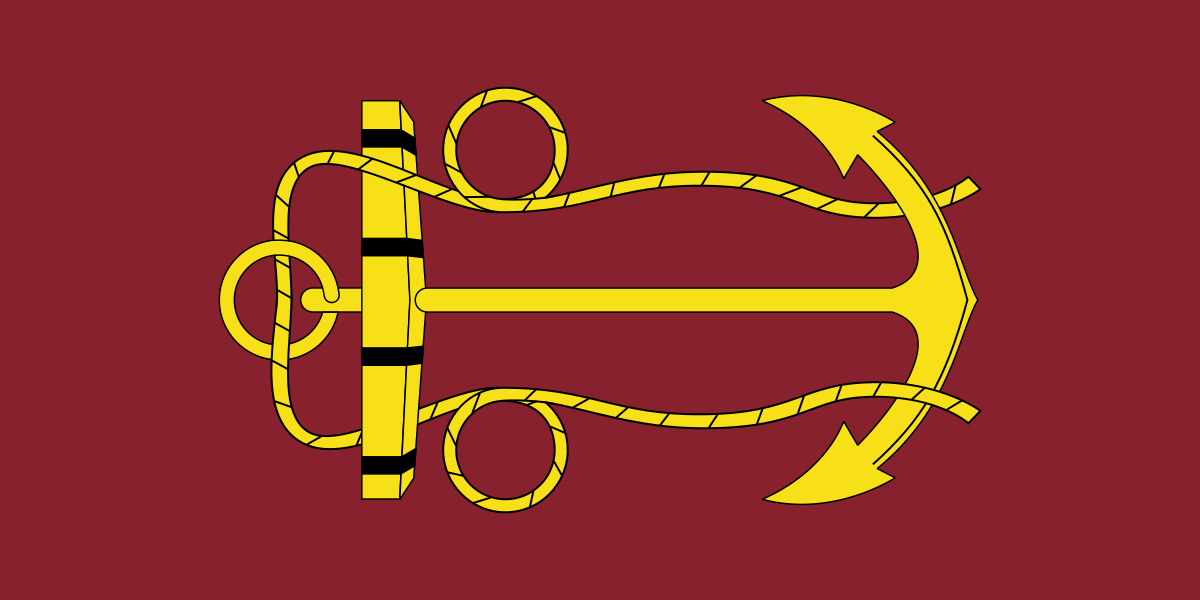
The Lord High Admiral has a flag of office – a fouled golden anchor on a crimson field. The Queen was presented with a “burgee” (pennant) with a red anchor on a white background when she visited HMNB Devonport. I just about saw Camilla’s impaled banner of arms as well.

On another note, today is also the twentieth anniversary of the death of Sir Edward Heath, Prime Minister 1970-1974. His military career was on land, though he was a noted yachtsman in later life. He stayed in the House of Commons for twenty-seven years after his premiership had ended, which is considerably longer than all his successors combined. He is the most recent Father of the House to have served more than one term, as well as the most recent to have formerly been Prime Minister.* He is also the most recent example of the Order of the Garter being conferred upon an incumbent member of the House of Commons**.

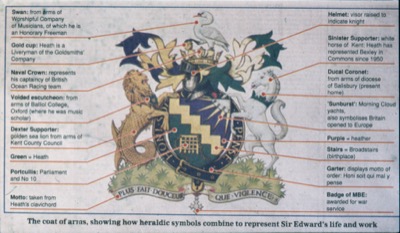
Wikimedia Commons has long had a vector graphic (by Sodacan, of course) of Sir Edward’s shield of arms, but it was only recently that I discovered, through the website of the Heraldry Society, a photograph of the heralds’ illustration of the full achievement. Heath had no offspring, so the arms as a hereditament became extinct.

This anniversary means that Arundells, his house in Salisbury, will now have been his museum for longer than he actually lived there. He bequeathed the building to his namesake charitable foundation who then opened it to the public. There was a fear in 2010 that the house would need to be sold due to high running costs, which then developed into a legal battle, but as of 2025 the estate seems to be running as normal again.

It should be noted that the spelling is Arundells with two Ls, not Arundels with one. Incidentally, it was an Earl of Arundel who is listed as England’s earliest Lord High Admiral, so everything links up I suppose!

*I’m phrasing it that way because Heath is not the most recent Prime Minister to be Father of the House – that was Callaghan.

**I hesitate to say “sitting member” because St George’s Day in 1992 fell in the interlude after the general election (9th April) but before the new Parliament actually assembled (27th April).

Some Heraldic Snippets

Today the Royal Household released the Sovereign Grant Report. I will discuss the actual substance of it – especially the planned retirement of the royal train – in a later article. For now I will note that the front cover and title page of the report both continue to use the old version of the royal arms with St Edward’s Crown. This was also true of the Birthday Honours published last month in the Gazette.

The Queen opened the Ratho Library in Edinburgh today. She travelled in the newly-acquired BMW G70 (also a topic for a later article) which had her banner flying from the bonnet. It was difficult to get a good look in the footage and the press stills don’t show it at all, but I think I could make out the impalement line, with the dexter side having a yellow top half while the sinister side was white on top and blue on bottom. That would indicate it to be the English marshalling of the royal quarters, surely an armorial faux-pas for an event taking place in the Scottish capital!

The Duke of Edinburgh is in Canada visiting his namesake island and regiment. The royal website’s page on the event depicts his Canadian banner of arms flying in at least one photograph, though again I can’t find it shown in any of the stills on Getty or Alamy.

Also last month another German car manufacturer, Mercedes-Benz, was recognised as a royal warrant-holder. I presume it will be the new Tudor crown illustration that they show, but I haven’t seen any photographs of it yet.

Mid-Year Reading Round-up

Having already posted some months ago a long list of all the books I’ve recently acquired, I suppose at some point I should say something about the experience of actually reading them. Here, then, are some mini-reviews of the publications I’ve finished during the period of January-June 2025, in no particular order.

The First Four Georges by Sir J. H. Plumb

Already reviewed in a different post.

The Extended Phenotype by Richard Dawkins

Although he is primarily famous for The God Delusion and maybe secondarily for The Selfish Gene, the professor himself generally regards this one as his true magnum opus. I’m not sure how famous Dawkins already was back in 1982, but this book feels as if written in his capacity as a biologist rather than as a public intellectual and activist. It is a much more academic work than his more famous ones and, having not been taught biology for just over a decade, I cannot claim full comprehension of the more terminologically-dense parts, but these aren’t really necessary for understanding the main thesis. Dawkins does not present new facts so much as a new way of interpreting facts we already possess: Normally the conception of evolution and natural selection is that they take place on the level of the individual organism, the family, the society and even the entire species. Dawkins instead looks at it in terms of the alleles of genes competing indirectly against each other with the organisms serving merely as a convenient – and disposable – host. The title of the book refers to Dawkins’s other big point that alleles affect the physical and behavioural characteristics of a species, which in turn affect the environment those species inhabit, as well as the ways in which other species evolve in response, so the phenotype of an allele in one species can be regarded as including the features observed in another species. The author also brings up a great many case studies of evolutionary adaptation and competition, including counter-intuitive examples such as between males and females of the same species, or even between parent and child! Of great interest here are his analyses of why some creatures are capable of adapting to “win” an evolutionary war while others are not. A theme which runs through the book as well is the difficulty of finding the vocabulary to comprehend these complex natural phenomena without slipping into metaphor and personification, which feels in some way prescient given the author’s later writings about religion.

The Final Curtsey by Margaret Rhodes

As with Lady Boothroyd’s autobiography, the early sections of this book felt a lot like reading my own grandmother’s childhood recollections, although from the opposite end of the class spectrum. Rhodes gives her account of her aristocratic early life, her experience of living through the war and her career as a courtier to the royal family. One thing that confused me a little was her choice of names for Britain’s senior mother and daughter after 1952 – the reigning sovereign is “The Queen” whereas George VI’s widow is “Queen Elizabeth”. Often I would get a long way into a paragraph before working out which one Rhodes meant. Despite being published in 2012, just four years before she died, Rhodes mentions a distinctly old-fashioned approach to writing. To modern eyes she appears curiously unfazed by the historical weight of her experiences, taking it in her stride that she dined nightly with the heiress presumptive while the bombs were falling, got roped into organising a faraway dynastic wedding, smuggled prisoners out of a country undergoing a violent coup and even watched a man drop dead in front of her. While the overall tone may seem a little twee at times it’s definitely worth the read and packs a lot into relatively few pages. The final days of the Princess Margaret and the Queen Mother are especially important for the record.

The Gathering Storm by Sir Winston Churchill

This is a very long book, and that’s only the first in a six-volume set amounting to more than three thousand pages in total. Churchill has written a great many well-renowned history books, but here it is a history in which he was a major protagonist so it also doubles as a memoir of sorts. The length here is justified as he writes in great detail about a multiplicity of topics, taking the reader step-by-step from the conclusion of WWI to the outbreak of WWII, with the volume ending at the point when he became Prime Minister. It’s astonishing to realise that he completed this enormous tome while he was serving as Leader of the Opposition, a feat of intellectual multitasking which feels impossible today. Given that Churchill’s reputation speaks for itself it almost feels redundant to comment further except to say that I am on the lookout for Volume 2, though given the backlog of books already accumulated it could take a while to get there.

The Glamour Boys by Sir Chris Bryant

Yet another World War II history, and also written by a sitting MP. Bryant’s behind-the-scenes account of the parliamentary machinations leading up to the war is in many ways complementary to Churchill’s own. The focus here is on the alternative, underground world that the “boys” were forced to inhabit, noting the parallels between their nonconformism, adamant against the mainstream of the time, on both personal and political levels. This book presents a major setback for anyone attempting a historical rehabilitation of Neville Chamberlain – his reputation before was of optimistic (or perhaps delusional) naivety rather than malevolence, but here he comes off as cruel and wicked in his attempts to suppress his glamorous detractors with an underhanded smear campaign. The only downside to this book is its length – at 448 pages it’s a rather weighty tome and it sometimes feels as if Bryant was padding it out to look more imposing on the shelves. Some critics have said he indulges too much in the lurid descriptions of the rebels’ relationships in the early part of the book, but I think the real waffle comes nearer the end, once the war has already gotten going, when the defining goal of the story has been completed and everything thereafter feels a bit more like generic wartime biography divorced from the specialist subject matter.

The King’s Painter by Franny Moyle

Going a bit further back this time takes us to the Tudor era. This is a biography of the portrait artist Hans Holbein the Younger, best remembered for his imposing image of Henry VIII. The biography covers the full length of Holbein’s life and career, with detailed analyses of his major works and the artistic innovations they represented. Not having studied the history of art (or art itself) much before I cannot fairly judge the quality of Moyle’s commentary here, except to note that she brought up verisimilitude so often it almost felt like a tic. Aside from the art itself, a lot of the book was dedicated to the religious and political upheavals in continental Europe which alternately expanded and restricted Holbein’s professional opportunities.

The Roman War Machine by John Peddie

Returning to the war theme but backing up even further to the ancient world, this is a book on the military structure and logistics of the Roman Empire. In some ways this felt like a throwback to my GCSE Latin course, in others like a memory of and educational field trip I might have done in primary school. This book is in English, of course, save for the heavy use of Latin military jargon. Peddie writes in detail, and with diagrams, about the ranks, formations, equipment and resources sustaining Rome’s military operations. Even here we cannot avoid World War II, for Peddie makes repeated comparisons to campaigns in the twentieth century to show the historical resilience of the Roman legacy.

The Penguin Guide to the Railways of Britain by Edgar Jones

This book was published in 1981 so a lot of the guidance here is obviously out of date now. On this note I would particularly highlight some lines from pages 36-38: “The Advanced Passenger Train represents the latest development in electric rail transport.”, “It is possible that a diesel-powered version of the APT will be developed for use on non-electrified lines.” and “At this moment 60 per cent of trains are diesel-powered. With the progressive introduction of the HST – the most advanced diesel-electric in the world – it is fair to say that this form of power has reached its apogee in Britain. Since electricity holds the key to the future, when these expresses become obsolete it is probable that the diesel, like steam, will disappear.”. The first fifty pages tell the history of locomotion in Britain from the early nineteenth century to the late twentieth, including the evolution (with diagrams) of different types of rail vehicles. The next three hundred pages take the reader around the country, region by region, explaining all the routes can be taken and all the stations that can be visited. The writing, though concise and eloquent, can be a little dry and it was difficult to keep up the momentum towards the end. From the way it’s structured, it less resembles a conventional reading book than the railway version of Burke’s and Debrett’s, so perhaps one is better off treating it that way instead of trying to finish it in a linear fashion.

Classical Literary Criticism by T. S. Dorsch

It is a little strange to realise that not only has literature itself been around for thousands of years but that literary criticism has been too. Even though the source texts may be as old as the fourth century BC and the translations into English were done in 1965, a lot of the prose still feels contemporary to one familiar with book and film reviews both amateur and professional. Indeed, a lot of the talking points would not have been out of place in a modern day “reviewtainment” video essay. There are multiple chapters on individual narrative devices, as well a the structures and purposes of different types of plays and comments on stories already performed in the writers’ memories. Most impressively, there are multiple instances when one of the writers goes into detailed analyses of the subtleties of another writer’s word choices and sentence structure. All of this, of course, has to be translated from Greek and Latin into English with the nuances intact. There are even times when one of them criticises another critic’s literary criticism, such as when (p65) Aristotle notes that “Ariphades ridiculed the tragedies for using expressions that no one would use in ordinary speech… these raise the diction above the level of the commonplace, but Ariphades failed to see this”. The introductory note by the editor explains who the sources – Aristotle, Horace and Longinus – actually were. The former belonged in the fourth century BC while the latter two belonged in the first. The gap between them is greater than between Shakespeare and Wilde, yet to us know they seem interchangeable, a good reminder of how long the ancient Greek and Roman eras really were.

Shadow State by Luke Harding

The book was just over three hundred page but I devoured it very rapidly. It tells of how the Russian Federation went from the collapse of the Soviet Union under Gorbachev to the emergence of Putin’s regime in which the military, business, the mafia and the President’s personal interests are all effectively merged into one and how this level of corruption affects not just Russia itself but also the other nations with which Russia interferes. The stories told are the ones you’d expect – Hillary Clinton’s emails, the Salisbury poisoning, and Brexit. There is some poetry in the timing: The book was published in 2020 as Trump was heading to the election he would lose. I bought it from Red Cross on 28th August 2024, as he was heading to the election which would see him restored. This also of course means that Putin’s ongoing war against Ukraine cannot be included, though there is much about the events leading up to it and Zelensky (suited and beardless) makes several appearances. The hero of the tale is Eliot Higgins, a journalist who created the Bellingcat online information exchange that allowed amateurs to monitor and scrutinise world events remotely. Harding resists the temptation to grant Russia an Orwellian omniscience, noting instead that Putin’s schemes often backfired or fell flat, that he only turned to online subterfuge because he lacked the funds for traditional spycraft, that many of his apparent successes – including Trump – were coincidence or blind luck and that the quality of Russian operatives had declined since Soviet times. The story of Salisbury assassins Chepiga and Mishkin, in particular, plays out as something of a farce. Nonetheless the death and destruction they caused is very real and, at time of writing, the threat feels as pressing as ever.

The Ricardian Century by John Saunders

This may be the newest book I’ve ever picked up from a charity shop, as I found it at Oakwood Dog Rescue in February and the copyright notice said 2025. The book was in pristine condition and I worked very hard to keep it that way, although despite my best efforts a few bits of the corner flaked off before I’d finished it. This is the official history of the Richard III Society from its foundation in 1924 (as the Fellowship of the White Boar) to its centenary celebrations in 2024. The book is the product of a print-on-demand service rather than an established publisher and at times looks, to paraphrase Mark Corrigan, like a printout rather than a book. The cover design is especially poor: On the rear is a small square photograph of Saunders, in low resolution and squinting a bit, clearly cropped from a larger group shot, while the front has an equally-fuzzy raster of a depiction of the Society’s coat of arms from which not all of the white space has been cut out of the background. Aesthetic issues aside the contents are engaging enough, giving the reader a detailed look at all the twist and turns of both Ricardianism as a movement and the Society as an organisation. What fascinates me is that by all logic the Society ought to be a dissident fringe group. Though clearly there has been a shift in public attitudes to Richard III over the centuries (and certainly in this millennium) towards acquitting him of history’s more outlandish charges, the consensus among historians is still that he was the most likely perpetrator of the regicide of his nephews. Furthermore, as Ricardianism asserts that “the wrong side won” at Bosworth in 1485, and that sad side includes the current royal family, it is tantamount to asserting (much like the Jacobites) that the entire royal line thereafter to the present day must be illegitimate. Despite this the Society has been accepted by the wider academic community as a legitimate scholarly institution (even if they still ultimately disagree with its conclusions) and has even been accepted by the royal establishment with Prince Richard, Duke of Gloucester serving as Patron for more than half of his and its lifetime and the College of Arms hosting the book’s launch. George Awdry, Wilbert’s brother, is also mentioned a few times. One thing that really stuck out at me was the revelation (p93-4) that the Society was not formally incorporated as a legal entity until 2019, which made me wonder how they’d acquired a grant of arms in 1988, among other things.

Sealing the Deal

This is the old one, obviously.

A mere thirty-two months into the New Carolean era, a new Great Seal of the Realm has been unveiled. The design is largely the same as the version made for Elizabeth II in 2001 – the obverse shows the monarch enthroned, the reverse shows the royal armorial achievement (as illustrated by Noad).

Noad’s heraldic drawing is well-known by now. The depiction of Charles on the front* has attracted some criticism: The King is, as at his actual coronation, wearing trousers rather than the more traditional stockings, and his shoes appear to jut out too much. Personally, I think they resemble the feet of 2006-era Cybermen. It is also notable that the crown shown on the monarch’s head is the idealised depiction of the Tudor crown, as opposed to the Imperial State Crown or the Crown of St Edward which he wore at the coronation itself.

The inscription around the outer rim is CHARLES III DEI GRATIA BRITANNIARUM REGNORUMQUE SUORIMQUE CETERORUM REX COSORTIONIS POPULARUM PRINCEPS FID DEF.

This is the official Latin equivalent of CHARLES III BY THE GRACE OF GOD OF THE UNITED KINGDOM OF GREAT BRITAIN AND NORTHERN IRELAND AND OF HIS OTHER REALMS AND TERRITORIES KING HEAD OF THE COMMONWEALTH DEFENDER OF THE FAITH, and the formulation is similar to that used by British sovereigns for centuries, though even I, eleven years on from having formally studied Latin, can see that it is not a perfectly literal translation.

Judging by the talk pages for both the English and Latin Wikipedias, it is clear I am not the only one to notice this. Britanniarum Regnorum just means “Kingdom of the Britains”** with no specific reference to Hibernia Septentrionalis.

Oddly it seems that the seals used from 1930 to 1953 actually did specify MAG BR and  HIB, short for Magnae Britanniae and Hiberniae as distinct items, but seals used both before and after do not. Uniti does not appear in any of them. The exact name in English of the polity ruling these isles has, of course, gone through many changes due to the evolution of our constitutional arrangements and is very confusing even to natives, but it is interesting to note that the Latin title doesn’t exactly move in step with the English one.

The use of Consortionis Populorum Princeps to mean Head of the Commonwealth of Nations is also a bit odd – “princeps” is of course whence we derive the words “prince” and “principal”, but it originally meant “chief” or “first in rank”. “Consortio Populorum” (“Partnership of the Peoples”?) is probably used because a more literal translation would probably be something more like “Respublica”, but of course in modern English (or British English at any rate), the words commonwealth and republic have diverged almost entirely to where the former means an organisation headed by a monarch and the latter means precisely not that.

Perhaps it is fitting that this event should take place just as a new Pope emerges – we’ll be seeing a lot of official Latin in use very soon!

*The many news articles I have found relating to this story all seem to be nearly word-for-word the same, and none of them identify the portrait artist.
**This is distinct from “King of the Britons”, which would be “Regnum Brittanorum”

Carney Summons The King

In the lead-up to, and immediate aftermath of, the Canadian general election, there were a few news pieces about the prospect of King Charles visiting in person to open the new Parliament. Most of these seemed like mere idle speculation or, indeed wishful thinking.

Today, however, it has been confirmed by both Buckingham Palace and the Office of the Prime Minister that Their Majesties will indeed be visiting for that purpose. This is unusually short notice for an overseas trip, particularly given the sovereign’s ongoing health problems and the length of the journey. As the couple are due to arrive on May 26th and leave on May 27th, it looks as if this will be a flying visit to Ottawa to perform the state opening and not much else, in contrast to last month’s state visit in Italy or last year’s royal tour of Australia. There has been no further detail about the hinted royal tour in 2026, but I presume any more elaborate plans are still delayed until then.

I know nothing at this point of the actual contents of the speech, and indeed suspect that the text will not be especially interesting from a literary perspective (throne speeches rarely are). Their Majesty’s attire may prove the more politically-contentious topic: When Elizabeth II opened Parliament in 1957 and 1977 she prominently wore the Order of the Garter, while Prince Philip wore a military uniform with his many decorations on it.

This will be the first time that the monarch has opened Parliament in person since the Patriation of the Constitution and, as much as Mark Carney is obviously an Anglophile, the purpose of this excursion is to reassert Canada’s sovereignty and national identity in the face of aggression from the United States. The King & Queen of Canada will need to find a distinctly Canadian look for themselves. This will be difficult as the Crown of Canada, before or after Trudeau’s controversial redesign, does not exist in real life as a physical object. Nor, for that matter, does the snowflake diadem. A separate set of Canadian royal robes does not exist either. To make matters worse, this won’t even be taking place in the real Parliament building, as that has been closed for major renovation works over the past few years. Currently the Senate meets in a repurposed railway station and the House of Commons in the West Block. These two buildings are a ten-minute walk apart, which could make the summoning of MPs a rather tedious ordeal. In 2021 shuttle buses were used for the 700m journey.

If maximum splendour is the goal then I suspect that Charles will wear a ceremonial military uniform (with corresponding hat) and Camilla either her coronation gown or a generic white dress with a tiara, both with all their Canadian medals as well as the sash of the Royal Victorian Order (since that is not realm-specific).

Finally, a point about Palace press releases – whereas the public sees these announcements on Royal.UK as text on a webpage, they seem to be sent to journalists as PDFs (which I only know because of how often I see journalists Tweeting them). Even now the old red outline illustration of Elizabeth II’s British arms (with St Edward’s Crown) is still used, despite this announcement relating to Canada. It’s also typed in Calibri, which irks me even more.

This story by Sky News includes a screenshot of an earlier version of the Tweet, in which the bullet points are punctuated with the French and British flags instead of the flag of Canada. Was this a clumsy attempt at representing Canada’s dual heritage, or had the template been mixed up with something intended for Macron’s state visit due this month?

A Very Late Announcement

Today is St George’s Day. It was delayed in the church calendar from its usual date of 23rd April so as not to clash with Easter, though this was not well publicised in advance and in practice not widely observed. The movement also means that St George’s Day clashes with Ed Balls Day!

I was disappointed to see no new appointments to the Order of the Garter either today or last Wednesday. Currently there are four vacancies among the ordinary Knights and Ladies Companion.

I was a little surprised to see that the News page on GOV.UK included “Prime Minister Liz Truss’s statement on the death of Her Majesty Queen Elizabeth II“, given that said prime minister resigned thirty months ago. Upon inspection of the Updates section, it seems the page was originally published with only the video link, and the transcription has now very belatedly been added. Amusingly, the note doesn’t even say “transcription”, but rather “translation”. Surely, Truss’s thoughts weren’t that incomprehensible, were they?