Armory and Architecture

This evening I attended a virtual lecture at Arts University Bournemouth. The presenter was David Lund and the subject was the history of architectural model-making, particularly that of John Brown Thorp.

Modelling is an invisible profession to most people as the model-makers are largely executing the ideas of architects, who thus take all the credit for the design. British model-making kicked off in the late sixteenth century with the arrival of trends from Italy. The earliest record is of a 1567 model of Longleat House, made for Sir John Finn. Sir Christopher Wren would go on to commission architectural miniatures on a regular basis.

Originally timber was favoured for model-building, but card proved to be more adaptable. Thorp is considered the grandfather of architectural model-making. He had his headquarters near to the Inns of Court, and his extremely-detailed scale models were used in court cases. By 1940 his firm was employing forty other modellers. The emergence of modelling as a dedicated profession allowed an increase in the size and standards of their creations.

Modelling boomed in the 1950s and ’60s, with the material fashions of the models changing in line with those of the buildings themselves – card representing brick was replaced by perspex representing glass and steel. The economic slump of the 1970s caused a change in clientele, with modellers working for private developers instead of state architects. Nowadays it is common for models to be designed on computers and then 3D-printed, incorporating lighting and even animation.

In the Q&A session, Lund was asked about the phenomenon of public disappointment when a finished construction fails to live up to what the model promised. Lund conceded that models and artistic renderings often gave a sanitised, optimistic prediction of the built environment, replete with happy people and clean surfaces, whereas the reality (especially in modernist constructions) proved quite different. Developers and the public often unfairly blame the artists and modellers for this, even though they are only following what the developers tell them to do.

On an entirely unrelated note, late last night I discovered that Sir Lindsay Hoyle, Speaker of the House of Commons since 2019, has finally been granted a coat of arms. I was relieved to come across this news at all, yet also a little perplexed to realise that the news articles were from almost a month ago. I don’t know how I missed this, given that I have been obsessively looking out for this ever since his election. The not-so-grand reveal came at the unveiling of a new set of stained-glass windows in the Palace of Westminster, the other panels of which were decorated with the arms of British Overseas Territories.

None of the news articles I have uncovered so far gave the blazon for the new achievement, so my illustration for Wikimedia Commons is based on visual inspection of the artwork in the photograph. It indeed includes the red rose of Lancaster, “busy bee” and rugby references as Sir Lindsay hinted two years ago. The use of the parliamentary mace Or on a fess conjoined to a bordure Vert is almost certainly copied from the arms of Sir Harry Hylton-Foster, who became speaker sixty years before Hoyle did – though one has to hope that Hoyle does not end his tenure quite so abruptly. The window shows mantling Gules and Argent (rather than Vert to match the shield), so I have copied that. It is not clear exactly when the grant was made, nor whether the grant was to Sir Lindsay himself or to his noble father (the mace makes the latter seem unlikely).

The search for other new grants continues. Last month I got a pretty strong hint about the arms of Lady Amos, but those of Sir Tony Blair remain as elusive as ever.

The Crown old and new

Early in the new reign, the College of Arms announced a new royal cypher for Charles III. A noted difference between this one and his mother’s (other than the name, of course) was the depiction of the crown.

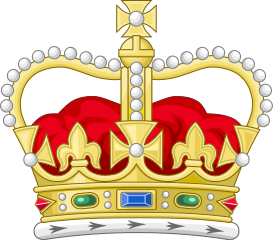
“St Edward’s” crown, favoured by Charles II to Victoria

Up to and including Victoria’s reign, depictions of the crown in heraldic drawings could be inconsistent. Edward VII ordered a standardised depiction with simple arches, which has come to be known as “the Tudor crown” due to its resemblance to one supposedly commissioned by Henry VII or VIII (and seen in royal portraits up to the Civil War). Elizabeth II later decided to change this to a version with depressed arches, better resembling St Edward’s crown which monarchs actually wear at coronations, and which seemed to be favoured in heraldic drawings before Victoria’s time. The timing of these decisions created a general misconception that the Tudor crown is always used when the monarch is male and St Edward’s when the monarch is female. Charles’s decision is likely to reinforce that belief.

The “Tudor” crown, as used by Edward VII-George VI

On the day of the coronation, the Canadian Heraldic Authority unveilved their own new version of the crown, intended to be more distinctly Canadian. The overall shape of the crown is still based on the Tudor version, but the jewels have been replaced by a wavy blue line, the uppermost cross by a snowflake (as already used in the Order of Canada) and the crosses around the rim by – of course – golden maple leaves. The removal of explicit Christian symbols may be due to the lack of an established church in Canada, though the omission of fleurs-de-lis is a little perplexing, given the constitutional importance of the country’s French heritage.

https://upload.wikimedia.org/wikipedia/commons/thumb/d/d4/Crown_of_Canada_2023.svg/248px-Crown_of_Canada_2023.svg.png

The Canadian crown, as used by Charles III

It is not clear on exactly what timescale the new crown is to supersede the old. Four days after the coronation the government of Canada released a revised Canadian passport design. Though many radical changes have been made, the 1952 depiction of the crown retains pride of place. It is also not certain whether this will apply to the parliamentary maces. Currently the mace of the House of Commons is modeled on the Tudor crown while that of the Senate is modeled on St Edward’s. This is reflected in the heraldic badge of the parliament, showing both maces in saltire behind the shield. Funnily enough, British passports, though updating the introductory text to reference His Britannic Majesty instead of Hers, also still seem to have the prior crown on their covers.

The shield itself (fleurs and all) remains unchanged. It was announced on the same day that the arms of Canada may be flown as a banner to represent Charles and all future sovereigns. Previously Elizabeth II’s flag had the royal arms of Canada with her personal EIIR cypher imposed on a hurt in the middle. The removal of the cypher brings Canada closer in line with British heraldic practice whereby the reigning monarch bears the arms of dominion undifferenced, as well as avoiding the hassle of redesigning the flag for each subsequent reign. It remains to be seen whether the heraldic banners of other members of the royal family will also omit their cyphers and keep just the cadency labels.

FURTHER READING

With Heart and Voice to Sing

The coronation, in addition to its visual majesty, is an opportunity for musical expression. In addition to the long list of traditional pieces, there were twelve brand new compositions commissioned for the day. The whole has been turned into an album, which was uploaded to YouTube and various streaming services on the same day. It is also due to go on sale in CD format on 15th May.

Naturally I took it upon myself to arrange it all into a convenient table for the coronation’s Wikipedia page, which another editor shortly afterwards redesigned almost entirely.

THE OLD

  • Johann Sebastian Bach: Magnificat in D Major; Sunday After New Year; Singet dem Herrn ein neues Lied; Alla breve in D Major.
  • William Boyce: The King Shall Rejoice: Opening Chorus
  • Anton Bruckner: Ecce sacerdos magnus.
  • William Byrd: Prevent Us, O Lord; Gloria; Earl of Oxford’s March.
  • Walford Davies: Confortare.
  • Edward Elgar: Nimrod; March No. 4.
  • Orlando Gibbons: Threefold Amen
  • John Goss:
  • George Friderich Handel: The Arrival of the Queen of Sheba; Oh, had I Jubal’s lyre; Care selve; Zadok the Priest.
  • William Henry Harris: Flourish for an Occasion.
  • Gustav Holst: Jupiter, the Bringer of Jollity.
  • Hubert Parry: I was glad; March from the Birds; Chorale Fantasia on “The Old Hundredth”.
  • Henry Purcell: Trumpet Tune; Christ Is Made The Sure Foundation.
  • Richard Georg Strauss: Wiener Philharmoniker Fanfare;
  • William Walton: Crown Imperial; Coronation Te Deum.
  • Thomas Weelkes: O Lord, Grant the King a Long Life.
  • Ralph Vaughan Williams: Fantasia on Greensleeves; Prelude on Rhosymedre.

THE NEW

  • Karl Jenkins: Crossing the Stone.
  • Sarah Class: Sacred Fire.
  • Patrick Doyle: King Charles III Coronation March.
  • Iain Farrington: Voices of the World.
  • Nigel Hess, Roderick Williams & Shirley Thompson: Be Thou My Vision.
  • Paul Mealor: Kyrie Eleison.
  • Roxanna Panufnik: Coronation Sanctus.
  • Tarik O’Regan: Coronation Agnus Dei.
  • Christopher Robinson: The Recognition; Homage Fanfare.
  • Andrew Lloyd-Webber: Make A Joyful Noise.
  • Judith Weir: Brighter Visions Shine Afar.
  • Debbie Wiseman: Alleluia.

Personally, I’m a little disappointed at the lack of Howard Shore.

William IV & the Royal Visit of 1827

Today’s virtual lecture was presented by Owen Ryles, Chief Executive of the Plymouth Athenaeum. It concerned the time that the Duke of Clarence (later King William IV) visited the naval yards at Plymouth.

The lecture began with a preamble establishing the titular character: William was his father’s third son, long expected to lead a relatively quiet life. Even his creation as Duke of Clarence & St Andrews was not guaranteed, being granted only because he threatened otherwise to stand as MP for Totnes. He was sent into the navy at age 13 to keep him away from the perceived negative influence of his elder brother George IV. In his active career he was the first British royal to set foot in the American colonies, took command of HMS Pegasus in 1786 and gave away Frances Nisbet in her wedding to Horatio Nelson in 1787. He was commissioned as an honorary admiral in 1798, and then appointed to the office of Lord High Admiral in 1827 during the brief ministry of George Canning. In his private life, he scandalised Georgian society by cohabiting with his mistress Dorothea Bland and siring ten illegitimate children with her. He gave her a stipend on the condition that she would not return to acting, and later took legal action against her when she did anyway. When his niece Princess Charlotte of Wales unexpectedly died in childbirth William moved up in the line of succession and was forced into a royal marriage, but his wife’s children all died young.

For the grand occasion the duke arrived on HMS Lightning to a deafening chorus from onlookers. He did not disembark until 7pm. He visited the original Admiralty House, later renamed Hamoaze House, and met the Superintendent of Works Jay Whitby. On 12th July he inspected the Plymouth Division of the Royal Marines and said that Plymouth was his favourite naval resort (it was also the first borough in which he had been made a freeman). On 13th he received a loyal address by the mayor and municipal corporation at the Royal Hotel. Among the military men with whom he dined was his own son, Colonel Frederick Fitzclarence.

Also during the visit he laid the top stone of the sea wall at the Royal William Victualling Yard and donated ten guineas to each of the workmen. He also witnessed a demonstration by William S. Harris of the application of fixed lightning conductors to ships.

William’s tenure as Lord High Admiral did not last long – the next year he was dismissed after taking HMS Britannia to sea for ten days without government permission. In 1830 he acceded to the throne, the eldest until Charles III last autumn. He was reluctant to have a coronation at all, eventually spending just £30k on it compared with his elder brother’s £420k. His reign was short, and he clung to life just long enough to see his niece Victoria come of age. He was regarded as the “least obnoxious Hanoverian”, which some might consider high praise.

Some Developments, Old and New

My hobby as an amateur armorial artist has been going in earnest for six years now and is fast approaching 1,400 illustrations. Every now and again I go back to revisit one of my earlier works to see if it can be improved.

Today’s retrospective was Lord Walker of Aldringham, former Chief of the Defence Staff, whose arms I first did in January 2019. I found an old thread about it on r/heraldry and, predictably, they weren’t very impressed.

I set out to remake the shield from scratch, smoothing out the fracture of the orle, refining the colours and, crucially, making the acorns a little more recognisable. The main difficulty I had was fitting the four acorns above and below the chevrons, for this arrangement works more naturally with three. When reading the blazon on Walker’s page I saw that there was no source given for it, and set out to find one. Reading Debrett’s Peerage 2019 (page 4691) I discovered that there were indeed three acorns not four, and corrected the image accordingly. I must wonder how that error originated (since it was written as a word not a numeral, so a simple typo would be difficult) and how far it has proliferated.

With nine days to go until King Charles’s coronation, his cypher has started to be seen on the liveries of royal soldiers. The Yeoman Warders (or “Beefeaters”) at the Tower of London recently debuted their new blue undress uniforms, and the state trumpeters have updated theirs as well.

UPDATE (30th April)

I see that on the same day I uploaded my re-illustration the Prime Minister’s Flickr account published a photograph taken inside Westminster Abbey, with Walker’s banner hanging in the background. Sure enough, three acorns only.

A Note on Royal Peerages

Today it was announced that The Prince Edward, Earl of Wessex and Forfar, was created Duke of Edinburgh, a title formerly held by his father. This had been speculated for years, but the intriguing part of the news is that the title is only for life – Edward’s son James will not inherit it. This is the first life peerage above the degree of baron for more than two hundred years, and the first given to a royal since medieval times.

For a newly-ascended king to denounce the principle of heredity seems unlikely. I think there is a more pragmatic reason for this – a desire to keep the title in circulation for the sons and brothers of future kings. The firm does not want to run out of place names (especially in Scotland) to use for dukedoms.

It has been tradition in Britain for the better part of a millennium that the younger sons of the monarch are granted dukedoms referring to prominent locations within the isles. Indeed, there is a lot of tradition in which particular place names are used, and even for which place in birth order.

On second thought, however, this shouldn’t be possible – if these honours are separately hereditary, and given to the offspring expected not to take the crown, then how do the same titles keep coming up time and time again. This paradox reveals an important detail about the royal dynasties of the past thousand years – their cadet branches normally don’t branch very far. It’s remarkably rare to find examples of a legitimate male line emanating from a younger son of a king that lasts for more than three generations. Most of the time either the junior line dies out (either only having daughters, or having no children at all), or the senior line fails so that the junior line ascends to the throne. To make matters worse, on the few occasions where a divergent line has managed to sustain itself, there has nearly always been some kind of intervention that prevented the title from doing so. What follows is by no means a complete history of the royal lineage, but a list of the most commonly-used royal dukedoms roughly in descending order of number of creations, with an explanation of what happened to them.

York

The first use of the northern city for a royal dukedom came in 1385, when Richard II bestowed the title on his uncle Edmund of Langley. This founded the House of York, which was to be one of the principal factions in the Wars of the Roses after Richard’s death. Edmund was succeeded by his son Edward of Norwich, who died at Agincourt, then his grandson Richard of York, who lead the opposition against the regime of Henry VI. Richard died before winning the throne, so the dukedom passed to his own son, who not long later succeeded as King Edward IV.

The title of Duke of York has since been conferred ten more times (thrice combined with Albany), nearly always for the monarch’s second son. Five dukes ascended to the throne, another four died without sons. Prince Andrew looks set to continue the latter tradition.

Sussex

Conferred twice as a dukedom – the first was for The Prince Augustus Frederick, sixth son of George III. He married twice without permission so his children were deemed illegitimate and the title died with him. The second was for Prince Henry of Wales in 2018. He currently has one legitimate son. It is too early to speculate about grandsons. An earldom of Sussex was also given by Queen Victoria for her son Arthur (see Connaught).

Gloucester

Created as a dukedom five times (and used as an informal style on two others), the most memorable recipient being Richard III. All died without an heir until Prince Henry, son of George V, whose son Richard (b. 1944) holds the title to this day. He has a line of succession two generations deep (though only one person wide) so barring any accidents for Xan Windsor we can expect the title to escape from the royal family for most of the rest of this century. The title “Duke of Gloucester and Edinburgh” was created once and inherited once, the second duke dying childless in 1834.

Cambridge

Five creations and two more stylings. The first four dukes died as small children. Prince George (1706) and Prince William (2011) were both directly in line to the throne so their honours were doomed to merge. Prince Adolphus, son of George III, produced an heir but his children were born outside the Royal Marriages Act so they could not inherit. His daughter’s son, Prince Adolphus of Teck, was created Marquess of Cambridge in 1917 and passed it to his son George ten years later, but George only had a daughter and Frederick, his brother, died a bachelor.

Albany

First granted by Robert II to his third son (also Robert) in 1398, the title passed to his son Murdoch in 1420, but five years later Murdoch was attainted and his peerages removed. Conferred again by James II on his second son Alexander in 1458, it passed to his son John, but John died childless and brotherless in 1536. James V’s son Robert was styled as such in 1541, but he died at eight days old. Mary I conferred the dukedom on her husband Henry in 1565 and it was inherited by their son – later James VI, merging with the crown on his accession. James recreated the title for his second son Charles, but his first son died so Charles also became king. Charles II upon his restoration gave the title to his brother James, who succeeded him on the throne. Albany was also created three times as a joint peerage with York. The final creation was in 1881 for Victoria’s son Leopold, and inherited by his son Charles (also Duke of Saxe-Coburg and Gotha) until he was stripped of it in 1919. The claimant today would be his great-grandson Prince Hubertus.

Cumberland

First created for Charles I’s nephew Prince Rupert of the Rhine, then William & Mary’s brother-in-law Prince George of Denmark, then George II’s son Prince William. All died without sons to succeed them. Prince Henry Frederick, George III’s brother, was made Duke of Cumberland and Strathearn in 1766, but he died childless as well. George later made his fifth son, Prince Ernest Augustus, Duke of Cumberland & Teviotdale. Ernest passed the dukedom (and the Hanoverian crown) to his son George in 1851, then grandson Ernest Augustus in 1878, but he was deprived of the title in 1919. The claimant today would be the first duke’s great-great-great grandson Prince Ernest Augustus (born 1954).

Kent

Ignoring non-royal creations, the title was conferred on George V’s youngest (surviving) son in 1934, and passed to his son in 1942. Currently the duke is fortieth in line to the throne, with two direct heirs and six spares of his own, so neither extinction nor merging is likely in the forseeable future. The double-dukedom “Kent & Strathearn” has been used once, for Queen Victoria’s father, but he died with no sons.

Clarence

Referring to the town of Clare in Suffolk, the first two creations were for the second sons of their respective kings, both dying without legitimate sons. The third creation was for George Plantagenet, brother of Edward IV. He was survived by a son, but the title was not passed on as he was attainted and executed for treason. The title fell out of favour until 1789 when George III made his third son (later William IV) Duke of Clarence & St Andrews. William had several children out of wedlock who used “Fitzclarence” as a surname. Queen Victoria ennobled her senior grandson Albert Victor as Duke of Clarence & Avondale in 1890, but two years later he died just before his planned wedding. An earldom of Clarence was already in existence, created nine years earlier for Victoria’s fourth son (see Albany).

Bedford

Granted twice to John of Lancaster, son of Henry IV, but he died childless. Conferred on John Nevill, intended son-in-law of Edward IV, in 1470, but he was later attainted for treason. Given in 1478 to George, said king’s third son, who died young. Given in 1485 to Jasper Tudor, uncle of Henry VII, who died childless. Given in 1694 to the non-royal William Russell, whose descendants carry it to this day.

Edinburgh

The first creation was by George I in 1726, for his senior grandson Frederick. Frederick predeceased his father, and the dukedom was held for nine years by his own eldest son, who then acceded as George III. Victoria gave it to her second son Alfred in 1866. He died in 1900, his only son having died the year before. The third and likely most significant creation was by George VI in 1947, for his son-in-law Philip Mountbatten. Philip spent a record time as royal consort and founded an award scheme under that title, raising the name to a significance it had not previously enjoyed (despite being a capital). Philip died in 2021 and his peerages were inherited by his eldest son Charles, who six months ago became King. Today Charles conferred the title for life on his youngest brother Edward.

Kendal

Style of Charles II’s nephew in 1666. He died young.

Windsor

Created by George VI for his brother, the former king Edward VIII. Edward died childless in 1972.

The Heraldry of Haiti

Malcolm Lobley’s lecture tonight for the Yorkshire Heraldry Society concerned the country which has long been a source of cult fascination among armory enthusiasts.

He began with a short history of how the country came to be – which was, by his own admission, a way of padding the event’s length.

Henry Christophe founded the Kingdom of Haiti in 1811. In addition to proclaiming himself as monarch, he established a native nobility on the European model consisting of four princes, eight dukes, twenty-two counts, thirty-seven barons and forty chevaliers. He assumed arms of dominion for his realm, and also created a heraldic authority to assign arms to his appointees.

Lobley noted that as in Britain there was a convention on helmet usage according to rank – nobles used a barred helmet, the most senior affrontee and the rest facing dexter. Some of the titles of the peers, based on contemporary local place names, sounded comical to English speakers, such as the Duc de la Marmelade and the Duc de Limonade. Lobley was especially drawn to the Duc de l’Anse, which he translated to “jug handle”. Hyenas were a common choice as supporters. The contents of the shield tended to a medieval degree of simplicity though incorporating more modern imagery, such as Baron de Beliard with his rake and watering can.

The lecture was also used as an opportunity to advertise the Armorial Général du Royaume d’Hayti, which the College of Arms has been trying to flog for more than a decade.

She Spoke to Serve

The late Baroness Boothroyd has fascinated me for as long as I have followed British politics, and hers was among the deaths I most dreaded.

Just last October, with my newly-registered library card, I took out her autobiography. There are eighty pages before she actually becomes an MP (and she goes into detail of her multiple failed attempts), describing her childhood in impoverished Dewsbury, then her time as a Tiller girl, then going into politics as a secretary to two Labour MPs, then going overseas to work for JFK. Even when she gets into parliament, her struggles are as within her own party as against the others – this being the age of entryism by Militant, which she was instrumental in rooting out.

Before the release of the 2018 parliamentary portrait series ,(and note that her image is the one used on the PDS blog) Boothroyd was one of the many prominent politicians for whom I struggled long to find a free photograph to use on Wikipedia. The only one on which I could lay my hands was a poor-quality screenshot from President Obama’s speech in Westminster Hall in 2011, published on the White House channel and thus public domain. The baroness is shown looking the wrong way, sandwiched awkwardly between George Osborne and Douglas Alexander. For the top (indeed, only) illustration in a prominent online biography it just wasn’t good enough.

The other big challenge was her coat of arms – one of my earliest such works. Unlike her successor Michael Martin, Boothroyd’s arms were widely photographed and shown online. Recreating the lozenge visually was easy enough, though it wasn’t until years later that I tracked down the text of the blazon to go with it. My first attempt was not well-received by the residents of r/heraldry, so it was one of the few of my graphics which I completely remade.

I never got to see how the community (or anyone else) viewed my second attempt, for within hours of her death being announced another user, ProfAuthor, had replaced it with his own vector graphic. It is technically superior, of course, but still it is disappointing to know that my own efforts are made redundant. Something similar happened with Sir Ernest Shackleton the last time he was in the news.