The King’s Cancer Message

Since the announcement last February that His Majesty had (an unspecified form of) cancer, speculation about the monarch’s health was inevitable. In just the past few days I found a handful of headlines suggesting that he was on death’s door:

The above are the few I can find that are close to original. There were plenty of duplicate headlines either from other news sources that were mirror sites of these, or that repackaged the same articles, or at least referred to these as their source. They all seem to come from one interview with an unnamed royal insider and the story was not picked up by any of the remotely reputable British papers (or even some of the fairly disreputable ones) so I would judge that it is safe to dismiss as trash.

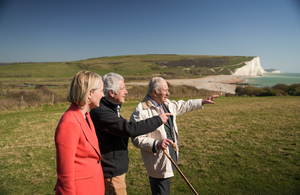
Early yesterday it was announced that Charles III himself would release a message about his experience. Some outlets referred to this as his “cancer journey”. Based on the headlines above, one would expect the message to be that he would soon, well… arrive. The message wasn’t actually released until after 8pm, so for the entire day viewers were held in suspense. This strikes me as perhaps a misstep, since the vacuum allowed further morbid rumours to circulate.

The King actually announced that he was recovering and his treatment could be reduced next year. Clearly, he does expect to see the Christmases of 2026, 2027 and beyond after all.

The message was uploaded on the royal family’s official YouTube channel as a standalone video but it was also broadcast on Channel 4 as part of an episode of Stand Up to Cancer. The video on the YouTube channel was clearly extracted directly from the television broadcast as, unlike their other videos, there were no title cards featuring any royal insignia. Instead all the onscreen graphics were from Channel 4, and it even had the “4” logo in the top left corner throughout. This could be an oversight, or perhaps it was at the channel’s own insistence.

Notes on the German State Visit

Last week Windsor Castle hosted the last of three state visits this year, featuring Frank-Walter Steinmeier & Elke BĂŒdenbender, President & First Lady of the Federal Republic of Germany.

This one made the news far less (most likely because it was far less controversial) than that of Donald Trump in September. Unlike Trump, Steinmeier was able to partake in the public-facing elements of a state visit, such as the carriage ride through the streets of Windsor and an address in the royal gallery of the House of Lords.

This was in some ways the reciprocation of the state visit which our King & Queen made to Germany in 2023. In his state banquet speech Steinmeier said to Charles

“the fact that your very first trip abroad as King brought you to Germany was a special symbol of the German-British friendship, a gesture of appreciation which meant a great deal to me and to us Germans.”

This is not strictly true as Their Majesties had been planning to visit France first, but that visit was postponed a few months as Macron dealt with protests over state pensions.

The King’s speech at the same event included this quip

“our languages, English and German, [ ] share such deep common roots, but now do sound a little different. It is undoubtedly true, that your language contains a very large number of very long words. As someone who has spent some time trying to learn a little Welsh, I have some sympathy for the proposition that needless gaps between words are a dreadfully inefficient use of paper
 “

There was no exchange of honours this time, as Steinmeier had already been appointed an honorary GCB during the aforementioned 2023 visit. He and Charles both wore their red sashes to dinner. The Prime Minister, a KCB, notably continues not to wear his badge.

The Duke of Kent did not attend the state banquet but he later separately met the BundesprÀsident at a service at Coventry Cathedral, to commemorate its bombing during the Second World War. It is worth remembering that the Duke is now the only living British prince to have been born before that war started. We got a rare glimpse of his royal cypher on a wreath lain at the old altar.

Steinmeier also had a meeting with Sir Keir Starmer at 10 Downing Street. While his state visit was still going on Starmer also had an unrelated meeting with the Prime Minister of Norway, and already since the President’s departure he has held another “Coalition of the Willing” meeting including Chancellor Merz.

From a ceremonial perspective there is little innovation here (bar a lot of stories about tiaras), as the proceedings stuck closely to the template established by recent precedents. The most interesting parts are His Majesty’s and His Excellency’s speeches, which I think, well, speak for themselves.

Recent state visits have been good opportunities for uploading free-licence photographs to Wikimedia Commons but sadly on this occasion the pickings have been very limited as the government Flickr accounts’ only pictures of Steinmeier are of his visit to Downing Street, leaving out anything involving the royals. Those on the Parliamentary accounts are not released under the correct licence, and it doesn’t look as if the German government has the same attitude to copyright that the British one does so finding anything from their end is also unlikely.

Royals and Remembrance

Once Halloween and Guy Fawkes Night have passed, poppy season is all that remains to block Christmas from achieving total domination for the rest of the year. There are, of course, two separate dates for this occasion — Armistice Day (always 11th November, the exact anniversary of the end of the First World War) and Remembrance Sunday (second Sunday in November, a broader commemoration of war dead). Both of these events involve two-minute national silences… assuming, of course, that a silence actually falls. Due to the logistics and practicalities of the working week, some organisations have to hold subsidiary events outside the universal dates. Silences here can be hard to regulate if everyone around isn’t coordinated with it. I remember quite a few occasions from childhood when a reverent, contemplative peace was anything but. Even the highest are not immune to this: The Queen attended a service at Westminster Abbey last Thursday, but it was immediately outside rather than inside the main building. As you would expect from an open-air event in central London on a weekday, the “silence” was actually filled with a lot of traffic noise as well as two different emergency sirens. The only blessing was that at least there were no dogs barking. I’m actually a little surprised that this phenomenon hasn’t been the subject of a Family Guy cutaway by now, given that it would be an easy way to get two minutes of padding with minimal animation.

Another big event in November is the United Nations Climate Change Conference, now taking place in BelĂ©m, Brazil. The Prince of Wales flew down some days in advance to present his Earthshot Prize, which Sir Keir Starmer also attended, though neither stayed for COP30 itself. This is the latest in a long line of solo overseas engagements undertaken by the heir apparent since his wife’s cancer diagnosis last year*. William was back in time for the Sunday cenotaph service but he missed the Festival of Remembrance at the Royal Albert Hall on Saturday night. Prince George attended for the first time, in his father’s place. The festival includes the religious and patriotic music expected for a solemn occasion, but also a handful of modern entries. One of these was a cover of Avicii’s The Nights. I can’t work out whether it adds to or detracts from the spirit of the event to know that Avicii himself, err, left this world behind some years ago, his life clearly remembered but tragically brief, and predeceased his father. He was from Sweden, a country formally neutral in both world wars. The festival featured multiple performances from Sir Rod Stewart, who sported the unusual sartorial combination of a knight bachelor’s badge hung from an open shirt.

The cenotaph ceremony in Whitehall traditionally involves the laying of wreaths by senior royals, senior servicemen, cabinet ministers, diplomats, various officials representing the British Overseas Territories and Crown Dependencies, and leaders of the significant political parties in the House of Commons. This has always been a bugbear for Nigel Farage, because his parties have so far never met the threshold of six MPs needed to qualify. UKIP in 2015 got 12.6% of the popular vote but only one seat. Douglas Carswell, as the party’s sole representative in the Commons, was regarded for procedural purposes as an independent rather than a leader. Reform in 2024 got 14.3% of the vote and five seats. The cruel twist here is that since the election the Reform caucus has gained two members (one from defection, one from by-election) but also lost two of the originals, so that when November came they were back as they started. It should be noted that the six-member rule, introduced in 1984, has exceptions for the Northern Ireland parties to avoid the appearance of sectarian bias. It is also possible for two or more parties to coalesce for this purpose, as Plaid Cymru and the Scottish National Party have done since 2001**.

The Princess Royal was also absent from the London commemorations, having gone on a royal tour of Australia. She instead paid her respects at the ANZAC memorial in Sydney. It is a little extraordinary for two royal overseas visits to take place at the same time, especially when both of those away from the United Kingdom are counsellors of state. Recently I have been constructing a Wikipedia page listing all of Anne’s official overseas travel (similar to those which already exist for other senior royals) but it has quickly become a little overwhelming to see just how busy she is, with twenty such journeys listed in the Court Circular just for the last two years.

One ought probably to discuss heraldic matters now. In some of the photographs of Anne’s visit I can see her two crosses and a heart flying in various places. I didn’t see William or Camilla flying theirs in the outings aforementioned. Close-up shots of the wreaths laid and crosses planted also show royal symbols. The Queen’s monogram appeared on hers, complete with the Tudor crown. William’s, even now, still uses the pre-Carolean design (note the oak leaves and lack of arch on the coronet). The King’s wreath did not use his monogram, but instead the full royal achievement with BUCKINGHAM PALACE underneath. Once again it was the old-style illustration with St Edward’s crown.

Sir Lindsay Hoyle is something of a vexillophile and has taken to Tweeting whenever a new flag is flown from New Palace Yard. In 2021 he began making a point of raising the flags of the Overseas Territories. His most recent example was the flag of the British Indian Ocean Territory, allegedly celebrating its national day. I can’t find photographic evidence (including on Parliament.UK) of the flag actually flying in the yard, so I can only go on the image shown in the Tweet itself. The BIOT flag includes the Imperial crown, sometimes with a cap of maintenance and sometimes without, but always in the St Edward form. Hoyle’s picture had a Tudor crown. I cannot find this version on the territory’s website or any other source. Is it a custom make? The BIOT is currently the subject of a slow-moving but high-stakes political controversy as Starmer’s government intends to cede sovereignty of the landmasses to Mauritius. This would mean that the territory as a political entity ceases to exist, hence no point updating the flag. I notice that there was not a representative of the BIOT among all the other BOT representatives laying wreaths at the cenotaph. The flag of the BIOT has been widely used in the campaign against the handover, including by the displaced islanders themselves. The bill to ratify the handover passed the House of Commons and recently had its second reading in the Lords, but then there were reports that the government has paused its progress due to public resistance. In this context it is tempting to read Mr Speaker’s Tweet as a not-so-subtle dig at the Prime Minister.

Finally, a point about Flickr: The cenotaph ceremony and the Earthshot prize both produced plenty of government photographs which can be moved onto Wikimedia Commons. The former had two photographers: Simon Dawson for the Prime Minister’s Office and Gunter Hofer for the DCMS. After migrating both albums across I quickly realised that the time stamps given in the metadata were wrong. Dawson’s were one hour too late (probably not adjusted for daylight savings) while the DCMS ones were in some cases out by a whole year! This feels like an elementary mistake for a professional photographer. Sadly there are not likely to be many photographs of Anne’s excursion to Sydney for the reasons I explained last year.

FOOTNOTES

*The Princess of Wales appears not to have gone abroad on official business since 15 October 2023.
**The SNP alone has won at least six seats in every subsequent general election, so in practice the utility of this alliance is one-sided.

Rolling Coverage

It quickly became apparent that the Duke of York’s dedication on 17th October to cease the use of his titles and honours was not enough to satisfy the public mood and so, not even a fortnight later, a further announcement was made that His Majesty would be taking measures to enact these changes in a formal way, and also that the changes would go further by removing his princely title as well so that he became Andrew Mountbatten Windsor. No notice to this effect has yet appeared in the London Gazette, but then it is fairly normal for that publication to lag by a few days and indeed for these processes themselves to take a few days to carry out. This is the first time since 1917 that a Prince of the United Kingdom has had that dignity removed in this way.

Less than a day after this announcement it was noted that the Roll of the Peerage had been updated to omit his name*. This is not actually a roll of parchment but rather a PDF. It is uploaded on and accessed through the website of the College of Arms but is actually controlled by the Ministry of Justice. As the page explains, the Roll was created as a government register of everyone who possessed a peerage of any rank of the United Kingdom or its predecessor states, the Roll of the Lords Spiritual and Temporal having been rendered quite inadequate for that purpose following the House of Lords Act 1999. Newly-created peers are added to the Roll automatically but those who have inherited their titles but those who inherit their titles are responsible for writing to the Secretary of State with the necessary documentation to prove their succession. It is also possible for those already listed to request their own removal. The absence of a peer from the Roll does not actually cause his peerages to cease to exist but does effectively mean that the state in its official capacity will cease to recognise him as holding them. This is probably as close as Andrew can get to fully giving up his dukedom and its subsidiaries without an Act of Parliament being passed specially for that purpose.

This has of course led to another flurry of edits on the former prince’s Wikipedia page. Some commentators noted how quickly the page had been moved from “Prince Andrew” to “Andrew Mountbatten Windsor“, but actually this was against procedure so the page name was reverted and not moved again until editor consensus was established. It would have been a lot more convenient for us if both of last month’s announcements had been made as one so that two separate page moves (and thus two separate discussions) would not have been needed. Of course, this still doesn’t entirely resolve matters because there is still some confusion as to whether “Mountbatten Windsor” needs a hyphen, as the royal warrant from 1960 includes one but the recent announcement does not. There is a further important, if largely academic, point to be made that even if Andrew has agreed to simply go by Mr from now on, he could still be called Sir until his knighthoods are fully removed, or indeed Lord as the younger son of a duke.

FOOTNOTES

*Contrast this version (archived on 16th December last year) to this one (archived yesterday): The first two pages list the principal peerages of members of the royal family, then the rest of the document lists all the non-royal peers. Within both groups the titles are listed alphabetically, so “York” was previously the last of the royals. Now he doesn’t appear at all. I note that the current version omits the “Latest revision” date underneath the Crown Copyright line on the first page, which makes me think that yesterday’s update was done in a hurry.

EXTERNAL LINKS

UPDATE (5th November)

The Gazette website has now published (as of noon today) notices confirming the removal of Andrew’s titles:

  • THE KING has been pleased by Letters Patent under the Great Seal of the Realm dated 3 November 2025 to declare that Andrew Mountbatten Windsor shall no longer be entitled to hold and enjoy the style, title or attribute of “Royal Highness” and the titular dignity of “Prince”.
  • THE KING has been pleased by Warrant under His Royal Sign Manual dated 30 October 2025 to direct His Secretary of State to cause the Duke of York to be removed from the Roll of the Peerage with immediate effect.

The first appears only in the London Gazette, while the second also appears in the Edinburgh and Belfast. So far I have not seen any of the usual experts dissecting these, although that will likely come in a few days. These are of course only the Gazette notices and not the full texts of the relevant documents, for which I have already seen some of them say they will file FOI requests. I will note that the removal of princely titles does not take the form of a royal licence, and refers to its target as already being named Andrew Mountbatten Windsor. The second, despite its triple publication, only refers to the Dukedom of York so the removal of the subsidiary earldom and barony must be read as implicit. It says that His Majesty directed the action rather than the Duke himself requesting it as the original warrant laid out, so presumably the new warrant must be amending the original in some way.

Depravity and Deprivation

The Prince Andrew made a statement two days ago that, following discussions with the rest of the royal family, he will “no longer use my title or the honours which have been conferred upon me”. This is a press release rather than any formal instrument of law, so does not properly remove those from him, though a complete stripping away of said title and honours may be looming anyway. It is important to be aware of the principles and procedures involved here.

Removal of the Peerages

Andrew holds three titles in the Peerage of the United Kingdom — Duke of York, Earl of Inverness and Baron Killyleagh — which were conferred on him by Queen Elizabeth II. He has committed to ceasing all use of these titles whether in public or private context and so most if not all press and official sources will no longer use them when referring to him, but legally removing them is not easy. For almost a thousand years it has been the case that the reigning monarch (nowadays always on the advice of the Prime Minister) was broad prerogatives to hand out peerages at will, but not to then take them back again.

Some media sources are misusing technical terms here: The peerages are not “dormant” (which occurs when the incumbent dies and it is not clear who, if anyone, is the heir), nor “abeyant” (which is where the peerage allows succession to heirs female but without ranking them by primogeniture as the males are, so that inheritance is split between them). They are also not “extinct” or “reverted to the crown” (when the incumbent dies there is definitely no heir), nor “merged with the crown” (when the peer ascends to the throne). Probably the most appropriate term here is disused, for while Andrew legally still is Duke of York, he and everyone else will behave as if he isn’t.*

This video by Dr Allan Barton, writer of The Antiquary, explains most of the processes of removing peerages, which I will here summarise in textual form:

Recent Legislation

The Peerage Act 1963 provided, among other measures, for a person who has inherited a peerage within the last twelve months to disclaim it for his lifetime by writing to the Lord Chancellor. This is not relevant to Andrew’s situation as he has held his titles for over thirty-nine years and they were newly-created for him rather than inherited.

The House of Lords Reform Act 2014 allows peers to retire from Parliament at will, and also allows the Lord Speaker to expel members who are absent without leave for a whole session of six months or longer, as well as those who receive criminal convictions resulting in imprisonment for more than a year. The House of Lords (Expulsion and Suspension) Act 2025 further gives the House the power to vote out members who breach the code of conduct. Notably neither of these acts say anything about removing the titles of those affected, only their membership of the legislature. These are not relevant to Andrew’s situation either because his membership of the upper house was already terminated by the House of Lords Act 1999 and he was not one of the peers elected to stay on at the time nor has he contested any of the hereditary peer by-elections since then.

The Titles Deprivation Act 1917 allowed King George V to revoke British peerages from those whom a specially-appointed committee of the Privy Council had identified as aiding or supporting an enemy country in the First World War. This is probably the closest precedent for Andrew’s situation but still is not itself applicable as his alleged offences are not of the nature described therein, plus “the present war” as specified is one that ended more than four decades before his birth.

Earlier Legislation

In medieval and early modern times, a recurrent political weapon was the Act of Attainder. This was a special Act of Parliament which convicted and sentenced its target for a serious crime without the need for a trial in court. An attainted man lost all of his civil rights and his property was all forfeit to the state. If he held a peerage this was forfeit in the same way.

This was used regularly to punish peers who were political enemies of the monarch, especially if they had led revolts against him. There is precedent for this being used against members of the monarch’s own immediate family, most notably in 1478 when George Plantagenet was attainted and then executed for treason against his brother King Edward IV. He lost the dukedom of Clarence and all subsidiary titles, which his own son Edward of Warwick was then unable to inherit.** The last use of an act of attainder against a peer of the realm was in 1745, when several dozen people were convicted for the Jacobite uprising against King George II.

The procedure for attainder was abolished in the nineteenth century and Winston Churchill was dissuaded from attempting to revive it in the twentieth. The concept of convicting a person of a crime through the legislature rather than the courts was open to abuse for political purposes and is considered incompatible with modern conceptions of Human Rights, so its future usage is highly unlikely.

If the present Duke is to be properly deprived of his peerages, a bespoke new law will need to be devised.

Removal of the Knighthoods and Other Honours

Elizabeth II appointed her son a Commander of the Royal Victorian Order in 1979, then promoted him to Knight Commander in 2003, then Knight Grand Cross in 2011. She also appointed him a Royal Knight Companion of the Order of the Garter in 2006.

Appointments to orders of chivalry are by the monarch’s letters patent, which can be cancelled and annulled by subsequent letters patent. Andrew’s knighthoods are both in orders under the monarch’s direct control rather than those subject to ministerial advice so I would logically assume that members can be removed (or, to use the technical term, degraded) at the monarch’s will as well, but this page on the Cabinet Office website is a little ambiguous.

Andrew was appointed a Grand Companion of the Order of Logohu in 2015. This order has the King of Papua New Guinea as sovereign and the Governor-General as Chancellor, but I haven’t so far found a source clarifying whether governmental advice is required for either appointment or removal.

Andrew also has a raft of military and commemorative medals, including the South Atlantic Medal for his service in the Falklands War. I haven’t looked up the rules of eligibility and forfeiture for all of these individually. His foreign awards (such as the Royal Norwegian Order of St Olav) are up to those countries to decide.

Removal of the Status of Prince

The dignity of Prince or Princess of the United Kingdom, along with the style of Royal Highness, is conferred by the sovereign either by letters patent or royal warrant and can be revoked by the same. François Velde of the website Heraldica has compiled the texts of all of these since 1864. It should be noted that, whereas the monarch himself has a distinct legal title in each of the Commonwealth Realms, the titles of the rest of the royal family only exist in the law of the United Kingdom and are recognised in the other realms by courtesy.

Removal from the Line of Succession

Per the Statute of Westminster 1931 any changes to the rules for succession to the throne must be agreed by all the Commonwealth Realms in unison. Per the Act of Settlement 1701 the Duke can remove himself from the line of succession by converting to Roman Catholicism. Perhaps that is something His Majesty can discuss with His Holiness at next week’s state visit.

Other Matters

The Order of Precedence in Scotland is determined by a royal warrant from 1905. That in England & Wales is based mainly on an ordnance by the Lord Chamberlain in 1595. These can be, and frequently are, amended in small ways by successive royal warrants to assign precedence to individuals and offices for which the original documents did not account. The King could likely revoke Andrew’s precedence as a brother of the monarch by this method.

The House of Lords Precedence Act 1539 (which per se only applies within the Lords chamber but in practice has been used as a basis for the order of precedence in England more widely) is primary legislation and would need another act of Parliament to change it.

Andrew is still eligible to be a Counsellor of State per the Regency Act 1937, as the Counsellors of State Act 2022 did not remove existing counsellors. His position as fourth adult in line to the throne will not change until Princess Charlotte has her twenty-first birthday in 2036. He could be ruled out early if he ceases to be a British subject and/or domiciled in the United Kingdom. Again, the only other way to remove him is by new primary legislation.

His precedence is largely an academic matter now that he is no longer attending even family events let alone public ones, and is fantastically unlikely to be called upon to attend a sitting of Parliament nor to sign state papers, but if there is to be a bill to remove his peerages then it would be fairly easy to tack on an extra couple of sentences dealing with these matters too.

I am a little uncertain as to the protocols around removing his naval rank, but it seems that, with the cooperation of the Admiralty Board, he can be permitted to resign his commission.

Before we get carried away with all of this, it is worth reminding ourselves of the state of limbo in which the addled prince currently lives — he has, after all, still yet to be convicted of, or even tried for, any crime, and in the future it may be considered by cooler heads that a bad precedent was set in such degradation based on the heat of public opinion.

Finally, spare a thought for Andrew Lownie, whose book is, much as I predicted, already seriously overtaken by events barely two months after publication. He’ll have to rush out a new edition next year, I suppose!


FURTHER READING

FOOTNOTES

*The closest parallel, though still quite weak, is how Queen Camilla was legally Princess of Wales from 2005 to 2022 but styled herself Duchess of Cornwall instead.

**As the attainder only applied to his father, he could still inherit the earldoms of Warwick and Salisbury from his maternal grandmother… but then in 1499 he too was attainted and executed for treason against King Henry VII. The latter title was restored in 1512 to his sister Margaret, but then she was attainted in 1539 and executed in 1541 for treason against King Henry VIII.

UPDATE (20th October)

Dr David Torrance has produced a briefing on this topic for the House of Commons Library. My FOI request to the Cabinet Office as to whether the Honours Forfeiture Committee’s remit includes those orders in the sovereign’s personal gift has been rejected.

Princes and Passports

The King and the Prince of Wales made an unusual joint appearance on Thursday night – at a “Countdown to COP30” event at the Natural History Museum. I was a little perplexed to see them both getting out of the same car, given that security protocols often require the incumbent monarch and the heir apparent to travel separately. Perhaps that was itself an environmental statement, but in that case they surely would have turned up in His Majesty’s new electric BMW instead of the petrol-powered State Bentley. The limousine was, of course, displaying the undifferenced royal shield and banner.

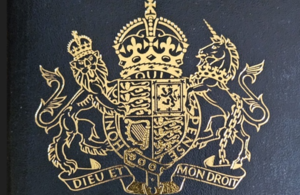
Today the Home Office announced that British passports had been updated to, among other things, display Timothy Noad’s illustration of the British royal arms, replacing the old Reynolds Stone illustration as it has in so many other contexts. Stone’s illustration, at time of writing, still appears on Acts of Parliament.

In other heraldic news, it has been five months since the last newsletter by the College of Arms and six since the last blog post by the Heraldry Society. Still, at least there’s another virtual Oxford lecture coming up in a fortnight’s time!

Balancing the Ball


Almost from birth I have had a strong aversion to even thinking about rugby and this was not assuaged during the few terms at secondary school when I had to learn to play it. This article is not about the sport, but about the peculiarity of a Buckingham Palace Tweet.

The text of the Tweet says:

A message from His Majesty The King to @RedRosesRugby and Women's @RugbyCanada Team following today’s #RWC2025 final.
The use of “following” here is a bit strange, since the message was put out eight hours before the game had even started. The King’s message is shown as an attached image, depicted against the backdrop of a rugby pitch with the England flag at the top and the Canadian flag at the bottom.
My wife and I send our warmest good wishes to both the
England Red Roses and Canada Women's Rugby Team as
you prepare for your World Cup final.

What a remarkable achievement for both teams to have
reached this pinnacle of the sport. I know that supporters
on both sides of the Atlantic will be cheering with equal
and tremendous pride.

May the best team win, and may you both play with the
spirit of sportsmanship, determination and true grit that
makes rugby such a wonderful game to watch. Whatever
the result, you have already done your countries proud.

Good luck to you all.

Charles R.
The message, of course, has to congratulate both teams equally for getting to the final and then be studiously neutral as to which of them will win it. I would plaintively suggest that including the Canadian coat of arms alongside the British one would have helped in this regard.
The King acted in a third capacity today when he held an audience at Balmoral Castle with Anthony Albanese, whom I think he last met in person at CHOGM in Samoa. Albanese had already been in Britain for bilateral discussions with Sir Keir Starmer at Downing Street.
Earlier this year Their Majesties made a state visit on Britain’s behalf to the Italian Republic. The trip was supposed to include a state visit to the Holy See in Vatican City as well, but things went awry when Pope Francis fell seriously ill. Eventually they managed to get a low-key private meeting on their anniversary, but anything grander was beyond His Holiness’s health. He died twelve days later. About a week ago, a few newspapers were reporting was going ahead with Leo XIV as host. Today the Palace confirmed it. The exact date has not been given yet, only “late October”. This will be the fourth British royal visit to the Vatican this year, as the Prince of Wales attended Francis’s funeral and the Duke of Edinburgh attended Leo’s inaugural mass. Those aforementioned news articles said it would be Charles III’s final overseas journey for 2025. That is very disappointing as it means there won’t be a royal tour of New Zealand this year. Given that 2026 is a general election year — in which royal tours are conventionally avoided — and that the sovereign is already expected to fly to Canada, the United States and Antigua & Barbuda at various points, it might not happen now until 2027, a full three years after it was originally planned.

Trump at Windsor and Chequers

The 47th President of the United States has now completed his much-anticipated second state visit to Britain. Here are my observations on it.

Time and Place

This time the state visit was at Windsor Castle instead of Buckingham Palace. Trump himself said that this was because Windsor was better. While most (including the royals themselves) would agree that Windsor is the superior setting by most metrics, the real reason for the change of location is that Buckingham Palace is undergoing major renovations so won’t be available for these kinds of events for some time. Trump had previously visited the castle on his Official (not state) visit in 2018.

There had been some speculation about the idea of the second state visit being held in Scotland rather than England. The King’s letter to him in February even speculated he could come to Balmoral, but this did not come to pass. Trump did make a visit to Scotland this summer while the monarch was also there, but it was a private rather than a political visit and the two men did not meet.

The timing of the visit was a little tight, as it was sandwiched between the Duchess of Kent’s funeral and the Queen’s Reading Room Festival. The Duke & Duchess of Edinburgh were not present due to clashing commitments — commemorating Independence Day in Papua New Guinea, then representing Britain at a business summit in Japan.

Ceremony and Security

What made this visit a little surreal is that, due to the intense unpopularity of Donald Trump among most of the British population and the scale of protests against him, this was the paradoxical phenomenon of a state visit done almost in secret. There were no “public-facing” events, with the foreign visitor instead being flown in his own presidential helicopter directly from Stansted airport to his ambassador’s residence, then to Windsor Castle, then to Chequers, then to Stansted again, thus avoiding the public roads (although his motorcade was still driven there without him in it).

What particularly stood out here was the carriage ride: For the state visitor to be pulled by horse through the streets of Windsor (or the Mall in Westminster) is a standard part of the tradition — witness Macron two months ago, the sovereigns of Japan and Qatar last year, and even Vladimir Putin in 2003 — but the enormous additional security requirements for American leaders had previously rendered this impractical. The solution here was for the carriage ride, like everything else, to happen entirely within the castle grounds. There were still soldiers lining the route, but no cheers from adoring crowds (or, more likely, jeers from abhorring crowds instead). The emptiness of the background gave the scene a visual quality reminiscent of much of the COVID years, especially Prince Philip’s funeral.

Other Parts

The First Lady had a tour of the Windsor Castle library with Queen Camilla, followed by a Scouts Squirrels event with the Princess of Wales. Her facial expressions throughout these events are noticeably different to when she is pictured with her husband.

Attire

As the state banquet was at Windsor, naturally the royal men were wearing the Windsor uniform while everyone else wore white tie. The King & Queen wore the sash of the Order of the Garter, as did the Duke & Duchess of Gloucester, the Prince of Wales and the Princess Royal, while the Princess of Wales and Sir Tim Laurence wore that of the Royal Victorian Order. Trump’s chest was noticeable for its lack of adornment, which is a little odd as he seems exactly the sort of person who would most covet medals and sashes. There was no exchange of honours between the two heads of state, which one would normally expect to see here if it hadn’t been done already.

I also spotted that, when first meeting each other, the sovereign and the president both wore ties the same colour as the hats worn by their respective consorts, which was a nice touch.

Music

We had copious renditions of God Save The King and The Star-Spangled Banner. I was a little surprised we never heard the presidency’s own anthem Hail to the Chief. Protocol aside, it would have been more artistically-apposite to have that one paired with the royal anthem while the national anthem was paired with something like Rule, Britannia!

Progress and Politics

Having completed his Dignified stay at Windsor, the President then moved to Chequers for the Efficient part of the visit. The British and American governments produced a Memorandum of Understanding regarding cooperation on advanced information technologies and, most intriguingly, nuclear energy. That last one is something that Britain has direly needed for a while, though the other parts have yet to fully escape the realm of folly.

Photographs

One of the main perks, for me at least, of having a US Government visit to the UK is that there will be a series of official photographs released into the public domain. I was a little disappointed on this occasion to see that the White House Flickr account didn’t publish any photographs of the visit, while the State Department only published one of Marco Rubio meeting Yvette Cooper on the runway. The collection on Wikimedia Commons is mainly made up of images found on White House Twitter and Instagram feeds. The White House YouTube channel also uploaded some nice long videos of the key events (albeit with a banner over much of the screen). There is less clarity on these platforms as to the copyright status, and it may later turn out that they are commercial photographs rather than government ones, in which case they will have to be removed. The Downing Street Flickr account published three dozen photographs of the event at Chequers but the only one from Windsor was the group shot shown above. This means there are no free photographs of the state dinner itself, so these will have to be sourced from screencaps of the aforementioned videos.

The Future

Already there have been further news articles hinting that Trump intends to invite Charles & Camilla to Washington D.C. next year, on a reciprocal state visit coinciding with the 250th anniversary of the United States’ independence. That should be interesting to see!

UPDATE (22nd September)

The White House Flickr account has now released an album of the state banquet with 27 photographs at time of typing, as well as 83 of the arrival ceremony and 48 of the Chequers conference, which sure makes my life a lot easier.

The Duchess of Kent’s Funeral

The funeral took place today at Westminster Cathedral. It was not televised, but there was a press-pool camera outside which livestreamed to YouTube. Unfortunately the camera feed only covered the outside of the cathedral, and our view of the inside was limited to a handful of still images (which seem to be of guests filing in rather than the ceremony itself), and what could be seen from the outside once the doors were opened. Since it was broad daylight from the outside, it took a while for the camera’s light sensitivity to adjust so that proceedings inside were actually visible. This was briefly undone every time someone in a white cassock walked across the camera’s field of vision outside, so that the interior became a black void again. I will make here what few observations I can, mainly about flags and cars.

When viewed from the piazza, the flagpole on the left of the main door normally flies the flag of the Holy See (or Vatican City) while that on the right flies the Union Flag (or Jack). This time the Vatican flag flew full-mast throughout while the right pole flew the sovereign’s banner of arms at full-mast in his presence and the Union Flag at half-mast in his absence.

Katharine did not have the use of a banner of her own arms (the Duke of Kent impaling Sir William Worsley) so her coffin was draped in the generic royal banner with the ermine bordure. Attendees on departure could be seen clutching the printed order of service with Katharine’s royal cypher (the letter K topped by a coronet of crosses and strawberry leaves, curiously not the version shown on Wikimedia Commons). The order of service itself has not been released, but the royal family website has this article explaining events that took place. An announcement on the cathedral’s website uses Sodacan’s illustration of the late duchess’s heraldic achievement.

The doors opened as the piper was walking out, after which the national anthem was played. Two verses were sung, preceded by Gordon Jacob’s fanfare. It was played on the cathedral’s organ but I don’t think any brass players were present.

I took notes on which royals arrived in which car:

  • The Late Duchess herself was carried in the claret Jaguar hearse (no numberplate) also seen at Elizabeth II’s funeral.
  • The Duke & Duchess of Gloucester in OY20FUL (a dark red diesel Jaguar)
  • Prince & Princess Michael in a blue BMW (probably YK74MHB, electric)
  • The Duke & Duchess of York in KN74EFK (a green hybrid Range Rover)
  • Sir Tim Laurence & The Princess Anne in DK74CMV (a blue petrol Bentley Bentayga)
  • The Prince & Princess of Wales in KU25UPR (a blue hybrid Range Rover)
  • The Duke of Kent & Lady Helen Taylor in a blue Jaguar (registration not shown in footage)
  • The King and Sir Clive Alderton in the Bentley State Limousine (no numberplate needed).

The Duke of York looked a little confused on the way out, walking towards the cars, then back to the cathedral, then to the car again, as if not sure which one he was meant to be using. A short wheelbase bus was used for several other family members, including Lord & Lady Frederick Windsor.

The Duke of Kent, aged 89, understandably looked rather frail and shrivelled. His siblings Prince Michael and Princess Alexandra were both seen in wheelchairs at some points, then walking with canes at others. The Queen did not attend, having pulled out at the last minute due to a sudden bout of acute sinusitis. It is not confirmed if she will still be attending the imminent American state visit.

Accession Day 2025

Today marks three years since the passing of Elizabeth II and thus the commencement of the fourth year of the New Carolean era. Here is a quick round-up of recent developments.

New Royal Biographies

The stream of these is continuous and too large to notice all of them, but three in particular have generated news coverage:

  • Entitled: The Rise and Fall of the House of York by Andrew Lownie (14th August, HarperCollins). The title alludes to the Wars of the Roses, but really it’s about the personal, professional and financial lives of the most recent Duke & Duchess. The book is overwhelmingly derogatory and might have been considered scandalous had not most of the topics therein been raised already some years ago (while the other claims are usually less-than-credible). Many reviewers and columnists have said words to the effect that it would be devastating to its targets’ reputations if only they had reputations left to devastate. The people who didn’t already believe the things Downie asserts here probably won’t read this book anyway so despite a few sensational headlines I doubt in the long run it will really change anyone’s position.
  • Power and the Palace: The Inside Story of the Monarchy and 10 Downing Street by Valentine Low (11th September, Headline). Low has already written Courtiers in 2022, which I have in my collection but have not gotten around to reading yet. I’m not sure I’ll ever read this one either since, as is often the case with this kind of book, the newspapers have already spent weeks running headlines explaining all the important bits. The book is about the relationship between senior members of the royal family and senior members of successive governments. The most outlandish part is the attempt to lift the lid on Schrödinger’s box regarding Elizabeth II’s political beliefs, long a source of speculation to all and sundry. Low, quite remarkably, claims that Her Late Majesty was much more candid than formerly thought and that everyone else around her was more studiously discreet. The most prominent assertion (in terms of news coverage) concerns her views on the 2016 EU referendum. Private Eye has this amusing summary:
GALLAGHER’S GALL
ORDERED by press watchdog Ipso to print a correction to his pre-referendum front-page headline “QUEEN BACKS BREXIT”, which was found to breach its accuracy rules since there was nothing in the story to show it was true, then-Sun editor Tony Gallagher was defiant.
“I don’t accept that we made an error at all,” he huffed to the BBC. “We made a judgement that the headline was right and that it was backed up by the story. We knew more than we put into the public domain. The sources were so impeccable that we had no choice but to run the story in the way that we did.”
Nine years on, Gallacher has been promoted to edit almost-as-respectable sister sheet the Times, which is serialising Power and the Palace, the new book by the paper’s retired royal-watcher Valentine Low. And what headline appeared on Saturday’s front page flagging the first revelations from the impeccably sourced tome? “The Queen was a Remainer.” (Eye 1657 page 7)
  • Charles III: New King. New Court. The Inside Story by Robert Hardman (Pan Macmillan). It actually made most of its headlines last year but apparently he has a new edition coming out soon. I’m not sure if this is the second edition or if there’s already been one in the interim that I’ve missed, as I found a version on Google Books which claims to have been published on 7th November 2024 yet includes photographs of events from 2025. It has three extra chapters compared to the one I borrowed from Hull Central Library, and these cover the two royal cancer crises as well as the D-Day Commemorations and the general election. This latest version is obviously too early to include Trump’s state visit or the Duchess of Kent’s funeral, so probably yet another version will be needed next year. Pan Macmillan ought to have a trade-in scheme so people who already bought the old edition can get discounts off the new one. In an interview with journalist Patricia Treble he said Charles is “just the King” now as opposed to “the new king” so perhaps the very name of the book is now redundant and it would be better in the long run to wait until he has enough extra material for a full-length sequel instead of endless retroactive add-ons.

The Tudor Crown

Yes, that old chestnut again. I note that HM Goverment is still not entirely consistent here: When Rushanara Ali resigned last month the Prime Minister’s typed response had the new Noad illustration on its letterhead but when Angela Rayner resigned last week Starmer’s handwritten reply was topped by the old image, as was the letter from the Standards Adviser. Recently Charles wrote a letter to King Mswati III of Eswatini (formerly Swaziland) congratulating his country on fifty-seven years of independence. That letter was Tweeted by the British High Commission in Mbabane, showing the new emblazonment. It uses the “lesser” version of the arms in blue instead of the greater version in red, so it perhaps it should be understood as an FCDO letterhead instead of a royal one.

State Visits

Britain has already received a state visit from France this year and is about to host one for America also. As far as outbound visits go, there doesn’t seem to be anything scheduled for the rest of this year. In 2026 Their Majesties are expected to travel to Canada again (for an extended royal tour), to the United States (for a British state visit) and to Antigua & Barbuda (for CHOGM). There is still no announcement as to when they will visit New Zealand, which must be frustrating to those who’ve been waiting well over a year now!