Don’t They Look Younger Now?

Fresh from attending special sittings of the States of Jersey and the States of Deliberation in Guernsey, today Their Majesties returned to Westminster for the opening of the first session of the fifty-ninth Parliament of the United Kingdom.

This was the first King’s Speech under a Labour government since 1950. There is some symmetry, perhaps, between Charles III’s second speech and George VI’s second-to-last.

This is the only free-licence photograph of the event so far.

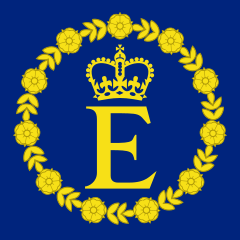
While the content of the speech was very lengthy and stood in radical contrast to the one delivered for Sunak’s government in November, in ceremonial terms there was very little change. The King’s getup was identical to that worn last time. The Queen’s changed a little – instead of her coronation gown, she has reverted to the style of dress she wore in 2019 and earlier. Reeta Chakrabarti, presenting the BBC’s coverage, described it as “very fine, off-white silk crepe embroidered by Fiona Claire”. She has not taken to wearing a sash again, but the star of the Order of the Garter appears around her left hip. This was also, incidentally, her 77th birthday.

Shabana Mahmood appeared as Lord Chancellor. Being a barrister, she wore the full-bottomed wig. This is the first time a woman has performed this role at a state opening, for Liz Truss’s brief tenure in the role did not include one. Justin Welby, the Archbishop of Canterbury, can be seen for the first time wearing the collar of the Royal Victorian Order.

The most striking visual difference was in the change of pages – last time King Charles’ train was carried by Nicholas Barclay, Ralph Tollemache, Charles van Cutsem and Lord Oliver Cholmondeley (three of whom also appeared at the coronation). This time Tollemache returned but the other three were replaced by William Sackville, Alfred Wellesley and Guy Tryon. I don’t know any biographical detail about them beyond what I can guess from their surnames but they all appeared to be several years younger than the boys whom they replaced. Queen Camilla continued to use William Keswick and Arthur Elliott as before. As at last year’s ceremony Her Majesty’s two pages held her robe in the middle rather than at the end so that the end still dragged along the carpet, whereas His Majesty’s four pages kept the whole garment elevated (despite it being longer than his wife’s).

Some other things of note – as is custom after the first state opening of a new parliament, the lower house appointed three temporary deputy speakers. The senior of these is Sir Edward Leigh. I don’t think a Father of the House has ever been appointed as a deputy speaker before. These three will hold office for the brief period until new deputies are elected. All three of the deputy speakers sitting before dissolution have now left the house (one against his will), which was last the case in 1997. There will thus be no continuity except for Sir Lindsay Hoyle himself. Also today the first life peerages of Sir Keir Starmer’s premiership were patented – Lord Vallance of Balham and Lady Smith of Malvern. It appears that the ministerial appointments will be taking priority over the dissolution honours after all.

EXTERNAL LINKS


Sightings in the Channel

A few months ago I noted that, during the illness of her husband, Queen Camilla had been carrying out royal engagements solo, and had been flying the generic ermine-bordered version of the royal banner of arms.

The King has since recovered at least enough to be allowed out, and today Their Majesties jointly visit the Bailiwick of Jersey – a crown dependency in the English channel. Although a self-governing country with its own coat of arms, Jersey is part of the realm of the United Kingdom (i.e. it doesn’t count as a separate crown from the British one) and the sovereign’s heraldic identity is the same as in England.

In the disappointingly-limited series of photographs and videos I have found so far (none of them free-licence) I could not see much evidence of the sovereign’s banner flying over buildings, though I did see it on the roof of the Bentley State Limousine. What intrigued me was seeing (at 2m08s in the video above) some enthusiasts who had brought their own banner of Her Majesty’s arms and draped it over the railing. Based on the art style, I am dead certain it is a printout of this creation by Fry1989. The King actually reacts to it, though I can’t quite make out the words he says. The presumed owner of the flag says to him “I hope you enjoyed France last year.” in what I take to be a French accent.

EXTERNAL LINKS

Why stop when you’re on a roll?

Today marks the first anniversary of Their Majesties’ coronation, and there have been some public ceremonies to commemorate.

A few days ago the coronation roll was unveiled, serving as a written record of the proceedings that took place in the abbey (and some of the key events leading up to it) as well as listing all the prominent attendees. As this was the first British coronation to take place in the internet age, a digital version of the roll has also been set up, interlaced with video interviews from many of the core participants.

David Torrance has produced a lengthy briefing document for the House of Commons library about it.

While I’m here, there is another aspect of the coronation on which I’d like to look back – the status of the chairs on which Their Majesties sat during the ceremony. Some weeks before the event the antiquarian Dr Allan Barton put out a video called When Is a Chair a Throne? The answer, essentially, is that it must be on some form of dais to raise it above the floor.

At the business end of the abbey during the coronation there are five seats of special importance: Closest to the alter is St Edward’s Chair, the ancient wooden relic on which the monarch is actually crowned. A few metres behind, in the crossing, sit two “throne chairs”, in this case a pair of X-framed armchairs (almost looking like something a film director would use) originally made for George VI & Elizabeth Bowes-Lyon. Perpendicular to these are chairs of estate, these ones originally made for Elizabeth II and Philip Mountbatten, allowing the couple to sit behind their respective faldstools.

From what I can see in images of past coronations, both painted and photographic, a pattern is clear – the consort’s throne sits on three steps and the monarch’s throne on five, while the chairs of estate and St Edward’s chair sit directly on the floor. The 2023 coronation breaks the trend – the monarch’s X-framed chair has just one block underneath it while the consort’s counterpart has none at all (though it still has upholstered footstools in front). Does this mean that, technically, only one of these chairs counts as a throne?

IMAGE REFERENCES

Review: Charles III by Robert Hardman

Robert Hardman is no stranger to royal biography, having already penned quite a handful about Elizabeth II in the last decade or so of her life, including Queen of Our Times which came out in March 2022 as part of her Platinum Jubilee season and then in December of the same year was released again in a “commemorative edition” to update for the fact that she’d died. Now he moves into the present reign with a biography of her eldest son. I am a little confused about the title of this one as the British publication is called “Charles III: New King. New Court. The Inside Story”1 but on Google Books I can see that the United States version is called “The Making of a King: King Charles III and the Modern Monarchy”. I suspect the titles must be written this way for SEO purposes, or perhaps he just couldn’t decide which description he wanted so used all of them at once. It must be quite a fraught process to come up with a distinctive and meaningful name for a biography when you know that lots of other biographies will be documenting the same person and all competing to emerge in future history as the one definitive authority thereon. Most likely in the long run the general public (maybe academics too) will discard the pretentious subtitle and just remember it as “[AUTHOR] on [SUBJECT]” (e.g. “Jenkins on Churchill”) instead.
Hardman’s lengthy volume covers the first year of the New Carolean era. As one might expect, this period in royal history was particularly dominated by two big ceremonial events: His mother’s funeral and his own coronation. In the book, the funeral (as well as the period of Operation London Bridge leading up to it) takes up chapters 3, 4 and 5 while the planning and execution of the coronation takes 9, 10, 11, 12, 13 and 14. That makes for nine chapters out of a total of eighteen across the whole book. The coronation section in particular is loaded with dense historical comparisons, detailing not just the crowning of Charles III but also quite a lot about those of George VI an Elizabeth II. A less charitable reader may accuse Hardman of padding here, though doubtless a lot of the innovations (and omissions) of 2023 cannot be fully appreciated without an understanding of what came before. Anyone buying this book at first printing will, doubtless, have already watched the public side of these events on television as they were happening, so the real value of these chapters is in reading the personal accounts of the people involved as to what went on behind the scenes, such as the aide who spontaneously hugged Princess Anne to console her in her grief, the brigadier getting a summons back to London while giving a speech at his daughter’s wedding in Corfu, the Duke of Norfolk getting his GCVO investiture in a rush so he could wear his sash in the procession or the royal pages being packed off into a side room with some video games. It is worth mentioning as well that Hardman directed a BBC documentary about the coronation and some other aspects of royal life that year which aired at Christmas and can be seen in some ways as the prelude to this book.

The other chapters are about the personalities of Charles & Camilla, the looming political challenges for the institution of the crown and some of the other projects in which the sovereign couple have engaged themselves (such as the Prince’s Trust/Charity/Foundation organisations which now all have to be renamed). The running thread is the process of establishing Charles’s approach to kingship and the need to assert, like most new incumbents whose predecessors served an unusually-long time, that he is his own person and is not obliged to become a clone of his forbear with whom the institution had become synonymous. Charles, of all our sovereigns, had the longest pre-accession life and a brings with him a much more complete (and publicly-known) individual persona, which makes this task all the more pressing. I was amused to read in Chapter 15 that an unnamed senior courtier refers to this as “Doctor Who syndrome”, showing that the habit of explaining the British constitution in terms of that franchise is one that runs all the way to the top. Given the relative perceptions of the new king and his late mother, I would especially see parallels to Colin Baker succeeding Peter Davidson, or Capaldi following Tennant and Smith.

Being acutely aware of some of the less-sympathetic perceptions that have swirled around the royal family as a whole in recent years, and around Charles in particular for many decades, Hardman occasionally includes explicit references to and arguments against ideas emanating from either that acclaimed Netflix drama or statements by the exiled Duke & Duchess of Sussex. At times it can feel as if he has a bit of an axe to grind. It’s probably redundant in any event, as the people likely to be credulous of the claims he’s refuting are not likely to picking up his book in the first place. I’d like to think this is merely a demonstration of Hardman’s passion for truth over sensationalism, but I can’t entirely trust him on that front given he writes for the Daily Mail after all.

These minor quibbles aside, New King New Court is an engaging and enlightening work which I would recommend to anyone interested in the topic area, though any customer (or library) sinking their money into the original edition now may wind up feeling short-changed he does another expanded version in the near future.

1The use of full stops means that the title mercifully evades what TV Tropes calls “Colon Cancer”, though I would have preferred commas.

The King’s Accession: Fast and Slow

The royal journalist Robert Hardman recently released his latest publication Charles III. New King. New Court. The Inside Story, which covers the end of the previous reign and the beginning of this one. Confusingly the same book seems to have been published under at least three titles: I’m also seeing it called Charles III: The Making of a Modern Monarch and The Making of a King: Charles III and the Modern Monarchy.

Reading the whole thing will obviously take some time, but I have managed to get through the first few pages, including those covering the decease of Elizabeth II. I was particularly fascinated by this passage:

…for visibility, Prince Charles was raised on his mother’s mantra that ‘I have to be seen to be believed’. Immediately after her death, it became clear that he would abide by this. Duties and conventions which might have been spread over many months at the start of the previous reign kicked in almost immediately. His first broadcast as monarch was recorded within twenty-four hours (Elizabeth II’s first broadcast, which was by radio, came ten and a half months into her reign). There would be visits to all the home nations within days. Court mourning, which continued for two and a half months after the state funeral of George VI, would end precisely one week after that of Elizabeth II. In less than three weeks, the King’s cypher, ‘CIIIR’ (Charles III Rex), was ready and released for immediate use on post boxes, military uniforms and official documents. It had taken more than five months before the design for ‘EIIR’ was approved in 1952. Investitures were up and running again within the month.

Of course, this is still slower than I would have liked, especially in heraldic, numismatic and vexillological matters: Sixteen months into the present reign, there is still uncertainty about the arms of The Queen and the Prince & Princess of Wales (especially in Scotland), as well as His Majesty’s personal banners in most other Commonwealth Realms. Though in almost all cases it is trivial to predict what they ought to look like, there are few in which I am certain that such designs have actually been granted. In addition, I am still yet to personally encounter any coinage or banknote bearing the current monarch’s face.

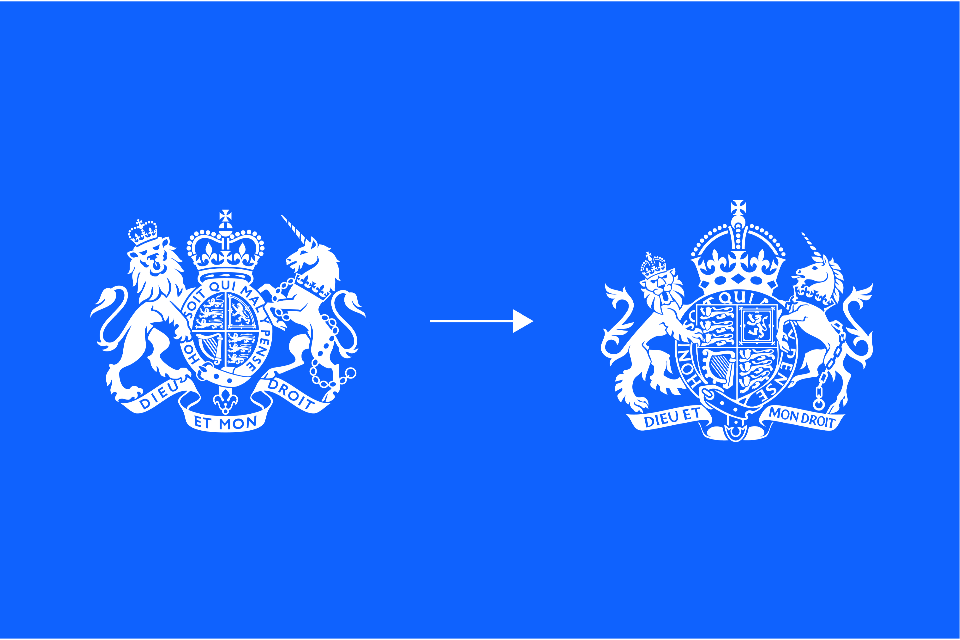
The slowness in updating online profiles is particularly baffling, given that it requires no physical material to be changed. This month there has been a hint of movement by His Majesty’s Revenue & Customs, whose Twitter icon now shows the Tudor crown, although the logo on the website itself still uses the St Edward version. The cover images for recent policy posts show both versions in use, suggesting that the filtering through of the new design is still ongoing.

UPDATE (19th February)

The crown logo is now updated across government websites.

The Crown old and new

Early in the new reign, the College of Arms announced a new royal cypher for Charles III. A noted difference between this one and his mother’s (other than the name, of course) was the depiction of the crown.

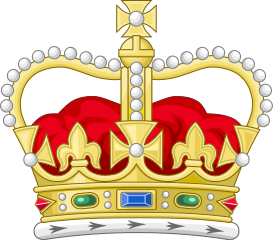
“St Edward’s” crown, favoured by Charles II to Victoria

Up to and including Victoria’s reign, depictions of the crown in heraldic drawings could be inconsistent. Edward VII ordered a standardised depiction with simple arches, which has come to be known as “the Tudor crown” due to its resemblance to one supposedly commissioned by Henry VII or VIII (and seen in royal portraits up to the Civil War). Elizabeth II later decided to change this to a version with depressed arches, better resembling St Edward’s crown which monarchs actually wear at coronations, and which seemed to be favoured in heraldic drawings before Victoria’s time. The timing of these decisions created a general misconception that the Tudor crown is always used when the monarch is male and St Edward’s when the monarch is female. Charles’s decision is likely to reinforce that belief.

The “Tudor” crown, as used by Edward VII-George VI

On the day of the coronation, the Canadian Heraldic Authority unveilved their own new version of the crown, intended to be more distinctly Canadian. The overall shape of the crown is still based on the Tudor version, but the jewels have been replaced by a wavy blue line, the uppermost cross by a snowflake (as already used in the Order of Canada) and the crosses around the rim by – of course – golden maple leaves. The removal of explicit Christian symbols may be due to the lack of an established church in Canada, though the omission of fleurs-de-lis is a little perplexing, given the constitutional importance of the country’s French heritage.

https://upload.wikimedia.org/wikipedia/commons/thumb/d/d4/Crown_of_Canada_2023.svg/248px-Crown_of_Canada_2023.svg.png

The Canadian crown, as used by Charles III

It is not clear on exactly what timescale the new crown is to supersede the old. Four days after the coronation the government of Canada released a revised Canadian passport design. Though many radical changes have been made, the 1952 depiction of the crown retains pride of place. It is also not certain whether this will apply to the parliamentary maces. Currently the mace of the House of Commons is modeled on the Tudor crown while that of the Senate is modeled on St Edward’s. This is reflected in the heraldic badge of the parliament, showing both maces in saltire behind the shield. Funnily enough, British passports, though updating the introductory text to reference His Britannic Majesty instead of Hers, also still seem to have the prior crown on their covers.

The shield itself (fleurs and all) remains unchanged. It was announced on the same day that the arms of Canada may be flown as a banner to represent Charles and all future sovereigns. Previously Elizabeth II’s flag had the royal arms of Canada with her personal EIIR cypher imposed on a hurt in the middle. The removal of the cypher brings Canada closer in line with British heraldic practice whereby the reigning monarch bears the arms of dominion undifferenced, as well as avoiding the hassle of redesigning the flag for each subsequent reign. It remains to be seen whether the heraldic banners of other members of the royal family will also omit their cyphers and keep just the cadency labels.

FURTHER READING

With Heart and Voice to Sing

The coronation, in addition to its visual majesty, is an opportunity for musical expression. In addition to the long list of traditional pieces, there were twelve brand new compositions commissioned for the day. The whole has been turned into an album, which was uploaded to YouTube and various streaming services on the same day. It is also due to go on sale in CD format on 15th May.

Naturally I took it upon myself to arrange it all into a convenient table for the coronation’s Wikipedia page, which another editor shortly afterwards redesigned almost entirely.

THE OLD

  • Johann Sebastian Bach: Magnificat in D Major; Sunday After New Year; Singet dem Herrn ein neues Lied; Alla breve in D Major.
  • William Boyce: The King Shall Rejoice: Opening Chorus
  • Anton Bruckner: Ecce sacerdos magnus.
  • William Byrd: Prevent Us, O Lord; Gloria; Earl of Oxford’s March.
  • Walford Davies: Confortare.
  • Edward Elgar: Nimrod; March No. 4.
  • Orlando Gibbons: Threefold Amen
  • John Goss:
  • George Friderich Handel: The Arrival of the Queen of Sheba; Oh, had I Jubal’s lyre; Care selve; Zadok the Priest.
  • William Henry Harris: Flourish for an Occasion.
  • Gustav Holst: Jupiter, the Bringer of Jollity.
  • Hubert Parry: I was glad; March from the Birds; Chorale Fantasia on “The Old Hundredth”.
  • Henry Purcell: Trumpet Tune; Christ Is Made The Sure Foundation.
  • Richard Georg Strauss: Wiener Philharmoniker Fanfare;
  • William Walton: Crown Imperial; Coronation Te Deum.
  • Thomas Weelkes: O Lord, Grant the King a Long Life.
  • Ralph Vaughan Williams: Fantasia on Greensleeves; Prelude on Rhosymedre.

THE NEW

  • Karl Jenkins: Crossing the Stone.
  • Sarah Class: Sacred Fire.
  • Patrick Doyle: King Charles III Coronation March.
  • Iain Farrington: Voices of the World.
  • Nigel Hess, Roderick Williams & Shirley Thompson: Be Thou My Vision.
  • Paul Mealor: Kyrie Eleison.
  • Roxanna Panufnik: Coronation Sanctus.
  • Tarik O’Regan: Coronation Agnus Dei.
  • Christopher Robinson: The Recognition; Homage Fanfare.
  • Andrew Lloyd-Webber: Make A Joyful Noise.
  • Judith Weir: Brighter Visions Shine Afar.
  • Debbie Wiseman: Alleluia.

Personally, I’m a little disappointed at the lack of Howard Shore.

A New Regency Bill

Ever since the state opening earlier this year, the topic of counsellors of state has been prominent in my mind, and in the minds of many others. Just as Elizabeth II’s health was failing and the necessity of this constitutional device was more pressing, so the actual availability of counsellors was at its lowest since the device was invented. Many in academic and political circles were discussing possible updates to the legislation. I even had a go at drafting a new bill myself. As the original 1937 Act had already been amended twice, and as I wanted to avoid a confusing change of pronouns mid-paragraph, I did consider neatening things up by repealing it wholesale and typing out most of its provisions again, but that version turned out to be too long-winded for the amount of actual change I needed to effect. By early September it was nearly in a presentable state, but then Her Majesty’s death seemed to render the matter moot for a while.

Today the Lord Chamberlain of the Household announced that King Charles wished his siblings Anne and Edward to be re-appointed as counsellors. This will require new legislation, which we can expect to be brought forward swiftly. I hope it’s not too late to send in my own.

A

BILL

TO

Amend the provisions for a regency in the event of the incapacity of the sovereignty due to illness or minority, and for the performance of certain of the royal functions in the name and on behalf of the Sovereign in certain other events.

BE IT ENACTED by the King’s most Excellent Majesty, by and with the advice and consent of the Lords Spiritual and Temporal, and Commons, in this present Parliament assembled, and by the authority of the same, as follows:—

1. The Regency Act 1937 is amended: –

  1. In subsection (1) of section two, replace “Lord Chancellor” with “Prime Minister” and “Chief Justice of England, and the Master of the Rolls” with “Speaker, and the President of the Supreme Court”.
  2. In subsection (2) of section two, replace “His Majesty’s Dominions and to the Government of India” with “His Majesty’s Realms and to the Commonwealth Secretariat”.
  3. In subsection (1) of section five, replace “mother, if she is living” with “living parent”.
  4. In subsection (1) of section six, replace “by telegraph” with “electronically”.
  5. For all of subsection (2) of section six, substitute “The counsellors of state shall be any five persons of His Majesty’s choosing, appointed by Statutory Instrument under this Act and subject to the affirmative resolution procedure.”.

2. The Regency Acts of 1943 and 1953 are repealed.

3. This Act may be cited as the Regency Act 2022, or it and the Regency Act 1937 may be cited as one.

4. This Act takes effect upon the approval by both Houses of Parliament of the first statutory instrument passed under section one.

EXPLANATORY NOTES

This bill updates the Regency Act 1937, as well as repealing the 1943 and 1953 Acts which had amended it already.

Section 1 (1) changes the list of persons empowered to determine the monarch’s absence or incapacity. It adds offices whose jurisdiction encompasses the whole United Kingdom (Prime Minister, Lord Speaker, President of the Supreme Court) and removes those whose roles are only applicable to parts of it (Lord Chancellor, Lord Chief Justice, Master of the Rolls).

Section 1 (2) removes reference to defunct bodies and adds reference to current ones.

Section 1 (3) updates the list of potential counsellors of state. The original text specified the consort and the first four adults in line to the throne. In early 2017 this would have meant Princes Philip, Charles, William, Harry and Andrew. By 2022 the former had died and the latter two had withdrawn from royal duties, leaving only two counsellors still active: the minimum for this provision to be used. The accession of King Charles III dulls the urgency of the situation by adding Queen Camilla and Princess Beatrice to the list (as consort and fourth adult in line respectively) but the current arrangements are still less than ideal. The new text allows for counsellors to be added or removed as necessary without the burden of new primary legislation each time.

Section 2 repeals intermediate legislation whose provisions are now redundant. The 1943 Act lowered the age of eligibility for the heir-apparent to be a counsellor, but that is negated by this Bill. The clause regarding counsellors’ absence is also covered by the revised wording. The 1953 Act anticipated minority reigns by persons who have since reached the age of majority and gave powers to persons who are now deceased. The sole active provision of the latter Act is to reduce the age at which the heir-apparent could be regent from twenty-one to eighteen years, but as the present heir-apparent is over the higher age that point is likewise moot.

Section 4 delays implementation of the legislation until His Majesty’s appointments have been approved, to avoid an interim situation in which there would be no counsellors of state at all.

Heralds-a-Heralding

Today and yesterday, Charles III was formally proclaimed as King across the world, following the meeting of his accession council. This is only the fourth accession in Britain since the invention of the television, and the first time that the council itself has been broadcast live. Indeed, to my knowledge the only other time that any meeting of the council in Britain has been recorded was for the 1993 documentary Days of Majesty, and even then only a small clip was shown. There was supposed to have been a meeting (probably done virtually) some days ago for the swearing in of Liz Truss’s new cabinet, but the fading of Queen Elizabeth’s health prevented it. When that session will eventually take place is unknown. We are in an odd situation where the new monarch is having his accession confirmed by a set of ministers whose own office-holding has not been fully confirmed either. The ceremony was something of a consolation prize for Penny Mordaunt, who lost the bid to become Prime Minister but was instead appointed Lord President. She took the lead role in the day’s proceedings. Once the proclamation had been approved and various oaths had been taken it was read out by David White, Garter King of Arms, on the palace’s balcony. Not long later it was repeated by Timothy Duke (Clarenceux) on the steps of the royal exchange. The next day it was read by Robert Noel (Norroy & Ulster) at Hillsborough Castle. Joseph Morrow (Lyon) read it at Mercat Cross, as did Morfudd Meredith (Lord Lieutenant of South Glamorgan) and Thomas Lloyd (Wales Herald) in Cardiff. The other proclamations made around the British Isles, and the Commonwealth, are far too numerous to list.

Times such as this are a rare opportunity (others being state openings and, next year, the coronation) to see officers of arms in their full finery. They will be very busy over the coming months.

It can be taken as read that, following his ascent to the throne, the undifferenced arms of the United Kingdom, and those of all his other realms and territories, now belong to His Majesty. The arms of his siblings, niblings and cousins have no reason to change from what they were before. The arms of his wife, sons, and daughters-in-law are all due for upgrades.

Probable arms of Camilla, Queen Consort

Camilla, as Queen Consort, can now be expected to impale the Shand arms with those of the King. Given that William now has all of the statuses and titles that his father held a week ago, it is most probable that he will bear the same heraldic achievement, with which Catherine will impale the Middleton arms. It is yet to be seen (and there are conflicting precedents) of the Duke & Duchess of Sussex will similarly upgrade by swapping their five-point cadency label for one of three points, and removing the strawberry leaves from their coronets. The ever-present yet ever-uncredited Sodacan has already uploaded multiple illustrations of how he expects the revised armorial achievements to look.

Probable arms of Catherine, Princess of Wales

There is some controversy over whether Charles will change the heraldic depiction of the crown from St. Edward’s (depressed arch) to Tudor (no depression). There is a perception that St. Edward’s Crown is for queens and the Tudor crown for kings (due to the latter being preferred from 1901 to 1952) but this is not binding and St. Edward’s was regularly used by kings before Victoria’s reign.

FURTHER VIEWING

UPDATE (April 2024)

I’ve just finished reading Charles III: New King. New Court. The Inside Story by Robert Hardman. Chapter Three: London Bridge explains that the Truss ministry was supposed to be sworn in on 7th September with the politicians meeting in Westminster and Queen Elizabeth attending by audio-only link from Balmoral, but the meeting was cancelled at short notice when her health took a downturn.

UPDATE (September 2025)

Historian Jason Loch has published this article analysing the intricacies of the accession council and the legal status of Truss’s cabinet.

Demise and Disarray

The death of Elizabeth II is a time of serious grief for her family and her many peoples. It is also a time of mild confusion for public bodies, and of course Wikipedians. Here is a run-down of some of the changes that have recently been made.

The Monarch

The man long known as Charles, Prince of Wales is now King. For many years there had been speculation that he would take the regnal name George VII in honour of his maternal grandfather and great-grandfather, but shortly after his accession it was confirmed that he would indeed go by Charles III. There was a brief period when his page was at Charles, King of the United Kingdom before being changed to Charles III. There is an ongoing debate as to whether the article title should include “of the United Kingdom”. The side in favour argues that there have been many other monarchs over the centuries called Charles III from whom the present monarch needs to be differentiated. The side against argues that Charles is king of far more than just Britain, and that if you included one realm in his title you would have to include all of them, lest you imply that one is more important than another.

The Consort

Camilla Shand, at the time of her marriage in 2005, was not popular among much of the public still grieving Diana Spencer. So as to avoid appearing to usurp her legacy, she never styled herself “Princess of Wales”, instead going by “Duchess of Cornwall”. It was also suggested back then that, upon her husband’s accession, she would be styled “Princess Consort” (presumably derived from Prince Albert) rather than Queen. How true this proved to be was always a matter of public relations rather than constitutional law. By the start of this year it was clear that her reputation had recovered sufficiently to abandon that idea, and Elizabeth II in an open letter explicitly endorsed her daughter-in-law to be called Queen Consort. Currently all major media and government sources are very insistent on styling her “The Queen Consort”, rather than simply “The Queen” as other queens consort were before her. It is not yet clear if she will be described this way for the whole of Charles’s reign or if it is simply a temporary measure so as not to confuse the public while the late queen regnant is still being mourned. Again, there is dispute over whether her article title should include “of the United Kingdom”.

The Heir Apparent

In 2011 Prince William of Wales was ennobled by his grandmother as Duke of Cambridge, Earl of Strathearn and Baron Carrickfergus in the peerage of the United Kingdom. He has not ceased to hold these titles, but they are now buried beneath several others. The dukedom of Cornwall, in the peerage of England, is governed by a 1337 Charter instructing that it belongs automatically to the eldest living legitimate son of the incumbent monarch and the heir apparent to the throne, and that if these two statuses are held by different people then the title is left vacant. This means that all dukes (save Richard of Bordeaux) are deemed to have held the original peerage, rather than it being created anew each time. The Duchy of Cornwall, a substantial land-holding corporation in the south of England, is governed by the same. The dukedom of Rothesay in the peerage of Scotland is mandated by an Act of Parliament from 1469 to follow an identical succession, as are the titles Earl of Carrick, Baron of Renfrew, Lord of the Isles, Prince of Scotland and Great Steward of Scotland. The titles of Prince of Wales and Earl of Chester, by contrast, are not automatic. They are conferred by letters patent at the discretion of the monarch. It appears from news reports that Charles III has opted to do so almost immediately after coming to the throne, though I am still waiting to see this formally confirmed in the Gazette or the Court Circular. There was a short interlude in which the royal website and Wikipedia styled him “Duke of Cornwall and Cambridge”. I argued that it was poor form to include Cambridge while leaving out Rothesay, to which an anonymous user replied:

It would, but we don’t have a basis for that usage in Wikipedia practice. The hierarchy is very much What the Papers Say > legal/heraldic/formal/official names > anything that actually makes sense. I’m guessing there will be a followup announcement about his distinct style in Scotland and indeed in Northern Ireland, and maybe they’ll end up with something more logical and less clumsy. After workshopping every other possibility.

The Others

The accession of a new sovereign causes a reshuffle in the orders of precedence among the royal family. In the male order, Charles is naturally now on top. His sons William and Harry also move up, as do his grandsons George, Louis and Archie (their position before, as great-grandsons of the sovereign, was a little unclear). Andrew and Edward are demoted from sons to brothers, James and Peter from grandsons to nephews, and the Earl of Snowdon from nephew to cousin. The Dukes of Gloucester and Kent and Prince Michael are unaffected. On the female side Camilla achieves supremacy, followed by Catherine, then Meghan, then Charlotte, then Lilibet, then Sophie, Anne, Beatrice, Eugenie, Louise, Zara, Birgitte, Katharine, Marie-Christine, Sarah and Alexandra.

The styles and titles of Charles’s descendants are also upgraded (though those of his siblings and niblings are not diminished). William and Harry both gain a definitive article in their princely titles. George, Charlotte and Louis are now “of Wales” rather than “of Cambridge”. There has, of course, already been a famous Princess Charlotte of Wales, so until an alternative solution emerges their Wikipedia pages must be differentiated by the awkward use of years in brackets. Archie and Lilibet, as children of a younger son of the sovereign, now qualify as royals under the terms of the 1917 letters patent. They could now correctly be styled as “His Royal Highness Prince Archie of Sussex” and “Her Royal Highness Princess Lilibet of Sussex”, though no move has been made in that direction so far. The situation regarding the Earl of Wessex’s children remains ambiguous. Charles could, of course, amend or revoke the letters patent however he wishes, but there has not yet been any indication in that regard.

The dukedom of Edinburgh, earldom of Merioneth and barony Greenwich, which were conferred by George VI on his daughter’s fiancé Philip Mountbatten in 1947, and were then inherited by Charles in 2021, have now merged with the crown. Any of them can be bestowed anew on whomever His Majesty chooses. His brother Edward has long been presumed to receive them next, but no decision has been taken at this time.

Under the Regency Act 1937 Camilla (consort) and Beatrice (fourth adult in line) have become Counsellors of State.

The office of Lord Great Chamberlain of England (not the same as Lord Chamberlain of the Household) has automatically transferred from the 7th Marquess of Cholmondeley to the 7th Baron Carrington. The former therefore loses membership of the House of Lords under Section 2 of the 1999 Act while the latter gains it. What happens to the place he already held among the ninety elected hereditary peers is still to be determined.

The Courts

The Queen’s Bench Divisions of the High Courts of England & Wales and of Northern Ireland, as well as the Courts of Queen’s Bench for the Canadian provinces of Alberta, Manitoba, New Brunswick and Saskatchewan, have all been renamed King’s Bench. The status of Queen’s Counsel in Australia, Britain, Canada and New Zealand has likewise changed to King’s Counsel, and all who hold it have had to amend their post-nominals accordingly. Only last month I created a new template for judges of the Queen’s Bench Division and had scrupulously added the specification to each of their infoboxes. Now I have had to change all of them. Still, it helps boost my edit count I suppose.

UPDATE (March 2023)

A few months late but better than never, the Palace now confirms that Archie & Lilibet have princely titles, as well as that Edward has become a duke.