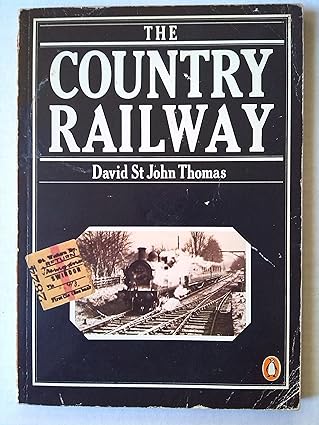
Review: The Country Railway by David St John Thomas

After a tumultuous voyage through Dead Europe I needed a rest on more familiar literary ground. The most obvious choice was another railway book. This one was printed in 1979 with an original price of £1.50. I picked it up from Dovehouse Hospice earlier this year for £1.00. The book is a few years older than The Penguin Guide to the Railways of Britain and rather different in scope: It is only really looking at the past rather than the present and it focuses, as the name implies, specifically on the rural lines rather than the urban ones. This book also doesn’t trouble itself to recap the evolution of locomotives and rolling stock from the beginning, assuming the reader already knows the broad strokes and only bringing up the details where directly necessary. Instead this book is mainly about the experience of daily life for the workers and passengers, as well as the financial aspects of operating the organisation.

The phrase “Country Railway” feels inherently nostalgic precisely because, following the Beeching Axe, there are not many of them around anymore (save heritage lines). A recurring theme of books like this is that the railways were vital to the survival of rural communities yet paradoxically those rural communities tended to be a dead loss to the railways. Closures of country lines would be bitterly mourned despite few people actually riding on them. There is an element of the rotten boroughs about some of the remote services where trains were run back and forth daily with full signalling operations and well-built stations even though the carriages would were at low capacity at the best of times and frequently had no passengers at all. The opening paragraphs of Chapter 8 (starting page 120) lay this out in most striking terms, and it is difficult to avoid simply quoting the entire page verbatim: Rural railways companies insisted on building and staffing their lines, stations and signal boxes to the same standards of quality — as well as safety — that would be expected on urban routes despite the far lower ticket revenue, in contrast to Continental Europe where country railways were far more cheaply constructed. As Thomas sums up:

“An army could have been carried in safety where only scores of people ever travelled. Because stations were so costly, they were often not provided at all where there might still have been useful traffic; and one could argue that in the motor age more lives would have been saved had the railways reduced safety standards — more people would have gone by train, which would still have been safer than buses and cars.”

It may feel a little odd to read someone explicitly argue for the moral virtue of cutting corners in public safety, but a robust case is made that the builders’ noble aspirations actually doomed their projects in the long run. Thomas notes another major obstacle in the need for the company to get a special Act of Parliament passed and/or secure the consent of all the landowners along the route, which an attempted streamlining of the process in 1864 failed to fix. The result was that construction costs per mile of track ended up being many times the original estimates and the railway companies frequently found themselves financially sunk before operations even started. These problems are entirely familiar in the present day. Indeed, I was struck when reading this section by how much the prose of a book on such a genteel topic, written nearly fifty years ago and describing events almost a hundred years before that, bore so much resemblance to that by Ezra Klein & Derek Thompson in Abundance, released earlier this year and addressing the same problems on a larger scale in the present — even including the building of railway lines!

On the flipside, the book also emphasises the death and destruction that results when strict safety protocols are not followed, the appendix retelling the tale of the Abermule Disaster of 1921, in which a quartet of negligent station staff got a pair of signalling tablets swapped around so that two trains collided head-on. The final sentence draws parallels with RMS Titanic:

“Time and again one or other of these mistakes had been made with impunity, but at Abermule on that disastrous day, like the scattered pieces of a jigsaw puzzle, these trifling faults fitted one into another until the sombre picture was complete.”

The book looks over the lifestyle of the rural stationmaster, isolated from the station’s local community, assailed from above as well as below and occupying a liminal, uncertain position within the British class system of the time. The ticket prices were no less convoluted then than now with a dizzying array of tariffs, rates, discounts, equivalences and exceptions. Thomas further looks at the advancement of new technologies and working practices in railway operations, particularly as regards the directions of trains — from turntables to passing loops to runarounds to push-pull to double-ended railcars. A recurrent problem for this sector was that, although the stationery infrastructure was kept to the same standard as the urban lines, the moving parts were not. Whereas the intercity main lines were upgraded to diesel and electric multiple units, the country branches were stuck with antiquated steam engines and their threadbare coaches. Even getting electric lighting on the platforms instead of gas was a struggle. Continuing with old-fashioned systems kept these lines more labour-intensive than they could otherwise have been, which only widened the gap in profitability compared to the main lines. Speed was also an issue for a lot of country lines, particularly in pre-war times, due to the low power of the locomotives and the mixing of passengers with goods on stopping trains.

In contrast to a lot of books of this type, which only look at Great Britain, this one also includes sections set in Ireland. Mostly these serve to tell us how the Irish rural railways were even more spendthrift, disorganised and ramshackle than the English, Scottish and Welsh ones. Attention is drawn to the larger gauges on this island (standard 5’6” and “narrow” typically 3′) which further increased expenditure. Timekeeping too was even worse and page 141 has an amusing anecdote relayed from Punch wherein a local dignitary was surprise to see his train actually leaving on time, only to be informed that it was the train from the previous day.

Despite the myriad problems in running the railways, Thomas is keen to point out that the local communities held great affection for them, staging elaborate celebrations when they were opened and even grander funerals at their closure. That books such as this (and indeed films, magazines and television series) about old railways and the engines that ran on them are so numerous and constitute such a well-established genre is testament to the high regard in which the British hold at least the idea of the railways, even if in practice relatively few get to make regular use of them.

Documentary Déjà Vu

Last month was the 200th anniversary of the opening of the Stockton & Darlington railway, the world’s first public railway to use steam locomotives. There have been quite a few commemorative events for this. The BBC has taken the opportunity to rerun a collection of some of their railway-related documentaries (not that they don’t have at least a handful of these at normal times anyway), which I have been watching on iPlayer over the last week or so.

When you watch a lot of documentaries about the same topic (e.g. railways, World War 2, the royal family, past general elections), especially if created by the same company, you will quickly notice a lot of repetition in what you’re being shown: You’ll notice the same stock film clips, the same talking points in the narration, the same talking heads being interviewed, the same background music being used. To some extent this is inevitable as, of course, they are all talking about the same event. Sometimes, however, the the resemblance is so specific as to be jarring.

Among the aforementioned documentaries were Ian Hislop Goes off the Rails, a standalone production, and The Last Days of Steam, an episode from series 8 of Timeshift. Both were originally aired in October 2008, the former on 2nd and the latter on 16th. When discussing the decline of the railways and the widespread adoption of the private motorcar, both show the same clip of a youngish couple in a red Austin-Healey roadster (registration 699 DON) driving on a motorway.

In Hislop’s documentary the clip starts at 39:19, accompanied by Terry Gourish, historian at LSE, saying

Well from the mid fifties things began to change. There was no fuel rationing affecting private motoring, road transport began to get a great impetus from new road-building, culminating in the first motorway, the M1, in 1959…

whereas in Timeshift‘s, it occurs at 41;30 as Jonathan Glancey, author of John Betjeman on Trains, says

The car from the mid-1950s was, apart from anything else, and beyond a means of transport, a consumer dream. It was something you could own. You can’t own a railway. A railway takes you where the railway goes. A care takes you, theoretically, where you want to go.

That the same clip should occur at almost exactly the same time in two documentaries produced by the same broadcaster a mere fortnight apart feels like a slight failure of quality control.

Some years ago I discovered the Railway Mania podcast series. Unfortunately that series has wound down a little recently, with just one new episode in almost a year. In its place I’ve recently turned to the Green Signals show, co-presented by Richard Bowker (former Chairman of the Strategic Rail Authority) and Nigel Harris, former editor of RAIL magazine. It’s a bit like the ex-politicians’ podcasts that have proliferated over recent years (e.g. Political Currency with Osborne & Balls) but more focused on industrial news.

Moving away from real railways, commemorations of the 80th anniversary year of The Railway Series continue. Today Historic England unveiled a blue plaque at 30 Rodborough Avenue in Stroud to mark that Wilbert Awdry had long ago lived there. The ceremony was attended by a group of his descendants. I was a little disappointed that so much of the news coverage identified him as the creator of Thomas the Tank Engine rather than of The Railway Series, including some incorrectly implying that the character debuted in 1945 rather than 1946. I also see that the display included a cardboard cut-out of the All Engines Go! version of Thomas himself, even though that series has been cancelled now and was generally disliked by most of the Awdry fandom. In some of the news videos a band outside can also be heard playing the Allcroft-era theme by O’Donnell & Campbell.

I also recently discovered that Thomas & Friends itself has an official 80th anniversary podcast. This is also includes many sound clips from the TV series. Curiously, the copyright notice credits the podcast to Gullane (Thomas) Ltd, showing that this company at least nominally still exists within the Mattel empire.

It’s The Dunn Thing

Today I noticed that BBC Four has started airing the documentary series The Architecture the Railways Built, presented by historian Tim Dunn, and put the whole first season on iPlayer. This series was originally made five years ago for Yesterday, a UKTV channel technically owned by BBC Studios but run more like the commercial stations. This series was already watchable on UKTV’s own catch-up website and repackaged on at least two different licensed YouTube channels, but the lack of advertisements and all-around superior functionality of the BBC’s service will make iPlayer my preferred platform. This makes for a rare case of televisual upcycling in a partnership where downcycling is the norm, the most obvious locomotion-related example being Michael Portillo’s many Great Railway Journeys programs.

Each episode of TATRB is forty-five minutes long and typically covers three locations, two in the United Kingdom and one abroad. No obvious connection is made between the three, so I’ve often been left feeling that it would be better if the three locations chosen were grouped by geographic region, architectural style or railway feature. Alternatively, they could be split up so that each location had a fifteen-minute episode to itself.

In addition to broadcast television, Dunn has made regular appearances in railway-related online channels, including several times presenting Sudrian pseudohistorical lectures hosted by the Talyllyn Railway.

The Books of Quinn and Kay

Since getting my library card, the first two books I have consumed are Life on the Old Railways by Tom Quinn and This Is Going To Hurt by Adam Kay, the former as a hardback and the latter as an online audiobook.

It may seem odd to review both of these together, but there is some similarity – both consist of recollections of employment in a British state institution established in 1948.

I was interested in the descriptions of the institutional rank structure: On the old railways it went from Cleaner to Passed Cleaner to Fireman to Passed Fireman to Driver. The “passed” indicated that you had already completed a set amount of time in that role and were training for the next one. One diarist remarked that despite the intensely hierarchical nature of the system, movement from one rank to another was oddly informal and that the job titles were more reflective of the job you’d already done than the one you were currently doing. Pay rises, whatever your rank, did not take effect until your birthday. Kay explained the ranks of the NHS as Pre-registration house officer, senior house officer, specialist registrar and consultant. That structure had already been abolished and replaced by the time his diaries began, but the old terminology lingered for years afterwards in staff usage. He noted that the “senior” house officer was in reality still a very junior role and that promotion was purely a function of time rather than performance. This, he reckoned, was to convince the lower employees that their next upgrade was always just around the corner and so prevent them bailing out.

Another theme of both books was the sheer amount of time dedicated to the profession – railwaymen would be up before dawn to get their engines ready whereas junior doctors would would stay long into the night to keep patients alive. Neither managed to get many weekends or holidays to themselves.

Record-keeping was also important – the railwaymen recalled how every ticket, time and tonnage had to be scrupulously written up by hand (under torch or even candlelight) in enormous ledgers many of which were later sadly thrown away, whereas Kay spoke of the hospital’s attempts to digitise, with computer systems that refused to communicate with each other, blocked employees’ emails, erased recordings and ran so slowly that the patient would be dead by the time you’d selected the right medicine from the drop-down menu.

Despite the arduity, it was noted that the workers at both organisations were passionate about their jobs and generally held in high esteem – train driving was what every child had always wanted to do, while medicine was where every parent wanted their children to go (some class differences, of course). Perhaps that could also be their problem – the external prestige of holding such a position was used to compensate for (and even cover up) the stress of actually performing it.

This Is Going To Hurt was dramatised earlier this year as a critically-acclaimed BBC series. There is no TV version of Life on the Old Railways, but stories and documentaries about the days of post-war steam are ten-a-penny on most channels and online.

Streets, Railways and Brownfields

Video

Today’s virtual outing took an unusual turn, featuring the London Natural History Society. The title proved a little misleading as the lecture was less about the streets and railways themselves than the plants growing on them.

At about 50:45, I asked Dr Spencer which species were most advantaged or disadvantaged by the presence of a railway line. He said the most advantaged were wind-dispersed plants, such as the “classic story” of Oxford ragwort which was confined to the walls of that town from the sixteenth to the nineteenth century when the railway arrived to blow its seeds around the country.

The History of the Shepaug Railroad

Today’s (well, tonight’s) virtual event was The History of the Shepaug Railroad. It was jointly hosted by the Gunn Historical Museum and the Danbury Railway Museum.

The former has put the whole presentation on its YouTube channel so I needn’t give a long synopsis, which is just as well since my computer was having difficulties and I probably missed a fair bit.

The Archives Arrive

The BBC Archive YouTube channel claims to have existed since 2018, but their videos only go back three months. I discovered them just yesterday. My favourite thus far is an interview with J. R. R. Tolkien explaining the writing of The Lord of the Rings. Also featured is the Shildon steam celebration of 1975, which includes an interview with Wilbert Awdry (strangely called “William” in the voiceover), and at least two short documentaries about the making of Classic Doctor Who.

It’s too early yet to know just how many videos this channel will post. If it’s anything like British Pathé I will be greatly impressed.

Sigh for A Deltic

This one was taken by Terry Foulger circa 1977, just to confuse you.

Today’s virtual lecture was put on by the North Eastern Railway Association. The Zoom session opened half an hour before the start of the actual presentation. This allowed the veteran members of the association to resolve technical issues, and also to trade jokes about Vladimir Putin. Neil Mackay, the association’s chairman, said that the upcoming Annual General Meeting would be held on Zoom due to the trustees’ lack of confidence in physical attendance, and asked if anyone would volunteer to be minutes secretary.

Our speaker was David Thomas. He had come to show off his photographs of the Class 55 diesel locomotives – popularly known as the Deltics, taken at various points along the East Coast Mainline in the period of 1977-1982, in anticipation of their displacement by the Class 43 High Speed Trains. Originally the photographs were taken with a Kodak Retinec 1B and the sound was captured by a Philips cassette tape recorder. Thomas’s original plan was to produce a tape-slide presentation, but this proved too costly at the time. Rather than settle for a less-than-professional presentation, he simply withheld the pictures until Microsoft Powerpoint came along to make things easier.

There followed a long stream of images. I will not attempt to describe them all. Thomas said that the Deltic engine was originally a marine concept, the admiralty having wanted a powerplant for its minesweepers. There were some technical diagrams included, and photographs of smashed engines undergoing repair. There were also insights into his personal life – he mentioned rushing to get a shot of No. 003 Meld at Holloway before going to see his wife give birth in York. He noted, too, where the environment in his photographs had changed, such as the “re-greening” around the viaduct at Leeds or the disappearance of poplar trees on the A64. Important moments in railway history were captured, such as the centenary of York Station in June 1978 and the final Deltic Scotsman service in February 1982.

The title of the lecture derived from Sigh for a Merlin by Alex Henshaw. The Rolls Royce Merlin engine had unofficially given its name to the Lancaster Bomber aeroplanes which used it, just as the Napier Deltic engine had done for the Class 55s. Thomas admitted that he didn’t like the locomotives originally but he grew to love them and he ended his talk by saluting all the volunteers who keep them working in preservation, the fleet between them having covered sixty-eight million miles.

EXTERNAL LINKS

UPDATE (8th March)

Chairman Mackay has accepted my offer to act as Minutes Secretary at the Annual General Meeting in May.

One Last Ride

I have mentioned before my delight at finding old documentaries uploaded for free on YouTube. One which has stuck with me for a long time is episode 10 of Monster Moves, in which a South African Class 15F tender engine is rescued from a breaker’s yard in Bloemfontein and returned to its birthplace in Glasgow.

As expected from this sort of program, every setback is milked for the drama. First, the lorry meant to move the engine to Durban turns out to be too small, so it has to be towed on rails by a diesel engine. Then the wheels all have to be re-lubricated so they don’t catch fire, then ten empty flatbeds have to be hauled behind for breaking capability, then the line is blocked by a stalled lorry, then the diesel breaks down just shy of the dock, then the ferry is diverted, then a giant floating crane is needed to lift the 100 tonnes aboard, then after arriving in Immingham another giant crane is needed to lift it off again, then the lorry trailer has to be redesigned for the narrower track gauge, then the load might be too high to get under British motorway bridges, then the long trailer struggles to navigate Glasgow’s tight corners. All of this is accompanied by a gloriously over-the-top orchestral Western song.

No. 3007 now resides at the Riverside Museum. It is a little disheartening to think that she can never actually run again – her track gauge being too narrow and her loading gauge too wide – and that the other old locomotives at the same depot probably won’t be saved. Many in the comments section also allege that South Africa’s rail infrastructure has deteriorated severely since 2006 and been hit by widespread looting during lockdown. All this makes the film’s ending a little bittersweet.

This was not the only rail-centric episode of the series – they also covered the relocation of two Gresley A4s from North America to York and the retrieval of two Stanier 8Fs from Turkey.