Rolling Coverage

It quickly became apparent that the Duke of York’s dedication on 17th October to cease the use of his titles and honours was not enough to satisfy the public mood and so, not even a fortnight later, a further announcement was made that His Majesty would be taking measures to enact these changes in a formal way, and also that the changes would go further by removing his princely title as well so that he became Andrew Mountbatten Windsor. No notice to this effect has yet appeared in the London Gazette, but then it is fairly normal for that publication to lag by a few days and indeed for these processes themselves to take a few days to carry out. This is the first time since 1917 that a Prince of the United Kingdom has had that dignity removed in this way.

Less than a day after this announcement it was noted that the Roll of the Peerage had been updated to omit his name*. This is not actually a roll of parchment but rather a PDF. It is uploaded on and accessed through the website of the College of Arms but is actually controlled by the Ministry of Justice. As the page explains, the Roll was created as a government register of everyone who possessed a peerage of any rank of the United Kingdom or its predecessor states, the Roll of the Lords Spiritual and Temporal having been rendered quite inadequate for that purpose following the House of Lords Act 1999. Newly-created peers are added to the Roll automatically but those who have inherited their titles but those who inherit their titles are responsible for writing to the Secretary of State with the necessary documentation to prove their succession. It is also possible for those already listed to request their own removal. The absence of a peer from the Roll does not actually cause his peerages to cease to exist but does effectively mean that the state in its official capacity will cease to recognise him as holding them. This is probably as close as Andrew can get to fully giving up his dukedom and its subsidiaries without an Act of Parliament being passed specially for that purpose.

This has of course led to another flurry of edits on the former prince’s Wikipedia page. Some commentators noted how quickly the page had been moved from “Prince Andrew” to “Andrew Mountbatten Windsor“, but actually this was against procedure so the page name was reverted and not moved again until editor consensus was established. It would have been a lot more convenient for us if both of last month’s announcements had been made as one so that two separate page moves (and thus two separate discussions) would not have been needed. Of course, this still doesn’t entirely resolve matters because there is still some confusion as to whether “Mountbatten Windsor” needs a hyphen, as the royal warrant from 1960 includes one but the recent announcement does not. There is a further important, if largely academic, point to be made that even if Andrew has agreed to simply go by Mr from now on, he could still be called Sir until his knighthoods are fully removed, or indeed Lord as the younger son of a duke.

FOOTNOTES

*Contrast this version (archived on 16th December last year) to this one (archived yesterday): The first two pages list the principal peerages of members of the royal family, then the rest of the document lists all the non-royal peers. Within both groups the titles are listed alphabetically, so “York” was previously the last of the royals. Now he doesn’t appear at all. I note that the current version omits the “Latest revision” date underneath the Crown Copyright line on the first page, which makes me think that yesterday’s update was done in a hurry.

EXTERNAL LINKS

UPDATE (5th November)

The Gazette website has now published (as of noon today) notices confirming the removal of Andrew’s titles:

  • THE KING has been pleased by Letters Patent under the Great Seal of the Realm dated 3 November 2025 to declare that Andrew Mountbatten Windsor shall no longer be entitled to hold and enjoy the style, title or attribute of “Royal Highness” and the titular dignity of “Prince”.
  • THE KING has been pleased by Warrant under His Royal Sign Manual dated 30 October 2025 to direct His Secretary of State to cause the Duke of York to be removed from the Roll of the Peerage with immediate effect.

The first appears only in the London Gazette, while the second also appears in the Edinburgh and Belfast. So far I have not seen any of the usual experts dissecting these, although that will likely come in a few days. These are of course only the Gazette notices and not the full texts of the relevant documents, for which I have already seen some of them say they will file FOI requests. I will note that the removal of princely titles does not take the form of a royal licence, and refers to its target as already being named Andrew Mountbatten Windsor. The second, despite its triple publication, only refers to the Dukedom of York so the removal of the subsidiary earldom and barony must be read as implicit. It says that His Majesty directed the action rather than the Duke himself requesting it as the original warrant laid out, so presumably the new warrant must be amending the original in some way.

On Admirals and Arundells

The Queen turned seventy-eight today. That’s not traditionally considered one of the big birthdays and so commemorations have been fairly muted. The most significant announcement was her appointment as Vice-Admiral of the United Kingdom.

The Vice-Admiral is the deputy to the Lord High Admiral, and it may be prudent to recap the outline of that office first: The Lord High Admiral is the ultimate head (originally operational, but later just ceremonial) of the Royal Navy. Appointments have been made since the late fourteenth century in the Kingdoms of England and Scotland, then later Great Britain. Occasionally in Stuart times, and almost permanently from Anne’s reign onwards, the singular office was not filled and instead the post was instead put “In Commission” – i.e. delegated to the Board of Admiralty with the First Lord of the Admiralty (a cabinet minister) as its chair. The creation of the modern Ministry of Defence in 1964 saw the Board with its First Lord dissolved and the title of Lord High Admiral resumed in the person of Queen Elizabeth II. In 2011, on his ninetieth birthday, she conferred the office upon her husband Philip. The status of the office following his death in 2021 is a little ambiguous but the general assumption is that it defaulted back to the sovereign and now resides in King Charles III. I had wondered if Vice-Admiral Sir Timothy Laurence would be appointed on his seventieth birthday this March, but this did not occur. The King perhaps intends to retain the top office for himself and have his wife as runner-up.

The Queen is both the first female and the first royal holder of the office of Vice-Admiral, whose previous recipients have all been career navy men (and indeed tended to hold the actual rank Full Admiral). Her Majesty’s most recent predecessor was the Lord Boyce, who was appointed in 2021 and died in 2022.

Below the Vice-Admiral is another deputy, the Rear-Admiral. This office is currently held by Sir Gordon General, a General in the Royal Marines who was formerly Vice-Chief of the Defence Staff and also served as Lord High Constable at the 2023 coronation.

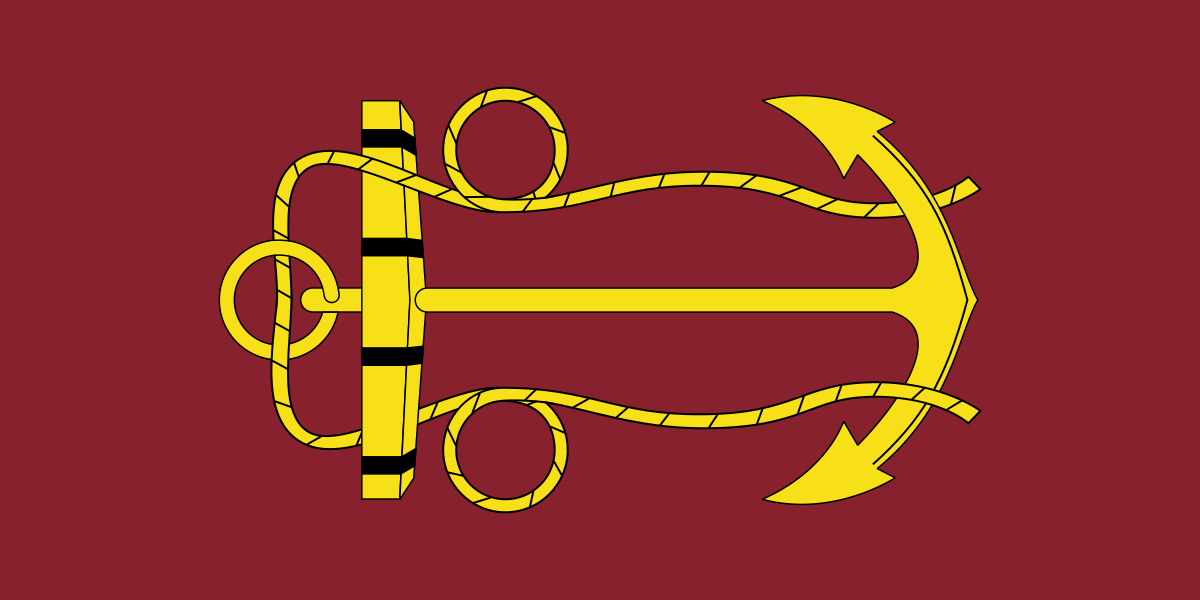
The Lord High Admiral has a flag of office – a fouled golden anchor on a crimson field. The Queen was presented with a “burgee” (pennant) with a red anchor on a white background when she visited HMNB Devonport. I just about saw Camilla’s impaled banner of arms as well.

On another note, today is also the twentieth anniversary of the death of Sir Edward Heath, Prime Minister 1970-1974. His military career was on land, though he was a noted yachtsman in later life. He stayed in the House of Commons for twenty-seven years after his premiership had ended, which is considerably longer than all his successors combined. He is the most recent Father of the House to have served more than one term, as well as the most recent to have formerly been Prime Minister.* He is also the most recent example of the Order of the Garter being conferred upon an incumbent member of the House of Commons**.

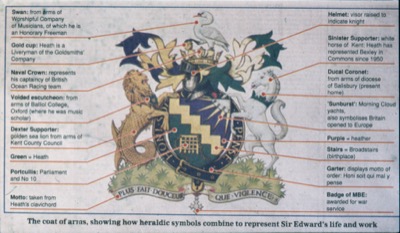
Wikimedia Commons has long had a vector graphic (by Sodacan, of course) of Sir Edward’s shield of arms, but it was only recently that I discovered, through the website of the Heraldry Society, a photograph of the heralds’ illustration of the full achievement. Heath had no offspring, so the arms as a hereditament became extinct.

This anniversary means that Arundells, his house in Salisbury, will now have been his museum for longer than he actually lived there. He bequeathed the building to his namesake charitable foundation who then opened it to the public. There was a fear in 2010 that the house would need to be sold due to high running costs, which then developed into a legal battle, but as of 2025 the estate seems to be running as normal again.

It should be noted that the spelling is Arundells with two Ls, not Arundels with one. Incidentally, it was an Earl of Arundel who is listed as England’s earliest Lord High Admiral, so everything links up I suppose!

*I’m phrasing it that way because Heath is not the most recent Prime Minister to be Father of the House – that was Callaghan.

**I hesitate to say “sitting member” because St George’s Day in 1992 fell in the interlude after the general election (9th April) but before the new Parliament actually assembled (27th April).

Ever to Succeed

News has broken that two days ago Her Royal Highness Princess Beatrice, Mrs Edoardo Mapelli Mozzi, gave birth for the first time. Her yet-unnamed daughter is eleventh in line to the throne. I wished to edit the relevant Wikipedia article accordingly, but that proved difficult as the list had multiple levels of indentation to reflect the generations and all the numbers had to be changed manually.

There is a challenge in deciding just how many names to include on the page. The legitimate non-Papist descendants of George I’s mother number well into the thousands nowadays and the vast majority of them are non-notable. The editors have here decided to limit the display to the descendants of the sons of George V. In practice this just means Bertie, Harry and Georgie, since David and John both died without issue. Even that restricted selection comprises sixty-three living people, of whom thirty-two have no pages of their own.

The clumsiness of editing this list brought up an idea I had some years ago for giving each member of the diaspora a numerical code to indicate their position within the succession. The electress herself, being the origin of the succession, would be 0. Her eldest son Georg Ludwig would be 1, her next son Frederick Augustus 2, Maximilian William 3 and so on. For each generation a digit is added, so Georg’s offspring George Augustus and Sophia Dorothea would be 1.1 and 1.2, while George Augustus’s children would be 1.11, 1.12, 1.13 and so forth. Under this system Princess Alexandrina Victoria of Kent & Strathearn would be 1.11141 while Princess Elizabeth Alexandra Mary of York would be 1.111411221. Prince Philip of Greece & Denmark would, I think, be 1.111416331. The beauty of this system is that the crown always goes to the living person with the lowest number, rather than each new birth or death close to the throne forcing everyone downstream to be renumbered.

There are downsides, of course. First, there is always the danger of one day discovering a missing sibling who died young and was forgotten to history. Second, until the commencement of the Perth Agreement the crown followed male-preference primogeniture, so any girl’s code was liable to change upon the arrival of a brother. Third, if any person in the line has more than nine legitimate children then the numerals would be inadequate (as in George III’s case, though perhaps there one could only number his nine sons and omit his six daughters, none of whom had surviving children of her own), and an alphabetical system might be needed instead – Elizabeth II would be AAAADAABBA and the late Prince Philip AAAADAFCCA.

On a related note, I have been keeping tabs on Judiciary UK for some months looking at new judgements as they come out. My main interest was Bell v Tavistock, but the day before that was resolved my eye was caught by the decision of Sir Andrew McFarlane (President of the Family Division) not to publish the Duke of Edinburgh’s will. Sir Andrew spoke at length about official etiquette regarding the royal family, and shed some light on that term’s definition. For Wikipedians, academics, press and others, there has always been a little confusion as to when membership of the family ends**. Is it the top X in line to the throne? Everyone descended from the current monarch? All descendants in the male line from George V? From Victoria? Everyone styled Royal Highness? Everyone on the balcony at Trooping the Colour? Then there are the gradations – often the headlines talk of “minor royals”, usually meaning the Dukes of Gloucester and Kent but sometimes including the Prince of Wales’s siblings and niblings, while mentions of “senior royals” are even more nebulous. One reason for this difficulty is that there are really three separate types of rank within group – precedence is determined by one’s relationship to the incumbent monarch, style and title by generations’ removal from any monarch and succession by primogeniture of descent from Sophia. McFarlane, in his judgement, may have given some more substance on which to build at least the latter’s definition.

From paragraph 15: This Court has been informed that in recent times the definition of the members of the Royal Family whose executors might,as a matter of course,apply to have the will sealed up has been limited to the children of the Sovereign or a former Sovereign, the Consort of the Sovereign or former Sovereign, and a member of the Royal Family who at the time of death was first or second in line of succession to the throne or the child of such a person. In addition, the wills of other, less senior, members of the Royal Family may have been sealed for specific reasons, or, as the list of names suggests, a wider definition of “Royal Family” may have been applied in this context in earlier times.

From paragraph 23: The confidential note that was disclosed and is attached to Charles J’s judgment contains an interesting account of the development of the practice of sealing Royal wills during the last century. That note provided that, in particular,the practice of applying to the Family Division applied, as a matter of course,to ‘senior members of the Royal Family’ who were defined as:

•The Consort of a Sovereign or former Sovereign;

•The child of a Sovereign or former Sovereign;and

•A member of the Royal Family who, at the time of His/or Her death, is first or second in line of succession to the throne or the child of such a person.

This means that, for judges’ purposes “senior royal” essentially means monarchs themselves, their consorts and their children (not necessarily children-in-law), as well as the first two in line to the throne and their children. Monarchs’ children are easy enough to spot from the rest, with the definitive article in their princely styles and their coronets of crosses interspersed with fleur-de-lys, but the latter category could be unstable – Princesses Elizabeth and Margaret of York would have been senior by this definition during their grandfather’s reign but would have lost that status had Edward VIII sired children of his own.

Applying it to the current situation, then, we can see that the seniors of the present royal family are:

  • HM The Queen
  • HRH The Prince Charles, Prince of Wales
  • HRH The Prince Andrew, Duke of York
  • HRH The Prince Edward, Earl of Wessex
  • HRH The Princess Anne, Princess Royal
  • HRH Prince William, Duke of Cambridge
  • HRH Prince Henry, Duke of Sussex
  • HRH Prince George of Cambridge
  • HRH Princess Charlotte of Cambridge
  • HRH Prince Louis of Cambridge

There is one part of the judgement with which I take issue – paragraph 13 says It is understood that the first member of the Royal Family whose will was sealed on the direction of the President of the Probate, Admiralty and Divorce Division was His Serene Highness Prince Francis of Teck. Prince Francis was the younger brother of Princess Mary of Teck who, upon her marriage to King George V, became Queen Mary in 1910. Later that same year, at the age of 40 years, Prince Francis died. An application was made for the will to be sealed and not published. The application was granted. This is a little misleading, as Mary married Prince George, Duke of York in 1893 and became Queen on his accession in 1910. The judge’s text implies that she didn’t marry him until he was already King.

*Some in the press have claimed that as her father is an Italian count, the baby will be a countess, but the title is not recognised by the Italian republic or by the United Kingdom. Most likely she will be Miss [[Firstname]] Mapelli Mozzi.
**Of course, any family can present this difficulty as few are consciously defined by any formal rules.

UPDATE (1st October)

Princess Beatrice’s baby is named Sienna Elizabeth Mapelli Mozzi.

And Ever Shall Be

It was always difficult to work out the exact year in which a given episode of Victoria was taking place, given the series’ sloppiness with chronology. Series 2 ended with “Luxury & Conscience” in which Sir Robert Peel resigns as prime minister following the murder of his personal secretary Edward Drummond – events which actually took place three years apart. Series 3 picks up with “Uneasy Lies the Head that Wears the Crown”, which covers the revolutions of 1848 and features Lord John Russell in charge. Dialogue indicates that the return of the Whigs to government is a recent development. In between these installments is the 2017 Christmas special “Comfort & Joy”, set in 1846 and showing, among other things, the adoption of Sarah Forbes Bonetta (which happened in 1850). The curious thing about the Christmas special is the absence of the political side of things. In real life Russell’s ministry had already been in place for six months but, in the series’ uncertain timeline, the political situation is simply ignored. This is almost certainly deliberate, as the intention is for the holiday special to be a purely family affair. Plus, with more than a year’s gap between the series it’s entirely possible that the later story arcs hadn’t yet been planned out, nor the relevant characters cast.

Flash forward to 2021: The Duke of Edinburgh had wished for a low-key funeral (well, by royal standards at any rate), and the pandemic meant that something on the scale of the Queen Mother’s funeral in 2002 or even Lady Thatcher’s in 2013 would not be possible. Instead Philip’s coffin was driven a short distance within the bounds of Windsor Castle and then lowered into the vault. Hundreds of soldiers were still present outside, but COVID regulations forbade more than thirty attendees. Ordinarily it would be expected that prime ministers and other senior officials would attend, but Boris Johnson (and, presumably, any others concerned) relinquished his place to make room for more of the deceased’s family. The resulting guest list included eighteen descendants of King George V, eight spouses thereof, three other descendants of Queen Victoria and one spouse thereof. I had wondered if the family or the press would have sought to orchestrate a photograph of Prince George of Cambridge saluting the coffin à la John Kennedy, but it was decided that the great-grandchildren were too young to be involved.

While the masks and social distancing ought to be obvious giveaways, I actually found that the reduced attendance gave the ceremony a strangely timeless quality – it was effectively a bottle show. Other than Mssrs Mozzia and Brooksbank all the people there were the same people one would have expected to see there at had this happened at any point in the last ten years – admittedly Viscount Severn and Lady Louise would have been smaller. Justin Welby might be considered a semi-political figure and he took office in 2013, but as St George’s Chapel is a royal peculiar he played a minor role compared to David Conner, who has been Dean since 1998. Thomas Woodcock as Garter King of Arms could also be considered vaguely political given his role introducing new members of the House of Lords, with that office the public tend to remember the uniform rather than the face. The sounds of the past week, too, were those you’d expect to hear: steady footsteps, military orders, cannon blasts, church bells, and, from the studio, the interminable wittering of Gyles Brandreth. Now the burbling of a Land Rover TD5 has been added to the mix. Even that adds to the timeless effect, since the Defender was in production for a third of a century and without a number plate even I – a subscriber to Land Rover Enthusiast for a few years – could not guess at a glance the decade in which this one was constructed.

Those who have studied British political history know that long ago the House of Commons met in St Stephen’s Chapel, with the Speaker’s chair on the altar steps and the members facing each other in the choir stalls – an arrangement which has been maintained in subsequent legislative chambers in Britain and around the world. As a consequence today’s proceedings – with only a few dozen people carefully spaced apart – resembled a session of the hybrid house, or perhaps even the failed 1am prorogation in 2019. Hopefully on this occasion the ceremony won’t have to be repeated a month later.

Having already done a piece about television scheduling in light of COVID, it would be pertinent to review it in relation to the royal death. Of course major newspapers and broadcasters have documentaries and obituaries prepared years in advance of the event – not just for the Duke of Edinburgh but for a wide range of prominent public figures. Eye 1545 page 18 notes how, in the build up to his centenary on 10th June, contributors often had to do each interview twice – the first speaking in present tense wearing light suits, the second in past tense wearing black ones. It was also noted that, in addition to different networks’ documentaries often – and unavoidably – using the same stock footage and delivering the same story as each other, there were some instances of companies recycling interview footage from their own documentaries in 2011 or even 2007, with talking heads who nowadays are visibly much older or even who themselves have died in the intervening years.

On other occasions this temporal tangle would be cause for disdain, but to commemorate a man who has been “a constant” for longer than most of the world can remember, somehow it feels oddly appropriate.

UPDATE (20th April)

The video I originally embedded (from the firm’s own YouTube channel) has now been set to private. The BBC’s has also disappeared. I have replaced it with the Teletrece version.

UPDATE (1st May)

That one has gone as well. I’m now using the one from 6abc Philadelphia.

Memories of Malta

Fort Manoel in Gżira, Malta, 1880.

This is Thursday and I still haven’t written anything and in any case, with the way I have been feeling and the things that have happened, I can’t even remember what I was supposed to write about. However, this week has seen the Queen celebrate her 80th birthday, and being a true royalist I was sitting watching the film of her life. She is a few months older than I am and was always there when I was a child. The two little princesses were my favourite pair. No television in those days, but I used to keep a scrapbook and cut out every picture I could find of them.

Sitting watching the program, Paull came and sat with me and I started telling him different things that had happened to granddad and myself over the years where our lives had touched with Elizabeth and Philip and had just been telling him about our lives in Malta when he left me to my program. No sooner had he gone than Malta appeared on the screen and I called him back. He watched the program with and said Grandma, you should write about these things. You knew all about that, didn’t you, so here you have a few memories. Just a few, I won’t bore you too much.

P.O. Stanley Edward Taylor & wife in Malta, 1949.

Stan and I met at Royal Arthur, a shore base at Butlins in Skegness. The first time I saw him he was wearing a pink tu-tu and dancing with four other PTIs to the music of the Sugar Plum Fairy. Shortly afterwards, Royal Arthur moved across country to Corsham in Wiltshire. There were three huge camps there: The first was the Ship’s Company camp for the Wrens, sailors and officers. The second was the working offices and training camps where new entries were taken in and trained, and their instructors lived on the same camp with them. I was a writer pay as it was termed and our office was very close to the gym where Stan spent his time. Up the road there was another camp, Kingsmoor where petty officers took their courses and it was there that we first made contact with Philip. We had been told that Prince Philip of Greece would be joining us and none of us had ever heard of him. We honestly thought that he was to be one of our young entrants so we were absolutely bowled over when this handsome blonde young man whizzed through the gate in an elderly open-topped sports car. The first time my friend and I saw him we were just going through the gate back to our working camp when this old black car without even slowing down shot past us taking Jean’s jacket off her arm and leaving it in the dust. Now, Jean was a Hull girl and no-one did that to her. When he didn’t stop she took her shoe off and aimed it at him together with a load of abuse. The poor old jaunty was dancing up and down waving his arms and mouthing no-no-no. That was our first meeting with Philip. We would occasionally meet him at sports events and he met with us when we played mixed hockey. Rumours started to circulate that he was getting mail from Buckingham Palace and returning from London one day he had a slight car accident. It was reported straight back to the Palace and Elizabeth dashed out and got into her car and started off for Corsham. However, word was sent that she had to be turned back and back home she was sent. Later, of course, came the Royal Wedding and ten Chiefs and Petty Officers from Kingsmoor were invited to the wedding and much to their embarrassment were known ever after that as the bridesmaids.

Philip’s ship, the Black Swan-class Magpie.

The following year Stan and I were married and Stan was posted to Malta where he was the PTI for six frigates, one of which was Philip’s Magpie. Stan was based on the Pelican which wasn’t easy for sport with six ships to look after and as we were newly-weds he pleaded his case and was allowed to stay ashore with me, except when they all went on exercises together. The little ships had never been heard of in the Med sports before but he went from one ship to the other getting his teams together by means fair and fowl. He had more AN Others on his lists than actual names, but by the time he had told each of his boxers that it didn’t really matter as so-and-so was a better boxer anyway, he ended up with his teams and that year took every cup in the Med. I can still see him and Captain Bonham Carter standing behind the goal with their faces up to the nets calling come on, hit me, hit me, and seeing their caps go flying in the air with each goal.

Stan’s ship, the Egret-class Pelican.

We went out with the footballers that night, starting out in Sliema, but the boys got restless and wanted to go down the Gutt as the red light district is known, but couldn’t because they knew Stan wouldn’t let me go. He said “As long as I am with her she can go anywhere.” and off we all went to Floriana. I was very innocent in those days and watched a matelot dancing with a large lady in a pink satin blouse. After a quick glance at this pair I remarked to Stan “What a large lady that is!”, at which all the lads curled up with laughter. We then went on to the main Gutt and after a while one of the lads came to Stan and whispered in his ear, and Stan said okay and decided that it was time we got ourselves home, and off we went. The next morning there was an SOS from Philip: “What have you done to my crew? Get yourself down to the local prison and see if you can get them out!”, and that was when I learned that Stan had been asked to remove me as there was a fight brewing between the navy and the army.

Lt. Mountbatten with the Princess Elizabeth, 1947.

Elizabeth sometimes came down to Manoel Island when the boys were playing friendly matches. There would hardly be a soul watching and a matelot would walk to the side of the of the pitch with a wooden chair and a few minutes later she would appear. No sign of her detective though, he was always around watching from a distance, and in no time a little group of sailors would be standing around her chair watching the match. She always looked so happy in Malta. They were very happy days for all of us.

Must go, it’s bedtime.

Written 27th April 2006
by Pauline Taylor (1927-2018)
 
UPDATE (12th April)
The Lord Judge, Convenor of the Crossbench Peers, referenced his own Maltese memories in a parliamentary speech earlier today.

The Late Duke

His Royal Highness Prince Philip of Greece & Denmark was born on 10th June 1921. He was the only son of His Royal Highness Prince Andrew of Greece & Denmark, who in turn was a younger son of His Majesty King George I of the Hellenes. Through his agnatic line he was a member of the House of Schleswig-Holstein-Sonderburg-Glücksburg, while his mother Princess Alice was from the House of Battenberg. Queen Victoria was his enatic great-great grandmother.

Philip’s titles have an interesting history, in that he was born a prince of Greece and of Denmark but later renounced these titles to obtain British citizenship. This move later turned out to be unnecessary as the Sophia Naturalization Act 1705 meant he had British citizenship already. He adopted the surname Mountbatten, which was used by his maternal uncle Louis (later Earl Mountbatten of Burma) and represented an Anglicised version of Battenberg. The subsequent controversy over whether his descendants should be the House of Windsor or Mountbatten-Windsor is a little ironic given that Philip himself was already effectively going by his mother’s maiden name rather than his father’s.

The marriage certificate says Philip Mountbatten.

New titles were bestowed rapidly in advance of his wedding: On 19th November George VI appointed him a Royal Knight of the Garter (one day after The Princess Elizabeth, to maintain her seniority) and granted him the style of Royal Highness (on British authority this time), then on 20th raised him to the peerage of the United Kingdom as Duke of Edinburgh, Earl of Merioneth and Baron Greenwich – all of which now belong to his eldest son. The lack of simultaneity between these events means that for a single day he was styled “Lieutenant His Royal Highness Sir Philip Mountbatten”. On the 21st his title was inserted into the Book of Common Prayer. He was ceremonially introduced to the House of Lords on 21st July 1948. For a while there was some controversy over whether or not he was a prince. This was resolved on 22nd February 1957 when his wife, now sovereign, made him a Prince of the United Kingdom of Great Britain & Northern Ireland, which put him level with her sons and uncles. There were some suggestions of making him “Prince Consort” like Albert or “Prince of the Commonwealth” to reflect the monarchy’s larger purview but these were ultimately turned down.

His precedence at this time is unclear, though obviously the lowest he could have ranked was as the newest ordinary duke. A royal warrant on 26th September 1952 declared his should “upon all occasions and in all Meetings except where otherwise provided by Act of Parliament have, hold and enjoy Place, Pre-eminence and Precedence next to Her Majesty”, which again followed the example set by Victoria with Albert. This technically made him second man in the land, for the monarch is always first man even when female, and is the reason he was often seen walking two paces behind his wife on formal occasions.

Heraldic banner at St Giles’s Cathedral in Edinburgh, 2010

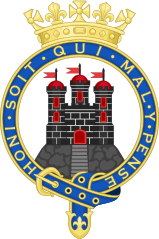
Philip’s heraldic status in his youth is not clear to me, but as a British adult he was – rather unconventionally – given two grants of arms. In 1947 his armorial achievement showed the arms of Greece surmounted by those of Denmark, which in turn were surmounted by those of his great-grandmother Alice (albeit omitting the Saxe-Coburg inescutcheon she used, which the British royals had abandoned in 1917). For reasons difficult to uncover these were deemed “unsatisfactory” so in 1949 the shield was replaced by a new quarterly version. The first quarter showed the lesser arms of the Kingdom of Denmark, the second quarter the white cross of Greece, the third the black and white stripes of Battenberg and the fourth a castle on a rock for Edinburgh. That last part is especially unusual as peers’ shields do not normally incorporate the municipal insignia of their nominal territories. These arms were of course rendered as a rectangular flag (confusingly called a royal standard, even though “standard” refers to a very different style of flag) and a square banner above his Garter stall at Windsor. In composing this article I also discovered that he had a badge, showing the castle surmounted by a princely coronet and encircled by the Garter, though I do not recall ever seeing it in use. Livery colours are not so prominent in modern times, and those of the royal family no longer change with the dynasty. Philip had his own personal livery of “Edinburgh Green”, used for his personal cars and the uniforms of his staff.

New badge illustration, published mere minutes ago.

Sodacan has of course illustrated all of these for Wikimedia Commons, and already I have spotted several instances of his illustrations being used in television coverage of his death as well as in reports online.

EXTERNAL LINKS